Brighter than Gold: Figurative Language in User Generated Comparisons
Vlad Niculae and Cristian Danescu-Niculescu-Mizil MPI-SWS
Cornell University
[email protected], [email protected]
Abstract
Comparisons are common linguistic de-vices used to indicate the likeness of two things. Often, this likeness is not meant in the literal sense—for example, “I slept like a log” does not imply that logs ac-tually sleep. In this paper we propose a computational study of figurative compar-isons, or similes. Our starting point is a new large dataset of comparisons extracted from product reviews and annotated for figurativeness. We use this dataset to char-acterize figurative language in naturally occurring comparisons and reveal linguis-tic patterns indicative of this phenomenon. We operationalize these insights and ap-ply them to a new task with high relevance to text understanding: distinguishing be-tween figurative and literal comparisons. Finally, we apply this framework to ex-plore the social context in which figurative language is produced, showing that simi-les are more likely to accompany opinions showing extreme sentiment, and that they are uncommon in reviews deemed helpful.
1 Introduction
In argument similes are like songs in love; they describe much, but prove nothing.
— Franz Kafka
Comparisons are fundamental linguistic devices that express the likeness of two things—be it en-tities, concepts or ideas. Given that their work-ing principle is to emphasize the relation between the shared properties of two arguments (Bredin, 1998), comparisons can synthesize important se-mantic knowledge.
Often, comparisons are not meant to be under-stood literally. Figurative comparisons are an im-portant figure of speech calledsimile.Consider the
following two examples paraphrased from Ama-zon product reviews:
(1) Sterling is much cheaper than gold.
(2) Her voice makes this song shine brighter than gold.
In (1) the comparison draws on the relation be-tween the price property shared by the two metals, sterlingandgold. While (2) also draws on a com-mon property (brightness), the polysemantic use (vocal timbre vs. light reflection) makes the com-parison figurative.
Importantly, there is no general rule separating literal from figurative comparisons. More gen-erally, the distinction between figurative and lit-eral language is blurred and subjective (Hanks, 2006). Multiple criteria for delimiting the two have been proposed in the linguistic and philo-sophical literature—for a comprehensive review, see Shutova (2010)—but they are not without ex-ceptions, and are often hard to operationalize in a computational framework. When considering the specific case of comparisons, such criteria cannot be directly applied.
Recently, the simile has received increasing at-tention from linguists and lexicographers (Moon, 2008; Moon, 2011; Hanks, 2013) as it became clearer that similes need to be treated separately from metaphors since they operate on funda-mentally different principles (Bethlehem, 1996). Metaphors are linguistically simple structures hid-ing a complex mapphid-ing between two domains, through which many properties are transferred. For example the conceptual metaphor of life as a journey can be instantiated in many particular ways:being at a fork in the road,reaching the end of the line(Lakoff and Johnson, 1980). In contrast, the semantic context of similes tends to be very shallow, transferring a single property (Hanks, 2013). Their more explicit syntactic structure al-lows, in exchange, for more lexical creativity. As Hanks (2013) puts it, similes “tend to license all
sorts of logical mayhem.” Moreover, the over-lap between the expressive range of similes and metaphors is now known to be only partial: there are similes that cannot be rephrased as metaphors, and the other way around (Israel et al., 2004). This suggests that figurativeness in similes should be modeled differently than in metaphors. To further underline the necessity of a computational model for similes, we give the first estimate of their fre-quency in the wild: over 30% of comparisons are figurative.1 We also confirm that a state of the art
metaphor detection system performs poorly when applied directly to the task of detecting similes.
In this work we propose a computational study of figurative language in comparisons. To this end, we build the first large collection of naturally oc-curring comparisons with figurativeness annota-tion, which we make publicly available. Using this resource we explore the linguistic patterns that characterize similes, and group them in two ceptually distinctive classes. The first class con-tains cues that are agnostic of the context in which the comparison appears (domain-agnostic cues). For example, we find that the higher the seman-tic similarity between the two arguments, the less likely it is for the comparison to be figurative—in the examples above, sterlingis semantically very similar to gold, both being metals, but song and goldare semantically dissimilar. The second type of cues are domaspecific, drawing on the in-tuition that the domain in which a comparison is used is a factor in determining its figurativeness. We find, for instance, that the less specific a com-parison is to the domain in which it appears, the more likely it is to be used in a figurative sense (e.g., in example (2), gold is very unexpected in the musical domain).
We successfully exploit these insights in a new prediction task relevant to text understanding: dis-criminating figurative comparisons from literal ones. Encouraged by the high accuracy of our system—which is within 10% of that obtained by human annotators—we automatically extend the figurativeness labels to 80,000 comparisons occur-ring in product reviews. This enables us to conduct a fine-grained analysis of how comparison usage interacts with their social context, opening up a research direction with applications in sentiment analysis and opinion mining. In particular we find 1This estimate is based on the set of noun-noun compar-isons with non-identical arguments collected for this study from Amazon.com product reviews.
that figurative comparisons are more likely to ac-company reviews showing extreme sentiment, and that they are uncommon in opinions deemed as be-ing helpful. To the best of our knowledge, this is the first time figurative language is tied to the so-cial context in which it appears.
To summarize, the main contributions of this work are as follows:
• it introduces the first large dataset of compar-isons with figurativeness annotations (Sec-tion 3);
• it unveils new linguistic patterns characteriz-ing figurative comparisons (Section 4);
• it introduces the task of distinguishing figura-tive from literal comparisons (Section 5);
• it establishes the relation between figurative language and the social context in which it appears (Section 6).
2 Further Related Work
and is able to provide weighted lists of categories for given words.
In text understanding systems, literal compar-isons are used to detect analogies between related geographical places (Lofi et al., 2014). Tandon et al. (2014) use relative comparative patterns (e.g., X is heavier than Y) to enrich a common-sense knowledge base. Jindal and Liu (2006) extract graded comparisons from various sources, with the objective of mining consumer opinion about products. They note that identifying objective vs. subjective comparisons—related to literality—is an important future direction. Given that many comparisons are figurative, a system that discrim-inates literal from figurative comparisons is essen-tial for such text understanding and information retrieval systems.
The vast majority of previous work on figu-rative language focused on metaphor detection. Tsvetkov et al. (2014a) propose a cross-lingual system based on word-level conceptual features and they evaluate it on Subject-Verb-Object triples and Adjective-Noun pairs. Their features include and extend the idea of abstractness used by Turney et al. (2011) for Adjective-Noun metaphors. Hovy et al. (2013) contribute an unrestricted metaphor corpus and propose a method based on tree ker-nels. Bridging the gap between metaphor identifi-cation and interpretation, Shutova and Sun (2013) proposed an unsupervised system to learn source-target domain mappings. The system fits concep-tual metaphor theory (Lakoff and Johnson, 1980) well, at the cost of not being able to tackle figu-rative language in general, and similes in particu-lar, as similes do not map entire domains to one another. Since similes operate on fundamentally different principles than metaphors, our work pro-poses a computational approach tailored specifi-cally for comparisons.
3 Background and Data
3.1 Structure of a comparison
Unlike metaphors, which are generally unre-stricted, comparisons are more structured but also more lexically and semantically varied. This en-ables a more structured computational representa-tion of which we take advantage. The constituents of a comparison according to Hanks (2012) are:
• the TOPIC, sometimes called tenor: it is
usu-ally a noun phrase and acts as logical subject;
• the VEHICLE: it is the object of the
compari-son and is also usually a noun phrase;
• the shared PROPERTYor ground: it expresses
what the two entities have in common—it can be explicit but is often implicit, left for the reader to infer;
• the EVENT (eventuality or state): usually a
verb, it sets the frame for the observation of the common property;
• the COMPARATOR: commonly a preposition
(like) or part of an adjectival phrase (better than), it is the trigger word or phrase that marks the presence of a comparison.
The literal example (1) would be segmented as:
[Sterling /TOPIC] [is /EVENT] much [cheaper /PROPERTY] [than /COMPARATOR] [gold /VE -HICLE]
3.2 Annotation
People resort to comparisons often when mak-ing descriptions, as they are a powerful way of expressing properties by example. For this rea-son we collect a dataset of user-generated compar-isons in Amazon product reviews (McAuley and Leskovec, 2013), where users have to be descrip-tive and precise, but also to express personal opin-ion. We supplement the data with a smaller set of comparisons from WaCky and WaCkypedia (Ba-roni et al., 2009) to cover more genres. In pre-liminary work, we experimented with dependency parse tree patterns for extracting comparisons and labeling their parts (Niculae, 2013). We use the same approach, but with an improved set of pat-terns, to extract comparisons with the COMPARA -TORSlike,asandthan.2 We keep only the matches
where the TOPICand the VEHICLEare nouns, and
the PROPERTY, if present, is an adjective, which
is the typical case. Also, the head words of the constituents are constrained to occur in the distri-butional resources used (Baroni and Lenci, 2010; Faruqui and Dyer, 2014).3
We proceed to validate and annotate for figu-rativeness a random sample of the comparisons extracted using the automated process described above. The annotation is performed using crowd-sourcing on the Amazon Mechanical Turk plat-form, in two steps. First, the annotators are asked to determine whether a displayed sentence is in-deed a comparison between the highlighted words (TOPIC and VEHICLE). Sentences qualified by
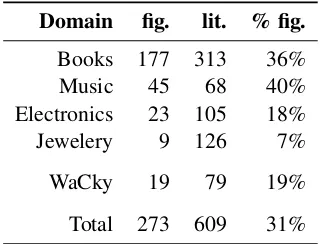
two out of three annotators as comparisons are used in the second round, where the task is to rate how metaphorical a comparison is. We use a scale of 1 to 4 following Turney et al. (2011), and then binarize to consider scores of 1–2 as lit-eral and 3–4 as figurative. Finally, in this work we only consider comparisons where all three annota-tors agree on this binary notion of figurativeness. For both tasks, we provide guidelines mostly in the form of examples and intuition, motivated on one hand by the annotators not having specialized knowledge, and on the other hand by the observa-tion that the literal-figurative distincobserva-tion is subjec-tive. All annotators have themaster worker qual-ification, reside in the U.S. and completed a lin-guistic background questionnaire that verifies their experience with English. In both tasks, control sentences with confidently known labels are used to filter low quality answers; in addition, we test annotators with a simple paraphrasing task shown to be effective for eliciting and verifying linguis-tic attention (Munro et al., 2010). Both tasks seem relatively difficult for humans, with inter-annotator agreement given by Fleiss’ k of 0.48 for the comparison identification task and of 0.54 for the figurativeness annotation after binarization. This is comparable to 0.57 reported by Hovy et al. (2013) for general metaphor labeling. We show some statistics about the collected data in Table 1. Overall, this is a costly process: out of 2400 auto-matically extracted comparison candidates, about 60% were deemed by the annotators to be actual comparisons and only 12% end up being selected confidently enough as figurative comparisons.
Our dataset of human-filtered comparisons, with the scores given by the three annotators, is made publicly available to encourage further work.4 This also includes about 400 comparisons
where the annotators do not agree perfectly on bi-nary figurativeness. Such cases can be interest-ing to other analyses, even if we don’t consider
4http://vene.ro/figurative-comparisons/
Domain fig. lit. % fig.
[image:4.595.336.496.62.184.2]Books 177 313 36% Music 45 68 40% Electronics 23 105 18% Jewelery 9 126 7% WaCky 19 79 19% Total 273 609 31%
Table 1: Figurativeness annotation results. Only comparisons where all three annotators agree are considered.
them in our experiments. It is worth noting that the existing corpora annotated for metaphor can-not be directly used to study comparisons. For ex-ample, in TroFi (Birke and Sarkar, 2006), a cor-pus of 6436 sentences annotated for figurative-ness, we only find 42 noun-noun comparisons with sentence-level (thus noisy) figurativeness labels. 4 Linguistic Insights
We now proceed to exploring the linguistic pat-terns that discriminate figurative from literal com-parisons. We consider two broad classes of cues, which we discuss next.
4.1 Domain-specific cues
Figurative language is often used for striking ef-fects, and comparisons are used to describe new things in terms of something given (Hanks, 2013). Since the norms that define what is surprising and what is well-known vary across domains, we ex-pect that such contextual information should play an important role in figurative language detection. This is a previously unexplored dimension of figu-rative language, and Amazon product reviews of-fer a convenient testbed for this intuition since cat-egory information is provided.
Specificity To estimate whether a compari-son can be considered striking in a particular domain—whether it references images or ideas that are unexpected in its context—we employ a simple measure of wordspecificitywith respect to a domain: the ratio of the word frequency within the domain and the word frequency in all domains being considered.5 It should be noted that
figurative literal 0.4
0.2 0.0 0.2 0.4 0.6 0.8 1.0 1.2 1.4
specificity
(a) VEHICLEspecificity.
figurative literal
0.2 0.0 0.2 0.4 0.6 0.8 1.0 1.2
similarity
(b) TOPIC-VEHICLEsimilarity.
figurative literal
0.4 0.2 0.0 0.2 0.4 0.6 0.8
1.01.2
1.4
imageability
(c) Imageability of the PROPERTY.
Figure 1: Distribution of some of the features we use, across literal and figurative comparisons in the test set. The profile of the plot is a kernel density estimation of the distribution, and the markers indicate the median and the first and third quartiles.
of the word and the context in which it appears. A comparison in the music domain that involves melodies is not surprising:
But the title song really feels like a pretty bland vocalmelody[...]
But the same word can play a very different role in another context, for example,bookreviews:
Her books are like sweet melodies that flow through your head.
Indeed, the wordmelodyhas a specificity of 96% in themusicdomain and only of 3% in thebooks domain.
An analysis on the labeled data confirms that literal comparisons do indeed tend to have more domain-specific VEHICLES (Mann-Whitney U
test, p < 0.01) than figurative ones. Further-more, the distribution of specificity across both types of comparisons, as shown in Figure 1a, has the appearance of a mixture model of general and specific words. Figurative comparison VEHICLES
largely exhibit only the general component of the mixture.6
Domain label An analysis of the annotation re-sults reveals that the percentage of comparisons that are figurative differs widely across domains, as indicated in the last column in Table 1. This suggests that simply knowing the domain of a text can serve to adjust some prior expectation about figurative language presence and therefore improve detection. We test this hypothesis using 6The mass around 0.25 in Figure 1a is largely explained by generic words such asthing, others, nothing, averageand barely specific words likeveil, reputation, dream, garbage.
a Z-test comparing all Amazon categories. With the exception of books and music reviews, that have similar ratios, all other pairs of categories show significantly different proportions of figura-tive comparisons (p <0.01).
4.2 Domain-agnostic cues
Linguistic studies of figurative language suggest that there is a fundamental generic notion of fig-urativeness. We attempt to capture this notion in the context of comparisons using syntactic and se-mantic information.
Topic-Vehicle similarity The default role of lit-eral comparisons is to assert similarity of things. Therefore, we expect that a high semantic simi-larity between the TOPIC and the VEHICLE of a
comparison is a sign of literal usage, as we pre-viously hypothesized in preliminary work (Nicu-lae, 2013). To test this hypothesis, we compute TOPIC-VEHICLE similarity using Distributional
Memory (Baroni and Lenci, 2010), a freely avail-able distributional semantics resource that cap-tures word relationships through grammatical role co-occurrence.
By applying this measure to our data, we find that there is indeed an important difference be-tween the distributions of TOPIC-VEHICLE
simi-larity in figurative and literal comparisons (shown in Figure 1b); the means of the two distribu-tions are significantly different (Mann-Whitney
p <0.01).
more concrete less concrete more imageable cinnamon, kiss devil, happiness
less imageable casque, pugilist aspect, however Table 2: Examples of words with high and low concreteness and imageability scores from the MRC Psycholinguistic Database.
applied in the context of comparisons. To that end we consider features shown to provide state of the art performance in the task of metaphor detection (Tsvetkov et al., 2014a): abstractness, imageabil-ity and supersenses.
Abstractness and imageability features are de-rived from the MRC Psycholinguistic Database (Coltheart, 1981), a dictionary based on manually annotated datasets of psycholinguistic norms. Im-ageability is the property of a word to arouse a mental image, be it in the form of a mental pic-ture, sound or any other sense. Concreteness is defined as “any word that refers to objects, materi-als or persons,” while abstractness, at the other end of the spectrum, is represented by words that can-not be usually experienced by the senses (Paivio et al., 1968). Table 2 shows a few examples of words with high and low concreteness and image-ability scores. Supersenses are a very coarse form of meaning representation. Tsvetkov et al. (2014a) used WordNet (Miller, 1995) semantic classes for nouns and verbs, for example noun.body, noun.animal, verb.consumption, or verb.motion. For adjectives, Tsvetkov et al. (2014b) developed and made available a novel classification in the same spirit.7 We compute abstractness,
image-ability and supersenses for the TOPIC, VEHICLE,
EVENT, and PROPERTY.8 We concatenate these
features with the raw vector representations of the constituents, following Tsvetkov et al. (2014a).
We find that such features relate to figurative comparisons in a meaningful way. For example, out of all comparisons with explicit properties, fig-urative comparisons tend to have properties that 7Following Tsvetkov et al. (2014a) we train a classifier to predict these features from a vector space representation of a word. We use the same cross-lingually optimized represen-tation from Faruqui and Dyer (2014) and a simpler classifier, a logistic regression, which we find to perform as well as the random forests used in Tsvetkov et al. (2014a). We treat su-persense prediction as a multi-label problem and apply a one-versus-all transformation, effectively learning a linear classi-fier for each supersense.
8If the PROPERTYis implicit, all corresponding features are set to zero. An extra binary feature indicates whether the PROPERTYis explicit or implicit.
are more imageable (Mann-Whitneyp <0.01), as illustrated by Figure 1c. This is in agreement with Hanks (2005), who observed that similes are char-acterized by their appeal to sensory imagination.
Definiteness We introduce another simple but effective syntactic cue that relates to concreteness: the presence of a definite article versus an nite one (or none at all). We search for the indefi-nite articlesaandanand the definite articlethein each component of a comparison.
We find that similes tend to have indefinite arti-cles in the VEHICLEmore often and definite
arti-cles less often (Mann-Whitneyp <0.01). In par-ticular, 59% of comparisons where the VEHICLE
has a indefinite article are figurative, as opposed to 13% of the comparisons where VEHICLEhas a
definite article.
5 Prediction Task
We now turn to the task of predicting whether a comparison is figurative or literal. Not only does this task allow us to assess and compare the effi-ciency of the linguistic cues we discussed, but it is also highly relevant in the context of natural lan-guage understanding systems.
We conduct a logistic regression analysis, and compare the efficiency of the features derived from our analysis to a bag of words baseline. In addition to the features inspired by the pre-viously described linguistic insights, we also try to computationally capture the lexical usage pat-terns of comparisons using a version of bag of words adapted to the comparison structure. In this
slotted bag of wordssystem, features correspond to occurrence of words within constituents (e.g., bright∈PROPERTY).
We perform a stratified split of our compari-son dataset into equal train and test sets (each set containing 408 comparisons, out of which 134 are figurative),9 and use a 5-fold stratified cross
vali-dation over the training set to choose the optimal value for the logistic regression regularization pa-rameter and the type of regularization (ℓ1orℓ2) for
each feature set.10
9The entire analysis described in Section 4 is only con-ducted on the training set. Also, in order to ensure that we are assessing the performance of the classifier on unseen com-parisons, we discard from our dataset all those with the same TOPICand VEHICLEpair.
10We use the logistic regression implementation
of liblinear (Fan et al., 2008) wrapped by the
Model # features Acc. P R F1 AUC Bag of words 1970 0.79 0.63 0.84 0.72 0.87
Slotted bag of words 1840 0.80 0.64 0.90 0.75 0.89
Domain-agnostic cues 357 0.81 0.70 0.74 0.72 0.90 only metaphor inspired 345 0.75 0.60 0.72 0.65 0.84
Domain-specific cues 8 0.69 0.51 0.81 0.63 0.76
All linguistic insight cues 365 0.86 0.76 0.83 0.79 0.92
Full 2202 0.88 0.80 0.84 0.82 0.94
Human - 0.96 0.92 0.96 0.94
-Table 3: Classification performance on the test set for the different sets of features we considered; human performance is shown for reference.
Classifier performance The performance on the classification task is summarized in Table 3. We note that thebag of wordsbaseline is remark-ably strong, because of common idiomatic simi-les that can be captured through keywords. Our
fullsystem (which relies on our linguistically in-spired cues discussed in Section 4 in addition to slotted bag of words) significantly outperforms the bag of words baseline and the slotted bag of words system in terms of accuracy, F1 score and AUC
(p < 0.05),11 suggesting that linguistic insights
complement idiomatic simile matching. Impor-tantly, a system using only ourlinguistic insight cuesalso significantly improves over the baseline in terms of accuracy and AUC and it is not signif-icantly different from the full system in terms of performance, in spite of having about an order of magnitude fewer features. It is also worth noting that the domain-specific cues play an important role in bringing the performance to this level by capturing a different aspect of what it means for a comparison to be figurative.
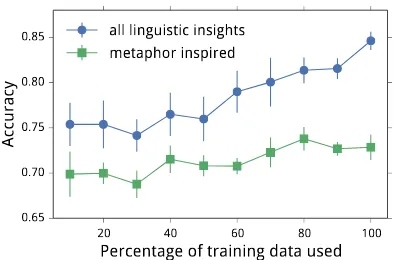
The features used by the state of the art metaphor detection system of Tsvetkov et al. (2014a), adapted to the comparison structure, per-form poorly by themselves and do not improve significantly over the baseline. This is consis-tent with the theoretical motivation that figura-tiveness in comparisons requires special compu-tational treatment, as discussed in Section 1. Fur-thermore, the linguistic insight features not only significantly outperform the metaphor inspired features (p <0.05), but are also better at exploit-ing larger amounts of data, as shown in Figure 2.
11All statistical significance results in this paragraph are obtained from 5000 bootstrap samples.
20 40 60 80 100
Percentage of training data used
0.65 0.70 0.75 0.80 0.85
Accuracy
[image:7.595.125.474.63.218.2]all linguistic insights metaphor inspired
Figure 2: Learning curves. Each point is obtained by fitting a model on 10 random subsets of the training set. Error bars show 95% confidence in-tervals.
Comparison to human performance To gauge how well humans would perform at the classifica-tion task on the actual test data, we perform an-other Amazon Mechanical Turk evaluation on 140 examples from the test set. For the evaluation, we use majority voting between the three anno-tators,12 and compare to the agreed labels in the
dataset. Estimated human accuracy is 96%, plac-ing our full system within 10% of human accuracy.
Feature analysis The predictive analysis we perform allows us to investigate to what extent the features inspired by our linguistic insights have discriminative power, and whether they actually cover different aspects of figurativeness.
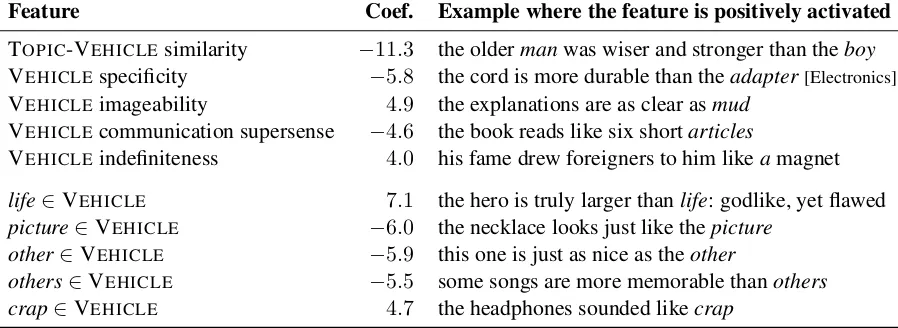
[image:7.595.319.516.283.413.2]Feature Coef. Example where the feature is positively activated
TOPIC-VEHICLEsimilarity −11.3 the oldermanwas wiser and stronger than theboy
VEHICLEspecificity −5.8 the cord is more durable than theadapter[Electronics]
VEHICLEimageability 4.9 the explanations are as clear asmud
VEHICLEcommunication supersense −4.6 the book reads like six shortarticles
VEHICLEindefiniteness 4.0 his fame drew foreigners to him likeamagnet life∈VEHICLE 7.1 the hero is truly larger thanlife: godlike, yet flawed
picture∈VEHICLE −6.0 the necklace looks just like thepicture
other∈VEHICLE −5.9 this one is just as nice as theother
others∈VEHICLE −5.5 some songs are more memorable thanothers
[image:8.595.74.523.67.231.2]crap∈VEHICLE 4.7 the headphones sounded likecrap
Table 4: Top 5 linguistic insight features (top) and slotted bag of words features (bottom) in the full model and their logistic regression coefficients. A positive coefficient means the feature indicates figurativeness.
Table 4 shows the best linguistic insight and slotted bag of words features selected by the full model. The strongest feature by far is the seman-tic similarity between the TOPIC and the VEHI -CLE. By itself, this feature gets 70% accuracy and
61%F1score.
The rest of the top features involve mostly the VEHICLE. This suggests that the VEHICLEis the
most informative element of a comparison when it comes to figurativeness. Features involving other constituents also get selected, but with slightly lower weights, not making it to the top.
VEHICLEspecificity is one of the strongest
fea-tures, with positive values indicating literal com-parisons. This confirms our intuition that domain information is important to discriminate figurative from literal language.
Of the adapted metaphor features, the noun communication supersense and the imageability of the VEHICLE make it to the top. Nouns with
low communication rating occurring in the train-ing set include puddles, arrangements, carbohy-drateswhile nouns with high communication rat-ing includelanguagesandsubjects.
Presence of an indefinite article in the VEHICLE
is a strong indicator of figurativeness. By them-selves, the definiteness and indefiniteness features perform quite well, attaining 78% accuracy and 67%F1score.
The salient bag of words features correspond to specific types of comparisons. The words other andothersin the VEHICLE indicate comparisons
between the same kind of arguments, for exam-plesome songs are more memorable than others, and these are likely to be literal. The word
pic-tureis specific to the review setting, as products are accompanied by photos, and for certain kinds of products, the resemblance of the product with the image is an important factor for potential buy-ers.13 The bag of words systems are furthermore
able to learn idiomatic comparisons by identify-ing common figurative VEHICLESsuch aslifeand crap, corresponding to fixed expressions such as larger than life.
Error analysis Many of the errors made by our full system involve indirect semantic mechanisms such as metonymy. For example, the false pos-itive the typeface was larger than most books really means larger than the typefaces found in most books, but without the implicit expansion the meaning can appear figurative. A similar kind of ellipsis makes the example a lot [of songs] are even better than sugar be wrongly classified as literal. Another source of error is polysemy. Ex-amples likethe rejuvelac formula is about 10 times better than yogurtare misclassified because of the multiple meanings of the wordformula, one being closely related to yogurt and food, but the more common ones being general and abstract, suggest-ing figurativeness.
6 Social Correlates
1 2 3 4 5
stars
0.30 0.32 0.34 0.36 0.38
figurative comparison ratio
(a) Figurative comparisons are more likely to be found in re-views with strongly polarized sentiment.
0.0 0.2 0.4 0.6 0.8 1.0
helpfulness ratio
0.300.35 0.40 0.45 0.50
figurative comparison ratio
(b) Helpful reviews are less likely to contain figurative compar-isons.
Figure 3: Interaction between figurative language and social context aspects. Error bars show 95% confidence intervals. The dashed horizontal line marks the average proportion of figurative comparisons. In Figure 3b the average proportion is different because we only consider reviews rated by at least 10 readers.
the user towards the reviewed product, indicated by the star rating of the review. An external factor present in the data is how helpful the review is per-ceived by other users. In this section we analyze how these factors interact with figurative language in comparisons.
To gain insight about fine grained interactions with human factors at larger scale, we use our clas-sifier to find over 80,000 figurative and literal com-parisons from the same four categories. The trends we reveal also hold significantly on the manually annotated data.
Sentiment While it was previously noted that similes often transmit strong affect (Hanks, 2005; Veale, 2012a; Veale, 2012b), the connection be-tween figurativeness and sentiment was never em-pirically validated. The setting of product reviews is convenient for investigating this issue, since the star ratings associated with the reviews can be used as sentiment labels. We find that com-parisons are indeed significantly more likely to be figurative when the users express strong opin-ions, i.e., in one-star or five-star reviews (Mann-Whitney p < 0.02 on the manually annotated data). Figure 3a shows how the proportion of fig-urative comparisons varies with the polarity of the review.
Helpfulness It is also interesting to understand to what extent figurative language relates to the external perception of the content in which it
ap-pears. We find that comparisons in helpful re-views14are less likely to be figurative. Figure 3b
shows a near-constant high ratio of figurative com-parisons among unhelpful and average reviews; as helpfulness increases, figurative comparisons be-come less frequent. We further validate that this effect is not a confound of the distribution of help-fulness ratings across reviews of different polarity by controlling for the star rating: given a fixed star rating, the proportion of figurative comparisons is still lower in helpful (helpfulness over 50%) than in unhelpful (helpfulness under 50%) reviews; this difference is significant (Mann-Whitneyp <0.01) for all classes of ratings except one-star. The size of the manually annotated data does not al-low for star rating stratification, but the overall dif-ference is statistically significant (Mann-Whitney
p < 0.01). This result encourages further exper-imentation to determine whether there is a causal link between the use of figurative language in user generated content and its external perception.
7 Conclusions and Future Work
insights can be successfully operationalized in a new prediction task: distinguishing literal from figurative comparisons. Our system reaches ac-curacy that is within 10% of human performance, and is outperforming a state of the art metaphor detection system, thus confirming the need for a computational approach tailored specifically to comparisons. While we take a data-driven ap-proach, our annotated dataset can be useful for more theoretical studies of the kinds of compar-isons and similes people use.
We discover that domain knowledge is an im-portant factor in identifying similes. This suggests that future work on automatic detection of figura-tive language should consider contextual parame-ters such as the topic and community where the content appears.
Furthermore, we are the first to tie figurative language to the social context in which it is pro-duced and show its relation to internal and exter-nal human factors such as opinion sentiment and helpfulness. Future investigation into the causal effects of these interactions could lead to a better understanding of the role of figurative language in persuasion and rhetorics.
In our work, we consider common noun TOP -ICS and VEHICLES and adjectival PROPERTIES.
This is the most typical case, but supporting other parts of speech—such as proper nouns, pronouns, and adverbs—can make a difference in many ap-plications. Capturing compositional interaction between the parts of the comparison could lead to more flexible models that give less weight to the VEHICLE.
This study is also the first to estimate how prevalent similes are in the wild, and reports that about one third of the comparisons we consider are figurative. This is suggestive of the need to build systems that can properly process figurative com-parisons in order to correctly harness the semantic information encapsulated in comparisons.
Acknowledgements
We would like to thank Yulia Tsvetkov for con-structive discussion about figurative language and about her and her co-authors’ work. We are grate-ful for the suggestions of Patrick Hanks, Con-stantin Or˘asan, Sylviane Cardey, Izabella Thomas, Ekaterina Shutova, Tony Veale, and Niket Tan-don. We extend our gratitude to Julian McAuley for preparing and sharing the Amazon review
dataset. We are thankful to the anonymous review-ers, whose comments were like a breath of fresh air. We acknowledge the help of the Amazon Me-chanical Turk annotators and of the MPI-SWS stu-dents involved in pilot experiments.
Vlad Niculae was supported in part by the European Commission, Education & Training, Erasmus Mundus: EMMC 2008-0083, Erasmus Mundus Masters in NLP & HLT.
References
Marco Baroni and Alessandro Lenci. 2010. Dis-tributional memory: A general framework for corpus-based semantics. Computational Linguis-tics, 36(4):673–721.
Marco Baroni, Silvia Bernardini, Adriano Ferraresi, and Eros Zanchetta. 2009. The WaCky wide web: A collection of very large linguistically processed web-crawled corpora. Language Resources and Evaluation, 43(3):209–226.
Louise Shabat Bethlehem. 1996. Simile and figurative language.Poetics Today, 17(2):203–240.
Julia Birke and Anoop Sarkar. 2006. A clustering ap-proach for nearly unsupervised recognition of non-literal language. InProceedings of EACL.
Hugh Bredin. 1998. Comparisons and similes. Lin-gua, 105(1):67–78.
Max Coltheart. 1981. The MRC psycholinguistic database. The Quarterly Journal of Experimental Psychology, 33(4):497–505.
Rong-En Fan, Kai-Wei Chang, Cho-Jui Hsieh, Xiang-Rui Wang, and Chih-Jen Lin. 2008. LIBLINEAR: A library for large linear classification. Journal of Machine Learning Research, 9:1871–1874.
Manaal Faruqui and Chris Dyer. 2014. Improving vector space word representations using multilingual correlation. InProceedings of EACL.
Eric N Forsyth and Craig H Martell. 2007. Lexical and discourse analysis of online chat dialog. In Proceed-ings of ICSC.
Patrick Hanks. 2005. Similes and sets: The English preposition ‘like’. In R. Blatn´a and V. Petkevic, ed-itors,Languages and Linguistics: Festschrift for Fr. Cermak. Charles University, Prague.
Patrick Hanks. 2006. Metaphoricity is grad-able. Trends in Linguistic Studies and Monographs, 171:17.
Patrick Hanks. 2013. Lexical Analysis: Norms and Exploitations. MIT Press.
Dirk Hovy, Shashank Srivastava, Sujay Kumar Jauhar, Mrinmaya Sachan, Kartik Goyal, Huiying Li, Whit-ney Sanders, and Eduard Hovy. 2013. Identifying metaphorical word use with tree kernels. In Pro-ceedings of the NAACL Workshop on Metaphors for NLP.
M. Israel, J.R. Harding, and V. Tobin. 2004. On simile. Language, Culture, and Mind. CSLI Publications. Nitin Jindal and Bing Liu. 2006. Identifying
compara-tive sentences in text documents. InProceedings of SIGIR.
George Lakoff and Mark Johnson. 1980. Metaphors we live by. University of Chicago Press.
Bin Li, Jiajun Chen, and Yingjie Zhang. 2012. Web based collection and comparison of cognitive prop-erties in English and Chinese. InProceedings of the Joint Workshop on Automatic Knowledge Base Con-struction and Web-scale Knowledge Extraction. Christoph Lofi, Christian Nieke, and Nigel Collier.
2014. Discriminating rhetorical analogies in social media. InProceedings of EACL.
Andr´e FT Martins, Noah A Smith, Eric P Xing, Pe-dro MQ Aguiar, and M´ario AT Figueiredo. 2010. Turbo parsers: Dependency parsing by approximate variational inference. InProceedings of EMNLP. Julian McAuley and Jure Leskovec. 2013. Hidden
fac-tors and hidden topics: Understanding rating dimen-sions with review text. InProceedings of RecSys. George A Miller. 1995. WordNet: a lexical
database for English. Communications of the ACM, 38(11):39–41.
Rosamund Moon. 2008. Conventionalized as-similes in English: A problem case. International Journal of Corpus Linguistics, 13(1):3–37.
Rosamund Moon. 2011. Simile and dissimilarity. Journal of Literary Semantics, 40(2):133–157. Robert Munro, Steven Bethard, Victor Kuperman,
Vicky Tzuyin Lai, Robin Melnick, Christopher Potts, Tyler Schnoebelen, and Harry Tily. 2010. Crowdsourcing and language studies: The new gen-eration of linguistic data. In Proceedings of the NAACL Workshop on Creating Speech and Lan-guage Data with Amazon’s Mechanical Turk. Vlad Niculae. 2013. Comparison pattern matching and
creative simile recognition. In Proceedings of the Joint Symposium on Semantic Processing.
Olutobi Owoputi, Brendan O’Connor, Chris Dyer, Kevin Gimpel, Nathan Schneider, and Noah A Smith. 2013. Improved part-of-speech tagging for online conversational text with word clusters. In Proceedings of NAACL-HLT.
Allan Paivio, John C Yuille, and Stephen A Madigan. 1968. Concreteness, imagery, and meaningfulness values for 925 nouns. Journal of Experimental Psy-chology, 76(1p2):1.
Fabian Pedregosa, Ga¨el Varoquaux, Alexandre Gram-fort, Vincent Michel, Bertrand Thirion, Olivier Grisel, Mathieu Blondel, Peter Prettenhofer, Ron Weiss, Vincent Dubourg, et al. 2011. Scikit-learn: Machine learning in Python. Journal of Machine Learning Research, 12:2825–2830.
Carlos Roncero, John M Kennedy, and Ron Smyth. 2006. Similes on the internet have explanations. Psychonomic Bulletin & Review, 13(1):74–77. Ekaterina Shutova and Lin Sun. 2013. Unsupervised
metaphor identification using hierarchical graph fac-torization clustering. In Proceedings of NAACL-HLT.
Ekaterina Shutova. 2010. Models of metaphor in NLP. InProceedings of ACL.
Niket Tandon, Gerard de Melo, and Gerhard Weikum. 2014. Smarter than you think: Acquiring compara-tive commonsense knowledge from the web. In Pro-ceedings of AAAI.
Yulia Tsvetkov, Leonid Boytsov, Anatole Gershman, Eric Nyberg, and Chris Dyer. 2014a. Metaphor de-tection with cross-lingual model transfer. In Pro-ceedings of ACL.
Yulia Tsvetkov, Nathan Schneider, Dirk Hovy, Archna Bhatia, Manaal Faruqui, and Chris Dyer. 2014b. Augmenting English adjective senses with super-senses. InProceedings of LREC.
Peter D Turney, Yair Neuman, Dan Assaf, and Yohai Cohen. 2011. Literal and metaphorical sense iden-tification through concrete and abstract context. In Proceedings of EMNLP.
Tony Veale and Yanfen Hao. 2008. A context-sensitive framework for lexical ontologies. Knowledge Engi-neering Review, 23(1):101–115.
Tony Veale and Yanfen Hao. 2011. Exploiting ready-mades in linguistic creativity: A system demonstra-tion of the Jigsaw Bard. InProceedings of ACL (Sys-tem Demonstrations).
Tony Veale and Guofu Li. 2013. Creating similarity: Lateral thinking for vertical similarity judgments. In Proceedings of ACL.
Tony Veale. 2012a. A computational exploration of creative similes. Metaphor in Use: Context, Cul-ture, and Communication, 38:329.