Proceedings of NAACL-HLT 2019, pages 2047–2053 2047
Differentiable Sampling with Flexible Reference Word Order
for Neural Machine Translation
Weijia Xu University of Maryland
Xing Niu University of Maryland
Marine Carpuat University of Maryland
Abstract
Despite some empirical success at correcting exposure bias in machine translation, sched-uled sampling algorithms suffer from a ma-jor drawback: they incorrectly assume that words in the reference translations and in sam-pled sequences are aligned at each time step. Our new differentiable sampling algorithm ad-dresses this issue by optimizing the probabil-ity that the reference can be aligned with the sampled output, based on a soft alignment pre-dicted by the model itself. As a result, the output distribution at each time step is eval-uated with respect to the whole predicted se-quence. Experiments on IWSLT translation tasks show that our approach improves BLEU compared to maximum likelihood and sched-uled sampling baselines. In addition, our ap-proach is simpler to train with no need for sam-pling schedule and yields models that achieve larger improvements with smaller beam sizes.1
1 Introduction
Neural machine translation (NMT) models are typically trained to maximize the likelihood of ref-erence translations (Sutskever et al., 2014; Bah-danau et al., 2015). While simple and effective, this objective suffers from the exposure bias prob-lem (Ranzato et al., 2015): the model is only ex-posed to reference target sequences during train-ing, but has to rely on its own predictions at infer-ence. As a result, errors can accumulate along the generated sequence at inference time.
This is a well-known issue in sequential deci-sion making (Langford and Zadrozny, 2005; Co-hen and Carvalho, 2005; K¨a¨ari¨ainen and Lang-ford, 2006, i.a.) and it has been addressed in past work by incorporating the previous decod-ing choices into the traindecod-ing scheme, usdecod-ing imi-tation learning (Daum´e et al., 2009; Ross et al.,
1The code is available at https://github.com/
Izecson/saml-nmt
2011; Bengio et al., 2015; Leblond et al., 2018) and reinforcement learning (Ranzato et al., 2015; Bahdanau et al., 2016) techniques. In this pa-per, we focus on a simple and computationally in-expensive family of approaches, known as Data as Demonstrator (Venkatraman et al., 2015) and scheduled sampling (Bengio et al., 2015; Goyal et al., 2017). The algorithms use a stochastic mix-ture of the reference words and model predictions with an annealing schedule controlling the mix-ture probability. Despite their empirical success in various sequence prediction tasks, they are based on an assumption that does not hold for machine translation: they assume that words in the refer-ence translations and in sampled sequrefer-ences are aligned at each time step, which results in weak and sometimes misleading training signals.
In this paper, we introduce a differentiable sam-pling algorithm that exposes machine translation models to their own predictions during training, and allows for differences in word order when comparing model outputs with reference transla-tions. We compute the probability that the refer-ence can be aligned with the sampled output us-ing a soft alignment predicted based on the model states, so that the model will not be punished too severely for producing hypotheses that devi-ate from the reference, as long as the hypotheses can still be aligned with the reference.
2 Approach
Our approach is designed to optimize the stan-dard sequence-to-sequence model for translating a source sentencexinto a target sentencey (Bah-danau et al., 2015). This model computes the probability ofygivenxas:
P(y|x) =
T Y
t=1
p(yt|y<t,x;θ) (1)
where θ represents the model parameters. Given x, the model first produces a sequence of hidden representations h1...T: ht = f(y<t,x),
where T is the length of y, and f is usually an encoder-decoder network. At each time step t, the hidden representation ht is fed to
a linear projection layer st = W ht + b to
obtain a vector of scores st over all possible
words in the vocabulary V. Scores are then turned into a conditional probability distribution:
p(· |y<t,x;θ) = softmax(st).
The traditional maximum likelihood (ML) ob-jective maximizes the log-likelihood of the train-ing data D ≡ {(x(n),y(n))}N
n=1 consisting ofN pairs of source and target sentences:
JM L(θ) =
N X
n=1
T X
t=1
logp(yt(n)|y<t(n),x(n);θ) (2)
At test time, prefixes y<t are subsequences generated by the model and therefore contain er-rors. By contrast, in ML training, prefixesy<tare subsequences of reference translations. As a re-sult, the model is never exposed to its own errors during training and errors accumulate at test time. This mismatch is known as the exposure bias prob-lem (Ranzato et al., 2015).
2.1 Limitations in Scheduled Sampling
Bengio et al. (2015) introduced the scheduled sampling algorithm to address exposure bias. Scheduled sampling gradually replaces the refer-ence words with sampled model predictions in the prefix used at training time. An annealing schedule controls the probability of using refer-ence words vs. model predictions. The training objective remains the same as the ML objective, except for the nature of the prefixyˆ<t, which con-tains a mixture of reference and predicted words:
JSS(θ) =
N X
n=1
T X
t=1
logp(y(tn)|yˆ<t(n),x(n);θ) (3)
Despite the empirical success of scheduled sam-pling, one limitation is that the discontinuity of the argmax operation makes it impossible to penalize errors made in previous steps, which can lead to slow and unstable training. We address this is-sue using a continuous relaxation to the greedy search and sampling process, similarly to Goyal et al. (2017), which we describe in Section 2.2.
Another limitation of scheduled sampling is that it incorrectly assumes that the reference and pre-dicted sequence are aligned by time indices which introduces additional noise to the training signal.2 We address this problem with a novel differen-tiable sampling algorithm with an alignment based objective called soft aligned maximum likelihood (SAML). It is used in combination with maximum likelihood to define our training objective J =
JM L +JSAM L, where JM L is computed based on reference translations, andJSAM Lis computed
based on sampled translations of the same input sentences. We defineJSAM Lin Section 2.3.
2.2 Differentiable Sampling
To backpropagate errors made in the previous de-coding steps, we use a continuous relaxation of the discrete sampling operation similar to Goyal et al. (2017), except that we use the Straight-Through (ST) Gumbel-Softmax estimator (Jang et al., 2017; Bengio et al., 2013) instead of Gumbel-Softmax (Jang et al., 2017; Maddison et al., 2014) to better simulate the scenario at in-ference time.3
The Gumbel-Softmax is derived from the Gumbel-Max trick (Maddison et al., 2014), an al-gorithm for sampling one-hot vectorz∈Rkfrom
a categorical distribution(p1, ..., pk):
z=one-hot(arg max
i
(logpi+βgi)) (4)
where gi is the Gumbel noise drawn i.i.d
from Gumbel(0,1)4, and β is a hyperparameter
controlling the scale of the noise. Here, the trick is used to approximate the discontinuous argmax function with the differentiable softmax:
˜
z= softmax((logpi+βgi)/τ) (5)
2
https://nlpers.blogspot.com/2016/03/a-dagger-by-any-other-name-scheduled.html
3
The Straight-Through estimator consistently outper-forms the Gumbel-Softmax in preliminary experiments.
We make dinner </s>
We will make </s>
log p(“dinner” | “We will”, x)
reference
alignment
output
objective for 3rd ref word
(a) Scheduled Sampling Objective
reference
alignment
output
We make dinner </s>
We will make dinner </s>
objective for 3rd ref word
log [ a13 p(“dinner” | x) + … + a43 p(“dinner” | “We will make”, x)
+ a53 p(“dinner” | “We will make dinner”, x) ]
[image:3.595.73.538.63.154.2](b) SAML Objective
Figure 1: Difference between objectives used in scheduled sampling (left) and our approach (right), when com-puting the contribution to the objective of the reference word “dinner”. The schedule sampling hypothesis uses a mixture of the reference (black) and sampled (blue underlined) words, while the entire hypothesis sequence is sampled in our approach.
where τ is the temperature parameter. As τ di-minishes to zero,z˜becomes the same as one-hot samplez.
The Straight-Through Gumbel-Softmax main-tains the differentiability of the Gumbel-Softmax estimator while allowing for discrete sampling by taking different paths in the forward and backward pass. It uses argmax to get the one-hot samplezin the forward pass, but uses its continuous approxi-mationz˜in the backward pass. While ST estima-tors are biased, they have been shown to work well in latent tree learning (Choi et al., 2018) and semi-supervised machine translation (Niu et al., 2019).
2.3 Soft Aligned Maximum Likelihood
The soft aligned maximum likelihood (SAML) is defined as the probability that the reference can be aligned with the sampled output using a soft alignment predicted by the model:
PSAM L(y|x) = T Y
t=1
T0 X
j=1
atj·p(yt|y˜<j,x;θ)
(6) whereTis the length of the reference sequence,T0
is the length of the sampled sequence, atj is the
predicted soft alignment between the reference wordytand sampled prefixy˜<j.
Training with the SAML objective consists in maximizing:
JSAM L(θ) = N X
n=1
logPSAM L(y(n)|x(n)) (7)
The conditional probability of the next wordp(yt|y˜<j,x;θ)is computed as follows:
p(· |y˜<j,x;θ) = softmax(Wh˜j +b) (8)
whereW andbare model parameters. ˜hj is the
hidden representation at stepjconditioned on the
Task sentences (K) vocab (K)
train dev test src tgt
de-en 153.3 7.0 6.8 113.5 53.3
[image:3.595.319.515.237.301.2]vi-en 121.3 1.5 1.3 23.9 50.0
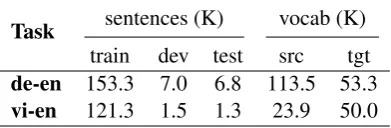
Table 1: We evaluate on two translation tasks.
source sequence xand the preceding words y˜<j sampled from the model distribution using differ-entiable sampling:
˜
hj =f(y˜<j,x) (9)
We compute the soft alignmentatj betweenyt
andy˜<jbased on the model’s hidden states:
atj =
exp(score(h˜j,eyt)) PT0
i=1exp(score(˜hi,eyt))
(10)
where eyt is the embedding of the reference
word yt. The score function captures the
simi-larity between the hidden state˜hj and the
embed-dingeyt. We use the dot product here as it does
not introduce additional parameters:
score(h,e) =h>e (11)
Figure 1 illustrates how the resulting objective differs from scheduled sampling: (1) it is com-puted over sampled sequences as opposed to se-quences that contain a mixture of sampled and ref-erence words, and (2) each refref-erence word is soft-aligned to the sampled sequence.
3 Experiments
Method Anneal de-en en-de vi-en
Baseline No 27.41±0.2622.64±0.13 23.59±0.13
+SS Yes 27.47±0.2822.56±0.17 23.97±0.39
+DSS Yes 27.30±0.2422.47±0.20 23.68±0.35
+SS No 22.91±0.2117.78±0.20 19.57±0.19
+SAML No 27.94±0.1223.30±0.19 24.60±0.35
Table 2: BLEU scores of our approach (SAML)
and three baselines including the maximum likelihood (ML) baseline, scheduled sampling (SS), and differ-entiable scheduled sampling (DSS). The Anneal col-umn indicates whether the sampling rate is annealed. For each task, we report the mean and standard devi-ation over 5 runs with different random seeds. SAML achieves the best BLEU scores and is simpler to train than SS and DSS, as it requires no annealing schedule.
2015 Vietnamese-English (vi-en). For de-en and en-de, we follow the preprocessing steps in Ran-zato et al. (2015). For vi-en, we use the data pre-processed by Luong and Manning (2015), with test2012 for validation and test2013 for testing. Table 1 summarizes the data statistics.
Setup Our translation models are attentional RNNs (Bahdanau et al., 2015) built on Sock-eye (Hieber et al., 2017). We use bi-directional LSTM encoder and single-layer LSTM decoder with 256 hidden units, embeddings of size 256, and multilayer perceptron attention with a layer size of 256. We apply layer normalization (Ba et al., 2016) and label smoothing (0.1). We add dropout to embeddings (0.1) and decoder hidden states (0.2). For ST Gumbel-Softmax, we use temperatureγ = 1and noise scaleβ = 0.5. The decoding beam size is 5 unless stated otherwise. We train the models using the Adam opti-mizer (Kingma and Ba, 2015) with a batch size of 1024 words. We checkpoint models every 1000 updates. The initial learning rate is 0.0002, and it is reduced by 30% after 4 checkpoints without validation perplexity improvement. Training stops after 12 checkpoints without improvement. For training efficiency, we first pre-train a baseline model for each task using onlyJM Land fine-tune it using different approaches. In the fine-tuning phase, we inherit all settings except that we initialize the learning rate to 0.00002 and set the minimum number of checkpoints before early stopping to 24. We fine-tune each randomly seeded model independently.
Baselines We compare our model against three baselines: (1) a standard baseline trained with the ML objective, and models fine-tuned with (2) scheduled sampling (SS) (Bengio et al., 2015) and (3) differentiable scheduled sampling (DSS) (Goyal et al., 2017). In SS and DSS, the probability of using reference words s is
annealed using inverse sigmoid decay (Bengio et al., 2015): s = k/(k+ exp(i/k))at thei-th
checkpoint withk= 10.
Results Table 2 shows that the SAML improves over the ML baseline by +0.5 BLEU on de-en, +0.7 BLEU on en-de, and +1.0 BLEU on vi-en task. In addition, SAML consistently improves over both the scheduled sampling and differen-tiable scheduled sampling on all tasks. All im-provements are significant with p < 0.002. In-terestingly, differentiable scheduled sampling per-forms no better than scheduled sampling in our ex-periments, unlike in Goyal et al. (2017).
Unlike scheduled sampling, our approach does not require an annealing schedule, and it is there-fore simpler to train. We verify that the annealing schedule is needed in scheduled sampling by train-ing a contrastive model with the same objective as scheduled sampling, but without annealing sched-ule (Table 2). We set the sampling rate to 0.5. The contrastive model hurts BLEU scores by at least 4.0 points compared to both the ML baseline and models fine-tuned with scheduled sampling, con-firming that scheduled sampling needs the anneal-ing schedule to work well.
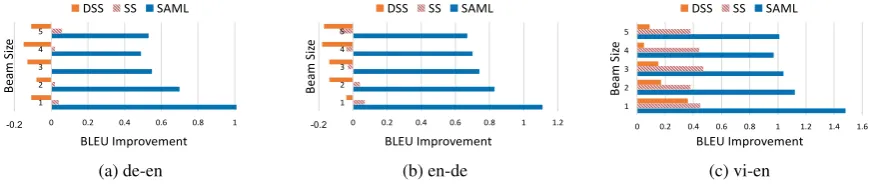
We further examine the performance gain of dif-ferent approaches over the baseline with varying beam sizes (Figure 2). Our approach yields larger BLEU improvements when decoding with greedy search and smaller beams, while there is no clear pattern for scheduled sampling models. These re-sults support the hypothesis that our approach mit-igates exposure bias, as it yields bigger improve-ments in settings where systems have fewer oppor-tunities to recover from early errors.
4 Related Work
al--0.2 0 0.2 0.4 0.6 0.8 1 1
2 3 4 5
BLEU Improvement
Be
am
S
ize
DSS SS SAML
(a) de-en
-0.2 0 0.2 0.4 0.6 0.8 1 1.2
1 2 3 4 5
BLEU Improvement
Be
am
S
ize
DSS SS SAML
(b) en-de
0 0.2 0.4 0.6 0.8 1 1.2 1.4 1.6 1
2 3 4 5
BLEU Improvement
Be
am
S
ize
DSS SS SAML
[image:5.595.81.520.65.158.2](c) vi-en
Figure 2: Improvements from our method (SAML), scheduled sampling (SS), and differentiable scheduled sam-pling (DSS) over the maximum likelihood (ML) baseline when decoding with varying beam sizes (average of 5 runs). The SAML model consistently yields the largest improvements with smaller beams.
gorithms require an expert policy, which produces the best next token given any model predicted pre-fix, and assume that policy can be efficiently com-puted from the reference. However, for struc-tured prediction tasks such as machine translation with large vocabulary and complex loss functions, it is intractable to find the best next token given any prefix. For time series modeling, the Data as Demonstrator algorithm (Venkatraman et al., 2015) derives the expert policy directly from the reference sequences which are aligned with the sampled sequences at each time step. Scheduled sampling algorithms (Bengio et al., 2015; Goyal et al., 2017) use the same strategy to train neu-ral sequence-to-sequence models for a broader range of language generation tasks, even though the time alignment between reference and sampled sequences does not hold. Leblond et al. (2018) proposed to complete a predicted prefix with all possible reference suffixes and picking the refer-ence suffix that yields the highest BLEU-1 score. However, they found that this approach performs well only when the prefix is close to the reference. Reinforcement learning (RL) algorithms (Bah-danau et al., 2016; Sutton and Barto, 2018; Van Hasselt et al., 2016) address exposure bias by directly optimizing a sentence-level reward for the model generated sequences. Evaluation met-rics such as BLEU can be used as rewards, but they are discontinuous and hard to optimize. Tech-niques such as policy gradient (Williams, 1992) and actor-critic (Sutton and Barto, 2018; Degris et al., 2012) are thus required to find an unbi-ased estimation of the gradient to optimize the model. Due to the high variance of the gradient es-timation, training with RL can be slow and unsta-ble (Henderson et al., 2018; Wu et al., 2018). Re-cent alternatives use data augmentation to incor-porate the sentence-level reward into the training objective more efficiently (Norouzi et al., 2016).
Finally, our SAML loss shares the idea of flexi-ble reference word order with the bag-of-word loss introduced by Ma et al. (2018) to improve source coverage. However, their loss is computed with teacher forcing and therefore does not address ex-posure bias.
5 Conclusion
We introduced a differentiable sampling algorithm which exposes a sequence-to-sequence model to its own predictions during training and compares them to reference sequences flexibly to back-propagate reliable error signals. By soft align-ing reference and sampled sequences, our ap-proach consistently improves BLEU over maxi-mum likelihood and scheduled sampling baselines on three IWSLT tasks, with larger improvements for greedy search and smaller beam sizes. Our ap-proach is also simple to train, as it does not require any sampling schedule.
Acknowledgments
References
Lei Jimmy Ba, Ryan Kiros, and Geoffrey E. Hinton. 2016. Layer normalization. CoRR, abs/1607.06450.
Dzmitry Bahdanau, Philemon Brakel, Kelvin Xu, Anirudh Goyal, Ryan Lowe, Joelle Pineau, Aaron C. Courville, and Yoshua Bengio. 2016. An actor-critic algorithm for sequence prediction. CoRR, abs/1607.07086.
Dzmitry Bahdanau, Kyunghyun Cho, and Yoshua Ben-gio. 2015. Neural machine translation by jointly learning to align and translate. In Proceedings of the 3th International Conference on Learning Rep-resentations.
Samy Bengio, Oriol Vinyals, Navdeep Jaitly, and Noam Shazeer. 2015. Scheduled sampling for se-quence prediction with recurrent neural networks. InAdvances in Neural Information Processing Sys-tems 28, pages 1171–1179.
Yoshua Bengio, Nicholas L´eonard, and Aaron C. Courville. 2013. Estimating or propagating gradi-ents through stochastic neurons for conditional com-putation.CoRR, abs/1308.3432.
Jihun Choi, Kang Min Yoo, and Sang-goo Lee. 2018. Learning to compose task-specific tree structures. In
Proceedings of the Thirty-Second AAAI Conference on Artificial Intelligence, pages 5094–5101. AAAI Press.
William W. Cohen and Victor R. Carvalho. 2005. Stacked Sequential Learning. InProceedings of the IJCAI.
Hal Daum´e, John Langford, and Daniel Marcu. 2009. Search-based structured prediction. Machine Learn-ing, 75(3):297–325.
Thomas Degris, Patrick M Pilarski, and Richard S Sut-ton. 2012. Model-free reinforcement learning with continuous action in practice. InAmerican Control Conference (ACC), 2012, pages 2177–2182. IEEE.
Kartik Goyal, Chris Dyer, and Taylor
Berg-Kirkpatrick. 2017. Differentiable scheduled
sampling for credit assignment. In Proceedings of the 55th Annual Meeting of the Association for Com-putational Linguistics (Volume 2: Short Papers), pages 366–371. Association for Computational Linguistics.
Peter Henderson, Riashat Islam, Philip Bachman, Joelle Pineau, Doina Precup, and David Meger. 2018. Deep reinforcement learning that matters. In
Proceedings of the Thirty-Second AAAI Conference on Artificial Intelligence. AAAI Press.
Felix Hieber, Tobias Domhan, Michael Denkowski, David Vilar, Artem Sokolov, Ann Clifton, and Matt Post. 2017. Sockeye: A toolkit for neural machine translation. CoRR, abs/1712.05690.
Eric Jang, Shixiang Gu, and Ben Poole. 2017. Cate-gorical reparameterization with gumbel-softmax. In
Proceedings of the 5th International Conference on Learning Representations.
Matti K¨a¨ari¨ainen and John Langford. 2006. Lower Bounds for Reductions. InTalk at the Atomic Learn-ing Workshop.
Diederik P. Kingma and Jimmy Ba. 2015. Adam: A method for stochastic optimization. In Proceed-ings of the 3th International Conference on Learn-ing Representations.
John Langford and Bianca Zadrozny. 2005. Relating reinforcement learning performance to classification performance. In Proceedings of the 22nd interna-tional conference on Machine learning, pages 473– 480. ACM.
R´emi Leblond, Jean-Baptiste Alayrac, Anton Osokin, and Simon Lacoste-Julien. 2018. SEARNN: Train-ing RNNs with global-local losses. InInternational Conference on Learning Representations.
Minh-Thang Luong and Christopher D Manning. 2015. Stanford neural machine translation systems for spo-ken language domains. In Proceedings of the In-ternational Workshop on Spoken Language Transla-tion, pages 76–79.
Shuming Ma, Xu Sun, Yizhong Wang, and Junyang Lin. 2018. Bag-of-words as target for neural ma-chine translation. InProceedings of the 56th Annual Meeting of the Association for Computational Lin-guistics (Volume 2: Short Papers), pages 332–338. Association for Computational Linguistics.
Chris J. Maddison, Daniel Tarlow, and Tom Minka. 2014. A* sampling. In Advances in Neural Infor-mation Processing Systems 27, pages 3086–3094. Curran Associates, Inc.
Xing Niu, Weijia Xu, and Marine Carpuat. 2019. Bi-directional differentiable input reconstruction for low-resource neural machine translation. In Pro-ceedings of the 2019 Conference of the North Amer-ican Chapter of the Association for Computational Linguistics: Human Language Technologies. Asso-ciation for Computational Linguistics.
Mohammad Norouzi, Samy Bengio, Zhifeng Chen, Navdeep Jaitly, Mike Schuster, Yonghui Wu, and Dale Schuurmans. 2016. Reward augmented max-imum likelihood for neural structured prediction. In D. D. Lee, M. Sugiyama, U. V. Luxburg, I. Guyon, and R. Garnett, editors, Advances in Neural Infor-mation Processing Systems 29, pages 1723–1731. Curran Associates, Inc.
Marc’Aurelio Ranzato, Sumit Chopra, Michael Auli,
and Wojciech Zaremba. 2015. Sequence level
Stephane Ross, Geoffrey Gordon, and Drew Bagnell. 2011. A reduction of imitation learning and struc-tured prediction to no-regret online learning. In Pro-ceedings of the Fourteenth International Conference on Artificial Intelligence and Statistics, volume 15 of
Proceedings of Machine Learning Research, pages 627–635. PMLR.
Ilya Sutskever, Oriol Vinyals, and Quoc V Le. 2014. Sequence to sequence learning with neural net-works. InAdvances in Neural Information Process-ing Systems 27, pages 3104–3112.
Richard S Sutton and Andrew G Barto. 2018. Rein-forcement learning: An introduction. MIT press.
Hado Van Hasselt, Arthur Guez, and David Silver. 2016. Deep reinforcement learning with double q-learning. InProceedings of the Thirtieth AAAI Con-ference on Artificial Intelligence, volume 2, page 5. AAAI Press.
Arun Venkatraman, Martial Hebert, and J. Andrew Bagnell. 2015. Improving multi-step prediction of learned time series models. In Proceedings of the Twenty-Ninth AAAI Conference on Artificial Intelli-gence, pages 3024–3030. AAAI Press.
Ronald J. Williams. 1992. Simple statistical gradient-following algorithms for connectionist reinforce-ment learning. Machine Learning, 8(3):229–256.