Linking Named Entities to Any Database
Avirup Sil∗
Temple University Philadelphia, PA
Ernest Cronin∗
St. Joseph’s University Philadelphia, PA
Penghai Nie
St. Joseph’s University Philadelphia, PA
Yinfei Yang
St. Joseph’s University Philadelphia, PA
Ana-Maria Popescu
Yahoo! Labs Sunnyvale, CA
Alexander Yates
Temple University Philadelphia, PA
Abstract
Existing techniques for disambiguating named entities in text mostly focus on Wikipedia as a target catalog of entities. Yet for many types of entities, such as restaurants and cult movies, relational databases exist that contain far more extensive information than Wikipedia. This paper introduces a new task, called Open-Database Named-Entity Disam-biguation (Open-DB NED), in which a system must be able to resolve named entities to sym-bols in an arbitrary database, without requir-ing labeled data for each new database. We introduce two techniques for Open-DB NED, one based on distant supervision and the other based on domain adaptation. In experiments on two domains, one with poor coverage by Wikipedia and the other with near-perfect cov-erage, our Open-DB NED strategies outper-form a state-of-the-art Wikipedia NED system by over 25% in accuracy.
1 Introduction
Named-entity disambiguation (NED) is the task of linking names mentioned in text with an established catalog of entities (Bunescu and Pasca, 2006; Rati-nov et al., 2011). It is a vital first step for se-mantic understanding of text, such as in grounded semantic parsing (Kwiatkowski et al., 2011), as well as for information retrieval tasks like person name search (Chen and Martin, 2007; Mann and Yarowsky, 2003).
NED requires a catalog of symbols, called refer-ents, to which named-entities will be resolved. Most NED systems today use Wikipedia as the catalog of
referents, but exclusive focus on Wikipedia as a tar-get for NED systems has significant drawbacks: de-spite its breadth, Wikipedia still does not contain all or even most real-world entities mentioned in text. As one example, it has poor coverage of entities that are mostly important in a small geographical region, such as hotels and restaurants, which are widely dis-cussed on the Web. 57% of the named-entities in the Text Analysis Conference’s (TAC) 2009 entity linking task refer to an entity that does not appear in Wikipedia (McNamee et al., 2009). Wikipedia is clearly a highly valuable resource, but it should not be thought of as the only one.
Instead of relying solely on Wikipedia, we pro-pose a novel approach to NED, which we refer to as Open-DB NED: the task is to resolve an en-tity to Wikipedia or to anyrelational database that meets mild conditions about the format of the data, described below. Leveraging structured, relational data should allow systems to achieve strong accu-racy, as with domain-specific or database-specific NED techniques like Hoffart et al.’s NED system for YAGO (Hoffart et al., 2011). And because of the availability of huge numbers of databases on the Web, many for specialized domains, a success-ful system for this task will cover entities that a Wikipedia NED or database-specific system cannot.
We investigate two complementary learning strategies for Open-DB NED, both of which signifi-cantly relax the assumptions of traditional NED sys-tems. The first strategy, a distant supervision ap-proach, uses the relational information in a given database and a large corpus of unlabeled text to learn a database-specific model. The second
egy, a domain adaptation approach, assumes a sin-gle source database that has accompanying labeled data. Classifiers in this setting must learn a model that transfers from the source database to any new database, without requiring new training data for the new database. Experiments show that both strategies outperform a state-of-the-art Wikipedia NED sys-tem by wide margins without requiring any labeled data from the test domain, highlighting the signifi-cant advantage of having domain-specific relational data.
The next section contrasts Open-DB NED with previous work. Section 3 formalizes the task. Sec-tions 4 and 5 present our distant supervision strategy and domain-adaptation strategy, respectively. Sec-tion 6 introduces a technique that is a hybrid of the two learning strategies. Section 7 describes our ex-periments, and Section 8 concludes.
2 Previous Work
As mentioned above, restricting the catalog of ref-erents to Wikipedia, as most recent NED systems do (Bunescu and Pasca, 2006; Mihalcea and Cso-mai, 2007; Fader et al., 2009; Han and Zhao, 2009; Kulkarni et al., 2009; Ratinov et al., 2011), can re-strict the coverage of the system. Zhouet al.(2010) estimate that 23% of names in Yahoo! news arti-cles have no referent in Wikipedia, and Cucerzan (2007) estimates the rate at 16% in MSNBC news articles. There is reason to suspect that these esti-mates are on the low side, however, as news tends to cover popular entities, which are most likely to ap-pear in Wikipedia; the mentions in TAC’s 2009 en-tity linking task are drawn from both newswire and blogs, and have a far higher rate (57%) of missing Wikipedia entries. Linet al.(2012) find that 33% of mentions in a corpus of 500 million Web documents cannot be linked to Wikipedia.
NED systems that are focused on specific do-mains (or verticals) greatly benefit from reposito-ries of domain-specific knowledge, only a subset of which may be found in Wikipedia. For exam-ple, Pantel and Fuxman (2011) use a query-click graph to resolve names in search engine queries to a large product catalog from a commercial search en-gine, while Dalviet al.(2009; 2012) focus on movie and restaurant databases. Bellare and McCallum
(2009) use the sequence information available in ci-tation text to link author, title, and venue names to a publication database. Open-DB NED systems work on any database, so they can serve as baselines for domain-specific NED tasks, as well as provide dis-ambiguation for domains where no domain-specific NED system exists.
Numerous previous studies have considered dis-tant or weak supervision from a single relational database as an alternative to manual supervision for information extraction (Hoffmann et al., 2011; Weld et al., 2009; Bellare and McCallum, 2007; Bunescu and Mooney, 2007; Mintz et al., 2009; Riedel et al., 2010; Yao et al., 2010). In contrast to these sys-tems, our distant supervision NED system provides a meta-algorithm for generating an NED system for anydatabase and any entity type.
Existing domain adaptation or transfer learning approaches are inappropriate for the Open-DB NED task, either because they require labeled data in both the source and target domains (Daum´e III et al., 2010; Ben-David et al., 2010), or because they lever-age some notion of distributional similarity between words in the source and target domains (Blitzer et al., 2006; Huang and Yates, 2009), which does not apply to the database symbols across the two do-mains. Instead, our domain adaptation technique usesdomain-independentfeatures of relational data, which apply regardless of the actual contents of the database, as explained further below.
3 The Open-DB NED Problem and
Assumptions
3.1 Problem Formulation
A mention is an occurrence of a named-entity in a document. Formally, a mention m = (d, start, end) is a triple consisting of a document d, as well as a start and end position for the men-tion within the document. We say that d is the context of m. A relational database is a 2-tuple (S, R). Here, S is a set of symbols for constants, attributes, and relations in the database, and R =
movie id title year
1 Next Door 1975 2 Next Door 2005
3 Next Door 2008
4 Next Door 2008 5 Next Door 2010
… … …
actor
id name
1 Nicole Kreux 2 Richard Ryan
3 Kristoffer Joner
4 Lee Perkins 5 Carla Valentine
… …
acted_in movie_id actor_id role
5 1 Evelyn 5 2 Bruce
2 3 John
1 4 Kid 3 5 Elana
… … …
player
id name height position 1 Carlos Lee 6’2” LF 2 Rob Bironas 6’0” K 3 Chris Johnson 6’3” 3B
4 Chris Johnson 5’11” RB
5 Chris Johnson 6’1” DB … … …
team
id name 1 San Diego Padres 2 Houston Texans 3 Tennessee Titans
4 Oakland Raiders
5 Houston Astros … …
plays_for
player_id team_id 4 3 5 2 3 5
1 5
[image:3.612.79.292.58.215.2]2 3 … …
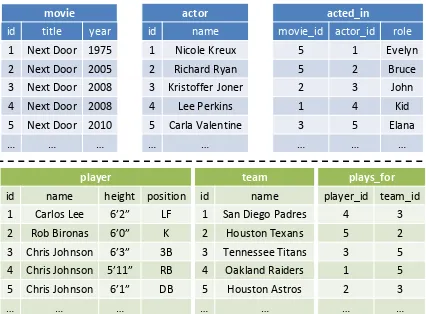
Figure 1: Example movie database (above) and sports database (below) in BCNF.
teletype, and mentions in “quotations.” For a particular databaseDB, we refer to its components asDB.S andDB.R. For a set of databasesD, de-fine the set of referents asSD = (SDB∈DDB.S)∪
{OOD}, whereOOD is a special symbol indicat-ing somethindicat-ing that is “out of database”, or not found in any of the databases inD.
Given a corpus C, a set of mentionsM that oc-cur in C, and a set of databases D, the Open-DB NED task is to produce a functionf : M → SD, which identifies an appropriate target symbol from one of the databases in D, or determines that the mention isOOD. Note that this problem formula-tion assumes no labeled data. This is significantly more challenging than traditional NED settings, but allows the system to generalize easily to any new database. In the domain adaptation section below, we relax this condition somewhat, to allow labeled data for a small number of initial databases; the sys-tem must then transfer what it learns from the la-beled domains to any new database. Also note that the focus for this paper is disambiguation; we as-sume that the set of mentions are correctly demar-cated in the input text. Previous systems, such as Lex (Downey et al., 2007), have investigated the task of finding correct named-entity boundaries in text.
3.2 Assumptions
To allow our systems to handle arbitrary databases, we need to make some assumptions about a standard format for the data. We will assume that databases are provided in a particular form, calledBoyce-Codd
Normal Form (BCNF) (Silberschatz et al., 2010). A relational schema is said to be in BCNF when all redundancy based on functional dependency has been removed, although other types of redundancy may still exist. Formally, a schema R is said to be in BCNF with respect to a set of functional de-pendenciesF if for every one of the dependencies (X →Y)∈ F, either
1. Y ⊂X, meaning this is a trivial functional de-pendency, or
2. Xis asuperkey, meaning thatX is a set of at-tributes that together define a unique ID for the relation.
In practice, this is a relatively safe assumption as database designers often aim for even stricter normal forms. For databases not in BCNF, such as tables extracted from Web pages, standard algorithms ex-ist for converting them into BCNF, given appropri-ate functional dependencies, although there are sets of functional dependencies for which BCNF is not achievable. Figure 1 shows two example databases in BCNF. We use these tables as examples through-out the paper.
We will additionally assume that all attributes, in-cluding names and nicknames, of entities that are covered by the database are treated as functional de-pendencies of the entity. Again, in practice, this is a fairly safe assumption as this is part of good database design, but if a database does not con-form to this, then there will be some entities in the database that our algorithms cannot resolve to. This assumption implies that it is enough to use the set of superkeys for relations as the set of possible refer-ents; our algorithms make use of this fact.
Finally, we will assume the existence of a func-tion µ(s, t) which indicates whether the text t is a valid surface form of database symbols. Our exper-iments in Section 7.3 explore several possible simple definitions for this function.
4 A Distant Supervision Strategy for
Open-DB NED
mentions have only a very small number of possi-ble referents in a given database. “Chris Johnson” is the name of doubtless thousands of people, but for articles that are reasonably well-aligned with our sports database, most of the time the name will refer to just three different people. Most sports names are in fact less ambiguous still. Thus, taking a corpus of unlabeled sports articles, we use the information in the database to provide (uncertain) labels, and then train a log-linear model from this probabilistically-labeled data.
This strategy requires a set of features for the model. Traditionally, such features would be hand-crafted for a particular domain and database. As a first step towards our Open-DB system, we present a log-linear model for disambiguation, as well as a simple feature-generation algorithm that produces a large set of useful features from a BCNF database. We then present a distant-supervision learning pro-cedure for this model.
4.1 Disambiguation Model
LetSDbe the set of possible referents. We construct a vector of feature functionsf(m, s)describing the degree to which m and s ∈ SD appear to match one another. The feature functions are described be-low. The model includes a vector of weightsw, one weight per feature function, and sets the probability of entitysgivenmandwas:
P(s|m,w) = P exp (w·f(m, s))
s0∈S
Dexp (w·f(m, s
0)) (1)
[image:4.612.309.546.56.522.2]4.2 Database-driven Feature Generation
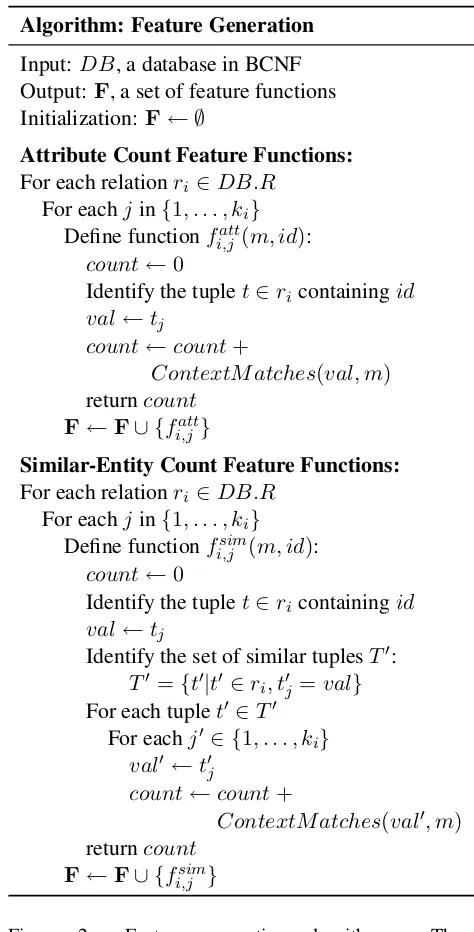
Figure 2 shows our algorithm for automatically gen-erating feature functions fi(m, s) from a BCNF database. As mentioned above, we only need to con-sider resolving to database symbolssthat are keys, or unique IDs, for some tuple in a database. For an entity in the database with key id, the feature generation algorithm generates two types of feature functions: attribute counts and similar entity counts. Each of these features measures the similarity be-tween the information stored in the database about the entityid, and the information in the text ind sur-rounding mentionm.
An attribute count feature function fi,jatt(m, id) for thejth attribute of relation ri counts how many
Algorithm: Feature Generation
Input:DB, a database in BCNF Output:F, a set of feature functions Initialization:F← ∅
Attribute Count Feature Functions: For each relationri∈DB.R
For eachjin{1, . . . , ki} Define functionfi,jatt(m, id):
count←0
Identify the tuplet∈ricontainingid val←tj
count←count+
ContextM atches(val, m) returncount
F←F∪ {fi,jatt}
Similar-Entity Count Feature Functions: For each relationri∈DB.R
For eachjin{1, . . . , ki} Define functionfi,jsim(m, id):
count←0
Identify the tuplet∈ricontainingid val←tj
Identify the set of similar tuplesT0: T0 ={t0|t0 ∈ri, t0j =val} For each tuplet0 ∈T0
For eachj0∈ {1, . . . , ki} val0 ←t0j
count←count+
ContextM atches(val0, m) returncount
F←F∪ {fi,jsim}
Figure 2: Feature generation algorithm. The ContextM atches(s, m) function counts how many times a string that matches database symbols appears in the context ofm. In our implementation, we use all of d(m) as the context. Matching between strings and database symbols is discussed in Sec. 7.3.
to attribute counts for attributes within a single rela-tion, we also use attributes from relations that have been inner-joined on primary key and foreign key pairs. For example, for movies, we include attributes such as director name, genre, and actor name. High values for these attribute count features indicate that the text aroundm closely matches the information in the database about entityid, and thereforeidis a strong candidate for the referent ofm. We use the whole document as the context for finding matches, although other variants are worth future investiga-tion.
A similar entity count feature function fi,jsim(m, id) for the jth attribute in relation ri counts how many entities similar to id are men-tioned in the neighborhood of m. As an example, consider a mention of “Chris Johnson”, id = 3, and the similar entity feature for the position
attribute of the players relation in the sports database. The feature function would first identify that3Bis the position of the player withid = 3. It would then identify all players that had the same position. Finally, it would count how often any attributes of this set of players appear near “Chris Johnson”. Likewise, the similar entity feature for
the team id attribute would count how many
teammates of the player with id = 3 appear near “Chris Johnson”. A high count for this teammate feature is a strong clue thatidis the correct referent for m, while a high count for players of the same position is a weak but still valuable clue.
4.3 Parameter Estimation via Distant Supervision
Using string similarity, we can heuristically deter-mine that three IDs with name attribute Chris Johnsonare highly likely to be the correct target for a mention of “Chris Johnson”. Our distant su-pervision parameter estimation strategy is to move as much probability mass as possible onto the set of realistic referents obtained via string similarity. Since our features rely on finding attributes and sim-ilar entities, the side effect of this strategy is that most of the probability mass for a particular mention is moved onto the one target ID with high attribute count and similar entity count features, thus disam-biguating the entity. Although the string-similarity heuristic is typically noisy, the strong information in
the database and the fact that many entity mentions are typically not ambiguous allows the technique to learn effectively from unlabeled text.
Let φ(m, DB) be a heuristic string-matching function that returns a set of plausible ID values in databaseDBfor mentionm. The objective function for this training procedure is a modified marginal log likelihood (MLL) function that encourages probabil-ity mass to be placed on the heuristically-matched targets:
M LL(M,w) = X m∈M
log X
id∈φ(m,DB)
P(id|m,w)
This objective is smooth but non-convex. We use a gradient-based optimization procedure that finds a local maximum. Our implementation uses an open-source version of the LBFG-S optimization tech-nique (Liu and Nocedal, 1989). The gradient of our objective is given by
∂LL(M,w) ∂wi
= X
m∈M
Eid∈φ(m,DB)[fi(m, id)]
−Eid∈DB.S[fi(m, id)]
where the expectations are taken according to P(id|m,w).
5 A Domain-Adaptation Strategy for
Open-DB NED
Our domain-adaptation strategy builds an Open-DB NED system by training it on labeled examples from an initial database or small set of initial databases. Unlike traditional NED, however, the purpose in Open-DB NED is to resolve to any database. Thus the strategy must take care to build a model that can transfer what it has learned to a new database, without requiring additional labeled data for the new database.
useful in the movie domain, but worthless in the sports domain.
Our solution works by re-defining the problem in such a way that we can define domain-independent and database-independent features. For example, rather than counting how often the director of a movie appears in the context around a movie mention, we create a domain-independent Count Att(m, s) feature function that counts how oftenany attribute of s appears in the context of m. For movies, Count Att will add together counts for ap-pearances of a movie’s production year and IMDB rating, among other attributes. In the sports domain, Count Att will add together counts for appearances of a player’s height, position, salary,etc.. But in ei-ther domain, the feature is well-defined, and in eiei-ther domain, larger values of the feature indicate a better match between m ands. Thus there is a hope for training a model with domain-independent features like Count Att on labeled data from one domain, say movies, and producing a model that has high accu-racy on the sports domain.
We first formalize the notion of a domain adap-tation NED model, and then describe our algorithm for producing such a model. We say that adomain consists of a database DB as well as a distribution
D(M), whereMis the space of mentions. For in-stance, the movie domain might consist of the Inter-net Movie Database (IMDB) and a distribution that places most probability mass on documents about movies and Hollywood stars. In domain adapta-tion, a system observes a set of training examples (m, s, g(m, s)), where instancesm∈ Mare drawn from a source domain’s distribution DS and refer-entssare drawn from the source domain’s database DBS. The labels g(m, s) are boolean values in-dicating a correct or incorrect match between the mention and referent. The system must then learn a hypothesis for classifying examples(m, s) drawn from atargetdomain’s distributionDT and database DBT. Note that for domain adaptation, we can-not use the more traditional problem formulation in which the referentsis a label (i.e.,s=g(m)) for the mention, since the set of possible referents changes from domain to domain, and therefore the output of gwould be completely different from one domain to the next.
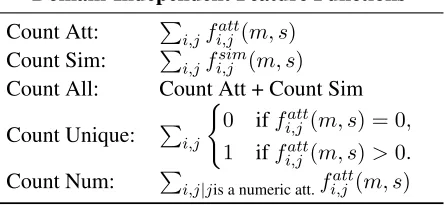
Table 1 lists the domain-independent features
Domain-Independent Feature Functions
Count Att: P
i,jfi,jatt(m, s) Count Sim: P
i,jfi,jsim(m, s) Count All: Count Att + Count Sim
Count Unique: P
i,j
(
0 iffi,jatt(m, s) = 0,
1 iffi,jatt(m, s)>0. Count Num: P
[image:6.612.316.538.71.174.2]i,j|jis a numeric att.fi,jatt(m, s)
Table 1: Primary feature functions for a domain adapta-tion approach to NED. These features made the biggest difference in our experiments, but we also tested varia-tions such as counting unique numeric attribute appear-ances, counting unique similar entities, counting relation name appearances, counting extended attributed appear-ances, and others.
used in our domain adaptation model. These fea-tures use the attribute counts and similar entity counts from the distant supervision model as subrou-tines. By aggregating over those domain-dependent feature functions, the domain adaptation system ar-rives at feature functions that can be defined forany database, rather than for a specific database.
Note that there is a tradeoff between the do-main adaptation technique and the distant super-vision technique. The domain adaptation model has access to labeled data, unlike the distant su-pervision model. In addition, the domain adapta-tion model requires no text whatsoever from the tar-get domain, not even an unlabeled corpus, to set weights for the target domain. Once trained, it is ready for NED over any database that meets our as-sumptions, out of the box. However, because the model needs to be able to transfer to arbitrary new domains, the domain adaptation model is restricted to domain-independent features, which are “coarser-grained.” That is, the distant supervision model has the ability to place more weight on attributes like director rather than genre, or team rather than po-sition, if those attributes are more discriminative. The domain adaptation model cannot place differ-ent weights on the differdiffer-ent attributes, since those weights would not transfer across databases.
do-main: conditional log likelihood (CLL) as the objec-tive function, and LBFG-S for convex optimization.
CLL(L,w) = X
(m,id,label)∈L
logP(label|m, id,w)
The training algorithm is guaranteed to converge to the globally optimal parameter setting for this objec-tive function over the training data. The manually annotated data contains only positive examples; to generate negative examples, we use the same name-matching heuristicφ(m, DB)to identify a set of po-tentially confusing bad matches. On test data, we use the trained model to choose theidfor a givenm with the highest probability of being correct.
6 A Hybrid Model
The distant supervision and domain adaptation strategies use two very different sources of evidence for training a disambiguation classifier: the string-matching heuristic and unlabeled text from the target domain for the the distant supervision model, and aggregate features over labeled text from a separate domain for domain adaptation. This begs the ques-tion, do these sources of evidence complement one another? To address this question, we design a Hy-brid model with features and training strategies from both distant supervision and domain adaptation.
The training data consists of a setLS of labeled mentions from a source domain, a source database DBS, a set of unlabeled mentionsMT from the tar-get domain, and the tartar-get-domain database DBT. The full feature set of the Hybrid model is the union of the distant supervision feature functions for the target domain and the domain-independent domain adaptation feature functions. Note that the distant supervision feature functions are domain-specific, so they almost always will be uniformly zero onLS, but the domain adaptation feature functions will be activated on bothLS andMT. The combined train-ing objective for the Hybrid model is:
LL(LS, MT,w) =CLL(LS,w) +M LL(MT,w)
7 Experiments
Our experiments compare our strategies for Open-DB NED against one another, as well as against a Wikipedia NED system from previous work, on two domains: sports and movies.
7.1 Data
For the movie domain, we collected a set of 156 cult movie titles from an online movie site (www.olivefilms.com). For each movie title, we ex-ecuted a Web search using a commercial search en-gine, and collected the top five documents for each title from the search engine’s results. Nearly all top-five results included at least one mention of an en-tity not found in Wikipedia; overall, only 16% of the mentions could be linked to Wikipedia. After strip-ping javascript and html annotations, we removed documents with fewer than 50 words, leaving a to-tal of 770 documents. We select one occurrence of any of the 156 movie titles from each document as our set of mentions. Many titles are ambiguous not just among different movies with the same name, but also among novels, plays, geographical entities, and assorted other types of entities. To provide labels for these mentions, we use both a movie database and Wikipedia. We downloaded the complete data dump from the online Internet Movie Database (IMDB, www.imdb.com). For our set of possible referents, we use the set of all key values in IMDB, and the set of all Wikipedia articles. Annotators manually la-beled each mention using this set of referents. Table 2 shows summary statistics about this labeled data.
For the sports domain, we downloaded all player data from Yahoo!, Inc.’s sports database for the years 2011-2012 and two American sports leagues, the National Football League (NFL) and Major League Baseball (MLB). From the database, we ex-tracted ambiguous player names and team names, including names like “Philadelphia” which may re-fer toPhiladelphia Eaglesin the NFL data,
Philadelphia Philliesin the MLB data, or
domain |M| E|φ(m, DB)| OOD Wiki
movies 770 2.6 13% 16%
sports 549 4.5 0% 100%
Table 2: Number of mentions, average number of refer-ents per mention, % of mentions that areOOD, and % of mentions that are in Wikipedia in our movie and sports data.
unambiguous completions appears in the same arti-cle (that is, if either of the team names “Philadelphia Eagles” or “Philadelphia Phillies” appears in the same article, we exclude the “Philadelphia” men-tion). As before, the set of possible referents in-cludes the symbolOOD, key values from the sports database, and Wikipedia articles, and a given men-tion may be labeled with both a sports entity and a Wikipedia article, if appropriate. All of our data is available from the last author’s website.
7.2 Evaluation Metric
We report on a version of exact-match accuracy. The system chooses the most likely labelsˆfor each m. This is judged correct ifsˆmatches the correct label sexactly, or (in cases where both a Wikipedia and a database entity are considered correct) if one of the labels matchesˆsexactly. This metric allows systems to resolve against either reference, Wikipedia or an-other database, without requiring it to match both if the same entity appears in both references.
7.3 Exact or Partial Matching?
One important question in the design of our systems is how to determine the “match” between database symbols and text. This question comes into play in two components of our systems: it affects the com-putation of feature functions that count how often a match of some attribute is found in text, and it af-fects which set of heuristically-determined database entities are considered to be possible matches for a given mention.
We experiment with two different matching strategies between a symbol s and text t, exact matching and partial matching. Exact matching µexact(s, t)requires the sequence of characters ins to appear exactly (modulo character encoding) int. For instance, the database valueChris Johnson
System Accuracy
No-Wikipedia Domain Adapt. 0.61 DocSim-Wikipedia Domain Adapt. 0.69
Table 3: Including a simple document-similarity feature for comparing a mention’s context with a Wikipedia page provides an 8% improvement over ignoring Wikipedia in-formation.
would match “Chris Johnson”, but not “C. John-son” or “JohnJohn-son” in text. For partial matching, we used different tests for numeric and textual en-tities. For numeric entities,µpartial matchedsand t if the numeric value of one was within 10% of the other, so that5312 would match “5,000.” We made no attempt to convert numeric phrases, such as “3.6 million”, into numeric values. For textual entities, µpartial matched s and t if at least one token from each matched exactly. Thus Chris Johnsonmatches both “Chris” and “C. Johnson”.
We foundµpartialto be consistently superior for computingφ(m, DB), since it has much better re-call for mentions like “Philadelphia”. On the other hand, if we useµpartialfor computing our models’ feature functions, like the Count Att(m, s) in the do-main adaptation model, counts varied widely across domains. A simple version of the domain adapta-tion classifier (only the Count All and Count Unique features) trained on sports data and tested on movies achieved an accuracy of 24% using µpartial, com-pared with 61% using µexact. For all remaining tests, we used µexact for computing features, and µpartialfor computingφ(m, DB).
7.4 Incorporating Wikipedia referents
Thus far, all of our features work on relational data, not Wikipedia. In order to allow our systems to link to Wikipedia, we create a single “document simi-larity” feature describing the similarity between the text around a mention and the text appearing on a Wikipedia page. We build a vector space model of both the document containing the mention and the Wikipedia page, remove stopwords, and use cosine similarity to compute this feature.
0.13
0.4 0.43 0.54
0.65 0.71 0.72 0.73
0 0.21
0.33 1
0.54
0.63 0.62 0.66
0 0.1 0.2 0.3 0.4 0.5 0.6 0.7 0.8 0.9 1
Ac
cur
ac
y
Open-DB NED Test
[image:9.612.74.299.58.209.2]Movies Sports
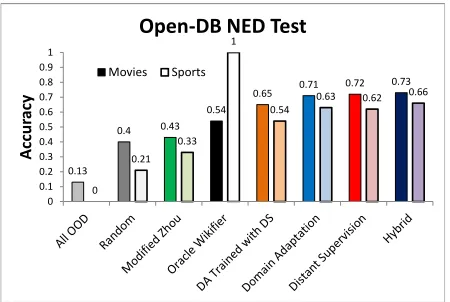
Figure 3: All three Open-DB NED strategies out-perform a state-of-the-art Wikipedia NED system by 25% or more on sports and movies, and outperform a Wikipedia NED system with oracle information by 14% or more on the movie data. Differences between the Modified Zhou Wikifier and the Open-DB strategies are statistically significant (p <0.01, Fisher’s exact test) on both domains.
on the movies domain. The first version involves no Wikipedia information whatsoever, thus it has no reason to select a Wikipedia article overOOD. The second system includes the document similarity fea-ture. Table 3 shows the results of these systems. En-couragingly, our single document similarity feature produces a significant improvement over the model without Wikipedia information, so we use this fea-ture in all of our systems tested below. More so-phisticated use of Wikipedia is certainly possible, and an important question for future work is how to combine Open-DB NED more seamlessly with Wikipedia NED.
7.5 Comparing Open-DB NED Strategies
For each domain, we compare our domain-adaptation strategy, distant supervision, and hy-brid strategies. The domain-adaptation model is trained on the labeled data for sports when testing on movies, andvice versa. We use a movies test set of 180 mentions that is separate from the develop-ment data used for the above tests. For the distant supervision strategy, we use the entire collection of texts from each domain as input (1300 articles for sports, 770 articles for movies), with the labels re-moved during training.
We compare against a state-of-the-art Wikipedia
NED system used in production by a major Web company. This system is a modified version of the system described by Zhou et al. (2010), where cer-tain features have been removed for efficiency. We refer to this as the Modified-Zhou Wikifier. This system uses a gradient-boosted decision tree and multiple local and global features for computing the similarity between a mention’s context and a Wikipedia article. We also test a hypothetical sys-tem, Oracle Wikifier, which is given no information about entities in IMDB, but is assumed to be able to correctly resolve any mention that refers to an entity found in Wikipedia. Thus, this system has perfect accuracy on mentions that can be found in Wikipedia, and accuracy similar to a baseline that predicts randomly on all mentions that fall outside of Wikipedia1. Oracle-Wikifier serves as an upper bound on systems that have no access to a domain-specific database. In addition, we compare against two standard baselines: a classifier that always pre-dictsOOD, and a classifier that chooses randomly. Finally, we compare against a system that trains the domain adaptation model using distant supervision (“DA Trained with DS”).
Figure 3 shows our results. All three Open-DB approaches outperform the baseline techniques on this test by wide margins, with the Hybrid model in-creasing by 30% or more over the random baseline. On the movie domain, the Hybrid model outper-forms the Oracle Wikifier by nearly 20%. Encour-agingly, the Hybrid model consistently outperforms both distant supervision and domain adaptation, sug-gesting that the two sources of evidence are partially complementary. Distant supervision performs better on the movies test, whereas domain adaptation has the advantage on sports. The differences among all three Open-DB approaches is relatively small, com-pared with the difference between these approaches and Oracle Wikifier on the movie data.
The domain adaptation system outperforms DA Trained with DS on both domains, suggesting that labeled data from a separate domain is bet-ter evidence for paramebet-ter estimates than unlabeled data from the same domain. The distant super-vision system also outperforms DA Trained with
1
Alternatively, one could make the oracle system predict
DS on both domains, suggesting that the fine-grained, domain-specific features do in fact provide more helpful information than the coarser-grained, domain-independent features of the domain adapta-tion model.
All of the Open-DB NED systems outperform the Modified Zhou Wikifier on both data sets by a wide margin. In fact the Modified Zhou Wikifier has sim-ilar results on both domains, despite the fact that Wikipedia has far greater coverage on sports than movies. In part, the poor performance of the Modi-fied Zhou Wikifier reflects the difficult nature of the task. In previous experiments on an MSNBC news test set it reached 85% accuracy, but a random clas-sifier there achieved 60% accuracy compared with 21% on our sports data. Another difficulty with the Modified Zhou Wikifier is its strong preference for globally common entities. It consistently clas-sifies mentions that are ambiguous between a city and a team (like “Chicago” in “Chicago sweeps the Red Sox”) as cities when they should be resolved to teams, in large part becauseChicagois a more common referent in general text than either of the baseball teams that play in that city. In sports arti-cles, however, both meanings are common, and only the surrounding context can help determine the cor-rect referent.
Besides wikifiers, NED systems may also be compared with dictionary-based word sense disam-biguation techniques like the Lesk algorithm2(Lesk, 1986). The Lesk algorithm is “open” in the sense that it works for arbitrary dictionaries, and it defines a vector space model of the dictionary definitions that may be likened to the attribute-value model in our representation of entities in the database. Our approach, however, estimates parameters for a sta-tistical model from data, whereas the Lesk algorithm uses an equal weight for all attributes. To make an empirical comparison, we created a variant of the Lesk algorithm for relational data: we took the dis-ambiguation model from Eqn. 1, supplied all of the features from the distant supervision model, and manually setw= 1. This “relational Lesk” model achieves an accuracy of 0.11 on movies, and 0.15 on sports, significantly below the random baseline. Giving equal weight to noisy attributes likegenre
2
We thank the reviewers for making this connection.
and more discriminative attributes likedirector
significantly hurts the performance.
For both the movie and sports domain, approx-imately 80% of the Hybrid model’s errors are be-cause of predicting database symbols, when the cor-rect referent is a Wikipedia page or OOD. This nearly always occurs because some words in the context of a mention match an attribute of an in-correct database referent. For instance, thecrime
genre is an attribute for several movies, but it also matches in contexts surrounding book titles and nu-merous other entities. In the movie domain, most of the remaining errors are incorrectOODpredictions for mentions that should resolve to the database, but the article contains no attributes or similar entities to the database entity. In the sports domain, many of the remaining errors were due to predicting in-correct player referents. Quite often, this was be-cause the document discusses a fantasy sports league or team, where players from different professional sports teams are mixed together on a “fantasy team” belonging to a fan of the sport. Since players in the fantasy leagues have different teammates than they do in the database, these articles consistently con-fuse our methods.
8 Conclusion and Future Work
This paper introduces the task of Open-DB Named Entity Disambiguation, and presents two distinct strategies for solving this task. Experiments indicate that a mixture of the two strategies significantly out-performs a state-of-the-art Wikipedia NED system, on a dataset where Wikipedia has good coverage and on another dataset where Wikipedia has poor cover-age. The results indicate that there is a significant benefit to leveraging other sources of knowledge in addition to Wikipedia, and that it is possible to lever-age this knowledge without requiring labeled data for each new source. The initial success of these Open-DB NED approaches indicates that this task is a promising area for future research, including ex-citing extensions that link large numbers of domain-specific databases to text.
Acknowledgments
References
Kedar Bellare and Andrew McCallum. 2007. Learn-ing extractors from unlabeled text usLearn-ing relevant data-bases. InSixth International Workshop on Information Integration on the Web.
Kedar Bellare and Andrew McCallum. 2009. General-ized Expectation Criteria for Bootstrapping Extractors using Record-Text Alignment. InEmpirical Methods in Natural Language Processing (EMNLP-09). Shai Ben-David, John Blitzer, Koby Crammer, Alex
Kulesza, Fernando Pereira, and Jennifer Wortman Vaughan. 2010. A theory of learning from different domains. Machine Learning, 79:151–175.
John Blitzer, Ryan McDonald, and Fernando Pereira. 2006. Domain adaptation with structural correspon-dence learning. InEMNLP.
Razvan Bunescu and Raymond Mooney. 2007. Learning to extract relations from the web using minimal super-vision. InProceedings of the 45th Annual Meeting of the Association for Computational Linguistics (ACL-07).
R. Bunescu and M. Pasca. 2006. Using encyclope-dic knowledge for named entity disambiguation. In Proceedings of the 11th Conference of the European Chapter of the Association for Computational Linguis-tics (EACL-06).
Ying Chen and James Martin. 2007. Towards Ro-bust Unsupervised Personal Name Disambiguation. In EMNLP, pages 190–198.
Silviu Cucerzan. 2007. Large-scale named entity dis-ambiguation based on wikipedia data. InProceedings of the 2007 Joint Conference on Empirical Methods in Natural Language Processing and Computational Natural Language Learning (EMNLP-CoNLL), pages 708–716.
Nilesh N. Dalvi, Ravi Kumar, Bo Pang, and Andrew Tomkins. 2009. Matching Reviews to Objects using a Language Model. InEMNLP, pages 609–618. Nilesh N. Dalvi, Ravi Kumar, and Bo Pang. 2012. Object
matching in tweets with spatial models. In WSDM, pages 43–52.
Hal Daum´e III, Abhishek Kumar, and Avishek Saha. 2010. Frustratingly easy semi-supervised domain adaptation. In Proceedings of the ACL Workshop on Domain Adaptation (DANLP).
D. Downey, M. Broadhead, and O. Etzioni. 2007. Lo-cating complex named entities in web text. InProcs. of the 20th International Joint Conference on Artificial Intelligence (IJCAI 2007).
Anthony Fader, Stephen Soderland, and Oren Etzioni. 2009. Scaling wikipedia-based named entity disam-biguation to arbitrary web text. In Proceedings of the WikiAI 09 - IJCAI Workshop: User Contributed
Knowledge and Artificial Intelligence: An Evolving Synergy.
Xianpei Han and Jun Zhao. 2009. Named entity dis-ambiguation by leveraging Wikipedia semantic knowl-edge. In Proceeding of the 18th ACM Conference on Information and Knowledge Management (CIKM), pages 215–224.
Johannes Hoffart, Mohamed Amir Yosef, Ilaria Bordino, Hagen Furstenau, Manfred Pinkal, Marc Spaniol, Bilyana Taneva, Stefan Thater, and Gerhard Weikum1. 2011. Robust Disambiguation of Named Entities in Text. InEMNLP, pages 782–792.
Raphael Hoffmann, Congle Zhang, Xiao Ling, Luke Zettlemoyer, and Daniel S. Weld. 2011. Knowledge-Based Weak Supervision for Information Extraction of Overlapping Relations. InProceedings of the Annual Meeting of the Association for Computational Linguis-tics (ACL).
Fei Huang and Alexander Yates. 2009. Distributional representations for handling sparsity in supervised se-quence labeling. InProceedings of the Annual Meet-ing of the Association for Computational LMeet-inguistics (ACL).
Sayali Kulkarni, Amit Singh, Ganesh Ramakrishnan, and Soumen Chakrabarti. 2009. Collective annotation of wikipedia entities in web text. In Proceedings of the 15th ACM SIGKDD International Conference on Knowledge Discovery and Data Mining (KDD), pages 457–466.
Tom Kwiatkowski, Luke Zettlemoyer, Sharon Goldwater, and Mark Steedman. 2011. Lexical Generalization in CCG Grammar Induction for Semantic Parsing. In Proceedings of the Conference on Empirical Methods in Natural Language Processing (EMNLP).
M.E. Lesk. 1986. Automatic sense disambiguation us-ing machine readable dictionaries: How to tell a pine cone from an ice cream cone. InProceedings of the SIGDOC Conference.
Thomas Lin, Mausam, and Oren Etzioni. 2012. Entity linking at web scale. InKnowledge Extraction Work-shop (AKBC-WEKEX), 2012.
D.C. Liu and J. Nocedal. 1989. On the limited mem-ory method for large scale optimization. Mathemati-cal Programming B, 45(3):503–528.
G.S. Mann and D. Yarowsky. 2003. Unsupervised per-sonal name disambiguation. InCoNLL.
Paul McNamee, Mark Dredze, Adam Gerber, Nikesh Garera, Tim Finin, James Mayfield, Christine Pi-atko, Delip Rao, David Yarowsky, and Markus Dreyer. 2009. HLTCOE Approaches to Knowledge Base Pop-ulation at TAC 2009. InText Analysis Conference. Rada Mihalcea and Andras Csomai. 2007. Wikify!:
Proceedings of the Sixteenth ACM Conference on Information and Knowledge Management (CIKM), pages 233–242.
Mike Mintz, Steven Bills, Rion Snow, and Daniel Juraf-sky. 2009. Distant supervision for relation extrac-tion without labeled data. InProceedings of the 47th Annual Meeting of the Association for Computational Linguistics (ACL-2009), pages 1003–1011.
Patrick Pantel and Ariel Fuxman. 2011. Jigs and Lures: Associating Web Queries with Structured Entities. In ACL.
L. Ratinov, D. Roth, D. Downey, and M. Anderson. 2011. Local and global algorithms for disambiguation to wikipedia. InProc. of the Annual Meeting of the Association of Computational Linguistics (ACL). Sebastian Riedel, Limin Yao, and Andrew McCallum.
2010. Modeling relations and their mentions without labeled text. In Proceedings of the Sixteenth Euro-pean Conference on Machine Learning (ECML-2010), pages 148–163.
Avi Silberschatz, Henry F. Korth, and S. Sudarshan. 2010. Database System Concepts. McGraw-Hill, sixth edition.
Daniel S. Weld, Raphael Hoffmann, and Fei Wu. 2009. Using Wikipedia to Bootstrap Open Information Ex-traction. InACM SIGMOD Record.
Limin Yao, Sebastian Riedel, and Andrew McCallum. 2010. Collective cross-document relation extraction without labelled data. InProceedings of the 2010 Con-ference on Empirical Methods in Natural Language Processing (EMNLP-2010), pages 1013–1023. Yiping Zhou, Lan Nie, Omid Rouhani-Kalleh, Flavian