Proceedings of the 7th Workshop on Balto-Slavic Natural Language Processing, pages 63–74, 63
The Second Cross-Lingual Challenge on Recognition, Normalization,
Classification, and Linking of Named Entities across Slavic Languages
Jakub Piskorski,1Laska Laskova,5Michał Marci ´nczuk,4
Lidia Pivovarova,2 Pavel Pˇribá ˇn,3Josef Steinberger,3Roman Yangarber2 1Joint Research Centre, Ispra, Italy [email protected]
2University of Helsinki, Finland [email protected] 3University of West Bohemia, Czech Republic
{pribanp, jstein}@kiv.zcu.cz 4Wrocław University of Science and Technology, Poland
[email protected] 5Bulgarian Academy of Sciences, Bulgaria
Abstract
We describe the Second Multilingual Named Entity Challenge in Slavic languages. The task is recognizing mentions of named entities in Web documents, their normalization, and cross-lingual linking. The Challenge was or-ganized as part of the 7th Balto-Slavic Natural Language Processing Workshop, co-located with the ACL-2019 conference. Eight teams participated in the competition, which covered four languages and five entity types. Perfor-mance for the named entity recognition task reached 90% F-measure, much higher than re-ported in the first edition of the Challenge. Seven teams covered all four languages, and five teams participated in the cross-lingual en-tity linking task. Detailed evaluation informa-tion is available on the shared task web page.
1 Introduction
Due to rich inflection and derivation, free word or-der, and other morphological and syntactic phe-nomena exhibited by Slavic languages, analysis of named entities (NEs) in these languages poses a challenging problem (Przepiórkowski, 2007; Piskorski et al.,2009). Fostering research on de-tection and normalization of NEs—and on the closely related problem of lingual, cross-documententity linking—is of paramount impor-tance for improving multilingual and cross-lingual information access in these languages.
This paper describes the Second Shared Task on multilingual NE recognition (NER), which aims at addressing these problems in a systematic way. The shared task was organized in the context of the 7th Balto-Slavic Natural Language Processing Workshop co-located with the ACL 2019 confer-ence. The task covers four languages—Bulgarian, Czech, Polish and Russian—and five types of NE: person, location, organization, product, and event. The input text collection consists of
doc-uments collected from the Web, each collection centered on a certain “focal” entity. The ratio-nale of such a setup is to foster the development of “all-round” NER and cross-lingual entity link-ing solutions, which are not tailored to specific, narrow domains. This paper also serves as an in-troduction and a guide for researchers wishing to explore these problems using the training and test data.1
This paper is organized as follows. Section 3 describes the task; Section4 describes the anno-tation of the dataset. The evaluation methodology is introduced in Section5. Participant systems are described in Section6and the results obtained by these systems are presented in Section 7. Con-clusions and lessons learned are discussed in Sec-tion8.
2 Prior Work
The work we describe here builds on the First Shared Task on Multilingual Named Entity Recog-nition, Normalization and cross-lingual Matching for Slavic Languages, (Piskorski et al., 2017), which, to the best of our knowledge, was the first attempt at such a shared task covering several Slavic languages.
Similar shared tasks have been organized pre-viously. The firstnon-English monolingual NER evaluations—covering Chinese, Japanese, Span-ish, and Arabic—were carried out in the con-text of the Message Understanding Conferences (MUCs) (Chinchor, 1998) and the ACE Pro-gramme (Doddington et al., 2004). The first shared task focusing onmultilingualnamed entity recognition, which covered several European lan-guages, including Spanish, German, and Dutch, was organized in the context of CoNLL confer-ences (Tjong Kim Sang, 2002;Tjong Kim Sang
and De Meulder, 2003). The NE types covered in these campaigns were similar to the NE types covered in our Challenge. Also related to our task is Entity Discovery and Linking (EDL), (Ji et al., 2014, 2015), a track of the NIST Text Analysis Conferences (TAC). EDL aimed to extract entity mentions from a collection of documents in mul-tiple languages (English, Chinese, and Spanish), and to partition the entities into cross-document equivalence classes, by either linking mentions to a knowledge base or directly clustering them. An important difference between EDL and our task is that we do not link entities to a knowledge base.
Related to cross-lingual NE recognition is NE transliteration, i.e., linking NEs across languages that use different scripts. A series of NE Translit-eration Shared Tasks were organized as a part of NEWS—Named Entity Workshops—(Duan et al., 2016), focusing mostly on Indian and Asian lan-guages. In 2010, the NEWS Workshop included a shared task on Transliteration Mining (Kumaran et al., 2010), i.e., mining of names from parallel corpora. This task included corpora in English, Chinese, Tamil, Russian, and Arabic.
Prior work targeting NEs specifically for Slavic languages includes tools for NE recognition for Croatian (Karan et al.,2013;Ljubeši´c et al.,2013), a tool tailored for NE recognition in Croatian tweets (Baksa et al.,2017), a manually annotated NE corpus for Croatian (Agi´c and Ljubeši´c,2014), tools for NE recognition in Slovene (Štajner et al., 2013; Ljubeši´c et al., 2013), a Czech corpus of 11,000 manually annotated NEs (Ševˇcíková et al., 2007), NER tools for Czech (Konkol and Konopík, 2013), tools and resources for fine-grained an-notation of NEs in the National Corpus of Pol-ish (Waszczuk et al.,2010;Savary and Piskorski, 2011) and a recent shared task on NE Recognition in Russian (Alexeeva et al.,2016).
3 Task Description
The data for the shared task consists of sets of doc-uments in four Slavic languages: Czech, Polish, Russian, and Bulgarian. To accommodate entity linking, each set of documents is chosen to focus around one certain entity—e.g., a person, an or-ganization or an event. The documents were ob-tained from the Web, by posing a keyword query to a search engine and extracting the textual con-tent from the Web pages.
The task is to recognize, classify, and
“normal-ize” all named-entity mentions in each of the doc-uments, and to link across languages all named mentions referring to the same real-world entity. Formally, the Multilingual Named Entity Recog-nition task includes three sub-tasks:
• Named Entity Mention Detection and Clas-sification: Recognizing all named mentions of entities of five types: persons (PER), organiza-tions (ORG), locations (LOC), products (PRO), and events (EVT).
• Name Normalization: Mapping each named mention of an entity to its corresponding base form. By “base form” we generally mean the lemma (“dictionary form”) of the inflected word-form. In some cases normalization should go beyond inflection and transform a derived word into a base word’s lemma, e.g., in case of personal possessives (see below). Multi-word names should be normalized to the canonical multi-word expression—rather than a sequence of lemmas of the words making up the multi-word expression.
• Entity Linking. Assigning a unique identifier (ID) to each detected named mention of an en-tity, in such a way that mentions referring to the same real-world entity should be assigned the same ID—referred to as the cross-lingual ID.
The task does not require positional information of the name entity mentions. Thus, for all occur-rences of the same form of a NE mention (e.g., an inflected variant, an acronym or abbreviation) within a given document, no more than one anno-tation should be produced.2 Furthermore,
distin-guishing typographical case is not necessary since the evaluation is case-insensitive. If the text in-cludes lowercase, uppercase or mixed-case vari-ants of the same entity, the system should produce only one annotation for all of these mentions. For instance, for “BREXIT” and “Brexit” (provided that they refer to the same NE type), only one an-notation should be produced. Note that recogni-tion of common-noun or pronominal references to named entities is not part of the task.
3.1 Named Entity Classes
The task defines the following five NE classes.
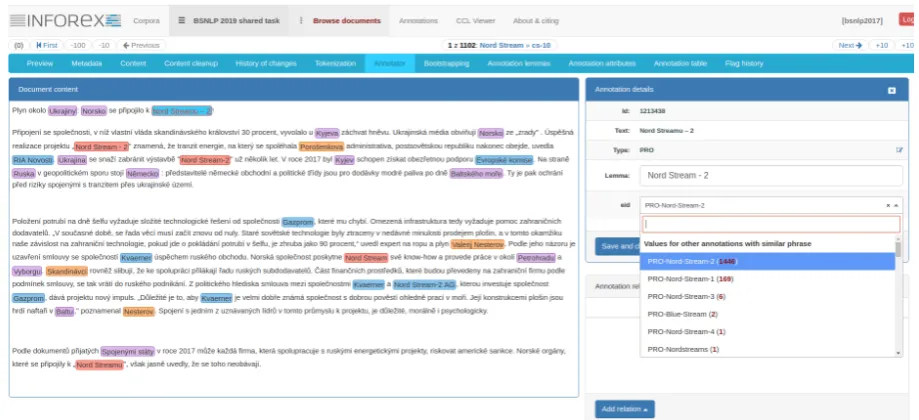
Figure 1: Screenshot of the Inforex Web interface, the tool used for data annotation
Person names (PER): Names of real (or fictional) persons). Person names should not include titles, honorifics, and functions/positions. For exam-ple, in the text fragment “. . . CEO Dr. Jan Kowal-ski. . .”, only “Jan Kowalski” is recognized as a person name. Initials and pseudonyms are con-sidered named mentions of persons and should be recognized. Similarly, named references to groups of people (that do not have a formal or-ganization unifying them) should also be rec-ognized, e.g., “Ukrainians.” In this context, mentions of a single member belonging to such groups, e.g., “Ukrainian,” should be assigned the same cross-lingual ID as plural mentions, i.e., “Ukrainians” and “Ukrainian” when referring to the nation receive the same cross-lingual ID.
Personal possessives derived from a person’s name should be classified as a Person, and the base form of the corresponding name should be extracted. For instance, in “Trumpov tweet” (Croatian) one is expected to classify “Trumpov” as PER, with the base form “Trump.”
Locations (LOC): All toponyms and geopolitical entities—cities, counties, provinces, countries, regions, bodies of water, land formations, etc.— including named mentions offacilities—e.g., sta-diums, parks, museums, theaters, hotels, hos-pitals, transportation hubs, churches, railroads, bridges, and similar facilities.
In case named mentions of facilitiesalsorefer to an organization, the LOCtag should be used. For example, from the text “The Schipol Airport has
acquired new electronic gates” the mention “The Schipol Airport” should be classified as LOC.
Organizations (ORG): All organizations, includ-ing companies, public institutions, political par-ties, international organizations, religious organi-zations, sport organiorgani-zations, educational and re-search institutions, etc.
Organization designators and potential mentions of the seat of the organization are considered to be part of the organization name. For instance, from the text “...Citi Handlowy w Poznaniu...” (a bank in Pozna´n), the full phrase “Citi Handlowy w Poznaniu” should be extracted.
Products (PRO): All names ofproducts and ser-vices, such as electronics (“Motorola Moto Z Play”), cars (“Subaru Forester XT”), newspapers (“The New York Times”), web-services (“ Twit-ter”).
When a company name is used to refer to a ser-vice(e.g., “na Twiterze” (Polish for “on Twitter”), the mention of “Twitter” is considered to refer to a service/product and should be tagged as PRO. However, when a company name refers to a ser-vice, expressing an opinion of the company, e.g., “Fox News”, it should be tagged as ORG.
This category also includes legal documents and treaties, e.g., “Traktat Lizbo´nski” (Polish: “Treaty of Lisbon”).
Japonci se ptají na czexit, ˇríká Špicar ze Svazu pr˚umyslu. “Odešli bychom z
ˇ
Ceska,” varovali ho Pˇrípadné vystoupení ˇ
Ceské republiky z Evropské unie by bylo podle ekonom˚u, Hospodáˇrské komory i Svazu pr˚umyslu a dopravy ekonomickou se-bevraždou. Odchod z EU by znamenal ztrátu stovek tisíc pracovních míst a ˇceská ekonomika by se podle nˇekterých dostala na úroveˇn Bˇeloruska. Praha 21:18 7. února 2018
cs-10
Japonci Japonci PER GPE-Japan
czexit czexit EVT EVT-Czexit
Špicar Špicar PER PER-Radek-Spicar
Svazu pr˚umyslu Svaz pr˚umyslu ORG ORG-Svaz-Prumyslu ˇ
Ceska Ceskoˇ LOC GPE-Czech-Republic
ˇ
Ceské republiky Ceská republikaˇ LOC GPE-Czech-Republic Evropské unie Evropská unie ORG ORG-European-Union Hospodáˇrské komory Hospodáˇrská komora ORG ORG-Hospodarska-Komora Svazu pr˚umyslu a dopravy Svaz pr˚umyslu a dopravy ORG ORG-Svaz-Prumyslu
EU EU ORG ORG-European-Union
Bˇeloruska Bˇelorusko LOC GPE-Belarus
Praha Praha LOC GPE-Prague
Figure 2: Example input and output formats.
Konference Žárovného Zinkování” (Czech: “Hot Galvanizing Conference”), concerts, festivals, holidays, e.g., “Vánoce” (Polish: “Christmas”), wars, battles, disasters, e.g., “Katastrofa Cz-ernobylska” (Polish: “the Chernobyl catastro-phe”). Future, speculative, and fictive events— e.g., “Czexit” or “Polexit”—are considered as event mentions as well.
3.2 Complex and Ambiguous Entities
In case of complex named entities, consisting of nested named entities, only the top-most entity should be recognized. For example, from the text “George Washington University” one should not extract “George Washington”, but only the top-level entity.
In case one word-form (e.g., “Washington”) is used to refer to more than one different real-world entities in different contexts in the same document (e.g., a person and a location), the system should return two annotations, associated with different cross-lingual IDs.
In case of coordinated phrases, like “ Euro-pean and British Parliament,” two names should be extracted (as ORG). The lemmas would be “European” and “British Parliament”, and the IDs should refer to “European Parliament” and “British Parliament” respectively.
In rare cases, plural forms might have two annotations—e.g., in the phrase “a border between Irelands”—“Irelands” should be extracted twice with identical lemmas but different IDs.
3.3 System Input and Response
Input Document Format: Documents in the collection are represented in the following format. The first five lines contain meta-data:
<DOCUMENT-ID> <LANGUAGE>
<CREATION-DATE> <URL>
<TITLE> <TEXT>
The text to be processed begins from the sixth line and runs till the end of file. The <URL> field stores the origin from which the text document was retrieved. The values of the meta-data fields were computed automatically (see Section 4 for details). The values of<CREATION-DATE>and <TITLE> were not provided for all documents, due to unavailability of such data or due to errors in parsing during data collection.
System Response. For each input file, the system should return one output file as fol-lows. The first line should contain only the <DOCUMENT-ID>, which corresponds to the in-put. Each subsequent line contains one annotation, as tab-separated fields:
<MENTION> TAB <BASE> TAB <CAT> TAB <ID> The<MENTION>field should be the NE as it ap-pears in text. The<BASE>field should be the base form of the entity. The <CAT> field stores the category of the entity (ORG, PER, LOC, PROD, or EVT) and <ID>is the cross-lingual identifier. The cross-lingual identifiers may consist of an ar-bitrary sequence of alphanumeric characters. An example document in Czech and the correspond-ing response is shown in Figure2.
For detailed descriptions of the tasks and guide-lines, please refer to the web page of the shared task.3
4 Data
The data consist of four sets of documents ex-tracted from the Web, each related to a givenfocus
BREXIT ASIABIBI NORDSTREAM RYANAIR
PL CS RU BG PL CS RU BG PL CS RU BG PL CS RU BG
Documents 500 284 153 600 88 89 118 99 151 153 137 130 146 149 149 87
PER 2 650 1 108 1 308 2 515 683 570 643 565 538 543 334 335 136 157 71 147 LOC 3 525 1 279 666 2 407 403 366 567 379 1 430 1 566 1 144 910 822 774 888 343 ORG 3 080 1 036 828 2 454 286 214 419 244 837 446 658 540 529 634 494 237
EVT 1 072 471 261 776 14 3 1 8 15 9 3 6 7 12 0 4
PRO 667 232 137 489 55 42 47 63 405 350 445 331 114 65 73 79
Total 10 994 4 126 3 200 8 641 1 441 1 195 1 677 1 259 3 225 2 914 2 584 2 122 1 608 1 642 1 526 810
Distinct
Surface forms 2 813 1 110 771 1 200 507 303 406 403 843 769 850 500 514 475 394 322 Lemmas 2 133 839 568 1 092 412 248 317 359 634 549 568 448 420 400 327 314 Entity IDs 1 508 582 269 777 273 160 178 231 444 393 314 305 322 306 247 246
Table 1: Overview of the training and test datasets.
entity. We tried to choose entities related to cur-rent events covered in news in various languages. ASIA BIBI, which relates to a Pakistani woman involved in a blasphemy case, BREXIT, RYANAIR, which faced a massive strike, and NORDSTREAM, a controversial Russian-European project.
Each dataset was created as follows. For the fo-cus entity, we posed a search query to Google, in each of the target languages. The query returned documents in the target language. We removed duplicates, downloaded the HTML—mainly news articles—and converted them into plain text. This process was done semi-automatically using the tool described in (Crawley and Wagner,2010). In particular, some of the meta-data—i.e., creation date, title, URL—were automatically extracted us-ing this tool.
HTML parsing results may include not only the main text of a Web page, but also some additional text, e.g., labels from menus, user comments, etc., which may not constitute well-formed utterances in the target language.4 The resulting set of par-tially “cleaned” documents were used to manually select documents for each language and topic, for the final datasets.
Documents were annotated using the Inforex5 web-based system for annotation of text cor-pora (Marcinczuk et al.,2017). Inforex allows par-allel access and resource sharing by multiple anno-tators. It let us share a common list of entities, and perform entity-linking semi-automatically: for a
4This occurred in a small fraction of texts processed. Some of these texts were included in the test dataset in or-der to maintain the flavor of “real-data.” However, obvious HTML parser failure (e.g., extraction of JavaScript code, ex-traction of empty texts, etc.) were removed from the data sets. Some of the documents were polished further by removing erroneously extracted boilerplate content.
5github.com/CLARIN-PL/Inforex
given entity, an annotator sees a list of entities of the same type inserted by all annotators and can select an entity ID from the list. A snapshot of the Inforex interface is in Figure1.
In addition, Inforex keeps track of all lemmas and IDs inserted for each surface form, and inserts them automatically, so in many cases the annotator only confirms the proposed values, which speeds up the annotation process a great deal. All tations were made by native speakers. After anno-tation, we performed automatic and manual con-sistency checks, to reduce annotation errors, espe-cially in entity linking.
Using Inforex allowed us to annotate data much faster than in the first edition of the shared task. Thus we were able to annotated larger datasets and provide participants with training data. (In the first edition participants received only test data.) Data statistics are presented in Table1.
Documents about ASIABIBIand BREXITwere used for training and distributed to the participat-ing teams with annotations. The testparticipat-ing datasets— RYANAIR and NORD STREAM—were released to the participants 2 days before the submission deadline. The participants did not know the topics in advance, and did not receive the annotations. Thus, we push participants to build a general solu-tion for Slavic NER, rather than to optimize their models toward a particular set of names.
5 Evaluation Methodology
The NER task (exact case-insensitive matching) and Name Normalization (or “lemmatization”) were evaluated in terms of precision, recall, and F1-measure. For NER, two types of evaluations were carried out:
document is considered to be extracted cor-rectly if the system response includesat least oneannotation of a named mention of this en-tity (regardless of whether the extracted men-tion is in base form);
• Strict: The system response should include exactly one annotationfor eachunique form of a named mention of an entity in a given document, i.e., identifying all variants of an entity is required.
In relaxed evaluation we additionally distinguish betweenexactandpartial matching: in the latter case, an entity mentioned in a given document is considered to be extracted correctly if the system response includes at least one partial match of a named mention of this entity.
We evaluate systems at several levels of gran-ularity: we measure performance for (a) all NE types and all languages, (b) each given NE type and all languages, (c) all NE types for each lan-guage, and (d) each given NE type per language.
In the name normalization task, we take into ac-count only correctly recognized entity mentions and only those that were normalized (on both the annotation and system’s sides). Formally, let
Ncorrect denote the number of all correctly
rec-ognized entity mentions for which the system re-turned a correct base form. Let Nkey denote the
number of all normalized entity mentions in the gold-standard answer key and Nresponse denote
the number of all normalized entity mentions in the system’s response. We define precision and re-call for the name normalization task as:
Recall = Ncorrrect Nkey
Precision= Ncorrrect Nresponse
In evaluating document-level, single-language and cross-lingual entity linking we adopted the Link-Based Entity-Aware metric (LEA) (Moosavi and Strube, 2016), which considers how im-portant the entity is and how well it is re-solved. LEA is defined as follows. Let K = {k1, k2, . . . , k|K|} denote the set of key entities
andR={r1, r2, . . . , r|R|}the set of response
en-tities, i.e.,ki ∈ K (ri ∈R) stand for set of
men-tions of the same entity in the key entity set (re-sponse entity set). LEA recall and precision are then defined as follows:
RecallLEA =
P
ki∈K(imp(ki)×res(ki))
P
kz∈Kimp(kz)
PrecisionLEA =
P
ri∈R(imp(ri)×res(ri))
P
rz∈Rimp(rz)
whereimpandres denote the measure of impor-tance and the resolution score for an entity, respec-tively. In our setting, we defineimp(e) = log2|e|
for an entity e(in K or R), |e|is the number of mentions of e—i.e., the more mentions an entity has the more important it is. To avoid biasing the importance of the more frequent entities log
is used. The resolution score of key entity ki is
computed as the fraction of correctly resolved co-reference links ofki:
res(ki) =
X
rj∈R
link(ki∩rj)
link(ki)
wherelink(e) = (|e| ×(|e| −1))/2is the num-ber of unique co-reference links ine. For eachki,
LEA checks all response entities to check whether they are partial matches forki. Analogously, the
resolution score of response entityriis computed
as the fraction of co-reference links inri that are
extracted correctly:
res(ri) =
X
kj∈K
link(ri∩kj)
link(ri)
LEA brings several benefits. For example, LEA considers resolved co-reference relations instead of resolved mentions and has more discriminative power than other metrics for co-reference resolu-tion (Moosavi and Strube,2016).
It is important to note at this stage that the eval-uation was carried out in “case-insensitive” mode: all named mentions in system response and test corpora were lower-cased.
6 Participant Systems
Sixteen teams from eight countries registered for the shared task. Half of the registered teams sub-mitted results by the deadline. Five teams submit-ted description of their systems in the form of a Workshop paper. The remaining teams submitted a short description of their systems.
We briefly review the systems; complete de-scriptions appear in the corresponding papers.
allows the model to train on datasets in multi-ple languages. The team submitted several mod-els trained on different combinations of input languages. They found that multi-source train-ing with multiltrain-ingual BERT outperforms strain-ingle- single-source. Cross-lingual (even cross-script) train-ing worked remarkably well. Multiltrain-ingual BERT can handle train/test sets with mismatching tagsets in certain situations. The best performing mod-els were trained on a combination of data in four languages, while adding English into training data worsen the overall performance, (Tsygankova et al.,2019).
CTC-NER is a baseline prototype of a NER component of an entity recognition system cur-rently under development at the Cognitive Tech-nologies Center, Russia. The system has a hybrid architecture, combining rule-based and ML tech-niques, where the ML-component is loosely re-lated to (Antonova and Soloviev, 2013). As the system processes Russian, English and Ukrainian, the team submitted output only for Russian.
IIUWR.PL combines Flair6, Polyglot7 and BERT.8 Additional training corpora were used: KPWr9 for Polish, CNEC10 for Czech, and data extracted using heuristics from Wikipedia. Lemmatization is partially trained on Wikipedia and PolEval corpora,11 and partially rule-based. Entity linking is rule-based, and uses WikiData and FastText (Bojanowski et al.,2017).
JRC-TMA-CC is a hybrid system combining a rule-based approach and machine learning tech-niques. It is a corpus-driven system, lightweight and highly multilingual, exploiting both automat-ically created lexical resources, such as JRC-Names (Ehrmann et al., 2017), and external re-sources, such as BabelNet (Jacquet et al.,2019a). The main focus of the approach is on gener-ating the possible inflected variants for known names (Jacquet et al.,2019b).
NLP Cube12is an open-source NLP framework
that handles sentence segmentation, POS Tagging and lemmatization. The low-level features ob-tained from the framework, such as part of speech tags, were used as input for an LSTM model. Each
6
github.com/zalandoresearch/flair 7
polyglot.readthedocs.io
8github.com/huggingface/pytorch-pretrained-BERT, github.com/sberbank-ai/ner-bert
9
clarin-pl.eu/dspace/handle/11321/270 10
ufal.mff.cuni.cz/cnec/cnec2.0 11
[image:7.595.311.518.60.562.2]poleval.pl/tasks/task2 12github.com/adobe/NLP-Cube
Figure 3: Average system performances on the test data
language was trained individually, producing four models. The models were trained using DyNet13.
RIS is a modified BERT model, which uses CRF as the top-most layer (Arkhipov et al.,2019). The model was initialized with an existing BERT model trained on 100 languages.
Sberiboba uses multilingual BERT embed-dings, summed with learned weights and followed by BiLSTM, attention layers and NCRF++ on the top (Emelianov and Artemova, 2019).
Figure 4: Evaluation results for closs-lingual entity linking. Averaged across two corpora.
gual BERT is used only for the embeddings, with no fine-tuning for the tasks.
TLR used a standard end-to-end architecture for sequence labeling, namely: LSTM-CNN-CRF, (Ma and Hovy, 2016). It was combined with contextual embeddings using a weighted av-erage (Reimers and Gurevych, 2019) of a BERT model pre-trained for multiple languages (includ-ing all of the languages of the Task).
As seen from these descriptions, most of the teams use the BERT model, except NLP Cube, which uses another deep learning model (LSTM), and JRC, which uses rule-based processing of Slavic inflection.
7 Evaluation Results
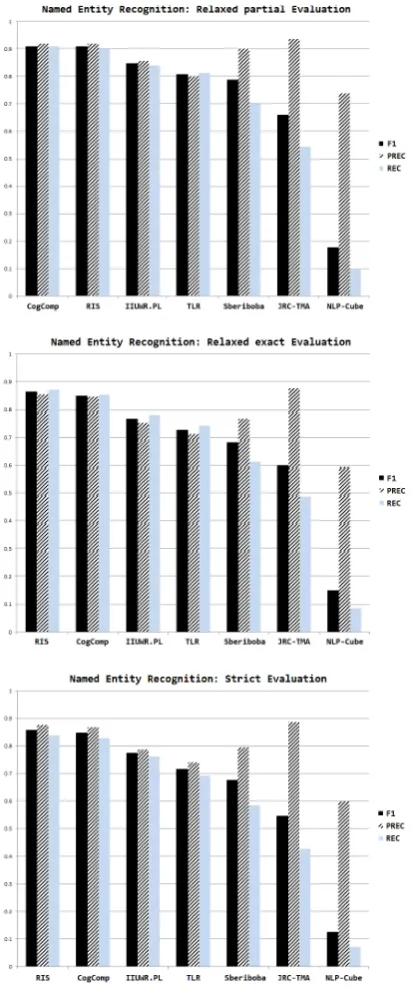
Figure 3 shows system performance averaged across all languages and two test corpora. We present results for seven teams, since CTC-NER submitted results only for Russian. For each team, we present their best-performing model.14
As the plots show, the best performing model, CogComp, yields F-measure 91% according to the relaxed partial evaluation, and 85.6% according to the strict evaluation. Also, the only hybrid model, JRC-TMA-CC, reaches the highest precision— 93.7% relaxed partial, and 88.6% strict—but lower recall—54.4% relaxed partial, 42.7% strict.
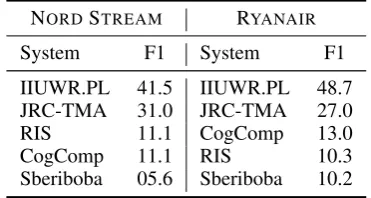
Five teams submitted results for cross-lingual entity linking. The best results for each team, av-eraged across two corpora, are presented in Fig-ure 4, and in Table 2. The plots show that this task is much more difficult than entity extraction.
14Complete results available on the Workshop’s Web page: bsnlp.cs.helsinki.fi/final_ranking.pdf
NORDSTREAM RYANAIR
System F1 System F1
IIUWR.PL 41.5 IIUWR.PL 48.7
JRC-TMA 31.0 JRC-TMA 27.0
RIS 11.1 CogComp 13.0
CogComp 11.1 RIS 10.3
Sberiboba 05.6 Sberiboba 10.2
Table 2: Cross-lingual entity linking.
The best performing model, IIUWR.PL, yields F-measure 45%. As seen from the plot, for this task it is harder to balance recall and precision: the first two models obtain much higher precision, while the last three obtain much higher recall. The two best-performing models used rule-based en-tity linking.
Note that in our setting the performance on entity linking depends on performance on name recognition and normalization: a system had to link entities that it extracted from documents up-stream, rather than link a correct set of entities.
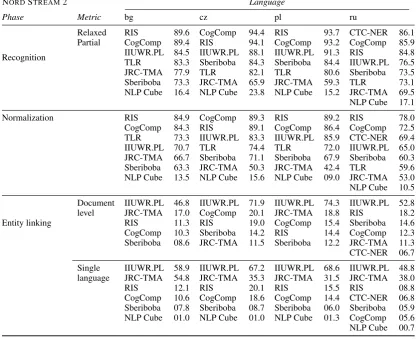
Tables 3 and 4 present the F-measure for all tasks, split by language, for the RYANAIR and NORD STREAM datasets; Table 2 shows perfor-mance on the final phase—cross-lingual entity linking. We show one top-performing model for each team. For recognition, we present only the
relaxed evaluation, since results obtained on the three evaluation schemes are correlated, as can be seen from Figure3.
[image:8.595.323.509.63.162.2]RYANAIR Language
Phase Metric bg cz pl ru
Recognition
Relaxed CogComp 87.5 CogComp 94.2 RIS 92.1 CogComp 94.3 Partial RIS 85.8 RIS 93.5 CogComp 91.4 RIS 92.5 IIUWR.PL 75.9 IIUWR.PL 84.1 IIUWR.PL 84.1 CTC-NER 91.0
TLR 75.9 TLR 82.2 TLR 82.2 TLR 83.4
JRC-TMA 64.2 Sberiboba 80.5 Sberiboba 80.5 IIUWR.PL 78.9 Sberiboba 64.6 JRC-TMA 53.6 JRC-TMA 53.6 JRC-TMA 63.7 NLP Cube 14.7 NLP Cube 18.8 NLP Cube 18.0 Sberiboba 76.9 NLP Cube 16.4
Normalization CogComp 83.4 CogComp 88.7 RIS 87.4 RIS 91.3 RIS 78.1 RIS 87.4 CogComp 86.3 CogComp 90.3 TLR 68.3 IIUWR.PL 80.7 IIUWR.PL 78.9 CTC 85.9 IIUWR.PL 68.0 Sberiboba 74.9 TLR 75.1 TLR 78.0 JRC-TMA 61.3 TLR 72.5 Sberiboba 73.1 JRC-TMA 74.2 Sberiboba 55.9 JRC-TMA 50.2 JRC-TMA 52.6 IIUWR.PL 73.5 NLPCube 11.2 NLPCube 11.0 NLPCube 15.2 Sberiboba 66.9 NLPCube 14.8
Entity linking
Document IIUWR.PL-5 35.5 IIUWR.PL 51.8 IIUWR.PL 58.6 IIUWR.PL 29.4 level JRC-TMA 15.8 JRC-TMA 51.7 JRC-TMA 54.6 CogComp 09.4 CogComp 10.5 CogComp 16.7 CogComp 25.7 RIS 09.3 RIS 07.1 Sberiboba 16.2 Sberiboba 23.2 CTC-NER 05.4 Sberiboba 03.1 RIS 13.9 RIS 22.3 Sberiboba 05.4 JRC-TMA 02.7
[image:9.595.94.503.69.407.2]Single IIUWR.PL 60.2 IIUWR.PL 70.0 IIUWR.PL 61.9 IIUWR.PL 55.9 language JRC-TMA 48.8 JRC-TMA 36.3 JRC-TMA 28.3 JRC-TMA 49.6 CogComp 13.9 RIS 13.4 RIS 23.3 RIS 14.8 RIS 07.4 Sberiboba 12.7 CogComp 23.1 CogComp 12.6 Sberiboba 05.2 CogComp 11.3 Sberiboba 16.9 CTC-NER 12.4 NLP Cube 02.0 NLP Cube 00.7 NLP Cube 02.0 Sberiboba 11.9 NLP Cube 03.1
Table 3: F-measure results for the RYANAIRcorpus
8 Conclusion
This paper reports on the Second Multilingual Named Entity Challenge, which focuses on rec-ognizing mentions of NEs in Web documents in Slavic languages, normalization/lemmatization of NEs, and cross-lingual entity linking. The Chal-lenge attracted much wider interest compared to the First Challenge in 2017, with 16 teams reg-istering for the competition and eight teams sub-mitting results from working systems, many with multiple systems variants. Many of the sys-tems used state-of-the-art neural network models. Overall, the results of the best-performing systems are quite strong for extraction and normalization, while cross-lingual linking appears to be substan-tially more challenging.
We show summary results for the main aspects of the challenge and the best-performing model for each team. For detailed, in-depth evaluations of all submissions systems and their performance figures please consult the Shared Task’s Web page. To stimulate further research into NER for Slavic languages, including cross-lingual entity
linking, our training and test datasets, the detailed annotations, and scripts used for evaluations are made available to the public on the Shared Task’s Web page.15 The annotation interface is released by the Inforex team, to support annotation of ad-ditional data for expanded future tests.
This challenge covered four Slavic languages. For future editions of the Challenge, we plan to expand the training and test datasets, cover-ing a wider range of entity types, and support-ing cross-lsupport-ingual entity linksupport-ing. We also plan to cover a wider set of languages, including non-Slavic ones, and recruit more annotators as the SIGSLAV community expands. We will also un-dertake further refinement of the underlying anno-tation guidelines—always a highly complex task in a real-world setting. More complex phenom-ena also need to addressed, e.g., coordinated NEs, contracted versions of multiple NEs, etc.
We hope that this work will stimulate research into robust, end-to-end NER solutions for process-ing real-world texts in Slavic languages.
NORDSTREAM2 Language
Phase Metric bg cz pl ru
Recognition
Relaxed RIS 89.6 CogComp 94.4 RIS 93.7 CTC-NER 86.1 Partial CogComp 89.4 RIS 94.1 CogComp 93.2 CogComp 85.9 IIUWR.PL 84.5 IIUWR.PL 88.1 IIUWR.PL 91.3 RIS 84.8 TLR 83.3 Sberiboba 84.3 Sberiboba 84.4 IIUWR.PL 76.5 JRC-TMA 77.9 TLR 82.1 TLR 80.6 Sberiboba 73.5 Sberiboba 73.3 JRC-TMA 65.9 JRC-TMA 59.3 TLR 73.1 NLP Cube 16.4 NLP Cube 23.8 NLP Cube 15.2 JRC-TMA 69.5 NLP Cube 17.1
Normalization RIS 84.9 CogComp 89.3 RIS 89.2 RIS 78.0
CogComp 84.3 RIS 89.1 CogComp 86.4 CogComp 72.5 TLR 73.3 IIUWR.PL 83.3 IIUWR.PL 85.9 CTC-NER 69.4 IIUWR.PL 70.7 TLR 74.4 TLR 72.0 IIUWR.PL 65.0 JRC-TMA 66.7 Sberiboba 71.1 Sberiboba 67.9 Sberiboba 60.3 Sberiboba 63.3 JRC-TMA 50.3 JRC-TMA 42.4 TLR 59.6 NLP Cube 13.5 NLP Cube 15.6 NLP Cube 09.0 JRC-TMA 53.0 NLP Cube 10.5
Entity linking
Document IIUWR.PL 46.8 IIUWR.PL 71.9 IIUWR.PL 74.3 IIUWR.PL 52.8 level JRC-TMA 17.0 CogComp 20.1 JRC-TMA 18.8 RIS 18.2 RIS 11.3 RIS 19.0 CogComp 15.4 Sberiboba 14.6 CogComp 10.3 Sberiboba 14.2 RIS 14.4 CogComp 12.3 Sberiboba 08.6 JRC-TMA 11.5 Sberiboba 12.2 JRC-TMA 11.3 CTC-NER 06.7
Single IIUWR.PL 58.9 IIUWR.PL 67.2 IIUWR.PL 68.6 IIUWR.PL 48.8 language JRC-TMA 54.8 JRC-TMA 35.3 JRC-TMA 31.5 JRC-TMA 38.0
RIS 12.1 RIS 20.1 RIS 15.5 RIS 08.8
[image:10.595.90.509.69.408.2]CogComp 10.6 CogComp 18.6 CogComp 14.4 CTC-NER 06.8 Sberiboba 07.8 Sberiboba 08.7 Sberiboba 06.0 Sberiboba 05.9 NLP Cube 01.0 NLP Cube 01.0 NLP Cube 01.3 CogComp 05.6 NLP Cube 00.7
Table 4: Evaluation results (F-measure) for the NORDSTREAM2 corpus
NORDSTREAM RYANAIR
bg cs pl ru bg cs pl ru
[image:10.595.73.288.446.526.2]Per 93.9 95.7 93.0 93.3 97.8 96.3 97.7 97.4 Loc 94.8 98.3 95.5 98.7 98.3 97.1 97.6 96.6 Org 85.1 95.0 95.5 92.5 90.1 90.1 89.9 83.4 Pro 59.5 79.6 54.1 65.1 72.8 92.3 90.4 57.1 Evt 0.50 0.55 100.0 - 50.0 18.2 50.0 40.0
Table 5: Recognition F-measure (relaxed partial) by entity type—best-performing systems for each lan-guage.
Acknowledgments
We thank Tomek Berna´s, Anastasia Golovina, Na-talia Novikova, Elena Shukshina, Yana Vorobieva, and Alina Zaharova and many others for contribut-ing to data annotation. We also thank Petya Osen-ova and Kiril Simov for their assistance.
The shared task was supported in part by the Europe Media Monitoring Project (EMM), carried out by the Text and Data Mining Unit of the Joint Research Centre of the European Commission.
Work was supported in part by investment in the CLARIN-PL research infrastructure funded by the
Polish Ministry of Science and Higher Education. Work was supported in part by ERDF “Re-search and Development of Intelligent Compo-nents of Advanced Technologies for the Pilsen Metropolitan Area (InteCom)” (no. CZ.02.1.01 / 0.0 / 0.0 / 17_048/0007267), and by Grant No. SGS-2019-018 “Processing of heterogeneous data and its specialized applications.”
References
Željko Agi´c and Nikola Ljubeši´c. 2014. The SE-Times.HR linguistically annotated corpus of Croa-tian. In Ninth International Conference on Lan-guage Resources and Evaluation (LREC 2014), pages 1724–1727, Reykjavík, Iceland.
AY Antonova and AN Soloviev. 2013. Conditional random field models for the processing of Russian. InComputational Linguistics and Intellectual Tech-nologies: Papers From the Annual Conference "Di-alogue"(Bekasovo, 29 May–2 June 2013), volume 1, pages 27–44.
Mikhail Arkhipov, MAria Trofimova, Yuri Kuratov, and Alexey Sorokin. 2019. Tuning multilingual transformers for language-specific named entity recognition. InProceedings of the 7th Workshop on Balto-Slavic Natural Language Processing. Associ-ation for ComputAssoci-ational Linguistics.
Krešimir Baksa, Dino Golovi´c, Goran Glavaš, and Jan Šnajder. 2017. Tagging named entities in Croatian tweets. Slovenšˇcina 2.0: empirical, applied and in-terdisciplinary research, 4(1):20–41.
Piotr Bojanowski, Edouard Grave, Armand Joulin, and Tomas Mikolov. 2017. Enriching word vectors with subword information. Transactions of the Associa-tion for ComputaAssocia-tional Linguistics, 5:135–146.
Nancy Chinchor. 1998. Overview of MUC-7/MET-2. In Proceedings of Seventh Message Understanding Conference (MUC-7).
Jonathan B. Crawley and Gerhard Wagner. 2010. Desktop Text Mining for Law Enforcement. In Pro-ceedings of IEEE International Conference on Intel-ligence and Security Informatics (ISI 2010), pages 23–26, Vancouver, BC, Canada.
Jacob Devlin, Ming-Wei Chang, Kenton Lee, and Kristina Toutanova. 2019. Bert: Pre-training of deep bidirectional transformers for language understand-ing. InNAACL-HLT.
George R. Doddington, Alexis Mitchell, Mark A. Przy-bocki, Lance A. Ramshaw, Stephanie Strassel, and Ralph M. Weischedel. 2004. The Automatic Con-tent Extraction (ACE) program—tasks, data, and evaluation. In Fourth International Conference on Language Resources and Evaluation (LREC 2004), pages 837–840, Lisbon, Portugal.
Xiangyu Duan, Rafael E. Banchs, Min Zhang, Haizhou Li, and A. Kumaran. 2016. Report of NEWS 2016 machine transliteration shared task. InProceedings of The Sixth Named Entities Workshop, pages 58–72, Berlin, Germany.
Maud Ehrmann, Guillaume Jacquet, and Ralf Stein-berger. 2017. Jrc-names: Multilingual entity name variants and titles as linked data. Semantic Web, 8(2):283–295.
Anton Emelianov and Ekaterina Artemova. 2019. Mul-tilingual named entity recognition using pretrained embeddings, attention mechanism and NCRF. In Proceedings of the 7th Workshop on Balto-Slavic Natural Language Processing. Association for Computational Linguistics.
Guillaume Jacquet, Jakub Piskorski, and Sophie Ches-ney. 2019a. Out-of-context fine-grained multi-word entity classification: exploring token, character N-gram and NN-based models for multilingual en-tity classification. In Proceedings of the 34th ACM/SIGAPP Symposium on Applied Computing, pages 1001–1010. ACM.
Guillaume Jacquet, Jakub Piskorski, Hristo Tanev, and Ralf Steinberger. 2019b. JRC TMA-CC: Slavic named entity recognition and linking. participation in the BSNLP-2019 shared task. InProceedings of the 7th Workshop on Balto-Slavic Natural Language Processing. Association for Computational Linguis-tics.
Heng Ji, Joel Nothman, and Ben Hachey. 2014. Overview of TAC-KBP2014 entity discovery and linking tasks. InProceedings of Text Analysis Con-ference (TAC2014), pages 1333–1339.
Heng Ji, Joel Nothman, and Ben Hachey. 2015. Overview of TAC-KBP2015 tri-lingual entity dis-covery and linking. InProceedings of Text Analysis Conference (TAC2015).
Mladen Karan, Goran Glavaš, Frane Šari´c, Jan Šna-jder, Jure Miji´c, Artur Šili´c, and Bojana Dalbelo Baši´c. 2013. CroNER: Recognizing named entities in Croatian using conditional random fields. Infor-matica, 37(2):165.
Michal Konkol and Miloslav Konopík. 2013. CRF-based Czech named entity recognizer and consoli-dation of Czech NER research. InText, Speech and Dialogue, volume 8082 of Lecture Notes in Com-puter Science, pages 153–160. Springer Berlin Hei-delberg.
A Kumaran, Mitesh M. Khapra, and Haizhou Li. 2010. Report of NEWS 2010 transliteration mining shared task. In Proceedings of the 2010 Named Entities Workshop, pages 21–28, Uppsala, Sweden.
Nikola Ljubeši´c, Marija Stupar, Tereza Juri´c, and Željko Agi´c. 2013. Combining available datasets for building named entity recognition models of Croat-ian and Slovene. Slovenšˇcina 2.0: empirical, ap-plied and interdisciplinary research, 1(2):35–57.
Xuezhe Ma and Eduard Hovy. 2016. End-to-end sequence labeling via bi-directional LSTM-CNNs-CRF. InProceedings of the 54th Annual Meeting of the Association for Computational Linguistics (Vol-ume 1: Long Papers), volume 1, pages 1064–1074.
Nafise Sadat Moosavi and Michael Strube. 2016. Which coreference evaluation metric do you trust? A proposal for a link-based entity aware metric. In Proceedings of the 54th Annual Meeting of the Asso-ciation for Computational Linguistics (ACL 2016), pages 632–642, Berlin, Germany.
Jakub Piskorski, Lidia Pivovarova, Jan Šnajder, Josef Steinberger, and Roman Yangarber. 2017. The first cross-lingual challenge on recognition, normaliza-tion and matching of named entities in Slavic lan-guages. In Proceedings of the 6th Workshop on Balto-Slavic Natural Language Processing. Associ-ation for ComputAssoci-ational Linguistics.
Jakub Piskorski, Karol Wieloch, and Marcin Sydow. 2009.On knowledge-poor methods for person name matching and lemmatization for highly inflectional languages. Information retrieval, 12(3):275–299.
Adam Przepiórkowski. 2007.Slavonic information ex-traction and partial parsing. In Proceedings of the Workshop on Balto-Slavonic Natural Language Pro-cessing: Information Extraction and Enabling Tech-nologies, ACL ’07, pages 1–10, Stroudsburg, PA, USA. Association for Computational Linguistics.
Nils Reimers and Iryna Gurevych. 2019. Alternative weighting schemes for elmo embeddings. arXiv preprint arXiv:1904.02954.
Agata Savary and Jakub Piskorski. 2011. Language Resources for Named Entity Annotation in the Na-tional Corpus of Polish. Control and Cybernetics, 40(2):361–391.
Magda Ševˇcíková, Zdenˇek Žabokrtsk`y, and Oldˇrich Kruza. 2007. Named entities in Czech: annotat-ing data and developannotat-ing NE tagger. InInternational Conference on Text, Speech and Dialogue, pages 188–195. Springer.
Tadej Štajner, Tomaž Erjavec, and Simon Krek. 2013. Razpoznavanje imenskih entitet v slovenskem besedilu. Slovenšˇcina 2.0: empirical, applied and interdisciplinary research, 1(2):58–81.
Erik Tjong Kim Sang. 2002. Introduction to the CoNLL-2002 shared task: Language-independent named entity recognition. InProceedings of the 6th Conference on Natural Language Learning - Volume 20, COLING-02, pages 1–4, Stroudsburg, PA, USA. Association for Computational Linguistics.
Erik Tjong Kim Sang and Fien De Meulder. 2003. Introduction to the CoNLL-2003 shared task: Language-independent named entity recognition. In Proceedings of the Seventh Conference on Natural Language Learning at HLT-NAACL 2003 - Volume 4, CONLL ’03, pages 142–147, Stroudsburg, PA, USA. Association for Computational Linguistics.
Tatiana Tsygankova, Stephen Mayhew, and Dan Roth. 2019. BSNLP2019 shared task submission: Mul-tisource neural NER transfer. In Proceedings of
the 7th Workshop on Balto-Slavic Natural Language Processing. Association for Computational Linguis-tics.