Maximum Margin Reward Networks for
Learning from Explicit and Implicit Supervision
Haoruo Peng1 Ming-Wei Chang2 Wen-tau Yih2 1University of Illinois, Urbana-Champaign
2Microsoft Research, Redmond
1[email protected] 2{minchang,scottyih}@microsoft.com
Abstract
Neural networks have achieved state-of-the-art performance on several structured-output prediction tasks, trained in a fully supervised fashion. However, annotated examples in structured domains are of-ten costly to obtain, which thus limits the applications of neural networks. In this work, we propose Maximum Mar-gin Reward Networks, a neural network-based framework that aims to learn from both explicit (full structures) and implicit supervision signals (delayed feedback on the correctness of the predicted structure). On named entity recognition and seman-tic parsing, our model outperforms previ-ous systems on the benchmark datasets, CoNLL-2003 and WebQuestionsSP. 1 Introduction
Structured-output prediction problems, where the goal is to determine values of a set of inter-dependent variables, are ubiquitous in NLP. Struc-tures of such problems can range from simple se-quences like part-of-speech tagging (Ling et al., 2015) and named entity recognition (Lample et al., 2016), to complex syntactic or semantic analysis such as dependency parsing (Dyer et al., 2015) and semantic parsing (Dong and Lapata, 2016). State-of-the-art methods of these tasks are often neu-ral network models trained using fully annotated structures, which can be costly or time-consuming to obtain. Weakly supervised learning settings, where the algorithm assumes only the existence of
implicitsignals on whether a prediction is correct, are thus more appealing in many scenarios.
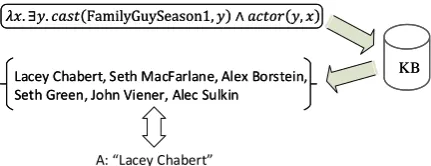
For example, Figure 1 shows a weakly super-vised setting of learning semantic parsers using only question–answer pairs. When the system generates a candidate semantic parse during train-ing, the quality needs to be indirectly measured by
Q: Who played Meg in Season 1 of Family Guy?
𝜆𝑥.∃𝑦.𝑐𝑎𝑠𝑡 FamilyGuySeason1,𝑦 ∧ 𝑎𝑐𝑡𝑜𝑟 𝑦,𝑥 𝜆𝑥.∃𝑦.𝑐𝑎𝑠𝑡 FamilyGuySeason1,𝑦 ∧ 𝑎𝑐𝑡𝑜𝑟 𝑦,𝑥
KB KB
Lacey Chabert, Seth MacFarlane, Alex Borstein, Seth Green, John Viener, Alec Sulkin
Lacey Chabert, Seth MacFarlane, Alex Borstein, Seth Green, John Viener, Alec Sulkin
[image:1.595.309.525.215.298.2]A: Lacey Chabert
Figure 1: Learning a semantic parser using im-plicitsupervision signals (labeled answers). Since there are no gold parses, a model needs to explore different parses, where their quality can only be indirectly verified by comparing retrieved answers and the labeled answers.
comparing the derived answers from the knowl-edge base and the provided labeled answers.
This setting of implicit supervision increases the difficulty of learning a neural model, not only because the signals are vague and noisy, but also
delayed. For instance, among different semantic parses that result in the same answers, typically only few of them correctly represent the meaning of the question. Moreover, the correctness of an-swers corresponding to a parse can only be eval-uated through an external oracle (e.g., executing the query on the knowledge base)after the parse is fully constructed. Early model update before the search of a full semantic parse is complete is gen-erally infeasible.1 It is also not clear how to
lever-age implicit and explicit signals integrally during learning when both kinds of labels are present.
In this work, we propose Maximum Margin Re-ward Networks (MMRN), which is a general neu-ral network-based framework that is able to learn from both implicit and explicit supervision sig-nals. By casting structured-output learning as a search problem, the key insight in MMRN is the 1Existing weakly supervised methods (Clarke et al., 2010; Artzi and Zettlemoyer, 2013) often leverage domain-specific heuristics, which are not always available.
special mechanism of rewards. Rewards can be viewed as the training signals that drive the model to explore the search space and to find the cor-rect structure. The explicit supervision signals can be viewed as a source of immediate rewards, as we can often instantly know the correctness of the current action. On the other hand, the implicit su-pervision can be viewed as a source ofdelayed re-wards, where the reward of the actions can only be revealed later. We unify these two types of reward signals by using a maximum margin update, in-spired by structured SVM (Joachims et al., 2009). The effectiveness of MMRN is demonstrated on three NLP tasks: named entity recognition,entity linkingandsemantic parsing. MMRNoutperforms the current best results on CoNLL-2003 named entity recognition dataset (Tjong Kim Sang and De Meulder, 2003), reaching 91.4% F1, in the
close setting where no gazetteer is allowed. It also performs comparably to the existing state-of-the-art systems on entity linking. Models for these two tasks are trained using explicit supervision. For semantic parsing, where only implicit super-vision signals are provided,MMRNis able to learn from delayed rewards, improving the entity link-ing component and the overall semantic parslink-ing framework jointly, and outperforms the best pub-lished system by 1.4% absolute on the WebQSP dataset (Yih et al., 2016).
In the rest of the paper, we survey the most related work in Sec. 2 and give an in-depth dis-cussion on comparing MMRN and other learning frameworks in Sec. 7. We start the description of our method from the search formulation and the state–action spaces in our targeted tasks in Sec. 3, followed by the reward and learning algorithm in Sec. 4 and the detailed neural model design in Sec. 5. Sec. 6 reports the experimental results and Sec. 8 concludes the paper.
2 Related Work
Structured output prediction tasks have been stud-ied extensively in the field of natural language pro-cessing (NLP). Many supervised structured learn-ing algorithms has been proposed for capturlearn-ing the relationships between output variables. These models include structured perceptron (Collins, 2002; Collins and Roark, 2004), conditional ran-dom fields (Lafferty et al., 2001), and structured SVM (Taskar et al., 2004; Joachims et al., 2009). Later, the learning to search framework is
pro-posed (Daum´e and Marcu, 2005; Daum´e et al., 2009), which casts the structured prediction task as a general search problem. Most recently, recurrent neural networks such as LSTM mod-els (Hochreiter and Schmidhuber, 1997) have been used as a general tool for structured output mod-els (Vinyals et al., 2015).
Latent structured learning algorithms address the problem of learning from incomplete labeled data (Yu and Joachims, 2009; Quattoni et al., 2007). The main difference compared to our framework is the existence of the external envi-ronment when learning from implicit signals.
Upadhyay et al. (2016) first proposed the idea of learning from implicit supervision, and is the most related paper to our work. Compared to their lin-ear algorithm, our framework is more principled and general as we integrate the concept of margin in our method. Furthermore, we also extend the framework using neural models.
3 Search-based Inference
In our framework, predicting the best structured output, inference, is formulated as a state/action search problem. Our search space can be de-scribed as follows. The initial state, s0, is the
starting point of the search process. We define
γ(s) as the set of all feasible actions that can be taken at s, and denote s0 = τ(s, a) as the
transition function, where s0 is the new state
af-ter taking action a from s. A path h is a se-quence of state–action pairs, starting with the ini-tial state: h = {(s0, a0), . . . ,(sk, ak)}, where si = τ(si−1, ai−1),∀i = 1, . . . , k. We denote h ; ˆs, ifsˆ=τ(sk, ak), the final state which the
pathh leads to. A path essentially is a partial or complete structured prediction. For each inputx, we defineH(x)to be the set of all possible paths for the input. We also define E(x) = {h | h ∈ H(x),h ; ˆs, γ(ˆs) = ∅}, which is all possible paths that lead to terminal states.
Given a statesand an actiona, the scoring func-tionfθ(s, a)measures the quality of an immediate
action with respect to the current state, whereθis the model parameters. The score of a path h is defined as the sum of the scores for state-action pairs inh: fθ(h) = Pki=0fθ(si, ai).During test
time, inference is to find the best path in E(x): arg maxh∈E(x)fθ(h;x). In practice, inference is
In the remaining of this section, we describe the states and actions in the targeted tasks in this work:named entity recognition,entity linkingand
semantic parsing. The the model and learning al-gorithm will be discussed in Sec. 4 and Sec. 5.
3.1 Named entity recognition
The task of named entity recognition (NER) is to identify entity mentions in a sentence, as well as to assign their types, such as Person or Location. Following the conventional setting, we treat it as a sequence labeling problem using the standard BIOES encoding. For instance, a “B-LOC” tag on a word means that the word is the beginning of a multi-word location entity.
Given a sentence as input, the states represent the tags assigned to the words. Starting from the initial state, s0, where no tag has been assigned,
the search process explores the sequence tagging from the left-to-right order. For each word, the actions are the legitimate tags that can be assigned to it, which depend on previous actions. For exam-ple, if the “S-PER” tag (“S” means a single word entity) has been assigned to the previous word, then an action of labeling the current word with either “I-PER” or “E-PER” cannot can be taken. The search reaches a terminal state when all words in the sentence have been tagged.
3.2 Entity linking
The problem of entity linking (EL) is similar to NER, but instead of tagging the mention using a small set of generic entity types, the goal here is to ground the mention to a specific entity, stored in a knowledge base or described by a Wikipedia page. For example, consider the sentence “nfl news: draft results for giants” and assume that the mention candidates “nfl” and “giants” are given. A state reflects how we have assigned the entity la-bels to these candidates. Following the same left-to-right order and starting from the empty assign-ment s0, the first action to take is to assign the
entity label to the first candidate “nfl”. A legit-imate action set can be all the entities that have been associated with this mention in the training set (e.g., “National Football League” or “National Fertilizers Limited”). Once the action is com-pleted, the transition function will bring the focus to the next mention candidate (i.e., “giants”). The search reaches a terminal state when all the candi-date mentions in the sentence have been linked.
Family Guy Season 1 cast actor
Meg Griffin
x y
𝜆𝑥.∃𝑦.𝑐𝑎𝑠𝑡 FamilyGuySeason1,𝑦 ∧ 𝑎𝑐𝑡𝑜𝑟 𝑦,𝑥
∧ 𝑐ℎ𝑎𝑟𝑎𝑐𝑡𝑒𝑟(𝑦,MegGriffin)
Figure 2: Semantic parses inλ-calculus (top) and query graph (bottom) of the question “who played meg in season 1 of family guy?”
3.3 Semantic parsing
Our third targeted task is semantic parsing (SP), which is a task of mapping a text utterance to a for-mal meaning representation. In this paper, we fo-cus on a specific type of semantic parsing problem that maps a natural language question to a struc-tured query, which is executed on a knowledge base to retrieve the answer to the original question. Figure 2 shows the semantic parses of an ex-ample question “who played meg in season 1 of family guy”, assuming the knowledge base is Free-base (Bollacker et al., 2008). An entity linking component plays an important role by mapping “meg” to MegGriffinand “season 1 of family guy” to FamilyGuySeason1. Predicates like cast,actorandcharacterare also from the knowledge base that define the relationships be-tween these entities and the answer. Together the semantic parse inλ-calculus is shown in the top of Figure 2. Equivalently, the semantic parse can be represented as a query graph (Figure 2 bottom), which is used in the STAGG system (Yih et al., 2015). The nodes are either grounded entities or variables, wherexis the answer entity. The edges denote the relationship between two entities.
Regardless of the choice of the formal language, the process of constructing the semantic parse is typically formulated as a search problem. A state is essentially a partial or complete semantic parse, and an action is to extend the current semantic parse by adding a new relation or constraint.
and the entity linking systems. To the best of our knowledge, this is the first work that jointly learns the entity linking and semantic parsing systems.
Our search space is defined as follows. Start-ing from the initial state s0, the model first
ex-plores the entity linking search space. Once the entity linking assignment are assigned (e.g. FamilyGuySeason1 in Figure 2.) The sec-ond phase is then to determine the main rela-tionship between the topic entity and the an-swer (e.g., the cast-actor chain between FamilyGuySeason1andx). Constraints (e.g., thecharacter isMegGriffin) that describe the additional properties that the answer needs to have are added last. In this case, any state that is a legitimate semantic parse (consisting of one topic entity and one main relationship, as well as zero or more constraints) can lead to a terminal state.
4 Maximum Margin Reward Networks In this section, we introduce the learning frame-work ofMMRN, which includes two main compo-nents:rewardandmax-margin loss. The former is a mechanism for using implicit and explicit super-vision signals in a unified way; the latter formally defines the learning objective.
4.1 Reward
The key insight ofMMRNis that different types of supervision signals can be represented using the appropriate design of the reward function. A re-ward function is defined over a state–action pair
R(s, a), representing thetruequality of taking ac-tion ain the state s. The reward for a path can be formally defined as: R(h) = Pki=0R(si, ai).
Intuitively, when the annotated action sequences (explicit supervision signals) exist, the model only needs to learn to imitate the annotated sequence. For instance, when learning NER in the fully su-pervised setting, the equivalent way of using Ham-ming distance is to define the rewardR(s, a)to be 1ifamatches the annotated sequence at the cur-rent state, and0otherwise.
In the setting where only implicit supervision is available, the reward function can still be de-signed to capture the signals. For instance, when only the question–answer pairs exist for learning the semantic parser, the reward can be defined by comparing the answers derived from a candidate parse and the labeled answers. More formally, as-sume that s = τ(s0, a)is the state after applying
Family Guy Season 1 cast y actor x
𝑌 𝑠 = {Lacey Chabert, Seth MacFarlane, Alex Borstein,
Seth Green, John Viener, Alec Sulkin}
𝐴= Lacey Chabert 𝑠=
Figure 3: For the question “who played meg in season 1 of family guy?”, the candidate semantic parseslists all the actors in “Family Guy Season 1” (Y(s)). By comparingY(s) to the answer set
A, the precision is 1
6 and the recall is1. Therefore,
the F1score used for the reward is 27.
actionato states0. LetY(s)be the set of predicted
answers generated from states, and Y(s) = {}
when s is not a legitimate semantic parse. The reward functionR(s0, a) can be defined by
com-paringY(s)and the labeled answers,A, to the in-put question. While a set similarity function like the Jaccard coefficient can be used as the reward function, we chose the F1 score in this work as
it was used as the evaluation metric in previous work (Berant et al., 2013). Figure 3 shows an ex-ample of this reward function.
4.2 Max-Margin Loss & Learning Algorithm The MMRN learning algorithm can be viewed as an extension of M3N (Taskar et al., 2004) and
Structured SVM (Joachims et al., 2009; Yu and Joachims, 2009). The learning algorithm takes three steps, where the first two involve two differ-ent search procedures. The final step is to update the models with respect to the inference results. Finding the best path The first search step is to find thebest pathh∗ by solving the following
optimization problem:
h∗ = arg max
h∈E(x) R(h;y) +fθ(h). (1)
The first term defines the path that has the highest reward. Because it is possible that several paths share the same reward, the second term leverages the current model and serves as the tie-breaker, whereis a hyper-parameter that is set to a small positive number in our experiments.
pairs are zeros. In this situation, the search algo-rithm uses the model scorefθ to guide the search.
One possible design is to use beam search for the optimization problem, where the search procedure follows the current model in the early stage (given thatR(h) = 0). After generating several complete action sequences, the true reward function is then used to findh∗. The tie-breaker also picks the best
sequence when there are multiple sequences that lead to the same reward. Note thath∗ can change
between iterations because of the tie-breaker.
Finding the most violated path Once h∗ is
found, it is used as our reference path. We would like to update the model so that the scoring func-tion fθ will behave similarly to the reward R.
More formally, we aim to update the model pa-rametersθto satisfy the following constraint.
fθ(h∗)−fθ(h)≥R(h∗)−R(h),∀h.
The constraint implies that the “best” action quence should rank higher than any other se-quence by a margin computed from rewards as R(h∗) − R(h). The degree of violation
of this constraint, with respect to h, is thus (R(h∗)−R(h))−(fθ(h∗)−fθ(h)) = fθ(h)− R(h)−fθ(h∗) +R(h∗). The max-margin loss is
defined accordingly:
L(h,h∗) = max(fθ(h)−R(h)−fθ(h∗)+R(h∗),0)
L(h,h∗)is our optimization goal, where we want
to update the model by fixing the biggest violation. Note that the associated constraint is only violated when L(h,h∗) is positive. To find the pathh in
this step that maximizes the violation is equivalent to maximizing fθ(h)−R(h), given that the rest
of the terms are constant with respect toh. When there exist only explicit supervision sig-nals, our objective function reduces to the one for optimizing structured SVM without regular-ization. For implicit signals, we findh∗
approxi-mately before we optimize the margin loss. In this case, the search is not exact as the reward signals are delayed. Nevertheless, we found the margin loss worked well empirically, as it kept decreasing in general until being stable.
Algorithm 1 summarizes the learning procedure ofMMRN. Search is used in both Line 2 and 3. In Line 4, the algorithm performs a gradient update to modify all the model parameters.
Algorithm 1Maximum Margin Reward Networks
1: fora random labeled data(x, y)do 2: h∗←arg max
h∈E(x) R(h;y) +fθ(h) 3: hˆ ←arg max
h∈E(x) fθ(h)−R(h;y) 4: updateθby minimizingL(ˆh,h∗) 5: end for
4.3 Practical Considerations
Although the learning algorithm ofMMRNis sim-ple and general, the quality of the learned model is dictated by the effectiveness of the search proce-dure. Increasing the beam size generally helps im-prove the model, but also slows down the training, and has a limited effect when dealing with a large search space. Domain-specific heuristics for prun-ing search space should thus be used when avail-able. For instance, in the task of semantic parsing, when the reward of a legitimate semantic parse is 0, it implies that none of the derived answers is in-cluded in the labeled set of answers. When all the possible follow-up actions can only make the se-mantic parse stricter (e.g., adding constraints), and result in a subset of the current derived answers, it is clear that the rewards of all these new states are 0 as well. Paths from this state can thus be pruned. Another strategy for improving search quality is to useapproximatedreward in the early stage of search. Very often the true rewards at this stage are 0, and are not useful to guide the search to find the best path. The approximated reward function can be thought of as estimating whether there ex-ists a high-reward state that is reachable from the current state. The effectiveness of this strategy has been demonstrated successfully by several recent efforts (Mnih et al., 2013; Krishnamurthy et al., 2015; Silver et al., 2016; Narasimhan et al., 2016). 5 Neural Architectures
While the learning algorithm ofMMRNdescribed in Sec. 4 is general, the exact model design is task-dependent. In this section, we describe in detail the neural network architectures of the three tar-geted tasks,named entity recognition,entity link-ingandsemantic parsing.
5.1 Named Entity Recognition
Input 𝑥
Previous action embedding f𝜃(𝑠, 𝑎)
State 𝑠determines the word index 𝑚
Action 𝑎
determines the tag type
[image:6.595.309.525.61.180.2]word
Figure 4: The action scoring model for NER.
The model of the action scoring functionfθ(s, a)
is depicted in Figure 4, which is basically the dot product of the action embedding and state em-bedding. The action embedding is initialized ran-domly for each action, but can be fine-tuned dur-ing traindur-ing (i.e. back-propagate the error through the network and update the word/entity type em-beddings). The state embedding is the concate-nation of bi-LSTM word embeddings of the cur-rent word, the character-based word embeddings, and the embedding of the previous action. We also include the orthographic embeddings pro-posed by Limsopatham and Collier (2016).
5.2 Entity Linking
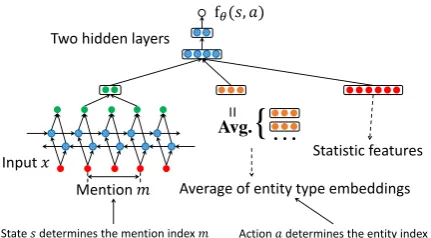
An action in entity linking is to determine whether a mention should be linked to a particular entity (cf. Sec. 3.2). As shown in Figure 5, we design the scoring function as a feed-forward neural network that takes as input three different input vectors: (1) surface features from hand-crafted mention-entity statistics that are similar to the ones used in (Yang and Chang, 2015); (2) mention context embed-dings from a bidirectional LSTM module; (3) en-tity embeddings constructed from enen-tity type em-beddings. All these embeddings, except the fea-ture vectors, are fine-tuned during training.
Some unique properties of our entity linking model are worth noticing. First, we add mention context embeddings from a bidirectional LSTM module as additional input. While using LSTMs is a common practice for sequence labeling, it is not usually used for short-text entity linking. For each mention, we only extract the output from the bi-LSTM module at the start and end tokens of the mention, and concatenate them as the men-tion context embeddings. Second, we construct entity embeddings using the average of its Free-base (Bollacker et al., 2008) type embeddings2,
2We use only the 358 most frequent Freebase entity types.
Avg.
{
…
Statistic features Input 𝑥
Two hidden layers
=
Average of entity type embeddings
f𝜃(𝑠, 𝑎)
State 𝑠determines the mention index 𝑚 Action 𝑎determines the entity index
[image:6.595.74.287.66.166.2]Mention 𝑚
Figure 5: The action scoring model for EL.
initialized using pre-trained embeddings. Adding these two types of embeddings has shown to im-prove the performance in our experiments.
5.3 Semantic Parsing
Our semantic parsing model follows the STAGG system (Yih et al., 2015), which uses a stage-wise search procedure to expand the candidate semantic parses gradually (cf. Sec. 3.3). Com-pared to the original system, we make two notable changes. First, we use a two-layer feed-forward neural network to replace the original linear ranker that scores the candidate semantic parses. Second, instead of using a separately trained entity link-ing system, we incorporate our entity linklink-ing net-works described in Sec. 5.2 as part of the semantic parsing model. The training process will thus fine tune the entity linking component to improve the semantic parsing system.
6 Experiments
It is important to have a general machine learn-ing model worklearn-ing for both implicit and explicit supervision signals. We valid our learning frame-work when the explicit supervision signals are pre-sented, as well as demonstrate the support of the scenario where supervision signals are mixed.
Specifically, in this section, we report the exper-imental results ofMMRNon named entity recogni-tion and entity linking, both using explicit super-vision, and on semantic parsing, using implicit su-pervision. In all our experiments, we tuned hyper-parameters on the development set (each task re-spectively), and then re-trained the models on the combination of the training and development set.
6.1 Named entity recognition
System F1
[image:7.595.99.260.61.202.2]Collobert et al. (2011) 89.59 Huang et al. (2015) 90.10 Chiu and Nichols (2015) 90.77 Ratinov and Roth (2009) 90.88 Lample et al. (2016) 90.94 Ma and Hovy (2016) 91.21 MMRN-NER Beam = 5 90.03 MMRN-NER Beam = 20 91.39
Table 1: Explicit Supervision: Named Entity Recognition. OurMMRN with beam size 20 out-performs current best systems, which are based on neural networks.
NEEL-Test TACL F1 F1
S-MART 77.7 63.6
NTEL 77.9 68.1
MMRN-EL 78.5 67.5
MMRN-EL -Entity 77.4 66.5 MMRN-EL -LSTM 76.6 66.0
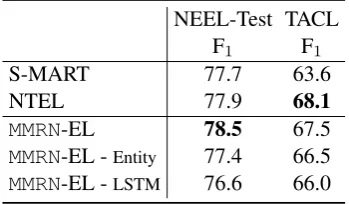
Table 2: Explicit Supervision: Entity Linking. Our system trained with MMRN is comparable to the state-of-art NTEL system.
metric is the F1 score. The pre-trained word
em-beddings are 100-dimension GloVe vectors trained on 6 billion tokens (Pennington et al., 2014)3. The
search procedure is conducted using beam search, and the reward function is simply the number of correct tag assignments to the words.
The results are shown in Table 1, compared with recently proposed systems based on neural models. When the beam size is set to 20, MMRN achieves 91.4, which is the best published result so far (without using any gazetteers). Notice that when beam size is 5, the performance drops to 90.03. This demonstrates the importance of search quality when applyingMMRN.
6.2 Entity linking
For entity linking, we adopt two publicly avail-able datasets for tweet entity linking: NEEL (Cano et al., 2014)4 and TACL (Guo et al., 2013; Fang
3Available at http://nlp.stanford.edu/projects/glove/ 4NEEL dataset was originally created for an entity link-ing competition: http://microposts2016.seas. upenn.edu/challenge.html
and Chang, 2014; Yang and Chang, 2015; Yang et al., 2016). We follow prior works (Guo et al., 2013; Yang and Chang, 2015) and perform the standard evaluation for an end-to-end entity link-ing system by computlink-ing precision, recall, and F1
scores, according to the entity references and the system output. An output entity is considered cor-rect if it matches the gold entity and the mention boundary overlaps with the gold mention bound-ary. Interested readers can refer to (Carmel et al., 2014) for more detail.
We initialize the word embeddings from pre-trained GloVe vectors pre-trained on the twitter cor-pus, and type embeddings from the pre-trained skip-gram model (Mikolov et al., 2013)5. Sizes
of both word embeddings are set to 200. Inference is done using a dynamic programming algorithm.
Results of entity linking experiments are pre-sented in Table 2, which are compared with those of S-MART (Yang and Chang, 2015)6 and
NTEL (Yang et al., 2016)7, two state-of-the-art
en-tity linking systems for short texts. OurMMRN-EL is comparable to the best system. We also con-ducted two ablation studies by removing the entity type vectors (MMRN-EL -Entity), and by removing
the LSTM vectors (MMRN-EL -LSTM). Both show
significant performance drops, which validates the importance of these two additional input vectors.
6.3 Semantic parsing
For semantic parsing, we use the dataset We-bQSP8(Yih et al., 2016) in our experiments. This
dataset is a clean and enhanced version of the widely used WebQuestions dataset (Berant et al., 2013), which consists of pairs of questions and an-swers found in Freebase. Compared to WebQues-tions, WebQSP excludes questions with ambigu-ous intent, and provides verified answers and full semantic parses to the remaining 4,737 questions. We follow the implicit supervision setting in (Yih et al., 2016), using3,098question–answer pairs for training, and1,639for testing. A subset of620pairs from the training set is used for hyper-parameter tuning. Because there can be multiple answers to a question, the quality of a semantic parser is measured using the averaged F1 score of
the predicted answers.
5Available at https://code.google.com/archive/p/word2vec/ 6The winning system of the NEEL challenge.
7To have a fair comparison, we compare to the results of NTEL which do not use pretrained user embedding.
[image:7.595.94.269.280.382.2]We experiment with two configurations of in-corporating the entity linking component.
MMRN-PIPELINE trains anMMRN-EL model using the
en-tity linking labels in WebQSP separately. Given a question, the entities in it are first predicted, and used as input to the semantic parsing system. In contrast, MMRN-JOINT incorporates the MMRN-EL
model in the whole framework. During this joint training process, 15 entity link results are sam-pled according to the current MMRN-EL model, and passed to the downstream networks. In both cases, we use the previous entity linking model trained on the NEEL dataset to initialize the pa-rameters. As discussed in Sec. 4.1, in this implicit supervision setting, we directly set the (delayed) reward function to be the F1 score, which can be
obtained by comparing the annotated answers with predicted answers.
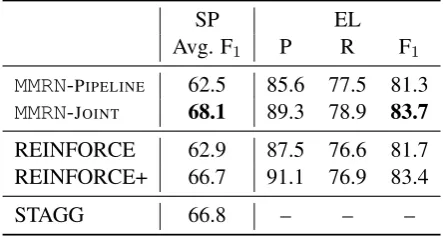
Table 3 summarizes the results of the MMRN-based semantic parsing systems and other strong baselines. The SP column reports the aver-aged F1 scores. Compared to the pipeline
ap-proach (MMRN-PIPELINE), the joint learning
frame-work (MMRN-JOINT) improves significantly,
reach-ing 68.1% F1. To compare different learning
methods, we also apply REINFORCE (Williams, 1992), a popular policy gradient algorithm, to train our joint model using the same setting and re-ward function.9 MMRN-JOINT outperforms
REIN-FORCE and its variant, REINFORECE+, which re-normalizes the probabilities of the sampled can-didate sequences. Its result is also better than the state-of-the-art STAGG system. Note that we use the same architectures and initialization procedures for MMRN-PIPELINE/JOINT and
REIN-FORCE/REINFORCE+. Therefore, the superior performance of MMRN-JOINT shows that the joint
learning plays a crucial role in addition to the choices of architecture. Comparing to STAGG, note that Yih et al. (2016) did not jointly train the entity linker and semantic parser together, but they did improve the results by taking the top 10 predic-tions of their entity linking system for re-ranking parses. Our algorithm further allows to update the entity linker with the labels for semantic parsing and shows superior performance.
Our joint model also improves the entity link-ing prediction on the questions in WebQSP us-ing the implicit signals (the EL columns in Ta-9The REINFORCE algorithm uses warm initialization— the entity linking parameters are initialized using the model trained on the NEEL dataset.
SP EL
Avg. F1 P R F1
MMRN-PIPELINE 62.5 85.6 77.5 81.3
MMRN-JOINT 68.1 89.3 78.9 83.7
REINFORCE 62.9 87.5 76.6 81.7 REINFORCE+ 66.7 91.1 76.9 83.4
[image:8.595.306.528.63.181.2]STAGG 66.8 – – –
Table 3: Implicit Supervision: Semantic Pars-ing. By updating the entity linking and semantic parsing models jointly,MMRN-JOINTimproves over
MMRN-PIPELINEby 5 points in F1 and outperforms
REINFORCE+ (SP). It also improves the entity linking result on the WebQSP questions (EL).
ble 3). The F1score ofMMRN-JOINTon entity
link-ing is2.4 points higher than the baseline
MMRN-PIPELINE. Note that the entity linking results of
MMRN-PIPELINE (line 1) are exactly the results of
the entity linking componentMMRN-EL. The result is also better than REINFORCE, and comparable to REINFORCE+.
Recently Liang et al. (2016) proposed Neural Symbolic Machine (NSM) and reported the best result of 69.0 F1 score on the WebQSP dataset us-ing the weak supervision settus-ings.10 The NSM
architecture for semantic parsing is significantly different from the architecture used in (Yih et al., 2016) and the one used in this paper. In contrast, MMRNis a general learning framework that allows joint training on existing models (i.e. entity link-ing and semantic parslink-ing modules). This allows MMRNto use the labels of semantic parsing task as implicit supervision signals for the entity linking module. It would be interesting to applyMMRNon the newly proposed architectures as well.
7 Discussion
We discuss several issues that are highly related to MMRNin this section.
(1) create cost-sensitive examples by listing state– action pairs and their corresponding (estimated) losses; (2) apply cost-aware training algorithms. In contrast,MMRNdirectly updates the parameters using back-propagation based on search results of each example. Second, SEARN mixes the op-timal and current policies during learning, while MMRN performs search twice and simply pushes the current policy towards the optimal one. Re-cently, Chang et al. (2015) extend this line of work and discuss different roll-in and roll-out strate-gies during training for structured contextual ban-dit settings. AsMMRNuses two search procedures, there is no need to mix different search policies.
Reinforcement Learning In many reinforce-ment learning scenarios, the search space is not fully controllable by the agent. For example, a chess playing agent cannot control the move made by its opponent, and has to commit a single move and wait for the opponent. Note that the agent can still think ahead and build a search tree, but only one move can be made in the end. In contrast, in scenarios like semantic parsing, the whole search space is controlled by the agent itself. Therefore, from the initial state, we can explore several search paths and get their real rewards. This may ex-plain why MMRN can be more efficient than RE-INFORCE, asMMRNcan use the reward signals of multiple paths more effectively. In addition,MMRN is not a probabilistic model, so it does not need to handle normalization issues, which often causes large variance in estimating the gradient direction when optimizing the expected reward.
Semantic Parsing MMRN can be applied for many semantic parsing tasks. One key step is to design the right approximated reward for a given task to guide the beam search to nd the reference parses inMMRN, given that the actual reward is of-ten very sparse. In our companion paper, (Iyyer et al., 2017), we used a simple form of approx-imated reward to get feedback as early as possi-ble during search. In other words, the semantic parse will be executed as soon as the parse is ex-ecutable (even if the parse is still not completed)
during search. The execution results will be used to calculate the Jaccard coefficient with respect to the labeled answers as the approximated rewards. The use of approximated reward has been proven to be effective in (Iyyer et al., 2017).
An important research direction for semantic
parsing is to reduce the supervision cost. In (Yih et al., 2016), the authors demonstrated that label-ing semantic parses is possible and often more effective with a sophisticated labeling interface. However, collecting answers may still be easier or faster for certain problems or annotators. This sug-gests that we could allow the annotators to choose to label semantic parses or answers in order to minimize the supervision cost. MMRN would be an ideal learning algorithm for this scenario. 8 Conclusion
This paper proposes Maximum Margin Reward Networks, a structured learning framework that can learn from both explicit and implicit supervi-sion signals. In the future, we plan to apply Max-imum Margin Reward Networks on other struc-tured learning tasks. ImprovingMMRNfor dealing with large search space is an important future di-rection as well.
Acknowledgments
We thank the anonymous reviewers for their in-sightful comments. The first author is partly sponsored by DARPA under agreement number FA8750-13-2-0008. The U.S. Government is authorized to reproduce and distribute reprints for Governmental purposes notwithstanding any copyright notation thereon. The views and con-clusions contained herein are those of the authors and should not be interpreted as necessarily rep-resenting the official policies or endorsements, ei-ther expressed or implied, of DARPA or the U.S. Government.
References
Yoav Artzi and Luke Zettlemoyer. 2013. Weakly su-pervised learning of semantic parsers for mapping
instructions to actions. TACL.
Jonathan Berant, Andrew Chou, Roy Frostig, and Percy Liang. 2013. Semantic parsing on Freebase from
question-answer pairs. InEMNLP.
Kurt Bollacker, Colin Evans, Praveen Paritosh, Tim Sturge, and Jamie Taylor. 2008. Freebase: a col-laboratively created graph database for structuring
human knowledge. InICDM.
Amparo E Cano, Giuseppe Rizzo, Andrea Varga, Matthew Rowe, Milan Stankovic, and Aba-Sah Dadzie. 2014. Making sense of microposts:(# mi-croposts2014) named entity extraction & linking
David Carmel, Ming-Wei Chang, Evgeniy Gabrilovich, Bo-June Paul Hsu, and Kuansan Wang. 2014. ERD’14: entity recognition and disambiguation
challenge. InACM SIGIR Forum.
Kai-Wei Chang, Akshay Krishnamurthy, Alekh Agar-wal, Hal Daum´e III, and John Langford. 2015. Learning to search better than your teacher. In ICML.
Jason PC Chiu and Eric Nichols. 2015. Named entity
recognition with bidirectional LSTM-CNNs. arXiv
preprint arXiv:1511.08308.
James Clarke, Dan Goldwasser, Ming-Wei Chang, and Dan Roth. 2010. Driving semantic parsing from the
world’s response. InCoNLL.
Michael Collins. 2002. Discriminative training meth-ods for hidden markov models: Theory and
experi-ments with perceptron algorithms. InSIGDAT.
Michael Collins and Brian Roark. 2004. Incremental
parsing with the perceptron algorithm. InACL.
Ronan Collobert, Jason Weston, L´eon Bottou, Michael Karlen, Koray Kavukcuoglu, and Pavel Kuksa. 2011. Natural language processing (almost) from
scratch. JMLR.
Hal Daum´e, John Langford, and Daniel Marcu. 2009.
Search-based structured prediction. Machine
learn-ing.
Hal Daum´e and Daniel Marcu. 2005. Learning
as search optimization: approximate large margin
methods for structured prediction. InICML.
Li Dong and Mirella Lapata. 2016. Language to logical
form with neural attention. InACL.
Chris Dyer, Miguel Ballesteros, Wang Ling, Austin Matthews, and Noah A Smith. 2015. Transition-based dependency parsing with stack long
short-term memory. InACL.
Yuan Fang and Ming-Wei Chang. 2014. Entity link-ing on microblogs with spatial and temporal signals. TACL.
Yuhang Guo, Bing Qin, Ting Liu, and Sheng Li. 2013. Microblog entity linking by leveraging extra posts. InEMNLP.
Sepp Hochreiter and J¨urgen Schmidhuber. 1997. Long
short-term memory.Neural computation.
Zhiheng Huang, Wei Xu, and Kai Yu. 2015. Bidi-rectional LSTM-CRF models for sequence tagging. arXiv preprint arXiv:1508.01991.
Mohit Iyyer, Wen-tau Yih, and Ming-Wei Chang. 2017. Search-based neural structured learning for
sequen-tial question answering. InACL.
Thorsten Joachims, Thomas Finley, and Chun-Nam John Yu. 2009. Cutting-plane training of
struc-tural svms.Machine Learning.
Akshay Krishnamurthy, CMU EDU, Hal Daum´e III, and UMD EDU. 2015. Learning to search better
than your teacher. arXiv preprint arXiv:1502.02206.
John Lafferty, Andrew McCallum, and Fernando Pereira. 2001. Conditional random fields: Prob-abilistic models for segmenting and labeling
se-quence data. InICML.
Guillaume Lample, Miguel Ballesteros, Sandeep Sub-ramanian, Kazuya Kawakami, and Chris Dyer. 2016. Neural architectures for named entity recognition. arXiv preprint arXiv:1603.01360.
Chen Liang, Jonathan Berant, Quoc Le, Kenneth D
Forbus, and Ni Lao. 2016. Neural symbolic
machines: Learning semantic parsers on
free-base with weak supervision. arXiv preprint
arXiv:1611.00020.
Nut Limsopatham and Nigel Collier. 2016. Bidirec-tional LSTM for named entity recognition in twitter
messages. InWNUT.
Wang Ling, Tiago Lu´ıs, Lu´ıs Marujo, Ram´on Fernan-dez Astudillo, Silvio Amir, Chris Dyer, Alan W Black, and Isabel Trancoso. 2015. Finding function in form: Compositional character models for open
vocabulary word representation. InEMNLP.
Xuezhe Ma and Eduard Hovy. 2016. End-to-end se-quence labeling via bi-directional LSTM-CNNS-CRF. arXiv preprint arXiv:1603.01354.
Tomas Mikolov, Ilya Sutskever, Kai Chen, Greg S Cor-rado, and Jeff Dean. 2013. Distributed representa-tions of words and phrases and their
compositional-ity. InNIPS.
Volodymyr Mnih, Koray Kavukcuoglu, David Sil-ver, Alex Graves, Ioannis Antonoglou, Daan Wier-stra, and Martin Riedmiller. 2013. Playing atari
with deep reinforcement learning. arXiv preprint
arXiv:1312.5602.
Karthik Narasimhan, Adam Yala, and Regina Barzilay. 2016. Improving information extraction by acquir-ing external evidence with reinforcement learnacquir-ing. InEMNLP.
Jeffrey Pennington, Richard Socher, and Christo-pher D. Manning. 2014. Glove: Global vectors for
word representation. InEMNLP.
Ariadna Quattoni, Sybor Wang, Louis-Philippe Morency, Morency Collins, and Trevor Darrell.
2007. Hidden conditional random fields. PAMI.
Lev Ratinov and Dan Roth. 2009. Design challenges and misconceptions in named entity recognition. In CoNLL.
St´ephane Ross, Geoffrey J Gordon, and Drew Bagnell. 2011. A reduction of imitation learning and
struc-tured prediction to no-regret online learning. In
David Silver, Aja Huang, Chris J Maddison, Arthur Guez, Laurent Sifre, George Van Den Driessche, Ju-lian Schrittwieser, Ioannis Antonoglou, Veda Pan-neershelvam, Marc Lanctot, et al. 2016. Mastering the game of go with deep neural networks and tree
search. Nature.
Ben Taskar, Carlos Guestrin, and Daphne Koller. 2004.
Max-margin markov networks. InNIPS.
Erik F. Tjong Kim Sang and Fien De Meulder. 2003. Introduction to the conll-2003 shared task: Language-independent named entity recognition. In NAACL.
Shyam Upadhyay, Ming-Wei Chang, Kai-Wei Chang, and Wen-tau Yih. 2016. Learning from explicit and implicit supervision jointly for algebra word
prob-lems. InEMNLP.
Oriol Vinyals, Łukasz Kaiser, Terry Koo, Slav Petrov, Ilya Sutskever, and Geoffrey Hinton. 2015.
Gram-mar as a foreign language. InNIPS.
Ronald J Williams. 1992. Simple statistical gradient-following algorithms for connectionist
reinforce-ment learning. Machine learning.
Yi Yang and Ming-Wei Chang. 2015. S-mart: Novel tree-based structured learning algorithms applied to
tweet entity linking. InACL.
Yi Yang, Ming-Wei Chang, and Jacob Eisenstein. 2016. Toward socially-infused information extrac-tion: Embedding authors, mentions, and entities. In EMNLP.
Wen-tau Yih, Ming-Wei Chang, Xiaodong He, and Jianfeng Gao. 2015. Semantic parsing via staged query graph generation: Question answering with
knowledge base. InACL.
Wen-tau Yih, Matthew Richardson, Christopher Meek, Ming-Wei Chang, and Jina Suh. 2016. The value of semantic parse labeling for knowledge base question
answering. InACL.