THE INFLUENCE OF ENVIRONMENT ON IT-OUTSOURCING
Towards the development of a model
MASTER THESIS
Author: Emile Bremmer
First supervisor: S. J. Maathuis MSc.
Second supervisor: Prof. dr ir E.J. de Bruijn
University of Twente Enschede, the Netherlands
Preface
This research project has been a great learning experience for me and I would to extend my gratitude to those that played an important part in making it possible. First I would like to thank Stephan Maathuis and Dr. Arjan Wassenaar for initiating this research project and for providing invaluable advice and insights that helped me complete it. Secondly I thank Roshan for helping me organize the field research at his company and all those who took the time after work for answering my questions. Last but not least my gratitude goes out to Kodo, Alafi and Asif. Our countless (and often late night)
discussions have been invaluable and I look forward to having boatdrinks with you all in due time.
After working on this project for well over a year I present the research in this report in the hope that it may contribute in some form to those involved in outsourcing related research.
Enschede, August 18th 2008,
Summary
Fields of research concerning practices of an international nature typically considers theories related to environmental characteristics of prime importance. For practitioners such theories are invaluable for systematically analysing these environments. However in the IT outsourcing field no dedicated models exists for doing such analysis while this practice typically takes place in an international context. As a result, practitioners need to apply theories from other fields such as from marketing or operations research. Unfortunately, these theories are not fit for purpose and as a result may not be comprehensive, lead practitioners to consider factors of limited or no importance, and fail to explain the relevance of factors in relation to IT outsourcing. This observation and recent surveys and case study reports demonstrating the need for more dedicated theoretical insights have led to the following research objective:
To contribute to the development of the existing outsourcing literature by exploring the role of environmental factors in the IT outsourcing field.
To reach this objective, this research attempts to provide a considerable step towards the development of a model that explains the influence of environmental factors on the success of IT outsourcing. To do so the following research questions were posed:
1. What are the characteristics of outsourcing when it concerns Information Technology?
2. What are the main problem areas associated with outsourcing and what factors are found to be particularly important?
3. What is an appropriate concept for an environment in relation to IT outsourcing? 4. What research model can be constructed for relating the selected concept of
environment with IT outsourcing?
5. To what extend do empirical findings support the research model and what additional insights are gained?
performed. As such a general process model was established upon which the research model is based.
The third and fourth research questions are aimed at proposing environmental factors that are expected to be important in the identified IT outsourcing phases. Literature describing environmental factors was explored and evaluated for this purpose. Based on this, as well as on insights gained earlier, it is argued that fifteen factors are expected to be relevant. These are subsequently used for proposing a theoretical research model. The environmental factors at this stage are not related to specific phases in the model since knowledge for doing the former was not possible based on the theory alone.
After finalizing the research model a pilot case study was conducted in accordance to the fifth research question. This provides a first step towards evaluating the model based on the practice while also allowing for additional insights to be gained for possible adjustments to the model. The pilot study was held at a software development firm in Sri Lanka. This company was particularly suitable for doing a pilot study as several companies worldwide have outsourced IT processes to this firm. Three main conclusions were drawn: First, it was found that twelve of the proposed environmental factors had indeed played a significant role. Secondly, two additional environmental factors were identified that had been of influence. Thirdly, several factors had been influential in some phases but were of insignificant influence in other phases. These conclusions demonstrate that the factors proposed in the model are indeed relevant and that using a model that acknowledges separate phases increases its potential for explaining what happened. However, it was also concluded that there were more distinct phases in the IT outsourcing process as was assumed in the research model. These phases were particularly important since considerable time had elapsed in transitioning between them and, more importantly, these phases showed to be influenced by different sets of environmental factors. Based on these conclusions the research model is adjusted to reflect these new insights. This means that two factors are added to the model and that additional phases are introduced. It is further demonstrated that these adjustments improve the usefulness of the model.
Table of contents
PREFACE ... III SUMMARY ...V TABLE OF CONTENTS ...VII LIST OF TABLES... IX LIST OF FIGURES...X
1. BACKGROUND, PROBLEM DEFINITION AND METHODOLOGY ... 11
1.1INTRODUCTION AND RESEARCH BACKGROUND... 11
1.2RESEARCH OBJECTIVE... 12
1.3RESEARCH QUESTIONS... 13
1.4RESEARCH APPROACH... 14
1.4.1 Literature study ... 14
1.4.2 Case study ... 15
1.4.3 Adjusted conceptual research model ... 15
1.5RESEARCH RELIABILITY AND VALIDITY... 15
1.5.1 Reliability... 15
1.5.2 Construct validity ... 15
1.5.3 Internal validity ... 16
1.5.4 External validity ... 16
1.6REPORT STRUCTURE... 17
2. THEORETICAL FOUNDATION ... 19
2.1INTRODUCTION... 19
2.2DEFINITION OF IT OUTSOURCING... 19
2.2.1 Most relevant definitions of outsourcing... 19
2.2.2 Comparison of definitions ... 21
2.3THE OUTSOURCING DECISION... 22
2.3.1 Core versus non-core... 22
2.3.2 Matrix of outsourcing options ... 22
2.3.3 Activity ranking ... 23
2.4OUTSOURCING TYPOLOGIES... 24
2.4.1 Type of value outcomes and delivery modes... 25
2.4.2 Relationship types... 26
2.5EVOLVING OUTCOMES AND EXPECTED OBJECTIVES... 28
2.5.1 Ad-Hoc and cost focussed outsourcing ... 29
2.5.2 Enhancement focussed outsourcing ... 30
2.5.3 Transformation through outsourcing... 30
2.6OUTSOURCING PROBLEMS AND RISKS... 31
2.6.1 Risks and problems associated with outsourcing... 31
2.6.2 Outsourcing risk factors... 33
2.7OUTSOURCING IMPLEMENTATION... 34
2.7.1 Key-capabilities for implementation ... 34
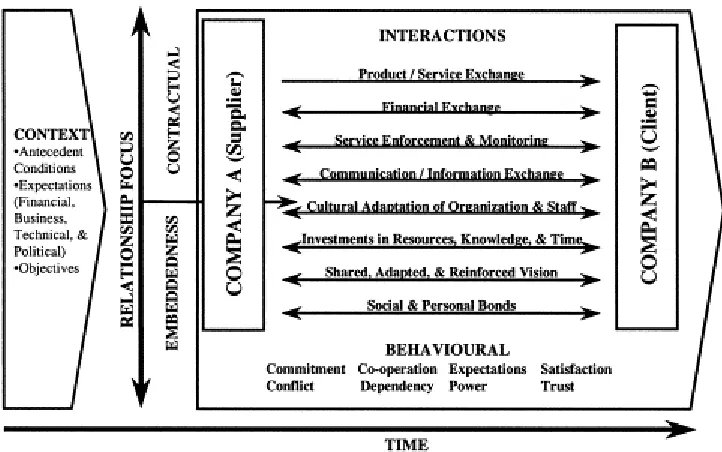
2.7.2 Social exchange and relational contracting ... 36
2.7.3 Structured approaches for implementation ... 37
2.8CONCLUSION... 42
2.8.1 Contribution of the literature ... 42
2.8.2 Towards a conceptual research model... 42
3. EXPLORING THE ROLE OF ENVIRONMENT... 45
3.2CONTEXTUAL APPROACHES IN ISDEVELOPMENT... 45
3.3INTERNATIONAL BUSINESS AND MANAGEMENT... 46
3.4CONCLUSION... 49
3.4.1 Contribution of the literature ... 49
3.4.2 Environmental factors adopted in the research model... 50
4. RESEARCH MODEL ... 51
4.1INTRODUCTION... 51
4.2ITOUTSOURCING PROCESS:KEY-ACTIVITIES... 51
4.3ENVIRONMENTAL FACTORS... 52
4.3.1 National context... 52
4.3.2 Culture ... 54
4.3.3 Operational level variables... 57
4.4CONCEPTUAL RESEARCH MODEL... 58
4.5PILOT CASE STUDY PROTOCOL... 59
4.5.1 Pilot study Issues ... 59
4.5.2 Case selection criteria ... 60
4.5.3 Pilot case study questions ... 60
5. PILOT CASE STUDY... 63
5.1INTRODUCTION... 63
5.2BACKGROUND... 63
5.2.1 Process ownership ... 64
5.3IDENTIFIED OUTSOURCING PHASES... 64
5.4ENVIRONMENTAL FACTORS... 65
5.4.1 National context... 65
5.4.2 Culture ... 68
5.4.3 Operational variables ... 71
5.5CONCLUSIONS PILOT STUDY... 72
6. ADJUSTED RESEARCH MODEL ... 75
6.1INTRODUCTION... 75
6.2OUTSOURCING IMPLEMENTATION PROCESS... 75
6.2.1 Adjusting the operational phase ... 75
6.3ENVIRONMENTAL FACTORS... 77
6.4ADJUSTED RESEARCH MODEL... 77
7. CONCLUSIONS AND RECOMMENDATIONS... 79
7.1INTRODUCTION... 79
7.2LIMITATIONS... 79
7.3CONCLUSIONS... 79
7.3.1 Research objective... 79
7.3.2 Contribution and implication ... 79
7.4RECOMMENDATIONS... 80
7.4.1 Recommendations for practitioners ... 80
7.4.2 Recommendations for further research... 80
7.5REFLECTION... 81
REFERENCES... 83
APPENDIX A: CASE STUDY PROTOCOL ... 93
APPENDIX B: CHARACTERISTICS OF SYSTEMS DEVELOPMENT LIFE CYCLE... 97
List of tables
Table 1 - Various outsourcing definitions ... 20
Table 2 - Multiple criteria evaluation matrix... 24
Table 3 - Problems associated with outsourcing ... 31
Table 4 - Capabilities for achieving superior outsourcing performance... 35
Table 5 - Combining factors with identified phases ... 40
Table 6 - Environments ... 47
Table 7 - National context ... 54
Table 8 - Dimensions of culture ... 56
Table 9 - Operational level variables ... 58
Table 10 - Three distinct sets of activities... 64
Table 11 - Findings national context factors ... 65
Table 12 - Findings cultural factors ... 68
Table 13 - Findings operational variables ... 71
Table 14 - Conflicting causality when applying existing framework... 73
List of figures
Figure 1 - Structure of the research... 17
Figure 2 - Three dimensions of organizational change ... 21
Figure 3 - Matrix of outsourcing options ... 23
Figure 4 - Concentric stratification based on evaluation matrix... 24
Figure 5 - Four worlds of outsourcing ... 26
Figure 6 - Relationship access best-in-class capabilities and control of service delivery 27 Figure 7 - Types of outsourcing relationships ... 27
Figure 8 - Outsourcing as an evolutionary phenomenon.. ... 29
Figure 9 - Factors leading to risks in IT outsourcing ... 33
Figure 10 - Factors leading to undesirable outcomes in IT outsourcing... 34
Figure 11 - Outsourcing relationship model... 37
Figure 12 - The outsourcing process: implementation as structured approaches ... 39
Figure 13 - Preliminary research model... 43
Figure 14 - Domestic and foreign environmental forces... 47
Figure 15 - The Business in Context model ... 48
Figure 16 - Three groups of environmental factors ... 50
Figure 17 - IT Outsourcing process and related factors... 51
Figure 18 - Theoretical research model... 59
Figure 19 - Simplified organizational chart of case study... 63
Figure 20 - ‘Ownership’ phases of the software development life cycle... 64
Figure 21 - The technology transfer course... 76
1. BACKGROUND, PROBLEM DEFINITION AND
METHODOLOGY
1.1 Introduction and research background
The boundary of firms have always taken an important position in business and organizational research, not in the least due to its relevance to competitive advantage and firm performance. Specifically theories such as transaction cost economics and the
resource based view are testament to this (Schilling and Steensma, 2002). Lonsdale and
Cox (2000) formulate four dimensions to the issue of firm boundaries including conglomeration, horizontal integration, vertical integration and internal integration of supporting activities. In relation to these, a multitude of practices have been employed by firms to adjust there boundaries. These include long-term practices such as investments or mergers and acquisitions but also those with typically a more temporary nature such as strategic alliances, joint ownerships or cooperative ventures.
A practice that has come under increased interest is that of outsourcing. While primarily applicable to a firm’s primary supply chain and supporting activities, it is precisely these two dimensions that are increasingly scrutinized by firms looking to reshape their business. Benefits obtained through outsourcing that have widely been recognized include cost reduction, improved quality of service, access to technological expertise, increase flexibility, round the clock service, and assurance of quality development (Ying, 2000; Khan and Curry, 2002; Bahli and Rivard, 2004). In achieving such benefits, the past three decades has seen a number of prominent changes in how the practice of outsourcing is being applied. Where initially firms looked for provision of supporting activities in the 80s and early 90s, activities on their primary value chain have since then increasingly been targeted for outsourcing (Londsdale and Cox, 2000). Currently the kind of work that is targeted for outsourcing are (1) software programming, testing, and maintenance, (2) IT research and development; (3) software architecture, product design, project management, IT consulting, and business strategy; (4) physical product manufacturing—semiconductors, computer components, computers; (5) business process outsourcing (often ‘IT Enabled Services’) such as insurance claim processing, medical billing and accounting (6) call centers and telemarketing (Aspray et al, 2006).
Belonging to the Information Systems development field, it is particularly the first three types of activities that this research is directed towards as outsourcing arrangements in this field have shown to increasingly rely on characteristics typically attributed to partnerships (Lee and Kim, 1999; Kern and Wilcocks, 2000; Lee 2001). Partly due to difficulties in exhaustively stipulating contingencies in contracts and the need for extensive interaction with suppliers, these often termed ‘outsourcing partnerships’ are expected to be exposed to a blend of factors related to both outsourcing as well as to those traditionally associated with joint ventures and strategic alliances.
1.1.1 The role of environment in outsourcing
outsourcer or supplier, or coordination and motivation issues that the agency theory poses as inherent in a relationship between a principal and an agent. However, the views expressed in the previous section pose that both the transaction and the exchange of information do not take place in a void, especially when the outsourcer and supplier are globally dispersed. Instead this research poses that the influence of the environment of both the supplier and the outsourcer must be considered. Similar notions have broadly been adopted in related fields of research; for instance the fact that internationalization requires firms to be aware of the environment in which they operate has been extensively addressed in international business and management literature (see for instance Root, 1994; Ball and McCullugh, 2001; Needle, 2004). This awareness has more recently been expanded in research concerning inter-firm collaborations such as strategic alliances and
joint venture (Douma, 1997; Mulyowahyudi, 2001; Parkhe, 2003). Explicitly recognizing
an environment or a context in which activities are taking place has allowed research in these fields to specifically address a multitude of factors that have proven to be particularly influential. A lack of such recognition in the outsourcing field however is limiting its ability to address these factors. This is surprising as the need to explicitly address issues such as culture-clash, operational incompatibilities, and communication issues are increasingly identified and acknowledged in recent studies (Heeks et al, 2001; Carmel and Tjia, 2005; Patel and Aran, 2005; Cohen and Young, 2006). While some authors are more dedicated to pointing out factors that are influential in relation to these issues, they are only superficially addressed (see for example Smith and Mitra, 1996 and, more recently Krishna et al, 2004 and Kobayashi-Hillary, 2004). Similarly, current best practice approaches for implementing and managing outsourcing largely ignores the role of environmental factors even though they may play an integral role. For instance Heeks et al (2001) identified a number of outsourcing projects who’s failure they partly contribute to such factors (Heeks et al, 2001). Other case studies and surveys also provide indications that they play a role in more fundamental problems such as limitations to
organizational learning, slow efficiency improvements and low service quality (Aurora et
al, 2000 Khan, 2003; SourcingMagazine, 2004; CIO, 2004; Nicholson and Sahay, 2004; Ventoro, 2005).
The observations made in the previous sections and the multitude of reported outsourcing failures constitutes the immediate background of this research. This chapter continues by introducing the research objective and, based on the current state of the IT outsourcing literature, the motivation for the research objective in the next section. This followed by the research questions that will be addressed in section 1.3. The remainder of the chapter describes the adopted research strategy in section 1.4 and 1.5, and concludes with an overview of the structure of this thesis.
1.2 Research objective
environmental factors that are increasingly influential. In addition, in improving the efficiency of their outsourcing portfolio, firms have increasingly turned to selective outsourcing which has resulted in having a multitude of suppliers and thinning out
resources available for managing individual arrangements (Cohen and Young, 2006).
Combining these observations with the fact that environmental factors are only scarcely addressed in existing theoretical models and typically lack comprehensiveness has led to the objective of this research which is:
To contribute to the development of the existing outsourcing literature by exploring the role of environmental factors in the IT outsourcing field.
During the literature study it became clear that the phenomenon of outsourcing itself is prone to several interpretations and that the literature does not provide a concise answer as to what can and what cannot be regarded as outsourcing. An additional research objective therefore is the formulation of a definition of outsourcing in the field of Information Technology as is the focus of this research. This objective is satisfied in the introduction of the literature review.
1.3 Research Questions
The objective of the research that was formulated in the previous section leads to the central research question which is formulated as:
What environmental factors influence the success of outsourcing IT projects?
In order to answer the main research question, five sub research questions are formulated. Since a research model is to be developed, comprehensive theoretical and empirical knowledge about (IT) outsourcing is required. This should specifically identify existing knowledge regarding the outsourcing phenomenon, the main risks and problems associated with it, and the factors that the literature addresses as particularly important. Furthermore, selected literature must be reviewed in order to gain the insights required for proposing a concept that describes environmental factors that are expected to be relevant to the IT outsourcing field. Based on this, the main research question can thus be re-formulated into the following sub research questions:
(1) What are the characteristics of outsourcing when it concerns Information
Technology?
(2) What are the main problem areas associated with outsourcing and what factors are
found to be particularly important?
(3) What is an appropriate concept for an environment in relation to IT outsourcing?
In order to take a first step in determining the ‘correctness’ of the model, a pilot case study is conducted to observe how the research model functions. Due to the exploratory nature of the research the pilot study is also meant to provide additional insights that may contribute to more pertinent propositions. Therefore, a fourth, and final sub research question can be formulated as:
(5) To what extend do empirical findings support the conceptual research model and what additional insights are gained?
1.4 Research approach
As outlined in the research objective, the research is focused on theory development instead of testing an existing theory. According to Wacker (1998) theory building research requires researchers to carefully define concepts, state the domain, explain how and why relationships exist, and then predict the occurrence of a specific phenomenon under study. This must then be followed by gathering of evidence that supports whether the phenomenon occurs. A number of research strategies are available for doing so including surveys, focus groups, experiments, grounded theory, studying the literature and case studies (Saunders, 1997). The approach chosen for carrying out this research consists of a literature study and a case study. These two strategies complement each other as the first results in formulated theory that can subsequently be tested, refined and further developed through case studies (Yin, 2002).
1.4.1 Literature study
According to Eisenhardt (1989), case study research should ideally begin with no theory
or hypothesis. However she concedes that conducting such research is hard to achieve without a priory specification of constructs. Yin (2002) on the other hand says that doing case study research requires researchers to have fundamental knowledge on the subject being studied. He further states that, in order to effectively observe a phenomenon, it is necessary to formulate a research model prior to carrying out a case study. Both of these requirements are addressed by reviewing and analysing the relevant literature. Such review has also allowed the research to build on existing knowledge which is commonly
perceived as an important academic requirement (Saunders, 1997; Hart, 1998).
Furthermore, the extensive amount of publications on outsourcing provides a good opportunity for investigating how existing knowledge may contribute to answering the research questions.
and a conceptual research model. Chapter four also finalizes the theoretical phase by providing the case study protocol and justifying the case selection.
1.4.2 Case study
In adopting a case study approach, three distinct forms can be distinguished: exploratory, developmental and test cases. As this research is focussed on developing a conceptual model, an exploratory case study approach is most appropriate. This leads to a rich understanding of the phenomenon being studied while at the same time allowing for adjustment of the conceptual model based on case study findings (Saunders, 1997; Yin, 2002). More developmental case studies and ultimately a test case are proposed for future research in section 6.2. Another distinction that is made in case study research is between single versus multiple case studies. A multiple case study is more robust as it allows for studying a phenomenon in different settings (Yin, 2002). With an eye on time constraints a single case study was conduced which may be regarded as a pilot case. Despite its limitation, a single case study still allows for observing the appropriateness of a theoretical model and, in accordance to Yin (2002) lead to more pertinent hypotheses and propositions for further research. This is in line with the objective and fits the exploratory nature of the empirical phase which is concluded with an adjustment of the theoretical research model.
1.4.3 Adjusted conceptual research model
As the case study is specifically exploratory in nature, its use mainly contributes to the determination to what extend the proposed model is appropriate in describing, as opposed to explaining, the observed phenomenon. In this phase a number of adjustments and additions to the model will also be proposed that were supported by the findings. In hindsight this further justifies the chosen approach.
1.5 Research reliability and validity
Validity and reliability are of great concern in regards to the overall quality of the research (Yin, 2002; Saunders, 1997). Validity entails that the results of a research, in this case the proposed conceptual model, describes reality with a good ‘fit’. Reliability implies that two or more researchers studying the same phenomenon with similar
purposes reach approximately the same results (Gummesson, 2000). This section
describes these two concerns and discusses what has been done to ensure that these aspects are met.
1.5.1 Reliability
Reliability of the research can be obtained by the adoption of research methods and procedures. For this research a standard procedure for exploratory case study research was adopted. A case study protocol was used in performing the case study and the steps of the research have been documented.
1.5.2 Construct validity
interviews and documentation as tools for gathering data during the case study. Since the case study was performed on company premises, the method of observation was also used in relation to the case study issues. Data source triangulation has been obtained through multiple interviews with various people concerning similar subjects. Respondents were also from distinct groups (junior/senior employees and Project Managers/Developers) and can therefore be expected to provide different points of view. When this approach has yielded conflicting data, an attempt has been made to determine what could cause such difference and which has the highest likelihood of correctness. Lastly drafts of the case study findings were continually discussed with two key participants that were particularly knowledgeable about the issues discussed in interviews. This, according to Yin (2002) should further increase validation of the findings.
1.5.3 Internal validity
Internal validity is of specific concern to explanatory research where causal relationships are to be determined. Since this research does not determine such causal relationships but merely propositions concerning such relationship, internal validity does not apply.
1.5.4 External validity
External validity deals with the extent to which the research findings can be generalized beyond the immediate case study (Yin, 2002). To achieve this, a theory must be tested by replicating findings in a number of case studies. Since a single, exploratory case study is performed, the relevance of this research lies largely in generating findings that can act as
arguments for future, more exemplary case studies (Yin, 2002). As such the requirement
1.6 Report structure
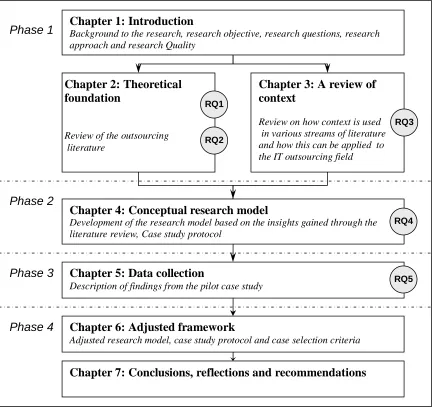
[image:17.612.92.524.294.701.2]This report is structured in four phases that are described over seven chapters. The first phase constitutes the first three chapters and provides the theoretical foundation for the research model. Chapter two is the result of a review of the existing outsourcing literature and answers the first two research questions while the third chapter provides the required insights used to answer the third research question. This sets the conditions for the second phase of the research which is the proposition of the research model and the case study protocol and provides the answer to the fourth research question. This is followed by the empirical phase in which the proposed model is applied in a pilot case study. The findings are used to make several adjustments to the research model as well as to the guidelines and selection criteria for future field work. The fourth phase concludes the research by providing a provisional answer to the main research question, discusses to what extend the research objective was met, and makes recommendations for future research.
Figure 1 - Structure of the research
Chapter 1: Introduction
Background to the research, research objective, research questions, research approach and research Quality
Chapter 2: Theoretical foundation
Review of the outsourcing literature
Chapter 3: A review of context
Review on how context is used in various streams of literature and how this can be applied to the IT outsourcing field
Chapter 4: Conceptual research model
Development of the research model based on the insights gained through the literature review, Case study protocol
Chapter 5: Data collection
Description of findings from the pilot case study
Chapter 7: Conclusions, reflections and recommendations
Phase 1
Phase 2
Phase 3
Phase 4 Chapter 6: Adjusted framework
Adjusted research model, case study protocol and case selection criteria RQ1
RQ4 RQ2
RQ3
2. THEORETICAL FOUNDATION
2.1 Introduction
The purpose of a literature review is to provide insights into the knowledge and ideas that have been established on the research topic. Both identifying what is known about the topic as well as what has not yet been addressed is required before a contribution to the theory can be proposed (Hart, 1998). For this literature review the emphasis lies on gaining insights on outsourcing regarding its characteristics, success criteria, and influencing factors. These insights provide the theoretical foundation for the preliminary model presented in the concluding section of this chapter. Since Delen (2000) has indicated that the concepts of IT outsourcing and business process outsourcing are very similar, this chapter draws both from the outsourcing literature specific to the IT field as well as from general outsourcing literature. The chapter will begin by addressing the question of defining the research topic. Formulating of such definition is important since it provides boundaries on the relevance of the proposed theoretical model and reduces ambiguity regarding its applicability.
2.2 Definition of IT outsourcing
In very general terms, outsourcing refers the phenomenon related to the obtainment of products or services from external suppliers in exchange for a fee. A more specific definition is not univocally provided by the literature. Instead authors use varying terminology and scope when addressing the outsourcing phenomenon and frequently adopt marketing oriented terms (Carmel and Tjia, 2005). While there are clearly similarities and a distinct overlap between the adopted definitions, it is apparent that out-tasking the maintenance of computer hardware has substantially different dynamics then outsourcing part of the IS function involving hundreds of employees and several departments. This pertains to its functioning, overseeability and impact on firm performance.
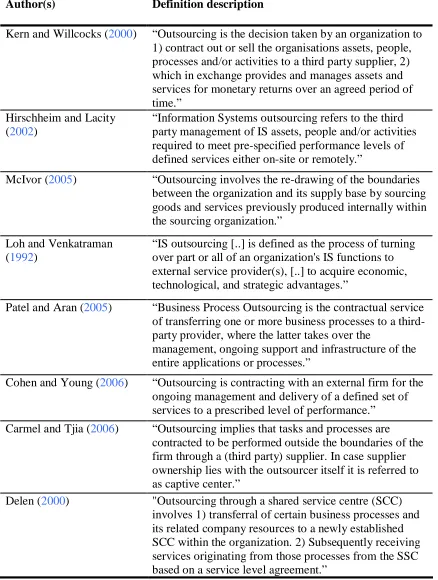
2.2.1 Most relevant definitions of outsourcing
Table 1- Various outsourcing definitions
Author(s) Definition description
Kern and Willcocks (2000) “Outsourcing is the decision taken by an organization to
1) contract out or sell the organisations assets, people, processes and/or activities to a third party supplier, 2) which in exchange provides and manages assets and services for monetary returns over an agreed period of time.”
Hirschheim and Lacity (2002)
“Information Systems outsourcing refers to the third party management of IS assets, people and/or activities required to meet pre-specified performance levels of defined services either on-site or remotely.”
McIvor (2005) “Outsourcing involves the re-drawing of the boundaries
between the organization and its supply base by sourcing goods and services previously produced internally within the sourcing organization.”
Loh and Venkatraman (1992)
“IS outsourcing [..] is defined as the process of turning over part or all of an organization's IS functions to external service provider(s), [..] to acquire economic, technological, and strategic advantages.”
Patel and Aran (2005) “Business Process Outsourcing is the contractual service
of transferring one or more business processes to a third-party provider, where the latter takes over the
management, ongoing support and infrastructure of the entire applications or processes.”
Cohen and Young (2006) “Outsourcing is contracting with an external firm for the
ongoing management and delivery of a defined set of services to a prescribed level of performance.”
Carmel and Tjia (2006) “Outsourcing implies that tasks and processes are
contracted to be performed outside the boundaries of the firm through a (third party) supplier. In case supplier ownership lies with the outsourcer itself it is referred to as captive center.”
Delen (2000) "Outsourcing through a shared service centre (SCC)
2.2.2 Comparison of definitions
As is evident from table 1, typical definitions revolve around the fact that 1) they concern processes or activities that are performed in-house, 2) the execution of these is moved outside of a company’s physical walls. Furthermore, regardless of whether a process is outsourced to an internal department (captive centre or SSC) or to a third party, it can be said that 3) ownership and control over how the process is executed and the necessary resources, such as people and assets are transferred to an external supplier. Finally, as indicated in the introduction, this research focuses on the Information Technology outsourcing which implies that the process that is transferred pertains to one or more phases of the Software Development Life Cycle. This leads to the following definition:
The characteristics of the Software Development Life Cycle are schematically presented in Appendix C.
2.2.3 Outsourcing as strategic organizational change
The research background and the formulated definition indicate that outsourcing shares characteristics with the phenomenon of strategic organizational change. For instance outsourcing inherently reshapes firm boundaries and the sourcing of goods or services previously performed in-house changes the role of human resources. This has also been
mentioned by Willcocks, Reynolds and Feeny (2007) who observe that both IT
Outsourcing and Business Process Outsourcing arrangements alike involve “[..] immense organizational, technical, and human resource changes [..]” (p.129). Therefore it is argued that an organizational change perspective can serve as an appropriate holistic basis for reviewing the outsourcing literature. More specifically this research uses the framework of organizational change as put forward by Pettigrew and Whipp (1991) consisting of the dimensions of process, content and context. Particularly the occurrence of the latter makes their framework attractive for this research as the objective is to add insights in this area.
Figure 2 - Three dimensions of organizational change (Pettigrew and Whipp, 1991)
The framework is originally proposed to holistically capture organizational change within single firms due to for instance process re-engineering, the introduction of new
technologies, new market expansion, or Quality Management implementation (Pettigrew
and Whipp, 1991; Irianto, 2005). An essential difference with such view of organizational change and outsourcing, is that the latter inherently involves two organizational entities involved instead of one (e.g. the outsourcing firm and supplier).
2.3 The outsourcing decision
Topics surrounding the outsourcing decision are typically the source of much debate (Kakabadse and Kakabadse, 2003). Based on findings from recent case studies it can be concluded however that the outcome of outsourcing is more successful if the decision is based on strategic considerations rather than being based on ad-hoc, experimental drivers or prompted by financial problems or shareholder pressures (Brandes et al, 1997; Ventoro, 2001). The literature shows several insights prescribing the outsourcing decision. Commonalities is that they revolve around determining what activities are potential candidates for outsourcing, and when to outsource these. The following describes several theories that prescribe methods and insights regarding the outsourcing decision.
2.3.1 Core versus non-core
One of the most basic approaches to the outsourcing decision is rooted in a resource-based perspective and revolves around determining the core capabilities of firms. These capabilities are the source of a firm’s competitive advantage over its rivals and that are hard for competitors to imitate (Carmel and Schumacher, 2006). As these are have the highest impact on competitive position and profitability, they should not be outsourced and hence the basis of the outsourcing decision lies with established knowledge about a firm’s core and none-core competencies so that the former can be kept in house while the latter are candidates for outsourcing (Prahalad and Hamel, 1990; Quinn, 1999). This approach has however had criticism in being too simplistic and not taking into
consideration numerous other factors involved the outsourcing decision (Saunders, 1997;
Lankford 1999; Baldwin et al, 2001; Kakabadse and Kakabadse, 2003). This is especially the case in IT that is largely seen as a corporate function in non-IT companies while in software development companies it has become increasingly difficult to determine what IT development activity is core (Carmel and Tjia, 2006).
2.3.2 Matrix of outsourcing options
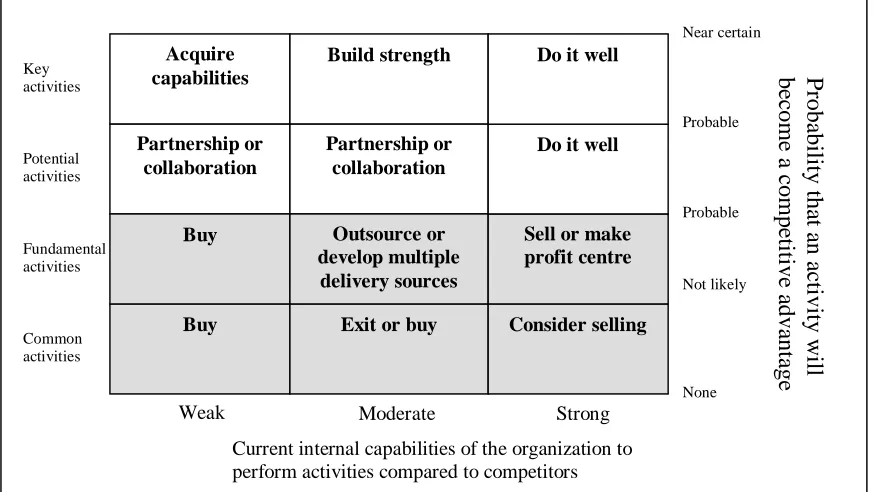
Figure 3 - Matrix of outsourcing options (Patel and Aran, 2005)
Based on a matrix as shown above a determination is made whether activities should be outsourced, performed using a partnership, or kept in-house. The top and bottom most layers are the most straightforward. Key activities are those that will, with near certainty provide organizations with competitive advantage and should always be kept in house. When current capabilities in these activities are weak, resources should be invested to acquire these capabilities. Commodity activities consist of those that provide no competitive advantage and should be sold so that proceeds can be invested elsewhere. Emerging activities may provide competitive advantage in the future (i.e. become a core-competency) and should therefore not be fully outsourced. Instead, when current capability is weak/moderate, companies should develop capabilities through partnerships so that risk is shared with the supplier while involvement is maintained to facilitate possible internalization in the future. When current capability in emerging activities is already strong and little additional investment is required they should be kept in-house to retain full control and ownership. The same is true for basic activities that have little probability in providing competitive advantage but are a business necessity. These may also be kept in-house in order to stay knowledgeable in a particular area to remain a smart buyer (Patel and Aran, 2005).
2.3.3 Activity ranking
One of the complications of the described approaches is that of differentiating between core and non-core activities is difficult due to various views on what is considered a core-competency. For instance a non-core activity may be a vital underpinning enabling a firm’s core business (Jennings, 1997). An approach that addresses this issue is that of Franceschini and Galetto (2003) who propose the use of a multiple criteria decision aiding method to achieve a ranking of activities to be outsourced. This method transcends the considerations made in the pervious sections by not only citing core and non-core activities but also determining relative importance of activities using a weighed score.
Acquire capabilities Partnership or collaboration Buy Build strength Partnership or collaboration Outsource or develop multiple delivery sources Near certain Probable Probable
Buy Exit or buy
Not likely
None Sell or make
profit centre
Consider selling Do it well Do it well
Weak Moderate Strong
Current internal capabilities of the organization to perform activities compared to competitors
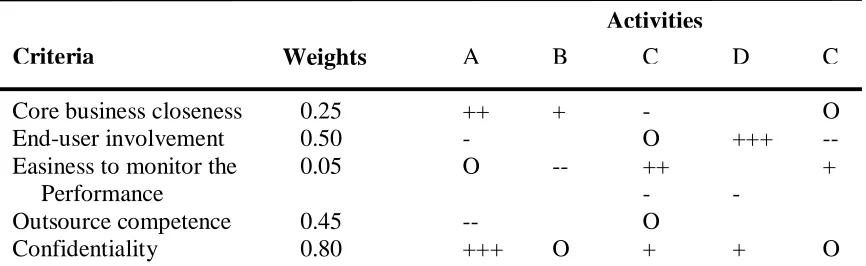
Table 2 - Multiple criteria evaluation matrix (Franceschini and Galetto, 2003)
This approach starts with the introduction of criteria such as total cost, easiness to monitor performance, and core business closeness. These are then weighted based on the importance that firms place on them so that activities can be valued based on their score in relation to the criteria. As a result the resultant matrix shows the relative strength of the relationship between the criteria and a particular activity. The criteria shown in table 2 results in a concentric stratification of activities as illustrated in the following figure.
Figure 4 - Concentric stratification based on evaluation matrix (Franceschini and Galetto, 2003)
The more externally placed activities are selected to be outsourced first. Activity B and E show the most potential for being outsourced since they have low to medium scores on the important criteria. Activity A is the least attractive candidate using this approach as it scores high on criteria that are considered especially important.
2.4 Outsourcing typologies
The previous discussion illustrates that firms have different motivations and expectations regarding their outsourcing efforts. This leads to the question of what forms of outsourcing arrangements are used by firms to satisfy these expectations. This section elaborates on two ways in which the literature classifies outsourcing arrangements. The first is based on the value achieved from outsourcing while the second is based on the relationship between the outsourcing firm and its supplier.
Criteria Weights
Activities
A B C D C
++ - O -- +++ + -- O - O ++ - O + +++ - + O -- + O 0.25 0.50 0.05 0.45 0.80 Core business closeness
End-user involvement Easiness to monitor the
[image:24.612.97.530.367.479.2]2.4.1 Type of value outcomes and delivery modes
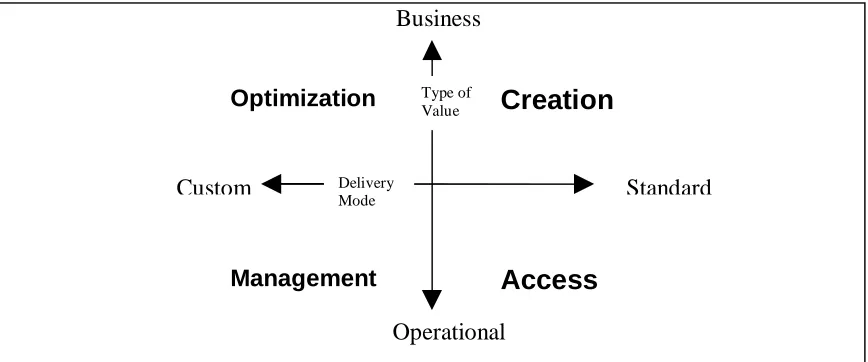
Both Cohen and Young (2006) and McIvor (2005) categorize outsourcing based on the type of value that is delivered by the supplier. McIvor differentiates between value that provides a direct impact on business outcomes, and which are therefore critical to competitive advantage, and value pertaining to costs and bottom line performance. He also relates activity importance to the volume and costs associated with sourcing an activity in relation to other purchases. He further stresses that activities with little associated cost and little impact on business outcomes do not have a ‘low value’ but require less strategic attention in managing the supplier relationship (McIvor, 2005). Similarly, Cohen and Young (2006) differentiate between processes that lead to strategic value on the one hand and operational value on the other. The latter concerns those services that have no direct relation to business goals, and whose impact on these goals is generally difficult to measure. These focus on so called operational concerns such as lowering costs or increasing productivity. Services that provide business value on the other hand, directly impact strategic business goals by contributing to competitive advantage, increasing brand dominance or by improving capability for innovation.
Figure 5 - Four worlds of outsourcing (Cohen and Young, 2006)
In the top quadrants fall the services that provide outcomes with business value.
Depending on their delivery mode these are termed optimization and creation
respectively. Services that provide value of operational value belong to the quadrants
termed management and access where the former provides these in a customized delivery
and the latter through standardized means.
2.4.2 Relationship types
The previous section illustrates that outsourcing arrangements can be categorized based on the value objective and its subsequent mode of delivery. These characteristics are important shapers for determining the appropriate type of relationship between outsourcer and supplier (McIvor, 2003; Francheschini and Galetto, 2003). Other factors of importance are that of accessibility to best-in-class capabilities and degree of risk in the
supply market (Cohen and Young, 2006; McIvor, 2003).
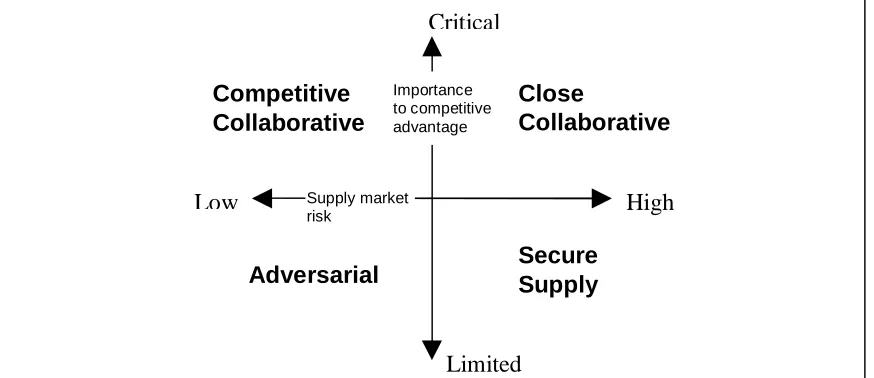
According to McIvor (2003), the importance of the objective to competitive advantage
constitutes one of the key factors that determine the attention required for managing the supplier relationship and in turn whether the supplier relationship should be more collaborative as opposed to being arms length. This is also stressed by Cohen and Young (2006) who indicate that those outsourcing arrangements that generate business value as opposed operational value lead to higher relationship complexity due to more interaction and service levels that are difficult to measure. Other aspects that increase complexity are integration, joint problem solving, goal adjustments, inter-organizational information exchange and sharing of risks and benefits (Francheschini and Galetto’s, 2003; McIvor, 2005; Ross and Beath, 2006). These kinds of requirements are difficult to stipulate in the type of contracts required for arms length relationships and requires more collaborative relationships. Processes with low importance to competitive advantage on the other hand do not require this as they are typically standardized and commoditized. These can therefore be managed through quantity- and quality based metrics (Cohen and Young, 2006). An advantage of the latter is that it allows for selecting best-in-class suppliers at the best price. This is typically not feasible through more collaborative arrangements (McIvor, 2003; Cohen and Young, 2006). These considerations largely determine the outsourcing relationship options illustrated in figure 6.
Custom Standard
Operational Business
Optimization
Creation
Access
ManagementDelivery Mode
Figure 6 – Relationship between access to best-in-class capabilities and control of service delivery (Cohen and Young, 2003)
As an additional defining characteristic for choosing a relationship option, McIvor (2003) stresses the importance of supply market risk. This leads outsourcing firms to incur some degree of risk that entails opportunistic behaviour of the supplier and reduction of control
over outsourced processes (McIvor, 2003). The supply market risk related to the former
can be attributed to the number of buyers and suppliers, degree of specificity, level of uncertainty and availability of information (McIvor, 2003; Francheschini and Galetto, 2003). Uncertainty in the environment increases supply market risk as conditions such technology or market demand may change during the duration of the contract. Renegotiating is typically expensive and may lead to opportunism. Depending on the activity importance and degree of supply market risk the four relationship types as stipulated in figure 7.
Figure 7 – Types of outsourcing relationships (McIvor, 2003)
The above figure shows that the collaborative nature of the outsourcing relationship can be characterized as either competitive or close depending on the supply market risk. In the latter case, the outsourcer depends on a number of suppliers that can be played off against each other by allocating business depending on performance. A similar split can be identified amongst arms length relationships that require limited interaction and are
Internal delivery Shared services Branded-services Full-service outsourcing Prime contractor Best-of-breed consortium Selective outsourcing Higher Control of Service Delivery Access to
best-in-class capabilities Arms length Cooperative Build Lower Higher Limited Critical Competitive Collaborative Secure Supply Adversarial
Low High
[image:27.612.91.528.430.619.2]typically uni-directional. An adversarial strategy is applicable when the supply market is competitive, allowing buyers to rapidly switch suppliers. In cases where supply market risk is high, outsourcing firms can ensure continuity of supply by establishing longer-term relationships and agree on consigned stock arrangements. This type of relationship is termed secure supply (McIvor, 2003).
2.5 Evolving outcomes and expected objectives
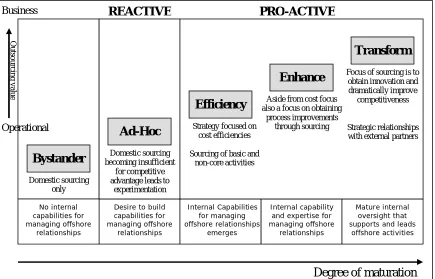
The literature indicates that the desired objectives from outsourcing depend heavily on a company’s experience, strategic focus, types of processes, stakeholder preference and environmental forces (Ventoro, 2005; Cohen and Young, 2006). Moreover there is a interrelation between what activities are outsourced and what the underlying motivations are. Specifically, Quelin and Duhamel (2003) argue that cost reductions, while important, are but one objective. Others include achieving greater flexibility, increased productivity, gaining competitive advantage, or increasing quality (Siakas, 2006; McLellan and Marcolin, 1995; Quelin and Duhamel, 2003). Furthermore, the literature demonstrates an evolutionary tendency governing these aspects.
The first authors to introduce a notion of maturation are Monczka and Trent (1991) in the domain of international sourcing. In their model, companies initially show a reactive approach (such as environmental or shareholder pressures) and subsequently become more pro-active in their sourcing strategies as their experience increases. A pro-active stance is characterized by the international sourcing being part of the global strategy and being fully integrated and coordinated in its operating units. An important implication is that the overall supplier relationship complexity will increase and the main condition for moving along this evolution is therefore characterized by a company’s ability to manage this increased relationship complexity. Carmel and Agarwal (2002) introduce the SITO stage model (Sourcing of IT Offshore) based on research in the field of off-shoring of IT work by U.S. firms. Their model also describes a perceived progression of stages where each stage can be characterized by a set of strategic imperatives and internal firm dynamics. Similarly, Cohen and Young (2006) describe so called ‘service deals’ and argue that evolutionary progression also changes the nature of the value provided from
Figure 8 – Outsourcing as an evolutionary phenomenon. Adapted from Monzka and Trent (1991), Carmel and Agarwal (2002), Cohen and Young (2006).
2.5.1 Ad-Hoc and cost focussed outsourcing
This phase is generally focussed on experimentation and is often characterized by a company looking to see how outsourcing might work for them. Companies may have different motivations for experimentation but typically there is no immediate necessity for outsourcing at this stage. Motivations include obtaining quick cost advantage, following general trend, or pressure from the board of directors or shareholders (Ventoro, 2005). More pressing considerations such as a tight local labour market also drives companies to experiment with outsourcing. For example US companies facing a tight IT labour market in the end of the 90’s were forced to find alterative labour supply. Many Y2K remediation projects were subject of outsourcing because of this very reason (Carmel, 2006). Cost reduction can also be a pressing force when profit margins dissipate. Since cost efficiencies in this phase generally remain characteristic, the outsourced activities generally impact the bottom line performance and typically have
limited importance to competitive advantage (Monzka and Trent, 1991; Cohen and
Young, 2006). Kobayashi-Hillary (2004) typifies these as tactical processes since they relate to a specific problem or task and are generally short termed (Kobayashi-Hillary, 2004). Because the outsourcing decision is typically based on limited argumentation, companies in this phase are vulnerable for risks such as loosing core competencies, exposure of intellectual property or exposure of company secrets to competitors (Glass, 2004). Research by Berends (1997) also implies this by showing that the outcome of outsourcing is more successful when it is based on strategic decisions rather then from ‘emergency action’. Cohen and Young (2006) stress this also and their evolutionary model starts with the assumption that companies have formulated a sourcing strategy and
No internal capabilities for managing offshore
relationships
Desire to build capabilities for managing offshore relationships Internal Capabilities for managing offshore relationships emerges Internal capability and expertise for managing offshore
relationships
Mature internal oversight that supports and leads
offshore activities Bystander Ad-Hoc Efficiency Enhance Transform Domestic sourcing only Domestic sourcing becoming insufficient for competitive advantage leads to
experimentation
Strategy focused on cost efficiencies
Sourcing of basic and non-core activities
Aside from cost focus also a focus on obtaining
process improvements through sourcing
Focus of sourcing is to obtain innovation and dramatically improve
competitiveness
Strategic relationships with external partners
REACTIVE PRO-ACTIVE
have a good understanding regarding what process(es) to outsource and what to keep internally.
2.5.2 Enhancement focussed outsourcing
After the initial stage, the evolutionary tendency lies in moving the scope from an experimental or cost focussed approach to one that can be characterized by the obtainment of operational enhancements. Since companies have limited resources, considerations other then transaction costs need to be made in order to obtain the biggest leverage from these resources. This implies allocating resources to those activities that generate this leverage while outsourcing those that do not. This also involves processes that companies may be able to perform internally but would require significant investment of existing (scarce) resources. Furthermore, firms may be economically unable to generate these capabilities and resources internally and as such have no other
option but to source these from external suppliers (Cohen and Young, 2006). This phase
is therefore characterized by firms contracting suppliers who are better capable of executing the outsourced activity. These contracts offer companies ways to gain relevant capabilities without having to become knowledgeable in issues that they are not skilled in and do not want to invest in (McFarlan and Nolan, 1995). This was also identified in the transformation of the IT function at British Petroleum. In 1990 British Petroleum concluded that most of their current IT function was better done by suppliers since there is always someone else who ‘does it better’. They subsequently reorganized their IT function as locating, purchasing and integrating of technologies (Cross, 1995). A recent study also shows this trend as 23% of involved companies are using considerations such as: ‘improve time to market’, ‘improve quality’ and ‘cost predictability’ (Ventoro, 2005). Using Monczka and Trent’s terminology this implies a more pro-active focus as opposed to one that is re-active.
2.5.3 Transformation through outsourcing
Motivations for outsourcing has more recently also shown to include obtainment of technical skill-sets and industry expertise Ventoro (2005). These go beyond a question of resource allocation and deal with value creation through initiating supplier relationships. Cohen and Young (2006) typify this in their ‘service deals’-model as a state in which a transformation is taking place in the way a company does business. This implies that the outcome of outsourcing in this phase is to dramatically improve the very competitiveness of the organization by creating new revenues, outmanoeuvring the competition and change the basis on which a corporation operates. These activities are close to a firm’s core business and give the ability to find ways to drive innovation, increase process speed and provide a high degree of flexibility (McIvor, 2005; Franceschini and Galletto, 2003). While considerations regarding transaction costs and resource allocation still apply, the reasoning behind why processes are outsourced is based on fulfilling strategic concerns. As such suppliers increasingly find themselves competing head on with traditional
onshore businesses (Loh and Venkatrama, 1995). Their study also points to the need for
2.6 Outsourcing problems and risks
While the practice of outsourcing provides firms with a mechanism to reduce cost, enhance operations, and transform the way they do business, it also adds additional risks and costs. Based on the outsourcing decision, the impact of costs is expected to be outweighed by the expected advantages and cost savings. However, outsourcing also carries additional risks and introduces additional problems. Citations of these are
abundant in the outsourcing literature (see for instance Elmuti and Kathawala 2000; Min
and Hokey, 1994). Often such problems are the motivation for research relating to
outsourcing (see for example Kakabadse and Kakabadse, 2003; Aubert et al, 2007). Both
escalating costs and unmanageable risks constitute the most commonly cited reason for
back sourcing (Hirschheim and Lacity, 2007; CIO, 2007).
2.6.1 Risks and problems associated with outsourcing
Aubert et al (2004) describe four types of risk: (1) a variance of distribution outcomes, (2) a probability of an adverse outcome, (3) an expected loss based on a probability function and a loss function and (4) as an undesirable event. The latter perspective concerns a wide range of negative events that are of material threat to an organization and seems to fit best in this research as it concerns the events that take place during an outsourcing arrangement that negatively affects the value that is to be achieved. These are not limited to the bottom line but may also be impact degree of product quality, time to market or speed of innovation (Momme, 2002). Therefore outsourcing risk can be presented as a direct, quantitatively measurable loss like poor turnaround times or hidden costs but may also have a qualitative proponent that describes more strategic loss such as loss of expertise, reduced innovative capacity or exposure of intellectual property (Aubert et al, 1998; Glass, 2004; Kakabadse and Kakabadse, 2003). An overview of issues cited by selected literary sources is shown in table 3.
Table 3 – Problems associated with outsourcing
Issues Sources
Strategic
Loss of core competence
(Aubert et al, 1998; Barthelemy, 2001; Kakabadse and Kakabadse, 2003)
Supplier dependence (Willcocks and Lacity, 1999; Kakabadse and Kakabadse,
2003; McIvor, 2004)
Inflexibility (Willcocks and Lacity, 1999; Aubert et al, 1998; Elmuti and
Kakabadse, 2003) Morale decline own
employees
(Elmuti and Kakabadse, 2003; Kakabadse and Kakabadse,
2003)
Loss of IP (Kakabadse and Kakabadse, 2003; Carmel and Tjia, 2005)
Exposed company secrets
(Carmel and Tjia, 2005)
Loss of expertise (Aubert et al, 1998; Willcocks and Lacity, 1999; McIvor,
2004; Carmel and Tjia, 2005) Loss of innovative
capacity
Confidentiality issues (Khan, 2002; Elmuti and Kakabadse, 2003)
Relationship
Supplier opportunism (Khan, 2002; Kakabadse and Kakabadse, 2003; McIvor,
2004)
Loss of control (Aubert et al, 1998; Elmuti and Kakabadse, 2003; Veltri,
2007)
Poor relationship (Min and Hokey, 1994)
Corruption (Carmel and Tjia, 2005)
Culture issues (Khan, 2002; Elmuti and Kakabadse, 2003)
Legal issues (Elmuti and Kakabadse, 2003)
Disputes and litigation (Aubert et al, 1998; Veltri, 2007; Veltri, 2007) Difficulties
renegotiating contracts
(Aubert et al, 1998; Willcocks and Lacity, 1999)
Economic / Operational
Supply interruptions (Kakabadse and Kakabadse, 2003)
Diminished quality of product/service
(Min and Hokey, 1994; Aubert et al, 1998; Kakabadse and Kakabadse, 2003)
Poor performance (Min and Hokey, 1994; Veltri, 2007)
Data exposure (Kobayashi-Hillary, 2004; Carmel and Tjia, 2005)
System exposure (Carmel and Tjia, 2005)
Hidden costs (Aubert et al, 1998; Barthelemy, 2001; Khan, 2002; Elmuti
and Kakabadse, 2003)
Miscommunication (Elmuti and Kakabadse, 2003; Kobayashi-Hillary, 2004)
Increased costs (Aubert et al, 1998; Hirschheim and Lacity, 2002; McIvor,
2004; Veltri, 2007) Geopolitical/Country
risk
(Khan, 2002; Kobayashi-Hillary, 2004; Carmel and Tjia,
2005)
As table 3 illustrates, the literature adopts varying perspectives in citing outsourcing risks. Several use risk to express negative outcomes such as loss of control, disputes and litigation, and reduced quality of service. These authors typically relate these issues to the outsourcing decision1 or to best-practice approaches for coping with them2. The other perspective uses risk to refer to the conditions leading to negative outcomes such as poor infrastructure or corruption (Aubert et al, 1998). For instance Elmuti and Kakabadse (2003) describe both political problems and loss of control as outsourcing risks but clearly they differ in that the latter has a direct negative effect while the first may or may not lead to such effect. These different perspectives account for the variety of issues, risks and potential problems being cited. The next section deals specifically with those conditions that may lead to cited negative consequences.
1
See for instance Kakabadse and Kakabadse (2003)
2
2.6.2 Outsourcing risk factors
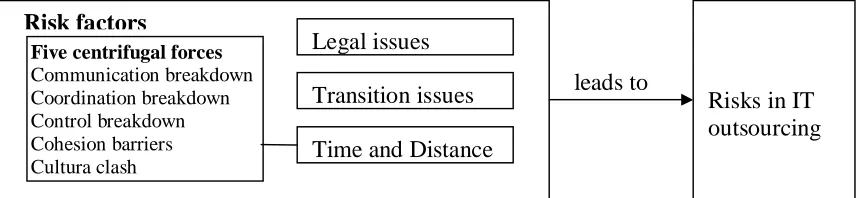
[image:33.612.95.525.197.296.2]While a majority of literature focuses on negative consequences themselves, a number of authors identify the factors leading to such consequences. For instance Carmel and Tjia (2006) cite legal issues, the transition of resources, and the introduction of distance and time as the three main factors responsible for causing problems typically encountered in IT outsourcing. They furthermore identify five so called centrifugal forces resulting from the aspect of distance which they state: “causes team members to be propelled apart from each other” (Carmel and Tjia, 2006, p.56).
Figure 9 - Factors leading to risks in IT outsourcing (Carmel and Tjia, 2006)
While the above figure provides insights from a practical point of view on factors that contribute to problems, the cited factors resulted from personal experience in several outsourced projects over the last 20 years. As such it does not provide a sound empirical foundation for their conclusions but derive these from personal reasoning and normative
judgement. Aubert et al (1998, 2007) on the other hand offer an academic approach using
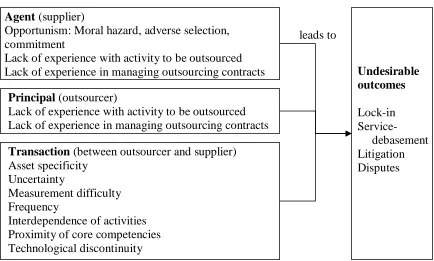
a risk assessment perspective. As theoretical foundation both the transaction cost theory and the agency based perspectives are used for categorizing risk factors. As such factors are structured to those inherent to the relationship between the outsourcer and supplier (using agency theory perspective) and transactional characteristics between them (using a transaction theory perspective) (Aubert et al, 1998, 2007). Building upon these findings, Bahli and Rivard (2003) subsequently cite the most common undesirable consequences that these factors may induce including cost escalations, service debasement, lock-in, disputes and litigation1.
1
Aubert et al (1998) also cite commonly occurring negative consequences as provided in table 3 but they do not offer a causal relation between these and the risk factors described in their empirically tested framework.
Legal issues
Transition issues
Time and Distance
Risks in IT outsourcing
Five centrifugal forces
Communication breakdown Coordination breakdown Control breakdown Cohesion barriers Cultura clash Risk factors
Figure 10 - Factors leading to undesirable outcomes in IT outsourcing (Aubert et al, 1998; Bahli and Rivard, 2004)
2.7 Outsourcing implementation
Risk assessment and management are important contributors to the success of an IT outsourcing venture (Aubert et al, 1998). As such a substantial part of literature prescribes implementation approaches and strategies that should contribute to the achievement of enhanced value, decreased risk uncertainty and cost reductions (Franceschini and Galetto, 2001; Kakabadse and Kakabadse, 2003; McIvor, 2005; Cohen and Young, 2006). The literature shows several perspectives pertaining to implementation of outsourcing arrangements consisting of both prescriptive and descriptive orientation including key implementation capabilities, structured approaches for successful implementation, and relational and social exchange considerations.
2.7.1 Key-capabilities for implementation
Several authors stress the capabilities that firms should posses in order to successfully implement an outsourcing arrangement. These capabilities are either distilled from research where certain competences were present in firms that were more successful in outsourcing compared to others or are based on authors’ experience in the field of outsourcing (see, for example, Carmel and Tjia, 2006; Cusick and Prasad, 2006). This section largely focuses on findings from the Cranfield study by Kakabadse and Kakabadse, (2003). This survey amongst seven hundred and forty-seven organizations showed that sixty-nine firms exhibited the characteristic of ‘best practice’1 who were at the same time identified as high performing compared to the remainder of the sample.
1
Best practice is determined in the Cranfield study to be “the degree to which there exists a visible commitment at top management level to the strategic direction being pursued by the organization and consequently the value outsourcing contributes to strategy” (Kakabadse and Kakabadse, 2003).
Agent (supplier)
Opportunism: Moral hazard, adverse selection, commitment
Lack of experience with activity to be outsourced Lack of experience in managing outsourcing contracts Small number of suppliers
Undesirable outcomes
Lock-in Service-
debasement Litigation Disputes Principal (outsourcer)
Lack of experience with activity to be outsourced Lack of experience in managing outsourcing contracts
Transaction (between outsourcer and supplier) Asset specificity
Uncertainty
Measurement difficulty Frequency
Interdependence of activities Proximity of core competencies Technological discontinuity
[image:34.612.90.524.65.326.2]