Training Data Augmentation for Low-Resource Morphological Inflection
Toms Bergmanis∗Katharina Kann† [email protected]
Hinrich Sch¨utze† [email protected]
Sharon Goldwater∗ [email protected]
∗School of Informatics
University of Edinburgh
†Center for Information & Language Processing
LMU Munich
Abstract
This work describes the UoE-LMU sub-mission for the CoNLL-SIGMORPHON 2017 Shared Task on Universal Morpho-logical Reinflection, Subtask 1: given a lemma and target morphological tags, gen-erate the target inflected form. We evalu-ate several ways to improve performance in the 1000-example setting: three meth-ods to augment the training data with iden-tical input-output pairs (i.e., autoencod-ing), a heuristic approach to identify likely pairs of inflectional variants from an un-labeled corpus, and a method for cross-lingual knowledge transfer. We find that autoencoding random strings works sur-prisingly well, outperformed only slightly by autoencoding words from an unlabelled corpus. The random string method also works well in the 10,000-example setting despite not being tuned for it. Among 18 submissions our system takes 1st and 6th place in the 10k and 1k settings, respec-tively.
1 Introduction
Morphological variation is a major contributor to the sparse data problem in NLP, especially for under-resourced languages. The SIGMORPHON 2016 Shared Task (Cotterell et al., 2016) and CoNLL-SIGMORPHON 2017 Shared Task ( Cot-terell et al., 2017) aimed to inspire researchers to develop better systems for morphological inflec-tion across a wide range of languages with vary-ing trainvary-ing resources. In 2016, when over 10,000 training examples were provided for each lan-guage, neural network-based systems performed considerably better than other approaches ( Cot-terell et al., 2016). The 2017 Shared Task there-fore included settings with different amounts of
training data (100, 1000, or 10,000 examples), to examine which approaches might work best when data is even more limited.
We focus on the 1000-example setting of Sub-task 1: given a lemma with its part of speech and target morphological tags, generate the target in-flected form. Our baseline system is the winning system from 2016, the morphological encoder-decoder (MED) from LMU (Kann and Sch¨utze, 2016). We explore methods for improving its per-formance in the face of fewer training examples, either with or without additional data from unla-beled corpora.1
In particular, we focus on various training data augmentation methods. One uses a heuristic ap-proach to identify likely pairs of inflectional vari-ants from an unlabeled corpus in an unsuper-vised way, and uses these as input-output pairs. Three other methods augment the training data with identical input-output pairs—i.e., simultane-ously training the network to perform autoencod-ing. We compare three types of autoencoder in-puts: either lemmas and inflected forms from the training data, words from an unlabeled corpus, or random strings.
We present detailed results and comparisons for various amounts of added training data for all 52 languages of the shared task. We find that all methods improve considerably over the MED baseline (7.2-10.7% across all languages; a 15.5% improvement over the shared task baseline). Most of the benefit comes with only 4k extra examples, but performance continues to improve up to 16k added examples.
After controlling for the amount of additional data, we see only a small benefit from autoen-coding corpus words rather than random strings. Using hypothesized morphological variants works
1We did not pursue the 100-example setting because pre-liminary experiments yielded such low baseline performance that we felt additional work would be unlikely to help much.
as well as random strings. These results suggest that the main advantage of all these methods is providing a strong bias towards learning the iden-tity transformation and/or working as regularizers, rather than learning language-specific phonotac-tics or morpho-phonological changes.2
Finally, following Kann et al. (2017), we test whether cross-lingual knowledge transfer can help, by multilingual training of joint models for groups of up to 10 related languages. However, we find no improvement as compared to using an equivalent amount of random-string autoencoder examples.
Our final submission to the shared task consists of two submissions for Subtask 1 (Inflection): the random string autoencoder for the medium and high data settings of the restricted (main) track and the corpus word autoencoder for the medium data setting of the bonus track (track with exter-nal monolingual corpora). All systems use 16K autoencoder examples and an ensemble of three training runs with majority voting.
In the high resource setting of the restricted track, our system outperforms all 17 other submis-sions, with an average test set accuracy of 95.32% over 52 languages. In the medium resource set-ting, among 18 submissions our system takes the 6th place with 81.02% (1.78% below the top sys-tem). In the medium resource setting of the bonus track, among 2 submissions our system comes first with 82.37%.
2 Baseline MED System
For our baseline system (henceforth MED-baselineorMED), we use the sequence encoder-decoder architecture and input/output format of the 2016 Shared Task winner (Kann and Sch¨utze, 2016). The architecture followsBahdanau et al. (2015): that is, the encoder is a bidirectional gated recurrent neural network (GRU) with attention, and the decoder is a uni-directional GRU. For de-tails, seeKann and Sch¨utze(2016) andBahdanau et al.(2015).
The input sequence consists of space sepa-rated characters of the input lemma—the dictio-nary form of the word—followed by space sepa-rated morphological tags, each prepended with a
2Of course, the morphological variants we find may be noisy, so a better method for identifying these might still im-prove upon random strings.
tag marker, for example:
w a l k t=V t=V.PTCP t=PRS (1)
The target output is a sequence of characters form-ing the inflected word, e.g.,w a l k i n g. 3 Augmenting the Training Data
For the Shared Task, the main competition permits no additional resources beyond the labeled train-ing examples given for each setttrain-ing. However, Wikipedia dumps in each language are provided for teams who wish to explore semi-supervised methods as well. We examine two methods that use only the training data, and two that also incor-porate corpus data. Finally, we explore a method that uses multilingual resources.
3.1 No Outside Resources (AE-TD, AE-RS) Morphologically related words are typically simi-lar in form, and in many cases, parts of the word are copied from the lemma to the inflected form. As suggested byKann and Sch¨utze(2017), we hy-pothesized that training MED to copy strings as a secondary task would help with the morpholog-ical inflection task. That is, we train the model simultaneously on the tasks of morphological re-inflection and sequence autoencoding, interspers-ing inflection traininterspers-ing examples and autoencodinterspers-ing examples. This can be viewed as a form of multi-task learning,3and is equivalent to maximizing the
log-likelihood for both tasks:
L(θ) = X
(l,t,w)∈D
logpθ(w|e(l, t)) (2)
+X
s∈S
logpθ(s|e(s)),
whereDis the labeled training data, with each ex-ample consisting of a lemma l, a morphological
tag t and an inflected form w, and S is a set of autoencoding examples. The functionerepresents
the encoder, which depends onθ.
In the setting with no outside resources we ex-periment with two variants of the sequence au-toencoder. The first of these, AE-TD, uses the
lemmas and target forms in the training data as inputs to the autoencoder, yielding up to twice as many autoencoder inputs as inflection training pairs (any duplicate lemmas or target forms are in-cluded only once).
Our second autoencoder variant, AE-RS, uses randomly generated strings as inputs, which means we can produce an arbitrary number of au-toencoding examples. In this and following sys-tems, we use the postfix XXK (e.g. 1K, 2K, 4K) to indicate the number of additional examples gen-erated. To obtain each example, we first choose its length uniformly at random from the interval [4, 12] and then sample each character uniformly at random from the alphabet of the respective lan-guage.
Input/Output Format We generally follow the input representation outlined in §2, except that morphological tags are replaced with one special tag that stands for autoencoding. The output for-mat does not change.
3.2 Corpus Word Autoencoder (AE-CW) In the setting where corpus data is available we can replace randomly generated strings with cor-pus words (system AE-CW). We hypothesized that autoencoding words from the actual language would give not only the benefit of learning to copy, but also the benefit of learning the character distri-butions typical of a given language.
To select words for the corpus word autoencod-ing task we use Wikipedia text dumps provided for the shared task. We filter out all words shorter than 4 characters. For each language we learn its alpha-bet from the letters that occur in training words of the original SIGMORPHON training sets and fil-ter out all words that contain foreign characfil-ters. We use the remaining words to sample uniformly without repetition the required amount of autoen-coding examples. The input and output formats are the same as for the previous approaches.
3.3 Data Mining for Inflected Pairs (DM) Our next method, DM, mines the corpus data to create new training examples by (a) inferring new lemma-inflected form pairs and (b) predicting the tags of the inflected forms. We describe each step below.
Inferring Lemma-Word Form Pairs Although most work on unsupervised learning of morphol-ogy has focused on decomposing words into
mor-Word 1⇔mor-Word 2 Sim. Dif.
deceive⇔deception dece ive⇔ption
receive⇔reception rece ive⇔ption
perceive⇔perception perce ive⇔ption
conceive⇔conception conce ive⇔ption
Table 2: Pairs of related words, their similarities and the respective differences.
phemes, their constituent parts, e.g., (Kurimo et al.,2010;Hammarstr¨om and Borin,2011), oth-ers have focused on finding morphologically re-lated words and the orthographic patterns relating them (Schone and Jurafsky, 2000; Baroni et al., 2002;Neuvel and Fulop, 2002;Soricut and Och, 2015):
walk⇔walking ε⇔ing (3)
We adopt the algorithm by Neuvel and Fu-lop (2002) to learn Word Formation Strategies (WFS)—frequently occurring orthographic pat-terns that relate whole words to other whole words. The input of this algorithm is a list ofN
words4. The algorithm works by comparing each
of the N words to all other words. It first finds word similarities as the Longest Common Sub-sequence (LCS) between the two words. Then it finds worddifferences as the orthographic differ-ences with respect tosimilarities(see Table2for examples). Finally, all word pairs with the same differenceshave their similaritiesanddifferences merged into one WFS. For example, words in Ta-ble2sanction the following WFS:
∗##ceive⇔ ∗##ception (4)
where * and # stand for the optional and manda-tory character wild cards respectively. The inter-pretation of the WFS in Example4is: “a word that ends withceivepreceded by 2 to 3 characters pre-dicts another word ending with ceptionpreceded by the same 2 to 3 characters” (Neuvel and Fulop, 2002). Table1gives English WFS examples and sample word pairs that warranted their creation.
Tag Prediction To perform labeling we make use of two resources: (i) a word embedding based part of speech (POS) classifier; (ii) the WFS we learned previously.
No WFS Examples
[image:4.595.70.551.60.132.2]1 *********####d⇔*********####s invited-invites, wired-wires, tried-tries 2 ********####ed⇔********####ing trailed-trailing, folded-folding, melted-melting 3 ********####e⇔********####ing violate-violating, liberate-liberating, raise-raising 4 **********####s⇔**********####al comics comical, clinics-clinical, corrections-correctional
Table 1: Examples of word formation strategies and sample word pairs that warranted them.
Each of the original shared task training exam-ples contains two word forms and a set of mor-phological tags including word POS information (see Example 1). We can use words with POS labels and word embeddings to train a POS clas-sifier. Namely we train a support vector ma-chine (SVM) (Cortes and Vapnik, 1995) to pre-dict POS labels using word embeddings as fea-tures. We train word embeddings on the Wikipedia text dumps provided for the task. We use Fast-Text5byBojanowski et al.(2016) to train 300
di-mensional continuous bag of words embeddings (Mikolov et al., 2013) for all words occurring at least 5 times.
For each training example in the SIGMOR-PHON training data we examine each of the pre-viously learned WFS. If the training example fits the WFS’s orthographic constraints, we examine all word pairs that warranted the creation of this WFS. For a word pair to be labeled with the same morphological tags as the training example we re-quire that both words are classified with the same part of speech as the original training example. Input/Output Format To encode the additional training examples we use the same format as for the original ones (see §2) except we add a tag which signals that this example has been automati-cally extracted. We do this as a measure of caution to avoid ambiguities introduced by potentially er-roneous training examples.
3.4 Using Multilingual Resources (MLT) Recently,Kann et al.(2017) showed that training on a high-resource language can improve morpho-logical inflection on a related low-resource lan-guage using an encoder-decoder system like the one here. This can be done using the same network as above, but training on inflection examples from multiple different languages—yet another form of multitask learning, since the model parameters are shared between languages. FollowingKann et al.
5https://github.com/facebookresearch/ fastText/
(2017), our multilingually trained system (MLT) uses the same input format as above, but with an additional tag prepended to each example indicat-ing which language it is from.
Our setup is slightly different from that ofKann et al.(2017), since they had only 50 or 200 exam-ples in each target language, and used only one or two other higher-resource languages for transfer. Here, we have similar amounts of data for each language (1000 examples in most cases), and use larger groups of related languages to train together (see§4).
4 Experiments
Datasets The official shared task data consists of sets for 52 different languages, of which 40 were released as development languages. We used these for our preliminary experiments to compare differ-ent systems and quantities of additional training data. The remaining 12 “surprise” languages were released shortly before the test phase of the shared task, and we report results for our best systems on these as well.6 In the “medium” training data
set-ting, which we focus on in this work, 1000 train-ing instances are given for each language, except for Scottish Gaelic with only 681 instances. Addi-tionally, development sets with 1000 instances are available for all languages except for Basque, Ben-gali, Haida, Welsh with 100 and Scottish Gaelic with 50.
MED Parameters In our experiments we use the same training method and hyper parameter set-tings as suggested by Kann and Sch¨utze (2016). Namely, we use 100 hidden units for the coder and decoder GRUs; 300 dimensions for en-coder and deen-coder embeddings. For training we use stochastic gradient descent, Adadelta (Zeiler, 2012), with gradient clipping threshold of 1.0 and mini batch size of 20. When making predictions
we use beam-search decoding with a beam of size 12.
Baselines We compare our results with two baselines: the SIGMORPHON baseline7 and
MEDbaseline (see§2).
Additional Training Data We train the AE-CW, AE-RS and DM systems with increasing amounts of data: 1k, 2k, or 4k additional train-ing examples. Four thousand traintrain-ing instances is the maximum number of mined training examples available for most languages. We train additional AE-CW and AE-RS systems with 8k and 16k ad-ditional training examples to see if any further per-formance gains are obtainable.
Multilingual Training We train together lan-guages that belong to the same language family. This results in the following groupings: Baltic (Latvian, Lithuanian), Celtic (Scottish Gaelic, Welsh, Irish),Germanic(Danish, Dutch, English, Icelandic, Faroese, German, Swedish, Norwegian-Nynorsk, Norwegian-Bokmal), Finnic (Finnish, Estonian), Iranian (Persian, Sorani, Kurmanji), Romance (Catalan, French, Italian, Portuguese, Spanish, Romanian), Semitic (Arabic, Hebrew), Slavic (Bulgarian, Czech, Lower-Sorbian, Mace-donian, Polish, Russian, Serbo-Croatian, Slovak, Slovene, Ukrainian).
We perform two different multilingual training experiments: First, we train MLT without any additional data. In this setting MED trained on individual languages gives a lower bound—MLT should work no worse than MED. We also train MLT-AE-TDin which the original training data is used to obtain up to twice as many autoencod-ing trainautoencod-ing examples for each language. In this setting the training file of Slavic languages, for example, contains 30K training examples (3K for each language). Here, AE-TD trained on individ-ual languages gives a lower bound on the expected performance. In this setting we also train another stronger and fairer baseline (AE-TD-RS-XK), for which training files for individual languages con-tain exactly the same number of training examples as in the multilingual training case. For exam-ple, the training file for MLT-AE-TD when trained on the Baltic branch has 6k training examples— 1k original and 2k AE-TD examples for each of
[image:5.595.311.530.64.195.2]7SIGMORPHON baseline: https://github. com/sigmorphon/conll2017/tree/master/ evaluation
Figure 1: The average performance over the 40 development languages for each of the methods, as a function of the number of added examples.
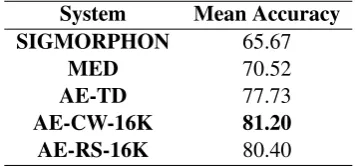
System Mean Accuracy
SIGMORPHON 65.67
MED 70.52
AE-TD 77.73
AE-CW-16K 81.20
[image:5.595.327.505.259.342.2]AE-RS-16K 80.40
Table 4: The average performance over all lan-guages except Haida and Khaling (see text).
the two Baltic languages (Latvian and Lithuanian). So, the Latvian training file for AE-TD-RS-3K also contains 6K training examples: 1K original and 2K training data autoencoding examples, plus an additional 3K random string autoencoding ex-amples, which substitute for the absent Lithuanian training examples. The Lithuanian training file is constructed analogously.
5 Results and Discussion 5.1 Number of Added Examples
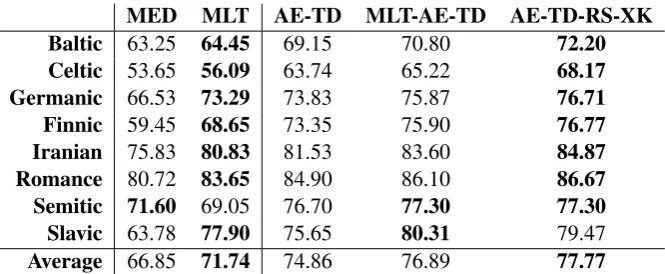
MED MLT AE-TD MLT-AE-TD AE-TD-RS-XK
Baltic 63.25 64.45 69.15 70.80 72.20
Celtic 53.65 56.09 63.74 65.22 68.17
Germanic 66.53 73.29 73.83 75.87 76.71
Finnic 59.45 68.65 73.35 75.90 76.77
Iranian 75.83 80.83 81.53 83.60 84.87
Romance 80.72 83.65 84.90 86.10 86.67
Semitic 71.60 69.05 76.70 77.30 77.30
Slavic 63.78 77.90 75.65 80.31 79.47
[image:7.595.133.466.61.198.2]Average 66.85 71.74 74.86 76.89 77.77
Table 3: Multilingual training. We report average development set accuracies, weighted by the number of examples in each development set. The letter X in AE-TD-RS-XK, stands for the number of random string autoencoding examples added (see§4for more details).
RS).
Figure 1 suggests that on average, adding 1K, 2K or 4k mined training examples (DM curve) gives a similar performance gain to what adding the same amount of autoencoding examples would give (AE-CW and AE-RS).
To investigate the quality of the mined train-ing examples we conduct an experiment where for each morphological tag in SIGMORPHON train-ing data we pick an alternative lemma and target form among the mined examples with the same tag. We hypothesize that, if correct, mined exam-ples should serve the same function as the origi-nal ones and the average performance should not change. On average this resulted in 500 swaps per language. The average MED performance on the modified training sets is about 10% lower than on the original training files.
This suggests, that—although noisy—the mined examples, when annotated with an addi-tional “mining”-tag, work as model regularizers, thus benefiting MED’s performance on the inflection task.
Obtaining autoencoding examples, however, is computationally simpler than mining additional training examples, hence given the similar effects the autoencoding approach seems preferable over the data mining.
5.2 Best Monolingual Systems
The average development set accuracy over 50 languages8 of our best system AE-CW-16K is
81.2% (see Table 4) closely followed by AE-RS-16K with 80.4%. For comparison, this is
8Haida and Khaling do not have Wikipedia text dumps to trainAE-CWand are thus excluded from all averages.
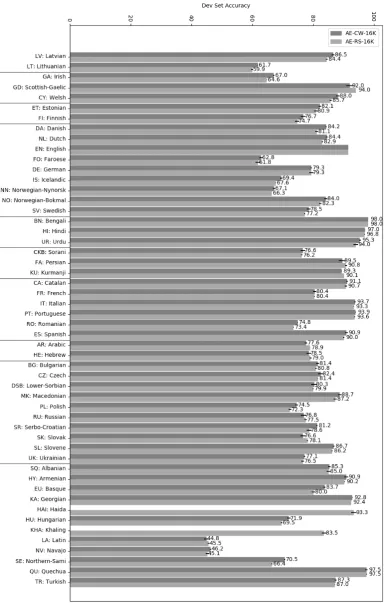
about 15.5% and 10.6% absolute gain over the SIGMORPHON and MED baselines respectively. AE-TD on average performs only 3.5% worse than AE-CW-16K although using 87.5% fewer autoen-coding examples and no external resources. Fig-ure2 shows the accuracy of our best systems on all languages. We report the average accuracy and standard error across three separate training runs for each language.
We conducted a paired-samples t-test to com-pare mean development set accuracies for 50 lan-guages between AC-CW-16K and AC-RS-16K systems, using 3 runs each. The test suggested that there was a significant difference between accura-cies of AC-CW-16K and AC-RS-16K (T(49) = 4.04, p < 0.01), although the difference is small
relative to the gains over the baselines.
5.3 Multilingual Training
exam-ples. Table3shows that on average MLT-AE-TD works no better than AE-TD-RS-XK. Currently, it is unclear whether the performance gains in MLT and MLT-AE-TD experiments are due to knowl-edge transfer from related languages as suggested by Kann et al. (2017), or because different lan-guages serve as model regularizers with respect to each other. Performance on 6 out of 8 groups of related languages, however, suggests that random string autoencoding is not only simpler but also a better performing method than multilingual train-ing.
5.4 Shared Task Submission: Test Results We submitted two final systems to the medium-resource track of Subtask 1 (Inflection): AE-RS-16Kfor the restricted (main) track, and AE-CW-16Kfor the bonus track (where external monolin-gual corpora are permitted). The final systems are ensembles of 3 separate training runs, and the final answer is selected by majority voting (or chosen at random in case of a tie).
Although we did not tune any system to the high-resource track, we also submitted results there, using an analogous ensemble system with 16k autoencoder at random strings in addition to the 10k training examples. We did not submit to the low-resource track because the results from the AE-RS-16k method were below the baseline sys-tem on the development set.
In the high resource setting of the restricted track, our system achieved an average test set accuracy of 95.32%, which is an 17.51% abso-lute improvement over the Shared Task baseline, and the top performance of 18 submissions. In the medium resource setting AE-RS-16K gives 81.02%—an improvement of 16.32% absolute over the Shared Task baseline. This result, how-ever, is 1.78% absolute lower than the best sys-tem’s performance, so among 18 submissions AE-RS-16K takes the 6th place. In the medium re-source setting of the bonus track among 2 submis-sions AE-CW-16K comes first with 82.37%. This is 1.35% better than our restricted track submis-sion (AE-RS-16K), but still 0.43% worse than the top performing system in the restricted track.
6 Conclusion
We evaluated several ways to improve the morpho-logical inflection performance of a state-of-the-art encoder-decoder model (MED) when relatively
few labeled examples are available. In experi-ments on 52 languages, we showed that all meth-ods considerably outperformed the MED baseline. Autoencoding corpus words (AE-CW) gave the largest improvement, but was only slightly bet-ter than autoencoding random strings (AE-RS). We found no benefit from cross-lingual knowledge transfer as compared to using an equivalent num-ber of random string autoencoder examples.
Our results suggest that the main benefit of the various data augmentation methods is providing a strong bias towards learning the identity transfor-mation and/or regularizing the model, with a slight additional benefit obtained by learning the typical character sequences in the language. These bene-fits can be achieved with very simple methods and few or no additional data resources.
References
H´ector Mart´ınez Alonso and Barbara Plank. 2017. Multitask learning for semantic sequence prediction under varying data conditions. In Proceedings of EACL. Association for Computational Linguistics. Dzmitry Bahdanau, Kyunghyun Cho, and Yoshua
Ben-gio. 2015. Neural machine translation by jointly learning to align and translate. In Proceedings of ICLR.
Marco Baroni, Johannes Matiasek, and Harald Trost. 2002. Unsupervised discovery of morphologically related words based on orthographic and semantic similarity. InProceedings of the ACL-02 Workshop on Morphological and Phonological Learning. As-sociation for Computational Linguistics.
Piotr Bojanowski, Edouard Grave, Armand Joulin, and Tomas Mikolov. 2016. Enriching word vec-tors with subword information. arXiv preprint arXiv:1607.04606.
Marcel Bollmann, Joachim Bingel, and Anders Søgaard. 2017. Learning attention for historical text normalization by learning to pronounce. In Proceedings of ACL. Association for Computational Linguistics.
Corinna Cortes and Vladimir Vapnik. 1995. Support-vector networks. Machine learning20(3):273–297. Ryan Cotterell, Christo Kirov, John Sylak-Glassman,
Ryan Cotterell, Christo Kirov, John Sylak-Glassman, David Yarowsky, Jason Eisner, and Mans Hulden. 2016. The SIGMORPHON 2016 shared task– morphological reinflection. InProceedings of ACL. Association for Computational Linguistics.
Andrew M Dai and Quoc V Le. 2015. Semi-supervised sequence learning. InAdvances in Neural Informa-tion Processing Systems. pages 3079–3087.
Harald Hammarstr¨om and Lars Borin. 2011. Unsuper-vised learning of morphology. Computational Lin-guistics37(2):309–350.
Herman Kamper, Micha Elsner, Aren Jansen, and Sharon Goldwater. 2015. Unsupervised neural net-work based feature extraction using weak top-down constraints. In IEEE International Conference on Acoustics, Speech and Signal Processing (ICASSP). IEEE, pages 5818–5822.
Katharina Kann, Ryan Cotterell, and Hinrich Sch¨utze. 2017. One-shot neural cross-lingual transfer for paradigm completion. InProceedings of ACL. As-sociation for Computational Linguistics.
Katharina Kann and Hinrich Sch¨utze. 2016. MED: The LMU system for the SIGMORPHON 2016 shared task on morphological reinflection. InProceedings of ACL. Association for Computational Linguistics. Katharina Kann and Hinrich Sch¨utze. 2017. Unlabeled data for morphological generation with character-based sequence-to-sequence models. arXiv preprint arXiv:1705.06106.
Mikko Kurimo, Sami Virpioja, Ville Turunen, and Krista Lagus. 2010. Morpho challenge competi-tion 2005–2010: Evaluacompeti-tions and results. In Pro-ceedings of the 11th Meeting of the ACL Special Interest Group on Computational Morphology and Phonology. Association for Computational Linguis-tics, SIGMORPHON ’10, pages 87–95.
Minh-Thang Luong, Quoc V Le, Ilya Sutskever, Oriol Vinyals, and Lukasz Kaiser. 2016. Multi-task se-quence to sese-quence learning. In Proceedings of ICLR.
Tomas Mikolov, Kai Chen, Greg Corrado, and Jef-frey Dean. 2013. Efficient estimation of word representations in vector space. arXiv preprint arXiv:1301.3781.
Sylvain Neuvel and Sean A Fulop. 2002. Unsuper-vised learning of morphology without morphemes. InProceedings of the ACL-02 workshop on Morpho-logical and phonoMorpho-logical learning-Volume 6. Asso-ciation for Computational Linguistics, pages 31–40. Patrick Schone and Daniel Jurafsky. 2000. Knowledge-free induction of morphology us-ing latent semantic analysis. In Proceedings of the 2nd Workshop on Learning Language in Logic and the 4th Conference on Computational Natural Language Learning (CoNLL). Association for Computational Linguistics, pages 67–72.
Radu Soricut and Franz Josef Och. 2015. Unsu-pervised morphology induction using word embed-dings. InProceedings of HLT-NAACL. Association for Computational Linguistics, pages 1627–1637.
Matthew D Zeiler. 2012. Adadelta: an adaptive learn-ing rate method.arXiv preprint arXiv:1212.5701.