Abstract—Parachute is a kind of high performance decelerators with sophisticated dynamic behaviors, especially for the inflation process, which is a typical fluid-structure interaction (FSI) problem. This article proposes a numerical study on the inflation of ringslot parachute in low speed airdrop. Combing with the CFD/CSD and Arbitrary Lagrangian Euler (ALE) coupling techniques, the FSI numerical model of ringslot parachute was built; utilizing the computational platform of nonlinear finite element code LS-DYNA, the simulation of FSI results of parachute during inflation process was addressed. The visualization of parachute deformation, canopy projected area and inflation forces are obtained. The FSI mechanism of parachute inflation was analysis. The results validated the validity and veracity of ALE coupling method for the simulation of slots-parachute inflation.
Index Terms— ringslot parachute, fluid-structure interaction, Arbitrary Lagrangian Euler, parachute inflation
I. INTRODUCTION
HE airdrop process of life parachute can be divided into follow steps: deployment, inflation, terminal descent and landing, among of which the inflation step is most complicated. The inflation process is a typical FSI problem, it involves with the interaction between the elastic deformation of flexible fabric and the aerodynamic forces. Because of the porosity and large deformation characteristic of canopy fabric, the distribution of aerodynamic pressure act on the canopy is relative complicated, which make the flow field show extreme irregularity. It's difficult to exactly predict the dynamic behaviors of canopy and surround fluid by utilizing the theoretical methods and traditional experiences..
In recent years, with the rapid development of computing
Manuscript received April 6, 2013; revised April 6, 2013. (Write the date on which you submitted your paper for review.) This work was supported in part by the Chinese National Nature Science Foundation under Grant 11274345 (sponsor and financial support acknowledgment goes here).
GAO Xinglong is with the National University of Defense Technology, Hunan, Changsha410073 China (corresponding author to provide phone: 86-731-84576436; fax: 86-731-84576436; e-mail: [email protected]).
ZHANG Qingbin is with the National University of Defense Technology, Hunan, Changsha410073 China (corresponding author to provide phone: 86-731-84576436; fax: 86-731-84576436; e-mail: [email protected]).
TANG Qiangang is with the National University of Defense Technology, Hunan, Changsha410073 China (corresponding author to provide phone: 86-731-84576436; fax: 86-731-84576436; e-mail: [email protected]).
YANG Tao is with the National University of Defense Technology, Hunan, Changsha410073 China (corresponding author to provide phone: 86-731-84576436; fax: 86-731-84576436; e-mail: [email protected]).
technology and modern computation mechanics, the numerical simulation techniques have been widely used in parachute research field. Russia introduced this technology into the parachute area as early as 1970's, and have already formed a comparatively perfect mathematical models for the whole working process of parachute by using the discontinuous vortex method, large particle method and et al, especially in airdrop and lifesaving field. Professor T.E. Tezduyar[2] and his team for advanced flow simulation and modeling (T*AFSM) have deeply investigated on the FSI problem of several kinds of parachutes like Cross parachute[3] and ring-sail parachute basing on DSD/SST (Deformable-Spatial-Domain/Stabilized Space-Time) finite element technique with 3D computations[4], their work have successfully addressed the 3D computational challenges of parachutes and parachute clusters with the Space-Time FSI technique[5, 6]. Taylor, Tutt, and Lingard et al of Irvin Aerospace Inc. (Irvin) have also make great efforts on the parachute FSI problems in recent years, typically they found a new explicit method to model and analysis the FSI characteristics of parachute by using the LS-DYNA software [7, 8], which has the ability to simulate the elaborate connections between a porous structure media and associated flow field. French ministry of defence procurement agency, DGA[9] (Délégation Générale pour l' Armement) has introduced the Arbitrary Euler-Lagrange (ALE) finite element technique into the investigation of parachute FSI problems, and has a long expertise of FEM explicit analysis (Finite Element Model formulations adapted to non-linear, dynamic cases) that developed a FSI capability in the early 2000's. As the development of parachute industry, a highly efficient and accurate numerical simulation technique can significantly reduce the risk and cost of the test, and be an indispensable promote of the development of parachute industry.
The ALE coupling method has a wide application in nonlinear, FSI, and large transformation problems[16, 17]. Utilizing a novel ALE finite element method within LS-DYNA software, this paper provides physical insight into ringslot parachute operation in the low speed airdrop test. Basing on the fluid mechanics mesh and structure mechanics mesh, the complexity of FSI modeling created by the narrow slots and geometric porosity of canopy were successfully addressed. The simulation results were obtained on condition that the velocity of inlet fluid was constant. This work could be used for the simulation and technical support of parachute’s airdrop test at low speed.
Fluid-Structure Interaction Simulation of
Parachute in Low Speed Airdrop
Gao Xing-long, Zhang Qing-bin, Tang Qian-gang, YANG Tao
II. BACKGROUND
Comparing with the solid parachute canopy, most of the parachutes used in airdrop and some other aeronautic engineering projects have slots. The canopy can provide aerodynamics lift, drag and stability needed to meet performance requirements, thus the parachutes with some slots and gaps on the fabric surface can significantly reduce the overload and achieve more stable aerodynamics performance.
Simulation of the inflation process of slots parachute is complicated even at low speed, the interaction between porous body of canopy structure and surrounding fluid exists in the whole inflation process, the shape of canopy gradually deform from slightness body to no-streamline body under the opening load. Respectively, the significant deformation can forwardly change the distribution of aerodynamic pressure on canopy, and vice versa.
FSI problems can be generally solved by both analytic and non-analytic methods, but these two methods show extreme limitation in solving quiet complicated problem like parachute inflation, the numerical methods are more applicable and easier to execute in computer. Basing on the coupling methods between fluid and structure, the numerical methods can be sorted into two approaches: Partitioned and Monolithic approach.
Considering the high efficiency of computation and prevalence of parallel computing, the FSI numerical simulation techniques basing on monolithic approach have already attracted many researchers’ attention. Combing with the parallel computing ability and ALE method within the LS-DYNA nonlinear dynamic code, the work of the FSI simulation of ringslot parachute have been presented in this paper.
III. SIMULATION METHODOLOGY
A. Eulerian-Lagrangian penalty method
The opening velocity of parachute’s airdrop process is commonly relative low, thus the fluid field can be considered as incompressible flow. Besides on, the canopy structure is flexible and permeable with typical nonlinear dynamic characteristic.
Considering the complicated structure dynamics (SD) and fluid dynamics (FD) characteristics of the parachute, some hypotheses should be proposed beforehand as follows:
1) Packed geometry of canopy before inflation is axially symmetric, and no pre-stress exists;
2) Opening process is infinite mass without considering the gravity;
3) Air fluid is considered as incompressible flow at low velocity;
4) Fluid field is considered as qusai-state with a constant velocity at the inlet boundary;
In FSI problems, the computation of coupling interface is a key technique for the conversation of energy must be ensured. Generally, it’s impossible to implement the total matching between structural and fluid mesh. The transformations of the structural and fluid nodes information have been implemented by the Eulerian-Lagrangian penalty coupling algorithm. As depicting in figure 1, where the solid
[image:2.595.315.539.114.258.2]circles represent the fluid element nodes, the hollow circles represent the structural membrane element nodes of which locations can be described in the local reference of ALE fluid elements, and thus the structural nodes can be tracked and coupling force can also be applied.
Fig. 1. Eulerian-Lagrangian penalty coupling of a membrane in ALE fluid(Reproduced from Reference [9])
Taking the fluid as porous media, in explicit dynamic integral method, when time stepttn, dn represents the penalty depth of structural nodes, it is incrementally updated in follow equation.
1 1/ 2
n n n
d d v t (1) r
v is the reference velocity of master and slave nodes, the slave node velocity isvs
, whereas the master node velocity
can be viewed as a fluid particle within a fluid element, with the mass and velocity interpolated from the fluid element nodes using finite element shape functions, thus
n 1/ 2 n 1/ 2 n1/ 2
r s f
v v v (2)
Penalty occurs if
0 n s
n d (3)
The coupling forces should be applied in master and slave nodes in opposite direction to satisfy the force equilibrium on the coupling interface, whereas for master nodes, the coupling force can be distributed basing on shape functionsNiat each nodei, thus
i
f i
F N F (4)
The action-reaction principle is satisfied on the coupling interface.
When the finite element models of parachute inflation are building, we can choose the Eulerian-Lagrangian penalty coupling algorithm within LS-DYNA software for solving such aerodynamics FSI problems. The structure elements should select the Lagrangian algorithm while the fluid elements should select the Eulerian algorithm, and the penalty method can assure the transmission of FSI information on the coupling interface.
B. Parachute models
are Kevlar tape.
Figure 2. Constructed surface of ringslot canopy
The folded model of parachute canopy will significantly affect the results of numerical simulation[18], so it’s important to accurately replicate the geometry shape of constructed parachute. Considering the complexity of modeling the packed flexible fabric, we ignore the longitude direction pack in this paper, thus the parachute was only packed in latitude direction, which means only the numerical model of inflation process after the deployment step was built. The location of slots need to be considered when the initial packed model of parachute was built, this problem can be solved utilizing mesh technique in ANSYS software. The packed and inflated models of ringslot parachute can be seen from figure 3.
(a)Packed model (b)Inflated model Figure3. 3D simulation models of ringslot parachute
C. Fluid models
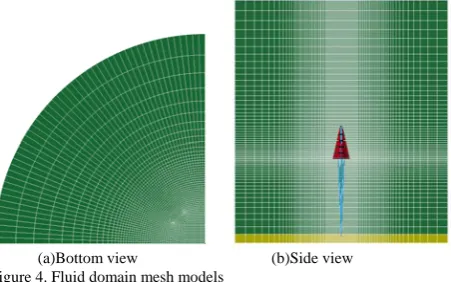
To avoid the influence of boundary reflection waves, the geometries of fluid model should be properly set corresponding with the profile of parachute. The fluid model size is 20m×20m×30m in this paper. Figure 4 shows the diversified mesh of model sections, the fluid mesh near the center that parachute located were refined, whereas the ones near the wall were coarse, this meshing way can significantly reduce the parallel computing cost of parachute FSI, and avoid that the deformed structure disturb the fluid field, these can improve the computing accuracy.
(a)Bottom view (b)Side view Figure 4. Fluid domain mesh models
D. Material models
The material model of canopy is fabric, it’s commonly used for simulation the mechanical behaviors of airbag model in LS-DYNA. This fabric material is orthotropic composite with permeable, large translation and nonlinear mechanic characteristics, considering the structural reliability of slots on aperture under loading, both the edges of slots and aperture were reinforced by high strength materials. Table 1 shows the material parameters of fabric and suspension lines, the fabric was meshed by 4 nodes membrane elements and the line was meshed by Cable elements within ANSYS/LS-DYNA.
TABLEI
MATERIAL PROPERTIES
name MEMBRANES Cables
Thicknes
s(area) Canopy
Suspen sion lines
Seam& Edge reinfor cement s
Apertur e reinfor cement s Density 0.0001m 410
-6
m2 0.001m 0.001m
Young’
modulus 5880kg/m
3 5840kg /m3
6800 kg/m3
6800kg /m3 Poisson’s
ration
4.309108 pa
1.21 012pa
4.309 108p a
5.309 108p a IV. RESULTS AND FINDINGS
A. Canopy shape deformation
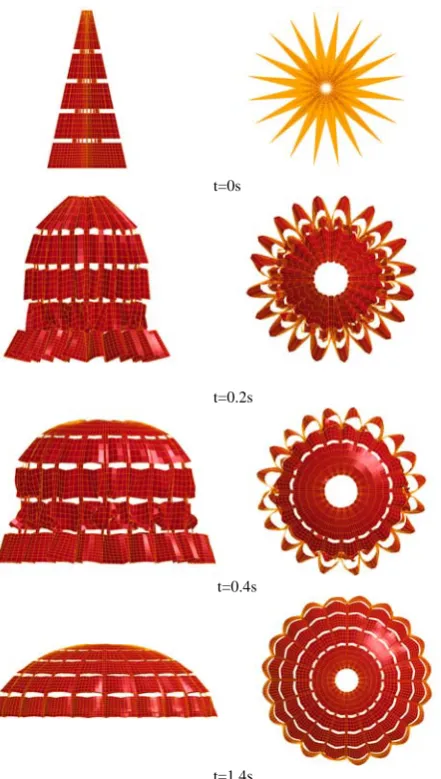
Figure 5 illustrates the spatial deformation of canopy shape during inflation process.
t=0s
t=0.2s
t=0.4s
t=1.4s
Figure 5. 3D shape deforming (side, top, and bottom) of canopy mesh model during inflation
From the canopy deformation results of inflation we can see that the numerical computing technique this paper employed can simulate and capture the inflation characteristics of slots-parachute, including the large impact of opening force, and the over inflation of canopy, especially the computing convergence of the slots were reached, this avoided the divergent and unstable results. It can be seen from the inflation results that the slots-parachute could still keep the reliable opening ability with a relative high total porosity, the reason is that the special flow characteristics of slots and fabric pores, which behaves like the function of sharp edge orifice with the significant jet effect, and thus the large circulate drag occur.
B. Inflated performance
During the inflation process, the canopy deformed with efficiency permeability, figure 5 displays time history data for inflation of the parachute, the opening force and diameter data of projected area of canopy are presented. Comparing with the results of force-time and diameter-time data for
[image:4.595.303.548.140.322.2]infinite mass inflation from Desabrais paper[19], it’s clear that the simulation results in this paper have captured the general inflation characteristics well, and there has an elastic phenomenon when the air flow afflux at about 0.6s, after the maximum canopy’s diameter reached, the inflation become stable without obvious re-inflate phenomenon, this is because the geometrical vent characteristics of slots.
Figure 6. Diameter and force time history data for ringslot parachute inflation
From figure 5 and figure 6, the inflation time is about 0.75s. This can also be estimated utilizing the experience equations. Book[20] present the experience equation for computing the inflation time of parachute with slots.
0 0.65 g m
L D t
v
(7)
0.65g = Ks correspond with the inflation distance represented by nominal diameter, vLis the velocity of fluid when parachute was draw straight andD0is the nominal diameter of canopy, referencing the Ks test data for slots-parachute of infinite mass in book[20], the experience result of inflation time is 0.73s.
[image:4.595.305.459.602.751.2]As the simulation results show that the numerical computing technique this paper employed can simulate and capture the dynamic characteristics of ringslot parachute during inflation, including the large impact of opening force, and the over inflation of canopy, especially that the computing of the slots converged.
C. Fluid structure interaction results
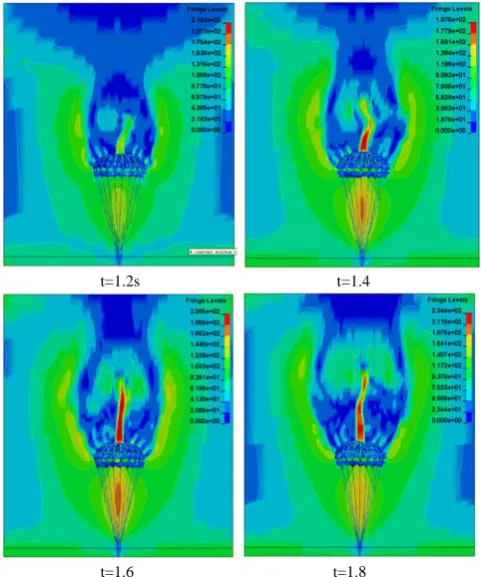
Figure 8 illustrates the FSI computing results of parachute inflation. The streamlines vector of fluid show that the turbulence of surrounding fluid gradually increased as the growing of parachute drag area. The canopy expanded and transformed into a resistance fluid under the action of flow that around the skirt. Because the resistance of fabric, the velocity of flow across the apex and ring slots is apparently higher than the other regions on canopy, these make the pressure on upper surface become low, while the pressure at the bottom keep some relatively high value for the continuous inlet fluid, thus the differential pressure could provide aerodynamic drag for parachute inflation.
t=1.2s t=1.4
[image:5.595.47.288.213.502.2]t=1.6 t=1.8
Figure 7 Velocity contour for ringslot parachute fluid structure interaction
From the above results of canopy deformation and FSI simulation that the methodology this paper employ could predict the structural responses of ringslot parachute to aerodynamics, and vice versa, especially the evolvement of interior and exterior fluid around canopy fabric.
V. CONCLUSION
This paper mainly studies on the inflation process of ringslot parachute within infinite mass for low speed airdrop test. The parachute inflation dynamics characteristic has been deeply investigated by the modeling technique of FSI finite element model and ALE coupling algorithm. Both the numerical simulation models of canopy structural and surrounding fluid were built by the computing mechanics method, solving by the ALE finite element technique, the 3D shape deformation of canopy as well as the overloading time history, especially the FSI results of ringslot parachute inflation were obtained. The divergent problem caused by narrow slots on canopy fabric has been solved. All the results have been computed and validated by the LS-DYNA no linear code; these also validate the applicability of parallel
computing of coupling technique within LS-DYNA in parachute FSI problems. The numerical simulation methodology and technique this paper employed can be generalized in engineering application and used for investigating the dynamics problems for some other types of parachutes, like recovery parachute and air bomb parachute et al. The simulation technique of finite mass inflation and higher efficiency of parallel computing for parachute FSI need to be investigated in future work.
REFERENCES
[1] Yand Xue-song. Simulation for Parachute Dropping Progress[D]. Wuhan: Huazhong University of Sicence and Technology, 2003. [2] S. Sathe a R.B., R. Charles, E. Doucette, J. Miletti, M. Senga,K. Stein,
T.E. Tezduyar. Fluid-structure interaction modeling of complex parachute designs with the space-time finite element techniques[J]. Computers&Fluids, 2005, 45(7930): 1-9.
[3] Keith Steini R.B., Tayfun Tezduyar, Jean Potivn. Fluid-structue interaction of a cross parachute: numerical simulation[J]. Computer methods in applied mechanics and engineering, 2001, 191: 673-687. [4] Vinay Kalro T.E.T. A parallel 3D computational method for
fluid-structure interactions in parachute systems[J]. Comput. Methods Appl. Mech. Engrg., 2000, 190: 321-332.
[5] Kenji Takizawa T.E.T. Computational Methods for Parachute Fluid-Structure Interactions[J]. Arch Comput Methods Eng, 2012, 19: 125-169.
[6] Keith Stein R.B., Vinay Kalro, Tayfun E. Tezduyar, John Leonard, Michael Accorsi. Parachute fluid-structure interactions: 3-D computation[J]. Comput. Methods Appl. Mech. Engrg., 2000, 190: 373-386.
[7] Ben Tutt a.A.P.T. The use of LS-DYNA to Simulate the Inflation of a Parachute Canopy[J]. 18th AIAA Aerodynamic Decelerator Systems Technology Conference and Seminar, 2005.
[8] Ben Tutt and Anthony P. Taylor J.-C.B.a.B.G. The use of LS-DYNA to Assess the Performance of Airborne Systems North America Candidate ATPS Main Parachutes[C], 18th AIAA Aerodynamic Decelerator Systems Technology Conference and Seminar, 2005.
[9] Christine Espinosa Y.d.L.d.P., Pascal Bordenave, and Luke Henke. Fluid-Structure Interaction simulation of parachute dynamic behaviour[C]. Williamsburg, VA, 19th AIAA Aerodynamic Decelerator Systems Technology Conference and Seminar, 2007. [10] PengYong Z.Q., Cheng Wenke, Qin Zizeng. Simulation of Parachute
Initial Inflation Phase[J]. CHINESE SPACE SCIENCE AND TECHNOLOGY, 2003(3): 7-12.
[11] YU Li S.X.-l., MING Xiao. Numerical Simulation of Parachute During Opening Process[J]. ACTA AERONAU TICA ET ASTRONAU TICA SINICA, 2007, 28(1): 52-57.
[12] PAN Xing H.L., CAO Yi-hua. Analysis of dynamic simulation and fluid field of parachute in inflation stage[J]. Journal of Aerospace Power, 2008, 23(1): 87-93.
[13] Song Qian-fu C.Y.-h., Jiang Chong-wen. Engineering analysis method in fluid-structure interaction problem of hemispherical parachute[J]. Journal o f Beijing University of Aeronautics and Astronautics, 2009, 35(1): 96-100.
[14] WU Zhuo C.Y.-h., SONG Qian-fu. Numerical simulation of fluid-structure interaction in conical parachute' opening process[J]. Journal of Aerospace Power, 2009, 24(9): 1584-1593.
[15] ZHANG Hong-yin L.W.-h., Qin Fu-de, TONG Ming-bo. Study on the canopy shape and the flow field during parachute inflation process[J]. ACTA AERODYNAMICA SINICA, 2011, 29(3): 288-294.
[16] M. Souli A.O., L. Lewin c. ALE formulation for fluid-structure interaction problems[J]. Comput. Methods Appl. Mech. Engrg., 2000, 190: 659-675.
[17] HUA Cheng F.C. Simulation of Fluid-Solid Interaction on Water Ditching Of An AIrplane By ALE Method[J]. Journal of Hydrodynamics, 2011, 23(5): 637-642.
[18] Drozd V.S. Axisymmetric Parachute Shape Study[C]. Seattle, Washington, 20th AIAA Aerodynamic Decelerator Systems Technology Conference and Seminar, 2009.
[19] Desabrais K.J. Velocity Field Measurements in the Near Wake of a Parachute Canopy [R]. Worcester Polytechnic Institute, 2002. [20] Ewing E G K.T.W., Bixby H W. . Recovery Systems Design Guide[M].
![Fig. 1. Eulerian-Lagrangian penalty coupling of a membrane in ALE fluid(Reproduced from Reference [9]) Taking the fluid as porous media, in explicit dynamic](https://thumb-us.123doks.com/thumbv2/123dok_us/1273803.655486/2.595.315.539.114.258/eulerian-lagrangian-penalty-coupling-membrane-reproduced-reference-explicit.webp)