Sign Language Recognition using Machine
Learning Approach
Prathamesh Dhavale
1, Nikita Gurjar
2, Divya Dave
3, Avinash Rajput
4, Deepika Patil
51, 2, 3, 4Student, 5Assistant Professor: Computer Science & Engineering, Department Sanjay Ghodawat Group of Institutions
Abstract:In the world of sign language, and hand gestures, a lot of research work has been done over the past three decades.
Woefully, every research has its own limitations and are still unable to be used commercially. The main problem of this way of communication is normal people who cannot understand sign language can't communicate with these people or vice versa. Many researches have known to be successful for recognizing sign language, but require an expensive cost to be commercialized. Researchers do their researches in various ways. It starts from the data acquisition methods. The data acquisition method changes because of the cost needed for a good device, but cheap method is needed for the Sign Language Recognition System to be commercialized. The method used in developing Sign Language Recognition also varies between researchers. Each method has its own strength compare to other methods and many researchers are still using different methods in developing their own Sign Language Recognition.
Keywords: Tensor Flow, SURF Feature Extraction, SVM Algorithm
I.INTRODUCTION
Language that is used by deaf and dumb people is called Sign Language. Sign Language is considered to be the only way of communication between deaf and hearing impaired peoples. Sign Language is generally composed of two types of signs, i.e., Manual signs and Non-manual signs. Manual signs are composed of sign gestures which are performed using hand and nger movements, whereas non-manual signs are represented by various facial expressions, head tilting, lip pattern, mouthing, and other similar signals. These are then added with the hand or manual signs to create a useful meaning. Thus, the meaning of a hand sign is incomplete without facial expressions. Non-manual signs play an important role in Sign Language Recognition (SLR) systems because they carry grammatical and prosodic information. At each time we cannot get Translator/Interpreter easily, because availability of translator is limited and expensive also. So the solution of this problem is that we have to use some automatic system that can automatically translate signs into spoken language. Sign Language Recognition system is the automatic computerized system that automatically recognize signs and translate into normal language. The idea is to make computers to understand sign language and develop a user friendly environment. Making a computer to understand facial expressions and human gestures are some steps towards it. Gestures are the non-verbally exchanged information. The project determines human gestures by creating an HCI. In our project we are focusing on Image Processing and for better output generation.
II.LITERATURESURVEY
Many researchers have been done on this issue and some of them are still operational, but nobody was able to provide a full edged solution to the problem. Ming Jin Cheok Zaid Omar and Mohamed Hisham Jaward developed hand gesture recognition system, in which recognition involves complex processes such as motion modeling, motion analysis[3].
V. V. Kishore, E. Kiran Kumar, D. Anil Kumar , presented methods for Indian Sign Language Recognition. Wavelet based fusion of two weak edge detection models. One is morphological subtraction model and another one is gradient based canny edge operator[4]. Vinay Kumar K, R.H.Goudar and V T Desai developed Sign Language Uni cation , in which they have used Sign language (SL) recognition under Support Vector Machines(SVM) are used to quickly and reliably determine between poses such as sitting, standing and reaching or facing left rather than right[5].
Keerti Keshav Kanchi developed a face recognition system which is one of the biometric information processing systems. The developed algorithm for the facial expression recognition system, which uses the two-dimensional discrete cosine transform(2DDCT) for image compression and the self organizing map(SOM) neural network for recognition purpose, simulated in MATLAB[6]. By using 2D-DCT we extract image vectors and these vectors become the input to neural network classifier, which uses self organizing map algorithm to recognize familiar faces (trained) and faces with variations in expression. In this paper they have developed and illustrated a recognition system for human faces using a novel self
organizing map based retrieval system. SOM has feature extracting property due to its topological ordering. The facial analytics result for the 25 images of AT &T database reflects that the face recognition rate using one the neural network algorithm SOM is 95.05% for 5 persons. Octavio Arriaga developed a general convolutional neural network (CNN) building framework for designing real-time CNNs.They validate their models by creating a real-time vision system which accomplishes the tasks of face detection, gender classification and emotion classification simultaneously in one blended step using there proposed CNN(convolutional neural network) architecture. Along with this they also introduced the very recent real-time enabled guided back propagation visualization technique. Guided back propagation which uncovers the dynamics of the weight changes and evaluates the learned features. They argue that the careful implementation of modern CNN architectures, the use of the current regu-larization methods and the visualization of previously hidden features are necessary in order to reduce the gap between slow performances and the real-time architectures[6].
Mrs. Archana S. Vaidya developed an identication of the number of ngers opened in a gesture representing an alphabet of the Binary Sign Language. The system doesn't requires the hand to be perfectly aligned to the camera. The project uses image processing system to identify, especially English alphabetic sign language used by the deaf people to communicate[2].The basic objective of this project is to develop a computer based intelligent system that will enable dumb people significantly to communicate with all other people using their natural hand gestures. The idea consisted of designing and building up an intelligent system using image processing, machine learning and artificial intelligence concepts to take visual inputs of sign language's hand gestures and generate easily recognizable form of outputs[2].Hence the objective of this project is to develop an intelligent system which can act as a interpreter between the sign language and the spoken language dynamically and can make the communication between people with hearing impairment and normal people both effective and efficient. Pradeep Kumar, Partha Pratim Roya, Debi Prosad Dogra developed recognizing hand and nger gestures. A SLR(Sign Language Recognition) system is incomplete without the signer's facial expressions corresponding to the sign gesture. In this paper, we present a novel multimodal framework for SLR system by incorporating facial expression with sign gesture using two dierent sensors, namely Leap motion and Kinect. We have collected a dataset of various dynamic sign word gestures. The recognition is performed by using Hidden Markov Model (HMM). Next, they applied Independent Bayesian Classification Combination (IBCC) approach to combine the decision of different modalities for improving recognition performance[2].
A.Existing System
III.PROPOSEDSYSTEM
Fig.3.1 System Architecture
We propose framework to analyze manual and non-manual sign inputs in the form of hand gesture and face expressions. It is necessary to capture both inputs simultaneously because sign language usually contains di erent signs which have same hand gestures with varying facial expressions. Hence such expressions or emotions help in adding syntactical and grammatical information in sign language. To accomplish this, we propose a framework using Image Processing. Proposed system model is classied into two major parts: Extract features from images using feature extraction technique Both one hand and two hand gesture including face are considered. The feature extraction method is applied on processed and target cropped images to extract features. Classied and Indentied word of sign on the base of extracted features using classi cation technique Extracted features will be taken as inputs into classi cation technique which will perform reorganization and output should be the word. The proposed method captures an image as input, which is composed of both hand gestures and face expression. Eigen values on vectors which are primarily the distance between our various features are calculated. These features are extracted and stored. Finally, after classication we get the nal output i.e. conversion of sign language in the form of text.
A.Modules
1) Emotion Detector
a) Start the webcam and capture the image.
b) Detect the face.
c) Load the emotion model consisting of pretrained emotions.
d) Implement the CNN and predict the emotion so as to save in file.
2) Capture Gesture
a) Open the webcam and detect the gesture.
b) The image is detected and the region of interest is stored as a 300x300 png image.
3) Training of Gesture
a) In this process various hand gestures are captured via webcam and stored as a dataset.
b) Each image is read and masked so as the retrieve only the area of the skin.
4) Prediction
a) The test image captured from the webcam is read, masked, converted to binary and edge.
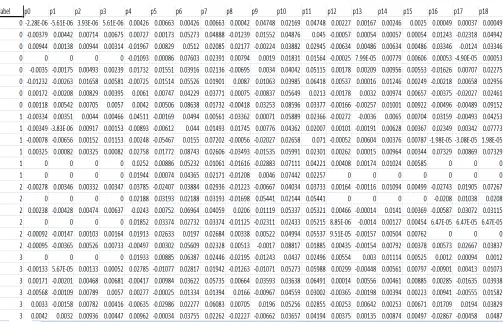
b) The SURF features are extracted and stored in test.csv
c) The following algorithms are executed for the train and test files.
i) SVM
ii) KNN
iii) NB
iv) LR
d) The algorithm with the highest accuracy is choosen.
e) It was observed that the overall accuracy of the algorithm is 0.875.
B.Tensorflow Algorithm
1) Start
2) Locating faces in the scene (e.g., in an image; this step is also referred to as facedetection)
3) Extracting facial features from the detected face region (e.g., detecting the shape of facial components or describing the texture
of the skin in a facial area; this step is referred to as facial feature extraction).
4) Analyzing the motion of facial features and/or the changes in the appearance of facialfeatures and classifying this information
into some facial-expression interpretative categories such as facial muscle activations like smile or frown, emotion (affect)categories like happiness or anger.
5) Display the emotion.
6) Stop.
C.SVM Algorithm
1) Start
2) Capture the emotions and gestures through webcam.
3) Prepare train set to train the system by getting features of the images being trained..
4) Generate image features using SURF.
5) Save the features of the actual image in test set.
6) Compare training set and test set using SVM algorithm.
7) Classify the gesture and emotion.
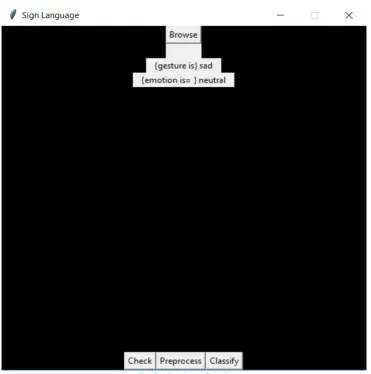
8) Display the gesture and emotion information on GUI when classify button is clicked.
9) Stop.
IV.TECHNIQUESUSED
A. Tensor Flow
Visually, of course, you represent vectors as arrows, as you can see in the picture above. This means that you can consider vectors also as arrows that have direction and length. The direction is indicated by the arrow’s head, while the length is indicated by the length of the arrow.
And, just like you represent a scalar with a single number and a vector with a sequence of three numbers in a 3-dimensional space, for example, a tensor can be represented by an array of 3R numbers in a 3-dimensional space.
The “R” in this notation represents the rank of the tensor: this means that in a 3-dimensional space, a second-rank tensor can be represented by 3 to the power of 2 or 9 numbers. In an N-dimensional space, scalars will still require only one number, while vectors will require N numbers, and tensors will require N^R numbers. This explains why you often hear that scalars are tensors of rank 0: since they have no direction, you can represent them with one number.
B. SURF Features
In SIFT, Lowe approximated Laplacian of Gaussian with Difference of Gaussian for finding scale-space. SURF goes a little further and approximates LoG with Box Filter. Below image shows a demonstration of such an approximation. One big advantage of this approximation is that, convolution with box filter can be easily calculated with the help of integral images. And it can be done in parallel for different scales. Also the SURF rely on determinant of Hessian matrix for both scale and location.
For feature description, SURF uses Wavelet responses in horizontal and vertical direction (again, use of integral images makes things easier). A neighbourhood of size 20sX20s is taken around the keypoint where s is the size. It is divided into 4x4 subregions. For each
subregion, horizontal and vertical wavelet responses are taken and a vector is formed like
this, . This when represented as a vector gives SURF feature descriptor with total 64
dimensions. Lower the dimension, higher the speed of computation and matching, but provide better distinctiveness of features.
For more distinctiveness, SURF feature descriptor has an extended 128 dimension version. The sums of and are computed
separately for and . Similarly, the sums of and are split up according to the sign of , thereby
doubling the number of features. It doesn’t add much computation complexity. OpenCV supports both by setting the value of flag extended with 0 and 1 for 64-dim and 128-dim respectively (default is 128-dim).
C. SVM Algorithm
“Support Vector Machine” (SVM) can be a supervised machine learning formula which will be used for each classification or regression challenges. However, it is mostly used in classification problems. In this algorithmic program, we tend to plot every information item as a degree in n-dimensional house (where n is variety of options you have) with the worth of every feature being the value of a particular coordinate.
Support Vector Machines are supported by the conception of call planes that outline call boundaries. A choice plane is one that separates between a collections of objects having completely different category memberships.
Fig 4.1 SVM Classification
The on top of may be a classic example of a linear classifier, i.e., a classifier that separates a collection of objects into their individual teams (GREEN and RED during this case) with a line. Most classification tasks however, don't seem to be that easy, and sometimes additional advanced structures are required so as to create An optimal separation, i.e., properly classify new objects (test cases) on the idea of the examples that are available (train cases). This situation is depicted in the illustration below. Compared to the previous schematic, it's clear that a full separation of the inexperienced and RED objects would require a curve (which is additional advanced than a line). Classification tasks based on drawing separating lines to differentiate between objects of various category memberships are referred to as hyperplane classifiers. Support Vector Machines are significantly suited to handle such tasks.
Fig 4.2 SVM Classification
An SVM classifies knowledge by finding the most effective hyperplane that separates all knowledge points of 1 category from those of the other class. The best hyperplane for Associate in Nursing SVM means that the one with the largest margin between the two classes. Margin means that the largest dimension of the block parallel to the hyperplane that has no interior data points.
V.COMPARATIVE STUDY AND RESULTS
Previous works have addressed the di culties faced by capturing real time ac-tions. As deaf and dumb people face di-culties in conveying the thing to the other people, it has been important to build a system for the ease of communi-cation, thus capturing real time of actions becomes a need. The complex back-ground and illumination conditions aect the hand tracking and make the SL reorganization very di-cult. Our system build a Sign Language Reorganization (SLR) using Image Processing and Machine Learning for ease of communication for deaf and dumb people.
between our various features are calculated. These features are extracted and stored. Finally, after classication we get the nal output i.e. conversion of sign language in the form of text.
[image:7.595.76.549.176.394.2]This system gives proper output if an image is good and clear so that Machine learning algorithms can be applied and proper output is given to user. Machine learning algorithms help to extract the features of image and then the extracted features are compared with the features available in the training set and emotion and gesture is classified. Proper output about getsure and emotion is given to user.
[image:7.595.46.549.416.741.2]Fig 5.3 Test Set
Fig 5.4 Predicted Result
In fig 5.1 we can notice there is one image which is having the face detected which is neutral and the another image which is having the sad gesture which is given as input after that image is given features are extracted and as we notice in fig 5.3 which is test set after comparing the test set with training set result is predicted emotion as neutral and the gesture as sad. Once the gesture is predicted gesture name and emotion name is provided to user.
A.Advantages
1) Fast and accurate detection and classification of emotions and gestures.
2) Manual Work is reduced.
3) SVM is the best algorithm used for image processing.
4) Predict the gesture, of the deaf and dumb people.
5) Display message to user and tells what the emotion and gesture is.
6) It can be easily train on small dataset.
VI.CONCLUSION
Our project aims to bridge the gap by introducing an inexpensive system in the communication path so that the sign language can be automatically captured, recognized and translated to speech for the benefit of deaf and dumb people. We proposed various methods Otsu's thresholding for segmentation, feature ex-traction. For classification of we will go to use SVM. This system will be very useful to our society. Common feature extraction with appearance-based approaches includes SIFT SURF, PCA and LDA. Model-based approaches includes both volumetric and skeletal modeling and convexity defects techniques.
REFERENCES
[1] Pradeep Kuma, Partha Pratim Roy, Debi Prosad Dogra, Independent Bayesian classifier combination based sign language recognition using facial expression , International Journal Information Sciences, 2018
[2] Sawant Pramada1, DeshpandeSayle, NalePranita, NerkarSamiksha, Archana S. Vaidya, “Intelligent Sign Language Recognition Using Image Processing”, IOSR Journal of Engineering (IOSRJEN),2013.
[3] Ming Jin Cheok, Zaid Omar, Mohamed Hisham Jaward, A review of hand gesture and sign language recognition techniques , International Journal of Machine Learning and Cybernetics, 2017
[4] M. V. D. Prasad, P. V. V. Kishore, E. Kiran Kumar, D. Anil Kumar, Indian Sign Language Recognition System Using New Fusion Based Edge Op-erator , Journal of Theoretical and Applied Information Technology,2016
[5] Vinay Kumar K, R.H.Goudar, V T Desai, Sign Language Uni cation: The Need for Next Generation Deaf Education , International Conference on Intelligent Computing, Communication & Convergence (ICCC-2014), 2015
[6] Keerti Keshav Kanchi, Facial Expression Recognition using Image Pro-cessing and Neural Network International Journal of Computer Science & En-gineering Technology (IJCSET), 2013.
[7] Sawant Pramada1, Deshpande Sayle, Nale Pranita, Nerkar Samiksha, Archana S. Vaidya, Intelligent Sign Language Recognition Using Image Pro-cessing , IOSR Journal of Engineering (IOSRJEN),2013