5
X
October 2017
Indian Sign Language Recognition System Using
PCA Features
Mr. Girme R B.1, Prof. Marathe V R.2 1
PG student, NBNSCOE, Solapur.2Assistant Professor,NBNSCOE, Solapur
Abstract: Sign language is the technique used for communication between deaf, mute, hard hearing people and normal people. Different types of project are done against deaf, mute, hard hearing people. A system with computer human interface is proposed for sign language recognition. But there is country wide variation available in that project. The main idea of this project is to design a system which is useful for communication of that person with the outside world in any public places, so that no need to interpreter in public places. In that project we need the isolated images in the form of database with Indian sign language of numeric sign. A regular camera is useful for acquiring this numeric sign.Principal Component Analysis (PCA) is used for preprocessing, in which the removal of redundant and unwanted data is done This PCA technique identify sign with an accuracy of 96%. The experimental result is shown that the system is used as “working System” in regular ISL Recognition.
Keywords:PCA; Eigenvector; Covariance;
I. INTRODUCTION
Sign language is helpful with communication between deaf, mute, hard hearing people and normal people. In normally, sign language is understandable for the signer and the person who know the sign language but it is so much difficult for who does not know the sign language or meaning of any gesture [4]. The strategy of the Eigenvectors method consists of extracting the characteristic features.
[image:2.612.224.428.445.589.2]Were the images of Indian sign language can be used as input and the system will display the English alphabet, which the mute, deaf people want to tell. A regular camera with 8 megapixels is used for acquiring this sign. For developing this project we need sign database with 26 English alphabets sign & 9 Numeric sign with proper images. The Alphabetical sign of sign language is shown in fig 1.
Fig. 1 Indian sign language[6]
In that project every word or every alphabet is assigned to a particular image. This image is in the form of .jpg so that we can easily use the database .This images are in static form. Static gestures have fixed position of the hand, whereas dynamic gestures have movement of hands and body parts. we used a total database of 200 images for training & 50 images for testing.
discarding minor components, the PCA effectively reduces the number of features and displays the data set in a low dimensional subspace. In this study the feature extraction algorithm based on PCA is chosen. The coefficients of these methods are used as feature vectors. This technique efficiently represents an extracted image.
II. LITERATURE REVIEW
There are different theories used for Indian Sign Convention presented by different authors. The surveyed literature on Sign Convention is as follows:
In the Tamil sign letter Balakrishnan, G, SubhaRajam, [1] proposed a method. This was recognizing a 32 set of combinations & 10 for each up and down position of the fingers. This method is used for the up/down position of the fingers which is converted into decimal numbers, this number is recognized into the Tamil alphabet A set of database in the form of images of sizes 640×480 pixels are captured. Palm image extraction is used to convert RGB to grayscale images. The experimental result is 96.87%.
For static and dynamic alphabet sign RekhaJ, [2] proposed a system this system was used 23 static ISL alphabet signs from 40 different signers are collected as training samples and 22 videos are used as testing samples. The images are extracted by the method of Principle Curvature Based Region Detector. Multi class non-linear KNN are used as sign classifiers. The experiment result for static 94.4% and for dynamics it was 86.4%.
In northern Bali jungle of Indonesia the village of “Bengkala” for generations, where a high percentage of residents are Deaf [14].Bengkala has a higher than normal deaf-since-birth population for over seven generations. Today, 42 of Bengkala's almost-3,000 villagers have been deaf since birth. The more percentage of deafness is caused due to DFNB3.By comparison, about two or three births per 1,000 in the United States produce a deaf or hard of hearing child.Rather than villagers in Bengkala have adapted to a deaf lifestyle or deaf language. Throughout the village, people speak with their hands. Kata kolok, known as "the talk of the deaf," is a unique, rural sign language, independent of international or Indonesian sign language
III. METHODOLOGY
The proposed system is shown in the figure 2. If no standard data set is available to experiment on automatic recognition of ISL gestures then Two data sets of ISL character signs are created. First set contains sign belongs to alphabetic characters for Indian Sign and the second set containsthe numeric sign for Indian sign. The details of acquiring of the data set are given in data set
A. Input Sign language Image
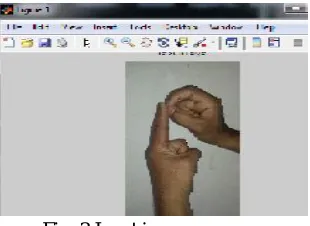
[image:4.612.248.403.155.268.2]Two types of dataset are creating for this experiment. In this dataset 26 images of single & double handed images are captured using a digital camera. This images are in the form of 200X300 RGB pixel size. This images are collecting from five differentmute male person for each character. We use this images in the JPG format because it is very easy to extract the image in different hardware and software environment. The second dataset created for this experiment are images for each number. The memory required for this dataset is nearly 40 KB. This images are flat rectangular shape in structure.
Fig. 3 Input image
B. Preprocessing
After collecting the database from the users we need to preprocessthose images.Preprocessing images commonly used for removing low-frequency background noise, normalizing the intensity of the individual particles image. Firstly, we convert RGB images into gray scale images by using MATLAB (RGB to Gray converter). This will convert RGB images to high intensity Gray scale images. In this step we can perform segmentation and noise removal operation. The main aim of pre-processing is an improvement in input data (sign language images) that data suppresses unwanted distortions. The Image preprocessing technique uses the considerable redundancy in images. Neighboring pixel corresponding to one object in real image has adjusted some or similar brightness value. Preprocessing consists of thresholding, erosion and dilation of collected data images.
1) Skin Thresholding:Skin detection is used to search for the human hands and discard other skin colored objects for everyframe captured from a webcam shown in fig 4.Image thresholding is used for extracting the significant or desired part of an image and removing the unwanted part or noise. The point operator of major interest is called thresholding, which selects pixels that have a particular value, or that are within a specified range. With thresholding, the image can be segmented based on the color. This holds true under the assumption that a reasonable threshold value is chosen. A reasonable threshold value is the taken from the histogram of the original image. The point operator helps us to find objects in a picture if the brightness level or range is known. Hence the object’s brightness must be known.
After detecting skin area for every frame captured, we used the contours comparison of that area with theloaded hand postures contours to get rid of other skin like objects exist in the image. If the contours comparisonof skin detected area complies with any one of the stored hand gesture contours, a small image will enclose thehand gesture area only and that small image will be used for extracting the PCA feaures.
Fig.4Thresholded image
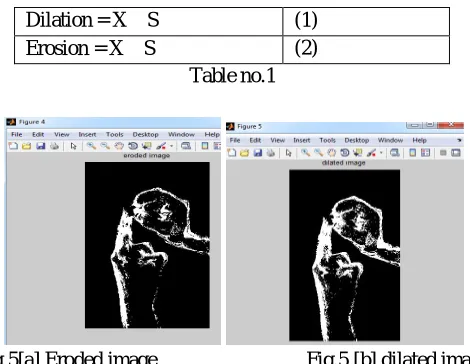
[image:4.612.220.394.540.661.2]image. The mask which is also called as structuringelement or sub image or kernel (Lim, 1990) and (Soille,2004) and it has both a shape and an origin. Thefollowing Eq. 1 and 2 are generally used for dilationand erosion:
Dilation = X⊕S (1)
[image:5.612.190.425.110.292.2]Erosion = X⊕S (2)
Table no.1
Fig.5[a] Eroded image Fig.5 [b] dilated image
Where, X is anoriginal image and S is a structuring element.Based on the image which is to be dilated or eroded thesize of the structuring element is choose it is an oddsquare matrix which contains binary elements that is0’s and 1’s and also the dimension should not exceedthe size of the image which is to be processed. Thestructuring element is a set of coordinates. The origin ofthe structuring element is the centre element in mostcases, but it may not be a centre point for less cases. Thestructuring element (Lim, 1990; Soille, 2004) is used toremove the eyelashes and eyelids whose dimensionbased on region of interest. Following are the examplesof structuring elements.
C. Feature Extraction
The input data which are to be processed istransformed into a reduced representation set of features. This is referred as feature extraction. Every imageconsists of large amounts of data. This information can be automatically extracted from the images is called as feature extraction. Here we are using Principal component analysis method for extracting the features.
1) PCA:Linear Discriminant Analysis (LDA), Independent Component Analysis and PCA are some of the techniques used for feature extraction, among them PCA is a powerful method in image formation, Data patterns, similarities and differences between them are identified efficiently.The other main advantage of PCA is dimension will be reduced by avoiding redundant information, (Daugman,1993) without much loss. Better understanding of principal component analysis is through statistics and some of the mathematical techniques which are Eigen values, Eigen vectors. PCA is a useful statistical and common technique that has found application in fields such as image recognition and compression. Principal Component Analysis (PCA) is a mathematical procedure that uses linear transformations to map data from a high dimensional space to low dimensional space. The low dimensional space can be determined by Eigen vectors of the covariance matrix.
2) PCA Algorithm: Following are steps involve;
Step 1: Column or row vector of size N2 represents theset of M images (B1, B2, B3…BM) with size N*N Step 2: The training set image average (µ) is describedas
(1)
Step 3: the average image by vector (W) is differentfor each trainee image Wi = Bi - µ (2)
Step 4: Total Scatter Matrix or Covariance Matrix iscalculated from Φ as shown below:
(3) Where A= [W1W2W3…Wn]
Step6: For image classification, this feature space canbe utilized. Measure the vectors of weights ΩT = [w1, w2, …,wM'], (4)
whereby,
Hk = UkT (B - µ), k = 1, 2, …, M' (5)
D. Feature Vector
In pattern recognition and machine learning, feature vector is a n-dimensional vector consist of numerical vector for represent some object. Many algorithms require feature numerical representation of the object. When representing the image feature value shows the pixel of image or whole object in images. Feature vector is equivalent to the vector of variable used in a linear process. It is just a vector consisting of multiple element or feature. Examples of features are color component length, area, circularity, gray level intensity, magnitude, direction it’s depend on which feature is useful for application.
Fig.7 Extracted image
Fig.8: PCA Performance Evaluation
E. SVM Classifier
IV. CONCLUSION
The training database contains a total of 200 images which are collected from 4 different users with 36 samples for each Indian sign. Total 50 different images are used for testing purposes.The result of PCA shows that, PCA is a good feature extraction method which is used for static sign recognition with an average accuracy of 96%. This Recognizing system is capable of Recognizing Alphabetical And numerical sign with high accuracy using SVM (Support Vector Machine) Classifier.
V. FUTURE SCOPE
system can be useful for ISL Static or dynamic alphabetical and numerical sign. the system is not useful for complete system. For complete system we have to include ISL word or sentences in future as we use the system in real time. Also other feature extraction algorithms like Wavelet transform, Invariant moments, Shape lets descriptors and other existing methods can be included in conducting experiments for improvement in the results.
REFERENCES
[1] Balakrishna, G. and P. S. Rajam. 2012. “Recognition of Tamil Sign Language Alphabet using image processing to aid Deaf-Dumb People”. International
Conference on Communication Technology and System Design. 30: 861-868.
[2] Rekha J., J. Bhattacharya and S. Majumder. 2011.”Shape, texture and local movement hand gesture features for Indian Sign Language recognition”. 3rd
International Conference on Trendz in InformationSciences and Computing (TISC). : 30-35
[3] DivyaDeora and Nikesh Bajaj, "Indian sign language recognition", 1st International Conference on Emerging Technology Trends in Electronics
Communication and Networking (ET2ECN), 2012, pp.1-5.
[4] M. Geetha and U. C. Manjusha, “A Vision Based Recognition of Indian Sign Language Alphabets and Numerals Using B-Spline Approximation”, International
Journal on Computer Science and Engineering (IJCSE), vol. 4, no. 3, 2012, pp. 406-415
[5] Rohit Sharma, YashNemani, Sumit Kumar, Lalit Kane, PriteeKhanna, Member, IAENG WCE 2013, July 3 - 5, 2013, London, U.K. “Recognition of Single
Handed Sign Language Gestures using Contour Tracing Descriptor”.
[6] DivyaDeora,Nitesh Bajaj, 2012 IEEE “Indian Sign Language Recognition” 1st International Conference on Emerging Technology Trends in Electronics,
Communication and Networking,
[7] “Study Of Vision Based Hand Gesture Recognition Using Indian Sign Language” Archana S. Ghotkar and Dr. Gajanan K. Kharate Pune Institute of Computer
Technology, Department of Computer Engineering, University of Pune, Pune, India. Feb. 14, 2014 International Journal On Smart Sensing And Intelligent Systems VOL. 7, NO. 1, MARCH 2014
[8] Madhuri Sharma, Ranjna Pal and Ashok Kumar Sahoo , ARPN Journal of Engineering VOL. 9, NO. 8, AUGUST 2014 “Indian Sign Language Recognition
Using Neural Networks AndKnn Classifiers”
[9] Ashok K Sahoo, GouriSankar Mishra and Kiran Kumar Ravulakollu, "Sign Language Recognition: State of the Art", ARPN Journal of Engineering and Applied Sciences, vol. 9, no. 2, 2014, pp. 116-134.
[10] Ashok Kumar Sahoo, Kiran Kumar Ravulakollu Department of Computer Science and Engineering, Sharda University, Greater Noida, India 30 th September
2014. Vol. 67 No.3 JATIT & LLS on “Vision Based Indian Sign Language Character Recognition”
[11] Zeshan U., M. M. Vasishta and M. Sethna. 2005.Implementation of Indian Sign Language inEducational Settings. Asia Pacific Disability Rehabiliation Journal.
(1): 16-40.
[12] SakshiGoyal, Ishita Sharma and Shanu Sharma, "Sign Language Recognition System For Deaf And Dumb People",International Journal of Engineering,vol.2,
no. 4, 2013,pp. 382-387.
[13] Sahoo, A. K., G. S. Mishra and K. K. Ravulakollu.2014. Sign Language Recognition: State Of The Art. ARPN Journal of Engineering and Applied
![Fig. 1 Indian sign language[6]](https://thumb-us.123doks.com/thumbv2/123dok_us/8304751.855640/2.612.224.428.445.589/fig-indian-sign-language.webp)