Chatbot: A Virtual Medical Assistant
Navida Belgaumwala1, (Prof.) Dr. Rajashekarappa2
1, 2
Department of Information Science and Engineering, Shri Dharmasthala Manjunatheshwara College of Engineering & Technology, Dharwad, 580002 (An Autonomous college under VTU, Belagavi and Recognized by AICTE)
Abstract: A Chatbot is a software that allows to initiate a conversation between the user and the system. It is an Artificial Intelligence (AI) based software that can be established as messaging applications, web applications or mobile applications. A chatbot represents a question answering system that uses Natural Language Processing (NLP). Formulating responses to questions in natural language. Chatbots are making a mark in the field of Medicine and provides an effective way to handle patients of medical organizations. Medical chatbots are able to conduct one-on-one conversations with patients and evaluate each patient’s individual requests. The objective of this project is to analyze the existing e healthcare system that involves a novel human – machine interaction and proposes an alternative system: a Chat Interface that is designed and trained in order to act and interact with patients as a human being. The Proposed system is a web application with a chatbot in it. The system provides a chat interface which allows the user to enter their symptoms manually; this helps the system to predict the diseases. After predicting the disease it shows the nearby physician to consult. Also the Patient can book an appointment with the physician. The system also provides daily health tips to the users to help them keep their health in check.
Keywords: Artificial Intelligence [AI]; Disease Prediction; Health Tips; Doctor’s Appointment.
I. INTRODUCTION
Most healthcare organizations, nowadays, have a passive relationship to their clients when it comes to communication. The client searches the website to find information and it’s even hard to navigate to reach the precise information they want. Most organizations, including hospitals and medical practices, have done little to advance their client communications systems. Often this includes a question and answer page on a website. This is very limiting and patients are not very satisfied with the results.
We can overcome these limitations with a Chabot, where the conversation goes back and forth, allowing the client to navigate towards information they want with great precision. Using a Chabot the consumers not only get quick and easy access to information but also an interactive platform that is more engaging and personal. Chabot acts as an information provider which works in real time, answering the questions on the spot. This is efficient, responsive and inclusive. An intelligent chatbot can guide the concerned patients by understanding and assessing their symptoms that they are experiencing and identify the care that they need. Chatbots help to improve the patient experience. They serve as a customer support team. Additionally, they can help in setting up an appointment with the doctor, predict health problems based on symptoms and provide daily health tips to improve the patients lifestyle. When chatbot technology is integrated with existing popular web services that provide healthcare services, it can be utilized securely by an even larger audience. Patients will just have to put their query to the bot which is used for chatting. The Architecture of the proposed system provides a way to have an informal communication between a human user and a Computer system that uses a natural language, thus enhancing user experience and providing new opportunities to improve the customer’s engagement process and operational efficiency by reducing the typical cost of customer service.
Artificial intelligence will be used to answer the patients’ queries. The base algorithm that the system uses is the ‘Decision Tree’ algorithm to give appropriate answers to the user.Patients can use the chatbot to get the answers to their queries, by using this web based system at any point of time.
II. LITERATURE SURVEY
Another way of developing an intelligent system is by incorporating Voice recognition where a simpler input method using voice is introduced; all messages are formatted in an extensible markup language (XML). This service provides an interface which allows XML processing. The chatbot consists of core and interface that is accessing that core in relational database management systems. The data is stored in a knowledge repository and every time the user poses a question to the chatbot system, the data is fetched based on pattern matching algorithm. [4][5] The problem with the personal relationship between a patient and their physician is that it is generally conducted in an 8-10 minute consultation, which is not a very satisfactory. With the help of AI and machine learning algorithms, chatbots are forecasted to save healthcare costs when used in place of a human or assist them as a preliminary step of helping to assess a condition and providing self-care recommendations[6] A chat bot (also known as a talk bot, Bot, chatterbox, Artificial Conversational Entity) is a computer program which conducts a conversation via auditory or textual methods. Such programs are often designed to convincingly simulate how a human would behave as a conversational partner, thereby passing the Turing test. [7]. In 1991, Dr. Sbaitso was created as an AI speech synthesis program created for MS DOS Personal Computers. In this software, Dr Sbaitso was a psychologist, with very limited possibilities. Four years later, A.L.I.C.E (Artificial Linguistic Internet Computer Entity) included 40,000 knowledge categories that was later awarded the Loebner Prize thrice. In 2001, SmarterChild was made available as a bot distributed across SMS networks and is now considered as a precursor to Apple’s Siri, which was released on iPhones in 2010.[8] Digital personal assistants in the form of ChatBots offer a lot more than simple messaging apps. They can be voice controlled, which makes it possible to use them also when your hands are busy. They come in handy when you want to play music, order food or take notes. The proposed system is a virtual chat assistant that can answer health-related questions empathically on the basis of a doctor-patient communication model. The proposed assistant is not only informative but also provides a positive user experience.[9] The Patients’ queries are all relevant questions, but they usually do not need the response from a physician. Moreover, doing Google searches to find the right answers is also challenging as most patients do not know how to assess the quality of information they find online. Plus the Internet is full of fake news and misleading sites that want to sell something. ChatBots allow the patient to interact with the health care organization via their platform of choice. A large number of data is generated by the health care sector. It is kept in a confusing array of different systems, applications and data silos. With the help of ChatBots this information can be accessed safely. Thus helping to initiate interactions which was not possible previously.
III. EXISTING SYSTEM
Health Organisations invest heavily in Health applications to connect with patients for their behavior coaching, medication monitoring, observing their symptoms etc. The results have been mixed. Research shows that some applications fared well while others fell flat. Even for the ones that showed promise, these applications often require a team of clinicians to follow up with patients to make sure that they use the technology solution on a regular basis. This affects the “scalability” factor of such technologies. The average performance of these Health apps lacks a truly engaging user experience.
Another way of engaging patients is through Telephone helpline systems that are already available as part of customer service. But providing customer service is also a tedious job in terms of financial sense and customer satisfaction. And in case of Web-Based Customer Service, Patients are asked to fill an enquiry form with personal details. The drawback with this is that patients are not willing to reveal their personal information through the Web-based customer service options, particularly if the website doesn’t provide security features. Another risk with a Web-based system that doesn’t rely on live chat is infuriating consumers with delayed responses. And if all the above means does not work for the patient/customer, he may have to pay a visit the hospital or the medical institute to get the information he is looking for. Thus, there is a need to develop a system that can help to overcome the above mentioned shortcomings and an Ai based chatbot can provide us a solution. A Chatbot is selfless and dedicated to you, it is always there for you and it always has time for you. And that’s even more incredible about this technology.
IV. PROPOSED SYSTEM
A Chatbot is an AI based software in a device (for example: Siri, Alexa, Google Assistant etc), application, website or other networks that help and assist customers to perform a particular task. It uses Natural language processing program to analyze the data and generate the results.
A. Natural Language Processing
Natural language processing (NLP) is a field of artificial intelligence that helps in designing a program to process and analyze natural language data. It allows to establish interactions between computers and humans in a natural language.
1) New advancements in AI have made today‟s chatBots a lot more pleasant than before.
2) A large repository of public chat scripts enable chatBots to learn and mimic human conversations.
3) The AI based service makes it easy to perform complex image recognition tasks, allowing chat users to send in photos, hand
written notes etc. Types Of Nlp
There are broadly two variants of Chatbots: Rule-Based[Supervised learning] and Self learning[Unsupervised learning.] a) Rule-Based Approach: In a rule-based approach, a bot answers questions based on some rules on which it is trained on. b) Self learn-able Bots: These are the bots that use some Machine Learning-based approaches that make them more efficient than
rule-based bots. These bots can be of two types:
c) Retrieval Based Models: These bots are trained on a set of questions and their possible outcomes. The bot is designed in such a way that for every question, the most relevant answers from the sets of all possible answers are analyzed and then the output is given to the user. There is no issue with the language and grammar as the answers are pre-determined and it cannot go wrong in syntax manner.
d) Generative Models: Generative models do not rely on trained set of possible answers as they can learn from the previous conversations it has with the users and generate answers on their own. Thus making them more intelligent as they processes the query and generate answers.
B. Proposed System Design
The proposed system is a chat interface that is based on Retrieval based model of NLP where the bot is trained for a set of questions with a set of possible answers. Such an intelligent chatbot can guide the concerned patients by understanding and assessing their symptoms that they are experiencing and identify the care that they need.
1) Features Of The Proposed System
a) Proposed system is a Web Application that incorporates a Chatbot in it.
i) Build a simple and interactive real time chat system.
ii) Dedicated system which is able to solve all the queries regarding a medicine.
iii) Effective Symptom based disease prediction.
iv) Suggest doctors based on the symptoms
v) Book a doctor’s appointment
vi) Provides reminders about the appointment
vii) A payment gateway (dummy) will be there to collect the payment and pay it to the physician.
b) Mental Health Disorder: The system has a feature that is specifically designed to help patients with mental health disorders. The system acts a friend that is available 24/7 to listen to the patients who have mental health problems. The chatbot talks to the patients about their feelings and what’s going on their lives, provides them tips about their well being and help them improve their mood.
2) Decision Tree Algorithm
a) Reference: Machine Learning with Decision Trees by Chris Smith] Decision tree learning is one of the predictive modeling approaches used in data mining and machine learning and also in in statistics. It processes the data by observing an item and drawing conclusions about the item. A decision tree has internal nodes, branches and leaf nodes. The First node in a tree is referred as root of the tree.
b) How Supervised Learning Algorithm Works: Given a set of N training examples of the form { (b1, c1)…..{bn, cn)} such
that xi is the feature vector of the i-th example and yi is its label, a learning algorithm seeks a function a:BC, where B is the
input space and C is the output space. The function is an element of some space of possible functions A, usually called
the hypothesis space. It is sometimes convenient to represent g using a scoring function f: B * C R such that g is defined as
returning the y value that gives the highest score: a(x): arg max f(b,c). Let F denote the space of scoring functions. There are two basic approaches to choosing f or a: empirical risk minimization and structural risk minimization . Empirical risk minimization deduces a function to fit the training data where as Structural risk minimization deduces a function for the variance of data.
In both cases, it is assumed that the training set consists of a sample of independent and identically distributed pairs, (bi, ci). In order
The risk R(a) of function g is defined as the expected loss of ‘a’. This can be represented as :
3) Software Requirements
a) HTML ,CSS , JavaScript / jQuery: For designing the web application, these are the building-blocks of web pages that allows you to put images, text, videos, forms and other pieces of content together into a cohesive webpage
b) Python (Flask): Flask is an API of Python that allows to build up web-applications.
c) Sqlite3: SQLite is a C-language library that implements a small, fast, self-contained, high-reliability, full-featured, SQL database engine.
d) Bootstrap, Push Notification Dynamic web Changes: Bootstrap is an open source toolkit for developing with HTML, CSS, and JS.
4) Architectural Design: The architectural design and the system modules of the proposed system are discussed here: The proposed system will have the following modules
a) Web Application
i) User
1. The web module provides a front end user interface, where the user will get an interface to communicate with the ChatBot.
2. The system is a standalone application where the user can register himself by logging into the application with his username
and password. After sign up the user can chat with the chatbot and can provide his personal information such: his age, ailments, symptoms etc, which will be stored in the user database.
3. The Login module will receive username and password from the user, it will then check the database if it is already present and
record the user information in its database.
4. The User can perform two tasks, they are: Chat with ChatBot and book a doctor’s appointment. The user can chat with the
ChatBot by asking a query, the keywords related to the query are fetched and matched with the keywords in the database, which helps to retrieve and process the information and display the results to the user.
5. The chatbot suggests the doctor’s based on the symptoms the user gives and allows the user to book an appointment with the
doctor.
6. The system also provides a reminder to the users about the time and schedule of their appointments.
7. The system also provides a dummy payment gateway for the users to make the payment.
ii) Admin: The Admin is responsible for updating and monitoring the system, he logs into the system through his username and password, which will be authenticated by checking the admin database. The admin after successful logging in, will view the update requests, and makes the required changes and update the database. The admin can perform tasks like: adding information, updating information, viewing information and deleting information
b) Chatbot Module: The chatbot module is an AI ENGINE that detects the users’ queries, extracts the requested data from the
Knowledge Base, Triggers the Actions and responds to the users. The proposed Chatbot system design integrates
computational algorithms and language model to stimulate a natural language chat communication between a human user and a Computer. In addition to that the system incorporates, some Medical details like: enquiry about a medicine, its dosage etc or symptoms of a particular disease, so that Chatbot delivers it to the user whenever the user needs it. When the query is asked by the user, keywords are fetched and matched with that of the database with the help of keyword matching algorithm
5) Algorithm
a) Chatbot PSEUDOCODE
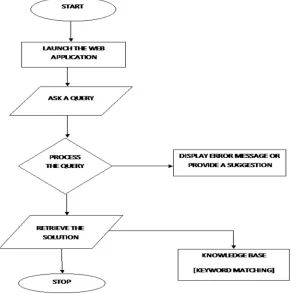
i) Step 1: Insert user query in the chatbot window. (INPUT)
ii) Step 2: Pre-processing of the query e.g. suppose there is this query “can I know the dosage of a paracetamol?” (Here the words like: dosage and paracetamol are given much importance.)
iii) Step 3: Fetch only keywords from the query.
iv) Step 4: ChatBot stores the session Information in its log.
v) Step 5: Processes the Command. Matches the fetched keywords with the keywords in Knowledge base, and provides an appropriate response. A keyword matching algorithm is used to process the query.
vi) Step 6: The response is fetched from the knowledge base and returned as an output to the user. vii) Step 7: Exit.
[image:5.612.162.458.253.550.2]The proposed Chatbot system functions based on a Decision Tree algorithm. It generates responses for the user queries based on the following method:
Fig 2: Chatbot Flowchart:
V. IMPLEMENTATION
The proposed system is a web application that has a chatbot integrated with it. There are several bot development frameworks like Microsoft Bot Framework, Facebook bot Engine, API.ai etc, in this project I am using the ‘Dialogflow’ API. The chatbot is built with Google’s DialogFlow are intelligent personal assistants. It abstracts out the Natural Language Processing, Machine Learning and other deeper concepts and gives a clean usable user interface to focus on the conversation flow and build bots.
A. Why Dialog flow?
1) Built-in natural-language processing (NLP) feature imparts artificial intelligence (AI) to the chatbot, thereby enabling it to
process the natural language and carry forward the conversation in a natural way
2) Machine learning makes Dialogflow intelligent enough to predict the hidden intention expressed in the natural input language.
3) Works with an array of platforms
B. DialogFlow Architecture
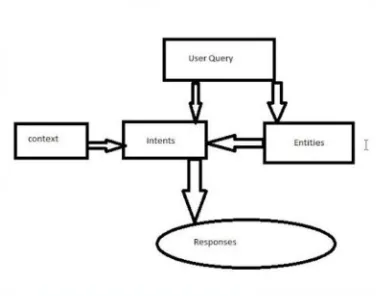
Fig 3: DialogFlow Architecture
1) User Query: The user initiates a conversation with the bot by asking it queries, these queries inturn creates
a) Intents: are the classes that help to design or create meaningful user queries, basically helping to create categories for different user queries.
b) Entities: are the parameters of the user query that help the bot to extract responses based on the keywords. c) Responses: After the intents are processed by the bot, it generates responses and displays them to the users.
C. Integrating Chatbot With The Web Application
1) Create a bot and configure it with one or more intents that you want to support. Configure the bot so it understands the user's
goal (intent), engages in conversation with the user to elicit information, and fulfills the user's intent.
2) Test the bot. You can use the test window client provided by the console.
3) Publish a version.
4) Deploy the bot. You can deploy the bot on various platforms such as Facebook Messenger, mobile applications or messaging
applications.
5) Since the proposed system is a web application, I deploy the bot on my web app.
The following code snippet is added in my program to integrate the bot to my web application:
Reference: https://bot.dialogflow.com/5df9efcc-ed4a-48a9-bd60-5c7d027ab6e9
Copy the above JavaScript code and add it to your website code. Dialogflow provides a chat widget ‘Kommunicate’ that will appear and you can now see the bot live in action on the web application.
VI. RESULTS AND DISCUSSIONS
This section provides with the results of the exhaustive experimentation of the developed methodology. The proposed system is an efficient, cheap, easy and a quick way to help patients to have a one to one conversation with the Chatbot that helps and assists them to take care of their health effectively.
A. Rise of AI and Chatbots in the field of Medicine
The following graph shows the rise of chatbots from 2014 - 2023:
The development and use of AI based chatbots is expected to rise in the coming years as you can see in the above graph derived from research made on growth of chatbot market revenue for the years 2014 – 2023.
B. The Proposed system Design
The Proposed Web application allows users to sign- up and login to their profiles. The application is integrated with the chatbot interface where the users can pose their queries and get the solutions from the bot.
Screenshot of the proposed system is shown below:
The users can book a doctor’s appointment; get a daily health tip reminder as a pop up notification, and Appointment reminders on the home screen.
The application also provides a payment gateway for the patients to make their initial payment.(optional)
Patients or Customers may no longer have to pay a visit the hospital or the medical institute to get the information he/she is looking for. The system can be accessed from anywhere and at anytime conveniently. The chatbot is available 24/7.Thus improving the overall customer experience.
C. Comparing The Proposed System With The Already Existing Systems
There are several medical chatbot systems already disgned. In the following section I am Comparing the proposed system with the already existing systems:
Refer the following papers 1) Paper [12]
Divya Madhu, Neeraj Jain C. J, Elmy Sebastain, Shinoy Shaji, Anandhu Ajayakumar, “A Novel Approach for Medical Assistance Using Trained Chatbot”, Published in: International Conference on Inventive Communication and Computational Technologies(ICICCT 2017)
In this paper the designed system is restricted to two features:
a) The system can predict the disease based on the symptoms.
2) Paper [13]
Divya S, Indumathi V, Ishwarya S, Priyasankari M, Kalpana Devi S,”A Self-Diagnosis Medical Chatbot Using Artificial Intelligence”, Published in: Journal of Web Development and Web Designing Volume 3 Issue 1, 2018
The above mentioned paper has proposed a system that concentrates on the following features:
a) The chatbot is designed to extract symptoms and predict disease that acts as an initial step for patients to assess their symptoms
before going to the doctor.
b) Based on the symptoms the disease is predicted and the system can suggest the patients to refer a doctor.
c) The system basically acts as a preliminary diagnostic tool.
3) Paper [14]
Mrs. Rashmi Dharwadkar, Dr.Mrs. Neeta A. Deshpande, “A Medical ChatBot”, Published in: International Journal of Computer
Trends and Technology (IJCTT) – Volume 60 Issue 1- June 2018
The above mentioned paper has a proposed system that has 2 main features:
a) Disease prediction.
b) Age based dosage of medications.
c) It uses Support vector machine algorithm [SVM] to predict the diseases and generate responses to user queries. The SVM
algorithm is usually helpful for a numerical dataset.
D. Proposed System
In Comparison to the systems designed in above mentioned papers, the system I am proposing has the following additional features: The designed system is a web application that is accessible at any time and has the following features:
1) The system can not only predict the diseases but can also predict the severity of the patient’s condition and can suggest a list of
doctors/ specialists along with their contact details so that the it becomes easier for the patient to get in touch with the doctor.
2) Another Feature that is unique with the proposed system is that it provides an online portal to Book an appointment with a
doctor. The patient does not have to look for other ways to book an appointment. The Chabot system will do it on his behalf. The system can book the appointment based on the patient’s convenience, time and schedule.
3) The Third unique feature of the proposed system is that, it allows the patients to make their initial consultancy payment through
the online payment gateway that the system provides.
4) The fourth feature that is unique to the proposed system is that, as soon as the user logs-in to his profile, the system pops up a
notification displaying a ‘Daily Helath Tip’, which acts as a Reminder for the patient to help him improve his lifestyle.
5) The Proposed system uses a ‘Decision Tree algorithm’ for the system Design which has the following advantages:
a) Easy to Understand and implement
b) Reduces problem complexity
c) Easily scalable
d) Easy to generate rules.
e) Allows the user to set the priority of a complex query structure.
6) In comparison to SVM algorithm used in Paper[3] mentioned above, the Decision tree algorithm can include multiple
classifications as compared to SVM. The Decision tree also provides dense features as compared to the sparse features SVM provides.
7) Another important feature of the proposed system is that, it not only allows the users to ask queries about general illness but it is
designed specifically to help patients with mental health disorders, the system can help the mental health patients to uplift their mood and acts as a friend that is available to help and listen to them at any time of the day.
VII. ADVANTAGES OF A CHATBOT
1) Available 24/7: The chatbot system never gets tired and is always available for the customers without taking any breaks unlike human customer service
2) Capacity: Chatbots can simultaneously have conversations with thousands of people and give instant responses unlike humans who can only communicate with one human at a time. No matter what time of the day it is or how many people are contacting you, every single one of them will be answered immediately.
4) Customer Satisfaction: Chatbots provide detailed and expert answers and they will always be respectful to the person no matter how foul language the person uses.
5) Cost Effective: Due to the boundaries of human beings who can handle one or two people at a time, Chatbots could help solve this problem. As one chatbot can easily communicate with thousands of customers at the same time.
6) Work Automation: Chatbots can now automate tasks which are to be done frequently and at the right time. They help automate repetitive tasks. This helps people save time and be more productive.
VIII. CONCLUSION
The main objective of the project is to develop an algorithm that will be used to identify answers related to users’ queries. The knowledge base stores information about the user queries, the system responses, keywords, reminders, logs and customer feedback information.
The system offers many services. Most of them are very complex. So as time passes each module can be optimized. So, the system must be designed in such a way that each module must be upgradable independently. The system must be able to improve the performance of each module. Thus, the system can be improved easily, and the capabilities of the system also improves.(We can scale the system to include more information that can predict more and more diseases, as well as can describe more medicines) However, AI based chatbot does pose some challenges, such as the accuracy of results and these algorithms and machines could replace most of the jobs infuture. Finally, a successful implementation of personalized medicine would save many lives and make the lives of individuals easier.
IX. FUTURE SCOPE
In future scope of this project, we can include voice based queries in addition to text based inputs. The users will have to give voice input and the system can generate either a text output or even a voice based output.
Since the system is Scalable, each module can be upgraded by adding more functionality’s, and increasing the information content in the knowledge base.
REFERENCES
[1] Bayu Setiaji, Ferry Wahyu Wibowo, “Chatbot Using A Knowledge in Database Human-to-Machine Conversation Modeling”, Published in: IEEE 7th International Conference on Intelligent Systems, Modeling and Simulation, 2016
[2] Jean-Emmanuel Bibault, Benjamin Chaix, Pierre Nectoux , Arthur Pienkowski, Arthur Guillemasé, Benoît Brouard , “Healthcare ex Machina: Are conversational agents ready for prime time in oncology?”, Published in: Elsevier: Clinical and Translational Radiation Oncology 16 (2019)
[3] Ayah Atiyah, Shaidah Jusoh, Sufyan Almajali, “An Efficient Search for Context-Based Chatbots”, Published in: 8th International Conference on Computer Science and Information Technology (CSIT), 2018.
[4] Ashay Argal ; Siddharth Gupta ; Ajay Modi ; Pratik Pandey ; Simon Shim ; Chang Choo , “Intelligent travel chatbot for predictive recommendation in echo platform”, Published in: IEEE 8th Annual Computing and Communication Workshop and Conference (CCWC), 2018
[5] Hyo Jin Do and Wai-Tat Fu, Department of Computer Science: “Empathic Virtual Assistant for Healthcare Information with Positive Emotional Experience”, Published in:IEEE International Conference on Healthcare Informatics, 2016.
[6] Dongkeon Lee, Kyo-Joong Oh, Ho-Jin Choi : “The chatbot feels you - a counseling service using emotional response generation“. Published in: Big Data and Smart Computing (BigComp), 2017 IEEE International Conference, 2017.
[7] Kyo-Joong Oh, Dongkun Lee, ByungsooKo: “A Chatbot for Psychiatric Counseling in Mental Healthcare Service Based on Emotional Dialogue Analysis and Sentence Generation”, Published in: Mobile Data Management (MDM), 2017 18th IEEE International Conference, 2017.
[8] BayuSetiaji, Ferry WahyuWibowo: “Chatbot Using a Knowledge in Database: Human-to-Machine Conversation Modeling“, Published in: Intelligent Systems, Modelling and Simulation (ISMS), 2016 7th International Conference, 2016.
[9] Ahmed Fadhil, “Beyond Patient Monitoring: Conversational Agents Role in Telemedicine & Healthcare Support For Home-Living Elderly Individuals”, a research article, 2017
[10] “Dialogflow,” https://dialogflow.com/, accessed: 2017 [11] Tutorials point for python programming.
[12] Divya Madhu, Neeraj Jain C. J, Elmy Sebastain, Shinoy Shaji, Anandhu Ajayakumar, “A Novel Approach for Medical Assistance Using Trained Chatbot”, Published in: International Conference on Inventive Communication and Computational Technologies(ICICCT 2017)
[13] Divya S, Indumathi V, Ishwarya S, Priyasankari M, Kalpana Devi S,”A Self-Diagnosis Medical Chatbot Using Artificial Intelligence”, Published in: Journal of Web Development and Web Designing Volume 3 Issue 1, 2018