567
©IJRASET: All Rights are Reserved
Smart Helmet
Sheetal Durgale1, Reshma Parveen2, Pooja Sonawane3, Neha Adawade4, Dr. Roshani Raut5
1, 2, 3, 4, 5
Computer Engineering, Savitribai Phule Pune University
Abstract: The basic idea behind “Smart Helmet” is that it could save many precious lives daily by avoiding fatal injuries caused during road accident and the smart helmet mechanism forces any rider to wear this protective helmet. This is also mentioned as ‘Your helmet is your key’ which means that the vehicle will only work with the helmet put on. Another major reason for accidents to take place is because the rider is drunk. To prevent this, the helmet consists of sensors that recognize the drunken condition of that person and thus it does not allow the bike to start or can say ignite the engine. Theft is one of the major problems everyone faces nowadays and therefore, to reduce the theft possibility, the helmet is connected to the vehicle and a mobile phone all the time. Hence this helmet covers most of the problems one faces and keeps us secure and the vehicle safe. Keywords: Smart Helmet , accident , sensor , theft possibility , IOT , Input and Output , Hardware
I. INTRODUCTION
The Internet of things is the combination of devices like vehicles, home appliances and other items which are embedded with electronics hardware, software, sensors and internet or network connectivity which enables these items to connect and exchange the data between them. Every element is uniquely identified through its embedded system and is able to operate and inter-communicate within the existing Internet infrastructure.
Today in India after every four minutes one death occur due to road accidents [1]. Out of total road accidents, 25% accidents come under two wheeler accidents [1]. According to studies, 98.6% bikers who died didn’t wear helmet [1]. Hence our government has made it mandatory to wear helmet while riding two wheelers. Riders especially two wheeler riders face many problems while driving such as unable to take calls, unable to see maps for navigation purposes etc. For increasing more safety we add more features to it to make it smart.
Smart Helmet is an idea of making a normal helmet smarter with latest technologies. This project will aid people to do various task such as navigation, receive calls, Bluetooth system and many more while driving. This helmet have multi features like vehicle engine control system with the smart helmet, inbuilt Bluetooth system ,accident alert system ,alcohol detection, over speed or rash driving alert on control.
Also this helmet will acts as a second key to the vehicle and in turn increases security of the person.
The smart helmet model consists of a helmet which has a pressure sensor on the inner side of the helmet and a Bluetooth module attached to a Raspberry Pi or Arduino Uno .On the other hand, another onboard Raspberry Pi or Arduino Uno is connected with a Bluetooth module on the vehicle. After the helmet is worn by the rider, the pressure is sensed and the data is send via Bluetooth module on the helmet to the onboard module on the vehicle. The gathered information is then computed and on that basis the engine of the vehicle can be started. If the sensor fails to send the information to the module, the engine of the vehicle would not start. In two wheeler vehicles a helmet with useful technologies can be used to avoid unwanted situations.[2][3][7]
The remaining part of this paper is distributed in seven sections. In section II, a brief review of related work is provided. Overall system architecture is provided in section III. The analysis of the survey is presented in section IV. In section V the outcome of our paper in described briefly. Finally, the conclusion of the paper is explained in section VI.
II. LITERATURE SURVEY
The IoT allows objects to be sensed or controlled remotely across existing network infrastructure, creating opportunities for more direct integration of the physical world into computer-based systems which results in improved efficiency, accuracy and economic benefit in addition to reduced human intervention and also making everything automatic.
A. History
568
©IJRASET: All Rights are Reserved
When IoT is augmented with sensors and actuators, the technology becomes an instance of the more general class of cyber-physical systems, which also encompasses technologies such as smart grids, virtual power plants, smart homes, intelligent transportation and smart cities. These devices collect useful data with the help of various existing technologies and then autonomously flow the data between other devices.
Some applications of IoT are
1) Smart Refrigerator: A smart refrigerator is basically a refrigerator which has Internet access and is able to manage and recognize items stored inside it. Automatic detection for every item requires a barcode or RIFD, or items can also be registered manually. Without opening the smart refrigerator user can get to know about the items present inside it, by simply checking the display on an LCD or other output device. The refrigerator is able to communicate and also able to send its content list to various other display devices.
2) Smart water Monitoring System: IoT based Smart Water Monitoring System can detect the stream of water and can record the volume or content of water that flows through the pipe for a given period of time. The collected data is then sent to the cloud for storage and analysis purpose. By placing this system in a smart building, it will become easy to collect and analyze the water usage patterns of the residents and save a lot of water from wastage.
3) Waste Management: The use of intelligent waste containers, which basically detect the level of load and allow for an optimization of the collector trucks route, can reduce the cost of waste collection and improve the quality of recycling. To produce this kind of a smart waste management service, the IoT shall connect the end devices, i.e., intelligent waste containers, to a control center where an optimization software processes the data and determines the optimal management of the collector truck fleet.[4]
4) Noise Monitoring: The city authorities have issued some specific laws to reduce the amount of noise in the city after some specific hours. IoT mechanism can offer a noise monitoring service to measure the amount of noise produced at any given hour. Besides building a map of noise pollution in the area, such a service can also be used for public security, by means of sound detection that can identify, for instance, the noise of glass crashes or brawls. Although the installation of sound detectors is little controversial, because of the obvious privacy concerns for this type of monitoring. [4]
5) Smart Lighting: This service can optimize the street lamp intensity according to the light in the surrounding at morning or at night, the weather condition, and the presence of people. This service can be included in the Smart City infrastructure. In addition to this, a fault detection system will be easily realized on top of the street light controllers.[4]
Accident management and IoT are the two main areas which are progressing very fast. We can use smart phones for many purposes like accident detection, notification etc. But, most of the already existing technology has been designed for four- wheeled vehicles. As these systems are very vast, maintenance also becomes expensive [5]. Therefore, there is a requirement for an intelligent vehicle safety system which can be affordable and are available to everyone.
Thus, we are planning to build and implement a low cost and secure IoT based smart helmet. WiFi enabled processor, some integrated network of sensors and cloud computing are being used to design the smart helmet for engine control system, inbuilt Bluetooth system, accident alert system , alcohol detection, over speed or rash driving alert on control. [5][6]
a) Accident Alert: The helmet is build to detect accident and will immediately alert the contacts of that person [5].During the course of accident the helmet uses the services of GSM with the help of GPS and sends message body containing the precise location of the vehicle to the desired phone number.
b) Engine Control: This feature make it mandatory for the rider to wear the helmet before starting the vehicle else it won’t start.
c) Inbuilt Bluetooth System: By providing this inside the helmet we can avoid the handy talking and continue the call without removing helmet.
d) Alcohol Detection System: If the smart helmet detects that the rider is riding the vehicle after consuming alcohol then it won’t let the vehicle to switch on.
569
©IJRASET: All Rights are Reserved
III. SYSTEM ARCHITECTURE
Fig.1: Smart Helmet Model
A. Accident Alert System
1) GSM Module
Fig.2: GSM Module
a) Power supply - DC supply voltage 3.3V- 4.2V.
b) Frequency bands - EGSM900/DCS1800 (default)
i) EGSM850/PCS1900 (customized)
c) GPRS - GPRS mobile station : class B
i) GPRS multi-slot class : class 10
d) Network protocols - PPP, TCP/IP, USSD
e) SMS - MO/MT/CB, support TEXT/PDU mode
i) SMS over GPRS.
f) SIM card - 1.8V, 3V.
g) LCD - SPI serial interface.
2) Accelerometer
570
©IJRASET: All Rights are Reserved
a) Type - Piezoelectric , piezoresistive, capacitive or MEMS
b) Analog /digital
c) Number of axes - 2D or 3D
d) Output range - +1.5g
e) Sensitivity (voltage output per g) -0.02 g pr
f) Dynamic range
g) Bandwidth - 40-60 Hz
h) Temperature range - 50 degree C to 60 degree C
i) Weight - 1.5 oz
B. Alcohol Detection 1) MQ3 Sensor
Fig.4: MQ3 Sensor
a) Circuit voltage - 5V +0.1
b) Heating voltage - 5V +0.1
c) Load resistance - 200k ohm
d) Heater resistance - 33 ohm + 5%(Room temperature)
e) Heating consumption less than 150 mW
f) Using temperature - -10 degree C to 50 degree C
g) Storage temperature - -20 degree C to 70 degree C
h) Sensing resistance - 1M ohm - 8M ohm (0.4 mg/L alcohol)
C. Engine Control System With The Smart Helmet 1) Force Sensing Resistor
Fig.5: Force sensing resistor
a) Force sensing area - 0.5" diameter.
b) Resistance - 1MΩ.
c) FSR can sense applied force anywhere in the range of 100g-10kg.
d) Two pins extend from the bottom of the sensor with 0.1" pitch making it bread board friendly.
571
©IJRASET: All Rights are Reserved
[image:5.612.87.486.467.734.2]D. Inbuilt Bluetooth System 1) Bluetooth hc-05 Module
Fig.6: Bluetooth hc-05 module
a) Bluetooth protocol: Bluetooth Specification v2.0 EDR
b) Frequency: 2.4GHz ISM band
c) Modulation: GFSK(Gaussian Frequency Shift Keying)
d) Emission power: ≤4dBm, Class 2
e) Speed: Asynchronous: 2.1Mbps(Max) / 160 kbps, Synchronous : 1Mbps/1Mbps
f) Profiles: Bluetooth serial port
g) Power supply: 3.3V DC 50mA
h) Working temperature: -20 ~ 75Centigrade
i) Dimension: 26.9mm x 13mm x 2.2 mm
IV. SURVEY ANALYSIS
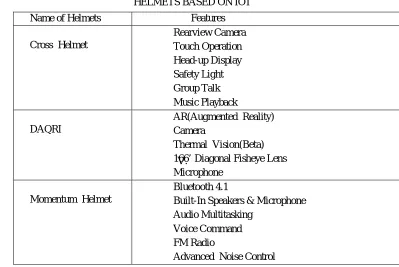
Nowadays, everything is becoming automated and so the helmets can do much more than keeping the driver’s head safe. Technology can make this helmets safer, easy to handle and more convenient. There are many smart helmets already available in the market. Some of them are listed below
(Table 1: Helmets Based on IoT) :-
TABLE I
HELMETS BASED ON IOT
V.
Name of Helmets Features
Cross Helmet
Rearview Camera
Touch Operation
Head-up Display
Safety Light
Group Talk
Music Playback
DAQRI
AR(Augmented Reality)
Camera
Thermal Vision(Beta)
166’ Diagonal Fisheye Lens
Microphone
Momentum Helmet
Bluetooth 4.1
Built-In Speakers & Microphone
Audio Multitasking
Voice Command
FM Radio
[image:5.612.100.494.469.733.2]572
©IJRASET: All Rights are Reserved
VI. RESULT
The main advantage of smart helmet is that a bike cannot be started without wearing helmet as the helmet of the bike is electronically connected with the ignition system of the bike and this idea helps in providing more security to the driver.
The helmet provides Bluetooth system which will be used for communication in the range of 2kms and it can be also used to give direction of route in the form of voice. If the driver is drunken then the bike will not start as the smart helmet provides alcohol detection. If speed is increased after certain threashold speed limit than it will give a warning if still it is not reduced than automatically speed is reduced.
VII. CONCLUSION
This helmet provides safety by forcing the driver to wear the helmet before starting the ignition of a bike. With the help of Bluetooth system it makes easy for the driver to use GPS system, receive the urgent calls and listen FM radio. By controlling the speed limit smart helmets avoid the chances of accidents and also it enforces people to follow all the traffic rules. Smart helmets are very efficient and easy to handle and use.
VIII. ACKNOWLEDGEMENT
It gives us an immense pleasure and satisfaction to present this paper on SMART HELMET, which is the result of unwavering support ,expert guidance and focused direction of our guide Dr. Roshani Raut, to whom we express our deep sense of gratitude and humble thanks, for her valuable guidance throughout the work.
REFERENCES
[1] National Crime Records Bureau, Ministry of Road Transport and Highway, Law Commission of India, Global Status Report on Road Safety 2013. [2] ”Smart Helmets: Vehicular Safety using Wireless Sensors” International Journal of Engineering Research & Technology (IJERT) Volume 6 Issue 7 (July
2017).
[3] ”Hi-tech Helmet and Accidental Free Transportation System” International Journal of Advanced Technology and Engineering Exploration Volume 2 Issue 6 (May 2015).
[4] Andrea Zanella, Nicola Bui, Angelo Castellani, Lorenzo Vangelista and Michele Zorzi, IEEE INTERNET OF THINGS JOURNAL, Volume 1 Issue 1, (February 2014).
[5] Sreenithy Chandran, Sneha Chandraseker, Edna Elizabeth N “ Konnect: An Internet of Things(IoT) based Smart Helmet for Accident Detection and Notification”(2016).
[6] Mohammed Khaja Areebuddin Aatif, Ainapurapu Manoj ” Smart Helmet Based On IoT Technology” International Journal for Research in Applied Science & Engineering Technology (IJRASET) Volume 5 Issue 7,(July 2017)
[7] Vehicle accident alert and locator” International Journal of Electrical & Computer Sciences IJECS-IJENS Volume 11 Issue 2. [8] World Health Organisation,Global status report on road safety 2015,2015.
[9] Chitte,Salunke,S.Akshay,Bhosale,T.Nilesh,Smart helmet and intelligent bike system,International Research Journal of engineering and technology(IRJET),vol. 5,no. 5,2016