Improved Multi-Verse Optimization (IMVO)
Algorithm for Solving Economic Load Dispatch
Shivani Mehta1, Rahul Bahl2
1
Assistant Professor, 2Student (Master of Technology), Electrical Engineering Department, D.A.V.I.E.T., Jalandhar
Abstract: This Paper Presents Improved Multi Verse Optimization (IMVO) to solve the economic load dispatch (ELD) problem. In this work the performance of basic MVO algorithm has been improved by hybridizing it with PSO algorithm. The objective of ELD Problem is to minimize the total generation cost by appropriate scheduling of load among generating units. The Proposed technique is applied for solving the ELD in two different test problems. At the end of this paper, the results obtained from MVPSO for solving ELD problem were compared with other well known existing methods which show MVPSO better than other techniques.
Keywords: IMVO, Economic Load Dispatch (ELD), Multi Verse Optimization (MVO), Particle swarm optimization (PSO)
I. INTRODUCTION
With large interconnection of electric networks, the energy crisis in the world, and continuous rise in prices, it is very essential to reduce the running charges of electricity generating unit. The efficient and optimum economic operation and planning of electric power generation systems have always occupied an important position in the electric power industry. By definition Economic Load Dispatch (ELD) can be defined as the method of determining the most efficient, low cost and reliable operation of a power system by generating electricity to supply the required load. The economic dispatch problem has been solved via many traditional optimization methods, including Gradient techniques, linear programming, Newton methods, and quadratic programming
[image:1.612.152.467.460.564.2]Evolutionary programming is one of the technique to solve ELD problem, but it suffer from problem of iteration of dimensionality [1], meta-heuristic techniques such as genetic algorithm [3], bio-geography based alogrithm [7], tabu search [8], grey wolf optimization [23], particle swarm optimization (PSO) [2], harmony search[16], hybrid gravitational search[15], cuckoo search (CS) [15] have successfully applied to ELD problem. In this paper ELD problem has been solved by improved multi-verse optimization(IMVO)
Figure 1 Schematic Diagram of BBoiler turbine generator unit
II. PROBLEM FORMULATION
The objective function of ELD problem is to minimize the total generation cost while satisfying the various constraint, when the required load of power system is being supplied. The objective function to minimized is given by the following equations:.
=∑ + + ………. (i)
Where : Total fuel cost, Rs/h
: Unit power output of ith generator, MW n : number of electric generating units
III. IMPROVED MULTI-VERSE OPTIMIZATION (IMVO)
A. Particle Swarm Optimization
Particle swarm optimization, motivated by societal behavior of birds is a swarm-intelligence-based optimization algorithm which offers a population-based searching method by taking particles and moving them around in the search space for receiving the best solution for the problem. In PSO, particlws move in a multi-dimensional search space, each particles regulates its position according to its own experience of neighbouring particles, utiling best position encountered by itself and its neigbours[2]. PSO is meta-heuristic optimization technique and provides a population-based search procedure for global optimization, having principal advantage of easy to perform and few parameters to adjust.
B. Multi-Verse Optimzation
Multi-Verse Optimizer (MVO) [24] is a novel nature inspired algorithm proposed by Seyedali Mirjalili. MVO is motivated by the philosophy of multi-verse in astronomy. According to this theory there are many big bangs and each gives birth to a new universe. The term multi-verse stands opposite of universe, which refers to the existence of other universes in addition to the universe that we all are living in [24]. Multiple universes interact and might even collide with each other in the multi-verse theory. Three main concepts of the multi-verse theory (white hole, black hole, and wormhole).
A big bang can be considered as a white hole, it is also argued in the cyclic model of multi-verse theory that big bangs/ white holes are created where the collisions between parallel universes occur. In contrast to white holes, black holes attract everything including light beams with their extremely high gravitational force [24]. Wormholes are those holes that connect different parts of a universe together and act as time/space travel tunnels where objects are able to travel instantly between any corners of a universe. Every universe has an inflation rate (eternal inflation) that causes its expansion through space. In MVO algorithm exploration of search space is done by utilizing the concepts of white and black holes while exploitation is assisted by wormholes. A universe is analogous to each solution and an object in that universe is analogous to each variable in the solution. An inflation rate is assigned to each solution, which is relative to the consequent fitness function value of the solution [24]. The following steps are done in order to do this
U =
⎣ ⎢ ⎢
⎡x x . . x
x x . . x
: : : :
x x . . x ⎦
⎥ ⎥ ⎤
(1)
where d is the number of parameters (variables) and n is the number of universes (candidate solutions):
x = x r1 < ( )
x r1≥NI(Ui) (2)
where x indicates the jth parameter of ith universe, Ui shows the ith universe, NI(Ui) is normalized inflation rate of the ith universe,
r1 is a random number in [0, 1], and x indicates the jth parameter of kth universe selected by a roulette wheel selection mechanism. The formulation of this mechanism is as follows:
⎩ ⎪ ⎨ ⎪
⎧ x + TDR × ub −lb × r4 + lb ; r3 < 0.5
x −TDR × ub −lb × r4 + lb ; r3≥0.5 ; r2 < WEP
where Xj indicates the jth parameter of best universe formed so far, TDR is a coefficient, WEP is another coefficient, lbj shows the
lower bound of jth variable, ubj is the upper bound of jth variable, x indicates the jth parameter of ith universe, and r2, r3, r4 are random numbers in [0, 1]. There are two main coefficients herein: wormhole existence probability (WEP) and travelling distance rate (TDR). The former coefficient is for defining the probability of wormhole’s existence in universes. It is required to increase linearly over the iterations in order to emphasize exploitation as the progress of optimization process. Travelling distance rate is also a factor to define the distance rate (variation) that an object can be teleported by a wormhole around the best universe obtained so far. In contrast to WEP, TDR is increased over the iterations to have more precise exploitation/local search around the best obtained universe. The adaptive formulator both coefficients are as follows[24]:
WEP = min + l × max−min L
Where min is the minimum (0.2 in this paper), max is the maximum (1 in this paper), l indicates the current iteration, and L shows the maximum iterations
TDR = 1−l
L
Where p (=6) defines the exploitation accuracy over the iterations. The higher p, the sooner and more accurate exploitation/local search. In the MVO algorithm, the optimization process starts with creating a set of random universes. At each iteration, objects in the universes with high inflation rates tend to move to the universes with low inflation rates via white/ black holes. Meanwhile, every single universe faces random teleportation in its objects through wormholes towards the best universe. This process is iterated until the satisfaction of an end criterion.
C. Basic Steps Of Hybrid Mvo-Pso Algorithm
1) Initialize the population and form the solution space. 2) Run MVO
3) Generate minimum values for all individuals 4) Pass these individuals to the PSO as starting points 5) Give the updated positions back to MVO.
6) Run till stopping criteria is met.
IV. RESULTS & DISCUSSION
IMVO has been used to solve ELD problem in two test framework for exploring its optimization potential. In this technique iteration has been performed are 500 in each test framework and 50 is the number of search agent.
A. Experimntal Model 1: Number of Generating Unit is 3
The statistical data for 3-generators and Bmn, i.e. the loss coefficient matrix is procured from reference and is provided in Appendix A.1. The ELD for 3-generators is explaining as suggested composite approach and foremost result had been contrasted by MVO. Also the fuel cost of different algorithms which had been applied to the same test model is contrasted with obtained results from the hybrid approach for demand load of 350MW, 450MW and 500MW in Table 1.
Table1. Comparison of Various Methods
Sr.No. Power
Demand
Conventional Method [15]
Cuckoo Search Algorithm[15]
MVO IMVO
1 350 18570.7 18564.5 18564.4841 185624.4839
2 450 23146.8 23112.4 23112.416 23112.363
3 500 25495.2 25465.5 25465.526 25465.469
B. Experimntal Model 1: Number of Generating Unit is 6
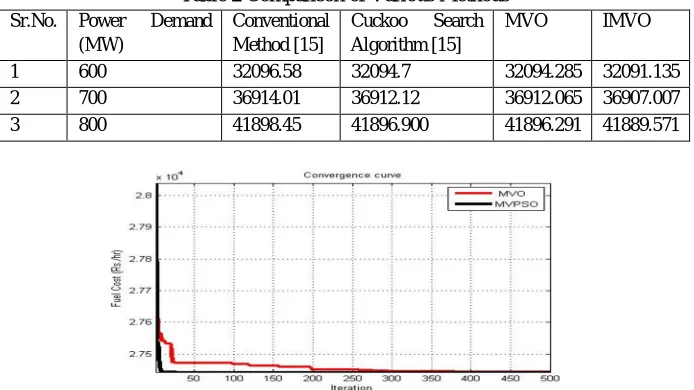
[image:4.612.78.530.208.281.2]The input data for six generators and Bmn, i.e. the loss constant matrix is obtained from reference [15] and is mentioned in Appendix A.2.The economic load dispatch is expressed withmix approach and the outcomes obtained is contrasted with particle swarm optimization, cuckoo search algorithm and whale optimization algorithm for an instance of fuel cost delivering load demand of 600MW, 700MW and 800MW in Table 2.
Table 2 Comparison of Various Methods
Sr.No. Power Demand
(MW)
Conventional Method [15]
Cuckoo Search
Algorithm [15]
MVO IMVO
1 600 32096.58 32094.7 32094.285 32091.135
2 700 36914.01 36912.12 36912.065 36907.007
3 800 41898.45 41896.900 41896.291 41889.571
Figure 2 Convergence curve of MVO & MVPSO with power demand 500 MW
[image:4.612.134.481.366.561.2]V. CONCLUSION
In this paper ELD problem has been solved by improved multi-verse optimization (IMVO). The result of IMVO are compared for three unit and six unit generating unit system with other techniques. The algorithm is programmed in MATLAB (2009a) software package. The result show effectiveness of IMVO for solving economic load dispatch.(A.1)
REFERENCES
[1] Nidul Sinha, R. Chakrabarti, and P. K. Chattopadhyay. Evolutionary programming techniques for economic load dispatch. IEEE Transactions on Evolution Computation. 2003; 7: 83-94.
[2] Gaing, Zwe-Lee. "Particle swarm optimization to solving the economic dispatch considering the generator constraints." Power Systems, IEEE Transactions on 18, no. 3 (2003): 1187-1195.
[3] Chiang, Chao-Lung. "Improved genetic algorithm for power economic dispatch of units with valve-point effects and multiple fuels." Power Systems, IEEE Transactions on 20, no. 4 (2005): 1690-1699.
[4] Devi, A. Lakshmi, and O. Vamsi Krishna. "combined Economic and Emission dispatch using evolutionary algorithms-A case study."ARPN Journal of engineering and applied sciences 3, no. 6 (2008): 28-35.
[5] Singh, Lakhwinder, and J. S. Dhillon. "Cardinal priority ranking based decision making for economic-emission dispatch problem."International Journal of Engineering, Science and Technology 1, no. 1 (2009): 272-282.
[6] Duman, S., U. Güvenç, and N. Yörükeren. "Gravitational search algorithm for economic dispatch with valve-point effects."International Review of Electrical Engineering 5, no. 6 (2010): 2890-2895.
[7] Bhattacharya, Aniruddha, and Pranab Kumar Chattopadhyay. "Solving complex economic load dispatch problems using biogeography-based optimization." Expert Systems with Applications 37, no. 5 (2010): 3605-3615.
[8] W.M. Lin, F.S Cheng and M.T.Tsay, “An improved Tabu searchfor economic dispatch with multiple minima”, IEEE Trans. onPower system,Vol.17,No.1,pp.108-112,Feb.2002
[9] Yohannes, M. S. "Solving economic load dispatch problem using particle swarm optimization technique." International Journal of Intelligent Systems and Applications (IJISA) 4, no 12 (2012): 12.
[10] Pandi, V. Ravikumar, and Bijaya Ketan Panigrahi. "Dynamic economic load dispatch using hybrid swarm intelligence based harmony search algorithm." Expert Systems with Applications 38, no. 7 (2011): 8509-8514.
[11] Swain, R. K.,N. C. Sahu, and P. K. Hota. "Gravitational search algorithm for optimal economic dispatch." Procedia Technology 6 (2012): 411-419. [12] Yang, Xin-She, Seyyed Soheil Sadat Hosseini, and Amir Hossein Gandomi. "Firefly algorithm for solving non-convex economic dispatch problems with
valve loading effect." Applied Soft Computing 12, no. 3 (2012): 1180-1186.
[13] Rajasomashekar, S., and P. Aravindhababu. "Biogeography based optimization technique for best compromise solution of economic emission dispatch." Swarm and Evolutionary Computation 7 (2012): 47-57.
[14] Güvenç, U., Y. Sönmez, S. Duman, and N. Yörükeren. "Combined economic and emission dispatch solution using gravitational search algorithm." Scientia Iranica 19, no. 6 (2012): 1754-1762.
[15] Adriane, B. S. "Cuckoo Search for Solving Economic Dispatch Load Problem." Intelligent Control and Automation , 4,(2013): 385-390.
[16] Wang, Ling, and Ling-po Li. "An effective differential harmony search algorithm for the solving non-convex economic load dispatch problems." International Journal of Electrical Power & Energy Systems 44, no. 1 (2013): 832-843.
[17] Dubey, Hari Mohan, Manjaree Pandit, B. K. Panigrahi, and Mugdha Udgir. "Economic Load Dispatch by Hybrid Swarm Intelligence Based Gravitational Search Algorithm." International Journal Of Intelligent Systems And Applications (Ijisa) 5, no. 8 (2013): 21-32.
[18] Gopalakrishnan, R., and A. Krishnan. "An efficient technique to solve combined economic and emission dispatch problem using modified Ant colony optimization." Sadhana 38, no. 4 (2013): 545-556.
[19] A.Hima Bindu, Dr. M. Damodar Reddy. “Economic Load Dispatch Using Cuckoo Search Algorithm.” International Journal of Engineering Research and Applications (IJERA), Vol. 3, Issue 4, Jul-Aug 2013, pp. 498-502.
[20] SECUI, Dinu Călin, Gabriel Bendea, and Cristina HORA. "A Modified Harmony Search Algorithm for the Economic Dispatch Problem." Studies in Informatics and Control 23, no. 2 (2014): 143-152.
[21] Aydin, Dogan, Serdar Ozyon, Celal Yaşar, and Tianjun Liao. "Artificial bee colony algorithm with dynamic population size to combined economic and emission dispatch problem." International journal of electrical power & energy systems 54 (2014): 144-153..
[22] Mirjalili, Seyedali, Seyed Mohammad Mirjalili, and Andrew Lewis. "Grey wolf optimizer." Advances in Engineering Software 69 (2014): 46-61. [23] Dr.Sudhir Sharma,Shivani Mehta,Nitish Chopra, “Economic Load Dispatch using Grey Wolf Optimization” Vol.5- Issue 4 (April-2015), International
Journal of Engineering Research and Applications(IJERA).