ISSN Online: 2325-744X ISSN Print: 2325-7458
DOI: 10.4236/jacen.2018.71004 Feb. 6, 2018 34 Journal of Agricultural Chemistry and Environment
A Comparative Analysis for a Novel Irrigation
Method: Partial Rootzone Drying
Alaa Abdallah El-Sadek
1, Mona Ezo Radwan
2, Ahmed Ali Salih
11Arabian Gulf University, Manama, Kingdom of Bahrain
2Nile Research Institute, National Water Research Center, El Qanater El Khairia, Egypt
Abstract
Partial Rootzone Drying (PRD) is an irrigation technique which offers a means of modifying the growth and development of crops through relatively simple changes to the method of water delivery. The technique causes the stimulation of physiological responses which are normally associated with water stress and this results in a significant reduction in water use through the production of chemical signals in drying roots. Partial drying of one half of the roots of plants grown with two root systems is rapidly translated into a reduction in transpiration and assimilation of all the crop leaves. The aim of this research is to examine and simulate the novel irrigation method (PRD), which would stimulate the endogenous stress response mechanisms of Con-ocarpus erectus trees in the pilot area of the Arabian Gulf University in Ba-hrain and wheat and maize crops in the Mashtul Pilot Area (MPA), Egypt us-ing Saltmed model so that vigor is reduced and the efficiency of water use is enhanced. This is to be achieved by the manipulation of the hydration status of parts of a crop’s roots that could be used to control vegetative vigor without detrimental effects on canopy water relations. The PRD technique is re-searched for wheat as a winter crop and maize as a summer crop in Egypt. The technique causes the stimulation of physiological responses which are normally associated with water stress and this results in a significant reduc-tion in water use through the producreduc-tion of chemical signals in drying roots. The results confirmed an increase in irrigation water use efficiency using PRD comparing with conventional flood irrigation. The research highly recom-mends applying the PRD method in the Gulf Cooperation Council (GCC) countries and in new reclaimed areas in Egypt to save water and improve crop quality.
Keywords
Partial Rootzone Drying, Conocarpus Erectus Trees, MPA, GCC
How to cite this paper: El-Sadek, A.A., Radwan, M.E. and Salih, A.A. (2018) A Comparative Analysis for a Novel Irrigation Method: Partial Rootzone Drying. Journal of Agricultural Chemistry and Environ- ment, 7, 34-44.
https://doi.org/10.4236/jacen.2018.71004
Received: December 5, 2017 Accepted: February 3, 2018 Published: February 6, 2018
Copyright © 2018 by authors and Scientific Research Publishing Inc. This work is licensed under the Creative Commons Attribution International License (CC BY 4.0).
DOI: 10.4236/jacen.2018.71004 35 Journal of Agricultural Chemistry and Environment
1. Introduction
Irrigation requirements are sometimes estimated from environmental data (pan evaporation, soil moisture reserves and rainfall) and crop factors. Crop factors are multipliers which reflect the water requirement of a particular crop at dif-ferent times of the year and depend on variables such as canopy area and stage of growth. They can vary by a factor of five and the success of this method of de-termining irrigation input is very much dependent on the use of realistic crop factors. In determining these factors, little thought is given to internal physio-logical changes in the plants which may substantially influence their efficiency of water use in the short term. For example, it has been known for a long time that water deficits will induce changes in the gas exchange characteristics of a plant which results in reduced water loss. Such a decrease in water use would ob-viously be an advantage if it could be achieved without detriment to the crop or any other aspects of crop performance [1]. However, to get the plant to exhibit these changed characteristics, it would normally be necessary to induce a degree of water deficit. This may be difficult to achieve in a controlled way and fur-thermore, the plant will recover over a period of time, making repeat water defi-cit events necessary for a sustained effect. This may be possible, but difficult to achieve in practice, and it is known that sustained water deficits usually result in a reduction in fruit yield. Ideally it would be desirable to separate the positive effects of water deficits (improved water use efficiency and reduced allocation of resources to vegetative growth in comparison to fruit growth) from the negative effects such as reduced crop yield.
DOI: 10.4236/jacen.2018.71004 36 Journal of Agricultural Chemistry and Environment enhanced [4]. This is to be achieved by the manipulation of the hydration status of parts of a crop’s roots could be used to control vegetative vigor without de-trimental effects on canopy water relations. In this paper, the PRD technique is researched for wheat as a winter crop and maize as a summer crop in Egypt. The technique causes the stimulation of physiological responses which are normally associated with water stress and this results in a significant reduction in water use through the production of chemical signals in drying roots. In addition, the research provides low cost irrigation techniques at farmers’ level, monitors per-formance of the new techniques, and assesses the feasibility of implementation and the possibility of extrapolation.
2. Case Studies
2.1. Experimental Pilot Area, Arabian Gulf University, Bahrain
In the arid region countries where water resources are scarce and where agricul-ture sector consumes more than 80% of the total water resources, improving water use efficiencies would be the key to ensure food security in the region. Most of the area of the GCC countries is situated in an extremely arid zone. Groundwater is a vital and essential source for all water use sectors, where groundwater dependency ratio in the GCC countries averages about 75%. At present, groundwater in the GCC countries are used extensively for irrigation purposes, experiencing over-exploitation and quality deterioration. Water scar-city is a key constrain facing the GCC agricultural sector which consumes more than 80% of the total water resources. In the face of rapid population growth and economic expansion, food security is presenting itself as an increasingly pressing policy concern in the GCC. Arid conditions in the GCC countries act as a natu-ral constraint for expansive agriculture. Efforts to maintain a balance between scarce water and land resources and pursue domestic agriculture have prompted the introduction of modern water-saving irrigation techniques.DOI: 10.4236/jacen.2018.71004 38 Journal of Agricultural Chemistry and Environment
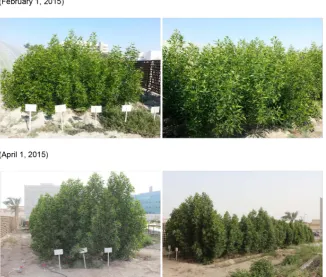
Figure 1. The growing stages of the Conocarpus erectus trees in the experimental pilot area at the Arabian Gulf University, Bahrain.
2.2. Mashtul Pilot Area, Egypt
The field work was carried out in the Mashtul Pilot Area (MPA). MPA was con-structed in 1980 in south-eastern part of the Nile Delta [5]. It is situated 90 km northeast of Cairo in a rather flat area. The area is approximately 260 feddans.
Table 1 shows Irrigation schedule & amount and crop productivity in the
Mashtul Pilot Area, 2005. The southern and western boundaries are formed by the Mahmoudia Drain and its branch; the northern and eastern are bound by tertiary irrigation canals. It is characterized by a deep clay top layer and a sandy aquifer. The clay layer, which is approximately 6.0 m thick, contains about 35% silt and 65% clay. Irrigation water is delivered by gravity to the tertiary canals and lifted approximately 0.5 m to field level by pumps.
DOI: 10.4236/jacen.2018.71004 39 Journal of Agricultural Chemistry and Environment
Table 1. Irrigation schedule & amount and crop productivity in the Mashtul Pilot Area, 2005.
Crop productivity kg/feddan Irrigation
applied m3/feddan No. of
irrigations Irrigation schedule
Crop
5088 1500 - 1900
3 40 - 60 days after first
irrigation then every 30 days Wheat
4233 2000 - 2700
6 every 20 days
Maize
of the collector drains to account for sedimentation and misalignment and change in diameters and maximum depth of 1.5 m for laterals and 2.5 m for col-lectors. The area was divided into eighteen drainage units with different drain depths and spacing. The units were cultivated with a single crop for each unit during each cropping season. Berseem (Egyptian clover) and wheat were culti-vated as winter crops and cotton, rice, and maize as summer crops [6].
3. Method and Materials
DOI: 10.4236/jacen.2018.71004 40 Journal of Agricultural Chemistry and Environment the model was used to examine and simulate the PRD technique in MPA for the same crops.
4. Results and Discussion
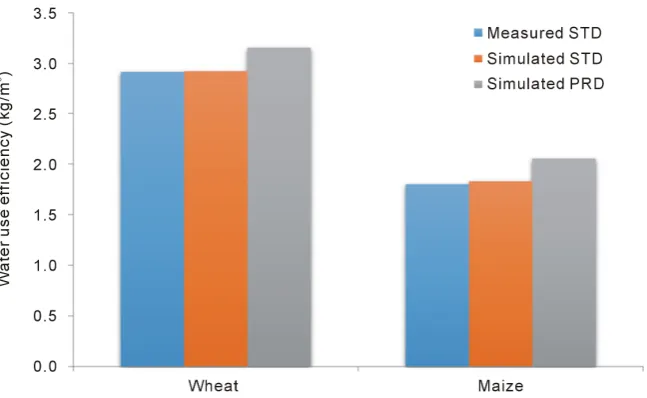
Applying irrigation management by using regulated deficit irrigation and sub-sequent trial have included simulating PRD was arranged in two experimental fields cultivated with wheat and maize. In the 2005 growing winter season for wheat and summer season for maize, PRD was modeled in MPA on a clay soil. The results confirmed an increase in apparent irrigation water use efficiency when compared with conventional flood irrigation. In this trial there were three irrigation cycles during the winter season and six cycles during the summer sea-son, and water was carefully applied and modeled in two ways, as follows: Stan-dard Flood Irrigation (STD) where the entire section was flooded and Partial Rootzone drying (PRD), where only one side of each crop line received water. The results indicated that the measured productivity of wheat and maize using STD was 5088 kg/fed and 4233 kg/fed in winter and summer season, 2005 re-spectively. The STD measured data were used to calibrate the Saltmed model, after the calibration, the Saltmed model was used to simulate the crop yield and the water use efficiency of the PRD treatment.
DOI: 10.4236/jacen.2018.71004 41 Journal of Agricultural Chemistry and Environment
Table 2. Water input, crop yield and water use efficiency (MPA trial) maintained under two different irrigation treatments; STD and PRD in 2005.
Irrigation applied (m3/fed)
Yield (kg/fed) Yield/Irrigation applied (kg/m3)
Measured Simulated Measured Simulated Crop STD PRD STD STD PRD STD STD PRD Wheat 1750 1200 5088 5104 3780 2.91 2.92 3.15 Maize 2350 1650 4233 4319 3402 1.80 1.83 2.06
[image:8.595.209.538.243.443.2]STD = standard flood irrigation; PRD = partial rootzone drying.
Figure 2. Measured and simulated crop yield in MPA trial maintained under STD and PRD irrigation treatments in 2005.
[image:8.595.214.538.493.692.2]DOI: 10.4236/jacen.2018.71004 42 Journal of Agricultural Chemistry and Environment PRD irrigation method requires that both wet and dry rootzones are both si-multaneously created. PRD method is a sensitive technique need very precise ir-rigation scheduling and good distribution uniformity is required to implement these techniques. The experiments have also shown that the dry roots are main-tained in a healthy condition by water supplied to them from the wet roots [16] [17][18][19]. This technique is capable of producing very high water use effi-ciency and improving crop quality for certain varieties. The PRD method will affect on water use efficiency, plant quality and nitrate leaching within the soil profile. PRD technique increases water use efficiency through a stress related chemical produced by the drying roots which is then transported to the leaves. The chemical brings about physiological changes that reduce water lost from leaves through evapotranspiration. In addition to water saving, PRD has also been showed to have beneficial effects on the nutrient uptake of wheat and maize crops compared with STD. The modeling results of this research are summa-rized below:
• Compared to fully irrigated crops, leaf evapotranspiration was reduced. • The effect of PRD on trunk growth was significant on both crops.
• Physiological changes associated with the release of the stress related
chemi-cal were observed.
• The PRD treatment reduced water application rates by 32% and 30% for
wheat and maize respectively.
Compared to flood irrigation, PRD treatment increased water productivity by 7% and 12% respectively and showed a reduction in crop yield by 27% and 18% respectively.
5. Conclusion
DOI: 10.4236/jacen.2018.71004 43 Journal of Agricultural Chemistry and Environment the distribution of soil moisture within the root zone and the development and physiology of crop growing phases on a range of soil textures and depths. Final-ly, the research highly recommends applying the PRD method in the GCC countries and in new reclaimed areas in Egypt such as million and 500 thou-sands faddens to save water and improve crop quality.
Acknowledgements
The authors would like to thank Arabian Gulf University for financing this re-search project via the Internal Rere-search Grant Number DAZ04. They would also like to thank the anonymous reviewers for their constructive rectifications and comments.
References
[1] Kang, S.Z., Li, Z.J., Hu, X.T., Jerie, P. and Zhang, L. (2001) An Improved Water Use Efficiency for Hot Pepper Grown under Controlled Alternate Drip Irrigation on Partial Roots. Scientia Horticulturae,89, 257-267.
https://doi.org/10.1016/S0304-4238(00)00245-4
[2] Kang, S., Hu, X., Goodwin, I. and Jerie, P. (2002) Soil Water Distribution, Water Use, and Yield Response to Partial Root Zone Drying under Shallow Groundwater Table Condition in a Pear Orchard. Scientia Horticulturae, 92, 277-291.
https://doi.org/10.1016/S0304-4238(01)00300-4
[3] Kang, S.Z., Shi, W.J., Cao, H.X. and Zhang, J. (2002) Alternate Watering in Soil Vertical Profile Improved Water Use Efficiency of Maize (Zea mays). Field Crops Research, 77, 31-41. https://doi.org/10.1016/S0378-4290(02)00047-3
[4] Kang, S.Z. and Zhang, J. (2004) Controlled Alternate Partial Root-Zone Irrigation: Its Physiological Consequences and Impact on Water Use Efficiency. Journal of Ex-perimental Botany, 55, 2437-2446. https://doi.org/10.1093/jxb/erh249
[5] Drainage Research Institute (DRI) (1987) Mashtul Pilot Area, Physical Description. Technical Report No. 57, Pilot Areas and Drainage Technology Project, Drainage Research Institute, Cairo, Egypt.
[6] El-Sadek, A., Sallam, G. and Embaby, M. (2013) Using DRAINMOD-Geostatistical Technology to Predict Nitrate Leaching: A Case Study of Mashtul Pilot Area, Egypt. Irrigation and Drainage Engineering, 139, 158-164.
https://doi.org/10.1061/(ASCE)IR.1943-4774.0000491
[7] Ragab, R. (2002) A Holistic Approach for Irrigation, Crop and Field Management: The Saltmed Model. Environmental Modelling & Software, 17, 345-361.
https://doi.org/10.1016/S1364-8152(01)00079-2
[8] Ragab, R. (2002) An Integrated Modelling Approach for Irrigation Water Manage-ment Using Saline and Non-Saline Water. The Saltmed Model. Acta Hort., 573, 129-138. https://doi.org/10.17660/ActaHortic.2002.573.15
[9] Bresler, E. (1975) Two-Dimensional Transport of Solute during Non-Steady Infil-tration for a Trickle Source. Soil Science Society of America Journal, 39, 604-613. https://doi.org/10.2136/sssaj1975.03615995003900040014x
DOI: 10.4236/jacen.2018.71004 44 Journal of Agricultural Chemistry and Environment https://doi.org/10.1016/j.agwat.2005.04.022
[11] Legates, D.R. and McCabe, G.J. (1999) Evaluating the Use of “Goodness-of-Fit” Measures in Hydrologic and Hydroclimatic Model Validation. Water Resources Re- search, 35, 233-241. https://doi.org/10.1029/1998WR900018
[12] Tang, L.S., Li, Y. and Zhang, J. (2005) Physiological and Yield Responses of Cotton under Partial Rootzone Irrigation. Field Crops Research, 94, 214-223.
https://doi.org/10.1016/j.fcr.2005.01.005
[13] El-Sadek, A. (2014) Stochastic Approach to Assess a Nitrate Process-Factor in Soil Water. Ain Shams Engineering Journal, 5, 315-320.
https://doi.org/10.1016/j.asej.2013.10.006
[14] Saleh, W., Hujair, T. and El-Sadek, A. (2013) Environmental Mechanism for As-sessing Point Sources Pollution in Wadi Gaza, Palestine. Arab Gulf Journal of Sci- entific Research, 29, 51-58.
[15] El-Sadek, A., Feyen, J. and Berlamont, J. (2001) Comparison of Models for Compu-ting Drainage Discharge. Irrigation and Drainage Engineering, 127, 363-369. https://doi.org/10.1061/(ASCE)0733-9437(2001)127:6(363)
[16] El-Sadek, A. (2002) Modeling of NO3-N Leaching to Shallow Groundwater during
the Fall-Winter Season. The Scientific World Journal, 2, 1006-1016. https://doi.org/10.1100/tsw.2002.204
[17] El-Sadek, A., Feyen, J., Skaggs, W. and Berlamont, J. (2002) Economics of Nitrate Losses from Drained Agricultural Land. Environmental Engineering, 128, 376-383. https://doi.org/10.1061/(ASCE)0733-9372(2002)128:4(376)
[18] El-Sadek, A., Feyen, J. and Ragab, R. (2002) Simulation of Nitrogen Balance of Ma-ize Field under Different Drainage Strategies Using the DRAINMOD-N Model. Ir-rigation and Drainage, 51, 61-75. https://doi.org/10.1002/ird.33