Effect of dietary vanadium on small intestinal
morphology in broilers
Kangping Wang, Hengmin Cui*, Xi Peng, Zhicai Zuo, Jing Fang, Junliang Deng, Yuanxin Deng, Wei Cui, Bangyuan Wu
Key Laboratory of Animal Diseases and Environmental Hazards of Sichuan Province, College of Veterinary Medicine, Sichuan Ag-ricultural University, Ya’an, China; *Corresponding Author: [email protected], [email protected]
Received 26 June 2012; revised 25 July 2012; accepted 5 August 2012
ABSTRACT
The objective of this study was to determine the effects of dietary vanadium on small intestinal morphology of broilers by the methods of light microscopy (LM) and transmission electron mi-croscopy (TEM). A total of 420 one-day-old avian broilers were divided into six groups (seven replicates in each group and ten broilers in each replicate) and fed on a control diet or the same diet supplemented with 5, 15, 30, 45 and 60 mg/kg vanadium in the form of ammonium metavanadate for 42 days. In comparison with those in the control group, the intestinal villus heights were decreased (P < 0.05 or P < 0.01) in the 30, 45 and 60 mg/kg groups, and crypt depths and villus height/crypt depth ratio were decreased in the 45 and 60 mg/kg groups. Ultra-structurally, the microvilli were apparently spar- se and short, and the numbers of lysosomes were increased in abovementioned three intes-tines in the 45 and 60 mg/kg groups at 42 days of age. In conclusion, dietary vanadium in excess of 30 mg/kg could alter the villus height, crypt depth, villus height/crypt depth ratio and ultra-structure, which might impact the development of small intestines in broilers.
Keywords:Vanadium; Villus; Crypt; Microvillus; Intestine; Broiler
1. INTRODUCTION
Vanadium as a “slightly” toxic has been ratified to be an essential trace element with anti-diabetic and anti- carcinogenic properties during the last few decades [1]. A number of observations have demonstrated that the bio-logical importance of vanadium [2], such as the insu-lin-like function [3,4], or the antidiabetic agent [5]. Va-nadium also is a potent inhibitor of several
phosphohy-drolases such as Na+K+-ATPase [6] and Ca2+-ATPase [7], an activator of adenyl cyclase [8] and a potent anti-car- cinogenic agent [9]. There are some reports regarding the effects of vanadium on lymphoid organs, liver and kid-ney [10-13].
Our previous researches have focused on the effect of vanadium in diets on the population of T cells, the con-tent of cytokines and oxidative stress in small intestine [14-16], while the effect of dietary vanadium on small intestinal morphology has been rarely reported at present. The absorptive functions of the intestine are related to its morphology and any alterations in morphology may pre-dispose the intestine to function disorder [17-19]. The objective of this study was to determine the effect of dietary vanadium on intestinal morphology in broilers by the methods of light microscopy (LM) and transmission electron microscopy (TEM), and provided the systematic data about the influences of dietary vanadium on the morphology of small intestines in broilers, and helpful information for the same or similar studies in both hu-man and other animals in the future.
2. MATERIALS AND METHODS
Broilers and Diets. A total of 420 one-day-old healthy avian broilers were randomly divided into six groups with 70 broilers in each group. There were seven repli-cates in each group and ten broilers in each replicate. Two of seven replicates in each group were used for the clinical observation during the experiment. Broilers were housed in cages with electrically heated units and were provided with water as well as the undermentioned diets
ad libitum for 42 days.
A corn-soybean basal diet formulated by NRC (1994) was used as a control diet. 11.5, 34.45, 68.87, 103.33, 137.75 mg ammonium metavanadate were mixed into the corn-soybean basal diet to produce experimental diets with 5, 15, 30, 45 and 60 mg/kg of vanadium, respec-tively.
for observing by the light microscopy.
Histological Observation. A color video camera (Ni- kon 3 CCD) and a light microscope (Olympus, Japan) were used to observe the morphological changes. The small intestinal villus height and crypt depth were deter-mined by Image Pro Plus analysis program. The villus height/crypt depth ratio was determined as the ratio of villus height to crypt depth.
Ultrastructural Observation. The ultrastructure was examined by the method of transmission electron Mi-croscopy (TEM). The tissue was processed by routine methods for TEM as described by Elbrønd et al. [20,21].
The area of interest was framed with silver paint and the tissue block meticulously cut from the stub and trans-ferred to 100% pure ethanol. The block was kept in the alcohol for at least 1 h and then cut into pieces suitable for TEM (1 mm3). These tissue blocks were then pre-pared following the normal standard embedding proce-dure. The TEM preparations were examined in a JEOL 1200 EX transmission electron microscope at 60 kV.
Statistical Analysis. The significance of difference among six groups was analyzed by variance analysis, and results presented as means ± standard deviation
XS
.The analysis was performed under SPSS 12.0 for win-dows.
3. RESULTS
Clinical Observation. Broilers grew much faster in 5
abovementioned three parameters was found to be not significant in duodenum, jejunum and ileum of the 5 mg/kg and 15 mg/kg groups. However, dietatry vana-dium in 30, 45 and 60 mg/kg could impact the three pa-rameters in intestines.
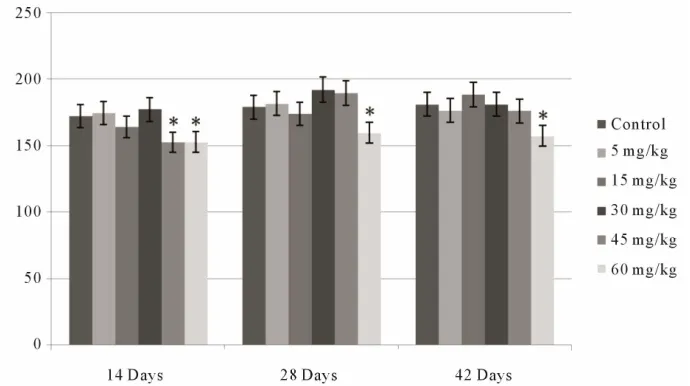
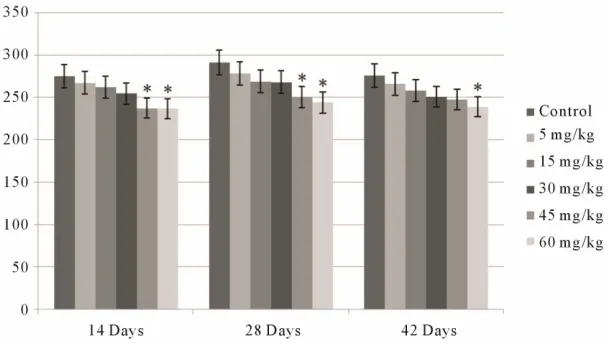
Duodenum. In comparison with that of control group, the duodenal villus heights were significantly decreased (P < 0.05 or P < 0.01) in the 30 mg/kg group at 28 and 42 days of age, and in the 45 and 60 mg/kg groups from 14 to 42 days of age. The crypt depths were significantly lower (P < 0.05 or P < 0.01) in the 60 mg/kg group from 14 to 42 days of age, and in the 45 mg/kg group at 28 and 42 days of age than those in the control group. The villus height/crypt depth ratio was decreased (P < 0.05 or P < 0.01) in the 45 and 60 mg/kg groups at 42 days of age. The results were shown in Figures 1-3.
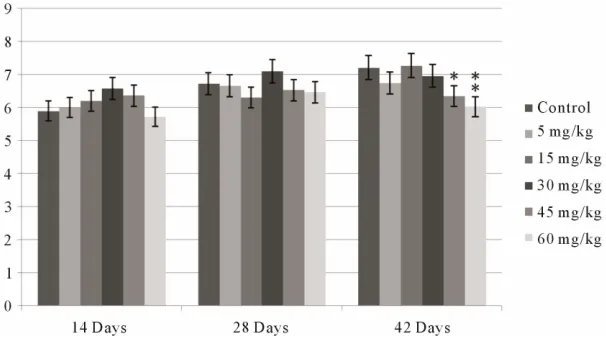
[image:2.595.57.540.623.724.2]Jejunum. Changes of the jejunum were similar to changes of the duodenum. The jejunal villus heights were decreased (P < 0.05 or P < 0.01) in the 30 mg/kg group at 14 and 42 days of age, and in the 45 and 60 mg/kg groups from 14 to 42 days of age when compared with those of control group. The crypt depths were lower (P < 0.05) in the 45 mg/kg group at 14 days of age and in the 60 mg/kg group from 14 to 42 days of age than those in the control group. The villus height/crypt depth ratio was significantly decreased (P < 0.05 or P < 0.01) in the 45 and 60 mg/kg groups from 14 to 42 days of age ex-cept the 45 mg/kg group at 14 days of age. The results
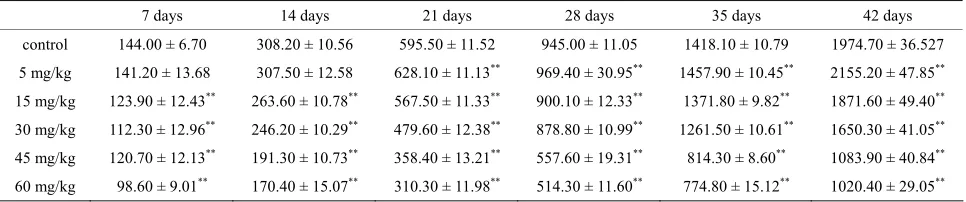
Table 1. Change of the body weight (g) in experimental chickens.
7 days 14 days 21 days 28 days 35 days 42 days
control 144.00 ± 6.70 308.20 ± 10.56 595.50 ± 11.52 945.00 ± 11.05 1418.10 ± 10.79 1974.70 ± 36.527
5 mg/kg 141.20 ± 13.68 307.50 ± 12.58 628.10 ± 11.13** 969.40 ± 30.95** 1457.90 ± 10.45** 2155.20 ± 47.85**
15 mg/kg 123.90 ± 12.43** 263.60 ± 10.78** 567.50 ± 11.33** 900.10 ± 12.33** 1371.80 ± 9.82** 1871.60 ± 49.40**
30 mg/kg 112.30 ± 12.96** 246.20 ± 10.29** 479.60 ± 12.38** 878.80 ± 10.99** 1261.50 ± 10.61** 1650.30 ± 41.05**
45 mg/kg 120.70 ± 12.13** 191.30 ± 10.73** 358.40 ± 13.21** 557.60 ± 19.31** 814.30 ± 8.60** 1083.90 ± 40.84**
60 mg/kg 98.60 ± 9.01** 170.40 ± 15.07** 310.30 ± 11.98** 514.30 ± 11.60** 774.80 ± 15.12** 1020.40 ± 29.05**
Figure 1. Effect of dietary vanadium on duodenal villus heights (μm); Data are pre-sented with the means ± standard deviation (n = 5); *P < 0.05, compared with the control group; **P < 0.01, compared with the control group.
Figure 2. Effect of dietary vanadium on duodenal crypt depths (μm); Data are pre-sented with the means ± standard deviation (n = 5); *P < 0.05, compared with the control group; **P < 0.01, compared with the control group.
[image:3.595.150.453.529.699.2]Figure 4. Effect of dietary vanadium on jejunal villus heights (μm); Data are presented with the means ± standard deviation (n = 5); *P < 0.05, compared with the control group; **P < 0.01, compared with the control group.
Figure 6. Effect of dietary vanadium on jejunal villus height/crypt depth ratio; Data are presented with the means ± standard deviation (n = 5); *P < 0.05, compared with the control group; **P < 0.01, compared with the control group.
Figure 7. Effect of dietary vanadium on ileac villus heights (μm); Data are pre-sented with the means ± standard deviation (n = 5); *P < 0.05, compared with the control group; **P < 0.01, compared with the control group.
[image:5.595.149.454.525.697.2]Figure 9. Effect of dietary vanadium on ileac villus height/crypt depth ratio; Data are pre-sented with the means ± standard deviation (n = 5); *P < 0.05, compared with the control group; **P < 0.01, compared with the control group.
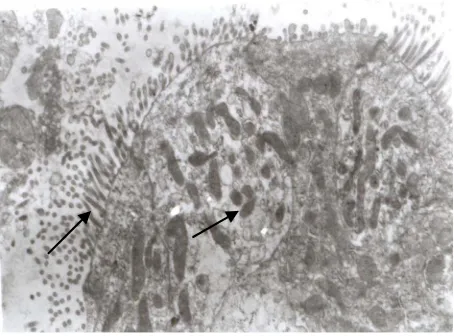
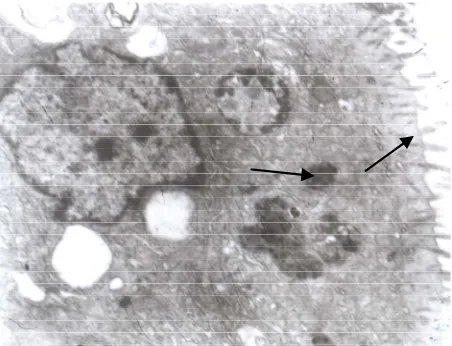
Figure 10. Duodenal villus ultrastructure in control group at 42
days of age (TEM × 10,000). Figuredays of age (TEM × 10,000). 12. Jejunal villus ultrastructure in control group at 42
Figure11. Duodenal villus ultrastructure in 60mg/kg group at 42 days of age. The microvilli are apparently sparse and short and the numbers of lysosomes are increased (TEM × 10,000).
[image:6.595.311.538.331.491.2] [image:6.595.308.540.528.697.2] [image:6.595.59.286.529.697.2]Figure 14. Ileac villus ultrastructure in control group at 42 days of age (TEM × 10,000).
Figure 15. Ileac villus ultrastructure in 60 mg/kg group at 42 days of age. The microvilli are apparently sparse and short and the numbers of lysosomes are increased (TEM × 10,000).
crypt depth and villus height/crypt depth ratio are direct representation of the intestinal environment and may be used as indicators of intestinal health. Previous studies have proved that villus height/crypt depth ratio was an end point in assessing the developmental state of an in-dividual’s intestine [23].
In the present study, we found that dietary vanadium in the range of 30 - 60 mg/kg caused marked effect on the small intestinal villi (duodenum, jejunum and ileum), including the shortened villus height and crypt depth and the decreased villus height/crypt depth ratio in the small intestines. The negative influences were found to be most severe in the 45 and 60 mg/kg groups, implying that die-tary vanadium in range of 45 - 60 mg/kg could impact the growth and development of small intestines.
Ultrastructure examination revealed that the microvil-lus height was shorter and the numbers of lysosomes in enterocytes were increased in the 45 and 60 mg/kg group at 42 days of age. The increased number of lysosomes
may indicate an increase in the amount of denatured protein and damaged organelles [24], which is consistent with results in the present study. Increased denatured protein and damage organelles may impact the microvil-lus growth and then impact the intestinal vilmicrovil-lus growth.
Our previous studies have proven that dietary vana-dium in 30, 45 and 60 mg/kg can impact the local muco-sal immune function of the intestine in broilers [14] and lead to a body weight loss [16], which is consistent with the negative effect of vanadium on the small intestines in broilers in the present study.
In conclusion, it is clear that dietary vanadium in ex-cess of 30 mg/kg can restrain the growth of villus and crypt, reduce the villus height/crypt depth ratio, and alter the ultrastructure in the small intestines. The abovemen-tional changes may impact the intestinal development in broilers. However, dietary vanadium in 5 mg/kg may promote the growth of broilers.
5. ACKNOWLEDGEMENTS
The study was supported by the program for Changjiang scholars and innovative research team in university (IRT 0848) and the Educa-tion Department of Sichuan Province (09ZZ017).
REFERENCES
[1] Mukherjee, B., Patra, B. and Mahapatra, S. (2004) Vana-dium—An element of atypical biological significance.
Toxicology Letters, 150, 135-143. doi:10.1016/j.toxlet.2004.01.009
[2] Milena, J.S., Snezana, U.M., Ivanka, H.A., Marija, T. and Predrag, D. (2007) Compounds of Mo, V and W in bio-chemistry and their biomedical activity. Journal of Trace Elements in Medicine and Biology, 21, 8-16.
doi:10.1016/j.jtemb.2006.11.004
[3] Dubyak, G.R. and Kleinzeller, A. (1980) Insulin-mimetic effects of vanadate in isolated rat adipocytes. Journal of Biological Chemistry, 255, 5306-5312.
[4] Madsen, K.L., Arisno, D. and Fedorak, R.N. (1995) Va-nadate treatment rapidly improves glucose transport and activates 6-phosphofructo-l-kinase in diabetic rat intestine.
Diabetologia, 38, 403-412. doi:10.1007/BF00410277 [5] Domingo, J.L. (2002) Vanadium and tungsten derivatives
as antidiabetic agents. Biological Trace Element Research,
88, 97-112. doi:10.1385/BTER:88:2:097
[6] Norgaard, A., Kjeldsev, K. and Hansen, O. (1983) A sim-ple and rapid method for the determination of the number of 3H-ouabain binding sites in biopsies of skeletal muscle.
Biochemical and Biophysical Research Communications,
111, 319-325. doi:10.1016/S0006-291X(83)80154-5 [7] Bahdan, R.N. (1984) Mechanisms of action of Vanadium.
Annual Review of Pharmacology and Toxicology, 24, 501-507. doi:10.1146/annurev.pa.24.040184.002441
[image:7.595.60.286.288.461.2]icity in broilers. Biological Trace Element Research, 145, 189-200. doi:10.1007/s12011-011-9185-8
[12] Cui, W., Cui, H., Peng, X., Fang, J., Zuo, Z., Liu, X. and Wu, B. (2012) Dietary vanadium induces lymphocyte apoptosis in the bursa of Fabricius of broilers. Biological Trace Element Research, 146, 59-67.
doi:10.1007/s12011-011-9215-6
[13] Liu, X., Cui, H., Peng, X., Fang, J., Cui, W. and Wu, B. (2012) Suppression of renal cell proliferation, induction of apoptosis and cell cycle arrest: Cytotoxicity of vana-dium in broilers. Health, 4, 101-107.
doi:10.4236/health.2012.42016
[14] Wang, K., Cui, H., Deng, Y., Peng, X., Fang, J., Zuo, Z. and Cui, W. (2012) Effect of dietary Vanadium on the Il-eac T-cells and contents of cytokines in broilers. Biologi-cal Trace Element Research, 147, 113-119.
doi:10.1007/s12011-011-9274-8
[15] Deng, Y., Cui, H., Peng, X., Fang, J., Wang, K., Cui, W. and Liu, X. (2012) Dietary vanadium induces oxidative stress in the intestine of broilers. Biological Trace Ele-ment Research, 145, 52-58.
doi:10.1007/s12011-011-9163-1
[16] Deng, Y., Cui, H., Peng, X., Fang, J., Wang, K., Cui, W. and Liu, X. (2011) Effect of dietary Vanadium on cecal tonsil T-cell Subsets and IL-2 contents in broilers. Bio-logical Trace Element Research, 144, 647-656.
[20] Elbrønd, V., Skadhauge, E., Thomsen, L. and Dantzer, V. (1998) Morphological adaptations to induced changes in transepithelial Na-transport in chicken lower intestine, coprodeum: A study of resalination, aldosterone stimula-tion, and epithelial turn over. Cell Tissue Research, 292, 543-552. doi:10.1007/s004410051083
[21] Elbrønd, V., Dantzer, V., and Skadhauge, E. (1999) Dif-ferences in epithelial morphology correlate to Na-trans- port. A study of the proximal, mid and distal region of the coprodeum from hens on high and low NaCl diet. Journal of Morphology, 239, 75-86.
doi:10.1002/(SICI)1097-4687(199901)239:1<75::AID-J MOR5>3.0.CO;2-D
[22] Zitnan, R., Kuhla, S., Nurnberg, K. and Schonhusen, U. (2003) Influence of the diet on the morphology of ru-minal and intestinal mucosa and on intestinal carbohy-drate levels in cattle. Veterinatni Medicina, 48, 177-182. [23] Wang, Y., Xu, M., Wang, F., Yu, Z.P., Yao, J.H., Zan, L.S.
and Yang, F.X. (2009) Effect of dietary starch on rumen and small intestine morphology and digesta pH in goats.
Livestock Science, 122, 48-52.
doi:10.1016/j.livsci.2008.07.024