425 |
P a g e
DEVELOPMENT AND STUDY OF BEHAVIOR OF
SELF-COMPACTING CONCRETE USING GGBS
Darshan H R
1, M.Rame Gowda
21
M.Tech Student, Department of Civil Engineering, Adichunchanagiri Institute of Technology,
Chikmagalur, Karnataka (India)
2
Professor & Head, Department of Civil Engineering, Adichunchanagiri Institute of Technology,
Chikmagalur, Karnataka (India)
ABSTRACT
In the present investigation Ground granulated blast furnace slag (GGBS) as a replacement of cement and understand its effects. The study also intended to quantify the amount of Ground granulated blast furnace slag (GGBS) to be added to the concrete according to the value of concrete properties Measured. Here Portland cement (PC) is replaced by 20-55% with an interval of 5% by GGBS. The w/p ratio is kept constant throughout the investigation as 0.45. Super plasticizer known as Conplast SP430 is used. Since there is no standard method of mix design is available for SCC. Hence the mix proportion is obtained as per the guidelines given by European Federation of producers and contractors of special products for structure (EFNARC). This paper presents an experimental investigation on strength aspects like compressive, flexural and split tensile strength and the workability tests. The result of fresh property test satisfies the limits specified by EFNARC. Results suggest that as much of 30% of cement can be replaced without any significant consequences on the concrete produced.
Keywords - Slag, Self-Compacting Concrete, Super Plasticizers
I. INTRODUCTION
Developments in Japan, beginning in 1983, had been focused on the elimination of poor compaction which was
identified as a major cause of poor durability of concrete structures by Ouchi (1998). Motivated by a lack of
skilled workers and a substantial number of durability damages due to insufficient compaction, Okamura
announced in 1986 the necessity to employ a SCC, which can be compacted into every corner of a formwork,
purely by means of its own weight and without the need for vibrating compaction by Okamura and Ozawa
(1995). SCC is a fluid mixture, which is suitable for placing difficult conditions and also in congested
reinforcement, without vibration. Ground granulated blast furnace slag (GGBS), due to its pozzolanic nature,
could be a great asset for the modern construction needs, because slag concretes can be of high performance, if
appropriately designed. The use of GGBS as a cementitious material as well as fine filler is being increasingly
advocated for the production of High Performance Concrete (HPC), Roller Compacted Concrete (RCC) and
426 |
P a g e
LITERATURE REVIEW
B. H. Venkataram Pai et al [ 1 ]: have experimentally aimed at producing SCC mixes of M25 grade by using
the Modified Nan Su method, incorporating five mineral admixtures. This paper gives the comparison of these
SCC mixes in terms of their properties. They have concluded that modified Nan Su method of developing SCC,
the quantity of the powder mainly depends on the specific gravity and consistency of the powder itself. The
SCC mix containing GGBS exhibiting greater strength could be because of the high pozzolonic activity of
GGBS like compressive, split tensile, and flexural strengths. The fresh concrete properties are also included in
the study.
Dr. Dinakar Pasla et al [2]: Presented new mix design methodology for the design of self-compacting GGBS
concretes based on the efficiency concept. In this study a new mix design methodology for the design of
self-compacting concrete with ground granulated blast furnace slag (GGBFS) for percentage replacements varying
between 20-80%. The results of the self-compacting GGBS 60 MPa concrete show even at 60% replacement,
showed strength gain rate similar to normal concrete and attained target strength at 28 days and attained
strengths much higher than normal concrete at 90 days.
K. GANESH BABU et al [3]: aimed to quantify the 28-days cementitious efficiency of ground granulated blast
furnace slag (GGBFS) in concrete at the various replacement levels. From the results of the investigations
reported that replacement levels in the concrete studied varied from 10% to 80% and the strength efficiencies at
the 28 days were calculated.Finally concluded that the prediction of the strength of concretes varying from 20
to 100 MPa with GGBFS levels varying from 10% to 80%.
MALLIKARJUNA REDDY V et al [4]: Investigatedon the workability and mechanical properties of
self-compacting concrete. In this research mix design used is based on NAN-SU method. This study represents
specifications of the mixes used for obtaining the workability, compressive strength, split tensile strength and
flexural strength of self-compacting concrete. From the result it is concluded that, Required minimum slump is
achieved for a w/c ratio of 0.23 with optimum strength for M70 grade high strength self compacting concrete.
Mr. Dhruvkumar H. Patel et al [5]: According to study the use of Ground granulated blast furnace slag
(GGBS) as a replacement of cement and understand its effects on the fresh properties, compressive strength
weathering. The study also intended to quantify the amount of Ground granulated blast furnace slag (GGBS) to
be added to the concrete according to the value of concrete properties Measured. The workability of
self-compacted concrete is increased as content of GGBS increased. Compressive strength of SCC with GGBS is
increased up to 10% replacement of cement with GGBS and also mineral admixture replacement have a better
workable concrete.
P. RAMANATHAN et al [6]: Investigated on strength aspects like compressive, flexural and split tensile
strength of self compacting concrete containing different mineral admixtures and workability tests for different
mineral admixtures are carried out.The methodology adopted is that mineral admixtures are replaced by 30%,
40% and 50% for Portland cement and performance is measured and compared. The replacement was done at
427 |
P a g e
water/powder ratio and varying percentage of super plasticizer content, an increase in slump flow was observed
up to 50% of slag content with an optimum at 30%.
SABEER ALAVI.C et al [7]: Investigated on strength aspects like compressive, flexural and split tensile
strength and the workability tests (slump, L-box, U-box and T50). aimed to investigate the effect of GGBFS as
mineral admixtures on the fresh and hardened properties of SCC. In this study Portland cement (PC) is replaced
with 10%, 20%, 30%, 40% and 50% of GGBFS.For 30% GGBFS replacement, the fresh properties observed
were good as compared to 10%, 20%, 40% and 50% GGBFS replacement. Hence if we increase the GGBFS
replacement we can have a better workable concrete.
II. MATERIALS AND METHODS
Materials
Cement: Portland cement is one of the most widely used additives for all types of construction activity. The
cement used for the investigation was Pozzolana Portland cement (PPC-43grade). It confirmed to the
requirement of Indian Standard Specification IS: 8112-1989. The tests on cement are carried out as per Indian
Standards.
Sand: Good river bank sand in the absence of any earthy matter and organic matter. Particles are angular in
shape passing 4.75mm and retaining on 150 micron standard sieve.
Coarse aggregates: The maximum size of aggregate is generally limited to 20mm. Coarse aggregate which
passed through 12mm sieve but retained on 6mm sieve are used for the SCC mix.
Mixing water: Ordinary potable water of normally pH 7 is used for mixing and curing the concrete specimen.
Super plasticizer: Conplast SP430 is been used because it is essential component of SCC to provide necessary
workability.
Ground Granulated Blast Furnace Slag:
Ground Granulated Blast Furnace Slag (GGBS) is a byproduct of the steel industry. Blast furnace slag is defined as “the non-metallic product consisting essentially of calcium silicates and other bases that is developed in a
molten condition simultaneously with iron in a blast furnace.”
428 |
P a g e
III. EXPERIMENTAL PROGRAMME
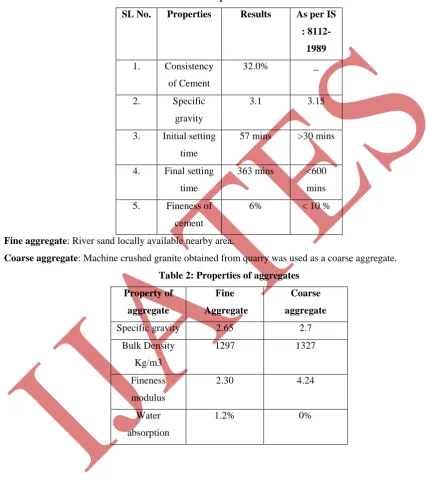
Cement: Ordinary Portland cement of 43 grade conforming to IS-1489(part I)-1991.All the test are conducted
as per IS 8112-1989 and results is shown in Table 1.
Table 1: Properties of cement
SL No. Properties Results As per IS
:
8112-1989
1. Consistency
of Cement
32.0% _
2. Specific
gravity
3.1 3.15
3. Initial setting
time
57 mins >30 mins
4. Final setting
time
363 mins <600
mins
5. Fineness of
cement
6% < 10 %
Fine aggregate: River sand locally available nearby area.
Coarse aggregate: Machine crushed granite obtained from quarry was used as a coarse aggregate.
Table 2: Properties of aggregates
Property of
aggregate
Fine
Aggregate
Coarse
aggregate
Specific gravity 2.65 2.7
Bulk Density
Kg/m3
1297 1327
Fineness
modulus
2.30 4.24
Water
absorption
1.2% 0%
IV. RESULTS AND DISCUSSIONS
Fresh Properties
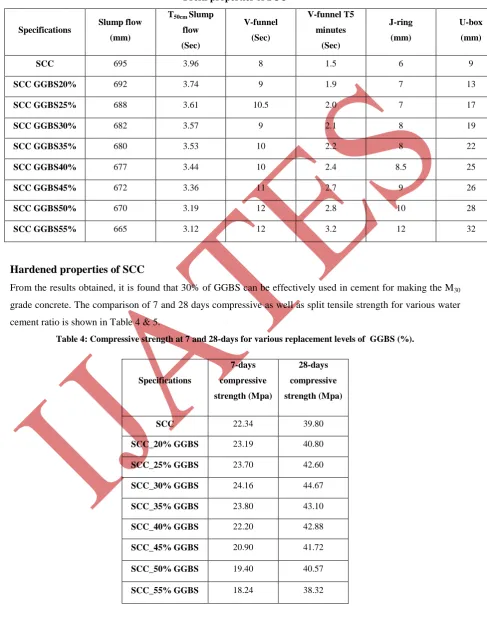
The rheological properties are assessed by using rheology tests such as Filling, Passing and Segregation
resistance. When cement is replaced by GGBFS, a lower dosage of Superplasticizer is required to maintain the
429 |
P a g e
greater flowability. The T50 was influenced by the dosage of water and superplasticizer. Ѵ funnel test was
performed to assess the flowabilty and stability of the SCC. The rheological properties are shown in Table 3.
Fresh properties of SCC
Specifications Slump flow (mm)
T50cm Slump
flow
(Sec)
V-funnel
(Sec)
V-funnel T5
minutes
(Sec)
J-ring
(mm)
U-box
(mm)
SCC 695 3.96 8 1.5 6 9
SCC GGBS20% 692 3.74 9 1.9 7 13
SCC GGBS25% 688 3.61 10.5 2.0 7 17
SCC GGBS30% 682 3.57 9 2.1 8 19
SCC GGBS35% 680 3.53 10 2.2 8 22
SCC GGBS40% 677 3.44 10 2.4 8.5 25
SCC GGBS45% 672 3.36 11 2.7 9 26
SCC GGBS50% 670 3.19 12 2.8 10 28
SCC GGBS55% 665 3.12 12 3.2 12 32
Hardened properties of SCC
From the results obtained, it is found that 30% of GGBS can be effectively used in cement for making the M30
grade concrete. The comparison of 7 and 28 days compressive as well as split tensile strength for various water
cement ratio is shown in Table 4 & 5.
Table 4: Compressive strength at 7 and 28-days for various replacement levels of GGBS (%).
Specifications
7-days
compressive
strength (Mpa)
28-days
compressive
strength (Mpa)
SCC 22.34 39.80
SCC_20% GGBS 23.19 40.80
SCC_25% GGBS 23.70 42.60
SCC_30% GGBS 24.16 44.67
SCC_35% GGBS 23.80 43.10
SCC_40% GGBS 22.20 42.88
SCC_45% GGBS 20.90 41.72
SCC_50% GGBS 19.40 40.57
430 |
P a g e
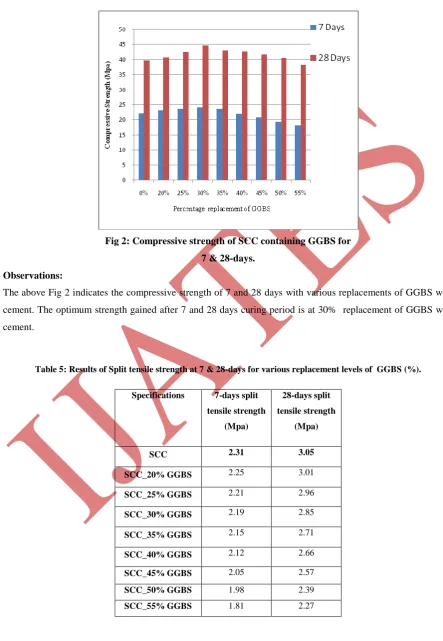
Fig 2:Compressive strength of SCC containing GGBS for
7 & 28-days.
Observations:
The above Fig 2 indicates the compressive strength of 7 and 28 days with various replacements of GGBS with
cement. The optimum strength gained after 7 and 28 days curing period is at 30% replacement of GGBS with
cement.
Table 5: Results of Split tensile strength at 7 & 28-days for various replacement levels of GGBS (%).
Specifications 7-days split
tensile strength
(Mpa)
28-days split
tensile strength
(Mpa)
SCC 2.31 3.05
SCC_20% GGBS 2.25 3.01
SCC_25% GGBS 2.21 2.96
SCC_30% GGBS 2.19 2.85
SCC_35% GGBS 2.15 2.71
SCC_40% GGBS 2.12 2.66
SCC_45% GGBS 2.05 2.57
SCC_50% GGBS 1.98 2.39
431 |
P a g e
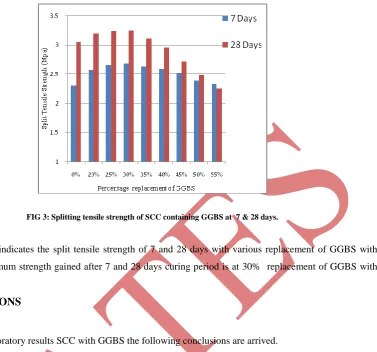
FIG 3: Splitting tensile strength of SCC containing GGBS at 7 & 28 days.
Observations:
The above Fig 3 indicates the split tensile strength of 7 and 28 days with various replacement of GGBS with
cement. The optimum strength gained after 7 and 28 days curing period is at 30% replacement of GGBS with
cement.
V. CONCLUSIONS
Based on the Laboratory results SCC with GGBS the following conclusions are arrived.
Trial and error procedure have to be adopted for maintaining flowability, self compatibility and obstruction
clearance as per Nan Su method till to arrive consistent SCC mix.
There is an increase in the strength of SCC when the cement is replaced by GGBS up to 30%. This also
reduces the cement content by increasing the GGBS thus reducing the further cost of SCC mixes developed. It is seen that density is directly proportional to strength, as the density increases, strength increases where
as the density decreases, strength also decreases.
GGBS can be very good replacement for cement with respect to economy, strength and the considerations
of availability of resources. The GGBS in place of cement shall be very economical and can also help in the
utility of Industrial wastes and in maintaining the ecological balance, thus reducing the consumption of
cement.
REFERENCES
[1] B. H. Venkataram Pai, Maitreyee Nandy, A. Krishnamoorthy, Pradip Kumar Sarkar,C. Pramukh
Ganapathy, Philip George, “Development of self compacting concrete with various mineral admixtures”, American Journal of Civil Engineering, Vol. 2, No. 3, May 30, 2014.
[2]Dinakarpasla,Mr. Kaliprasannasethy and Umesh c sahoo, “ Development of High Strength Self-Compacting
432 |
P a g e
[3] K. Ganesh Babu and V. Sree Rama Kumar, “Efficiency of GGBS in concrete” , Cement and Concrete Research 30 (2000), PP.1031- 1036.
[4] Mallikarjuna Reddy V, Seshagiri Rao M V, Srilakshmi P and SateeshKumar B,“Effect of W/C Ratio on
Workability and Mechanical Properties of High Strength Self Compacting Concrete (M70 Grade)”
International Journal of Engineering Research and Development, Vol 7, No 1, May 2013, PP. 06-13.
[5] Mr. Dhruvkumar H. Patel, Mr Dixitkumar D. Patel, Mr Dhaval P. Patel, Mr Vivek A. Patva, Mr Yashasvikumar R. Patel, “ Literature Review On Self Compacting Concrete”, International Journal For Technological Research In Engineering, Vol 1, No 9, May-2014.
[6] P. Ramanathan, I. Baskar, P. Muthupriya, and R. Venkatasubramani .“ Performance of Self-compacting concrete containing different mineral admixtures”. KSCE Journal of Civil Engineering 17(2):465-472, May 30, 2012.
[7] SabeerAlavi.C, I.Baskar and R.Venkatasubramani , “Strength and Durability Characteristics of GGBFS based SCC , International Journal of Emerging trends in Engineering and Development, Vol.2 , No 3, March (2013).