DOI : https://doi.org/10.32628/
QoS based Route Optimization Model in MANET
K. Lakshmi
Assistant Professor, Department of Computer science and Engineering, G. Pullaiah College of Engineering and Technology, Kurnool, Andhra Pradesh, India
ABSTRACT
The primary objective of this paper is to develop specific evolutionary algorithms using Machine learning approach to enhance the selection of efficient and stable optimized routing path in MANET with a guarantee on QoS parameters. The primary QoS constraints considered include delay delay - jitter, bandwidth and packet loss rate for computing the possible network route. The essential characteristics of this routing process such as the accuracy, interpretability, robustness and versatility have been considered while calculating the workable routing path for MANETs. To attain this Machine learning techniques play vital, role in identify patterns such as optimized routing path and node-link failure detection which leads other than QoS and energy efficiency, security which attracts many researchers.
1. To develop an innovative mechanism for the feasible path selection of the given network with a guarantee on QoS metrics.
2. To identify the optimized routing patterns using Machine learning Approach to achieve an effective routing mechanism for dynamic, scalable networks.
3. To Identify the Pattern for Node link failure among MANET by Machine Learning to handle the link failure in dynamic networks which establish the communication efficiency .
4. Develop a secure authentication mechanism for improving the security in MANETs
Keywords : MANET, QOS, Routing Mechanism, Machine Learning Techniques.
I. INTRODUCTION
Mobile Ad hoc network is a network which is dynamic where the mobile nodes form a temporary network in the deficiency of centralized administration, i.e. A MANET is an autonomous group of distributed mobile nodes. Due to the absence of centralized administrator in a network, routing in mobile ad hoc network (MANET) becomes the primary issue which reduces the selection of an optimal path for routing. Specific performance parameters such as latency, overhead, and packet delivery ratio (PDR) are affected
PDR is better as compared to the traditional methods.
II. RELATED WORK
The following are the contribution exists in routing mechanisms of MANETS by considering the QoS parameters.
• Ant Colony Based QoS Routing Algorithm for Mobile AdHoc Networks is an on-demand QoS routing algorithm [1] proposed by P.Deepalakshmi. This algorithm is adaptive in nature and reduces the end to end delay in high mobility cases. But the other QoS constraints i.e. other network layer or link layer metrics like energy, jitter, link stability etc. are not considered here. Furthermore, here link failure is not handled properly.
• Metrics in Mobile Ad Hoc Networks proposed by R. Asokan [2] and it performs well in route discovery phase with dynamically changing topology and produces better throughput and low delay variance. Again flooding of route request may potentially reach all nodes in the network, so bandwidth wastage increases and efficiency degrades. Besides this, it is a collision and contention prone routing protocol. Thus, packet delivery ratio decreases, congestion increases and throughput also become very poor in case of multimedia. The routing overhead is also increased.
III. Types of ACO based routing protocols in MANET
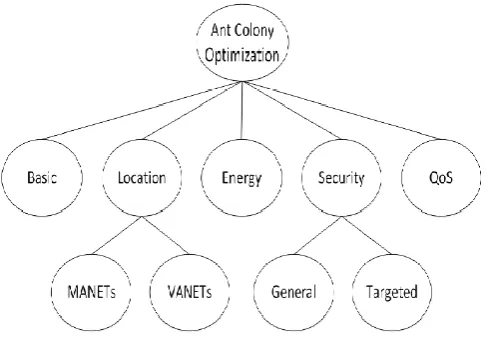
QoS has always been a focus of attention in mobile ad hoc networks. It is a challenging problem when transmitting packets via multiple paths in a dynamic network. At the same time, the pheromone concept from ant colony algorithms also inspires many authors to use QoS parameters for selecting routes
Figure 1. Types of ACO based routing protocols in MANET
IV. QoS AWARE ACO ROUTING PROTOCOLS
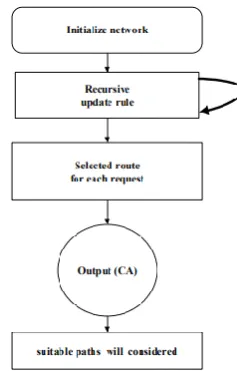
QoS has always been a vital task for dat transmission in MANETs .The proposed method was a new energy and delay-aware routing protocol that combines cellular automata (CA) with the hybrid genetic algorithm (GA) and African Buffalo Optimization (ABO) to optimize the path selection in the ad-hoc on-demand distance vector (AODV) routing protocol.
AN EFFICIENT ENERGY AND DELAY ROUTING PROTOCOL
Our proposed work attempt to establish a robust path and get fulfil the QoS requirement as energy and delay. Our research comprised two stages to achieve our objective, The proposed method was a new energy and delay-aware routing protocol that combines cellular automata (CA) with the hybrid genetic algorithm (GA) and African Buffalo Optimization (ABO) to optimize the path selection in the ad-hoc on-demand distance vector (AODV) routing protocol.
selects the path based on highest energy level for each node in the path by using hybrid algorithm GAABO. We proposed hybrid techniques that will enable the discovery of routes in MANETs which satisfy both the delay constraints and some simple energy constraints (every node on a path has a minimum energy level). Aforementioned, the CA generate the paths from source to destination nodes based on the minimum delay, the RREQ message that sends by CA content a threshold term to ensure all paths achieve the requirement of delay. Subsequently, the Hybrid Algorithm Gaabo.
Discovering Routes by CA
To find the delay path as the QoS constraint. There exists no hierarchy among the nodes, and the network plane is found to be fully homogeneous (i.e. all nodes consist of the same characteristics). Our approach involves the broadcasting of the RREQ message that constitutes the delay requirement of the connection request [maximum delay (Dmax)] by the source node to its communicating neighbours. All the nodes at the right, left, top, and down side are involved in this, as depicted in Figure 2.
The message re-broadcast by the intermediate nodes to their neighbors, which also establish a reverse path to the sender. Certain nodes, when given a delay constraint, turn into a wave, take in a wave node to their neighbors, re-broadcast the message, and establish a reverse path to the nodes from which they had obtained the message. This activity continues till the message is collected by the destination node or
the delay faced by the packet outstrips the limit Dmax. The destination obtains many RREQ messages for the same sender when there are more paths from the sender to the destination. Consequently, reply to some of the RREQ messages is done by the destination through sending an RREP message through the reverse path that is established when the RREQ messages are passed on. The entire set of nodes observed along these routes amidst the source and the destination constitute the path nodes. Each and every communication between the source and the destination from this juncture happens through this path till the topology of the network gets modified..
Figure 3. The Process rule for short path selection
A hybrid GAABO with CA:
V. Proposed Protocol
The main aim of the proposed protocol is to construct an efficient robust backbone to overcome the limitations of existing protocols and to provide a mechanism for the quick recovery of link failures by generating an alternate path from the point of failure to the destination, which can be adoptable in any sort of environment.
Energy Efficient Routing based on Route Segmentation
The proposed energy efficient routing based on route segmentation (EER-RS) provides a scalable and energy saving routing model for MANETs. This maintains small route segments for the active routes. The functionality of route discovery of EER-RS is comparable to DSR where multiple routes are discovered to reach the target node, and the shortest and optimal route is used for routing. In the case of longer routing, the shortest route might have a few hops to reach the target node. These hops, when segmented into w node, make v route segments. The process of construction segmentation is described below.
Route Segmentation Mechanism
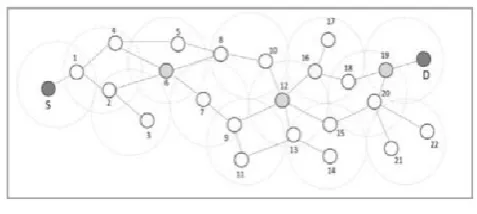
The intention of segmenting route is to make EER-RS scale for the bigger network. The distribution of network in MANET is into regions based on the node ranges as shown in Fig.5. The two highlighted node in the figure makes a 2-hop segment. One can decide the number of hops based on the route hops length.
Fig 5 : A general network with regions and 1-hop nodes
Let's consider a route discovery process of node S, identifies two prominent routes to reach D as shown below.
Route1: S→1→4→6→8→10→12→16→18→19→D Route2: S→1→2→6→7→9→12→15→20→19→D If the segment length, w=2, then each route will be divided w segments having a segment head which maintain the segment path to reach segment end node as shown in Table-1.
Table 1: Node Segment routes
The advantage of these route segment supports in low energy utilization in maintenance in case of broken links. It can be present locally at the stage of a segment. Fixing a failure route within a segment broadens the life span of the route and accumulate energy through minimizing frequent route discoveries process. Thus, this mechanism will substantially help in reducing the routing overhead and energy consumption and improve the performance. Even varying segment length, w can support the adaptive routing scheme, which will be important for MANETs. Utilizing these segments we compute the minimum energy required to route data over it which will save the energy further.
Energy Saving Mechanism:
adequate left over energy of a battery and then choose the routes with lowest total transmission power.
Let’s represent a routing structure by a graph V = (N, E), where, N is "the set of nodes" and E is "the set of communication edges".
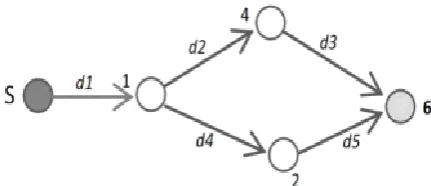
Figure 6 : A graph model of node S to reach Node-6
Based on fig.6, the node S has to send a packet to N6, which has two paths to reach and the energy needed to send a message to each hopping node is directly comparative to the square of its distance. If the first path distance, p1 have a distance is, p1=(d1+d2+d3) then the energy required for transmitting is, e1= (p1)2. Since, node S also have another path for transmitting and its distance is, p2 = (d1+d4+d5), and its energy required is, e2 = (p2)2. In this case, if e1 ≥ e2 then, S transmit data through p2 instead of p1 to save energy. The minimum energy, B required between nodes S to next node n to send the message can be computed using the equation-1 as follows
EER-RS Based Routing Mechanism:
A new path to reach segment end provides a clear energy saving and low overhead performance. Based on EER-RS, the nodes in the primarily discovered path are selected as segment end point based on the configured segment length. The advantage of the proposal is that when a node-link fails or a routing node moves out it does not discard the entire path, only the segment has to discover on functionality it routes the data packets in energy efficient route as described in Alogorithm-1 below.
Significance of proposed Algorithm:
However due to the evolution of the multimedia technology and the commercial interest of companies to reach widely civilian applications made QoS in MANETs an area of great interest. But providing QoS in MANET becomes very difficult and challenging task because network bandwidth is shared among neighbouring nodes and the network topology continuously changes with node mobility. This condition requires extensive association between the nodes for establishing the routes and for securing the scarce resources necessary to provide the QOS.
the feasible network route. The key characteristics of this routing process such as the accuracy, interpretability, robustness and versatility have been considered while computing the feasible routing path for MANETs.
To attain this Multicast routing that satisfies QoS requirements, the problem can be combated with optimization techniques based on nature inspired or bio inspired processes. Other than QoS and energy efficiency, security is another hot topic in routing protocols which attracts many researchers ‘attention. As is well-known there exist many security threats in the network layer, such as black hole attacks, wormhole attacks, Flooding attacks and so on. When these attacks are launched during the routing process, this usually leads to strong harmful effects on the network. In the worst cases, an attacker might even make the communication in the network impossible. Therefore, mechanisms that help participants in a network to defend against the potential attacks are necessary.
VI. REFERENCES
[1]. P Deepalakshmi and Dr.S.Radhakrishnan, "Ant colony based QoS routing algorithm for mobile ad hoc networks, International Journal of Recent Trends in Engineering, vol. 1, no. 1, May 2009, pp. 459-462.
[2]. Asokan, R. Natarajan, A. Nivetha, "A swarm based distance vector routing to support multiple quality of service (QoS) metrics in MANETs, J. Comput. Sci., vol. 3, 2007, pp. 700-707.
[3]. S Sethi and S. Udgata, "The efficient ant routing protocol for MANET, International Journal on Computer Science and Engineering, vol. 02, no. 07, 2010, pp. 2414-2420.
[4]. S Kannan, T. Kalaikumaran, S. Karthik and V. Arunachalam, "Ant colony optimization for routing in mobile ad hoc networks,
International Journal of Soft Computing, vol. 5, Iss. 6, 2010, pp. 223-228.
[5]. BR.Sujatha and Dr. M.V. Sathyanarayana, "PBANT Optimized ant colony routing algorithm for manets, Global Journal of Computer Science and Technology, vol. 10, Iss. 2, April 2010, pp. 29- 34.
[6]. P Venkata Krishna, V. Saritha, G. Vedha, A. Bhiwal and A. Bhiwal,"Quality of service enabled ant colony based multipath routing for mobile ad hoc networks, IET Commun., vol. 6, Iss. 1, 2012, pp. 76-83.
[7]. E Bonabeau, M. Dorigo, and G. Theraulaz, Swarm Intelligence: From Natural to Arti_cial Systems. Oxford, U.K.: Oxford Univ. Press, 1999.
[8]. J Bishop, "Stochastic searching networks," in Proc. 1st IEE Int. Conf.Artif. Neural Netw. (Conf.), 1989, pp. 329_331.
[9]. R Poli, J. Kennedy, and T. Blackwell, "Particle swarm optimization,"Swarm Intell., vol. 1, no. 1, pp. 33_57, Jun. 2007, doi: https://doi.org/10.1007/s11721-007-0002-0. [10]. M. Dorigo, "Optimization, learning and natural
algorithms," Ph.D. dissertation, Politecnico di Milano, Milan, Italy, 1992.
[11]. H. Zhang, X. Wang, and D. Hogrefe, "A survey of location aware ant colony optimization routing protocols in MANETs," in Proc. 10th EAI Int.Conf. Bio-Inspired Inf. Commun. Technol. (BIONETICS), 2017.[Online].Available:
http://bionetics.org/2017/show/accepted-papers [12]. C. S. Moreau, C. D. Bell, R. Vila, S. B.
Archibald, and N. E. Pierce, "Phylogeny of the ants: Diversiation in the age of angiosperms," Science,vol. 312, no. 5770, pp. 101_104, 2006. [13]. B. Hlldobler and E. O. Wilson, The ANTS.
[14]. G.F. Oster and E. O. Wilson, Caste and Ecology in the Social Insects. Princeton, NJ, USA: Princeton Univ. Press, 1978.
[15]. T. Flannery, Here on Earth: A Natural History of the Planet. New York, NY, USA: Grove, 2011.
[16]. C.Anderson, G.Theraulaz, and J.-L. Deneubourg, "Self-assemblages in insect societies," Insectes Sociaux, vol. 49, no. 2, pp. 99_110, 2002.
[17]. N. J. Mlot, C. A. Tovey, and D. L. Hu, "Fire ants self-assemble into water proof rafts to survive _oods," Proc. Nat. Acad. Sci. USA, vol. 108, no. 19, pp. 7669_7673, 2011.
[18]. P. C. Foster, N. J. Mlot, A. Lin, and D. L. Hu, "Fire ants actively control spacing and orientation within self-assemblages," J. Experim. Biol., vol. 217, no. 12, pp. 2089_2100, 2014.
[19]. N. Fujiwara-Tsujii, N. Yamagata, T. Takeda, M. Mizunami, and R. Yamaoka, "Behavioral responses to the alarm pheromone of the ant camponotus obscuripes (hymenoptera: Formicidae)," Zool. Sci., vol. 23, no. 4, pp. 353_358, 2006.