220
Analysis Of Vacuum Failures During Curing Of
Cfrp Composites.
Mr. K.Vijaya Kumar, Dr. Mir Safiulla, Dr. A.N Khaleel Ahmed
ABSTRACT: Carbon fiber reinforced Composite structures posses‟ high strength and stiffness to weight ratios, also exhibits good fatigue resistance, and are less prone to deterioration caused by corrosion and cracking. Fabrication of these composite structures is highly process dependent. During curing process, the physical, mechanical and chemical properties are imparted to the components, and are generally cured in autoclaves under controlled temperature, pressure and vacuum. Any variation in these parameters leads to change in properties of a composite structure, hence there is a need to analyse the effects of vacuum failures at during curing on mechanical and Ultrasonic Characteristics. Efforts are also made to analyze the root causes for the vacuum failures during curing process. Laminates made of Hexcel 913 carbon/ epoxy prepeg are prepared and cured in the autoclave by varying the vacuum levels at different salient points of cure process during curing. The specimens were prepared as per the DIN 29971 standards to evaluate the DT and NDT characteristics. The Experimental results shows that ILSS will not vary much if the vacuum f ails after (Tg) Glass Transition point, hence the vacuum can be maintained up to the Tg point and thereby it can be slowly reduced to zero. This shows that there is a scope to optimize the manufacturers recommended cure cycle so as to reduce the curing cost and time. This research work helps the designers in developing the tools and optimum cure cycles for carbon epoxy composite structures.
Index Terms: Autoclaves, Composites, Curing, Epoxy, Glass Transition, ILSS (interlaminar shear strength), Vacuum.
————————————————————
1.
INTRODUCTION
From the invention of epoxy resins by Pierre Castan in 1938 to now a days, epoxy resins attract the interest in Fiber Reinforced polymers due to their excellent balance between various properties like adhesion, electrical insulation, humidity resistance and mechanical properties . Hence these resins are widely used as a matrix for the fiber reinforced polymer structures, which cross links the fibers during curing due to polymerization. Voids in composite laminates have been extensively studied for many years, some authors have focused their work on the influence of voids upon physical and ultrasonic characteristics.[1] The presence of voids has detrimental effects particularly on the matrix dominated mechanical properties [2], The reasons for the voids formation is complex due to the variable factors in layup and processing in autoclaves also it may be due to the environmental factors like moisture absorption. [3] The resin flow models are derived by the Alfred C.Loos and G.S.Springer [4] are used to design the cure cycles for the epoxy matrix composites. But the equations developed are for the flat plate composites constructed from Hercules AS/3501-6 graphite epoxy prepeg tape. The causes for the vacuum failures or the effects of the vacuum at different stages of cure cycle are not focused.
Curing optimization involves the best setting parameters related to material properties, tooling properties , part geometry etc.[5] , Although few works focused on the cure simulation of epoxy, limited work is carried on the effects of vacuum during curing of hexcel 913 carbon fiber/ epoxy structures. Few researchers [6-11] have studied the effect of vacuum and pressure on voids and also the relation between the voids and the ultrasonic characteristics but they have not focused on the duration of the vacuum in the cure cycle.
2.
R
OOTC
AUSEA
NALYSISO
F VACUUMF
AILURES.
A root cause analysis has carried out considering from the Layup stage to the curing stage of 10 complex structural parts. It is observed that the vacuum bags fail during curing process as shown in fig.1 due to a) Improper bagging techniques. b) improper placement of valves during bagging c) Leakage in vacuum hoses & valves d) Resin block in tool vacuum lines e) malfunctioning of vacuum controllers / solenoid valvesFig.1 Shows the vacuum failure during curing where the vacuum failed at elevated temperature (135 deg.C)
2.1 Improper Bagging Techniques
The bagging film or a reusable elastic bladder is located over the material being cured and sealed against the tool surface as shown in the fig.2 which is called as the restraints or the dams to prevent the lateral motion and to minimize the resin flow parallel to the tool plate and through the edges.
_____________________________
•
Research Scholar, Gousia College of Engineering. Ramnagaram. [email protected]•
Prof. & Head (R&D), Department of Mechanical Engineering, Gousia College of Engineering.Ramnagaram, Bangalore Dist,
221
Fig.2 Vacuum bagging with thermocouple and vacuum
valve.
Vacuum is applied between the bagging material and the material being cured such that the plies of material are compressed through the thickness against the mold. In some instances, an interim debulk step to enhance the quality of the finished product through improved consolidation. After vacuum bagging the vacuum leak rate from the bag is to be ensured before loading the part in to the autoclave for curing. Generally the allowable leak rate is only 50 milli bar for 5 mins. If the bagging is improper the leak rate will be more, generally the vacuum leak will be at thermocouple connection loops as shown in the fig.3 where the thermocouple is pulled out due to turbulence of air in the autoclave as the sealant becomes soft after heating. Hence it is recommended to provide the inbuilt thermocouples along with the tools and proper sealing to be ensured at the thermocouples provided for the part end.
Fig.3 Thermocouple pulled out during curing that leads to vacuum failure.
2.2 Improper placement of Vacuum valves
If the vacuum valves are not placed properly on the breather then the vacuum flow will be blocked as a result white patches or the voids in the cured part as shown in the fig.4.
Fig.4 Improper placement of valve, where the vacuum flow
is blocked.
Even when the valves are placed on the part with insufficient layers of breather over the part or using a thin breather the resin enters the vacuum valves through the breather as shown in the fig.5 Due to this the volatile gases will be retained in between the layers and leads to defects like voids and improper distribution of resin, Hence the valves are to be placed on the ends with proper layers of breather to avoid direct contact of the resin to the valve.
Fig.5 Resin collection in the vacuum valve due to the use of thin breather, where the vacuum flow is blocked.
2.3 Leakage in Vacuum Hoses & valves
Vacuum hoses and the valves that are fitted with the connectors or the male plugs as shown in the fig 6. are properly tightened and checked before connecting it to the part to ensure the leakages. If the hoses and the valves are not fitted properly, it may read maximum vacuum initially, but at some point after application of pressure it fails abruptly causing part rejections due to defects. If part geometry is more complex to withstand the vacuum then it is more difficult to achieve uniform consolidation and to avoid wrinkling.
Fig.6 Vacuum hose fitted with the connector.
2.4 Resin Block in tool inbuilt Vacuum Lines
222 Fig.7 NMG metallic tools with inbuilt vacuum lines form
suction and measurement.
2.5 Malfunctioning of vacuum controllers/ solenoid valves
Vacuum controllers fitted with the autoclaves are to be calibrated periodically to ensure the safe working condition as shown in the fig. 8.
Fig.8 Calibrated autoclave Vacuum controllers.
Even the solenoid valves are ensured to work in auto mode for continuous supply of vacuum during the curing process in autoclaves.
3.
EXPERIMENTAL
SETUP
Five Test Laminates of size 200 x 200 made of carbon BD V913/40%/G801 . The prepegs are cut along the fiber wrap direction for the symmetric balanced layup sequence . It is cured as per the manufacturer recommended cure cycle as shown in the fig. 9. Vacuum levels are varied at each stage.
Fig.9 Manufacturers recommended two step cure cycle
where the vacuum is applied throughout the cure process.
Vacuum is removed from the bags at the various salient points for each specimen during curing.
Specimen no. 1 considered as the reference panel which is cured with full vacuum throughout the cure cycle.
Specimen no.2 cured without vacuum throughout the cure
cycle.
Specimen no.3 with full vacuum up to the start of first dwell (75 deg C)and there after the vacuum is vented to zero until the end of the cure cycle.
Specimen no.4 with full vacuum up to the end of the first dwell and thereafter the vacuum is vented out for the rest of the cure cycle.
Specimen no.5 with full vacuum up to the start of second dwell (125 deg C) and there after the vacuum is vented out.
After curing the laminates were tested for visual and NDT tests like A-Scan and the Ultrasonic C-Scan to check for the voids , internal cracks, FODs, etc. and then the specimens were cut in dimensions of 20x10x2mm as per the DIN 29971 standards to test the ILSS values.
Length L= 20 mm, width b= 10 mm, thickness t= 2 mm.
ILSS CALCULATIONS :
ILSS - Inter Laminar Shear Strength
= ¾ { F / ( b x t)} mpa
Where F = Peak Load, Newton‟s,
b = Width of the specimen, mm &
t = Thickness of the specimen, mm
4.
RESULTS
&
DISCUSSIONS:
223 Table 1. Ultrasonic ‘A’ Scan Values of the test
Laminates.
Specimen
no. Description
Attenuation in DB
(gain) Remarks
1 With full
vacuum 31
2 Without
vacuum
NO TRANSMISSION
No compaction
3 Fail @ start of
1st dwell 36
4 Fail @ end of
1st dwell 35
5 Fail @ start of
2nd dwell 36
Table 2. Ultrasonic ‘C’ Scan Values of the test Laminates.
The fig 10- 13 shows the profile view of the Ultrasonic ‘C’ Scan plots of the test laminates.
Fig.10 Ultrasonic „C‟ Scan view of the specimen cured after
vacuum vent out at the begin of first dwell ( 75 deg.C)
Fig.11 Ultrasonic „C‟ Scan view of the specimen cured after
vacuum vent out at the End of first dwell ( 75 deg.C)
Fig.12 Ultrasonic „C‟ Scan view of the specimen cured
without vacuum, the yellow spots indicate the existence of Voids in the laminate.
Fig.13 Ultrasonic „C‟ Scan view of the specimen cured after
vacuum vent out at the begin of second dwell ( 135 deg.C)
It is also found that the specimens cured with vacuum is vent out at the begin of the first dwell and at the end of the first dwell results in attenuation levels as same as the Master or the reference specimen cured with full vacuum. This indicates that the vacuum plays a vital role during the first ramp and the gel point where the resin changes its phase from semi solid to the gel state during which it emits the volatile gases because of the chemical reaction .There Specimen
no. description
Attenuation
DB (gain) Remarks
1 With full
vacuum 24
2 Without
vacuum 34 high
3
Vacuum Vent at start of Ist
dwell
24
4
Vacuum Vent at end of Ist
dwell
24
5
Vacuum Vent at start of IInd
dwell
224
after even in the absence of vacuum it will not have any effect for the strength or on the quality of the part because the resin viscosity increases and the cross linking slowly diminishes that leads to the solidification stage.
Table 3. ILSS (Interlaminar Shear Strength) values of the test specimens.
Specime
n no. Description
ILSS (Mpa)
Load N
Remark s
1 With full vacuum 67 1993
2 Without vacuum 44 1596 Low
3 Vacuum Vent at
start of 1st dwell 66 1991
4 Vacuum Vent at
end of 1st dwell 68 2002
5
Vacuum Vent at start of 2nd
dwell
66 1960
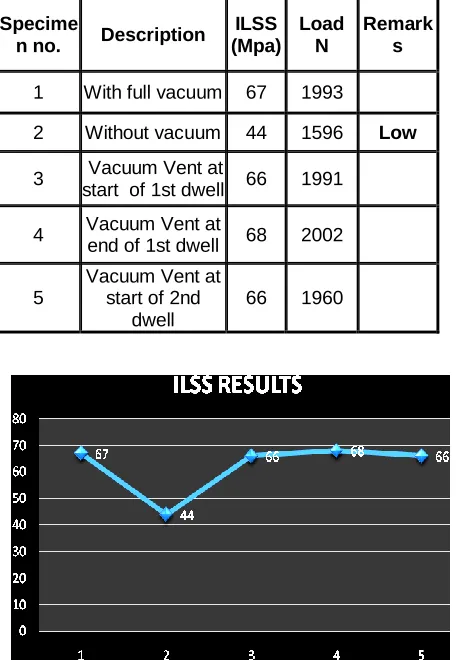
Fig.14. ILSS values curve of the specimens, where the specimen no.2 indicates low strength.
From the table. 3 it is noticed that the Interlaminar Shear strength (ILSS) is very low for the specimen which is cured without vacuum. This signifies that the presence of voids and the compaction of the layers is poor, as a result all the mechanical properties like tensile, flexural and the stiffness will be low. Whereas the other specimens exhibit appreciable strength equal to the reference laminate. Hence the existing cure cycle recommends for the vacuum through out the cure cycle and by this experiment it is evident that the cure cycle can be modified so as to save the power and curing cost. In the recommended cure cycle shown in fig.15 the vacuum can be cut off or vented out at 80 deg.C after the application of pressure that over comes the static vapor pressure of the resin.
Fig.15. Recommended cure cycle for 913 monolithic parts,
where the vacuum is cut off gradually after increasing the external pressure.
5.
CONCLUSIONS:
1. Vacuum plays a vital role on the compaction of the composite part in the 913 resin system up to the first dwell temperatures 75-80 deg.c.
2. The specimen cured without vacuum exhibits the presence of voids and low mechanical properties. 3. Vacuum can be vent out at the first dwell gradually
as the external air pressure is increased.
4. It is also recommended to ensure the vacuum level (vacuum leak check) before taking up for curing. 5. A vacuum failure during curing also occurs due to
leakage in vacuum hoses and Vacuum valves. Hence these are to be checked before using it for curing for every cure cycle.
6. If the Bagging technique and bagging materials including bleeder materials and cauls, etc are not proper then due to vacuum failure at the edge loops (i.e., bridging) causes non-uniformity in material compaction and resin flow affecting the quality of the finished product.
7. If the number of interim debulk cycles and debulk time, or insufficient vacuum debulking cause‟s thickness and surface finish variability as well as wrinkles in the finished part.
8. Number of vacuum ports, location of vacuum ports, and vacuum integrity during cure cycles; materials are consolidated through the thickness during cure as the resin flows and gels. Vacuum integrity affects the level of compaction
6.
REFERENCES:
[1]. “Rubin A.M., Jerina K.L., Evaluation of porosity in composite aircraft structures. Mechanics of composite materials, Vol.30, No.6 pp 587-600,1994.
[2]. Ling LIU, Boming ZHANG, Zhanjun WU and Dianfu WANG ., “ Effects of Cure Pressure Induced Voids on the Mechanical Strength of Carbon/Epoxy Laminates” J.Mater.Sci.Technol.,Vol 21 No.1,2005.
[3]. Ling, L., Zhang, B.M. et. Al ,, “ Effects of Cure Cycles on void content and mechanical properties of composite Laminates “ Comp. Struct., ,Vol73 pp 303-309 . 2006.
225
Composites “ Journal of Comp. Materials., ,Vol 17 pp 135-168. 1983.
[5]. L.Amantini, F.Compagno, A.V Lombadri, M.Marchetti “ A Study of Aeronautical Components for Optimization of Curing Parameters” RTO-MP-069 (II) -2001.
[6]. F.Y.C Boey & S.W Lye “ Effects of Vacuum & Pressure in an autoclave curing process for a thermosetting fiber reinforced composites “ Journal of Materials Processing Technology Vol.23. No.2 1990 PP 121-131.
[7]. Ghiorse S.R. “Effects of void content on the mechanical proerties of carbon/epoxy laminates”, SAMPE Quarterly, January 1993:54-59.
[8]. Journal of composite materials, vol31,no.3/1997,ASTM D-3171, “Effects of voids on mechanical strength”.
[9]. Journal of composite materials, vol26,10-12/1992,”Void effects on ILSS of UD graphite FR composites”.
[10].Journal of composite materials, vol27,4-6/1987, “Effects of cure pressure on resin flow,voids and mechanical properties”.