Using a Serious Game to Collect a Child Learner Speech Corpus
Claudia Baur, Manny Rayner, Nikos Tsourakis
Universit´e de Gen`eve FTI / TIM
40, bvd Du Pont-d’Arve, CH-1211 Gen`eve 4, Switzerland
[email protected], [email protected], [email protected]
Abstract
We present an English-L2 child learner speech corpus, produced by Swiss German-L1 students in their third year of learning English, which is currently in the process of being collected. The collection method uses a web-enabled multimodal language game implemented using the CALL-SLT platform, in which subjects hold prompted conversations with an animated agent. Prompts consist of a short animated Engligh-language video clip together with a German-language piece of text indicating the semantic content of the requested response. Grammar-based speech understanding is used to decide whether responses are accepted or rejected, and dialogue flow is controlled using a simple XML-based scripting language; the scripts are written to allow multiple dialogue paths, the choice being made randomly. The system is gamified using a score-and-badge framework with four levels of badges. We describe the application, the data collection and annotation procedures, and the initial tranche of data. The full corpus, when complete, should contain at least 5 000 annotated utterances.
Keywords:child speech, corpora, CALL, serious games
1.
Introduction
The process of collecting spoken corpus data has tradition-ally been tedious and expensive, but recent technological advances have opened interesting new possibilities. In par-ticular, the fact that speech-enabled applications can now easily be deployed on the internet makes it possible to dis-tribute data-collection work far more efficiently than was previously the case; this idea can often be combined with crowd-sourcing, using sites like the Amazon Mechanical Turk to send requests to a large pool of prospective users and automate the process of harvesting data and handling payments (McGraw et al., 2010; Jur˘ci˘cek et al., 2011). In the present paper, we describe how these techniques can be adapted to the task of collecting a corpus of child learner speech, specifically speech by German-speaking children learning English. We created an online language-learning game designed for beginner German-speaking students, and deployed it on the web. The game, implemented using the CALL-SLT platform (Rayner et al., 2010), uses speech recognition to give users an interactive learning experience and encourage them to produce spontaneous speech. Data is automatically logged in an easily manipulable tabular form, which can then be efficiently cleaned up by human annotators. We present a concrete data collection exercise, using students at a school in German-speaking Switzerland who are currently in their third year of learning English. In the rest of this paper, we first describe the language-learning game and then the data collection and annotation process with the achieved results.
2.
The Language Game
2.1. Basic Functionality and Architecture
CALL-SLT is a prompt-response system based on speech recognition and machine translation technology, in which the system and the user take alternate turns; CALL applica-tions of this general kind can be traced back to the “spoken translation game” described in (Wang and Seneff, 2007).
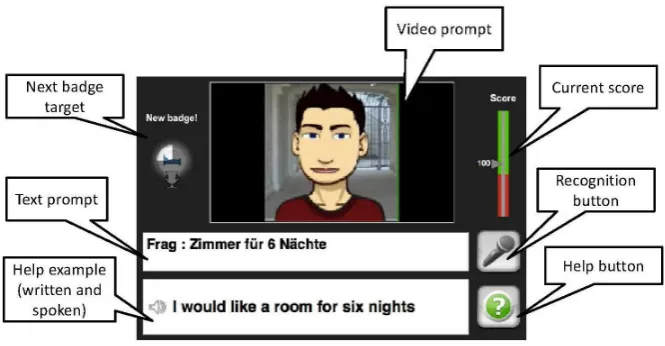
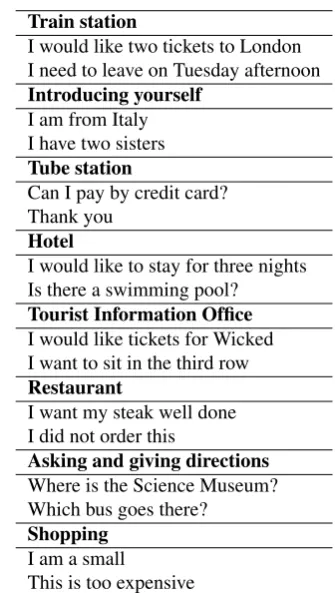
Each interchange begins with the system giving the student a prompt, which in the present version is a combination of an English-language multimedia file and a piece of German text; for example, at the beginning of the Hotel lesson, the system plays a cartoon clip of a desk clerk asking “How many nights would you like to stay at our hotel?”, simul-taneously showing the German text “Frag: Zimmer f¨ur 6 N¨achte” (“ask: room for 6 nights”). The student then gives a spoken response; the intent is that this should be reason-ably free, so here one can for instance answer “I would like to stay for six nights”, “I want a room for six nights”, “A room for six nights please”, and several other variants.
The system decides whether to accept or reject the response by first performing speech recognition, then translating to a language-neutral (interlingual) representation, and finally matching this representation against the language-neutral representation of the prompt. A “help” button allows the student, at any time, to access a correct sentence in both written and spoken form; spoken help examples are col-lected from previous successful interactions. When the sys-tem has decided whether to accept or reject, it moves to a new dialogue state; the choice of state is determined by an XML-based script written by the course designer, which specifies various options. Continuing the example, an “ac-cept” moves to a state where the desk clerk’s next question is “What type of room would you like?”; a “reject” stays in the same state, with the desk clerk saying that he didn’t understand; and a sequence of three rejects moves to a state where the clerk says he didn’t understand, but asks whether a room for one night will be okay. On reaching the end of the lesson, the student either exits or selects a new lesson from a menu. Figure 1 shows the user interface.
Figure 1: Screenshot of CALL-SLT user interface.
al., 2006), which in turn sits on top of the commercial Nu-ance Toolkit package. The core idea is reusability. A gen-eral resource grammar, written in a feature-grammar nota-tion, is defined for the recognition language (here, English) and shared between applications. Efficient domain-specific feature grammars are compiled out of it using a version of the Explanation Based Learning algorithm, driven by small corpora of examples; these grammars are then further com-piled into the proprietary CFG form required by the Nuance Toolkit. The Nuance Toolkit performs two more compila-tion steps, first using the example corpus to add probabilis-tic weights to the CFG form, and then converting the result-ing PCFG grammar into a Nuance language model. In prac-tice, the training corpus is usually partitioned into smaller subcorpora, with each subcorpus producing a different lan-guage model. This makes it easy to construct tightly con-strained recognizers which offer good performance on in-coverage utterances.
In the context of the CALL-SLT application, the corpus used for training the recogniser also defines the examples used for each lesson. We construct a language model for each individual lesson, covering the examples listed for that lesson, and various generalizations of them obtained by combining rules and lexical entries taken from different training examples. We have also experimented with com-piling models for unions of sets of lessons, for example for the union of all the lessons, or for the current lesson to-gether with all the preceding lessons. The tradeoff with these larger models is between increased coverage and de-graded recognition. For beginner students like the ones we are dealing with here, forgiving recognition seemed more important, and we consequently used only the small lesson-specific language models.
The same specialised grammars used to construct the language models are also used to parse recognition re-sults: every recognition result is thus grammatically well-formed. Semantic representations are produced in a min-imal feature-value notation called Almost Flat Functional Semantics (AFF; (Rayner et al., 2008). For example, “Could you give me directions to the zoo?” is represented as the structure
[null=[utterance_type, ynq], agent=[pronoun, you],
null=[modal, could], null=[action, give], null=[voice, active],
object=[abstract, directions], indobj=[pronoun, i],
to_loc=[loc, zoo]]
L2 – here, English-language – AFF representations are mapped into language-neutral (interlingual) counterparts, using a set of rules which rewrite tagged lists of elements to tagged lists of elements. This is done in a way which tries to map semantically equivalent L2 utterances to the same in-terlingual utterance, so that matching between prompt and response can be performed at the interlingual level. A sec-ond grammar is responsible for realizing the interlingual forms in the L1, here German. Thus, to continue the exam-ple, the English AFF form above is mapped into the inter-lingual AFF form
[null=[utterance_type, request] arg2=[abstract, directions], to=[loc, zoo]]
which is realized in German as the prompt “Frag : Wo ist der Zoo ?” (“Ask: where is the zoo?”). The same repre-sentation is produced from e.g. “Where is the zoo?”, “I am looking for the zoo?” and “Can you tell me where the zoo is?”.
The system is deployed over the web using a scalable ar-chitecture designed for cloud-based computing. In com-mon with similar platforms, like WAMI (Gruenstein et al., 2008) and Nuance’s Mobile Developer Platform, it uses a client/server approach in which speech recognition is car-ried out on the server side. The overhead due to web de-ployment is a few hundred milliseconds per recognition op-eration, compared to execution on a desktop machine. Full details are presented in (Fuchs et al., 2012).
2.2. Content
Length [words] Occurrences Proportion
1 173 23.10%
2 68 9.08%
3 28 3.74%
4 114 15.22%
5 110 14.69%
6 110 14.69%
7 48 6.41%
8 62 8.28%
9 24 3.20%
10 8 1.07%
11 1 0.13%
12 1 0.13%
13 1 0.13%
14 1 0.13%
Table 3: Utterance length
Table 4 shows the measured weighted Cohen’s Kappa (squared weights) for the ratings by the two annotators (us-ing 95% C.I.), indicat(us-ing a moderate agreement on the cate-gories “vocabulary”, “grammar”, “pronunciation” and “flu-ency”.
Category Kappa C.I.
Vocabulary 0.46 (0.32, 0.58)
Grammar 0.45 (0.32, 0.57)
Pronunciation 0.66 (0.61, 0.70)
Fluency 0.53 (0.48, 0.58)
Table 4: Cohen’s Kappa
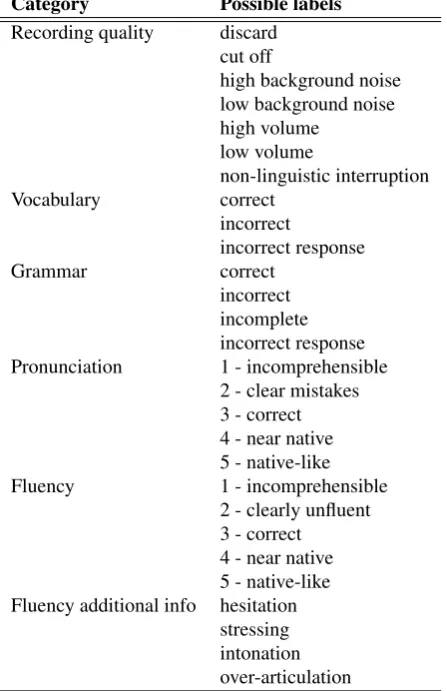
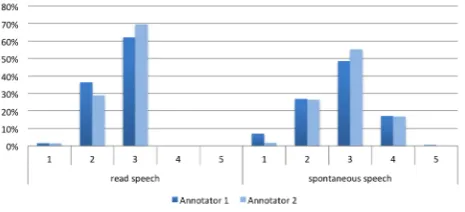
The overall annotation distribution for the categories “pro-nunciation” and “fluency” by the two annotators, divided into spontaneous and read speech, are displayed in Figures 2 and 3. Figures 4 and 5 indicate the distribution of correct and incorrect utterances.
Figure 2: Pronunciation results read and spontaneous speech
Inter-annotator agreement on recording quality was unfor-tunately less good. Figure 6 shows that annotator 1 judged more than half of all utterances (56%) to have a low level of background noise and 12% as having high background noise. The number of recordings with very high or low recording volume (0.6% and 2.6% respectively) can be
ne-Figure 3: Fluency results read and spontaneous speech
Figure 4: Grammar annotations
glected for this annotator. Annotator 2 judged less utter-ances as having (high or low) background noise, namely a total of 27%. In his subjective annotations, there were on the other hand more utterances with high or low recording volumes compared to annotator 1 (3.3% and 4.1% respec-tively). In continued work, we will evidently need to intro-duce stricter guidelines for this part of the task.
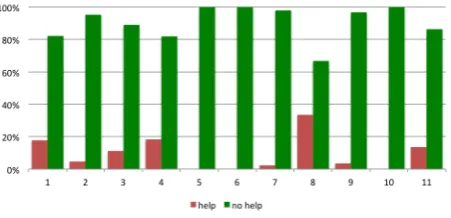
Most users made no or only little use of the help function, as can be seen in Figure 7. We presume that this was at least in part due to the advanced level of the test subjects, and the fact that the lessons were based on material which they had already covered in class.
Figure 8 shows the accept/reject rates individually listed for all 11 users. We can see that 7 users got a high acceptance rate, one user had about the same proportion of accepts and rejects and only 3 users had a higher rate of rejects. Look-ing at Table 5, it seems plausible that the poor results for these three users are largely due to issues with recording quality. For user 6, 94% of all recorded utterances con-tained (low or high) background noise; the same applies to user 9, with a proportion of 83% showing background noise. The problem with user 8 was mainly poor recording quality due to low volume (43%) and also some background noise (24%).
Figure 5: Vocabulary annotations
Figure 6: Recording quality annotations
are similar but less extreme for annotator 2: out of 173 low-noise utterances, 70% were accepted and 30% were re-jected, and again the opposite behavior applied for the 64 high-noise utterances, where only 28% were accepted and 72% rejected. Unsurprisingly, it seems clear that high back-ground noise is an important disruptive factor which low-ers the acceptance rate, whereas utterances with low back-ground noise are most often accepted by the system. This same reasoning also applies to cut off utterances. However, since we only have very few of those in the current set of data (1%), they are not listed separately.
4.
Availability of corpus data
The initial tranche of data described in the preceding sec-tion consists of 814 annotated utterances, and can be downloaded from http://www.issco.unige.ch/ en/research/resources/. The zipfile contains the recorded wavfiles themselves, in RIFF format, and an Ex-cel spreadsheet with the annotation data. Each line in the spreadsheet has a link to the relevant wavfile. A second tab on the spreadsheet provides demographic data – in particu-lar, linguistic background – for the subjects used.
The intention was to run the experiment for four weeks, presenting new lessons at the rate of two a week. Based on the results of our initial experience and previous evalu-ation exercises of a similar nature (Rayner and Tsourakis, 2013); (Jolidon, 2013), we consider it reasonable to expect to log at least 5 000 utterances. Unfortunately, for
admin-Figure 7: Usage of help function
Figure 8: Accept/reject results
istrative reasons beyond our control, we were forced to put data collection temporarily on hold after a few days. We expect to resume later in the Spring of 2014, and will post new annotated data as it becomes available.
We hope that this substantial annotated corpus of sponta-neous child learner speech may be of interest for at least a few researchers in SLA and CALL. In the context of our own work, we have two main reasons for collecting the data. First, we wish to measure how students improve, and compare their performance against that of a parallel con-trol class at the same school, which is not using the system. Second, we will use the data to improve the speech recog-nition process; in particular, we will be able to better tune the threshold parameters which control the balance between false positives and false negatives.
5.
Discussion and conclusions
User Recording quality Proportion
6 low background noise 38%
high background noise 56%
8 low background noise 12%
high background noise 12%
low volume 43%
discard 7%
9 low background noise 37%
high background noise 46%
Table 5: Recording quality for poorly performing users
accept/ accept/ reject/ reject/
high low high low
Annotator 1 0 425 106 59
Annotator 2 18 121 46 52
Table 6: Correlation between background noise and accep-tance rate (high and low levels of background noise)
question found that frivolous responses were mostly re-jected, and tired of the game1. This suggests to us that it is necessary for the recognition language model to be fairly strict. By way of contrast, the popular Duolingo site has extremely relaxed speech recognition feedback, usually ac-cepting playful variants of the kind our students were using. Anecdotally, our impression is that this behaviour is corre-spondingly more common there.
On the negative side, the fact that we were not present while the data was being collected meant that we had no direct control over the process. An immediate consequence was high levels of background noise; a few students, who had a quiet background, appeared to be doing the exercises on their own at home, but the majority seemed to find it more enjoyable as a group activity. It was also apparent that the strictness of the language model had a downside. When responses were not accepted by the system (as far as we could see, quite often due to the noisy environment), a fre-quent pattern was for the student to hyperarticulate in the following utterance, making the data less natural and use-ful.
We are for the moment guardedly optimistic about the merits of our scheme, and hope to be able to translate the lessons learned from the initial round of experiments into improved data collection protocols when testing is re-sumed. We expect to report on this work in due course.
6.
References
Baur, C., Rayner, M., and Tsourakis, N. (2013). A textbook-based serious game for practising spoken lan-guage. InProceedings of ICERI 2013, Sevilla, Spain. Council of Europe. (2001). Common European
Frame-work of Reference for Languages: Learning, Teaching, Assessment. Cambridge University Press, Cambridge.
1
An unexpected exception, found by one ingenious student, was that a Spanish¡Hola!was consistently accepted as an alter-native to “Hello!”.
Fuchs, M., Tsourakis, N., and Rayner, M. (2012). A scalable architecture for web deployment of spoken di-alogue systems. InProceedings of LREC 2012, Istanbul, Turkey.
Gruenstein, A., McGraw, I., and Badr, I. (2008). The WAMI toolkit for developing, deploying, and evaluating web-accessible multimodal interfaces. InProceedings of the 10th international conference on Multimodal inter-faces, pages 141–148. ACM.
Jolidon, A. (2013).Reconnaissance vocale et am´elioration de la prononciation : ´elaboration et ´evaluation de lec¸ons avec le logiciel CALL-SLT. Masters thesis, Universit´e de Gen`eve.
Jur˘ci˘cek, F., Keizer, S., Ga˘si´c, M., Mairesse, F., Thomson, B., Yu, K., and Young, S. (2011). Real user evalua-tion of spoken dialogue systems using Amazon Mechan-ical Turk. InProceedings of Interspeech 2011, Florence, Italy.
McGraw, I., Lee, C. Y., Hetherington, I. L., Seneff, S., and Glass, J. (2010). Collecting voices from the cloud. In Proceedings of LREC 2010.
Morrissey, F. A., F¨as, H., Marchini, D., and Stotz, D. (2001). Ready For English 1. Klett und Balmer AG, Zug, Switzerland.
Rayner, M. and Tsourakis, N. (2013). Methodological is-sues in evaluating a spoken CALL game: Can crowd-sourcing help us perform controlled experiments? In Proceedings of the SLaTE Workshop, Grenoble, France. Rayner, M., Hockey, B.A., and Bouillon, P. (2006).
Putting Linguistics into Speech Recognition: The Reg-ulus Grammar Compiler. CSLI Press, Chicago.
Rayner, M., Bouillon, P., Hockey, B.A., and Nakao, Y. (2008). Almost flat functional semantics for speech translation. In Proceedings of COLING-2008, Manch-ester, England.
Rayner, M., Bouillon, P., Tsourakis, N., Gerlach, J., Georgescul, M., Nakao, Y., and Baur, C. (2010). A mul-tilingual CALL game based on speech translation. In Proceedings of LREC 2010, Valetta, Malta.
Wang, C. and Seneff, S. (2007). Automatic assessment of student translations for foreign language tutoring. In Proceedings of NAACL/HLT 2007, Rochester, NY. Werbach, K. and Hunter, D. (2012). For the Win: How