© 2017 IJSRST | Volume 3 | Issue 7 | Print ISSN: 2395-6011 | Online ISSN: 2395-602X Themed Section: Science and Technology
Design and Simulation of Closed Loop Controller for SEPIC
Converter to Improve Power Factor
R. Jai Ganesh
*1, A. Bhuvanesh
2*1Department of EEE, K. Ramakrishnan College of Technology, Tiruchirapalli, Tamil Nadu, India 2Department of EEE, Mepco Schlenk Engineering College, Sivakasi, Tamil Nadu, India
ABSTRACT
One of the solid state switch mode rectification converters is SEPIC converter. This paper presents the design, simulation and development of single phase AC-DC SEPIC converter with 1.5W output power. The non-isolated SEPIC converter is performed in this paper. The control techniques such as voltage follower control, average current control with voltage follower, borderline control technique are implemented to improve the overall power factor and to reduce Total Harmonic Distortion.
Keywords: Single switch buck-boost SEPIC converter, Control techniques, L-C input filter
I.
INTRODUCTION
Power electronic converters are a family of electrical circuits which convert electrical energy from one level
of voltage/current/frequency to other using
semiconductor based electronic switches. The essential characteristic of these types of circuits is that the switches are operated only in one of the two states, either fully ON or fully OFF, unlike other types of electrical circuits where the control elements are operated in a linear active region. The process of switching the electronic devices in a power electronic converter from one state to another is called modulation. The thyristorised power converters are referred to as the static power converters and they perform the function of power conversion by converting the available input power supply into output power of desired form. The different types of thyristorised power converters are diode rectifiers, line commutated converters, AC voltage controllers, cycloconverters, DC choppers and inverters. The conventional technique of single phase ac-dc conversion using a diode bridge rectifier with dc filter capacitor results in poor power quality in terms of injected current harmonics, voltage distortion, poor power factor at input ac mains, slow varying rippled dc output at load end, low efficiency and large size of AC and DC filters. A low power factor reduces the real power available from the utility grid, while a high harmonic distortion of line current causes Electro Magnetic Interference problems and cross interferences.
They do not comply with the international regulations governing the power quality. Solid state switch mode rectification converters have the ability to improve the power quality of AC mains and regulate DC output in buck, boost, and buck-boost modes. Improvements in power factor and reduction in harmonic distortion can be achieved by modifying the stage of the diode rectifier’s filter capacitor circuit. Several power factor correction (PFC) topologies are conceived [1]. Normally AC-DC conversion is carried out by simply rectifying the AC input and the rectified output is filtered by means of a large value of capacitance to get a nearly constant DC output voltage. In this conversion, the input AC supply current is drawn in narrow pulses since the capacitor voltage variation is nearly constant. This narrow pulse current of high peak, results in power quality problems to nearby consumers, which include higher value of Total Harmonic Distortion (THD) on supply current, higher THD of input supply voltage, lower value of power factor and displacement factor and poor distortion factor [2]. These large harmonic currents are undesirable because they not only produce distortion of AC line voltage but also result in conducted and radiated electromagnetic interference. The problem becomes more serious particularly when several drive units are connected to single-phase supply where the input power pulsates at twice the frequency.
driver for power quality enhancement in input AC supply side has been presented in [3]. The fuzzy-tuned PI voltage controller and the hysteresis current controller were implemented in a FPGA-based hardware platform for three level LED driver. The comparison revealed that the fuzzy-tuned PI voltage controller with the hysteresis current controller for three level LED driver showed better performance. An improved power quality positive output super-lift Luo converter is proposed for high power LED industrial lighting applications in [4]. The proposed LED driver has shown high level performance such as low total harmonic distortion and unity power factor for variation of the LED lamp load power and variation of the supply voltage. The design and implementation of closed loop controllers for single phase AC-DC three level converter has been presented in [5]. The closed loop control for the converters consists of two loops-one outer voltage controller and the other inner current controller. HCC controller is used as an inner current controller. For outer voltage controllers, two controllers are designed-one PI controller and the other fuzzy logic controller.
II.
SEPIC CONVERTER
The SEPIC converter is a non-inverting Buck-Boost converter (step-down/step-up) [6]. This converter has the mutually coupled inductors which are wound on the same core [7]. SEPIC has the following advantages such as, the output voltage can be greater than or less than or equal to the input voltage, the output voltage polarity is same as that of the input voltage, there is no need for commutation circuit, it is simple and has fast response [8]. Due to the above advantages both Boost-Buck and Buck-Boost can be replaced by the SEPIC converter. This SEPIC converter can be operated in both continuous conduction mode and discontinuous conduction mode [9]. Previously, the single phase ac-dc three-level boost converter with controller circuit such as sliding mode controller, proportional integral controller and employs three-level pulse width modulation technique has been proposed in [10] to verify the performances of converter under load variation, unbalanced load condition and sudden change in load condition for various control strategies. The simulation and analysis of single phase single-switch, converter topologies of AC-DC SEPIC converter and modified SEPIC converter for Continuous Conduction
Mode (CCM) of operation with 48V, 100W output power has been presented in [11]. The results of SEPIC converter and modified SEPIC converter are compared for closed loop analysis in simulation which is done in PSIM. It is found that modified SEPIC converter has high regulated output voltage and high power factor. The design of closed loop controllers operating a single-phase AC-DC three-level converter for improving power quality at AC mains has been presented in [12]. Closed loop inhibits outer voltage controller and inner current controller. Simulations of three level converter with three different voltage and current controller combinations such as PI-Hysteresis, Fuzzy-Hysteresis and Fuzzy tuned PI Hysteresis are carried out in MATLAB/Simulink.
A. Control Techniques
An ideal power factor corrector should emulate a resistor on the supply side while maintaining a fairly regulated output voltage. In the case of sinusoidal line voltage, this means that the converter must draw a sinusoidal current from the utility. In order to do that, a suitable sinusoidal reference is generally needed and the control objective is to force the input current to follow this current reference as close as possible. The various control techniques are peak current control, average current control, voltage follower approach, hysteresis control and borderline control. In this paper, the most popular control techniques namely voltage follower control, average current control and borderline control techniques are reviewed and compared [13], [14].
B. Proposed Topology
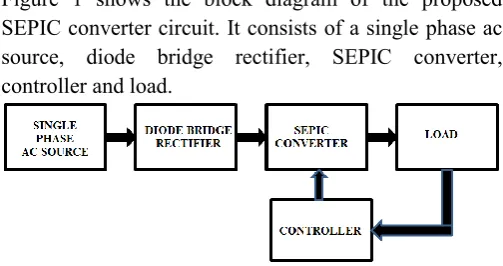
Figure 1 shows the block diagram of the proposed SEPIC converter circuit. It consists of a single phase ac source, diode bridge rectifier, SEPIC converter, controller and load.
Figure 1: Block diagram of the proposed converter circuit
shows the circuit diagram of the proposed converter. The coupled inductor reduces the reverse recovery current of the additional diode. The SEPIC converter is used to obtain the output voltage, less than, greater than, or equal to that of the input voltage.
Figure 2. Circuit diagram of the proposed converter
The SEPIC converter is classified into two types. They are,
1. Non-isolated SEPIC converter 2. Isolated SEPIC converter
In this paper, the non-isolated SEPIC converter is considered.
III.
DESIGN PROCEDURE
The design steps for the proposed system are as follows, [15]
Step 1 - The switching frequency, FSW is assumed.
Step 2 - The duty cycles are calculated using the formula,
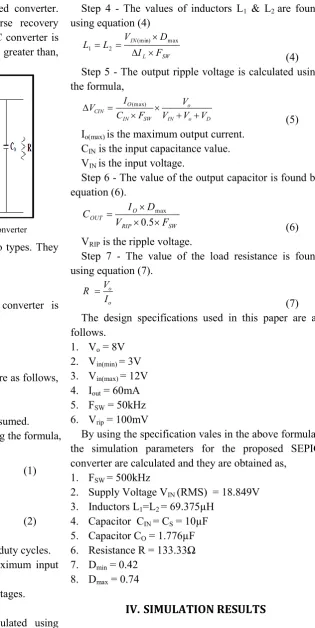
D IN O D O V V V V V D (max) min (1) D IN O D O V V V V V D (min) max (2)
Dmin, Dmax are the minimum and maximum duty cycles.
VIN(min), VIN(max) are the minimum and maximum input
voltages.
Vo is the output voltage, VD is the diode voltages.
Step 3 - The inductor current is calculated using equation (3) (min) % 40 IN O O L V V I I
(3)
Io is the output current.
Step 4 - The values of inductors L1 & L2 are found
using equation (4)
SW L IN F I D V L L
(min) max 2
1
(4) Step 5 - The output ripple voltage is calculated using the formula, D o IN o SW IN O CIN V V V V F C I V (max) (5) Io(max) is the maximum output current.
CIN is the input capacitance value.
VIN is the input voltage.
Step 6 - The value of the output capacitor is found by equation (6). SW RIP O OUT F V D I C 5 . 0 max (6) VRIP is the ripple voltage.
Step 7 - The value of the load resistance is found using equation (7).
o o I V R (7)
The design specifications used in this paper are as follows.
1. Vo = 8V
2. Vin(min) = 3V
3. Vin(max) = 12V
4. Iout = 60mA
5. FSW = 50kHz
6. Vrip = 100mV
By using the specification vales in the above formulae, the simulation parameters for the proposed SEPIC converter are calculated and they are obtained as,
1. FSW = 500kHz
2. Supply Voltage VIN (RMS) = 18.849V
3. Inductors L1=L2 = 69.375µH
4. Capacitor CIN = CS = 10µF
5. Capacitor CO = 1.776µF
6. Resistance R = 133.33Ω 7. Dmin = 0.42
8. Dmax = 0.74
IV.
SIMULATION RESULTS
A. Open Loop Control
turned on L1 and L2 get energized, thus currents iL1 and iL2 are the same. The voltage across Cs is equal to the input voltage. When the switch is turned off, the energy stored in the inductors get dissipated to the capacitor in the output side and thus the output voltage is obtained from the resistive load.
Figure 3. Circuit diagram for the open loop control of the proposed SEPIC converter
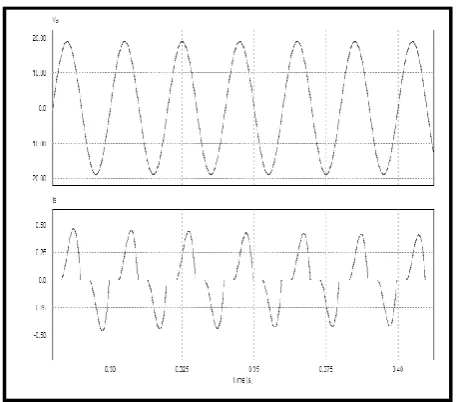
Figure 3(a). Simulation waveforms of input voltage and current of the SEPIC converter in open loop control
Figure 3(b). Simulation waveforms of output voltage and current of the SEPIC converter in open loop control
B. Closed Loop Control
This closed loop control has different types of techniques to improve the power quality in a circuit.
They are,
Voltage follower control
Average current control with voltage follower control Borderline control
1) Voltage follower approach
Figure 4. Circuit diagram for voltage follower approach of proposed SEPIC converter
Figure 4(a). Simulation waveforms of input voltage and current of the SEPIC converter in voltage follower approach
In this approach, as shown in Figure (4), the internal current loop is completely eliminated, so that the switch is operated at constant on-time and frequency.
Figure 4(b) Simulation waveforms of output voltage and current of the SEPIC converter in voltage follower approach
2) Average current control with voltage follower control
Figure 5. Circuit diagram for average current control with voltage follower approach for the proposed SEPIC converter
Figure (5) shows the average current control technique for the proposed SEPIC converter. Figure (5a) shows the input voltage and current waveforms for this control. Figure (5b) shows the output voltage and current waveforms.
Figure 5(a) Simulation waveforms of input voltage and current for average current control with voltage follower approach of the SEPIC
Figure 5(b). Simulation waveforms of output voltage and current for average current control with voltage follower approach of the SEPIC
converter
3) Borderline control
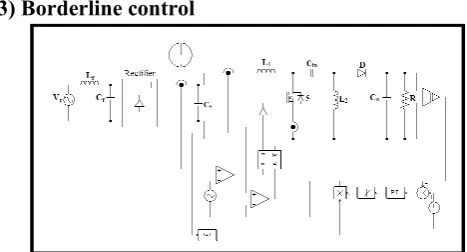
Figure 6. Circuit diagram of borderline control technique for proposed SEPIC converter
Figure 6 shows the borderline control technique for the proposed SEPIC converter. Figure 6(a) shows the input voltage and current waveforms for this control. Figure 6(b) shows the output voltage and current waveforms.
Figure 6(a). Simulation waveforms of input voltage and current for borderline control technique of the SEPIC converter
Figure 6(b). Simulation waveforms of output voltage and current for borderline control technique of the SEPIC converter
C. Comparison of Results
TABLE 1COMPARISON OF RESULTS
Control techniques
Output voltage (V)
Power
factor THD%
Open loop 11.2 0.7056 65.28
Voltage Follower
Approach 11.85 0.7286 41.55
Average Current
Control 12.12 0.9567 11.15
Borderline
Control 11.99 0.9598 8.65
Table 1 shows that power factor is well improved in the borderline control technique when compared to other control techniques. THD is also reduced much in borderline control. The output voltage obtained in borderline control is very close to the designed output value of 12V. Borderline control technique is found to be better compared to other control techniques.
V.
CONCLUSION
frequency, non-isolation has been carried out for 12 V output. With this designed converter, simulation has been done in standard PSIM software. High power quality is obtained with the design parameters and the power factor obtained is 0.9598 and THD in the order of 8.65% using the borderline control technique which is found to be better compared to other control techniques. Simulated and test results on the developed converter show the improved performance of the proposed high frequency Non-isolated AC-DC SEPIC converter in terms of low THD of supply current and improved power factor of AC mains. The SEPIC acts as a Power Factor Preregulator with higher reliability.
VI.REFERENCES
[1] J.Sebastian, J.Uceda, J.A.Cobos, J.Arau and
R.Lorenzo. 1991. Using SEPIC Topologies For Improving Power Factor in Distributed Power Supply System. EPE. Florence. Vol. 1, pp. 304-309.
[2] Esam H. Ismail. 2009. Bridgeless SEPIC Rectifier
with Unity Power Factor and Reduced Conduction Losses. IEEE Transactions on Industrial Electronics, Vol. 56, No. 4, pp. 1147-1157.
[3] J. Gnanavadivel, N. Senthil kumar, P.
Yogalakshmi. 2016. Implementation of FPGA based three-level converter for LED drive applications. Journal of Optoelectronics and Advanced Materials. Vol. 18, Iss. 5-6, pp. 459 – 467.
[4] J.Gnanavadivel, N.Senthil Kumar, C.N. Naga
Priya, S.T.Jaya Christa. 2016. Single phase positive output super-lift luo converter fed high power LED lamp with unity power factor and reduced source current harmonics. Journal of Optoelectronics and Advanced Materials. Vol. 18, No. 11-12, pp. 1007 – 1017.
[5] J.Gnanavadivel, N.Senthil Kumar, S.T.Jaya
Christa. 2015. Implementation of FPGA based fuzzy and hysteresis controllers for power quality improvement in single phase three-level rectifier. Optoelectronics and Advanced Materials– Rapid Communications, Vol. 9, No. 9-10, pp. 1264 - 1272
[6] Domingos Savio Lyrio Simonetti, Javier Sebastian
and Javier Uceda. 1997. Discontinuous conduction
mode SEPIC and CUK power factor
preregulators: Analysis and design. IEEE Transaction on Industrial Electronics. Vol. 44, No. 5, pp. 630-637.
[7] G. Spiazzi and L.Rossetto. 1994. High-quality
Rectifier based on Coupled-Inductor Sepic Topology. PESC conference.
[8] Andrea Cantillo, Antonietta De Nardo, Nicola
Femia and Walter Zamboni. 2011. Stability issues
in Peak-Current-Controlled SEPIC. IEEE
Transactions on Power Electronics. Vol. 26, No. 2, pp. 551-562.
[9] J.M. Kwon, W.Y.Choi, J.J.Lee, E.H. Kim and
B.H. Kwon. 2006. Continuous conduction mode SEPIC converter with low reverse loss for power factor correction. IEEE proc. Electronics Power Applications. Vol. 153, No. 5, pp. 673-681.
[10] J.Gnanavadivel, A.Aswini, N.Senthil Kumar,
S.T.Jaya Christa. 2014. Power Quality
Improvement in Single Phase AC-DC Three Level Boost Converter Using PI and SMC. Applied Mechanics and Materials Vol. 573, pp 72-77. DOI: 10.4028/www.scientific.net/AMM.573.72
[11] J. Gnanavadivel, K. Sree Revathy, S.T. Jaya
Christa, N. Senthil Kumar. 2014. Analysis and Design of Single phase AC-DC Modified SEPIC Converter. Applied Mechanics and Materials. Vol.
573, pp 108-114. DOI:
10.4028/www.scientific.net/AMM.573.108
[12] Gnanavadivel J, Senthil Kumar N and
Yogalakshmi P. 2016. Comparative Study of PI, Fuzzy and Fuzzy tuned PI Controllers for Single-Phase AC-DC Three-Level Converter. Journal of Electrical Engineering and Technology, Vol. 12,
No. 1, pp. 78-90. DOI:
http://dx.doi.org/10.5370/JEET.2017.12.1.078
[13] Bhim Singh and Ganesh Dutt Chaturvedi. 2008. Analysis, design and development of a single switch Flyback Buck-Boost AC-DC converter for low power battery charging applications. Journal of Power Electronics. Vol. 8, No. 1, pp. 51-59.
[14] W.Tang, F.C.Lee, and R.B.Ridley. 1992.
Small-Signal Modeling of Average Current-Mode Control. APEC, pp.747-755.
[15] Wei Gu. 2007. “Designing a SEPIC converter”,
National semiconductor note 1484.