Combinatorial level densities for practical applications
S. Hilaire1,a, S. Goriely2, M. Girod1, A. J. Koning3, R. Capote4, and M. Sin5
1 CEA, DAM, DIF, F-91297, Arpajon, France
2 Institut d’Astronomie et d’Astrophysique, Universit´e Libre de Bruxelles, Campus de la Plaine CP 226, BE-1050 Brussels,
Belgium
3 Nuclear Research and Consultancy Group, P.O. Box 25, NL-1755 ZG Petten, The Netherlands
4 Nuclear Data Section, International Atomic Energy Agency, Wagramerstrasse 5, Vienna AT-1400, Austria 5 Nuclear Physics Department, Bucharest University, Bucharest-Magurele, Romania
Abstract. We review our calculated energy-, spin- and parity-dependent nuclear level densities based on the microscopic combinatorial model described in ref. [1]. We show that this model predicts the experimental s-and p-wave neutron resonance spacings with a degree of accuracy comparable to that of the best global models available and also provides reasonable description of low energies cumulative number of levels as well as of the experimental data obtained by the Oslo group [2]. We also provide a renormalization recipe which enables to play with the tabulated results for practical applications. Finally, we study the impact of temperature dependent calculation on s-wave neutron resonance spacings.
1 Introduction
The knowledge of nuclear level densities (NLDs) has been a matter of interest and study for years going back at least to 1936 with Bethe’s pioneering work [3]. Level densities are required when modeling nuclear reactions as soon as the number of levels to which decay occurs is too large to allow for an individual description. With the develop-ment of new industrial or experidevelop-mental facilities, as well as for astrophysical interest, the increasing need of nuclear data far from the valley of stability challenges the nuclear reaction models. Indeed, so far, cross section predictions have relied on more or less phenomenological approaches, depending on parameters adjusted to scarce experimental data or deduced from systematical relations. While such predictions are expected to remain reliable for nuclei not too far from experimentally accessible regions, the predic-tive power of analytical models in general, and of analyt-ical level densities expressions in particular, is more and more questionable when dealing with more and more ex-otic nuclei. To face such difficulties, it is preferable to rely on approaches as fundamental as possible. Such micro-scopic description by a physically sound model based on first principles ensures a reliable extrapolation away from experimentally known region.
Global microscopic models of NLD have been devel-oped for the last decades (see [1] and references therein), but they have almost never been used for practical appli-cations, because of their lack of accuracy in reproducing experimental data (especially when considered globally on a large data set) or because they do not offer the same flex-ibility as that of the highly parametrized analytical
expres-a e-mail:[email protected]
sions. We have therefore developed a combinatorial ap-proach and demonstrated that such an apap-proach can clearly compete with the statistical approach in the global repro-duction of experimental data [1, 4]. As we will see, this ap-proach provides the energy, spin and parity dependence of the NLD, and, at low energies, describes the non-statistical limit which, by definition cannot be described by statistical-based analytical approaches, and yet clearly can have a sig-nificant impact on cross section predictions. We will also show how we plan to improve our predictions in the com-ing future.
2 The combinatorial method
The combinatorial method has been extensively described in refs. [1, 4, 5] and we just summarize here its main fea-tures. It consists in using the single-particle level schemes obtained from constrained axially symmetric Hartree-Fock-Bogoliubov (HFB) method based on the BSk14 Skyrme force [6] to construct incoherent particle-hole (ph) state densities as a function of the excitation energy, the spin projection (on the intrinsic symmetry axis of the nucleus) and the parity. Once these incoherent ph state densities are determined, collective effects are included. In [4] the vibra-tional effects was described by multiplying the total level densities by a phenomenological enhancement factor simi-lar to that of refs.[7, 8] once rotational bands had been con-structed. However, such a choice has shown its limits [9] and has been replaced by an improved but more compli-cated treatment. The latter explicitly allows for phonon ex-citations using the boson partition function of ref. [5] and includes quadrupole, octupole as well as hexadecapole
vi-DOI:10.1051/epjconf/20100204005
© Owned by the authors, published by EDP Sciences, 2010
This is an Open Access article distributed under the terms of the Creative Commons Attribution-Noncommercial License, which permits
brational modes. However, whereas single-particle levels are theoretically obtained for any nucleus, phonon’s ener-gies are taken from experimental information when avail-able and from analytical expressions [1] otherwise. Once the vibrational and incoherent ph state densities are com-puted, they are folded to deduce the total state densities. Level densities are then obtained by constructing rotational bands if present (i.e. if the nucleus is deformed) or using the classical expression that relates state and level densi-ties for a spherical nucleus [1]. To account for the damping of vibrational effects with increasing energies, we restrict the folding to the ph configurations having a total exciton number (i.e. the sum of the number of proton and neutron particles and proton and neutron holes)Nph ≤4. This re-striction stems from the fact that a vibrational state results from a coherent excitation of particles and holes, and that this coherence vanishes with increasing number of ph in-volved in the description. Therefore, if one deals with a ph configuration having a large exciton number, one should not simultaneously account for vibrational states which are clearly already included as incoherent excitations.
3 Results
The new NLD are now compared with experimental data. In spite of considerable experimental efforts made to derive NLD, the lack of reliable data–especially over a wide en-ergy range–constitutes the main problem that the NLD the-ories have to face. Nevertheless, a large number of analysis of slow neutron resonances and of cumulative numbers of low energy levels have greatly helped to provide experi-mental information on NLD. Other sources of information have also been suggested, such as analysis of spectra of evaporated particles and coherence widths of cross section fluctuations. However, most of these experimental data are affected by systematic errors resulting from experimental uncertainties as well as the use of approximate theories to analyze them.
frms= 1.79 frms= 2.14 frms= 2.30
Results at B
nBack-Shifted Fermi Gas HFBCS+Statistical Present work
Fig. 1. Ratio of HFB plus combinatorial (Dth) to the
experimen-tal (Dexp) s-wave (squares) and p-wave (circles) neutron
reso-nance spacings compiled in [10] compared with other global ap-proaches such as the Back-Shifted-Fermi-Gas model of ref. [11] and the HFBCS+statistical approach of ref. [12].
The most extensive and reliable source of experimental information on NLD remains the s-and p-wave neutron
res-onance spacings [8, 10] and the observed low-energy ex-cited levels [10]. We show in Fig. 1 the result of our HFB plus combinatorial approach with respect to experimental s- and p-wave spacings compiled in the RIPL-2 database [10]. The quality of a global NLD formula can be described by the rms deviation factor defined as
frms =exp
1 Ne Ne X
i=1 ln2 D
i th Di exp
1/2
, (1)
whereDth(Dexp) is the theoretical (experimental) resonance spacing and Ne is the number of nuclei in the compila-tion. Globally, as can be seen in Fig. 1, the resonance spac-ings are predicted within a factor of 2 (the exact rms fac-tor amounts to frms = 2.3) for both the s- and p-wave data. This result is to be compared to the deviations of global analytical formula [11, 13] typically of the order of 1.7−1.9 and to the frms = 2.14 value obtained with the HFBCS+statistical model introduced in ref. [12], which was the first global microscopic NLD prescription having the capacity to compete with phenomenological models in the reproduction of experimental data. Our new approach therefore gives rather comparable predictions with respect to the other existing global models.
10 100 1000
N(E)
42K 56Fe 60Co
10 100
N(E)
94Nb 107Cd 127Te
10 100
N(E)
148
Pm 172
Yb 194
Ir
0 1 2 3 4
Excitation energy E (MeV) 1 10 100 N(E) (-2.5 MeV) 208 Pb
1 2 3 4
Excitation energy E (MeV) 237
U
1 2 3 4
Excitation energy E (MeV) 239
Pu
Fig. 2.Comparison of the cumulative number of observed lev-els (thin staircase) with the HFB plus combinatorial predictions (thick line) as a function of the excitation energyUfor a sample of 12 nuclei. Only for208Pb, both curves have been shifted by 2.5 MeV, the energy range corresponding consequently to [2.5-7.5] MeV instead of [0-5] MeV.
compare in Fig. 2 the predicted cumulative number of lev-elsN(U) with the experimental data [10] for 12 nuclei, in-cluding light as well as heavy and spherical as well as de-formed species. Globally, the present model provides sim-ilar results as those illustrated in Ref.[4]. Yet one can ob-serve significant disagreement in certain case which could be reduced with a simple renormalization procedure. Such renormalizations are also often required, in particular for nuclear data evaluation or for an accurate and reliable esti-mate of reaction cross sections. Though the HFB plus com-binatorial NLD are provided in a table format, it is pos-sible to renormalize them on both the experimental level scheme at low energy and the neutron resonance spacings atU=Snin a way similar to what is usually done with an-alytical formulae. More specifically, the level density can be renormalized through the expression
ρ(U,J,P)renorm=eα
√
(U−δ)×ρ(U−δ,J,P) (2)
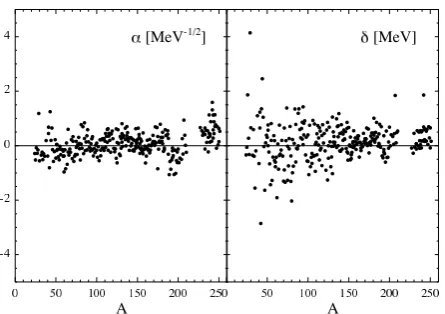
where the energy shiftδis essentially extracted from the analysis of the cumulative number of levels andαfrom the experimental s-wave neutron spacing. With such a renor-malization, the experimental low-lying levels and theDexp values can be reproduced reasonably well, as discussed in detail in [13]. Eq.(2) has been used to fit the 289 nuclei for which both an experimental s-wave spacing (D0) and a discrete level sequence exist. The correspondingδandα values are plotted in Fig. 3. It is important to note that the obtainedαandδparameters show no systematic trend or
A-dependence, and more particularly no correlation with shell closures. Of course, when noDexpvalue is available and only the experimental discrete level scheme is known, only theδshift is used to reproduce at best the low-lying levels.
Fig. 3.αandδvalues plotted as a function of the atomic mass. See text for more details.
Comparisons have also been performed with the exper-imental data extracted by the Oslo group from the analysis of particle-γcoincidence in the (3He,αγ) and (3He,3He’γ) reactions [2]. The experimental determination of level den-sities out of these reactions is however model-dependent
and requires a normalization at the neutron binding energy as explained and discussed in ref. [1]. If we normalize our calculation using the same total level density as that of the Oslo group, using Eq. (2) for each isotope, with anα pa-rameter such that
ρHFB(Sn)×exp(α
p
Sn)=ρoslo(Sn) (3)
our combinatorial results agree extremely well with the so-called experimental values below Sn, as illustrated in Fig. 4.
51
V
102
104
Total level density (MeV
-1) 50
V
94
Mo
57
Fe
2 4 6 8 10 Energy (MeV) 100
102
104
106
Total level density (MeV
-1) 96
Mo
95
Mo
102
104
Total level density (MeV
-1) 93
Mo
2 4 6 8 10 Energy (MeV)
97
Mo
2 4 6 8 10 12 Energy (MeV)
98
Mo
Fig. 4. Comparison between the total NLD determined by the Oslo group (Grey areas) and the HFB combinatorial predic-tions (solid lines). The full triangles correspond to the
model-dependent normalization point derived from theD0 value used
by the Oslo group. See text for more details.
As mentioned previously, one advantage of the com-binatorial method with respect to the statistical method is its non statistical feature which enables us to obtain realis-tic parity and spin distributions. Deviations from the usu-ally adopted equipartition of parities have been shown to have a non negligible impact, in particular when looking at capture cross sections [4]. Concerning the spin distri-bution, the combinatorial approach provides nuclear level densities which strongly deviate from the usually adopted Wigner law, in particular at low energy. Such deviations can play a key role in the description of the decay to spin isomers at low energies [14], since high spin population is usually strongly underestimated within a statistical ap-proach. In particular, this implies an underestimate of the decaying probability to high spin levels.
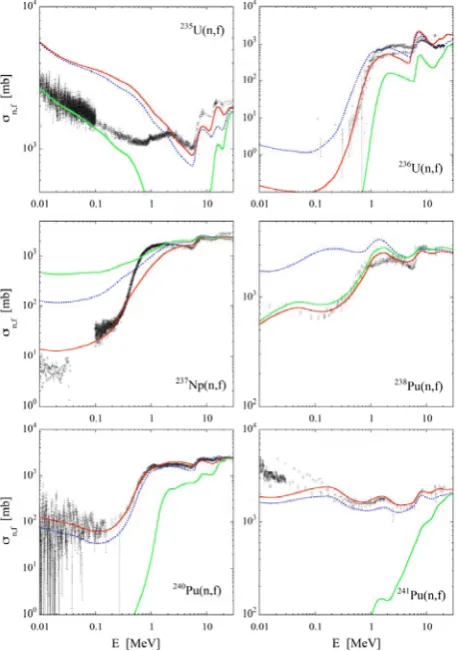
a very large number of parameters which are generally not constrained by experimental data. More than in any other channel, the predictive power of the traditional approaches is poor, and by no mean such approaches can be employed to make extrapolations far from the regions where fission cross section has been measured. The only solution left in this case is to rely on microscopic predictions provided they give reasonable answers. Quite a complete study has been performed on the use of microscopic ingredients ap-plied to fission cross section prediction [17] and we just summarize here part of this work, by plotting in Fig. 5, cal-culated fission cross sections using both the microscopic fission barriers and associated combinatorial level densi-ties for several actinides. As can be seen, the quality
ob-Fig. 5.Neutron-induced fission cross sections obtained with the microscopic fission path and the combinatorial nuclear level den-sities using the raw fission paths (green lines), when the fission paths are renormalized for each actinide (red line) or by a system-atical factor depending on the oddness of the nuclei (blue dotted line).
tained by default (green line) is not satisfactory for prac-tical applications which require a few percent of accuracy. In this case both nuclear level densities and fission barriers are directly obtained from HFB+BSk14 predictions. The bad description obtained using these raw (not adjusted) in-gredients is mainly due to the fact that the microscopic
bar-riers are generally too high by a few hundreds of keV [6, 17] which is too big an error to provide reasonable cross sections. If the barriers are individually normalized, with-out even modifying the combinatorial level densities, it is possible to obtain cross sections which are in much bet-ter agreement with experimental data (red lines). However, such normalizations only make sense if experimental data are available. If not, it is still possible to use systematic nor-malizations deduced by averaging those which have been obtained fitting the nuclei for which experimental data are available. In that case, one obtains fission cross section which are globally within a factor of 3 (blue dotted lines). Of course, the quality of the fit can be further improved us-ing Eq. 2, but this would go beyond our present discussion.
4 Temperature effect on combinatorial
level densities
We have seen that the combinatorial level densities we have obtained and tabulated provide quite good results when compared to available experimental data as well as when they are used to produce cross sections, even in compli-cated reactions such as neutron induced fission on actinides. Yet, they still suffer from several approximations which can be reduced with more or less complicated treatment. Among these approximations, the way collective enhance-ment evolves with increasing excitation energy remains questionable. If it is well established that with increasing energy, a deformed nucleus in its ground state becomes spherical and that the vibrational enhancement vanishes. These features are usually described using more or less elaborated phenomenological approximations [12, 18]. The disappearance of the rotational enhancement at increas-ing excitation energies has already been studied theoreti-cally [19] for a few nuclei but not within a systematic ap-proach. Another way to describe this transition to spheric-ity is to use temperature-dependent HFB approach follow-ing the method described in ref. [20]. In particular, for a heated system, the average value of an observableOreads
¯ O=
R
Oexp[−F(q)/T]dq R
exp[−F(q)/T]dq (4)
where the free energyFdepends on the energyE, the tem-perature T and the entropy S through the usual relation
F(q)=E(q)−T S(q) andqis the quadrupole deformation considered to be the most relevant property to describe the deformation changes with the temperature evolution. In a first approximation, neglecting the thermal fluctuation, the equilibrium deformation of the nucleus at a temperatureT
den-Fig. 6.Total nuclear level densities for238Ucalculated for several temperatures. Each level density curve covers an energy interval which starts at the excitation energy corresponding to the chosen temperature. In the present case the total level density is plotted without any smoothing procedure (see text for more details).
sities strongly depend on the corresponding temperature and display discontinuities stemming from the vanishing (gradual or sudden) of shell and pairing effects as well as from the fact that we use a finite set of temperatures to compute our level densities. Indeed, in principle the level density determined for a given temperature is only valid at the corresponding excitation energy. However, for prac-tical reasons, we consider the level density determine for the temperatureTi to be valid over the excitation energy interval [Ui,Ui+1]. To suppress the discontinuity at a given temperatureTi, an energy-dependent shift is applied to the level density in the [Ui−1,Ui] range. With such a simple treatment, the discontinuous level density of Fig. 6 can be regularized into that illustrated in Fig. 7 and the NLD esti-mated within a reasonable computer time.
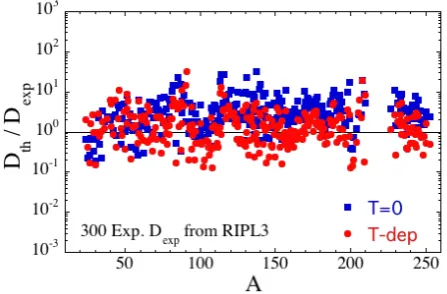
As can observed, the temperature dependent level den-sity is significantly different from that obtained on the ba-sis of theT =0 ingredients. In particular, the T-dependent HFB plus combinatorial NLD is higher than the one ob-tained with theT = 0 approximation, stemming from a modification of the single-particle configuration at increas-ing energies and in particular the disappearance of the shell effect. The temperature effect has a non negligible impact even at low energies around the neutron binding energy and consequently may affect the prediction of the s-wave spacing at Bn. To check that, we have estimated the T-dependent HFB plus combinatorial NLD for all the nu-clei for which an experimental s-wave spacing is avail-able. The results are displayed in Fig. 8 and compared with the results obtained within the T =approximation. The improvement obtained with the temperature depen-dent method is quite clear. In terms of the to frms factor introduced in Eq.( 1), we found frms = 4 in theT = 0 case andfrms =2.7 for the temperature-dependent calcula-tion. Note however that contrary to what has been done in ref. [1], we have not included here any hexadecapole vibra-tional phonon the energy of which remains highly
uncer-Fig. 7.Total nuclear level densities for238Ucalculated for sev-eral temperatures connected smoothly thanks to the procedure described in the text. The reference points, i.e those not affected by the smoothing procedure, are also plotted. The level density
obtained using the HFB ingredients determined withT = 0 is
shown for comparison (gray curve).
Fig. 8.Ratio of HFB plus combinatorial (Dth) to the experimental
(Dexp) s-wave neutron resonance spacings compiled in [10] with
the temperature dependent treatment (red circles) and using the
HFB ingredients obtained forT =0 (squares).
tain. In the current situation, the only phenomenological ingredients are the octupole vibrational phonon energies and the number of phonons and particle-hole configura-tion included in the vibraconfigura-tional-intrinsic state density fold-ing procedure. In particular note that the analytical expres-sion for the quadrupole phonons’ energies has now been replaced by those predicted coherently using the method described in refs. [22, 23] on the basis of the same D1M Gogny interaction [21].
5 Conclusion
Microscopic nuclear level densities have been determined for more than 8000 nuclei in a tabular form using the com-binatorial method. These tables are available at the website
pro-vide fairly good results both when compared with purely experimental level density data or when employed to pre-dict nuclear reaction cross sections. Yet, the combinatorial method can still be improved to better account for collec-tive effects and in particular their evolution with excita-tion energy. A first attempt has been made to account for the variations of nuclear structure properties with increas-ing excitation energy through the temperature-dependent Hartree-Fock-Bogoliubov calculations. The results are very promising and encouraging for further investigation.
References
1. S. Goriely, S. Hilaire, and A. J. Koning, Phys. Rev. C
78, (2008) 064307.
2. A.C. Larsen et al., Phys. Rev. C73, (2006) 064301 and references therein.
3. H.A. Bethe, Phys. Rev.50, (1936) 332.
4. S. Hilaire and S. Goriely, Nucl. Phys. A779, (2006) 63. 5. S. Hilaire, J.P. Delaroche and M. Girod, Eur. Phys. J. A
12, (2001) 169.
6. S. Goriely, M. Samyn, and J. M. Pearson, Phys. Rev. C
75, (2007) 064312.
7. A.V. Ignatyuk, IAEA report, INDC(CCP)-233/L (1985).
8. A.V. Ignatyuk, IAEA report, TECDOC-1034, (1998). 9. M. Sin et al.,Nuclear Data for Science and Technology
O. Bersillon et al (eds); EDP Sciences, (2008) p. 313. 10. Belgya T., Bersillon, O., Capote Noy, R. et al.,
Hand-book for calculations of nuclear reaction data, RIPL-2
(IAEA-Tecdoc-1506), 2006.
11. S. Goriely et al., J. Nucl. Sci. Technol. Suppl.2, (2002) 536.
12. P. Demetriou and S. Goriely, Nucl. Phys. A 695, (2001) 95.
13. A.J. Koning, S. Hilaire, S. Goriely, Nucl. Phys.A810, 13 (2008).
14. S. Goko et al., Phys. Rev. Lett.96, (2006) 192501. 15. M. Sin et al., Phys. Rev. C74(2006) 014608. 16. M.J. Lop´ez Jim´enez et al., Ann. Nucl. Energy 32
(2005) 195.
17. S. Goriely et al., Phys. Rev. C.79, (2009) 024612. 18. A.R. Junghans et al., Nucl. Phys. A629, (1998) 635. 19. G. Hansen and A.S. Jensen, Nucl. Phys. A406, (1983)
236.
20. V. Martin, J.L. Egido and L.M. Robledo, Phys. Rev. C
68, (2008) 034327.
21. S. Goriely et al., Phys. Rev. Lett.102, (2009) 242501. 22. G. F. Bertsch et al., Phys. Rev. Lett. 99, (2007)
032502.
![Fig. 1. Ratio of HFB plus combinatorial (tal (nance spacings compiled in [10] compared with other global ap-proaches such as the Back-Shifted-Fermi-Gas model of ref](https://thumb-us.123doks.com/thumbv2/123dok_us/9046582.1440710/2.595.330.553.390.637/ratio-combinatorial-spacings-compiled-compared-proaches-shifted-fermi.webp)