International Ayurvedic Medical Journal, (ISSN: 2320 5091) (July, 2017) 5(7)
EFFECT OF AN AYURVEDIC FORMULATION IN THE MANAGEMENT OF
PHARYNGITIS
Vijayant Bhardwaj1, Suresh Gupta2
1
Senior Lecturer,2PG.Scholar
R.G.G.P.G.A.C. Paprola, Kangra, Himachal Pradesh, India
Email:[email protected]
ABSTRACT
The Mukha i.e. Oral cavity, works as reflector of the body health by acting as gateway of the alimen-tary canal and in that way it is considered to be one of the most important part of the Urdhwa–jatru.
There are enumerable ailments but only few of them are most common in world population affecting the health scenario worldwide. The disease pharyngitis is certainly one of these ailments and may be regarded as most common disease of upper respiratory tract. As an abstract, annexation of proven anti-inflammatory, analgesic, antipyretic, ulcer healing herbal drugs when combined with authentic principles of Ayurveda can combat the symptoms effectively and that too in a safe manner and no any side effects are found. As side effects are commonly encountered in modern antibiotic it may be regarded as a treatment to cherish and can substantially ameliorate the quality of life of a pharyngitis patient. Total 30 patients were registered in a single group in the present study and 25 patients com-pleted the trial with Haritaki Kashaya Kawala and Kalaka choorna for 15 days with weekly evalua-tion and effects of drug was evaluated. The analysis based on subjective and objective improvements reveals that 4 patients (16%) were cured, 7 (28%) were moderately improved and 14 (56%) patients were markedly improved.
Keywords: Pharyngitis, ekvrinda, vrinda
INTRODUCTION
The disease pharyngitis can be observed in the domain of Kantha-/Galgata Pradesh of
Sap-tayatanas of Mukha1. In recent years there has
These factors have lead to the increased preva-lence of the disease pharyngitis.
Since pharynx is a common path way for
res-JOURNAL
International Ayurvedic Medical Journal, (ISSN: 2320 5091) (July, 2017) 5(7)
EFFECT OF AN AYURVEDIC FORMULATION IN THE MANAGEMENT OF
PHARYNGITIS
Vijayant Bhardwaj1, Suresh Gupta2
1
Senior Lecturer,2PG.Scholar
R.G.G.P.G.A.C. Paprola, Kangra, Himachal Pradesh, India
Email:[email protected]
ABSTRACT
The Mukha i.e. Oral cavity, works as reflector of the body health by acting as gateway of the alimen-tary canal and in that way it is considered to be one of the most important part of the Urdhwa–jatru.
There are enumerable ailments but only few of them are most common in world population affecting the health scenario worldwide. The disease pharyngitis is certainly one of these ailments and may be regarded as most common disease of upper respiratory tract. As an abstract, annexation of proven anti-inflammatory, analgesic, antipyretic, ulcer healing herbal drugs when combined with authentic principles of Ayurveda can combat the symptoms effectively and that too in a safe manner and no any side effects are found. As side effects are commonly encountered in modern antibiotic it may be regarded as a treatment to cherish and can substantially ameliorate the quality of life of a pharyngitis patient. Total 30 patients were registered in a single group in the present study and 25 patients com-pleted the trial with Haritaki Kashaya Kawala and Kalaka choorna for 15 days with weekly evalua-tion and effects of drug was evaluated. The analysis based on subjective and objective improvements reveals that 4 patients (16%) were cured, 7 (28%) were moderately improved and 14 (56%) patients were markedly improved.
Keywords: Pharyngitis, ekvrinda, vrinda
INTRODUCTION
The disease pharyngitis can be observed in the domain of Kantha-/Galgata Pradesh of
Sap-tayatanas of Mukha1. In recent years there has
These factors have lead to the increased preva-lence of the disease pharyngitis.
Since pharynx is a common path way for
res-JOURNAL
International Ayurvedic Medical Journal, (ISSN: 2320 5091) (July, 2017) 5(7)
EFFECT OF AN AYURVEDIC FORMULATION IN THE MANAGEMENT OF
PHARYNGITIS
Vijayant Bhardwaj1, Suresh Gupta2
1
Senior Lecturer,2PG.Scholar
R.G.G.P.G.A.C. Paprola, Kangra, Himachal Pradesh, India
Email:[email protected]
ABSTRACT
The Mukha i.e. Oral cavity, works as reflector of the body health by acting as gateway of the alimen-tary canal and in that way it is considered to be one of the most important part of the Urdhwa–jatru.
There are enumerable ailments but only few of them are most common in world population affecting the health scenario worldwide. The disease pharyngitis is certainly one of these ailments and may be regarded as most common disease of upper respiratory tract. As an abstract, annexation of proven anti-inflammatory, analgesic, antipyretic, ulcer healing herbal drugs when combined with authentic principles of Ayurveda can combat the symptoms effectively and that too in a safe manner and no any side effects are found. As side effects are commonly encountered in modern antibiotic it may be regarded as a treatment to cherish and can substantially ameliorate the quality of life of a pharyngitis patient. Total 30 patients were registered in a single group in the present study and 25 patients com-pleted the trial with Haritaki Kashaya Kawala and Kalaka choorna for 15 days with weekly evalua-tion and effects of drug was evaluated. The analysis based on subjective and objective improvements reveals that 4 patients (16%) were cured, 7 (28%) were moderately improved and 14 (56%) patients were markedly improved.
Keywords: Pharyngitis, ekvrinda, vrinda
INTRODUCTION
The disease pharyngitis can be observed in the domain of Kantha-/Galgata Pradesh of
Sap-tayatanas of Mukha1. In recent years there has
These factors have lead to the increased preva-lence of the disease pharyngitis.
Since pharynx is a common path way for
gens get their way from both nasal and oral routes.
Pharyngitis is one of the most common condi-tions encountered by the family physician. Pharyngitis has high tendency to reoccur. The reoccurrence of the disease also leads to sense of frustration both to the patients and clinician because no significant treatment regime is available which can effectively combat this ailment. The myriad nature of organisms in-volved in this disease often complicate the pic-ture. The long duration of treatment by antibi-otic in the chronic pharyngitis and limited sur-gical role, discourages the patient and his in-volved family members. Patient often feel himself ill, out of the proportion of the dis-ease. A meticulous approach is the need of the time for the prudent approach of this particular disease.
Annexation and confluence of certain indigen-ous Ayurvedic approach certainly enlighten the obscuring darkness of the disease. Charaka
Sutrasthan in Trisothiya3 describes when the vitiated Kapha is firmly located within the throat; it causes swelling and produces
Gal-graha. Acharya Sushruta has described 17
diseases occuring in Kanthapradesh4. Out of the 17 diseases like Rohini, Ekvrinda, Vrinda,
Shataghani, and Galaugha seems to be
representing a particular group of disorders indicating toward inflammatory pathologies. On going through the classical texts and subtle description of Kanthagatarogas Ekvrinda5and
Vrinda are more compatible with pharyngitis
while visualizing on the ground of clinical fea-tures.
agement with the help of some herbal drugs with the hope that these will prove to be more efficacious and least toxic. So keeping this in mind based upon the aetiopathogenesis of
Kanthagataroga, the drug formulation Harita-ki Kashaya Kawala6 with Madhu (As.H.Ut.
22/55) Kalaka choorna7 (Ch. Chi. 26/194-195) which are described in classical texts for chikitsa of Galgatarogas have been selected
for the present study.
The present study ‘’Effect of an Ayurvedic
formulation in the management of
Pharyn-gitis’’ has been under taken with aim and ob-jective of studying the effect of both yoga. Aims and
objectives:-1. To study the Ayurvedic concept to define the equivalent terminology for pharyngitis. 2. To study the role of Ayurvedic
formula-tion Kalaka Choorna and Haritaki
Ka-shaya Kawala in Pharyngitis.
3. To study the effectiveness of the selected drugs.
4. To study the side effects or hypersensitivi-ty of the drugs if any.
Materials and methods Clinical study
i) Patient presenting with signs and symptoms of Pharyngitis.
ii) Age above 5 years irrespective of sex.
Exclusion criteria
a) Patients not willing for the trial b) Cases of adenoids and sinusitis c) Cases of carcinoma of pharynx
d) Cases of herpes simplex I and II, herpes zoster, thrush, syphilitic pharyngitis, diph-theroid pharyngitis, HIV-I and II, tubercu-lar pharyngitis, and others specific and complicated cases of pharyngitis.
Method of Study
After careful examination, 25 patients were selected from the OPD of Shalakya Tantra of R. G. G. P. G. Ayu. Hospital, Paprola and treated in single trial group. Trial group and
Trial
drug:-In this group both Haritaki Kashaya Kawala with Madhu and Kalaka Choorna were given to the 30 patients as a trial drugs combination.
Mode of administration and dose of trial drug in trial group
-Haritaki Kashaya Kawala with Madhu was
given for gargles in a dose of 40ml twice daily
Kalaka Choorna was given orally 3gm thrice a
day with Madhu
Duration of trial - 15 days
Follow up - 2 follow-ups at weekly interval.
1 follow-up in the last of the month.
Criteria for assessment of
results:-Grading and scoring system was adopted for assessing each symptom before the com-mencement of trial and after completion of trial.
Statistical
analysis:-The information gathered regarding demo-graphic data was given in percentage. The scoring of criteria’s of assessment was an a-lysed statistically in terms of B.T. (before treatment), A.T. (after treatment), X (B.T.-A.T.), S.D. (Standard deviation), S.E. (Stan-dard Error) andPaired ‘t’ test carried out at the level of p< 0.05 and p < 0.001.
Overall results were adjusted in terms of percentage relief obtained in symptoms. Cured – 100% relief in chief complaint and no reoccurrence during follow up study. Markedly improved – >75% relief in chief complaints was recorded as markedly im-proved.
Moderately improved – 50%, <75% relief in chief complaints was considered moderately improved.
Slightly improved – >25%, < 50% relief in chief complaints was considered slightly im-proved.
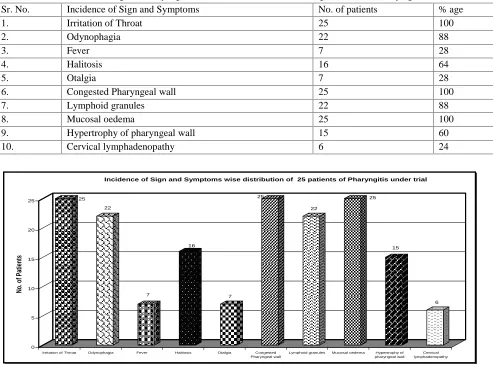
Table 1: Incidence of Sign and Symptoms wise distribution of 25 patients of Pharyngitis under trial
Sr. No. Incidence of Sign and Symptoms No. of patients % age
1. Irritation of Throat 25 100
2. Odynophagia 22 88
3. Fever 7 28
4. Halitosis 16 64
5. Otalgia 7 28
6. Congested Pharyngeal wall 25 100
7. Lymphoid granules 22 88
8. Mucosal oedema 25 100
9. Hypertrophy of pharyngeal wall 15 60
10. Cervical lymphadenopathy 6 24
Effect of therapy
The efficacy of both i.e. Haritaki Kashaya as gargles and Kalaka Churna orally in 25 patients was adjusted on varied parameters and results were derived after execution of statistical methodology.
Table 2: The effect of therapy on criteria assessed has been presented here as under:
Sr. No.
Signs and symptoms
n Mean X (d)
BT-AT
%age of relief
SD SE T p
BT AT
1. Irritation of throat 25 2.4 0.44 1.96 81.66 0.53 0.10 18.21 <0.001
2. Odynophagia 22 1.54 0.31 1.22 79.33 0.43 0.09 12.29 <0.001
3. Fever 7 1 0.28 0.71 71.46 0.49 0.18 3.82 <0.01
4. Halitosis 16 1.37 0.25 1.12 82.11 0.34 0.08 13.52 <0.001
25 22
7
16
7 25
22
25
15
6
0 5 10 15 20 25
N
o.
o
f P
at
ie
nt
s
Irritation of Throat Odynophagia Fever Halitosis Otalgia Congested Pharyngeal wall
Lymphoid granules Mucosal oedema Hypertrophy of pharyngeal wall
wall
7. Lymphoid granules 22 1.72 0.81 0.91 58.55 0.48 0.10 5.93 <0.001
8. Mucosal oedema 25 1.68 0.48 1.2 71.4 0.57 0.11 10.38 <0.001
9. Hypertrophy of pha-ryngeal wall
15 1.73 1.13 0.60 34.68 0.25 0.06 9.03 <0.001
10. Cervical lymphadeno pathy
6 1.5 0.5 1 66.66 0.63 0.25 3.87 P<0.05
1. Irritation of Throat:- The initial score of irritation of throat was 2.4 which was re-duced to 0.44 after the treatment. The per-centage of relief was 81.66% which is highly significant statistically at the level of p < 0.001 (t = 18.21).
2. Odynophagia:–The initial score of ody-nophagia was 1.54 which was reduced to 0.31 after the treatment. The percentage of relief was 79.33%, which is highly signifi-cant statistically at the level of p <0.001 (t = 12.29)
3. Fever–The initial mean score of fever be-fore the treatment was 1 which was re-duced to 0.28 after the treatment. The per-centage of relief was 71.46% which is sig-nificant at the level of p< 0.01 (t =3.82). 4. Halitosis–The initial mean score of
halito-sis before the treatment was 1.37 which was reduced to 0.25 after the treatment. The percentage of relief was 82.11%
which is highly significant at the level of p< 0.001 (t =13.52).
5. Otalgia:–The initial mean score of otalgia before the treatment was 1.28 which was reduced to 0.28 after the treatment. The percentage of relief was 77.73% which is significant at the level of p < 0.01 (t =4.57).
6. Congestion over mucosa of Pharyngeal wall:–The initial mean score of conges-tion over mucosa of pharyngeal wall be-fore the treatment was 1.52 which was re-duced to 0.36 after the treatment. The per-centage of relief was 76.31% which is highly significant at the level of p < 0.001 (t = 15.50).
7. Lymphoid granules on posterior pha-ryngeal wall–The initial mean score of lymphoid granules on posterior pharyn-geal wall before the treatment was 1.72 which was reduced to 0.81 after the
treat-2.4
0.44 1.54
0.31 1
0.28 1.37
0.25 1.28
0.28 1.52
0.36 1.72
0.81 1.68
0.48 1.73
1.13 1.5
0.5
0 0.5 1 1.5 2 2.5
M
ean
Sco
re
Irritation of Throat Odynophagia Fever Halitosis Otalgia Congested Pharyngeal wall
Lymphoid granules Mucosal oedema Hypertrophy of pharyngeal wall
Cervical lymphadenopathy
Effect of therapy (On BT and AT Scale)
ment. The percentage of relief was 58.55% which is highly significant at the level of p < 0.001 (t = 5.93).
8. Mucosal oedema:-The initial mean score of mucosal oedema before the treatment was 1.68 which was reduced to 0.48 after the treatment. The percentage of relief was 71.44% which is highly significant at the level of p < 0.001 (t = 10.38).
9. Hypertrophy of lateral bands of pha-rynx:-The initial mean score of
hypertro-phy of lateral bands of pharynx before the treatment was 1.73 which was reduced to 1.13 after the treatment. The percentage of relief was 34.68% which is highly sig-nificant at the level of p < 0.001 (t = 9.03). 10. Cervical Lymphadenopathy:-The initial
mean score of cervical lymphadenopathy before the treatment was 1.5 which was reduced to 0.5 after the treatment. The per-centage of relief was 66.66% which is sig-nificant at the level of p < 0.05 (t = 3.87)
Table 3: Overall result of treatment in 25 patients of Pharyngitis under trial
Sr. No. Assessment No. of Patients %age
1. Cured 4 16
2. Markedly Improved 7 28
3. Moderately Improved 14 56
4. Slightly Improved 0 0
5. Unimproved 0 0
DISCUSSION
Inflammatory disorders of pharynx are the most common reason for which patients visit to the otorhinolaryngologist. Pharyngitis is very common disorder in school going child-ren and also common in adults. Both sexes are equally affected.
Spicy and oily food products, multiple varie-ties of cold foods, atmospheric pollution, crowded, ill ventilated environment and mul-tiple newer organism predisposes and increas-es the number of patients suffering from pha-ryngitis. The inflammation of the mucous membrane of the pharynx is termed as pha-ryngitis8. Pain, heat, redness and swelling are the four basic symptoms of inflammation.
Mukharogas10i.e. aaharaj, viharaj factors and not following dincharya generally predisposes the patient to disease of Mukha. Ayurvedic ap-proach certainly enlight the obscuring darkness of the disease. Acharya Charaka in Charaka
Sutrasthan of Trisothiya chapter11
(Ch.Su.18/22) describes that vitiated Kapha
firmly located within the throat causes swel-ling and produces Galgraha. Acharya
Sushru-ta says that diseases occurring in the Kantha-pradesh are mainly due to vitiation of Kapha
and Raktadoshas12. Swelling and redness are due to Kapha and Raktadushti13 which causes inflammation in Galapradesh and Mandagni aggravates these factors. Acharya Sushruta has detailed subtle description of 17 types of
Rohini, Ekvrinda, Vrinda, Shataghni and Ga-laugha seems to be representing an
inflamma-tory pathology and symptoms.
The clinical features of Rohini15 in which in-flammatory pathologies produces Mansankura which obstruct the passage of Kantha and
Aa-shuhara i.e. patient dies within 3, 4 or 7 days, so
on the basis of these properties disease is not compatible to pharyngitis but may be compared with specific type of pharyngitis i.e. diptheri-coropharyngitis.
The disease Shataghni in which varti like eruption occurs which obstruct the passage16, where as in pharyngitis there is hemispherical lymphoid appearance and does not obstruct the passage. The disease like Valaya and
Ba-lasa17 causes progressive obstruction of upper aero digestive tract which indicates benign or malignant growth of pharynx. So these diseas-es are also excluded when compared with pha-ryngitis.
The clinical feature of Galaugha18 in which in-flammatory pathology produces shotha which obstruct the passage of food, water and air. So this disease is also excluded.
So these upper description of Kanthagatrogas19 in which inflammatory pathologies occur on the basis of clinical features are excluded from the list of the diseases to be compared with pha-ryngitis on the ground of their incurable na-ture.
Ekvrinda and Vrinda20represent more similar-ity with symptoms and signs of Pharyngitis
o`ÙkksUurks·Ur% Üo;Fkq
Lympho-id and mucosal oedema over pharynx
ld.Mq Itching or
irrita-tion in throat
vikD;e`nqxqZ:’p Non suppurative
soft inflammatory condition
nkg Burning
sensa-tion in throat
Toj Fever
Rkksn Pain in throat
While Acharya Vagabhata describes only
Vrinda21 which indicates cervical lymphade-nopathy in acute condition.
o`Unks o`ÙkksUurks nkg Tojd`r
xyikJoZx%A (As. Ut. 21/46)
So after observing the symptomatology of
Ek-vrinda and Vrinda, EkEk-vrinda is more
compa-rable with chronic pharyngitis and Vrinda is acute pharyngitis. Dalhana and Madhava22 explains that Ekvrinda and Vrinda are counted under single roga which are stages of same disease. While on treatment part Ekvrinda is
sadhya and Vrinda is asadhya. So, on the basis
of clinical features Ekvrinda and Vrinda may be taken as pharyngitis.
Acharya Charaka and Kashyapa have not
scribed Ekvrinda and Vrinda, Charaka de-scription of the Galgraha on the basis of eti-opathogenesis may be taken while Kashyapa description of the Galgraha & Kantasotha can
be compared with pharyngitis when evaluated
on the basis of clinical features.
CONCLUSION
25 patients were taken in the clinical trial. They were studied in detail as.
belonged to middle class (52%), matricu-late (36%) and most of the patients used to take mixed diet. (64%)
Majority of the patients were having no addiction. (48%)
Majority of patients had pitta kaphaja
pra-kriti (60%) with madhyama satva (72%), madhyama sara (60%) madhyama samha-nana (76%) and madhyama satmya (84%) Out of 25 patients under trial 100% had
irritation of throat, 88% had odynophagia, 28% had fever, 64%had halitosis, 28% had otalgia, 100% had congestion over mucosa of pharyngeal wall, 88% had lymphoid granulation on posterior pharyngeal wall, 100% had mucosal oedema, 60% had hypertrophy of lateral bands of pharynx, 24% patients had cervical lymphadenopa-thy.
The results showed that therapy provided significant relief in irritation of throat (81.66%), odynophagia (79.33%), fever (71.46%), halitosis (82.11%), otalgia (77.73%), congestion over mucosa of pha-ryngeal wall (76.31%), lymphoid granules on posterior pharyngeal wall (58.55%), mucosal oedema (71.4%), hypertrophy of lateral bands of pharynx (34.68%) and cervical lymphadenopathy (66.66%) which is also significant statistically.
No adverse effect of both the trial drugs came into light during the course of tri-al.
REFERENCES
edition; 2010, chapter 16 versus 3, Vara-nasi: Chaukhambha Sanskrit Sansthana, 2010, P. 381.
2. Michal Gleeson, Scott”s Brown Otorhin o-laryngology, Reprint edition 2008,Chapter 149, Page no. 1942
3. Pt.Kashinathshastri and Dr. Gorakhanath-chaturvedi, Charaka Samhita of charaka with Vidyotini Hindi Commentary, Sutras-thana, Reprint edition; 2013 chapter 18 versus 22 Varanasi: Chaukhambhachauk-hambhabharati academy, 2013, P.378. 4. Ambikadatt Shastri, Sushruta Samhita of
Sushruta with Ayurveda TatvaSandipika Hindi Commentary, Nidanasthana, Reprint edition; 2010, chapter 16 versus 48, Vara-nasi: Chaukhambha Sanskrit Sansthana, 2010, P.388.
5. Ambikadatt Shastri, Sushruta Samhita of Sushruta with Ayurveda TatvaSandipika Hindi Commentary, Nidanasthana, Reprint edition; 2010, chapter 16 versus 57-58, Varanasi: Chaukhambha Sanskrit Sansthana, 2010, P.390.
6. Atridevagupt, Ashtangahridaya of Vagbhatta with Vidyotini Hindi Commen-tary, Uttartantra, Reprint Edition, 2014 chapter 22 versus 55, Varanasi: Chauk-hambhaPrakashan, 2014, P.719
8. Michal Gleeson, Scott”s Brown Otorhin o-laryngology, Reprint edition 2008, Chapter 152, Page no. 1982
9. Ambikadatt Shastri, Sushruta Samhita of Sushruta with Ayurveda Tatva Sandipika Hindi Commentary, Nidanasthana, Reprint edition; 2010, chapter 16 versus 3, Vara-nasi: Chaukhambha Sanskrit Sansthana, 2010, P. 381.
10. Pt. Kashinathshastri and Dr. Gorakhanath-chaturvedi, Charaka Samhita of charaka with Vidyotini Hindi Commentary Su-trasthana, Reprint edition; 2013 chapter 5 versus 71-78, Varanasi: Chaukhamb-hachaukhambhabharati academy, 2013, P.124-125.
11. Pt. Kashinathshastri and Dr. Gorakhanath-chaturvedi, Charaka Samhita of charaka with Vidyotini Hindi Commentary, Su-trasthana,Reprint edition; 2013 chapter 18 versus 22 Varanasi: Chaukhambhachauk-hambhabharati academy, 2013, P.378. 12. Ambikadatt Shastri, Sushruta Samhita of
Sushruta with Ayurveda Tatva Sandipika Hindi Commentary, Nidanasthana, Reprint edition; 2010, chapter 16 versus 3, Vara-nasi: Chaukhambha Sanskrit Sansthana, 2010, P. 381.
13. Ambikadatt Shastri, Sushruta Samhita of Sushruta with Ayurveda Tatva Sandipika Hindi Commentary, Nidanasthana, Reprint edition; 2010, chapter 16 versus 49, Vara-nasi: Chaukhambha Sanskrit Sansthana, 2010, P. 388.
14. Ambikadatt Shastri, SushrutaSamhita of Sushruta with Ayurveda TatvaSandipika Hindi Commentary, Nidanasthana, Reprint edition; 2010, chapter 16 versus 59,
Vara-nasi: Chaukhambha Sanskrit Sansthana, 2010, P. 390.
15. Ambikadatt Shastri, Sushruta Samhita of Sushruta with Ayurveda TatvaSandipika Hindi Commentary, Nidanasthana, Reprint edition; 2010, chapter 16 versus 55-56, Varanasi: Chaukhambha Sanskrit Sansthana, 2010, P. 390.
16. AmbikadattShastri, Sushruta Samhita of Sushruta with Ayurveda TatvaSandipika Hindi Commentary, Nidanasthana, Reprint edition; 2010, chapter 16 versus 62, Vara-nasi: Chaukhambha Sanskrit Sansthana, 2010, P. 391.
17. Ambikadatt Shastri, Sushruta Samhita of Sushruta with Ayurveda TatvaSandipika Hindi Commentary, Nidanasthana, Reprint edition; 2010, chapter 16 versus 57-58, Varanasi: Chaukhambha Sanskrit Sansthana, 2010, P390.
18. Atridevagupt, Ashtangahridaya of Vagbhatta with Vidyotini Hindi Commen-tary, Uttartantra, Reprint Edition, 2014 chapter 21 versus 46, Varanasi: Chauk-hambha Prakashan, 2014, P.712
19. K.R. Srikantha Murthi, Madhav Nidan of Madhavkaar 4th Edition 2001, Chapter 56 /46-47 ChaukhambhaorientalaPage . 190
Source of Support: Nil
Conflict Of Interest: None Declared
How to cite this URL: Vijayant Bhardwaj & Suresh Gupta: Effect Of An Ayurvedic Formulation In The Management Of Pharyngitis. International Ayurvedic Medical Journal {online} 2017 {cited July, 2017} Available from: