HIGH PERFORMACE THI LAYER CHROMATOGRAPHY AALYSIS OF
SPERMACOCE HISPIDA
M.A. Rathi1, P. Meenakshi 2
, D. Guru kumar 2 , C. Arul Raj 3 , M . Sunitha and V.K. Gopalakrishnan2, 3*
1
Department of Biochemistry, Sree Narayanaguru College, Coimbatore, India
2
Department of Biochemistry, Karpagam Arts and Science College, Coimbatore, India
3
Department of Biochemistry, Karpagam University, Coimbatore, India
* Corresponding Author Dr.V.K.Gopalakrishnan Department of Biochemistry Karpagam University Coimbatore- 641 021
Tel: 091-0422-6453777 Fax: 091-0422-2611043
E.mail address:[email protected]
Summary
Spermacoce hispida is used as traditional herbal medicine in India to treat various disorders. A rapid, accurate and simple high performance thin layer chromatography method for quantitative estimation of Spermacoce hispida is described here. The result showed that Spermacoce hispida showed the presence of alkaloids, flavonoids, alkaloids, phenolics, steroids, tannins and terpenoids.
Introduction
Spermacoce hispidaLinn belongs to the family Rubiaceae, was popularly known as “Nattaiccuri” in Tamil or “Shaggy button weed” in English [1]. It is widely present in the Western Ghats of Kerala [2] and in Maruthamalai forest [3] in Tamil Nadu. The seed- of the plant has been used for the treatment of internal injuries of nerves and kidney. It is suggested that it remove signs of old age, purify blood and improve vitality, and has been used by the tribals living in the forest regions in the Western ghats of Kerala since ancient times [2]. It has been also reported that S. hispida is an effective natural drug for the treatment of hypertension [4]. S. hispida was one of the five plants which contained the maximum amount of flavonoids among 25 plants analyzed [3]. It has been reported that methanolic extract of this whole plant extract exhibited strong antioxidant activity [5]. The objective of the present investigation was to determine the presence of phytochemical constituents by HPTLC.
Materials and Methods
Plant Collection and Extraction:
Spermacoce hispida was collected from Coimbatore, Tamilnadu, India. The plant specimen was authenticated by Dr. G.V.S. Murthy, Botanical Survey of India, Coimbatore, India. A voucher specimen has been deposited in the laboratory for future reference (BSI/SC/5/23/08-09/Tech.1784). The voucher specimen was deposited at the herbarium of Karpagam University, Coimbatore. The whole plants of Spermacoce hispida were washed thoroughly in tap water, shade dried and powdered. The powder (100 gms) was eshaustively extracted with ethanol in the ratio of 1:5 (w/v) for 24h by using soxhlet apparatus. The extract was completely evaporated to dryness using rotary flash evaporator (Buchi type).
Mobile phase:
Flavonoids : Ethyl acetate-formic acid-glacial acetic acid-water
(10:1.1:1.1:2.6)
Alkaloid : n-Butanol - Acetic acid – water (4 : 4 : 1) Polyphenolics : Toluene-acetone-formic acid (4.5: 4.5: 1) Sterols : Ethyl acetate-chloroform-water (9:1:0.1) Tannins : Isobutanol-acetic acid-water (14:1:3.5) Terpenoids : n-hexane - ethyl acetate (1: 1)
Spray reagent
Flavonoids : 1% Ethanolic aluminium chloride reagent.
Alkaloid : Dragendorff reagent followed with 10% Ethanolic sulphuric acid reagent
Polyphenolics : Fast blue B reagent
Test solution preparation
The given aqueous extract 100 mg was dissolved in 5 ml of water, centrifuged and collected the supernatant liquid. This portion was used as test solution for HPTLC analysis.
Sample and reference standard preparations
5 µl of each test solutions and reference standard were loaded as 8 mm band length in the 5x 10 Silica gel 60F254 TLC plate using Hamilton syringe and CAMAG LINOMAT
5 instrument.
Results and Discussion
HPTLC chromatogram of alkaloids
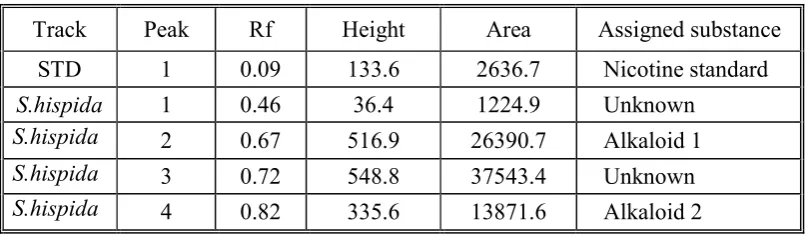
Table 1 and figure 1 showed the alkaloid profile of Spermacoce hispida. Here nicotine was used as standard which developed with Rf value 0.09. About two alkaloids were present in Spermacoce hispida with the Rf values of 0.67 and 0.82 respectively.
Table 1 HPTLC – Peak table for alkaloid profile for Spermacoce hispida
Track Peak Rf Height Area Assigned substance
STD 1 0.09 133.6 2636.7 Nicotine standard
S.hispida 1 0.46 36.4 1224.9 Unknown S.hispida 2 0.67 516.9 26390.7 Alkaloid 1
S.hispida 3 0.72 548.8 37543.4 Unknown
S.hispida 4 0.82 335.6 13871.6 Alkaloid 2
Figure 1 Peak densitogram displayed for alkaloids
Nicotine standard Spermacoce hispida
Table 2 and figure 2 showed the flavonoid profile for Spermacoce hispida. Here rutin was used as standard, which developed with the Rf value 0.26. In this profile, one flavonoid compound was present in Spermacocoe hispida with the Rf value of 0.88.
Table 2 HPTLC - Peak table for flavonoid profile for Spermacoce hispida
Track Peak Rf Height Area Assigned substance
STD 1 0.26 82.6 2435.3 Rutin standard
S.hispida 1 0.80 34.5 856.9 Unknown
S.hispida 2 0.88 178.4 5708.8 Flavonoid 1
S.hispida 3 0.94 290.6 14695.5 Unknown
Figure 2 Peak densitogram displayed for flavonoids
Spermacoce hispida
HPTLC chromatogram of phenolics
Table 3 and figure 3 showed the phenolics profile for Spermacoce. Here quercetin was used as standard, which developed with the Rf value 0.58. In this profile two phenolic compounds were present with the Rf value of 0.58 and 0.62. A compound with similar Rf value was also obtained in the chromatogram reveled the presence of quercetin in Spermacoce hispida.
Table 3 HPTLC - Peak table for Phenolics profile for Spermacoce hispida
Track Peak Rf Height Area Assigned substance
STD 1 0.58 500.8 13306.6 Quercetin standard
S.hispida 1 0.03 31.1 498.7 Unknown
S.hispida 2 0.58 387.6 18346.5 Quercetin S.hispida 3 0.62 449.6 23888.5 Phenolics 1 S.hispida 4 0.69 388.4 15833.9 Unknown S.hispida 5 0.78 494.6 60092.6 Unknown
Figure 3 Peak densitogram displayed phenolics
Quercetin Spermacocce hispida
HPTLC chromatogram of steroid
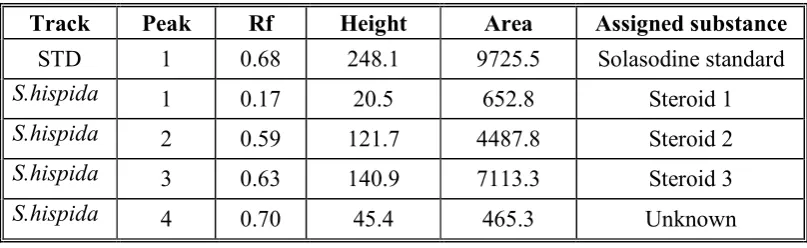
Table 4 and figure 4 showed the steroid profile for Spermacoce hispida. The standard solasodine produced a clear zone with Rf value 0.68. Three steroid compounds were present in Spermacoce hispida with the Rf value of 0.17, 0.59 and 0.63 respectively.
Table 4 HPTLC - Peak table for steroid profile for Spermacoce hispida
Track Peak Rf Height Area Assigned substance
STD 1 0.68 248.1 9725.5 Solasodine standard
S.hispida 1 0.17 20.5 652.8 Steroid 1
S.hispida 2 0.59 121.7 4487.8 Steroid 2
S.hispida 3 0.63 140.9 7113.3 Steroid 3
Figure 4 Peak densitogram displayed steroids
Solasodine Spermacocce hispida
HPTLC chromatogram of tannins
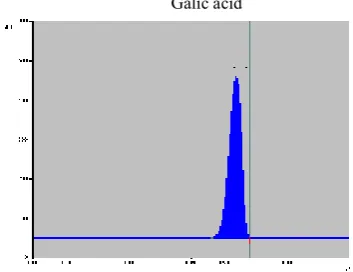
Table 5 and figure 5 showed the tannin profile for Spermacoce hispida. The standard gallic acid produced a prominent spot with Rf value 0.64. Two tannin compounds were developed in Spermacoce hispida with the Rf value of 0.71 and 0.80.
Table 5 HPTLC - Peak table for tannins profile for Spermacoce hispida
Track Peak Rf Height Area Assigned substance
STD 1 0.64 437.8 18474.8 Gallic acid standard
S.hispida 1 0.25 15.5 569.9 Unknown
S.hispida 2 0.54 34.0 815.9 Unknown
S.hispida 3 0.71 634.8 63272.9 Tannin 1
S.hispida 4 0.80 480.0 23731.2 Tannin 2
S.hispida 5 0.93 16.1 313.2 Unknown
Figure 5 Peak densitogram displayed tannin
Galic acid Spermacocce hispida
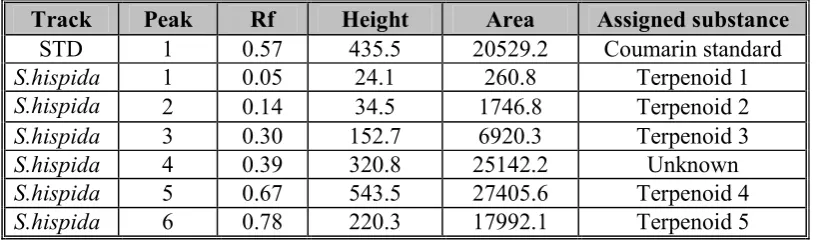
Table 6 and figure 6 showed the terpenoid profile for Spermacoce hispida. The coumarin was used as a standard which developed with the Rf value 0.57. Five terpenoid compounds were present in Spermacoce hispida with the Rf value of 0.05, 0.14, 0.30,0.67 and 0.78 respectively.
Table 6 HPTLC - Peak table for terpenoids profile for Spermacoce hispida
Track Peak Rf Height Area Assigned substance
STD 1 0.57 435.5 20529.2 Coumarin standard
S.hispida 1 0.05 24.1 260.8 Terpenoid 1 S.hispida 2 0.14 34.5 1746.8 Terpenoid 2 S.hispida 3 0.30 152.7 6920.3 Terpenoid 3 S.hispida 4 0.39 320.8 25142.2 Unknown S.hispida 5 0.67 543.5 27405.6 Terpenoid 4 S.hispida 6 0.78 220.3 17992.1 Terpenoid 5
Figure 5 Peak densitogram displayed terpenoid
Coumarin Spermacocce hispida
Chromatographic fingerprint is a holistic, valid and rapid method. HPTLC is an invaluable quality assessment tool for the evaluation of botanical materials it allows for the analysis of a broad number of compounds both efficiently and cost effectively. HPTLC studies have shown that it is more versatile than ordinary TLC methods, as the spots were well resolved. In the past few years, there has been growing interest in the involvement of reactive oxygen species (ROS) in several pathological situations. ROS produced in vivo include superoxide radical (O2 .•-), hydrogen peroxide (H2O2) and hypochlorous acid (HOCl). H2O2 and O2
anti-Conclusion
The reported HPTLC method was found to be rapid, simple and accurate for quantitative estimation of phytochemicals in ethanolic extract of whole plant of Spermacoce hispida.The result showed that Spermacoce hispida showed the presence of alkaloids, flavonoids, alkaloids, phenolics, steroids, tannins and terpenoids. Quercetin was present in Spermacoce hispida.Thus spermacoce hispida has high medicinal properties for various diseases.
Acknowledgement
We, the authors are thankful to our Chancellor, Chief Executive Officer, Vice Chancellor and Registrar of Karpagam University for providing facilities and encouragement.
References
1. Narayan DP, Kumar U A Agro’s Dictionary of Medicinal Plants. Agrobios Publishers, Jodhpur 2003.
2. Pushpangandan P, Atal CK Ethno-medico-botanical investigations in Kerala. Some primitive tribals of Western ghats and their herbal medicine. J Ethnopharmacol. 1984; 11: 59-77.
3. Sekar T, Francis K A preliminary investigation of some Maruthamalai forest plants for phytochemical compounds. A. Biores Tech. 1999; 70: 303-304.
4. Arnold N, Schmidt J Plant and fungal metabolites/ microanalytics In S. Pieplow C. Kaufmann, A. Kohlberg, B. Hause (eds.): Constituents of Traditional Medicinal Plants, 2nd ed. Scientific report, Leibniz Institute of Plant Biochemistry, Leibniz 2004.
5. Surveswaran S, Cai Y, Corke H, Sun M Systematic evaluation of natural phenolic antioxidants from 133 Indian medicinal plants. Food Chem. 2007; 102: 938-953.
6. Aruoma OI, Halliwell B Superoxide-dependent and ascorbate-dependent formation of hydroxyl radicals from hydrogen peroxide in the presence of iron: Are lactoferrin and transferrin promoters of hydroxyl radical generation? Biochemical Journal.1987; 241: 273-278.
7. Rice-Evans C, Sampson J, Bramley PM, Holloway DE. Why do we expect carotenoids to be antioxidants in vivo. Free Radical Res. 1997; 26: 381–398.