IJEDR1702276 International Journal of Engineering Development and Research (www.ijedr.org) 1756
A class of efficient Ratio type estimators for the
Estimation of Population Mean Using the
auxilliary information in survey sampling
Mir Subzar, S. Maqbool and T. A. Raja
Division of Agricultural Statistics, SKUAST-Kashmir (190025) India.
Abstrac t: - Estimation of the population mean is the persistent issue in sampling practices and many efforts have been made by various statisticians to improve the precis ion of the estimates by using the auxilliary in formation. In this paper we proposed a class of effic ient estimators for estimating the population mean in SRSW OR by using the auxilliary information of coeffic ient of skewness and population deciles of the auxillia ry variable. The properties associated with the proposed estimators are analysed through MSE and bias. We also provide an emp irical study for illustration and verificat ion.
Ke ywor ds: Coe fficient of Ske wness; Population Deciles; Ratio -type estimators; Mean square error; Bias; Effic iency.
1. INTRODUCTION
The use of auxiliary information in survey sampling has its own e minent role both at design and estimation stage. It is we ll known that the use of auxilia ry in formation at the estimat ion stage improves the precision of estimates of the population mean or to tal. Ratio, product and regression methods of estimat ion are good exa mp les in this context. If the corre lation between study varia te y
and the auxiliary variate x is positive (high), the rat io method of estimat ion envisaged by Cochran is used. So in this paper we a lso take the advantage of correlat ion between study variable and au xilliary variable and thus by proposing the ratio type estimators by using the auxilliary information of coeffic ient of skewness and population deciles of au xilliary variable.
Consider a fin ite population
U
{
U
1,
U
2,
U
3,
...,
U
N}
ofN
distinct and identifiab le units. LetY
be the study variable with valueY
i measured ofU
i,
i
1
,
2
,
3
,...,
N
giving a vectorY
{
Y
1,
Y
2,
Y
3,...,
Y
N}
. The object ive is to estimatepopulation mean
Ni
Y
iN
Y
1
1 on the basis of a random samp le. When the population parameters of the au xilia ry variable, such as population mean, kurtosis, skewness, coefficient of variation, median, quartiles, correlation coeffic ient, deciles etc., are known, ratio estimators and their mod ifications are available in the lite rature wh ich perform better than the usual sample me an under the simple random sa mpling without replace ment (SRSW OR).The notations used in this paper can be described as follows:
NOMENCLATURE Rome n
N
Population sizen
Sa mp le sizeN
n
f
Sa mpling fractionY
Study variab leX
Au xiliary va riab leX
,
Y
Population meansy
x
,
Sa mp le meansx
,
y
Sa mp le totalsy x
s
s
,
Population standard deviationss
xy Population covariance betweeny x
c
c
,
Coeffic ient of variation
Co rre lation coefficient(.)
B
Bias of the EstimatorMSE
(.)
Mean square error of the estimatori
Y
Existing mod ified ratio estimator o f
Y
Y
pj
Proposed modified ratio estimator of
Y
10
,....,
2
,
1
k
D
k Dec iles,
2 Kurtosis,
`1 SkewnessSubscript
i
For e xisting estimators,j
For proposed estimators Based on the above mentioned notations, the mean ratio estimator for estimating the Population mean,Y
, of the study variableY
is defined as
X
x
y
Y
r
(1)
The bias, related constant and the mean squared error (MSE) of the rat io estimator are respectively given by
)
2
(
1
)
(
)
(
1
)
1
(
)
(
r x2 x Y rS
y2R
2S
x2R
S
xS
Yn
f
Y
MSE
X
Y
R
S
S
RS
X
n
f
Y
B
IJEDR1702276 International Journal of Engineering Development and Research (www.ijedr.org) 1757
The ratio estimator given in (1) is used for improving the precision of the estimate of the population mean as compared to us ual sample mean estimator whenever a positive correlat ion e xists between the study variable and the auxiliary variable . Cochran (1940) suggested a classical ratio type estimator for the estimat ion of finite population mean using one auxilia ry variab le u nder simp le random sa mpling scheme. Murthy (1967) proposed a product type estimator to estimate the population mean or total of study variable by using auxiliary informat ion when coeffic ient of corre lation is negative. Rao (1991) introduced diffe rence typ e ratio estimator that outperforms conventional ratio and linear regression estimators. Upadhyaya & Singh (1999) modified ra tio type estimators using coeffic ient of variation and coefficient of kurtosis of the au xiliary variate. Singh & Ta ilor (2003) propo sed a fa mily of estimators using known values of some para meters by using SRSWOR for estimation of population mean of the study variable. Sisodia & Dwivedi (1981) and Singh et al. (2004) utilized coeffic ient of variation of the auxilia ry variate. Further improve ments are achieved by introducing a large nu mber of mod ified rat io estimators with the use of known coefficient of variation, kurtosis, skewness, med ian, coeffic ient of corre lation, decile (see Subra mani and Ku marpandiyan, 2012 a, b and c). The organization of the rest of the article is as follows: Section 2 provides a description of the e xisting estimators. The s tructure of suggested modified linear regression type ratio estimator and the effic iency comparison of the suggested estimator with the e xisting estimators are presented in Section 3. Section 4 consists of an empirical study of proposed estimators. Finally, Sec tio n 5 summarizes the findings of the study.
2. Existing Ratio Esti mators
Kadilar and Cingi (2004) suggested ratio type estimators for the population mean in the simp le random sa mpling using some known au xiliary informat ion on coeffic ient of kurtosis and coefficient of variation. They showed that their suggested estimat ors are more e ffic ient than traditional ratio estimator in the estimation of the population mean.
Kadilar & Cingi (2004) estimators are given by
,
)
(
1X
x
x
X
b
y
Y
(
),
)
(
)
(
2 x xC
X
C
x
x
X
b
y
Y
(
),
)
(
)
(
2 23
X
x
x
X
b
y
Y
),
(
)
(
)
(
2 2 4 x xC
X
C
x
x
X
b
y
Y
(
),
)
(
)
(
2 25
x xC
X
C
x
x
X
b
y
Y
The biases, related constants and the MSE for Kad ila r and Cingi (2004) estimators are respectively as follows:
)),
1
(
(
)
1
(
)
(
,
)
1
(
)
(
12 1 1 12 2 2 22
1
x yx
S
S
R
n
f
Y
MSE
X
Y
R
R
Y
s
n
f
Y
B
)),
1
(
(
)
1
(
)
(
)
(
,
)
1
(
)
(
22 2 2 22 2 2 22
2
x yx
x
R
S
S
n
f
Y
MSE
C
X
Y
R
R
Y
s
n
f
Y
B
)),
1
(
(
)
1
(
)
(
)
(
,
)
1
(
)
(
3 32 2 2 22 3
2 3 2
3
xR
S
xS
yn
f
Y
MSE
X
Y
R
R
Y
s
n
f
Y
B
)),
1
(
(
)
1
(
)
(
)
(
,
)
1
(
)
(
4 42 2 2 22 4
2 4 2
4
x yx x
S
S
R
n
f
Y
MSE
C
X
Y
R
R
Y
s
n
f
Y
B
)).
1
(
(
)
1
(
)
(
)
(
,
)
1
(
)
(
5 5 52 2 2 22 5 2
5
x yx x x
S
S
R
n
f
Y
MSE
C
C
X
Y
R
R
Y
s
n
f
Y
B
Kadilar and Cingi (2006) developed some modified ratio estimators using known value of coefficient of correlation, kurtosis and coeffic ient of variation as follows:
),
(
)
(
)
(
6
X
x
x
X
b
y
Y
(
),
)
(
)
(
7
x xC
X
C
x
x
X
b
y
Y
(
),
)
(
)
(
8 x xC
X
C
x
x
X
b
y
Y
),
(
)
(
)
(
2 29
X
x
x
X
b
y
Y
(
).
)
(
)
(
2 210
X
x
x
X
b
y
Y
The biases, related constants and the MSE for Kad ila r and Cingi (2006) estimators are respectively given by
)),
1
(
(
)
1
(
)
(
,
)
1
(
)
(
6 6 62 2 2 22 6 2
6
x yx
S
S
R
n
f
Y
MSE
X
Y
R
R
Y
s
n
f
Y
B
)),
1
(
(
)
1
(
)
(
,
)
1
(
)
(
72 7 7 72 2 2 22
7
x yx x
x
R
S
S
n
f
Y
MSE
C
X
C
Y
R
R
Y
s
n
f
Y
B
)),
1
(
(
)
1
(
)
(
,
)
1
(
)
(
82 8 8 82 2 2 22
8
x yx
x
R
S
S
IJEDR1702276 International Journal of Engineering Development and Research (www.ijedr.org) 1758
)),
1
(
(
)
1
(
)
(
,
)
1
(
)
(
9 92 2 2 22 2 9 2 9 2
9
xR
S
xS
yn
f
Y
MSE
X
Y
R
R
Y
s
n
f
Y
B
)).
1
(
(
)
1
(
)
(
,
)
1
(
)
(
10 102 2 2 22 10
2 10 2
10
xR
S
xS
yn
f
Y
MSE
X
Y
R
R
Y
s
n
f
Y
B
Yan and Tian
(2010) proposed some modified ratio estimators using coefficient of ske wness and kurtosis as follows:
),
(
)
(
)
(
1 111
X
x
x
X
b
y
Y
(
).
)
(
)
(
2 1 2 112
X
x
x
X
b
y
Y
The biases, related constants and the MSE for Yan and Tian (2010) estimators are respectively given by
)).
1
(
(
)
1
(
)
(
,
)
1
(
)
(
11 112 2 2 21 11
2 11 2
11
x x yS
S
R
n
f
Y
MSE
X
Y
R
R
Y
s
n
f
Y
B
)).
1
(
(
)
1
(
)
(
,
)
1
(
)
(
12 122 2 2 22 1 1 12 2 12 2
12
x x yS
S
R
n
f
Y
MSE
X
Y
R
R
Y
s
n
f
Y
B
Yan and Tian
(2010) showed that the use of coefficient of ske wness and coefficient of kurtosis, respectively, provides better estimates for the population mean in co mparison to the usual ratio estimator and nu merous e xisting estimators.
3. Propose d Modi fie d Ratio Esti mator
Motivated by the mentioned estimators in Sect ion 2, we propose new class of efficient rat io type estimators using the linear combination of coefficient of ske wness and population deciles.
The p roposed estimators is given below:
(
).
)
(
)
(
1 1 1 11
X
D
D
x
x
X
b
y
Y
p
(
).
)
(
)
(
2 1 2 12
X
D
D
x
x
X
b
y
Y
p
(
).
)
(
)
(
3 1 3 13
X
D
D
x
x
X
b
y
Y
p
(
).
)
(
)
(
4 1 4 14
X
D
D
x
x
X
b
y
Y
p
(
).
)
(
)
(
5 1 5 15
X
D
D
x
x
X
b
y
Y
p
(
).
)
(
)
(
6 1 6 16
X
D
D
x
x
X
b
y
Y
p
(
).
)
(
)
(
7 1 7 17
X
D
D
x
x
X
b
y
Y
p
(
).
)
(
)
(
8 1 8 18
X
D
D
x
x
X
b
y
Y
p
(
).
)
(
)
(
9 1 9 19
X
D
D
x
x
X
b
y
Y
p
(
).
)
(
)
(
10 1 10 110
X
D
D
x
x
X
b
y
Y
p
The bias, related constant and the MSE for the first proposed estimator can be obtained as follo ws: MSE of this estimator can be found using Taylor series method defined as
)
(
|
)
,
(
)
(
|
)
,
(
)
,
(
)
,
(
, ,y
Y
d
d
c
h
X
x
c
d
c
h
Y
X
h
y
x
h
XY XY
(3.1)Where
h
(
x
,
y
)
R
ˆ
pjandh
(
X
,
Y
)
R
.
As shown in Wolter (1985), (3.1) can be applied to the proposed estimators in order to obtain MSE equation as follows:
IJEDR1702276 International Journal of Engineering Development and Research (www.ijedr.org) 1759
Where 2 2
.
x y
x y x
x xy
s
s
s
s
s
s
s
B
Note that we omit the difference of(
E
(
b
)
B
)
.)
2
2
2
(
)
1
(
2
)
(
2
)
(
2
)
(
)
1
(
)
(
)
,
(
)
(
)
(
2
2
)
(
)
(
)
(
)
(
2
)
(
)
,
(
)
(
))
(
(
2
)
(
)
(
))
(
(
)
ˆ
(
)
(
)
(
2 2
2 2 2
2
2 1
2 2 1
2 1
2
1 1 2
1
2 1
2 1
2
1 1 2
1
2 1
2 2
1
y xy xy
x x
x
y xy k
x k
k
k k
k
k k
k k
k k pj
k pj
S
BS
RS
S
B
BRS
S
R
n
f
S
S
B
D
X
Y
S
B
D
X
Y
B
D
X
Y
n
f
y
V
y
x
Cov
D
X
D
X
B
Y
x
V
D
X
D
X
B
Y
D
X
B
Y
y
V
y
x
Cov
D
X
D
X
B
Y
x
V
D
X
D
X
B
Y
R
R
E
D
X
y
MSE
)
1
(
(
)
1
(
)
(
)
1
(
2
2
2
(
)
1
(
)
(
2 2 2 2 2
2 2 2 2
2 2 2 2
2 2
2
y x y
y x
y y y
x y
y x x
pj
S
S
R
n
f
S
S
S
R
n
f
S
S
S
S
R
S
S
S
R
S
R
n
f
y
MSE
Similarly, the bias is obtained as
2 2
)
1
(
)
(
pj xR
jY
S
n
f
y
Bias
Thus the bias and MSE of the proposed estimators is given below:
)),
1
(
(
)
1
(
)
(
,
)
1
(
)
(
2 2 2 21 1 1
2 2
pj j x yk j
j x
pj
R
S
S
n
f
Y
MSE
D
X
Y
R
R
Y
s
n
f
Y
B
Where
j
1
,
2
,...,
10
andk
1
,
2
,...,
12
.
4. Efficiency Comparisons4.1. Comparisons with existing ratio estimators
Fro m the e xpressions of the MSE of the proposed estimators and the existing estimators, we have derived the conditions for which the proposed estimators are more e fficient than the e xisting mod ified ratio estimators as follows:
,
,
)),
1
(
(
)
1
(
)
1
(
(
)
1
(
),
(
)
(
2 2 2 2
2 2 2 2 2
2 2 2
i pj
x i x pj
y x i y
x pj
i pj
R
R
S
R
S
R
S
S
R
n
f
S
S
R
n
f
Y
MSE
Y
MSE
Where
j
1
,
2
,....,
10
andi
1
,
2
,....,
12
.
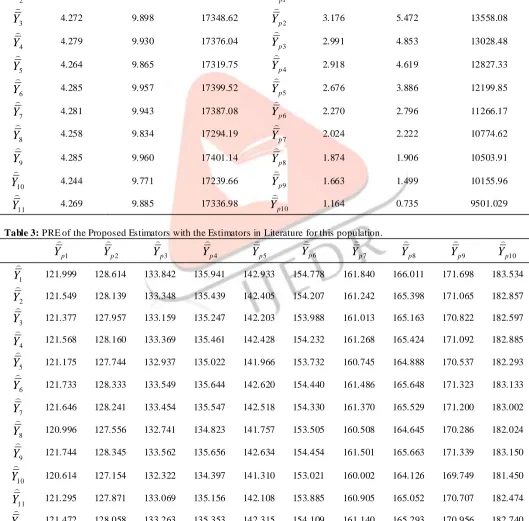
5. Empiric al StudyThe performances of the suggested ratio estimators are evaluated and compared with the usual ratio estimator and the mention ed ratio estimators in Section 2 by using natural Population.
The percentage relative efficiency (PREs) of the proposed estimators (p), with respective to the existing estimators (e), are computed as
100
estimator
propoesd
of
MSE
Estimator
Existing
of
MSE
PRE
The statistics of population taken fro m Singh and Chaudhary (1986) is given in table 1
Table 1
Parame ters Populati on 1 Parame ters Populati on 1 Parame ters Populati on 1
N
34S
x 150.2150D
4 111.20n
20C
x 0.7531D
5 142.50Y
856.4117
2 1.0445D
6 210.20IJEDR1702276 International Journal of Engineering Development and Research (www.ijedr.org) 1760
0.4453D
1 60.60D
8 304.40y
S
733.1407D
2 83.00D
9 373.20y
C
0.8561D
3 102.70D
10 634.00
Table 2: The Statistical Analysis of the Estimators for this Population
E
st
im
a
to
r
s
Pop I
E
st
im
a
to
r
s
Pop I
Constant Bias MS E Constant Bias MS E
1
Y
4.294 10.002 17437.65
12
Y
4.275 9.914 17362.26
2
Y
4.278 9.927 17373.31
1
p
Y
3.416 6.330 14293.17
3
Y
4.272 9.898 17348.62
2
p
Y
3.176 5.472 13558.08
4
Y
4.279 9.930 17376.04
3
p
Y
2.991 4.853 13028.48
5
Y
4.264 9.865 17319.75
4
p
Y
2.918 4.619 12827.33
6
Y
4.285 9.957 17399.52
5
p
Y
2.676 3.886 12199.85
7
Y
4.281 9.943 17387.08
Y
p6
2.270 2.796 11266.17
8
Y
4.258 9.834 17294.19
7
p
Y
2.024 2.222 10774.62
9
Y
4.285 9.960 17401.14
8
p
Y
1.874 1.906 10503.91
10
Y
4.244 9.771 17239.66
Y
p9
1.663 1.499 10155.96
11
Y
4.269 9.885 17336.98
Y
p10
1.164 0.735 9501.029
Table 3: PRE of the Proposed Estimators with the Estimators in Literature for this population.
1
p
Y
2
p
Y
3
p
Y
4
p
Y
5
p
Y
6
p
Y
7
p
Y
8
p
Y
9
p
Y
10
p
Y
1
Y
121.999 128.614 133.842 135.941 142.933 154.778 161.840 166.011 171.698 183.534
2
Y
121.549 128.139 133.348 135.439 142.405 154.207 161.242 165.398 171.065 182.857
3
Y
121.377 127.957 133.159 135.247 142.203 153.988 161.013 165.163 170.822 182.597
4
Y
121.568 128.160 133.369 135.461 142.428 154.232 161.268 165.424 171.092 182.885
5
Y
121.175 127.744 132.937 135.022 141.966 153.732 160.745 164.888 170.537 182.293
6
Y
121.733 128.333 133.549 135.644 142.620 154.440 161.486 165.648 171.323 183.133
7
Y
121.646 128.241 133.454 135.547 142.518 154.330 161.370 165.529 171.200 183.002
8
Y
120.996 127.556 132.741 134.823 141.757 153.505 160.508 164.645 170.286 182.024
9
Y
121.744 128.345 133.562 135.656 142.634 154.454 161.501 165.663 171.339 183.150
10
Y
120.614 127.154 132.322 134.397 141.310 153.021 160.002 164.126 169.749 181.450
11
Y
121.295 127.871 133.069 135.156 142.108 153.885 160.905 165.052 170.707 182.474
12
Y
IJEDR1702276 International Journal of Engineering Development and Research (www.ijedr.org) 1761 Conclusion
Fro m the above emp irical study we reveal that by proposing the class of ratio type estimators in SRSWOR by using the population deciles and coefficient of skewness as auxilliary informat ion are found more efficient than the existing estimators as their MSE and bias is lowe r than the existing estimators and hence we strongly recommend that our proposed estimat ors preferred over e xisting estimators for practica l applications.
References
Cochran, W. G. (1940). The Estimation of the Yie lds of the Cerea l Experiments by Samp ling for the Ratio of Gra in to Total Produce. The Journal of Agric Science, 30. 262-275.
Kadilar, C. & Cingi, H. (2004), ‘Ratio estimators in simp le random sampling’, Applied Mathematics and Computation 151, 893–902.
Kadilar, C. & Cingi, H. (2006), ‘An improvement in estimating the population mean by using the correlation coefficient’, Hacettepe Journal of Mathematics and Statistics 35(1), 103–109.
Murthy, M. (1967), Sa mp ling Theory and Methods, 1 edn, Statistical Publishing Society, India.
Rao, T. J. (1991), ‘On certain methods of improving ratio and reg ression estimators’, Co mmunicat ions in Statistics -Theory and Methods 20(10), 3325–3340.
Singh, D. & Chaudhary, F. S. (1986), Theory and Analysis of Sample Survey Designs, 1 edn, New Age International Publisher, India.
Singh, H. P. & Tailo r, R. (2003), ‘Use of known correlation coefficient in estimating the fin ite population means’, Statistics in Transition 6(4), 555–560.
Singh, H. P., Tailor, R., Tailor, R. & Kakran, M. (2004), ‘An improved estimator o f population mean using power transformation’, Journal of the Indian Society of Agricultural Statistics 58(2), 223–230.
Sisodia, B. V. S. & Dwivedi, V. K. (1981), ‘A modified ratio es timator using coefficient of variation of auxiliary variable’, Journal of the Indian Society of Agricu ltural Statistics 33(1), 13–18.
Subraman i, J. & Ku marapandiyan, G. (2012a), ‘Estimation of population mean using co - efficient of variation and median of an auxiliary variab le’, International Journal of Probability and Statistics 1(4), 111–118.
Subraman i, J. & Ku marapandiyan, G. (2012b), ‘Estimation of population mean using known med ian and co-efficient of skewness’, A merican Journal of Mathematics and Statistics 2(5), 101–107.
Subraman i, J. & Ku marapandiyan, G. (2012c), ‘Modified ratio estimators using known median and co-efficient of kurtosis’, American Journal of Mathemat ics and Statistics 2(4), 95– 100.
Upadhyaya, L. N. & Singh, H. (1999), ‘Use of transformed au xiliary variable in estimating the fin ite population mean’, Bio metrica l Journa l 41(5), 627– 636.
Wolter K.M . (1985). Introduction to Variance Estimation, Sp ringer-Verlag.