R E S E A R C H A R T I C L E
Open Access
Constitutional delay of puberty:
presentation and inheritance pattern in 48
familial cases
Sarah Winter
1†, Aldjia Ousidhoum
1†, Kenneth McElreavey
2and Raja Brauner
1*Abstract
Background:The mechanism that initiates the onset of puberty is largely unknown but the age of onset is mainly under genetic control and influenced by environmental factors including nutrition. Familial forms of constitutional delay of puberty (CDP) suggest the involvement of genetic factors. The purpose of this study is to describe the presentation and the mode of inheritance of CDP in a series of familial cases.
Methods:A retrospective, single center study was carried out over 10 years on 48 probands (14 girls and 34 boys) from 48 families seen for CDP with a familial component.
Results:Of the 48 probands, 46 (96 %) had at least one affected 1stdegree relatives and 2 (4 %, 2 boys) had only 2nddegree relatives affected.
In girls, 11 families (79 %) exhibited exclusive maternal inheritance, 1 (7 %) paternal inheritance and 2 (14 %) both maternal and paternal inheritance. In boys, 14 families (41 %) exhibited exclusive maternal inheritance, 12 (35 %) paternal inheritance and 8 (24 %) both maternal and paternal inheritance.
In the boys with bilineal inheritance, the ages at onset of puberty (16 ± 1.41 years) and at evaluation (16.05 ± 2.47 years) were higher than in those with unilineal inheritance (15.25 ± 0.35 and 15.1 ± 0.42 years respectively), but the difference was not significant.
Conclusions:In girls exclusive maternal inheritance seems to be the major mode of inheritance whereas for boys the mode of inheritance was almost equally maternal, paternal or bilineal. Clinical phenotype of boys with bilineal inheritance seems to be more severe, but the difference did not reach statistical significance, perhaps because of the small sample size. This greater severity of the phenotype in boys with bilineal inheritance is likely due to inheriting different puberty timing genes from each parent. Future research should be directed at identifying such genes.
Keywords:CDP constitutional delay of puberty, GnRH, Hypothalamic-pituitary-gonadal axis, Pubertal delay, Unilineal and bilineal inheritance, Autosomal dominant inheritance
Background
Delayed puberty is diagnosed when there is no testicular enlargement after 14 years in boys or breast develop-ment after 13 years in girls. The constitutional delay of puberty (CDP) can be diagnosed only after underlying conditions have been ruled out and when the pubertal delay is followed by spontaneous pubertal development [1]. Boys are affected much more frequently than girls,
while the reverse is true in idiopathic central precocious puberty [2].
The age at onset and the progression of puberty are driven by a complex interaction between genetic, meta-bolic and environmental factors. The age at onset of puberty is often homogeneous within the family and concordant between twins [3]. Kaprio et al. [4] analyzed the age at menarche in monozygotic twins and showed that 74 % of the variance is due to genetic factors and 26 % to environmental factors. The frequency of the fa-milial forms has been reported at 56–80 % in CPD [5] while they represent 41 % in our series of 493 girls with
* Correspondence:[email protected]
†Equal contributors
1Université Paris Descartes and Fondation Ophtalmologique Adolphe de
Rothschild, Paris, France
Full list of author information is available at the end of the article
central precocious puberty [6]. Two studies analyzed the inheritance of CDP [7, 8]. The studies [7–10] sug-gested an autosomal dominant mode, without the influ-ence of obesity.
We evaluated 48 patients seen consecutively by the same senior pediatric endocrinologist for CDP with a familial component. The purpose of this study is to de-scribe the presentation and the mode of inheritance of CDP in a series of familial cases.
Methods
Compliance with the ethical standards
The protocol was approved by the Ethical Review Committee Comité de Protection des Personnes Ile de France III (certificate AC 048 joined). All of the clin-ical investigations were conducted according to the principles expressed in the Declaration of Helsinki. Written informed consent for the evaluations was ob-tained from the children’s parents and was included in their hospital medical records. No additional activity to routine patient care was performed.
Patients
This retrospective, single center study was carried out on 48 probands (14 girls and 34 boys) from 48 families seen for CDP with a familial component by a senior pediatric endocrinologist (R Brauner) in a university pediatric hospital from 2001 to 2011 (over 10 years). CDP was diagnosed on the absence of pubertal develop-ment after 14 years in boys and 13 years in girls after ex-clusion of other diseases (see below) and followed by spontaneous pubertal development [1]. The diagnosis of delayed puberty assigned to the individuals in the paren-tal and grandparenparen-tal generations was based on inter-views and recall.
Methods
First-degree relatives were defined as mother, father, brother(s) and sister(s); second-degree relatives as grand-parents, aunt(s) and uncle(s). The familial probands were further subdivided into two groups: 1) unilineal families (only one affected parent and no evidence for delayed puberty in the other parent or his/her first-degree rela-tives); 2) bilineal families (either both parents affected or an unaffected parent having an affected sibling or par-ent). Families with lineal maternal are those in which at least one member of the mother’s family is affected, and no father’s family, with similar schema for the lineal paternal involvement.
No patient had suffered from intrauterine growth re-tardation, a disease or any symptoms.
The onset of puberty is defined as the appearance of breast buds in girls and a testicular volume index of 4 cm2or greater in boys. The dimensions of the testes
were measured by a clinical evaluation, the testicular volume index (cm2) being length x width [11]. The puber-tal stage was rated according to Marshall and Tanner [12, 13]. Body mass index (BMI) (weight in kg/height in m squared) was expressed as the standard deviation score (SDS) for chronological age [14, 15]. Bone age (BA) was assessed in 39 cases (by R Brauner) using the Greulich and Pyle method [16].
The other evaluations were performed to 1) exclude abnormalities of the hypothalamic-pituitary-gonadal axis, and of the uterus in girls, 2) evaluate the pubertal stage, and 3) exclude general diseases responsible for the delayed puberty.
The hypothalamic-pituitary-gonadal axis was evaluated by basal and gonadotropin-releasing hormone (GnRH)-stimulated plasma concentrations of luteinizing hormone (LH) and follicle-stimulating hormone (FSH). The basal plasma LH and FSH concentrations were normal, against primary gonadal failure. The GnRH test, consisting of an intravenous injection of GnRH (100μg/m2) and measure-ment of LH and FSH peaks at 0, 30, 60 and 90 min, was performed in 4 girls ad 11 boys. The results excluded go-nadotropin deficiency. The following values were consid-ered to be pubertal: uterus length≥35 mm [17], LH/FSH peak ratio after GnRH test≥0.66 in girls and≥2 in boys [18], and plasma estradiol concentrations≥15 pg/mL in girls and testosterone≥0.5 ng/mL in boys. Blood samples were collected at 14.05 ± 0.35 (13–16) years in girls and 15.9 ± 2.69 (14–17.8) years in boys, explaining the wide variations in the pubertal stage, increase in LH and FSH after the GnRH test, and plasma testosterone or estradiol concentrations. Plasma estradiol and testosterone concen-trations were measured with a radioimmunoassay. Pelvic ultrasonography was performed in 5 girls (cases 7, 11, 12, 13, and 14).
any clinical doubt, x-rays of the pelvis and lumbar spine were taken (front and profile) to exclude constitutional bone disease. All of these investigations showed normal results. All of the patients were followed until complete pubertal development. Those with low BMI were en-couraged to increase their caloric intake.
Karyotype was performed in 6 girls and was denoted 46 XX for all of them and in 4 boys and the only abnor-mality found was a 9p trisomy, usually associated with growth and puberty retardation [19].
Results were expressed as the means ± SD. The data are normally distributed and p values are corrected for mul-tiple comparisons. Statistical analysis were performed using the Student test, except for comparing boys with bilineal to those with unilineal inheritance. Their data were not normally distributed because of the small sam-ple; they were compared by the Mann-Whitney test.
Results
Fourteen girls and thirty-four boys were included.
Characteristics of the patients
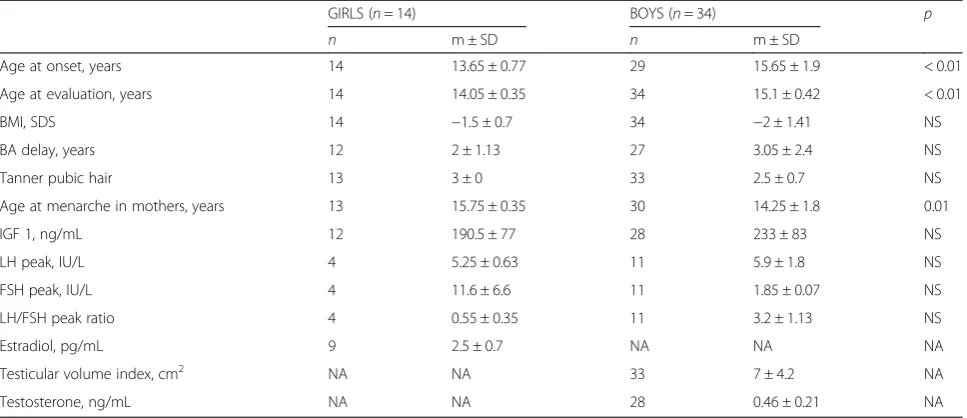
The girls and boys had similar characteristics, excluding the ages at onset of puberty and at evaluation greater in boys, as expected (Table 1). The mean age of menarche among the girls’ mothers was significantly greater than among the boys’mothers. Among the girls’mothers, the menarche age was between 14 and 15 years in 2 and above 15 years in 10 (total 12, 86 %); among the boys’ mothers, the menarche age was between 14 and 15 years in 7 and above 15 years in 14 (total 21, 62 %).
Among the girls, 6 had a BMI≤-2 SDS and only one was considered obese with a BMI≥2 SDS; among the
boys, 6 had a BMI≤-2 SDS and 5 were considered
obese. Among the girls, 8/14 had no breast development at the first evaluation. The uterus was prepubertal on the pelvic ultrasonography in the 5 evaluated.
Mode of inheritance
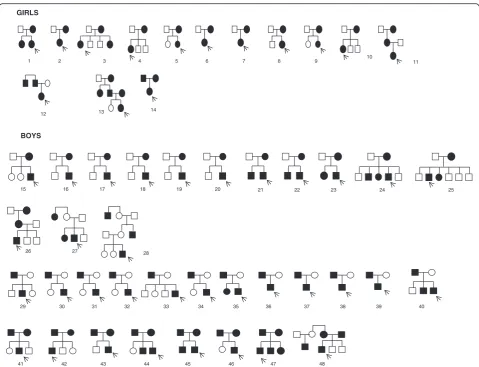
None of the families reported a history of consanguinity. Pedigrees of the 48 families are represented in Fig. 1 and familial clustering in Fig. 2. A total of 128 cases of CDP were identified, of whom 60 were affected girls and 68 affected boys. The male to female ratio for the probands was 2.4:1. It was 1:1.37 for the first degree relatives.
Of the 48 probands, 46 (96 %, 14 girls and 32 boys) had at least one affected 1stdegree relatives and 2 (4 %, cases 27 and 28) had only 2nd degree relatives affected. There was no family in whom only siblings were affected.
In the girls, 11 families (79 %) exhibited exclusive mater-nal inheritance, 1 (7 %) patermater-nal inheritance and 2 (14 %) presented both maternal and paternal inheritance. In the boys, 14 families (41 %) exhibited exclusive maternal in-heritance, 12 (35 %) paternal inheritance and 8 (24 %) pre-sented both maternal and paternal inheritance.
Of the 36 unilineal families, CDP was verified in three generations in only 3 of the patients (families 11, 26 and 28). In the boys with bilineal inheritance, the ages at onset of puberty (Fig. 3) and at evaluation were higher than in those with unilineal inheritance, but the difference was not significant (Table 2). They had similar plasma testos-terone concentrations suggesting that these differences are not due to a difference in their pubertal development stages.
Discussion
The results of this study suggest that despite various inheritance patterns among the pedigrees, there is Table 1Characteristics at presentation of 48 probands with familial constitutional delay of puberty
GIRLS (n= 14) BOYS (n= 34) p n m ± SD n m ± SD
Age at onset, years 14 13.65 ± 0.77 29 15.65 ± 1.9 < 0.01 Age at evaluation, years 14 14.05 ± 0.35 34 15.1 ± 0.42 < 0.01 BMI, SDS 14 −1.5 ± 0.7 34 −2 ± 1.41 NS BA delay, years 12 2 ± 1.13 27 3.05 ± 2.4 NS Tanner pubic hair 13 3 ± 0 33 2.5 ± 0.7 NS Age at menarche in mothers, years 13 15.75 ± 0.35 30 14.25 ± 1.8 0.01 IGF 1, ng/mL 12 190.5 ± 77 28 233 ± 83 NS LH peak, IU/L 4 5.25 ± 0.63 11 5.9 ± 1.8 NS FSH peak, IU/L 4 11.6 ± 6.6 11 1.85 ± 0.07 NS LH/FSH peak ratio 4 0.55 ± 0.35 11 3.2 ± 1.13 NS Estradiol, pg/mL 9 2.5 ± 0.7 NA NA NA Testicular volume index, cm2 NA NA 33 7 ± 4.2 NA
Testosterone, ng/mL NA NA 28 0.46 ± 0.21 NA
evidence of autosomal dominant inheritance in CDP, with either complete or incomplete penetrance. In girls exclu-sive maternal inheritance seems to be the major mode of inheritance whereas for boys the mode of inheritance was almost equally maternal, paternal or bilineal. The results also suggest a more severe phenotype for boys with bili-neal inheritance, but the difference did not reach statistical significance perhaps because of the small sample size.
Previous data, such as studies of twins, suggested that genetic factors account for 50–80 % of all variations in pubertal timing [4, 20]. Two extended studies addressed the segregation of CDP in families [7, 8] and showed an inheritance pattern compatible with autosomal domin-ant inheritance with complete or incomplete penetrance. Our study confirms this hypothesis and is the first to present all of the pedigrees included. We deliberately chose to include only familial CDP and no sporadic CDP, contrary to the previous studies, to focus on the
mode of inheritance. Reproducing all of the pedigrees highlighted that 11/12 girls with CDP with unilineal in-heritance had a mother who also had late puberty, while Wehkalampi et al. [7] reported a proportion of 5/12. We found no explanation for this discrepancy. The greater age at menstruation in the girls’ mothers than the boys’ mothers is probably linked to this quasi exclusive trans-mission by the mothers of the girls. Families with only siblings affected were rare: none in our series and 2 % in that reported by Wehkalampi et al. [7].
result has to be interpreted carefully regarding the small number of probands with bilineal inheritance analyzed.
In previous reports, the male to female ratio among CDP has ranged from 2:1 to 5:1 [5, 21, 22]. In our study, this ratio was 2.4:1 for the probands, but this male pre-ponderance disappeared when calculated for the first de-gree relatives (1:1.37). In their study, Wehkalampi et al. [7] found this ratio at 1.2:1 . They suggested that the marked overrepresentation of boys with CDP at pediatric clinics may be biased. The authors noted that this poten-tial biased overrepresentation could be linked to psycho-social reasons with boys being more interested in athletic performance and physical characteristics around puberty. Another explanation given by the authors is the trend to-ward earlier puberty in girls [23, 24], which has also been reported for boys [25].
Many studies of girls have demonstrated a link be-tween more advanced breast development and higher BMI [26, 27] and that obese girls achieve menarche earlier than lean ones [28]. In boys, the association between pubertal development and adiposity has been less consistently reported with studies finding a positive association [25], lack of association [29] or negative
association [30]. Children and adolescents with delayed puberty are typically relatively lean and this is true for the majority of our case series. However, it is possible that reporting the BMI SDS to BA, and not to chrono-logical age, reduce the frequency of the lean patients as puberty itself results in increases in BMI. Some of the probands were overweight, especially the boys, which was already reported in CDP [5]. A recent genome-wide association study reported that BMI-increasing alleles correlated with earlier breast development in girls, whereas in boys some BMI-increasing alleles are associated with earlier and others with delayed sexual development [31]. This finding is consistent with epi-demiological data and confirms that some mechanisms regulating pubertal onset in males and females might be different. These data are also consistent with our finding of different modes of inheritance in CDP for boys and girls; however, the high percentages of mothers that reached menarche after 14 years of age in both sexes suggest that if the low BMI has a role, it is additional to that of the familial factor. Alternatively, there could be a gene-environment interaction such that genetics could produce greater susceptibility to having pubertal timing affected by BMI.
What controls puberty remains largely unknown. The genome-wide association studies have shown that vari-ants of more than 30 genes are associated with the age of menarche in humans [32]. Lomniczi et al. recently re-ported that the timing of female puberty was under the regulatory control of an epigenetic mechanism of tran-scriptional repression [33]. All of these reports confirm that the timing of puberty is controlled by many genes. This hypothesis is supported by the greater severity of the phenotype in boys with CDP with a bilineal family history, likely due to inheriting different puberty timing genes from both parents. This hypothesis should be con-firmed in a larger cohort.
We acknowledge that our study has some limitations. We have no extended pedigrees. This may bias ascer-tainment/inclusion towards pedigrees with autosomal dominant inheritance. Relying on a parental report for the onset of puberty is not very accurate as many par-ents fail to notice when the puberty actually starts; how-ever, even recalled information is valuable; studies suggest that even decades after the event, 75–90 % of women remember their age of menarche and 50 % of Fig. 3Boys with familial delayed puberty (n= 34): distribution of the
ages at onset of puberty according to the unilineal or bilineal inheritance
Table 2Comparison of boys with familial constitutional delay of puberty according to the type (unilineal bilineal) of inheritance
Unilineal inheritance (n= 26) Bilineal inheritance (n= 8) p
n m ± SD n m ± SD
men remember the timing of their pubertal growth spurt within a year [34, 35]. Despite a 10-year inclusion period, the number of families included is much lower than for precocious and advanced puberty [36]. To try to confirm our data, further multicenter studies on larger cohorts should be conducted.
Conclusions
This study confirms the autosomal dominant inheritance pattern in CDP in a monocentric pediatric cohort and the need for further genetic studies. Our data are also consistent with other studies suggesting that the mecha-nisms underlying the onset of puberty are different in girls and boys, and different modes of transmission in boys and girls were revealed. The greater severity of the phenotype in boys with a bilineal family history is likely due to inheriting different puberty timing genes from both parents. Future research should be directed at iden-tifying such genes.
Abbreviations
BA:bone age; BMI: body mass index; CDP: constitutional delay of puberty; FSH: follicle-stimulating hormone; GH: growth hormone; GnRH: gonadotropin-releasing hormone; IGF: insulin-like growth factor; LH: luteinising hormone; MRI: magnetic resonance imaging; SDS: standard deviation score.
Competing interests
The authors declare that they have no financial and non-financial competing interests.
Authors’contributions
SW drafted the manuscript; AO collected and analyzed the data; KM participated in the design of the study and in the analysis of data; RB conceived the study and participated in its design and coordination and drafted the manuscript. All authors read and approved the final manuscript.
Author details
1
Université Paris Descartes and Fondation Ophtalmologique Adolphe de Rothschild, Paris, France.2Human Developmental Genetics, Institut Pasteur,
Paris, France.
Received: 22 April 2015 Accepted: 9 March 2016
References
1. Palmert MR, Dunkel L. Clinical practice. Delayed puberty. N Engl J Med. 2012;366:443–53.
2. Chemaitilly W, Trivin C, Adan L, Gall V, Sainte-Rose C, Brauner R. Central precocious puberty: clinical and laboratory features. Clin Endocrinol (Oxf). 2001;54:289–94.
3. Parent A-S, Teilmann G, Juul A, Skakkebaek NE, Toppari J, Bourguignon J-P. The timing of normal puberty and the age limits of sexual precocity: variations around the world, secular trends, and changes after migration. Endocr Rev. 2003;24:668–93.
4. Kaprio J, Rimpelä A, Winter T, Viken RJ, Rimpelä M, Rose RJ. Common genetic influences on BMI and age at menarche. Hum Biol. 1995;67:739–53. 5. Sedlmeyer IL, Palmert MR. Delayed puberty: analysis of a large case series
from an academic center. J Clin Endocrinol Metab. 2002;87:1613–20. 6. Giabicani E, Allali S, Durand A, Sommet J, Couto-Silva A-C, Brauner R.
Presentation of 493 consecutive girls with idiopathic central precocious puberty: a single-center study. PloS One. 2013;8:e70931.
7. Wehkalampi K, Widén E, Laine T, Palotie A, Dunkel L. Patterns of inheritance of constitutional delay of growth and puberty in families of adolescent girls and boys referred to specialist pediatric care. J Clin Endocrinol Metab. 2008;93:723–8.
8. Sedlmeyer IL, Hirschhorn JN, Palmert MR. Pedigree analysis of constitutional delay of growth and maturation: determination of familial aggregation and inheritance patterns. J Clin Endocrinol Metab. 2002;87:5581–6.
9. Sperlich M, Butenandt O, Schwarz HP. Final height and predicted height in boys with untreated constitutional growth delay. Eur J Pediatr. 1995;154:627–32. 10. Han JC, Balagopal P, Sweeten S, Darmaun D, Mauras N. Evidence for
hypermetabolism in boys with constitutional delay of growth and maturation. J Clin Endocrinol Metab. 2006;91:2081–6.
11. Burr IM, Sizonenko PC, Kaplan SL, Grumbach MM. Hormonal changes in puberty. I. Correlation of serum luteinizing hormone and follicle stimulating hormone with stages of puberty, testicular size, and bone age in normal boys. Pediatr Res. 1970;4:25–35.
12. Marshall WA, Tanner JM. Variations in pattern of pubertal changes in girls. Arch Dis Child. 1969;44:291–303.
13. Marshall WA, Tanner JM. Variations in the pattern of pubertal changes in boys. Arch Dis Child. 1970;45:13–23.
14. Sempé M, Pedron G, Roy-Pernot MP.Auxologie, Méthodes et Séquences. Paris, France: Theraplix; 1979.
15. Rolland-Cachera MF, Cole TJ, Sempé M, Tichet J, Rossignol C, Charraud A. Body Mass Index variations: centiles from birth to 87 years. Eur J Clin Nutr. 1991;45:13–21.
16. Greulich, WW., Pyle, SI.: Radiographic Atlas of Skeletal Development of the Hand and the Wrist. 2nd edition. Stanford University Press; 1959. 17. De Vries L, Horev G, Schwartz M, Phillip M. Ultrasonographic and clinical
parameters for early differentiation between precocious puberty and premature thelarche. Eur J Endocrinol Eur Fed Endocr Soc. 2006;154:891–8. 18. Oerter KE, Uriarte MM, Rose SR, Barnes KM, Cutler GB. Gonadotropin
secretory dynamics during puberty in normal girls and boys. J Clin Endocrinol Metab. 1990;71:1251–8.
19. Stagi S, Lapi E, Seminara S, Guarducci S, Pantaleo M, Giglio S, Chiarelli F, de Martino M. Long-term auxological and endocrinological evaluation of patients with 9p trisomy: a focus on the growth hormone-insulin-like growth factor-I axis. BMC Endocr Disord. 2014;14:3.
20. Treloar SA, Martin NG. Age at menarche as a fitness trait: nonadditive genetic variance detected in a large twin sample. Am J Hum Genet. 1990;47:137–48. 21. Poyrazoğlu S, Günöz H, Darendeliler F, Saka N, Bundak R, BaşF. Constitutional
delay of growth and puberty: from presentation to final height. J Pediatr Endocrinol Metab JPEM. 2005;18:171–9.
22. Crowne EC, Shalet SM, Wallace WH, Eminson DM, Price DA. Final height in girls with untreated constitutional delay in growth and puberty. Eur J Pediatr. 1991; 150:708–12.
23. Mul D, Oostdijk W, Drop SLS. Early puberty in girls. Best Pract Res Clin Endocrinol Metab. 2002;16:153–63.
24. Roche AF, Wellens R, Attie KM, Siervogel RM. The timing of sexual maturation in a group of US white youths. J Pediatr Endocrinol Metab JPEM. 1995;8:11–8.
25. Sørensen K, Aksglaede L, Petersen JH, Juul A. Recent changes in pubertal timing in healthy Danish boys: associations with body mass index. J Clin Endocrinol Metab. 2010;95:263–70.
26. Kaplowitz PB, Slora EJ, Wasserman RC, Pedlow SE, Herman-Giddens ME. Earlier onset of puberty in girls: relation to increased body mass index and race. Pediatrics. 2001;108:347–53.
27. Morrison JA, Barton B, Biro FM, Sprecher DL, Falkner F, Obarzanek E. Sexual maturation and obesity in 9- and 10-year-old black and white girls: the National Heart, Lung, and Blood Institute Growth and Health Study. J Pediatr. 1994;124:889–95.
28. Anderson SE, Dallal GE, Must A. Relative weight and race influence average age at menarche: results from two nationally representative surveys of US girls studied 25 years apart. Pediatrics. 2003;111(4 Pt 1):844–50. 29. Herman-Giddens ME, Wang L, Koch G. Secondary sexual characteristics in
boys: estimates from the national health and nutrition examination survey III, 1988–1994. Arch Pediatr Adolesc Med. 2001;155:1022–8.
30. Lee JM, Kaciroti N, Appugliese D, Corwyn RF, Bradley RH, Lumeng JC. Body mass index and timing of pubertal initiation in boys. Arch Pediatr Adolesc Med. 2010;164:139–44.
a role for body mass and menarche loci in male puberty. Hum Mol Genet. 2014;23:4452–64.
32. Perry JRB, Day F, Elks CE, Sulem P, Thompson DJ, Ferreira T, et al. Parent-of-origin specific allelic associations among 106 genomic loci for age at menarche. Nature. 2014;514(7520):92–7.
33. Lomniczi A, Loche A, Castellano JM, Ronnekleiv OK, Bosch M, Kaidar G, Knoll JG, Wright H, Pfeifer GP, Ojeda SR. Epigenetic control of female puberty. Nat Neurosci. 2013;16:281–9.
34. Damon A, Bajema CJ. Age at menarche: Accuracy of recall after thirty-nine years. Hum Biol. 1974;46:381–4.
35. Casey VA, Dwyer JT, Coleman KA, Krall EA, Gardner J, Valadian I. Accuracy of recall by middle-aged participants in a longitudinal study of their body size and indices of maturation earlier in life. Ann Hum Biol. 1991;18:155–66. 36. Durand A., Bashamboo A., McElreavey K., Brauner R. R: Predominantly
matrilineal inheritance of familial precocious puberty suggests an underlying imprint anomaly 53rd Annual European Society for Pediatric Endocrinology meeting, Dublin, 2014, Abstract inHorm Res Paediatr p 298
• We accept pre-submission inquiries
• Our selector tool helps you to find the most relevant journal
• We provide round the clock customer support
• Convenient online submission
• Thorough peer review
• Inclusion in PubMed and all major indexing services
• Maximum visibility for your research
Submit your manuscript at www.biomedcentral.com/submit