Genetics Practice Test
Modified True/False
Indicate whether the statement is true or false. If false, change the identified word or phrase to make the statement true.
____ 1. A trait is a specific characteristic that varies from one individual to another. _________________________
____ 2. True-breeding plants that produced axial flowers were crossed with true-breeding plants that produced terminal flowers. The resulting offspring all produced terminal flowers because the allele for terminal flowers is recessive. _________________________
____ 3. During the formation of gametes in a hybrid tall plant, the tall allele and the short allele stay together. _________________________
____ 4. If the alleles for a trait did not segregate during gamete formation, offspring would always show the trait of at least one of the parents. _________________________
____ 5. The principles of probability can explain the numerical results of Mendel’s experiments. _________________________
____ 6. The probability that a gamete produced by a pea plant heterozygous for stem height (Tt) will contain the recessive allele is 100%. _________________________
____ 7. If Mendel had found that an F2 cross of plants that were heterozygous for two traits had made offspring with
two phenotypes, this finding would have supported the theory of independent assortment. _________________________
____ 8. A trait in an unidentified plant is controlled by one gene that has two alleles. One allele is dominant over the other. According to Mendel’s principles, one fourth of the offspring made from a cross between two heterozygous plants will show the recessive trait. _________________________
____ 9. If two speckled chickens are mated, according to the principle of codominance, 25% of the offspring are expected to be speckled. _________________________
____ 10. Coat color in rabbits is determined by a single gene that has multiple alleles. _________________________
____ 11. If an organism has 16 chromosomes in each of its egg cells, the organism’s diploid number is 32. _________________________
____ 12. If an organism is heterozygous for a particular gene, the two different alleles will be separated during anaphase II of meiosis, assuming that no crossing-over has occurred. _________________________
____ 13. Mitosis results in two cells, whereas meiosis results in one cell. _________________________
____ 14. If an organism has four linkage groups, it has eight chromosomes. _________________________
____ 15. Genes in the same linkage group are usually inherited separately. _________________________
____ 17. In a human karyotype, 44 of the chromosomes are autosomes. _________________________
____ 18. To make a karyotype, biologists take pictures of cells during mitosis, when they are condensed and easier to view. _________________________
____ 19. A recessive X-linked trait would be more common in males than in females. _________________________
____ 20. If a cat has both orange and black spots, it is homozygous for the alleles on the X chromosome that code for spot color. _________________________
____ 21. If a person has blood type A, he or she cannot safely receive a blood transfusion from a person with blood type O. _________________________
____ 22. Two parents who have Huntington disease may produce an offspring who does not have Huntington disease. _________________________
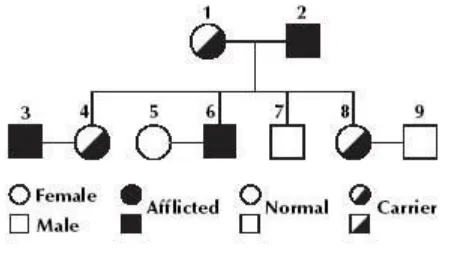
Figure 14–10
____ 23. The pedigree chart in Figure 14-10 shows that some people can be carriers of the trait without being afflicted. This means the allele for the trait is dominant. _________________________
____ 24. The pedigree chart in Figure 14–10 shows 4 generations. _________________________
____ 25. A person who has Down syndrome has two copies of chromosome 21. _________________________
____ 26. Down syndrome, Turner’s syndrome, and Klinefelter’s syndrome are all caused by nondisjunction. _________________________
____ 27. When DNA fragments are separated by gel electrophoresis, the longest fragments move fastest. _________________________
____ 28. When sequencing DNA, replication stops when nucleotide bases marked with dye are added to chains of DNA as the DNA is being synthesized. _________________________
____ 30. Information from the Human Genome Project can be used to learn more about human diseases. _________________________
____ 31. Animal breeders maintain cat and dog breeds by the process of hybridization. _________________________
____ 32. Native Americans took teosine and used selective breeding to make corn, a more productive and nutritious plant. _________________________
____ 33. Exposing bacteria to radiation or certain chemicals can increase the frequency of mutations that occur within the population. _________________________
____ 34. A polyploid plant has more than two copies of each gene. _________________________
____ 35. Scientists use genetic markers to determine which cells have been successfully transformed. _________________________
____ 36. During a polymerase chain reaction, the number of DNA copies increases exponentially with each cycle. _________________________
____ 37. Bacterial cells that have been transformed with a plasmid that carries a genetic marker for resistance to the antibiotic tetracycline will not survive in a culture treated with tetracycline. _________________________
____ 38. To transform a plant cell, scientists inject protein into the plant cell. _________________________
____ 39. To produce a cloned sheep, Ian Wilmut removed the nucleus from a sheep’s body cell and injected the cell with a nucleus taken from a body cell of another adult sheep. _________________________
____ 40. Farmers growing Bt corn can use more insecticide than farmers growing the same amount of non-GM corn. ______________________________
____ 41. Transgenic plants are often used to simulate humans in medical tests. _________________________
____ 42. DNA fingerprinting analyzes sections of DNA that have little or no known function but are similar from person to person. _________________________
____ 43. Patenting genetic technology sometimes keeps technology out of the hands of people who need it. _________________________
____ 44. Herbicide-resistance in crops can increase yields by allowing farmers to use fewer chemicals to control weeds. _________________________
____ 45. Patenting a process, such as PCR, restricts the use of the process to the patent holder and to those who pay a fee. _________________________
Completion
46. The plants that Gregor Mendel crossed to produce the F1 generation made up the ____________________
generation.
47. Due to the process of segregation, alleles separate during the production of ____________________ .
48. An organism has 38 chromosomes in a body cell. After mitosis each cell has 38 chromosomes. After meiosis each gamete has ____________________ chromosomes.
49. What is the probability of flipping a coin and getting heads 5 times in a row?
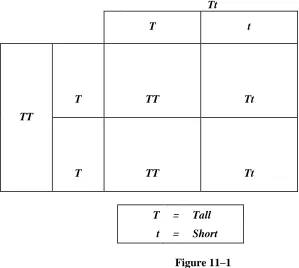
Tt
T t
TT
T TT Tt
T TT Tt
T = Tall
t = Short
Figure 11–1
50. In the Punnett square shown in Figure 11–1, the genotypes of the offspring are ____________________.
51. The principle of independent assortment states that ____________________ for different traits can segregate independently during the formation of gametes.
52. If pea plants that are homozygous for round, yellow seeds (RRYY) were crossed with pea plants that are heterozygous for round, yellow seeds (RrYy), the expected phenotype(s) of the offspring would be _________________________.
53. ____________________’s principles can be used to study heredity in dogs, cats and sheep.
55. Western white butterflies that hatch in springtime have more pigment in their wings than those that hatch in summer. The darker wings help the butterflies stay warmer by absorbing more ____________________ than the lighter-colored wings.
56. The characteristics of an organism are determined by two factors: ____________________.
57. In four o’clock plants, flower color is controlled by two alleles that show _________________________.
58. An organism’s gametes have ____________________ the number of chromosomes found in the organism’s body cells.
59. Crossing-over occurs during the stage of meiosis called ____________________.
60. The relative locations of each known gene can be shown on a ____________________ map.
61. In humans, sex is determined by the X and ____________________ chromosomes.
62. If a couple has five boys, the probability that the next child will be a boy is ____________________.
63. A(An) ____________________ can be used to determine whether a person has inherited the normal number of chromosomes.
64. A boy who is colorblind inherited the disorder from his ____________________.
65. A Barr body is an inactivated ____________________ chromosome.
66. The alleles IA and ____________________ for the AB blood group are codominant.
67. A person who has blood type O can safely receive a blood transfusion only from a person who has blood type ____________________.
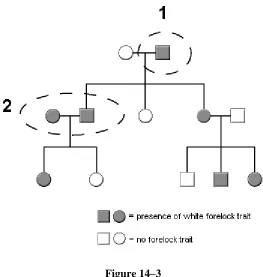
Figure 14–3
69. The allele for the trait illustrated in the pedigree chart in Figure 14–3 is dominant. The probability of the couple labeled 2 in the pedigree having a child without the trait is ____________________ percent.
70. People who have sickle cell disease inherited ____________________ copies of the sickle cell allele.
71. A female with the disorder _________________________ inherits only one X chromosome.
72. Nondisjunction can lead to the disorder called ______________________________, in which a male has an extra X chromosome.
73. An advantage of using a restriction enzyme such as EcoR1 is that it creates ______________ that can match to complimentary base pairs.
74. The new field of Bioinformatics combines the fields of ______________ and ______________.
75. The law that protects people from being discriminated against because of information learned in genetic tests is called the __________________________.
76. ____________________ is the technique of selective breeding that maintains desirable characteristics in a line of organisms, but increases the risk of genetic defects in certain animal breeds.
77. To produce a fruit that has some characteristics of an orange and some of a grapefruit, you would use the selective breeding technique of _________________________.
79. Bananas planted as crops are____________________ plants which have 2 or 3 times the normal diploid number of chromosomes.
80. Some plasmids have genes that make bacteria resistant to ____________________ and allow them serve as genetic markers.
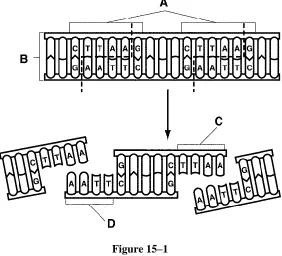
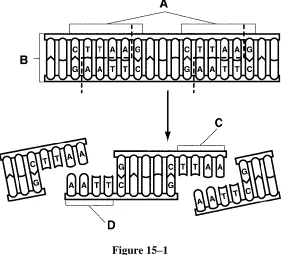
Figure 15–1
81. ____________________ are proteins that cut DNA at specific sequences, as illustrated in Figure 15–1.
82. DNA finger printing has dramatically changed the field of ____________________, which is the study of crime scene evidence.
83. Using a _________________________ to locate a gene is like using a magnet to find a needle in a haystack.
84. If DNA fingerprints were made from DNA samples taken from Dolly and the sheep that donated the body cell, they would show ____________________ patterns of bands on an electrophoresis gel.
85. The human growth hormone produced by __________ bacteria is identical to the human growth hormone produced by humans because both are coded by the same DNA sequence.
86. The process of _________________________ replaces a faulty gene with a normal, working gene.
87. In DNA fingerprinting, the DNA probe that is used is ____________________ to the DNA sequence of the repeats in the sample.
89. Critics of GM crops worry that GM plants engineered to be resistant to insects might unintentionally kill ____________________ insects.
90. To prevent companies from misusing genetic information, the United States Congress passed the __________________.
Short Answer
91. What attributes of the garden pea plant made it an excellent organism for Gregor Mendel’s genetic studies?
92. Explain how allowing the F1 generation plants to self-pollinate in producing the F2 generation allowed
Mendel to reach his conclusions about inheritance.
93. What is the difference between segregation and independent assortment?
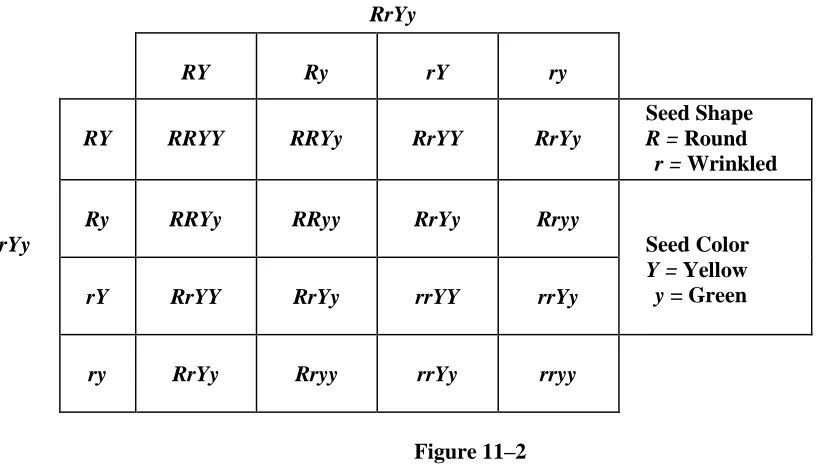
RrYy
RY Ry rY ry
RY RRYY RRYy RrYY RrYy
Seed Shape R = Round
r = Wrinkled
RrYy
Ry RRYy RRyy RrYy Rryy
Seed Color Y = Yellow y = Green
rY RrYY RrYy rrYY rrYy
ry RrYy Rryy rrYy rryy
Figure 11–2
94. What is the phenotype ratio of the offspring of the plants in the Punnett square in Figure 11–2?
95. A tall pea plant with yellow seeds is heterozygous for height and seed color (TtYy). This plant is crossed with a pea plant heterozygous for height but homozygous recessive for seed color (Ttyy). If 80 offspring are produced, how many are expected to be tall and have yellow seeds?
96. Which kinds of organisms can be used to study Mendel’s principles of heredity?
97. What is the probability that a cross between parents who are both homozygous recessive for trait will have offspring that are homozygous recessive for that trait?
98. Arctic foxes have blue-gray fur in summer and change to white fur in winter. What would be one way to test whether this change is influenced by cooling seasonal temperatures?
100. Define homologous chromosomes.
101. What happens to the number of chromosomes per cell during meiosis?
102. Contrast the cells produced by mitosis with those produced by meiosis.
103. What are the only kinds of cells that undergo meiosis?
104. Why did Gregor Mendel not observe gene linkage during his experiments with pea plants?
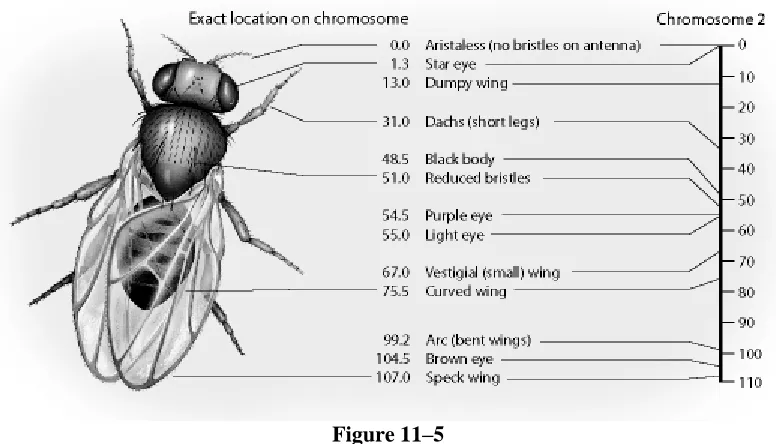
Gene Map of Chromosome 2 of the Fruit Fly
Figure 11–5
105. Figure 11–5, the gene map of a fruit fly’s chromosome 2, shows the relative locations of the star eye, dumpy wing, and black body genes to be 1.3, 13.0, and 48.5, respectively. Between which two genes does
crossing-over occur most frequently?
106. If human gametes have just 23 chromosomes, why does a human karyotype show 46?
107. Why are the sex chromosomes considered homologous, even though they vary in size and appearance?
108. Why are all X-linked alleles expressed in males, even if they are recessive?
109. A man who is not colorblind and a woman who is a carrier of the disorder have a son. What is the probability that their son will be colorblind?
110. Why are Barr bodies not found in male cells?
111. A person who has type AB blood is sometimes referred to as a universal recipient. Explain why.
113. When making a pedigree that shows the inheritance of a recessive allele for a trait within a family, how do you know whether a certain individual should be represented by a shaded symbol?
114. How is the DNA sequence of the allele that causes cystic fibrosis different from that of the normal allele?
115. If malaria were eliminated from a certain area, how do you think the frequency of the sickle cell allele in that area would change? Explain.
116. Why is a person who has Klinefelter’s syndrome (XXY) a male, even though he has two X chromosomes in his cells?
Figure 14–7
117. How can you tell that the nondisjunction occurred during the formation of the gametes in Figure 14–7?
118. How are DNA fragments separated for sequencing?
119. How do restriction enzymes help make DNA manipulation possible?
121. How are the selective breeding techniques of hybridization and inbreeding opposites?
Figure 15–1
122. What are structures C and D in Figure 15–1, and what is their significance?
123. Briefly explain what plasmids are and how they can be used to create transgenic organisms.
124. What does the polymerase chain reaction enable scientists to do?
125. How did Douglas Prasher find the gene that make the GFP protein?
126. What are two ways in which scientists transform plant cells without using plasmids?
127. Compare the genes in Dolly and the sheep from which she was cloned.
128. Describe how a scientist might make a transgenic animal.
129. How would making crops resistant to herbicides assist farmers?
130. Explain what a DNA probe is and how it could be used to identify a person who carries an allele for a genetic disorder.
131. Why are viruses used in gene therapy?
133. Why are DNA from the Y chromosome and mitochondria used in DNA fingerprint tests to establish parent-child relationships?
134. Why might adding a gene for herbicide resistance to crops be harmful to the environment?
135. Can an individual be barred from employment based on information learned from a genetic test? Explain your answer.
Other
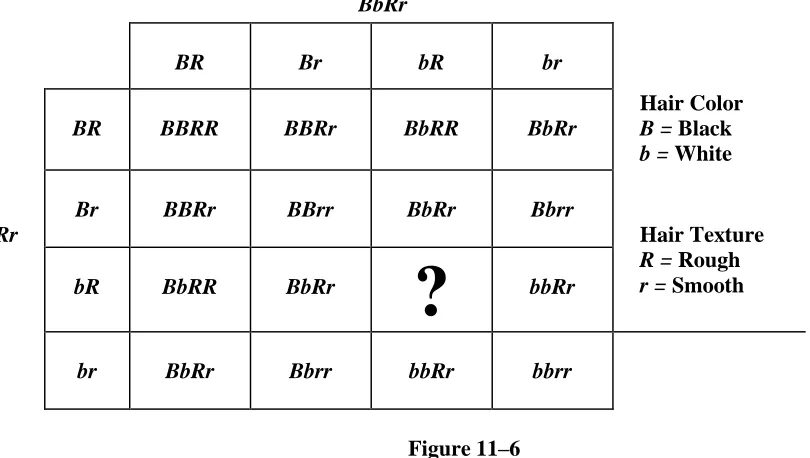
Heterozygous male guinea pigs with black, rough hair (BbRr) are crossed with heterozygous female guinea pigs with black, rough hair (BbRr). The incomplete Punnett square in Figure 11–6 shows the expected results from the cross.
BbRr
BR Br bR br
BR BBRR BBRr BbRR BbRr
Hair Color B = Black b = White
BbRr
Br BBRr BBrr BbRr Bbrr
Hair Texture R = Rough r = Smooth
bR BbRR BbRr
?
bbRrbr BbRr Bbrr bbRr bbrr
Figure 11–6
136. Interpret Tables Identify the genotype of the offspring that would be represented by the question mark in Figure 11–6.
137. Interpret Tables Identify the phenotype of the offspring represented by the question mark in Figure 11–6.
138. Analyze Data In Figure 11–6, what are the different phenotypes of the offspring?
139. Analyze Data In Figure 11–6, what are the genotypes of the offspring that have black, rough hair?
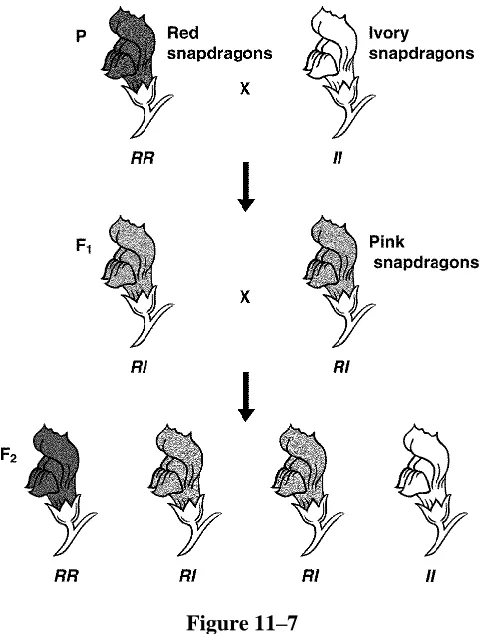
Figure 11–7
141. Infer What do the letters R and I represent in Figure 11–7?
142. Interpret Visuals In Figure 11–7, what is the genotype of the pink-flowered snapdragons?
143. Infer Explain whether the alleles in Figure 11–7 show dominance, incomplete dominance, or codominance.
144. Infer According to Figure 11–7, if red-flowered snapdragons and ivory-flowered snapdragons are crossed, what percentage of their offspring would be expected to be pink-flowered?
Figure 11–8
146. Interpret Visuals In Figure 11–8, what is the structure labeled X in stage A?
147. Interpret Visuals In Figure 11–8, during which stage might new allele combinations form? Identify the stage.
148. Infer If the stages shown in Figure 11–8 were taking place in a female animal, how many eggs would generally result from stage G? Explain your answer.
149. Interpret Visuals List the stages in Figure 11–8 in which the cells are 2N and those in which the cells are N.
Figure 14–11
151. Infer In the human karyotype in Figure 14–11, what term is used to describe the pair of chromosomes in each numbered group?
152. Compare and Contrast In Figure 14–11, how are the chromosomes that make up each numbered pair similar?
153. Classify Which chromosomes in Figure 14–11 are autosomes?
154. Interpret Visuals Study the human karyotype in Figure 14–11. Explain whether the person will be male or female, and describe the abnormality that this person has.
155. Draw Conclusions Study the abnormality at position 23 in Figure 14–11. What type of abnormality is this, and how might it have occurred?
Figure 14–12
156. Interpret Visuals Which numbered slide in Figure 14–12 shows type B blood?
157. Infer In Figure 14–12, which slide shows the blood of a person who can safely receive any type of blood in a transfusion? Identify the person’s blood type.
158. Interpret Visuals Which slide in Figure 14–12 shows blood that contains no antigens? How do you know?
159. Infer In Figure 14–12, what is the genotype or possible genotypes of the person whose blood is shown in slide 1?
160. Infer Anti-sera are extracted from blood. Based on what is shown in Figure 14–12, what type of blood does not contain anti-A or anti-B serum? Explain why.
Figure 14–13
161. Infer Is individual 2 in Figure 14–13 homozygous or heterozygous for free earlobes? Explain.
162. Interpret Visuals In Figure 14–13, how many children of individuals 4 and 5 have attached earlobes?
163. Infer Can you be certain of the genotype of individual 5 in Figure 14–13? Explain.
164. Predict Predict the genotype and phenotype of individual 14 in Figure 14–13.
165. Infer In Figure 14–13, are any of the descendants of individuals 1 and 2 homozygous for free earlobes?
Figure 15–4
166. Interpret Visuals What process is being illustrated in Figure 15–4?
167. Interpret Visuals In Figure 15–4, during which numbered step(s) are bacteria reproducing?
168. Interpret Visuals During which numbered steps(s) in Figure 15–4 is a restriction enzyme used?
169. Infer How might the bacterial cell produced in step 6 in Figure 15–4 be useful?
Figure 15–5
171. Interpret Visuals In the process shown in Figure 15–5, which sheep is the source of the nucleus in the fused cell?
172. Infer In Figure 15–5, why was the nucleus removed from the egg cell?
173. Interpret Visuals Which animal in Figure 15–5 is a clone?
174. Interpret Visuals In the cloning shown in Figure 15–5, which sheep provided an egg cell?
175. Infer Which two animals in Figure 15–5 are genetically identical?
176. Interpret Visuals In Figure 15–6, what do the bands shown in B consist of?
177. Interpret Visuals Which group of bands in Figure 15–6 moved faster, C or D? Why?
178. Infer What is occurring in A in Figure 15–6?
179. Infer In Figure 15–6, why are the bands in shown in B moving toward the positive end of the gel?
180. Draw Conclusions In Figure 15–6, were the any of the three DNA samples from the same person? Explain your answer.
Essay
181. You wish to determine whether a tall pea plant is homozygous or heterozygous for tallness. What cross should you perform to arrive at your answer? Explain your choice of cross.
182. A pea plant with yellow seeds was crossed with a plant with green seeds. The F1 generation produced plants
with yellow seeds. Explain why green seeds reappeared in the F2 generation.
183. Why are the results of genetic crosses shown in Punnett squares interpreted as probabilities, not certainties? Give some specific reasons.
184. A cross between two organisms heterozygous for two different genes (AaBb) likely results in a 9 : 3 : 3 : 1 phenotype ratio among the offspring. Is the offspring’s genotype ratio the same? Explain your answer.
185. A plant nursery owner wants to guarantee that the seeds she sells produce only pink-flowered four o’clock plants. How should she obtain the seeds?
186. Suppose you have western white butterflies from a population that hatched in spring, and those butterflies then had offspring that hatched in the summer. What would you expect the offspring born in the summer to look like? Explain your answer.
187. Which has more genetic information, a body cell or a gamete? Explain your answer.
188. The stages of meiosis are classified into two phases: meiosis I and meiosis II. Compare and contrast these two phases.
189. Explain why the daughter cells produced by meiosis are genetically different from each other, whereas the daughter cells produced by mitosis are not.
190. Define linkage, and explain how linkage is used to make gene maps.
191. How might karyotypes be useful to doctors?
192. What can you conclude if you observe a male cat that has both black and orange spots? Explain your answer.
Figure 14–10
194. Could the pedigree in Figure 14–10 show the pattern for the transmission of colorblindness? Explain your answer.
195. Explain why the father of a girl who is colorblind must also be colorblind.
196. Compare and contrast the causes of Turner’s syndrome and Down syndrome.
197. Compare and contrast Turner’s syndrome and Klinefelter’s syndrome.
198. What two kinds of enzymes are used in sequencing DNA, and what does each enzyme do in the process?
199. Why might it be incorrect to assume that if one chromosome is larger than another, the larger chromosome has more genes?
200. Shotgun sequencing was one of the techniques used to sequence the human genome. Below are five DNA fragmentslabeled A, B, C, D, and E, respectivelythat were shotgun sequenced and determined to be part of the same DNA sequence. Notice that the fragments are single stranded. Determine the single-stranded DNA sequence that the fragments below are part of. Explain your reasoning.
Fragment A: GATCTAGGTCATG Fragment B: ACAG
Fragment C: CAGTCTGATC Fragment D: AGGTC
Fragment E: CATGCGATC
201. Explain an advantage and a disadvantage of inbreeding.
202. Suppose you want to produce a new animal breed or plant species with certain desirable traits. Write a brief description of the traits you would want the organism to have. Then, explain how you would use selective breeding techniques to produce an organism with those traits.
203. Suppose you are a scientist trying to help people who cannot produce an enzyme needed for proper digestion. How could you use genetic engineering techniques to make transformed bacteria that produce the enzyme?
205. How might cloning be useful to animal breeders?
206. What are three general ways that scientists can use recombinant DNA technology to help improve human health?
207. Today, people who have hemophilia can be treated by receiving injections of normal clotting proteins. How would gene therapy be more beneficial to these people? Describe the general procedure that would be used.
208. How does DNA fingerprinting help preserve endangered species, such as elephants?
209. How does the right to patent genetic material and genetic engineering techniques both help and hinder scientific progress in understanding the human genome?
Genetics Practice Test
Answer Section
MODIFIED TRUE/FALSE
1. ANS: T PTS: 1 DIF: L1
REF: p. 309 OBJ: 11.1.1 Describe Mendel's studies and conclusions about inheritance. STA: UT.BIO.4.1.a | UT.BIO.4.2.a TOP: Foundation Edition
BLM: comprehension 2. ANS: F, dominant
PTS: 1 DIF: L3 REF: p. 310
OBJ: 11.1.1 Describe Mendel's studies and conclusions about inheritance. STA: UT.BIO.4.1.a | UT.BIO.4.2.a BLM: application
3. ANS: F, separate
PTS: 1 DIF: L1 REF: p. 325
OBJ: 11.1.2 Describe what happens during segregation. STA: UT.BIO.4.2.a TOP: Foundation Edition BLM: knowledge
4. ANS: T PTS: 1 DIF: L3
REF: p. 324 | p. 325 OBJ: 11.1.2 Describe what happens during segregation. STA: UT.BIO.4.2.a BLM: evaluation
5. ANS: T PTS: 1 DIF: L2
REF: p. 313
OBJ: 11.2.1 Explain how geneticists use the principles of probability to make Punnett squares. STA: UT.BIO.4.2.a | UT.BIO.4.2.b TOP: Foundation Edition
BLM: comprehension 6. ANS: F
50%
PTS: 1 DIF: L2 REF: p. 313 | p. 314
OBJ: 11.2.1 Explain how geneticists use the principles of probability to make Punnett squares. STA: UT.BIO.4.2.a | UT.BIO.4.2.b TOP: Foundation Edition
BLM: application 7. ANS: F, contradicted
PTS: 1 DIF: L3 REF: p. 317
OBJ: 11.2.2 Explain the principle of independent assortment. STA: UT.BIO.4.2.a | UT.BIO.4.2.b BLM: evaluation
8. ANS: T PTS: 1 DIF: L2
REF: p. 316 | p. 318
OBJ: 11.2.3 Explain how Mendel's principles apply to all organisms. STA: UT.BIO.4.2.a TOP: Foundation Edition BLM: analysis
9. ANS: F, 50%
OBJ: 11.3.1 Describe the other inheritance patterns. STA: UT.BIO.4.2.b BLM: analysis
10. ANS: T PTS: 1 DIF: L1
REF: p. 320 OBJ: 11.3.1 Describe the other inheritance patterns. STA: UT.BIO.4.2.b TOP: Foundation Edition BLM: knowledge
11. ANS: T PTS: 1 DIF: L2
REF: p. 323 OBJ: 11.4.1 Contrast the number of chromosomes in body cells and in gametes. STA: UT.BIO.2.3.a TOP: Foundation Edition
BLM: analysis 12. ANS: F, anaphase I
PTS: 1 DIF: L3 REF: p. 324 | p. 325
OBJ: 11.4.2 Summarize the events of meiosis. STA: UT.BIO.2.3.a | UT.BIO.4.1.a BLM: analysis
13. ANS: F, four cells
PTS: 1 DIF: L1 REF: p. 326 | p. 327
OBJ: 11.4.3 Contrast meiosis and mitosis. STA: UT.BIO.2.3.a | UT.BIO.4.1.a TOP: Foundation Edition BLM: knowledge
14. ANS: F, four
PTS: 1 DIF: L2 REF: p. 328 | p. 329
OBJ: 11.4.4 Describe how alleles from different genes can be inherited together. STA: UT.BIO.4.2.b TOP: Foundation Edition
BLM: analysis 15. ANS: F, together
PTS: 1 DIF: L2 REF: p. 328 | p. 329
OBJ: 11.4.4 Describe how alleles from different genes can be inherited together. STA: UT.BIO.4.2.b TOP: Foundation Edition
BLM: application 16. ANS: F, father’s gamete
PTS: 1 DIF: L2 REF: p. 393
OBJ: 14.1.1 Identify the types of human chromosomes in a karyotype. STA: UT.BIO.4.2.b TOP: Foundation Edition BLM: application
17. ANS: T PTS: 1 DIF: L1
REF: p. 393 OBJ: 14.1.1 Identify the types of human chromosomes in a karyotype. STA: UT.BIO.4.2.b TOP: Foundation Edition
BLM: comprehension
18. ANS: T PTS: 1 DIF: L2
REF: p. 392 OBJ: 14.1.1 Identify the types of human chromosomes in a karyotype. STA: UT.BIO.4.2.b TOP: Foundation Edition
BLM: application 19. ANS: F, less
PTS: 1 DIF: L2 REF: p. 395
STA: UT.BIO.4.2.b TOP: Foundation Edition BLM: evaluation
20. ANS: F, heterozygous
PTS: 1 DIF: L3 REF: p. 396
OBJ: 14.1.2 Describe the patterns of the inheritance of human traits. STA: UT.BIO.4.2.b BLM: synthesis
21. ANS: F, can
PTS: 1 DIF: L1 REF: p. 394
OBJ: 14.1.2 Describe the patterns of the inheritance of human traits. STA: UT.BIO.4.2.b TOP: Foundation Edition BLM: application
22. ANS: T PTS: 1 DIF: L3
REF: p. 399 OBJ: 14.1.2 Describe the patterns of the inheritance of human traits. STA: UT.BIO.4.2.b BLM: synthesis
23. ANS: F, recessive
PTS: 1 DIF: L2 REF: p. 396 | p. 397 OBJ: 14.1.3 Explain how pedigrees are used to study human traits. STA: UT.BIO.4.2.b TOP: Foundation Edition BLM: synthesis
24. ANS: F, 2
PTS: 1 DIF: L1 REF: p. 396 | p. 397 OBJ: 14.1.3 Explain how pedigrees are used to study human traits. STA: UT.BIO.4.2.b BLM: analysis
25. ANS: F, three
PTS: 1 DIF: L1 REF: p. 401
OBJ: 14.2.2 Summarize the problems caused by nondisjunction. STA: UT.BIO.4.3.d BLM: knowledge
26. ANS: T PTS: 1 DIF: L3
REF: p. 401 OBJ: 14.2.2 Summarize the problems caused by nondisjunction. STA: UT.BIO.4.3.d BLM: synthesis
27. ANS: F, shortest
PTS: 1 DIF: L1 REF: p. 403 | p. 404
OBJ: 14.3.1 Summarize the methods of DNA analysis. STA: UT.BIO.4.3.a | UT.BIO.4.3.e BLM: knowledge
28. ANS: T PTS: 1 DIF: L2
REF: p. 404 | p. 405 OBJ: 14.3.1 Summarize the methods of DNA analysis. STA: UT.BIO.4.3.a | UT.BIO.4.3.e BLM: comprehension
29. ANS: T PTS: 1 DIF: L3
REF: p. 407
OBJ: 14.3.2 State the goals of the Human Genome Project and explain what we have learned so far. STA: UT.BIO.4.3.a | UT.BIO.4.3.e BLM: comprehension
30. ANS: T PTS: 1 DIF: L1
REF: p. 408
STA: UT.BIO.4.3.a | UT.BIO.4.3.e BLM: knowledge 31. ANS: F, inbreeding
PTS: 1 DIF: L2 REF: p. 419
OBJ: 15.1.1 Explain the purpose of selective breeding. STA: UT.BIO.4.2.c TOP: Foundation Edition BLM: knowledge
32. ANS: T PTS: 1 DIF: L2
REF: p. 418 | p. 419 OBJ: 15.1.1 Explain the purpose of selective breeding. STA: UT.BIO.4.2.c TOP: Foundation Edition
BLM: application
33. ANS: T PTS: 1 DIF: L2
REF: p. 419 | p. 420 OBJ: 15.1.2 Explain how people increase genetic variation. STA: UT.BIO.4.1.c TOP: Foundation Edition
BLM: comprehension
34. ANS: T PTS: 1 DIF: L2
REF: p. 420 OBJ: 15.1.2 Explain how people increase genetic variation. STA: UT.BIO.4.1.c TOP: Foundation Edition
BLM: comprehension
35. ANS: T PTS: 1 DIF: L1
REF: p. 425 OBJ: 15.2.1 Explain how scientists manipulate DNA. STA: UT.BIO.4.3.a TOP: Foundation Edition BLM: knowledge
36. ANS: T PTS: 1 DIF: L3
REF: p. 423 OBJ: 15.2.1 Explain how scientists manipulate DNA. STA: UT.BIO.4.3.a BLM: synthesis
37. ANS: F, will
PTS: 1 DIF: L2 REF: p. 425
OBJ: 15.2.2 Describe the importance of recombinant DNA. STA: UT.BIO.4.3.e TOP: Foundation Edition BLM: application
38. ANS: F, DNA
PTS: 1 DIF: L2 REF: p. 426
OBJ: 15.2.3 Define transgenic and describe the usefulness of some transgenic organisms to humans. STA: UT.BIO.4.3.f TOP: Foundation Edition
BLM: comprehension 39. ANS: F, egg
PTS: 1 DIF: L1 REF: p. 427
OBJ: 15.2.3 Define transgenic and describe the usefulness of some transgenic organisms to humans. STA: UT.BIO.4.3.f TOP: Foundation Edition
BLM: knowledge 40. ANS: F, less
PTS: 1 DIF: L3 REF: p. 428
OBJ: 15.3.1 Describe the benefits of genetic engineering as they relate to agriculture and industry. STA: UT.BIO.4.3.f | UT.BIO.5.1.d BLM: analysis
41. ANS: F, animals
OBJ: 15.3.2 Explain how recombinant DNA technology can improve human health. STA: UT.BIO.4.3.f TOP: Foundation Edition
BLM: knowledge 42. ANS: F
vary widely are different
PTS: 1 DIF: L2 REF: p. 433 | p. 434
OBJ: 15.3.3 Summarize the process of DNA fingerprinting and explain its uses. STA: UT.BIO.4.3.f TOP: Foundation Edition
BLM: knowledge
43. ANS: T PTS: 1 DIF: L1
REF: p. 436 OBJ: 15.4.1 Describe some of the issues that relate to biotechnology. STA: UT.BIO.4.3.f TOP: Foundation Edition
BLM: knowledge 44. ANS: F, more
PTS: 1 DIF: L2 REF: p. 438
OBJ: 15.4.2 Identify some of the pros and cons of genetically modified food. STA: UT.BIO.4.3.f | UT.BIO.5.1.d TOP: Foundation Edition BLM: knowledge
45. ANS: T PTS: 1 DIF: L2
REF: p. 439 OBJ: 15.4.3 Describe some of the ethical issues relating to biotechnology. STA: UT.BIO.4.1.c | UT.BIO.4.2.d TOP: Foundation Edition
BLM: comprehension
COMPLETION
46. ANS: P
PTS: 1 DIF: L2 REF: p. 310
OBJ: 11.1.1 Describe Mendel's studies and conclusions about inheritance. STA: UT.BIO.4.1.a | UT.BIO.4.2.a TOP: Foundation Edition BLM: application
47. ANS: gametes, sex cells
PTS: 1 DIF: L2 REF: p. 314
OBJ: 11.1.2 Describe what happens during segregation. STA: UT.BIO.4.2.a TOP: Foundation Edition BLM: comprehension
48. ANS: 19
PTS: 1 DIF: L3 REF: p. 324
OBJ: 11.2.1 Explain how geneticists use the principles of probability to make Punnett squares. STA: UT.BIO.4.2.a | UT.BIO.4.2.b TOP: Foundation Edition
BLM: analysis
49. ANS: 1/2 x 1/2 x 1/2 x 1/2 x 1/2 = 1/32
PTS: 1 DIF: L3 REF: p. 313
STA: UT.BIO.4.2.a | UT.BIO.4.2.b BLM: analysis 50. ANS: TT and Tt
PTS: 1 DIF: L2 REF: p. 314
OBJ: 11.2.1 Explain how geneticists use the principles of probability to make Punnett squares. STA: UT.BIO.4.2.a | UT.BIO.4.2.b TOP: Foundation Edition
BLM: application
51. ANS: genes, chromosomes
PTS: 1 DIF: L1 REF: p. 317 | p. 329
OBJ: 11.2.2 Explain the principle of independent assortment. STA: UT.BIO.4.2.a | UT.BIO.4.2.b TOP: Foundation Edition BLM: knowledge
52. ANS: round yellow seeds only
PTS: 1 DIF: L2 REF: p. 317
OBJ: 11.2.2 Explain the principle of independent assortment. STA: UT.BIO.4.2.a | UT.BIO.4.2.b BLM: analysis
53. ANS: Mendel
PTS: 1 DIF: L1 REF: p. 318
OBJ: 11.2.3 Explain how Mendel's principles apply to all organisms. STA: UT.BIO.4.2.a TOP: Foundation Edition BLM: application
54. ANS: polygenic trait
PTS: 1 DIF: L2 REF: p. 320
OBJ: 11.3.1 Describe the other inheritance patterns. STA: UT.BIO.4.2.b BLM: comprehension
55. ANS: light energy
PTS: 1 DIF: L3 REF: p. 321
OBJ: 11.3.2 Explain the relationship between genes and the environment. STA: UT.BIO.5.1.a BLM: evaluation
56. ANS: genes and environmental conditions
PTS: 1 DIF: L1 REF: p. 321
OBJ: 11.3.2 Explain the relationship between genes and the environment. STA: UT.BIO.5.1.a TOP: Foundation Edition BLM: knowledge
57. ANS: incomplete dominance
PTS: 1 DIF: L1 REF: p. 319 | p. 320
OBJ: 11.3.2 Explain the relationship between genes and the environment. STA: UT.BIO.5.1.a TOP: Foundation Edition BLM: analysis
58. ANS: half
PTS: 1 DIF: L2 REF: p. 323
BLM: comprehension 59. ANS: prophase I
PTS: 1 DIF: L2 REF: p. 324 | p. 325
OBJ: 11.4.2 Summarize the events of meiosis. STA: UT.BIO.2.3.a | UT.BIO.4.1.a BLM: analysis
60. ANS: gene
PTS: 1 DIF: L1 REF: p. 328 | p. 329
OBJ: 11.4.4 Describe how alleles from different genes can be inherited together. STA: UT.BIO.4.2.b TOP: Foundation Edition
BLM: knowledge 61. ANS: Y
PTS: 1 DIF: L1 REF: p. 393
OBJ: 14.1.1 Identify the types of human chromosomes in a karyotype. STA: UT.BIO.4.2.b BLM: knowledge
62. ANS: 50% 1/2
PTS: 1 DIF: L2 REF: p. 393
OBJ: 14.1.1 Identify the types of human chromosomes in a karyotype. STA: UT.BIO.4.2.b TOP: Foundation Edition BLM: application
63. ANS: karyotype
PTS: 1 DIF: L2 REF: p. 392
OBJ: 14.1.1 Identify the types of human chromosomes in a karyotype. STA: UT.BIO.4.2.b TOP: Foundation Edition BLM: application
64. ANS: mother
PTS: 1 DIF: L1 REF: p. 395
OBJ: 14.1.2 Describe the patterns of the inheritance of human traits. STA: UT.BIO.4.2.b BLM: analysis
65. ANS: X
PTS: 1 DIF: L2 REF: p. 396
OBJ: 14.1.2 Describe the patterns of the inheritance of human traits. STA: UT.BIO.4.2.b BLM: comprehension 66. ANS: IB
PTS: 1 DIF: L2 REF: p. 394
OBJ: 14.1.2 Describe the patterns of the inheritance of human traits. STA: UT.BIO.4.2.b TOP: Foundation Edition BLM: application
67. ANS: O
OBJ: 14.1.2 Describe the patterns of the inheritance of human traits. STA: UT.BIO.4.2.b BLM: application 68. ANS: pedigree
PTS: 1 DIF: L1 REF: p. 396 | p. 397 OBJ: 14.1.3 Explain how pedigrees are used to study human traits. STA: UT.BIO.4.2.b BLM: knowledge 69. ANS: 25
PTS: 1 DIF: L3 REF: p. 397
OBJ: 14.1.3 Explain how pedigrees are used to study human traits. STA: UT.BIO.4.2.b BLM: application 70. ANS: two
PTS: 1 DIF: L2 REF: p. 398
OBJ: 14.2.1 Explain how small changes in DNA cause genetic disorders. STA: UT.BIO.4.3.d TOP: Foundation Edition BLM: application
71. ANS: Turner’s syndrome
PTS: 1 DIF: L2 REF: p. 401
OBJ: 14.2.2 Summarize the problems caused by nondisjunction. STA: UT.BIO.4.3.d TOP: Foundation Edition BLM: comprehension
72. ANS: Klinefelter’s syndrome
PTS: 1 DIF: L3 REF: p. 401
OBJ: 14.2.2 Summarize the problems caused by nondisjunction. STA: UT.BIO.4.3.d BLM: synthesis 73. ANS: sticky ends
PTS: 1 DIF: L3 REF: p. 404
OBJ: 14.3.1 Summarize the methods of DNA analysis. STA: UT.BIO.4.3.a | UT.BIO.4.3.e BLM: comprehension
74. ANS: Life Science, Information Science
PTS: 1 DIF: L3 REF: p. 407
OBJ: 14.3.2 State the goals of the Human Genome Project and explain what we have learned so far. STA: UT.BIO.4.3.a | UT.BIO.4.3.e BLM: synthesis
75. ANS: Genetic Information Nondiscrimination Act
PTS: 1 DIF: L2 REF: p. 409
OBJ: 14.3.2 State the goals of the Human Genome Project and explain what we have learned so far. STA: UT.BIO.4.3.a | UT.BIO.4.3.e TOP: Foundation Edition
BLM: comprehension 76. ANS: Inbreeding
PTS: 1 DIF: L1 REF: p. 419
77. ANS: hybridization
PTS: 1 DIF: L2 REF: p. 418
OBJ: 15.1.1 Explain the purpose of selective breeding. STA: UT.BIO.4.2.c TOP: Foundation Edition BLM: analysis
78. ANS: radiation, chemicals
PTS: 1 DIF: L3 REF: p. 420
OBJ: 15.1.2 Explain how people increase genetic variation. STA: UT.BIO.4.1.c BLM: synthesis
79. ANS: polyploid
PTS: 1 DIF: L1 REF: p. 420
OBJ: 15.1.2 Explain how people increase genetic variation. STA: UT.BIO.4.1.c TOP: Foundation Edition BLM: knowledge
80. ANS: antibiotics
PTS: 1 DIF: L2 REF: p. 425
OBJ: 15.2.1 Explain how scientists manipulate DNA. STA: UT.BIO.4.3.a TOP: Foundation Edition BLM: comprehension
81. ANS: Restriction enzymes
PTS: 1 DIF: L2 REF: p. 424
OBJ: 15.2.1 Explain how scientists manipulate DNA. STA: UT.BIO.4.3.a TOP: Foundation Edition BLM: analysis
82. ANS: forensics
PTS: 1 DIF: L2 REF: p. 433 | p. 434
OBJ: 15.2.1 Explain how scientists manipulate DNA. STA: UT.BIO.4.3.a TOP: Foundation Edition BLM: application
83. ANS: DNA probe
PTS: 1 DIF: L2 REF: p. 421
OBJ: 15.2.2 Describe the importance of recombinant DNA. STA: UT.BIO.4.3.e TOP: Foundation Edition BLM: synthesis
84. ANS: identical the same
PTS: 1 DIF: L3 REF: p. 427
OBJ: 15.2.3 Define transgenic and describe the usefulness of some transgenic organisms to humans. STA: UT.BIO.4.3.f BLM: synthesis
85. ANS: transgenic
genetically engineered
PTS: 1 DIF: L3 REF: p. 425
OBJ: 15.2.3 Define transgenic and describe the usefulness of some transgenic organisms to humans. STA: UT.BIO.4.3.f BLM: analysis
PTS: 1 DIF: L2 REF: p. 431
OBJ: 15.3.2 Explain how recombinant DNA technology can improve human health. STA: UT.BIO.4.3.f TOP: Foundation Edition
BLM: comprehension 87. ANS: complementary
PTS: 1 DIF: L2 REF: p. 433
OBJ: 15.3.3 Summarize the process of DNA fingerprinting and explain its uses. STA: UT.BIO.4.3.f BLM: application
88. ANS: DNA sample
PTS: 1 DIF: L1 REF: p. 427
OBJ: 15.4.1 Describe some of the issues that relate to biotechnology. STA: UT.BIO.4.3.f TOP: Foundation Edition BLM: knowledge
89. ANS: beneficial helpful needed good
PTS: 1 DIF: L2 REF: p. 438
OBJ: 15.4.2 Identify some of the pros and cons of genetically modified food. STA: UT.BIO.4.3.f | UT.BIO.5.1.d TOP: Foundation Edition BLM: analysis
90. ANS: Genetic Information Nondiscrimination Act.
PTS: 1 DIF: L1 REF: p. 437
OBJ: 15.4.3 Describe some of the ethical issues relating to biotechnology. STA: UT.BIO.4.1.c | UT.BIO.4.2.d TOP: Foundation Edition BLM: comprehension
SHORT ANSWER
91. ANS:
Garden pea plants produce many offspring, they have traits that come in only two forms, and crosses between the plants can be controlled easily.
PTS: 1 DIF: L3 REF: p. 308 | p. 309
OBJ: 11.1.1 Describe Mendel's studies and conclusions about inheritance. STA: UT.BIO.4.1.a | UT.BIO.4.2.a TOP: Foundation Edition BLM: synthesis
92. ANS:
Allowing the F1 pea plants to self-pollinate caused the recessive phenotype to reappear in the F2 generation.
Self-pollination of the F1 plants also allowed the 3:1 phenotype ratios to occur, supporting Mendel’s theory.
Self-pollination showed that traits controlled by recessive alleles could reappear in the F2 generation.
PTS: 1 DIF: L3 REF: p. 311 | p. 312
BLM: synthesis 93. ANS:
Segregation happens when the alleles for each gene separate. Each gamete gets only one allele for each gene. The principle of independent assortment states that the way alleles for one pair of genes segregate does not affect the segregation of other alleles.
PTS: 1 DIF: L2 REF: p. 312 | p. 317
OBJ: 11.1.2 Describe what happens during segregation. STA: UT.BIO.4.2.a TOP: Foundation Edition BLM: analysis
94. ANS:
The phenotype ratio is 9 round, yellow seeds : 3 round, green seeds : 3 wrinkled, yellow seeds : 1 wrinkled, green seed.
PTS: 1 DIF: L2 REF: p. 317
OBJ: 11.2.2 Explain the principle of independent assortment. STA: UT.BIO.4.2.a | UT.BIO.4.2.b TOP: Foundation Edition BLM: application
95. ANS:
Thirty of the offspring are expected to be tall and have yellow seeds.
PTS: 1 DIF: L3 REF: p. 316 | p. 317
OBJ: 11.2.2 Explain the principle of independent assortment. STA: UT.BIO.4.2.a | UT.BIO.4.2.b BLM: analysis
96. ANS:
Mendel’s principles of heredity apply to all organisms.
PTS: 1 DIF: L1 REF: p. 318
OBJ: 11.2.3 Explain how Mendel's principles apply to all organisms. STA: UT.BIO.4.2.a TOP: Foundation Edition BLM: knowledge
97. ANS: 100%
PTS: 1 DIF: L2 REF: p. 314 | p. 315 | p. 316 OBJ: 11.2.3 Explain how Mendel's principles apply to all organisms. STA: UT.BIO.4.2.a TOP: Foundation Edition BLM: analysis
98. ANS:
Keep an arctic fox warm when its native environment would be cool.
PTS: 1 DIF: L3 REF: p. 321
OBJ: 11.3.2 Explain the relationship between genes and the environment. STA: UT.BIO.5.1.a BLM: evaluation
99. ANS:
A diploid cell has two sets of chromosomes.
PTS: 1 DIF: L1 REF: p. 323
OBJ: 11.4.1 Contrast the number of chromosomes in body cells and in gametes. STA: UT.BIO.2.3.a TOP: Foundation Edition
Homologous chromosomes are the two sets of chromosomes found in a body cell—one set inherited from the male parent and the other inherited from the female parent.
PTS: 1 DIF: L2 REF: p. 323
OBJ: 11.4.1 Contrast the number of chromosomes in body cells and in gametes. STA: UT.BIO.2.3.a TOP: Foundation Edition
BLM: comprehension 101. ANS:
The number of chromosomes is cut in half.
PTS: 1 DIF: L1 REF: p. 324
OBJ: 11.4.2 Summarize the events of meiosis. STA: UT.BIO.2.3.a | UT.BIO.4.1.a TOP: Foundation Edition BLM: knowledge
102. ANS:
Mitosis produces diploid body cells, whereas meiosis produces haploid gametes.
PTS: 1 DIF: L2 REF: p. 327 OBJ: 11.4.3 Contrast meiosis and mitosis. STA: UT.BIO.2.3.a | UT.BIO.4.1.a TOP: Foundation Edition
BLM: analysis 103. ANS:
sex cells, gametes
PTS: 1 DIF: L1 REF: p. 323 | p. 325
OBJ: 11.4.3 Contrast meiosis and mitosis. STA: UT.BIO.2.3.a | UT.BIO.4.1.a TOP: Foundation Edition BLM: knowledge
104. ANS:
The genes that Mendel studied were located on different chromosomes or were located far apart on the same chromosome.
PTS: 1 DIF: L2 REF: p. 328 | p. 329
OBJ: 11.4.4 Describe how alleles from different genes can be inherited together. STA: UT.BIO.4.2.b BLM: evaluation
105. ANS:
Crossing-over occurs most frequently between the star eye gene and the black body gene.
PTS: 1 DIF: L3 REF: p. 328 | p. 329
OBJ: 11.4.4 Describe how alleles from different genes can be inherited together. STA: UT.BIO.4.2.b BLM: synthesis
106. ANS:
A sperm that has 23 chromosomes fertilizes an egg that has 23 chromosomes resulting in a 23 pairs of chromosomes (46 total) in the autosomal cells of the individual.
PTS: 1 DIF: L2 REF: p. 392 | p. 393 OBJ: 14.1.1 Identify the types of human chromosomes in a karyotype. STA: UT.BIO.4.2.b TOP: Foundation Edition BLM: comprehension
107. ANS:
PTS: 1 DIF: L3 REF: p. 393
OBJ: 14.1.1 Identify the types of human chromosomes in a karyotype. STA: UT.BIO.4.2.b BLM: synthesis
108. ANS:
Males have just one X chromosome.
PTS: 1 DIF: L2 REF: p. 395
OBJ: 14.1.2 Describe the patterns of the inheritance of human traits. STA: UT.BIO.4.2.b TOP: Foundation Edition BLM: comprehension
109. ANS:
The probability that their son will be colorblind is 50%.
PTS: 1 DIF: L2 REF: p. 395
OBJ: 14.1.2 Describe the patterns of the inheritance of human traits. STA: UT.BIO.4.2.b TOP: Foundation Edition BLM: analysis
110. ANS:
Male cells do not have two X chromosomes.
PTS: 1 DIF: L3 REF: p. 393
OBJ: 14.1.2 Describe the patterns of the inheritance of human traits. STA: UT.BIO.4.2.b BLM: synthesis
111. ANS:
A person who has type AB blood can safely receive transfusions of all ABO blood types.
PTS: 1 DIF: L2 REF: p. 394
OBJ: 14.1.2 Describe the patterns of the inheritance of human traits. STA: UT.BIO.4.2.b TOP: Foundation Edition BLM: application
112. ANS:
A pedigree chart is a drawing that shows the genetic relationships within a family.
PTS: 1 DIF: L1 REF: p. 396 | p. 397 OBJ: 14.1.3 Explain how pedigrees are used to study human traits. STA: UT.BIO.4.2.b BLM: comprehension 113. ANS:
The symbol should be shaded if the individual has the trait.
PTS: 1 DIF: L2 REF: p. 396 | p. 397 OBJ: 14.1.3 Explain how pedigrees are used to study human traits. STA: UT.BIO.4.2.b TOP: Foundation Edition BLM: application
114. ANS:
The DNA sequence of the allele that causes cystic fibrosis has a deletion of three bases.
PTS: 1 DIF: L2 REF: p. 399
115. ANS:
The frequency of the sickle cell allele would probably decrease because the allele would no longer be beneficial in heterozygous individuals.
PTS: 1 DIF: L3 REF: p. 400
OBJ: 14.2.1 Explain how small changes in DNA cause genetic disorders. STA: UT.BIO.4.3.d BLM: evaluation
116. ANS:
If human cells have a Y chromosome, the person is a male regardless of how many X chromosomes are in the cells.
PTS: 1 DIF: L2 REF: p. 401
OBJ: 14.2.2 Summarize the problems caused by nondisjunction. STA: UT.BIO.4.3.d TOP: Foundation Edition BLM: analysis
117. ANS:
You can tell that nondisjunction occurred because the gametes have an abnormal number of chromosomes.
PTS: 1 DIF: L1 REF: p. 401
OBJ: 14.2.2 Summarize the problems caused by nondisjunction. STA: UT.BIO.4.3.d BLM: analysis 118. ANS:
The fragments are separated using gel electrophoresis.
PTS: 1 DIF: L1 REF: p. 403 | p. 404
OBJ: 14.3.1 Summarize the methods of DNA analysis. STA: UT.BIO.4.3.a | UT.BIO.4.3.e BLM: comprehension
119. ANS:
Restriction enzymes cut large DNA molecules into smaller, more manageable pieces.
PTS: 1 DIF: L2 REF: p. 403
OBJ: 14.3.1 Summarize the methods of DNA analysis. STA: UT.BIO.4.3.a | UT.BIO.4.3.e TOP: Foundation Edition BLM: synthesis
120. ANS:
The goal of the Human Genome Project is to attempt to sequence all human DNA.
PTS: 1 DIF: L1 REF: p. 406
OBJ: 14.3.2 State the goals of the Human Genome Project and explain what we have learned so far. STA: UT.BIO.4.3.a | UT.BIO.4.3.e BLM: knowledge
121. ANS:
In hybridization, organisms with dissimilar traits are crossed. In inbreeding, organisms with similar traits are crossed.
PTS: 1 DIF: L3 REF: p. 419 | p. 420
OBJ: 15.1.1 Explain the purpose of selective breeding. STA: UT.BIO.4.2.c BLM: analysis
122. ANS:
PTS: 1 DIF: L2 REF: p. 422
OBJ: 15.2.1 Explain how scientists manipulate DNA. STA: UT.BIO.4.3.a TOP: Foundation Edition BLM: application
123. ANS:
A plasmid is a circular DNA molecule that is naturally found in bacteria. Scientists use them to transform bacteria and plants.
PTS: 1 DIF: L1 REF: p. 424 | p. 425
OBJ: 15.2.1 Explain how scientists manipulate DNA. STA: UT.BIO.4.3.a TOP: Foundation Edition BLM: knowledge
124. ANS:
The polymerase chain reaction enables scientists to make many copies of a gene.
PTS: 1 DIF: L1 REF: p. 423
OBJ: 15.2.1 Explain how scientists manipulate DNA. STA: UT.BIO.4.3.a TOP: Foundation Edition BLM: knowledge
125. ANS:
He used the amino acid sequence of GFP and the genetic code to find the mRNA sequences that code GFP. Once he had the mRNA, he used it as a probe to find its DNA complement, which was the GFP gene.
PTS: 1 DIF: L3 REF: p. 422
OBJ: 15.2.1 Explain how scientists manipulate DNA. STA: UT.BIO.4.3.a BLM: synthesis
126. ANS:
Scientists inject DNA directly into plant cells. They also remove the cell walls of plant cells and allow the cells to take up DNA on their own.
PTS: 1 DIF: L2 REF: p. 426
OBJ: 15.2.3 Define transgenic and describe the usefulness of some transgenic organisms to humans. STA: UT.BIO.4.3.f BLM: application
127. ANS:
Dolly and the sheep from which she was cloned have identical genes.
PTS: 1 DIF: L2 REF: p. 427
OBJ: 15.2.3 Define transgenic and describe the usefulness of some transgenic organisms to humans. STA: UT.BIO.4.3.f TOP: Foundation Edition
BLM: comprehension 128. ANS:
Sample answer: Scientists can inject DNA directly into the nucleus of an egg cell, where it may be inserted into the chromosomes.
PTS: 1 DIF: L2 REF: p. 426
OBJ: 15.2.3 Define transgenic and describe the usefulness of some transgenic organisms to humans. STA: UT.BIO.4.3.f BLM: comprehension
129. ANS:
Farmers can spray their crops with herbicides that will kill the weeds and leave the crop plants unharmed.
PTS: 1 DIF: L2 REF: p. 428
BLM: evaluation 130. ANS:
A DNA probe is short piece of DNA designed to detect a certain gene. A probe can be made to be
complementary to part of the sequence of a disease-causing allele, and it will only bind to that specific allele. This enables scientists to see who has the allele and who does not.
PTS: 1 DIF: L3 REF: p. 431
OBJ: 15.3.2 Explain how recombinant DNA technology can improve human health. STA: UT.BIO.4.3.f BLM: application
131. ANS:
Viruses are used in gene therapy because they can transfer genes into human cells.
PTS: 1 DIF: L2 REF: p. 431
OBJ: 15.3.2 Explain how recombinant DNA technology can improve human health. STA: UT.BIO.4.3.f TOP: Foundation Edition
BLM: analysis 132. ANS:
These sections of DNA vary widely from person to person.
PTS: 1 DIF: L2 REF: p. 433 | p. 434
OBJ: 15.3.3 Summarize the process of DNA fingerprinting and explain its uses. STA: UT.BIO.4.3.f TOP: Foundation Edition
BLM: comprehension 133. ANS:
Because the DNA in the Y chromosome and mitochondria do not undergo crossing over and are passed from parents to children unchanged. If two Y chromosomes or mtDNA samples from two people match, there is a good chance they are related.
PTS: 1 DIF: L3 REF: p. 434
OBJ: 15.3.3 Summarize the process of DNA fingerprinting and explain its uses. STA: UT.BIO.4.3.f BLM: analysis
134. ANS:
Using herbicide resistant plants might encourage farmers to spray much more herbicide into the environment.
PTS: 1 DIF: L1 REF: p. 438
OBJ: 15.4.3 Describe some of the ethical issues relating to biotechnology. STA: UT.BIO.4.1.c | UT.BIO.4.2.d TOP: Foundation Edition BLM: comprehension
135. ANS:
No. The Genetic Information Nondiscrimination Act protects against discrimination based on genetic information.
PTS: 1 DIF: L1 REF: p. 437
OBJ: 15.4.3 Describe some of the ethical issues relating to biotechnology. STA: UT.BIO.4.1.c | UT.BIO.4.2.d TOP: Foundation Edition BLM: comprehension
OTHER
The genotype of the offspring is bbRR.
PTS: 1 DIF: L1 REF: p. 316 | p. 317
OBJ: 11.2.2 Explain the principle of independent assortment. STA: UT.BIO.4.2.a | UT.BIO.4.2.b TOP: Foundation Edition BLM: application
137. ANS:
The phenotype of the offspring is white, rough hair.
PTS: 1 DIF: L1 REF: p. 316 | p. 317
OBJ: 11.2.2 Explain the principle of independent assortment. STA: UT.BIO.4.2.a | UT.BIO.4.2.b TOP: Foundation Edition BLM: application
138. ANS:
The phenotypes of the offspring are black, rough hair; black, smooth hair; white, rough hair; and white, smooth hair.
PTS: 1 DIF: L2 REF: p. 316 | p. 317
OBJ: 11.2.2 Explain the principle of independent assortment. STA: UT.BIO.4.2.a | UT.BIO.4.2.b TOP: Foundation Edition BLM: application
139. ANS:
Offspring with black, rough hair have the genotypes BBRR, BBRr, BbRR, and BbRr.
PTS: 1 DIF: L2 REF: p. 316 | p. 317
OBJ: 11.2.2 Explain the principle of independent assortment. STA: UT.BIO.4.2.a | UT.BIO.4.2.b BLM: analysis
140. ANS:
One sixteenth of the offspring would be expected to have white, smooth hair.
PTS: 1 DIF: L3 REF: p. 316 | p. 317
OBJ: 11.2.2 Explain the principle of independent assortment. STA: UT.BIO.4.2.a | UT.BIO.4.2.b BLM: analysis
141. ANS:
R represents the allele for red flowers. I represents the allele for ivory flowers.
PTS: 1 DIF: L1 REF: p. 315
OBJ: 11.1.2 Describe what happens during segregation. STA: UT.BIO.4.2.a TOP: Foundation Edition BLM: knowledge
142. ANS:
The genotype of the pink-flowered snapdragons is RI.
PTS: 1 DIF: L1 REF: p. 315
OBJ: 11.3.1 Describe the other inheritance patterns. STA: UT.BIO.4.2.b TOP: Foundation Edition BLM: application
143. ANS:
The alleles show incomplete dominance, because a cross between red-flowered snapdragons and ivory-flowered snapdragons produces snapdragons with an in-between trait—pink flowers.
PTS: 1 DIF: L2 REF: p. 319 | p. 320
OBJ: 11.3.1 Describe the other inheritance patterns. STA: UT.BIO.4.2.b TOP: Foundation Edition BLM: application
One hundred percent of the offspring would be expected to be pink-flowered.
PTS: 1 DIF: L2 REF: p. 319
OBJ: 11.3.1 Describe the other inheritance patterns. STA: UT.BIO.4.2.b TOP: Foundation Edition BLM: application
145. ANS:
It is not possible for the red snapdragon to have white offspring. They are homozygous (RR) and therefore do not carry any white alleles. The red snapdragons in Figure 11–7 will always pass the R allele on to offspring and therefore the offspring can only be red or pink.
PTS: 1 DIF: L3 REF: p. 319 | p. 320
OBJ: 11.3.1 Describe the other inheritance patterns. STA: UT.BIO.4.2.b BLM: evaluation
146. ANS:
The structure is a tetrad.
PTS: 1 DIF: L1 REF: p. 324
OBJ: 11.4.2 Summarize the events of meiosis. STA: UT.BIO.2.3.a | UT.BIO.4.1.a TOP: Foundation Edition BLM: analysis
147. ANS:
New allele combinations might form during stage A, which is prophase I.
PTS: 1 DIF: L3 REF: p. 324
OBJ: 11.4.2 Summarize the events of meiosis. STA: UT.BIO.2.3.a | UT.BIO.4.1.a BLM: synthesis
148. ANS:
Generally, one egg would result. One of the four haploid cells would form an egg.
PTS: 1 DIF: L2 REF: p. 324 | p. 325
OBJ: 11.4.2 Summarize the events of meiosis. STA: UT.BIO.2.3.a | UT.BIO.4.1.a TOP: Foundation Edition BLM: comprehension
149. ANS:
The cells in stages A, B, and C are 2N. The cells in stages D, E, F, and G are N.
PTS: 1 DIF: L3 REF: p. 324 | p. 325
OBJ: 11.4.2 Summarize the events of meiosis. STA: UT.BIO.2.3.a | UT.BIO.4.1.a BLM: synthesis
150. ANS:
Each cell in stage G, telophase II, has a single copy of each gene.
PTS: 1 DIF: L2 REF: p. 324 | p. 325
OBJ: 11.4.2 Summarize the events of meiosis. STA: UT.BIO.2.3.a | UT.BIO.4.1.a BLM: analysis
151. ANS:
The chromosomes in each group are called homologous chromosomes.
PTS: 1 DIF: L1 REF: p. 392 | p. 393 OBJ: 14.1.1 Identify the types of human chromosomes in a karyotype. STA: UT.BIO.4.2.b BLM: knowledge
The chromosomes in each pair are similar in shape and size. They also contain the same genes, though not necessarily the same alleles of those genes.
PTS: 1 DIF: L1 REF: p. 392 | p. 393 OBJ: 14.1.1 Identify the types of human chromosomes in a karyotype. STA: UT.BIO.4.2.b BLM: knowledge
153. ANS:
The chromosomes in groups 1 through 22 are autosomes.
PTS: 1 DIF: L2 REF: p. 392 | p. 393 OBJ: 14.1.1 Identify the types of human chromosomes in a karyotype. STA: UT.BIO.4.2.b TOP: Foundation Edition BLM: knowledge
154. ANS:
This person will be male, due to the presence of a Y chromosome. This person has Klinefelter’s syndrome and is likely to be infertile.
PTS: 1 DIF: L3 REF: p. 392 | p. 393 OBJ: 14.1.1 Identify the types of human chromosomes in a karyotype. STA: UT.BIO.4.2.b BLM: synthesis
155. ANS:
The karyotype shows a chromosomal abnormality. Position 23 has 3 chromosomes instead of the usual two. This abnormality was caused by nondisjunction of sex chromosomes during meiosis while a sperm or egg cell was developing in a parent.
PTS: 1 DIF: L3 REF: p. 392 | p. 393 OBJ: 14.1.1 Identify the types of human chromosomes in a karyotype. STA: UT.BIO.4.2.b BLM: evaluation
156. ANS:
Slide 2 shows type B blood.
PTS: 1 DIF: L2 REF: p. 394
OBJ: 14.1.2 Describe the patterns of the inheritance of human traits. STA: UT.BIO.4.2.b BLM: application 157. ANS:
Slide 3 shows the blood of a person who can safely receive any type of blood. The person’s blood type is AB.
PTS: 1 DIF: L3 REF: p. 394
OBJ: 14.1.2 Describe the patterns of the inheritance of human traits. STA: UT.BIO.4.2.b BLM: synthesis
158. ANS:
The blood on slide 4 contains no antigens. There is no clumping in either drop of blood.
PTS: 1 DIF: L3 REF: p. 394
OBJ: 14.1.2 Describe the patterns of the inheritance of human traits. STA: UT.BIO.4.2.b BLM: synthesis
159. ANS:
The person’s genotype is IAIA or IAi.
OBJ: 14.1.2 Describe the patterns of the inheritance of human traits. STA: UT.BIO.4.2.b BLM: synthesis
160. ANS:
Type AB blood does not contain anti-A or anti-B serum because it contains both antigen A and antigen B. If it did contain either serum, the serum would cause the blood to clump in the person’s body.
PTS: 1 DIF: L3 REF: p. 394
OBJ: 14.1.2 Describe the patterns of the inheritance of human traits. STA: UT.BIO.4.2.b BLM: evaluation
161. ANS:
The individual is heterozygous (Ff), since her daughter has attached earlobes. The daughter inherited one allele for attached earlobes from individual 2 and another from individual 1.
PTS: 1 DIF: L2 REF: p. 396 | p. 397 OBJ: 14.1.3 Explain how pedigrees are used to study human traits. STA: UT.BIO.4.2.b TOP: Foundation Edition BLM: analysis
162. ANS:
None of those children have attached earlobes.
PTS: 1 DIF: L2 REF: p. 396 | p. 397 OBJ: 14.1.3 Explain how pedigrees are used to study human traits. STA: UT.BIO.4.2.b TOP: Foundation Edition BLM: application
163. ANS:
No, the genotype of individual 5 is uncertain because his children have free earlobes. Thus, individual 5 could be homozygous (FF) or heterozygous (Ff) for free earlobes. If, however, one of his children had attached earlobes, it would be certain that individual 5 was heterozygous.
PTS: 1 DIF: L3 REF: p. 396 | p. 397 OBJ: 14.1.3 Explain how pedigrees are used to study human traits. STA: UT.BIO.4.2.b BLM: analysis
164. ANS:
Individual 14 will be homozygous for the recessive allele (ff) and will have attached earlobes.
PTS: 1 DIF: L2 REF: p. 396 | p. 397 OBJ: 14.1.3 Explain how pedigrees are used to study human traits. STA: UT.BIO.4.2.b BLM: analysis
165. ANS:
No, none of the descendants are homozygous (FF) for free earlobes.
PTS: 1 DIF: L3 REF: p. 396 | p. 397 OBJ: 14.1.3 Explain how pedigrees are used to study human traits. STA: UT.BIO.4.2.b BLM: evaluation 166. ANS:
Transformation
PTS: 1 DIF: L2 REF: p. 425
167. ANS:
Bacteria are reproducing during step 7.
PTS: 1 DIF: L2 REF: p. 424 | p. 425
OBJ: 15.2.1 Explain how scientists manipulate DNA. STA: UT.BIO.4.3.a TOP: Foundation Edition BLM: analysis
168. ANS:
A restriction enzyme is used between steps 2 and 3, and in step 4.
PTS: 1 DIF: L3 REF: p. 424 | p. 425
OBJ: 15.2.2 Describe the importance of recombinant DNA. STA: UT.BIO.4.3.e BLM: evaluation
169. ANS:
The bacterial cell produced in step 6 contains the gene for human growth hormone. It can produce human growth hormone identical to the hormone produced in human cells in great quantities.
PTS: 1 DIF: L3 REF: p. 424 | p. 425
OBJ: 15.2.2 Describe the importance of recombinant DNA. STA: UT.BIO.4.3.e BLM: synthesis
170. ANS:
Step 5 produces a recombinant plasmid.
PTS: 1 DIF: L2 REF: p. 424 | p. 425
OBJ: 15.2.1 Explain how scientists manipulate DNA. STA: UT.BIO.4.3.a TOP: Foundation Edition BLM: analysis
171. ANS: Sheep A
PTS: 1 DIF: L2 REF: p. 426 | p. 427
OBJ: 15.2.3 Define transgenic and describe the usefulness of some transgenic organisms to humans. STA: UT.BIO.4.3.f TOP: Foundation Edition
BLM: application 172. ANS:
The nucleus was removed from the egg cell to make sure that all of the DNA in the clone was from a single sheep.
PTS: 1 DIF: L2 REF: p. 426 | p. 427
OBJ: 15.2.3 Define transgenic and describe the usefulness of some transgenic organisms to humans. STA: UT.BIO.4.3.f TOP: Foundation Edition
BLM: analysis 173. ANS:
The lamb is a clone.
PTS: 1 DIF: L1 REF: p. 426 | p. 427
OBJ: 15.2.3 Define transgenic and describe the usefulness of some transgenic organisms to humans. STA: UT.BIO.4.3.f TOP: Foundation Edition
BLM: application 174. ANS:
PTS: 1 DIF: L1 REF: p. 426 | p. 427
OBJ: 15.2.1 Explain how scientists manipulate DNA. STA: UT.BIO.4.3.a TOP: Foundation Edition BLM: application
175. ANS:
Sheep A and the lamb are genetically identical.
PTS: 1 DIF: L2 REF: p. 426 | p. 427
OBJ: 15.2.3 Define transgenic and describe the usefulness of some transgenic organisms to humans. STA: UT.BIO.4.3.f TOP: Foundation Edition
BLM: analysis 176. ANS:
The bands consist of DNA fragments.
PTS: 1 DIF: L2 REF: p. 433 | p. 434
OBJ: 15.3.3 Summarize the process of DNA fingerprinting and explain its uses. STA: UT.BIO.4.3.f TOP: Foundation Edition
BLM: comprehension 177. ANS:
The bands in group D moved faster because they consist of smaller DNA fragments.
PTS: 1 DIF: L2 REF: p. 433 | p. 434
OBJ: 15.3.3 Summarize the process of DNA fingerprinting and explain its uses. STA: UT.BIO.4.3.f BLM: application
178. ANS:
The restriction enzyme is cutting the DNA into fragments.
PTS: 1 DIF: L2 REF: p. 433 | p. 434
OBJ: 15.3.3 Summarize the process of DNA fingerprinting and explain its uses. STA: UT.BIO.4.3.f TOP: Foundation Edition
BLM: analysis 179. ANS:
The bands consist of DNA, which is negatively charged.
PTS: 1 DIF: L3 REF: p. 433
OBJ: 15.3.3 Summarize the process of DNA fingerprinting and explain its uses. STA: UT.BIO.4.3.f BLM: comprehension
180. ANS:
No, none of the DNA samples were from the same person because they produced different patterns of bands on the gel.
PTS: 1 DIF: L2 REF: p. 433
OBJ: 15.3.3 Summarize the process of DNA fingerprinting and explain its uses. STA: UT.BIO.4.3.f TOP: Foundation Edition
BLM: application
ESSAY