ISSN: 2231-5381
http://www.ijettjournal.org
Page 2945Proposed Multi Level Cache Models Based on
Inclusion & Their Evaluation
Megha Soni#1, Rajendra Nath*2
#1
M.Tech., Department of Computer Science and Applications,
Kurukshetra University, Kurukshetra, Haryana, India.
*2
Professor, Department of Computer Science and Applications,
Kurukshetra University, Kurukshetra , Haryana, India.
Abstract— The performance of a multi-level cache hierarchy is
decided by the number of cache levels following the inclusion or mutual exclusion property. Making all the cache levels in a hierarchy to behave either as inclusive or exclusive is not much beneficial. Significant performance improvement is possible if some of the cache levels are made to follow inclusion property while others not. Different cache design models are possible under this situation. This paper presents two proposed cache design models in a three level cache hierarchy. Our first proposed cache model involves making level1 and level2 as exclusive and level3 as inclusive with both of them. In second proposed cache model, level1 and level2 are taken as inclusive and level3 is taken as exclusive with level2. Both the proposed cache models have been experimentally evaluated and compared on six evaluation parameters using simulator which has been implemented in PHP-5.3. Proposed cache model 2 has been found to give better overall performance than proposed cache model 1.
Keywords— cache memory, inclusive, exclusive, multi-level
cache.
I. INTRODUCTION
Scaling cache size with the advancement in on-chip technology is not possible. For this reason, computer architectures resort to multi-level cache hierarchies. Multi-level cache hierarchy is a promising approach for dealing with large cache sizes. But, still more sophisticated cache design techniques are needed with the increasing reliance on more on-chip caches. One such cache design technique that needs to be re-thinked includes the inclusion property of multi-level caches. The inclusion property states that in a multi-level cache hierarchy, the data held by upper cache levels must also be replicated to lower cache levels i.e. upper cache levels are subsets of those of lower cache levels. Therefore, multi-level cache inclusion represents the amount of duplicated data present in cache levels. This property is of great importance in multiprocessor environment as the introduction of cache hierarchy there could aggravate the well known cache coherence problem. Multi-level inclusion simplifies this problem by limiting the effect of coherence messages only in
upper levels of the cache hierarchy and shields lower cache levels from their effect.
According to whether the multi-level cache follows the inclusion property or not, they are categorised into two main groups: inclusive cache and exclusive cache. Inclusive cache satisfies multi-level inclusion property and thus, data is present at different levels concurrently. In a three level cache hierarchy, this implies that L1⊂L2, and L2⊂L3. This data duplication decreases the effective cache capacity available for unique information but simplifies the cache coherence mechanism in multi-processors. Inclusive caches generally undergo the problem of frequent back-invalidations which in turn raises the number of inclusion victims and also the bandwidth requirement in cache hierarchies. Modern day Intel microprocessors like the Intel Core i7processors uses inclusive cache hierarchies.
Inclusive cache hierarchy reduces the overall system performance as there may be possibility that duplicated data will not be referenced again in future and thus, causes loss of useful data. To mitigate this problem, another multi-level cache design choice includes the use of exclusive caches. In exclusive cache hierarchy, data is not replicated from one level to another .This implies that L1⊄L2 and L2⊄L3. Exclusive cache hierarchy efficiently utilizes total cache area and also, modification of any data item at a cache level does not require modification at another level. Therefore, there is no back-invalidation and inclusion victim concept involved. Thus, exclusive cache hierarchy improves the system’s performance with the limitation of difficult cache coherence mechanism. Processors of AMD Athlon and Operton, uses this cache hierarchy design choice.
ISSN: 2231-5381
http://www.ijettjournal.org
Page 2946 inclusive and level3 is taken as exclusive with level2. Wehave experimentally evaluated these two models using simulator which has been implemented in PHP-5.3 and compared both using various evaluation parameters like hit count, cache access time etc.
The rest of the paper is organized as follows: Section II. gives an overview of the related work on inclusive and exclusive cache hierarchies. Two proposed cache design models are presented in Section III. Both the proposed models is experimentally evaluated and compared in Section IV. Section V. concludes and summarizes the paper.
II. RELATED WORK
A multi-level cache hierarchy has remained an important concept since cache memories have been introduced. Baer et al. in [1] firstly studied the simplification of cache coherence protocol using multi-level inclusive cache hierarchies. Coherence problem was simplified, but low capacity and inclusion victims still remained a problem in inclusive caches. Different techniques were used to reduce the number of inclusion victims. Inclusion victims in direct mapped network caches were observed by Fletcher et al. [2]. Three solutions were proposed to minimise the problem. These were increasing the cache associativity, using a victim cache [3], or making the LLC non-inclusive and using a snoop filter to ease cache coherence. Additional hardware requirement still remained main problem. To further reduce the number of inclusion victims and minimise the hardware requirement, Jaleel et al. [4] proposed three Temporal Locality Aware (TLA) cache management policies to allow an inclusive LLC to be aware of the temporal locality of blocks present in upper level caches. Junlin Lu et al. [5] proposed a two-level eviction priority policy. It appends an additional high level of eviction priority to LLC blocks besides the eviction priority provided by the baseline replacement policy. Theodore et al. [6] introduced a DEMOTE operation to achieve exclusive caching. To minimize the overheads inherited in DEMOTE operation, Gill et al. [7] proposed a better alternative called as PROMOTE which provides exclusive caching without demotions. Gaur [8] explored selective insertion and bypass algorithms for exclusive LLCs. As cache bypassing inherently breaks the inclusion property, S. Gupta [9] presented a solution to enabling cache bypassing for inclusive caches by introducing a bypass buffer to an LLC.
III. PROPOSED MULTI-LEVEL CACHE MODELS
In [10], we have seen a comparative study on two inclusion property based multi-level caches, where either we can apply inclusion property to all the cache hierarchy levels (inclusive cache hierarchy) or to none of them (exclusive cache hierarchy). To take benefits of both design choices, it is possible that we can apply inclusion property to some cache levels and mutual exclusion property to others, so that some cache levels behaves as inclusive cache while others behave as exclusive cache. Using this fact, a cache hierarchy could be
designed in many ways. We have proposed two multi-level cache design models. In a three level cache hierarchy, our first model involves cache levels L1 and L2 as exclusive and L3 as inclusive with both of them (as shown in Figure 1) and second model involves cache levels L1 and L2 as inclusive and L3 as exclusive with L2 (as shown in Figure 2). To find out which proposed cache model gives best performance, we have compared them using various performance parameters like hit count, miss count, hit rate, cache access time, local and global miss rates.
Proposed Cache model 1: L1 and L2 exclusive and L3 inclusive.
Figure 1. L1 and L2 exclusive & L3 inclusive
Proposed Cache model 2: L1 and L2 inclusive and L3 exclusive.
Figure 2 L1 and L2 inclusive & L3 exclusive with L2
A. Evaluation Parameters for Proposed Cache Memories
The two proposed cache models have been compared using following evaluation parameters:
1) Hit count (h): A hit is access to data already resident in cache memory. Number of hits can be calculated for different cache levels. Higher the hit count value better is the performance.
ISSN: 2231-5381
http://www.ijettjournal.org
Page 2947 to next slower cache level and finally to mainmemory. Performance degrades with increase in miss count.
3) Hit-rate (hr): It is the fraction or percentage of time data is found in cache memory. Higher the hit-rate value better is the performance. For example, for L1 cache,
hrL1 = hL1 / aL1
where hrL1 is the hit rate at level 1 and hL1 and aL1 is number of hits at cache level1 and number of accesses to level 1 respectively.
4) Local Miss-rate (lmr): Number of misses in the cache divided by number of accesses to this cache. Lower the local miss-rate value, higher is the performance. For L1 cache,
lmrL1 = mL1 / aL1
where lmrL1 is the local miss rate at cache level 1 and mL1 and aL1 is the miss count for L1 and number of accesses to L1 respectively.
5) Global miss-rate (gmr): Number of misses in the cache divided by total number of CPU generated accesses. Lower the global miss-rate value, higher is the performance. For L1 cache,
gmrL1 = mL1 / aCPU
Where gmrL1 is global miss rate at L1 cache and mL1 and aCPU is the miss count for L1 and total CPU generated accesses respectively.
6) Access time (ta): It is the total time required to access all blocks of reference string. Time can either be in terms of cycles or in nano-seconds.
ta = (aL1 * cL1) + (aL2 * cL2) + (aL3 * cL3) where ta is the total cache access time, aL1, aL2 and aL3 is the number of times L1, L2 and L3 cache is accessed & cL1, cL2 and cL3 is the number of cycles required to access L1,L2 and L3 cache.
IV. EXPERIMENTAL EVALUATION
In this section we present a detailed quantitative evaluation of the two proposed cache models. Such an evaluation is important to compare the two proposed cache models and to find out which cache model gives better overall performance gain.
A. Experimental Methodology and Setup
To evaluate the performance of two proposed multi-level cache models, we have used a simulator which has been implemented in PHP version-5.3. PHP stands for: Hypertext Pre-Processor, is widely-used, open source server side scripting language, and a powerful tool for making dynamic and interactive web pages. Work has done using Apache HTTP Server version 2.2. PHP has support for a wide range of databases. Here, we have used open-source My SQL 5.6. Various assumptions have been made. Cache memory hierarchy has been supposed to consist of three cache levels - 8-entry fully associative L1, 16-entry fully associative L2 and 32-entry fully associative L3 cache. Again, we have assumed main memory as consisting of 1000 blocks and our reference string consisting of 771 blocks with some of them repeating after certain time interval. Common line size has been used for movement of blocks between cache levels. Normally, access to L1 cache takes about 3-4 CPU cycles, access to L2 cache takes 6-14 cycles and access to L3 cache takes 20-38 cycles. We have taken access time for L1 cache as 3 cycles, for L2 it is 11 and for L3, it is taken as 25 cycles.
In model 1, data in L1 cache and L2 cache are different and L3 cache holds data of L1 cache & L2 cache and some extra data. LRU block replacement policy has been used. Most recently accessed block is placed at top in L1 cache. Least recently used blocks are placed at bottom in L1 cache and evicted blocks are placed in L2 cache. If any block is referenced again, then it is moved at top in both L1 and L3 cache. Table I. shows simulation parameters used for our simulator.
Table I. Simulation Parameters
Parameters Value
Main Memory Size (number of
blocks)
1000
Reference String Size (number of
blocks)
771 with some
repeating
L1 Cache 8-entry fully
associative
L2 Cache 16-entry fully
associative
L3 Cache 32-entry fully
associative
L1 Cache Access Time (cycles), cL1 3
L2 Cache Access Time (cycles), cL2 11
L3 Cache Access Time (cycles), cL3 25
Block Size Common for all cache
levels
Policy used (by all cache
levels)
ISSN: 2231-5381
http://www.ijettjournal.org
Page 2948 In Model 2, L1 cache is subset of L2 cache and data in L2cache and L3 cache is different. Here, also LRU replacement policy has been used. Most recently accessed data is placed at top in both L1 and L2 cache and L3 cache holds blocks evicted from L2 cache. Thus, least recently accessed blocks are placed in L3 cache. Environment for Proposed Cache Model 2 has been configured in same way as for Proposed Cache Model 1.
B. Experimental Results
In this section, we present and analyze our simulation results and based upon resulting parameter values we compare two proposed multi-level cache models. Graphical representations of simulation results have been prepared
using Microsoft Excel 2013.
1) Hit Counts (h): The first set of experiment deals with hit counts at all cache levels. Hit counts in L1, L2 and L3
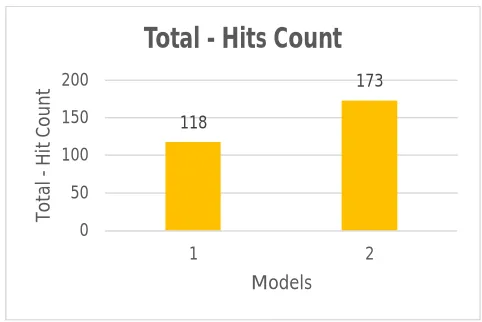
caches for both proposed models are shown in Figure 3. It has been observed that hit count remains same in L1 cache. Large difference in hit count values have been seen at L2 and L3 caches. Proposed cache model 1 has largest L2 cache hit count value than cache model 2. For cache model 2, L3 cache has largest hit count value than cache model 1. In cache model 1, hit count value at L2 is high because it contains no duplicated data of L1 cache, which is there in cache model 2 causing its hits to be shifted from L2 to L3 cache. Thus, it is clear that exclusive LLC gives better performance than inclusive LLC. Therefore, cache model 1 performs better at L2 and cache model 2 performs better at L3. To find out which proposed cache model gives overall best performance at hit count parameter, the total hit counts for both the cache models are shown in Figure 4. Higher the hit count value better is the performance. It has been found that proposed cache model 2 performs better than proposed cache model 1.
Figure 3 Individual Cache Hit Counts Figure 4 Total Hit Counts
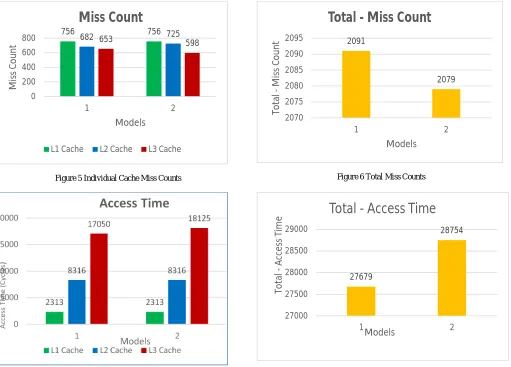
2) Miss Counts (m): Miss counts in L1, L2 and L3 caches for both the cache models are shown in Figure 5.Total number of misses in L1 cache is same for both models. It has been found that model 1 performs better at L2 and model 2 performs better at L3. In order to find out which proposed cache model gives overall best performance at miss count parameter, the total number of miss counts for both the cache models is shown in Figure 6. Lower the miss count value better is the performance. Thus, model 2 gives overall better performance than model 1.
3) Cache Access Time (ta): Figure 7. shows number of cycles used in L1, L2 and L3 caches for both our proposed cache models. It has been found that L1 and L2 caches are accessed
the same number of times in both models. But the number of accesses at L3 cache level for model 2 is greater than model 1. This is because exclusive LLC (model 2) contains more unique entries than inclusive LLC (model 1) in cache hierarchy. Therefore, in model 1, miss at L2 cache level mostly leads to an access to costly main memory. In order to find out which proposed cache model gives overall best performance, the total number of CPU cycles used by both cache models are shown in Figure 8. Lower the number of CPU cycles used, better is the performance. Model 2 has been found to use 1075 extra CPU cycles than model 1. Thus, model 1 is better than model 2 for this evaluation parameter.
15 15
74
31 29
127
0 50 100 150
1 2
H
it
C
o
u
n
t
Models
Hit Count
L1 Cache L2 Cache L3 Cache
118
173
0 50 100 150 200
1 2
To
ta
l
-H
it
C
o
u
n
t
ISSN: 2231-5381
http://www.ijettjournal.org
Page 2949 Figure 5 Individual Cache Miss Counts Figure 6 Total Miss Counts
Figure 7 Number of Cycles Used in L1, L2 and L3 Cache Figure 8 Total Number of Cycles Used
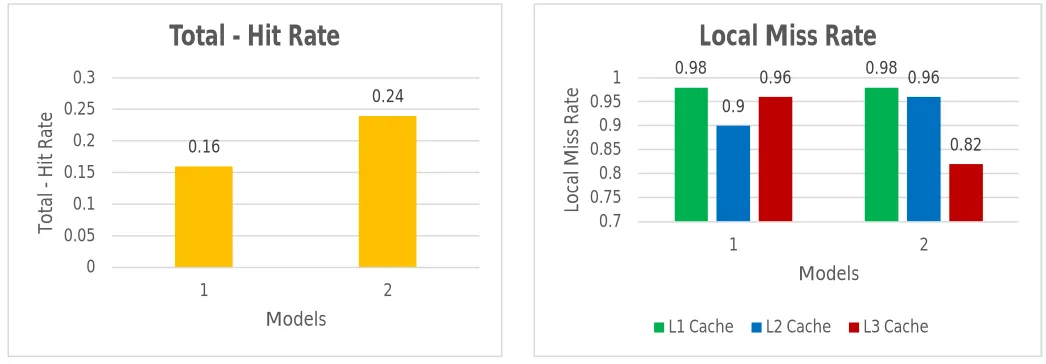
4) Hit – Rate (hr): Hit rates in individual cache levels for both cache models are shown in Figure 9. Again, hit rate is same for L1 cache in both the models. Hit rate at L2 and L3 cache levels is greater in model 1 and model 2 respectively for the obvious reasons. The total hit rates in both the proposed cache models for this performance parameter is shown in Figure 10. Higher the hit rate better is the performance. Thus, model 2 gives better overall performance than model 1.
5) Local Miss Rate (lmr): It depends on both the number of accesses to cache level and the number of misses occurring there. Lower the local miss rate values, better is the performance. For both proposed cache models, local miss rate in individual cache levels are shown in Figure 11. The number of accesses to slower LLC is more in model 2 but the possibility of occurrence of miss there is low causing local miss rate to go low at LLC (L3 here). Also, the number of accesses to L2 is same for both models, but in model 2, possibility of miss is high at L2 cache level causing local miss rate to go high there. Thus, model 1 performs better at L2 cache level and model 2 performs better at L3 cache level.
Total local miss rates for two proposed cache models are shown in Figure 12. Cache model 2 has been found to perform better than cache model 1.
756 756
682 653 725
598
0 200 400 600 800
1 2
M
is
s
C
o
u
n
t
Models
Miss Count
L1 Cache L2 Cache L3 Cache
2091
2079
2070 2075 2080 2085 2090 2095
1 2
To
ta
l
-M
is
s
C
o
u
n
t
Models
Total - Miss Count
2313 2313
8316 8316
17050 18125
0 5000 10000 15000 20000
1 2
A
cc
es
s
Ti
m
e
(C
yc
le
s
)
Models
Access Time
L1 Cache L2 Cache L3 Cache
27679
28754
27000 27500 28000 28500 29000
1 2
To
ta
l
-A
cc
es
s
Ti
m
e
Models
Total - Access Time
0.02 0.02
0.1
0.04 0.04
0.18
0 0.05 0.1 0.15 0.2
1 2
H
it
R
at
e
Models
Hit Rate
ISSN: 2231-5381
http://www.ijettjournal.org
Page 2950 Figure 9 Individual Cache Hit-RatesFigure 10 Total Cache Hit-Rates Figure 11 Local Miss Rates in L1, L2 & L3 Cache
Figure 12 Total Local Miss Rates
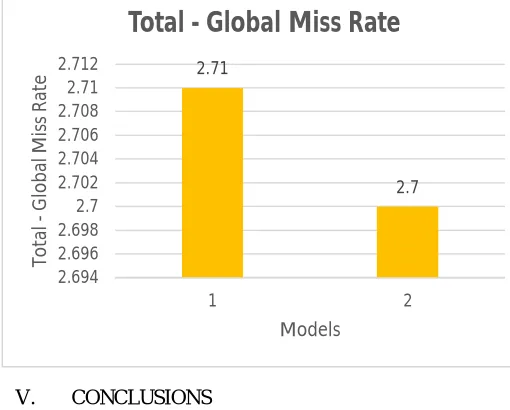
6) Global Miss Rate (gmr): It is miss count at all cache levels divided by total number of CPU generated accesses. CPU generated accesses are fixed i.e. 771. Thus, global miss rate value depends only on number of misses occurring at each cache level. As the number of misses is more in inclusive L2 cache in Model 2 than exclusive L2 cache in Model 1, global miss rate is more at L2 in Model 2. Similarly, global miss rate is low at LLC in Model 2. Global Miss Rates for individual cache levels are shown in Figure 13. Therefore, model 1 performs best at L2 cache level and model 2 performs best at L3 cache level. Total Global Miss Rate for two cache models are shown in Figure 14. No large gap has been observed between the two model’s global miss rates, but still model 2 gives better performance than model 1.
Figure 13 Global Miss Rates in L1, L2 & L3 Cache 0.16
0.24
0 0.05 0.1 0.15 0.2 0.25 0.3
1 2
To
ta
l
-H
it
R
at
e
Models
Total - Hit Rate
0.98 0.98
0.9
0.96 0.96
0.82
0.7 0.75 0.8 0.85 0.9 0.95 1
1 2
Lo
ca
l M
is
s
R
at
e
Models
Local Miss Rate
L1 Cache L2 Cache L3 Cache
2.84
2.76
2.72 2.74 2.76 2.78 2.8 2.82 2.84 2.86
1 2
To
ta
l
-Lo
ca
l M
is
s
R
at
e
Models
Total - Local Miss Rate
0.98 0.98
0.88 0.85 0.94
0.78
0 0.2 0.4 0.6 0.8 1 1.2
1 2
G
lo
b
al
M
is
s
R
at
e
Models
Global Miss Rate
ISSN: 2231-5381
http://www.ijettjournal.org
Page 2951 Figure 14 Total Global Miss RatesV. CONCLUSIONS
Multi-level caching is emerging as an important field in
memory system architecture. A key factor to obtain good
application performance in today’s computer systems is to
have a proper understanding of various concepts of
hierarchical memory system. One such concept is multi-level
cache inclusion. The inclusion property of cache hierarchies
dictates that the contents of the upper level caches be a subset
of those of lower level caches. According to whether this
property has been enforced or not, multi-level caches have
been grouped into mainly two categories- inclusive and
exclusive. We’ve also proposed two cache models. The two
proposed cache models have been experimentally evaluated
using simulator which is implemented in PHP version-5.3.
Our first proposed cache model involves making level1 and
level2 as exclusive and level3 as inclusive to both level1 and
level2 in a three level cache hierarchy and second proposed
cache model involves level1 and level2 as inclusive and level3
as exclusive to level2. These two multi-level cache models
have been compared using 6 parameters- hit count, miss
count, hit rate, access time, local miss rate, global miss rate. It
has been found that second proposed cache model gives best
overall performance in terms of high hit count and hit rate and
low local and global miss rates.
REFERENCES
[1] J.L. Baer and W.H. Wang, “On the inclusion properties for
multi-level cache hierarchies,” In ISCA-10, pp. 73–80, 1988.
[2] K. Fletcher, W. E. Speight, and J. K. Bennett, “Techniques for
Reducing the Impact of Inclusion in Shared Network Cache
Multiprocessors,” Rice ELEC TR 9413, 1995.
[3] N. P. Jouppi, “Improving direct-mapped cache performance by the
addition of a fully associative cache and pre-fetch buffers,” In
ISCA, 1990.
[4] A. Jaleel, E. Borch, M. Bhandaru, S. C. Steely Jr., and J. Emer,
“Achieving non-inclusive cache performance with inclusive
caches: Temporal Locality Aware (TLA) cache management
policies,” In MICRO-43, MICRO ’43, 2010.
[5] Junlin Lu, Xu Cheng, Zichao Xie, Lingda Li, Dong Tong,
“Improving inclusive cache performance with two-level eviction
priority,” In IEEE 30th International Conference on Computer
Design (ICCD), pp. 387-392, 2012.
[6] T. M. Wong and John Wilkes, “My cache or yours? Making
storage more exclusive,” USENIX Annual Technical Conference,
pp. 161–175, 10–15 June 2002.
[7] B. S. Gill, “On Multi-level Exclusive Caching: Offline Optimality
and Why promotions are better than demotions,” FAST'08
Proceedings of the 6th USENIX Conference on File and Storage
Technologies, No. 4, 2008.
[8] J. Gaur, M. Chaudhuri, S. Subramoney, “Bypass and insertion
algorithms for exclusive last-level caches,” ISCA-38, 2011.
[9] S. Gupta, H. Gao, H. Zhou, “Adaptive Cache Bypassing for
Inclusive Last Level Caches,” 2012.
[10] Zheng, Ying, Brian T. Davis, and Matthew Jordan, “Performance
evaluation of exclusive cache hierarchies,” In Performance
Analysis of Systems and Software, 2004 IEEE International
Symposium on-ISPASS, pp. 89-96, 2004. 2.71
2.7
2.694 2.696 2.698 2.7 2.702 2.704 2.706 2.708 2.71 2.712
1 2
To
ta
l
-G
lo
b
al
M
is
s
R
at
e