MODEL FOR THE CONTINUANCE USE INTENTION OF MOBILE LEARNING
GAMES
MI VENTER* & L DE WET** *CENTRAL UNIVERSITY OF TECHNOLGY
**UNIVERSITY OF THE FREE STATE Abstract
Mobile educational applications encompass some of the most valuable learning tools that have ever been developed. Games for learning are most effective when multiple sessions are involved. Previous research on the use of educational games in mathematics education has focused primarily on the learning potential of these games and has not adequately addressed the continuance use intention of these games. The purpose of this paper is to provide a model for the continuance use intention of mobile mathematical learning games. A mixed method research methodology was employed where qualitative and quantitative data was gathered through surveys and interviews. Sixty children, aged 8 to 12, from selected schools in one of South Africa’s provinces, participated in the study. The results indicated that a combination, balance and interplay of the various dimensions of enjoyment and engagement (cognitive, affective and physical) in a mathematical mobile learning game influenced the continuance use intention of learners. The resultant theoretical model could provide educators, parents and educational game designers with an integrated approach that should allow them to design and evaluate specific mathematical mobile learning games for motivational potential.
Keywords: mathematical applications, mathematical games, mobile games, continuance use intention, primary school learners
1. INTRODUCTION
Many teachers, parents and learners are experiencing the transformational opportunities that mobile technologies bring to learning (Thiruchelvam, 2014; Huang, Chang & Wu, 2017). Research studies have shown improved performance of primary school learners in mathematics (maths) after the use of several mobile mathematical learning games (MMLGs) (Bos & Lee, 2013; Pope, Boaler & Mangram, 2015; Riconscente, 2013; Subramanya & Farahani, 2012). Despite the promising findings of these studies, MMLGs will be able to assist primary school learners in improving their maths skills in the long run only if they perceive these MMLGs in a positive light and continue to use them on a regular basis (Kapp, 2013). Continuance use intention (CUI) can be defined as a user’s intention to continually use a system or reuse a system (Bhattacherjee, 2001). The continuous use of content in MMLGs has the advantage of learners gaining deeper insight into certain maths concepts, as they repeatedly practise difficult problems (Bos & Lee, 2013). Without knowledge of what drives the continuance use intention (CUI) of learners towards MMLGs, educators and parents will not be able to select the MMLGs with the best potential to stimulate continued use behaviour. This may result in MMLGs failing to be an effective tool to assist in the elevation of the maths skill levels of primary school learners in South Africa (SA).
Currently, limited research is available regarding the factors that drive learners to continue using MMLGs. The aim of this paper is to propose a novel model that could be used to predict the CUI of MMLGs. The main research question that was formulated to guide this study was: Which constructs influence the CUI of primary school learners towards MMLGs?
The paper is structured firstly to present the theoretical model. Secondly, the research design and methodology are discussed, followed by the results, conclusions, limitations and future research.
2. LITERATURE REVIEW
2.1 Theoretical model
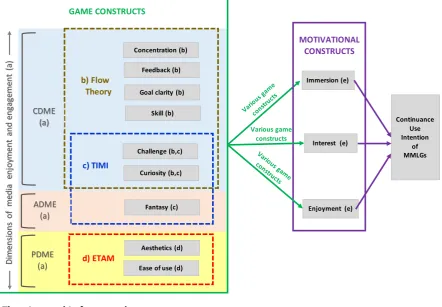
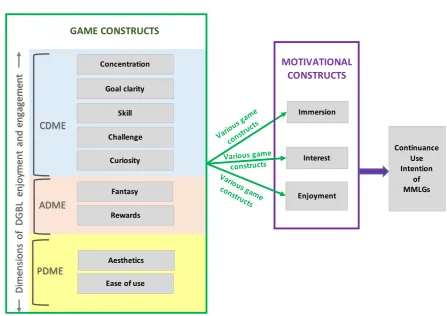
provide a positive experience, children are unlikely to interact with it or accept it, let alone re-use it (Wang, Shen & Ritterfeld, 2008). Vorderer, Klimmt and Ritterfeld (2004) argued that media-related enjoyment is quite a complex construct and is composed of various physical, affective and cognitive dimensions. In addition, they claimed that a comprehensive account of media enjoyment should also consider the antecedents of enjoyment. In a similar fashion, Domagk, Schwartz, and Plass (2010) believed that constructs related to motivation in DGBL environments, correlate to cognitive, affective and behavioural theoretical foundations and should be taken into account when designing educational games. These authors created the INTERACT model of learner engagement in DGBL environments, which distinguishes among cognitive engagement, affective engagement, and behavioural engagement. Therefore, based on the conceptualisations of Vorderer, Klimmt and Ritterfeld (2004) and Domagk et al. (2010), the antecedents of interactive media engagement and enjoyment were divided into three dimensions, namely:
the cognitive dimension of media engagement and enjoyment (CDME), referring to the mental processing, integration, organisation and cognition in a game and the perceptions thereof; the affective dimension of media engagement and enjoyment (ADME), referring to the emotional
engagement with the game environment and experienced emotions invoked by the game environment;
the physical dimension of media engagement and enjoyment (PDME), referring to the aspects that the physical senses perceive, as well as the physical interaction with the system.
Theories that address these separate dimensions were therefore, sought to shed light on the constituents of these dimensions. Designers and researchers of video games regularly use the concept of flow as an indication of engagement and enjoyment and direct their attention to the important balance that have to exist between challenge and skill. Games should be designed so that the level of challenge is not too great (resulting in frustration), nor too slight (which would lead to boredom) (Salisbury & Tomlinson, 2016). The constructs of Flow Theory (Csíkszentmihályi, 1990), namely concentration, challenge, curiosity, feedback, goal clarity and skill, are generally accepted to be able to predict the cognitive engagement and enjoyment in various game settings (Sweetser & Wyeth, 2005). These constructs were, therefore, included in the theoretical model of the study in order to explain the CDME.
In order to explain the ADME, the Theory of Intrinsically Motivating Instruction (TIMI) proposed by Malone and Lepper (1987), was investigated. According to these two authors, the fantasy component of TIMI has the potential to invoke strong emotions from players, which then act as a mechanism to draw them into an instructional game. As the players identify with game characters and stories, they become emotionally involved with the fantasy world (Kiili, 2005). Moreover, Sedano, Laine, Vinni and Ellis (2013) found a significant positive correlation between fantasy and affective engagement. The fantasy construct was, therefore, included in the theoretical model to address the ADME.
With regard to PDME, Bailey, Wise and Bolls (2009) argued that physical engagement in a game depends on the number of senses engaged by the medium. They further added that it is related to how aesthetically pleasing the graphics, sound and animation components of a game are. Van der Heijden (2003) coined this term as perceived visual attractiveness and included it in his extended Technology Acceptance Model (TAM) for website usage. He further claimed that the perceived visual attractiveness will impact the physical enjoyment of users only if the system was easy to use. Two constructs contained in the expanded TAM of Van der Heijden (2003) were included in the PDME, namely perceived ease of use and aesthetics (perceived visual attractiveness). The following nine constructs included in the theoretical model, namely aesthetics, challenge, concentration, curiosity, fantasy, feedback, goal clarity, ease of use and skill, will be referred to as game constructs in this paper.
In the following section each of the game constructs will be discussed, followed by a discussion on each of the motivational constructs.
2.1.1 Game constructs Concentration
Concentration can be defined as the focused attention of an individual on what he or she is doing (Jin, 2012). The more concentration a task requires in terms of attention and workload, the more captivating it will be. Concentration is, therefore, positively related to the engagement of learners in DGBL environments (Brown, Ceccarini & Eisenhower, 2007). In addition, concentration is one of the most important predictors of flow and enjoyment in gaming and DGBL environments (Kiili, 2005; Chang, 2013).
Figure 1: Theoretical model for CUI towards MMLGs
Feedback
In educational games, feedback refers to some response from the game to an action by the learner. Educational games should use scores to tell players how they are progressing and reward players with positive feedback on progress and success, thereby encouraging mastery of the game content (Parsons, Ryu & Cranshaw, 2007). Klimmt, Hartmann and Frey (2007) observed that players enjoyed watching the results of the actions they performed in a digital game.
Continuance Use Intention
of MMLGs
Ease of use (d) Concentration (b)
Challenge (b,c) Skill (b) Goal clarity (b)
Aesthetics (d) Fantasy (c) Feedback (b) Curiosity (b,c) d) ETAM c) TIMI b) Flow Theory GAME CONSTRUCTS Immersion (e)
Goal clarity
According to Shi and Shih (2015), the goals of a game are the central concept of a game on which all game element designs should be based. Goals and objectives help learners to engage, since the achievement of goals plays a significant role in motivating them (Parsons et al., 2007). For example, Samur (2012) found that clear, meaningful and achievable goals increased and sustained Grade 5 learners’ engagement while they were playing two MMLGs, namely Candy Factory and Pearl Diver.
Skill
Skill is defined as how adept a player is at playing a game and is one of the components deemed necessary by Csíkszentmihályi (1990) for an individual to enter a state of flow. In order for players to experience flow, their perceived skills must match the challenge provided by the game, and both challenge and skills must exceed a certain threshold (Sweetser & Wyeth, 2005). Skill has been used to measure the flow experience of playing console-based video games (Jin, 2012), as well as the flow experience in DGBL environments (Shernoff et al., 2014).
Challenge
Challenge is defined as a sense that one’s capabilities are being stretched (Sweetser & Wyeth, 2005). A positive challenge is frequently recognised as among the most important predictors of flow and players’ enjoyment in DGBL and gaming environments. This is because players experience positive challenges as rewarding and become excited when these challenges match their skills (Shernoff et al., 2014). In empirical studies in DGBL environments, challenge has been widely found to improve learner enjoyment, engagement, understanding of educational content, as well as prolonged play intention (Sadler, Romine, Stuart & Merle-Johnson, 2013).
Curiosity
Curiosity in digital game-based environments refers to the desire of players for uncertainty and the pleasure of reducing information gaps through the exploratory actions a player takes in a game. In addition, there is a direct link between curiosity and player engagement levels (To, Ali, Kaufman & Hammer, 2016). Likewise, Sedano et al. (2007) confirmed that curiosity was the main driving force for the engagement in mobile learning games for learners of varying ages. According to Mouaheb, Fahli and Moussetad (2012), the curiosity generated by uncertainty in a game, activates and maintains the desire of players to continue playing a game.
Fantasy
‘Game fantasy’ refers to the virtual fantasy world embedded in digital games by making use of virtual characters, stories and multimedia (Tamborini & Skalski, 2006). A large body of evidence suggests that the fantasy world (virtual characters and environment) embedded in educational games presents a wide array of benefits and advantages. For example, it was found that due to the fantasy world of DGBL environments, learners were more engaged and motivated to learn (Tan, Goh, Ang & Huan, 2013), felt immersed and developed self-efficacy and collaboration skills (Sadler et al., 2013).
Aesthetics
Ease of use
Perceived ease of use includes how easy it is to learn, control and understand a mobile game, as well as the clarity of instructions and flexibility of game play (Chinomona, 2013). In addition, it is proposed that educational games that are easy to use will be less threatening to learners and, therefore, increase perceived enjoyment (Moon & Kim, 2001). Empirical studies have proven that ease of use is a significant predictor of the intention to play mobile games (Liu & Li, 2011), as well as of the CUI of mobile games (Chinomona, 2013).
2.1.2 Motivational constructs
Immersion
Immersion is an element of flow that can be described as deep but effortless involvement that often results in loss of concern for self and everyday life, as well as an altered sense of time (Sweetser & Wyeth, 2005). When players are in a state of immersion, they become less aware of themselves, their surroundings and time (Brown & Cairns, 2004). Immersion has been widely cited as the reason why players have enjoyed and wanted to replay digital games (Krall, 2012; Pedersen, 2012). For example, Shin and Shin (2011) found immersion to be a significant predictor of perceived enjoyment and use intention of social network games, while Li, Liu, Xu and Heikkila (2013) found immersion to be a significant predictor of the CUI in social network games. It is also positively associated with the CUI of online games (Xu, Turel & Yuan, 2012).
Interest
Samur (2012) defined interest in a DGBL environment as the learners’ positive and negative feelings about the task, such as a task being interesting or boring. Interest is closely linked to intrinsic motivation and learners will be intrinsically motivated only by activities that they find intrinsically interesting, activities that have the appeal of challenge, novelty, or aesthetic value (Ryan & Deci, 2000). Experimental studies have found several constructs that could increase the interest of learners in DGBL settings. For example, Sedano et al. (2013) reported that the incorporation of fantasy significantly increased learners’ interest in DGBL activities. Moreover, Gilakjani (2012) highlighted the role of multimedia in enhancing student interest, while Parsons (2007) illustrated the positive relationship between task-specific goals and leaner interest and involvement in game play. Research also indicated that higher levels of interest in educational games lead to higher levels of engagement and usage (Coller & Shernoff, 2009; Coller, Shernoff & Strati, 2011).
Enjoyment
Enjoyment can be defined as the extent to which the activity of using an information system is perceived to be enjoyable in its own right, apart from any performance consequences that may be anticipated (Van der Heijden, 2004). According to Vorderer et al. (2004), enjoyment is at the core of all media entertainment, including digital games. Wang et al. (2008) agreed by stating that enjoyment is regarded as one of the most important factors affecting consumer behaviour in gaming contexts. Enjoyment has been found to be a significant predictor of the intention to use mobile games (Liu & Li, 2011), and of the CUI of mobile games (Chinomona, 2013; Nguyen, 2015).
3. RESEARCH DESIGN AND METHODOLOGY 3.1 Research Design
3.2 Research Methodology
3.2.1 Research instrument
The Ballometer, a visual research tool that was designed to obtain Likert scale responses from children (Rebane & Roost, 2014), was used as the survey instrument for the study. The 5-point Likert scale used in the Ballometer, namely '1 - Not at all', '2 - A little', '3 - Somewhat', '4 - Pretty much' and '5 - Very much', was adopted from a questionnaire designed by Shernoff et al. (2014) for the measuring of engagement in educational games and ‘gamified’ learning environments. The measures included in the Ballometer were adapted from prior research and are shown in Appendix A. In addition, open-ended, in-depth group interviews were conducted to gather the qualitative data for the study.
3.2.2 Reliability and validity
The Ballometer was pilot-tested before being used in the actual research study. In addition, measures from previous studies were applied to ensure content validity of the Ballometer. A principal component analysis (PCA) on the 13 constructs included in the Ballometer was conducted and the results indicated good convergent validity. The Cronbach’s α was calculated, resulting in a value of 0.934, which was above the accepted level of 0.8 (Field, 2009). This indicated that the Ballometer was a reliable measuring instrument. The MMLGs that learners were exposed to during the study were carefully selected for their educational potential by using two reputable educational media rating sites, namely Barefire Labs and Common Sense Education (Costanza, 2014).
3.2.3. Population and sampling
The population for the study consisted of primary school learners in Bloemfontein, a city in the Free State province of South Africa (SA). A purposeful sampling technique was employed by applying various criteria, for example age and gender, where the researcher chose participants who would be most suitable to answer the research questions (Etikan, Musa & Alkassim, 2016). The sampling strategy that was used resulted in the following sample: 60 learners, of which 53.33% were girls and 47.67% were boys, 8.33% were eight (8) years old, 10.00% were nine (9) years old, 33.33% were 10 years old, 28.33% were 11 years old and 20.00% were 12 years old.
3.2.4 Data collection
Four groups of learners were exposed to 20 MMLGs over a period of eight (8) weeks during the afternoons in classrooms at various schools. Each session ranged between 60 and 90 minutes. The MMLGs were installed on seven-inch Android tablets. Learners completed a Ballometer for every MMLG they played, resulting in 626 valid surveys. Interviews were conducted with learners on three occasions during the eight-week period.
3.2.5 Data analysis
The quantitative data collected in the study was analysed in SPSS 19. Stepwise linear multiple regression was used to analyse the quantitative data. Additionally, all interviews were recorded and transcribed. Content analysis was used in order to identify recurrent themes in the qualitative data gathered from these interviews.
3.2.6 Ethical considerations
4. RESULTS
4.1 Results of regression models
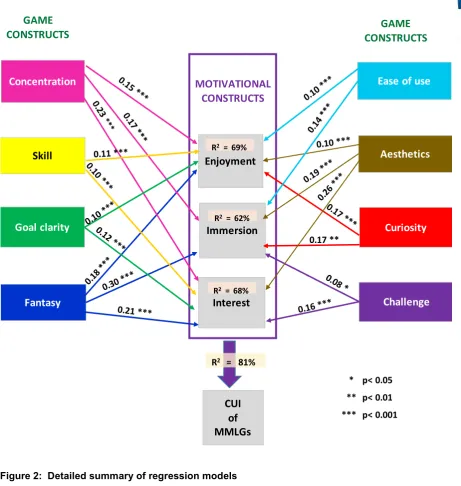
Three stepwise multiple regression models were constructed in order to determine which combination of game constructs (aesthetics, challenge, concentration, curiosity, fantasy, feedback, goal clarity, ease of use and skill) were able to predict the three motivational constructs (enjoyment, interest, and immersion) respectively. An additional multiple regression model was constructed in order to determine which combination of motivational constructs were able to predict the CUI of MMLG of primary school learners.
4.1.1 Results of stepwise multiple regression for the enjoyment motivational construct
A total of seven game constructs, namely aesthetics, concentration, curiosity, fantasy, goal clarity, ease of use and skill, made a statistically significant contribution to the first regression model and were entered into this regression model. This resulted in a significant model R2= 0.69, F(7,618) =
197.50, p < 0.001; adjusted R2=0.688. The adjusted R2 value of 0.69 indicated that 69% of the
enjoyment motivational construct could be accounted for by the aesthetics, concentration, curiosity, fantasy, goal clarity, ease of use and skill game constructs.
4.1.2 Results of stepwise multiple regression for the interest motivational construct
A total of six game constructs, namely aesthetics, challenge, concentration, fantasy, goal clarity and skill, made a significant statistical contribution to the second regression model and were entered into this regression model. This resulted in a significant model R2= 0.68, F(6,619) = 223.59, p < 0.001;
adjusted R2=0.68. The adjusted R2 value of 0.68 indicated that approximately 68% of the interest motivational construct could be accounted for by the aesthetics, challenge, concentration, fantasy, goal clarity and skill game constructs.
4.1.3 Results of stepwise multiple regression for immersion motivational construct
A total of six game constructs, namely aesthetics, challenge, concentration, curiosity, fantasy and ease of use, made a statistical contribution to the third regression model and were entered into this regression model. This resulted in a significant model R2= 0.62, F(6,619) = 168.78, p < 0.001; adjusted R2=0.62. The adjusted R2 value of 0.62 indicates that y 62% of the immersion motivational
construct could be accounted for by the aesthetics, challenge, concentration, curiosity, fantasy and ease of use game constructs. A coefficients table comparing the three regression models is shown in Table 1.
Table 1: Table of compassion between motivational constructs
Motivational Constructs Game
Constructs
Enjoyment Immersion Interest
β t p β t p β t p
Aesthetics 0.23 6.22 <0.001 0.19 4.71 <0.001 0.26 7.26 <0.001
Challenge - - ns 0.08 2.33 <0.020 0.16 5.28 <0.001
Concentration 0.15 5.66 <0.001 0.17 5.50 <0.001 0.23 7.88 <0.001
Curiosity 0.16 4.84 <0.001 0.11 2.91 0.004 - - ns
Fantasy 0.18 4.74 <0.001 0.30 7.26 <0.001 0.21 5.53 <0.001
Goal clarity 0.14 4.45 <0.001 - - ns 0.12 3.80 <0.001
Ease of use 0.10 3.47 0.001 0.14 4.71 <0.001* - - ns
Skill 0.11 3.71 <0.001 - - ns 0.10 3.72 <0.001
4.1.4 Results of stepwise multiple regression for CUI construct
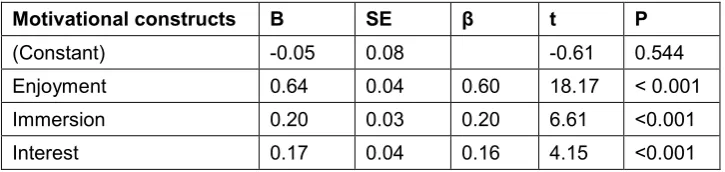
All motivational constructs made a significant statistical contribution to the last regression model used for the study, and were entered into this regression model. This resulted in a significant model R2=
0.80, F(4,621) = 652.68, p < 0.001; adjusted R2=0.80. The adjusted R2 value of 0.80 indicates that 80% of the CUI construct could be accounted for by the enjoyment, immersion, and interest constructs. The coefficients table of this regression model is shown in Table 2.
Table 2: Model coefficients for regression model of CUI motivational construct
Motivational constructs B SE β t P
(Constant) -0.05 0.08 -0.61 0.544
Enjoyment 0.64 0.04 0.60 18.17 < 0.001
Immersion 0.20 0.03 0.20 6.61 <0.001
Interest 0.17 0.04 0.16 4.15 <0.001
Figure 2: Detailed summary of regression models
Figure 3: High level summary of regression results
* p< 0.05 ** p< 0.01 *** p< 0.001
CUI
of
MMLGs
Ease of use
Concentration
Challenge
Skill
Aesthetics
Goal clarity
Fantasy
Curiosity
GAME
CONSTRUCTS
Immersion
Enjoyment
Interest
MOTIVATIONAL
CONSTRUCTS
R2 = 81%
0.17 **
GAME
CONSTRUCTS
R2 = 68%
R2 = 62%
R2 = 69%
CUI of MMLGs Immersion
Enjoyment Interest
MOTIVATIONAL
CONSTRUCTS
Various game constructs
R2 = 68%
4.2 Results of interviews
During interviews learners were asked why they wanted to replay MMLGs. The reasons that were provided are summarised in Table 3. From Table 3 it can be seen that the rewards that learners received while playing MMLGs were mentioned by the largest percentage of learners. Games usually reward the players’ achievements as a mechanism to increase engagement and immersion (Torrente
et al., 2011). In most games, the system provides rewards when players reach a target specified by the designers. These player rewards could include gathering valuable game objects, gaining power or unlocking new levels or objects (Shi & Shih, 2015).
Table 3: Reasons why learners wanted to replay MMLGs
Reason n %
1 Rewards 48 32.0%
2 Fantasy 35 23.3%
3 Interaction mechanisms 14 9.3%
4 Variety 10 6.7%
5 Learning math 9 6.0%
6 Simulates real games 8 5.3% 7 Control - Customisation 7 4.7%
8 Aesthetics 6 4.0%
9 Interest 5 3.3%
10 Challenge 4 2.7%
11 Concentration 2 1.3%
12 Clear Goals 1 0.7%
13 Immersion 1 0.7%
Total 150 100.0
%
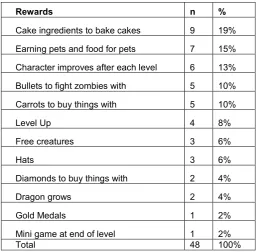
Table 4 indicates the various rewards that learners mentioned during interviews. Learners particularly enjoyed the following four rewards: cake ingredients to bake cakes (19%), earning pets and food for pets (15%), characters improving after each level (13%), and bullets to fight zombies with (10%).
Table 4: Types of rewards in MMLGs
Rewards n %
Cake ingredients to bake cakes 9 19%
Earning pets and food for pets 7 15%
Character improves after each level 6 13%
Bullets to fight zombies with 5 10%
Carrots to buy things with 5 10%
Level Up 4 8%
Free creatures 3 6%
Hats 3 6%
Diamonds to buy things with 2 4%
Dragon grows 2 4%
Specific comments in terms of the rewards received in MMLGs made by some learners were:
Learner 1 (boy): 'I want to play the Squeebles Fractions game again because I liked the different flavours and toppings I get to bake cakes with. You do cake sums that makes you crave the cake and then you can bake your own cake. I just wish I could eat my own cake. The judges in the game decide how your cake tastes (like) and then give you a score'.
Learner 2 (girl): 'I want to play Pet Bingo again because I want more pets, they are so adorable!' Learner 3 (girl): 'I want to play King of Maths Junior again because your player gets more pretty
and more funny as you go along'.
Learner 4 (boy): 'I want to play Math Vs Zombies again, the most because you collect bullets to shoot the zombies'.
5. CONCLUSIONS
The potential of MMLGs to improve the maths skill levels of SA learners is of utmost importance for the educational system in SA. This study has shed light on what drives learners to continue using these MMLGs. The main research question that was formulated to guide this study was: Which constructs influence the CUI of primary school learners towards MMLGs? This research question was answered by providing a theoretical model composed of three motivational constructs, namely enjoyment, interest and immersion. These constructs were able to predict the CUI of primary school learners towards MMLGs. In turn, various game constructs in the theoretical model were able to predict the three motivational constructs.
In contrast to existing research in DGBL, the main contribution of this research study is the integrated theoretical model that was developed through in-depth and systemic effort to incorporate elements from different distinct theories. The constructs in the theoretical model and the relationships amongst them represent the complex and dynamic interplay that is characteristic of MMLGs, and that in turn influences the CUI of primary school learners. The theoretical model that was developed can, therefore, be used to predict the CUI of primary school learners towards MMLGs.
Figure 4: Revised Theoretical model for CUI towards MMLGs
This study also provides empirical evidence that a combination of balance and interplay of the various dimensions of enjoyment and engagement (cognitive, affective and physical) in a MMLG influences the motivation of a learner to continue using MMLGs. This can be substantiated with three points:
Firstly, the aesthetics and ease of use constructs, grouped together as the PDME, were found to be significant predictors of motivation to continue using MMLGs. These physical aspects are therefore very important to motivate learners to continue using an MMLG. Learners will be influenced by how pleasing the graphics, sound and animations in a game are to the physical senses and how easy it is to physically use the MMLG. Educators and parents should, therefore, ensure that an optimal combination of these constructs is present in MMLGs. However, the physical dimension of a MMLG in isolation will not be enough to keep learners motivated. Another dimension is needed to stimulate the cognitive abilities of learners.
Secondly, the challenge, concentration, curiosity, goal clarity and skill constructs were grouped together to form the CDME and were found to be significant predictors of motivation to continue playing a MMLG. This means that activities provided in a MMLG need to be challenging, must be coupled with sufficient skill levels, and must require the player to concentrate and have clear goals in order to cognitively engage learners. Educators and parents should, therefore, also ensure that MMLGs provide sufficient opportunity for learners to be cognitively engaged in various activities. The cognitive dimension of a MMLG on its own will, however, also not be able to keep learners motivated to continue using an MMLG. Without emotional engagement in an MMLG, embodied by the ADME, learners will not be motivated to continue using an MMLG.
Continuance Use Intention
of MMLGs
Ease of use Concentration
Challenge Skill Goal clarity
Aesthetics Fantasy Curiosity
CDME - Cognitive dimention of media enjoyment and engagement ADME - Affective dimention of media enjoyment and engagement PDME - Physical dimention of media enjoyment and engagement
GAME CONSTRUCTS
Immersion
Enjoyment Interest MOTIVATIONAL
CONSTRUCTS
CDME
ADME
PDME
Dim
en
sio
ns
of
D
G
BL
e
nj
oy
m
en
t
an
d e
ng
ag
em
en
t
power towards the motivational constructs, as well as the strong support that it received during the interviews. Additionally, the rewards construct was found to create strong positive emotions in learners and was highly intertwined with the fantasy worlds of the MMLGs. Therefore, the fantasy world and rewards in a MMLG should be used to emotionally engage learners with the characters, environment and storyline. The implication of this is that educators and parents should, in particular, select MMLGs with engaging fantasy environments that offer meaningful rewards. The theoretical model developed in this study could provide educators, parents and educational designers with an integrated approach that will allow them to design and evaluate specific MMLGs for motivational potential.
6. LIMITATIONS AND FUTURE RESEARCH
The study had the following limitations: It was conducted in one city of SA only, random sampling was not possible or feasible, and the study had a limited sample size due to time and budgetary constraints. Due to the above-mentioned limitations, the findings from this study cannot be generalised to the broader population of SA.
As the scope of this study focused only on the CUI of primary school learners and not on the educational potential of these MMLGs for learning, it did not investigate the influence of the game constructs on the maths knowledge improvement of learners. It is suggested that the theoretical model of the study could be used to investigate the role that various game constructs could play on measured maths learning improvement of learners. The theoretical model of the study, which proposed a system of linked game constructs that predicted motivational constructs, could also serve to clarify existing findings, as well as to structure future research. Existing studies could be classified in accordance with the three dimensions of media enjoyment and engagement. Clarifying which constructs are examined in a given study will enable useful comparisons. The application of the theoretical model could provide the base for in-depth comparisons that would highlight similarities and differences between different studies.
APPENDIX A: Measures of constructs adopted from prior literature
Construct Ballometer Measures
Aesthetics How much did you like the music, animations and the images in the game? (Shi & Shih, 2015).
Challenge How challenging is the game? (Shi & Shih, 2015).
Concentration How hard were you concentrating while playing the game? (Shernoff et al., 2014)
Control How much control did you have over what you wanted to do in the game? (Fu, Su & Yu, 2009).
CUI of MMLGs How much would you like to play the game again at home? (Lee & Tsai, 2010).
Curiosity How curious were you in the game about what would happen next? (Lee & Tsai, 2010; Choi & Kim, 2004).
Fantasy How much do you like the make-believe aspects of the game, e.g. the environment, characters and story of the game? (Shi & Shih, 2015).
Feedback How much feedback did you receive when you did things correctly or incorrectly in the game? (Fu et al., 2009).
Goal clarity How clear was the goal of the game? (Rebane & Roost, 2014)
Immersion How immersed were you in the game? (I lost track of time while using it / I became very involved in the game forgetting about other things.) (Shernoff et al., 2014).
Interest How interesting was the game? (Shernoff et al., 2014; Choi & Kim, 2004). Ease of use How easy was the game to use? (Thong, Hong & Tam, 2006).
Enjoyment How much fun did you experience while playing the game? (Shernoff et al., 2014)
REFERENCES
Bailey, R., Wise, K. & Bolls, P. 2009. How avatar customizability affects children’ s arousal and subjective presence during junk food – Sponsored online video games. Cyberpsychology & behavior,
12(3): 277–283.
Bhattacherjee, A. 2001. Understanding information systems continuance: an expectation-confirmation model. MIS quarterly, 25(3): 351–370.
Bos, B. & Lee, K. 2013. Mathematics apps and mobile learning. Society for Information Technology & Teacher Education International Conference, 2013, 3654–3660.
Brown, E. & Cairns, P. 2004. A grounded investigation of immersion in games. In Extended Abstracts
of the 2004 Conference on Human Factors in Computing Systems, 1297–1300.
Brown, A., Ceccarini, P. & Eisenhower, C. 2007. Muckrakers: Engaging students in the research process through an online game. In Proceedings of the Thirteenth National Conference of the Association of College and Research Libraries, 226–236.
Chang, C.C. 2013. Examining users′ intention to continue usi ng social network games: A flow experience perspective. Telematics and Informatics, 30(4): 311–321.
Chang, T., Kaasinen, E. & Kaipainen, K. 2012. What Influences Users’ Decisions to Take Apps into Use?: A Framework for Evaluating Persuasive and Engaging Design in Mobile Apps for Well-being. In
Proceedings of the 11th International Conference on Mobile and Ubiquitous Multimedia, 2000–2010.
Chinomona, R. 2013. Mobile Gaming perceived enjoyment and ease of play as predictors of student attitude and mobile gaming continuance intention. Mediterranean Journal of Social Sciences, 4(14): 237–248.
Choi, D. & Kim, J. 2004. Why people continue to play online games : In search of online contents.
Cyberpsychology & behavior, 7(1): 11–25.
Coller, B.D. & Shernoff, D.J. 2009. Video Game-based education in mechanical engineering: A look at student engagement. International Journal Of Engineering Education, 25(2): 308–317.
Coller, B.D., Shernoff, D.J. & Strati, A.D. 2011. Measuring engagement as students learn dynamic systems and control with a video game. Advances in Engineering Education, 2(3): 1–32.
Costanza, K. 2014. App reviews to help choose ed tech this holiday season. [Online], Available: http://www.joanganzcooneycenter.org/2014/12/19/app-reviews-to-help- choose-ed-tech-this-holiday season/ [2016, January 15].
Creswell, J.W. 2008. Research design: Qualitative, Quantitive, and mixed methods approaches. Thousand Oaks, California: Sage Publications Ltd.
Csíkszentmihályi, M. 1990. Finding flow: The psychology of engagement with everyday life. New York: Harper Perennial.
Domagk, S., Schwartz, R.N. & Plass, J.L. 2010. Interactivity in multimedia learning: An integrated model. Computers in Human Behavior, 26(5): 1024–1033.
Etikan, I., Musa, S.A. & Alkassim, R.S. 2016. Comparison of convenience sampling and purposive sampling. American Journal of Theoretical and Applied Statistics, 5(1):1–4.
Garris, R., Ahlers, R. & Driskell, J.E. 2002. A research and practice model. Simulation and Gaming, 33(4): 441–467.
Gilakjani, A.P. 2012. The significant role of multimedia in motivating EFL learners’ interest in English language learning. International Journal of Modern Education and Computer Science, 4(4): 57–66.
Huang, W.D., Johnson, T.E. & Han, S.H.C. 2013. Impact of online instructional game features on college students’ perceived motivational support and cognitive investment: A structural equation modeling study. Internet and Higher Education, 17(1): 58–68.
Huang, Y., Chang, D. & Wu, B. 2017. Mobile Game-Based Learning with a Mobile App: Motivational Effects and Learning Performance. Journal of Advanced Computational Intelligence, 21(6): 963–970.
Jin, S.A. 2012. Toward integrative models of flow: Effects of performance, skill, challenge, playfulness, and presence on flow in video games. Journal Of Broadcasting & Electronic Media, 56(2): 169–186.
Kapp, K. 2013. Top 10 + 1 instructional game design best practices. [Online], Available: http://karlkapp.com/top-10-1instructional-game-design- best-practices/ [2017, November 09].
Kiili, K. 2005. On educational game design : Building blocks of flow experience on educational game design. Published Doctoral Thesis, Tampere University of Technology, Publication 571, Tampere, Finland.
Klimmt, C., Hartmann, T. & Frey, A. 2007. Effectance and control as determinants of video game enjoyment. Cyberpsychology & Behavior, 10(6): 845–847.
Krall, J. 2012. Aspects of replayability and software engineering: Towards a methodology of developing games. Journal of Software Engineering and Applications, 5(7): 459–466.
Kumar, R. 2014. Research Methodology a step by step guide for beginners. Thousand Oaks, California: Sage Publications Ltd.
Lee, M.C. & Tsai, T.R. 2010. What drives people to continue to play online games? An extension of Technology Model and Theory of Planned Behavior. International Journal of Human-Computer Interaction, 26(6): 601–620.
Li, H., Liu, Y., Xu, X. & Heikkila, J. 2013. Please stay with me! An empirical investigation on hedonistic IS continuance model for social network games. In Proceedings of the Thirty Fourth International Conference on Information Systems, 1–18.
Liao, Y. & Wang, Y. 2011. Investigating the factors affecting students’ continuance intention to use business simulation games in the context of digital learning. In Proceedings of the 2011 International Conference on Innovation, Management and Service, 119–124.
Liu, Y. & Li, H. 2011. Computers in human behavior: Exploring the impact of use context on mobile hedonic services adoption : An empirical study on mobile gaming in China. Computers in Human Behavior, 27(2): 890–898.
Malone, T.W. & Lepper, M.R. 1987. Making learning fun: A taxonomy of intrinsic motivations for learning. Aptitude learning and instruction, 3(3): 223–253.
Moon, J.W. & Kim, Y.G. 2001. Extending the TAM for a World-Wide-Web context. Information and Management, 38(4): 217–230.
Mouaheb, H., Fahli, A. & Moussetad, M. 2012. The serious game: what educational benefits ?
Procedia - Social and Behavioral Sciences, 46: 5502–5508.
Nguyen, D. 2015. Understanding Perceived Enjoyment and Continuance Intention in mobile games.
Parsons, D., Ryu, H. & Cranshaw, M. 2007. A design requirements framework for mobile learning environments. Journal of Computers, 2(4): 1–8.
Pavlas, D. 2010. A model of flow and play in game-based learning: The impact of game characteristics, player traits, and player states. Doctoral thesis. University of Central Florida. [Online], Available: http://www.navistudios.net/Pavlas_Davin_A_201012_PhD.pdf.
Pedersen, K. 2012. Replayability in strategic computer games. [Online], Available: https://halhprints.archives-ouvertes.fr/hprints-00728892/ [2016, September 11].
Pope, H., Boaler, J. & Mangram, C. 2015. Wuzzit Trouble : The Influence of a digital math game on student number sense. International Journal of Serious Games, 2(4): 1–18.
Rebane, R. & Roost, K. 2014. Design and development of virtual environments. (Unpublished master’s thesis), University of Tartu Viljandi Culture Academy,Viljandi, Estonia.
Riconscente, M.M. 2013. Results From a controlled study of the iPad fractions game Motion Math.
Games and Culture, 8(4): 186–214.
Ryan, R. & Deci, E. 2000. Self-determination theory and the facilitation of intrinsic motivation, social development, and well-being. The American psychologist, 55(1): 68–78.
Sadler, D.T., Romine, L.W., Stuart, E.P. & Merle-Johnson, D. 2013. Game- based curricula in biology classes: Differential effects among varying academic levels. Journal of Research in Science Teaching, 50: 479–499.
Salisbury, J.H. & Tomlinson, P. 2016. Reconciling Csikszentmihalyi ’ s Broader Flow Theory with Meaning and Value in Digital Games. Transactions of the Digital Games Research Association, 2(2): 55–77.
Samur, Y. 2012. Measuring Engagement Effects of Educational Games and Virtual Manipulatives on Mathematics. Doctoral dissertation. Virginia Polytechnic Institute and State University.
Sedano, C., Leendertz, V., Vinni, M. & Ellis, S.M. 2013. Hypercontextualized learning games: Fantasy, motivation, and engagement in reality. Simulation & Gaming, 44(6): 821–845.
Sedano, C.I., Laine, T.H., Vinni, M. & Sutinen, E. 2007. Where is the answer?: The importance of curiosity in pervasive mobile games. Proceedings of the 2007 conference on Future Play, 46–53.
Shernoff, D., Hamari, J. & Rowe, E. 2014. Measuring Flow in Educational Games and Gamified Learning Environments. In Tampere, Finland EdMedia.
Shi, Y. & Shih, J. 2015. Game Factors and Game-Based Learning Design Model. International Journal of Computer Games Technology, 2015: 3.
Shin, D.H. & Shin, Y.J. 2011. Why do people play social network games? Computers in Human Behavior, 27(2): 852–861.
Subramanya, S.R. & Farahani, A. 2012. Point-of-View Article on: Design of a Smartphone App for Learning Concepts in Mathematics and Engineering. International Journal of Innovation Science, 4(3): 173–184.
Sweetser, P. & Wyeth, P. 2005. GameFlow: A model for evaluating enjoyment in games. Computers in Entertainment, 3(3): 5–6.
Tan, L.J., Goh, H.L.D., Ang, P.R. & Huan, S. V. 2013. Participatory evaluation of an educational game for social skills acquisition. Computers & Education, 64: 70–80.
Tao, Y., Cheng, C. & Sun, S. 2009. What Influences college students to continue using business simulation games? The Taiwan experience. Computers & Education, 53(3): 929–939.
Thiruchelvam, N. 2014. Attitudes towards tablet devices as an educational tool. Master’s thesis. Heriot Watt University.
Thong, J.Y.L., Hong, S.J. & Tam, K.Y. 2006. The effects of post-adoption beliefs on the expectation-confirmation model for information technology continuance. International Journal of Human Computer Studies, 64(9): 799–810.
To, A., Ali, S., Kaufman, G. & Hammer, J. 2016. Integrating curiosity and uncertainty in game design. In Proceedings of 1 st International Joint Conference of DiGRA and FDG, 1–16.
Torrente, J., Marchiori, E.J., Blanco, A. Del, Sancho, P., Ortiz, I.M., Moreno-Ger, P., Fernandex- Manjon, B., Mellini, B., et al. 2011. Production of creative game-based learning scenarios: A
Handbook for Teachers. [Online], Available:
http://collection.openlibra.com.s3.amazonaws.com/pdf/Production-of-creative-game-based-learning- scenarios.pdf?AWSAccessKeyId=AKIAIGY5Y2YOT7GYM5UQ&Signature=X0jnbFo7X/5IxSkgueRv4 1rQbmg=&Expires=1396519661 [2016, June 05].
Van der Heijden, H. 2003. Factors Influencing the Usage of Websites : The Case of a Generic Portal in the Netherlands. Information & Management, 40(1): 174–185.
Van der Heijden, H. 2004. User Acceptance of Hedonic Information Systems. MIS Quarterly, 28(4): 695–704.
Vorderer, P., Klimmt, C. & Ritterfeld, U. 2004. Enjoyment: At the heart of media entertainment.
Communication Theory, 14(4): 388–408.
Wang, H., Shen, C. & Ritterfeld, U. 2008. Enjoyment of digital games: What makes them “ seriously ” fun ? In U. Ritterfeld, M. Cody, & P. Vorderer (eds.). New York: Routledge Serious games: Mechanisms and effects, 25–47.
Xu, Z., Turel, O. & Yuan, Y. 2012. Online game addiction among adolescents: Motivation and prevention factors. European Journal of Information Systems, 21(3): 321–340.