Performance and Fatty Acid Composition of Adipose Tissue,
Breast and Thigh in Broilers Fed Flaxseed: A Review
F. I. L. HERNANDEZ*
Alberta Agriculture and Rural Development, Research and Innovation Division, 7000 113 Street,307 J.G. O’Donoghue Building, Edmonton, AB, T6H 5T6, Canada.
http://dx.doi.org/10.12944/CRNFSJ.1.2.01
(Received: November 18, 2013; Accepted: December 10, 2013)
ABSTRACT
Interest on the enrichment of poultry meat with n-3 fatty acids has increased given its important role in human health. Flaxseed is the main sources of n-3 fatty acids, and contains between 45 to 71% of total fatty acids of the oil as α-linolenic acid. This paper reviews the plausibility of n-3 enrichment. Its focus is on the processing of flaxseed and begins by summarizing the benefits of supplementation on broiler performance. The literature on altering the FA deposition in different tissues is then reviewed, and the factors that affect the incorporation of n-3 PUFA into edible tissues of poultry are investigated. Flaxseed supplementation caused a reduction in the abdominal fat pad, and the main fatty acid deposited in the tissue is LNA. The use of fold-change analysis allowed interpreting and determining the variation of results within experiments that do not report data in similar units of measure. The fold change analysis identified three categories of desaturation response to feeding flaxseed to broilers, resulting in different values for EPA and DHA in both breast and thigh tissues: high, medium and low fold-changes. The use of flaxseed oil, whole or ground flaxseed 14 to 21 day before slaughter is recommended to poultry producers as feeding strategies to optimize n-3 enrichment, without compromising animal performance. Enriched DHA deposition could be accomplished feeding whole flaxseed.
Key words : Abdominal fat, Flaxseed, Intake, α-linolenic acid, n-3 enriched broiler meat.
INTRODUCTION
World-wide health professionals are emphasizing the need to increase intake of n-3 polyunsaturated fats, while reducing trans-fatty acids, saturated fatty acids and cholesterol due to its role in the prevention and treatment of coronary heart disease, major depression, aging and Crohn’s disease, ulcerative colitis, and lupus
erythematosus1,2,3,4. Omega-3 fatty acids, especially
EPA and DHA, are important in mitigating platelet aggregation, blood triglycerides and cholesterol levels, as well as the occurrence of blood clots, and show both antithrombotic and
anti-inflammatory effects5. On the other hand, DHA is a
vital component in the retina and the membrane
phospholipids of the brain6. Be that as it may, the
most important n-3 fatty acids in human nutrition are eicosapentaenoic acid (EPA; 20:5n-3),
docosahexaenoic acid (DHA; 22:6n-3), and
α-linolenic acid (LNA; 18:3n-3), which serves as a
precursor for EPA and DHA synthesis7,8. As people
become more concerned about health issues, demand for more healthy chickens and eggs has risen. Nowadays, farmers are looking at the possibilities to include in the feed of chickens more flaxseed due to its nutritional properties.
Flaxseed or linseed (Linum usitatissimum L) contains 42 to 46% oil, of which 45 to 71% is
α-linolenic acid (LNA; 18:3n-3)9,10,11, it is also an
excellent source of polyunsaturated fatty acids, moderate levels of monounsaturated fat, and low
levels of saturated fat12.
Flaxseed is known for having a number of
anti-nutrients13,14 including cyanogenic glycosides,
called linatine. Apparently, the limiting consumption of flaxseed is due to the presence of these anti-nutrients.
Since flaxseed fat should be readily available for chicks, processing of flaxseed could be a very important step to maximize the potential of flaxseed as an alternative n-3 source for meat enrichment. Research spanning three decades suggests that feeding flaxseed in chickens would significantly alter the fatty acid composition and improve the n-3 content of poultry meat. It is the objective of this review, to synthesize, summarize and compare the impact of different feeding strategies and processing alternatives of flaxseed on performance and fatty acid deposition in edible tissues of poultry using fold change analysis.
Effects of Dietary Composition and Processing of Flaxseed on Performance of Broilers
It is known that the incorporation of flaxseed into livestock feed, especially for poultry,
serve as source of energy, protein and α-linolenic
acid. A number of studies have been conducted to determine how feeding flaxseed oil to broilers influences their performance. In general, flaxseed oil is readily accepted by broilers, and feeding up to 6% of the total dietary matter had no effect on dry
matter intake and on body weight15,17,16 and An et
al., 199719). This may be partially explained by the
fact that digestibility of unsaturated fats is higher
than saturated fats18. Interestingly, broilers fed 10%
flaxseed oil from 28 d to 48 d or 53 d showed an improve or not different final body weight and weight gain when compared to a control diet, and feed
efficiency was not affected by treatments19,20.
In trying to reduce the high cost of the use of n-3 sources in commercial diets, to maximize the use of flaxseed, and to achieve desirable levels of n-3 fatty acids in meat, non-conventional feeding
strategies have been used21, 22,23. Most of the
experiments, analyzed here, carried out on the effect of feeding whole flaxseed have shown that inclusion levels of up to 20%, on a dry matter basis, adversely affected feed conversion efficiency, body
weight and weight gain24. Broiler meat can be
enriched if birds were fed differently, and they used a feeding system that incorporated whole flaxseed at 7 and 14 days prior to slaughter. In addition,
optimal dietary intake of whole flaxseed was reported, where the addition of 10% flaxseed did
not affect carcass and live weights of birds21, 25.
Some studies have shown that feeding ground flaxseed at dietary levels in excess of 7.5% in the dry matter, reduced growth rate and body
weight26,23, resulting in a poor feed conversion
efficiency29,28.This could be explained by the fact
that impaired performance of broilers is accompanied with drastic reduction in the protein
efficiency ratio (PER) and net protein ratio (NPR)26,
mainly due to a reduction in the retention of nitrogen and amino acids caused by the presence of
mucilage29.
Pelleting is a conventional processing procedure that includes the use of pressure and heat. High pressure, increased friction and heat are factors that modify the seed physical structure and cause the lipid content to be more available to digestive enzymes in broilers. It is expected that poisoning by cyanogenic glycosides will be greatly diminished if the endogenous enzymes are
inactivated by heat30. Chicks fed 10% of the total
dry matter as pelleted flaxseed increased their body
weight and feed consumption31.Clearly, pelleting
primarily improves energy and nitrogen
efficiencies32. It increases the density of the feed
and breaks down the cells of the grains, and wet heat can make the nutrients (other than starch) more available. Lately, it waspointed out that the use of NSP-degrading enzyme in a 15% whole flaxseed pelleted diet fed to young birds (18 d) did not affect
BW gain32.
The presence of cyanogenic glycosides in flaxseed has been the major problem with its utilization in poultry diets. Thus, heat treatment of flaxseed has been used to reduce these
compounds32. Some studies were developed to test
the effects of feeding heated flaxseed to broilers, and no deleterious effect on body weight and feed efficiency was achievable when broilers were fed heated flaxseed at 5%; however, the n-3 enrichment
was not desirable or very low 34.
be avoided in young birds. Although, using water-boiled, water-soaked, flaxseed meal + flaxseed oil, autoclaved whole flaxseed or wet autoclaving flaxseed meal at 10% of the dry matter did not
depress the growth of chicks35,36,37,27.
Abdominal Fat Pad
Even though, the increase in carcass fat deposition of the modern broiler chicken continues to be a health concern of consumers, the waste product to the poultry processor and the added waste management problems. However, data
obtained by some authors40,15,19,39,20,39, showed that
feeding flaxseed oil up to 10% of the dry matter to male and female broiler chicks, or up to 17% of
whole flaxseed24 reduced the abdominal fat pad.
Low abdominal and body-fat deposition of broilers fed polyunsaturated fatty acids is considered to be
a result of very high rates of lipid oxidation40,41,42,
accompanied with high lipogenic activity, reflected
by the high ratio of SFA +n-7 +n-943,44.
Effect of Dietary Composition and Processing of Flaxseed on Composition and Fatty Acid Profile of Different Broiler Tissues
Earlier studies have demonstrated that feeding flaxseed-containing diets to broilers can modify the n-3 fatty acids content of meat. For this reason, many research studies have been concentrated to increasing the levels of these fatty acids in almost all products of animal origin. Even though, the increase in meat LNA is a gradual
process45. Phetteplace and Watkins were the first
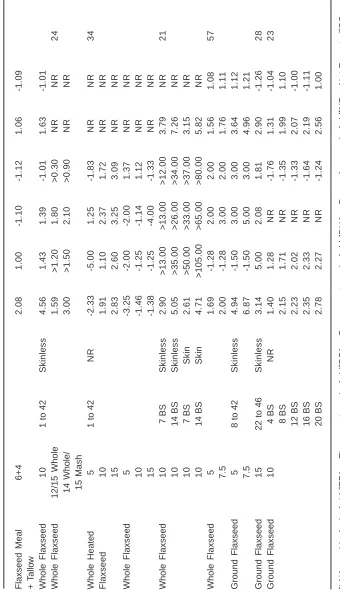
to show that flaxseed increased n-3 fatty acids deposition in chickens. Tables 1, 2 and 3 summarize the fold change in abdominal, breast and thigh tissues PUFA analysis for a number of studies, whose objectives were to contrast the PUFA profile of broilers fed flaxseed supplemented diets and control diets. Regrettably, not all studies report data in similar units of measure (i.e., g/100 g of tissue), so direct comparisons between studies are not possible. Fold change is commonly used in microarray expression analysis; this is an intuitive and powerful method to quickly determine a change
in the expression level of a gene46,47, therefore,
comparisons between studies can be done by using fold change analysis. This is the first time that such type of analysis is done to compare the impact of different feeding strategies and processing
alternatives of flaxseed on fatty acid deposition in edible tissues of poultry.
Abdominal Fatty Acid Profile
Flaxseed oil is not typically employed in
poultry diets as the preferred source of α-linolenic
acid (LNA; 18:3n-3) due to its oxidative potential
during storage and mixing feeds48. However, the
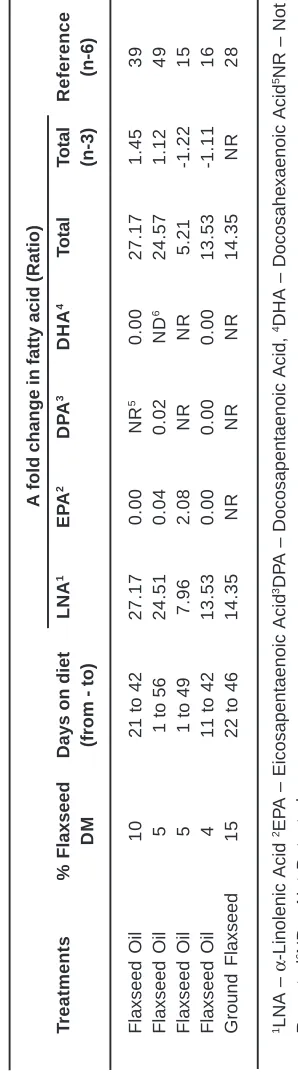
effects of flaxseed oil supplementation on the abdominal fatty acid profile, in essence, showed that as the level of supplementation increased the fold change in fatty acid increased for LNA fatty acid (Table1). On the other hand, long-chain n-3 PUFAs were undetectable and total n-6 unchanged
or decreased16,49. As noted in Table 1, LNA fold
change varied from 7.96 to 27.17, those variations were due to the dietary fat sources used in the control diets. In astudy was compared flaxseed oil with a control diet based on tallow, which is a source
of saturated fatty acids39. On the other hand, it was
used sunflower oil as a control diet, which is
considered a rich source of n-6 and n-9 fatty acids15.
In a study with ground flaxseed LNA and total n-3 fatty acids were increased, while eicosapentaenoic (EPA), docosahexaenoic (DHA)
and other derivatives of n-3 acids were not found28.
The absence of long-chain n-3 PUFA could be the result of the fact that long-chain n-3 PUFAs are deposited in muscle fat rather than in abdominal fat. PUFAs are preferentially incorporated into phospholipids which are in higher proportion in
muscle fat than in adipose tissue fat50.
Breast Muscle Fatty Acid Profile
The main interest in feeding flaxseed to broilers in recent years is to increase n-3 PUFAs deposition in breast meat, since breast is the most popular poultry meat. Flaxseed fed broilers consistently produce high concentrations of PUFAs, which include FAs such as LNA, the primary PUFA in broilers.
explained by the dietary fat sources used in the control diets of those experiments and the presence or not of skin. Even though, LNA fold-change could be lower than those found in some of the studies due to the fact that some authors did not report on whether the samples were analyzed with or without
skin. According to some authors 21,52 the presence
of skin dramatically increased n-3 content of all tissues analyzed, and specifically, LNA concentrations. Because, it is known that LNA is associated more with the triacylglycerols (TAG)
rather than phospholipids53, it is the skin that has
the highest lipid content and the greater proportion
of TAG, in which LNA accumulates54. On the other
hand, LNA and LCn-3 fold changes varied by time of feeding with increased deposition occurring over
time49,39. Negative fold change values were found
in some studies, indicating that the control diets produced higher values of fatty acids than the tested
diets45, 55. For example, in a study was used fish oil
as a control diet, rich in LCn-3. Feeding 8.2% of flaxseed oil for 14 d before slaughter showed that under commercial settings n-3 fatty acids can be increased in meat, minimizing the cost of
enrichment45.
Humans have very limited capacity of
conversion of LNA to EPA and DHA56. There is a
theory that poultry has a relatively low capability to
transfer LNA to EPA and DHA57, 58. Despite that
theory, comparing the results of feeding strategies, the fold change analysis showed that the source of LNA, and feeding time affected the capacity of LNA to desaturate and elongate.
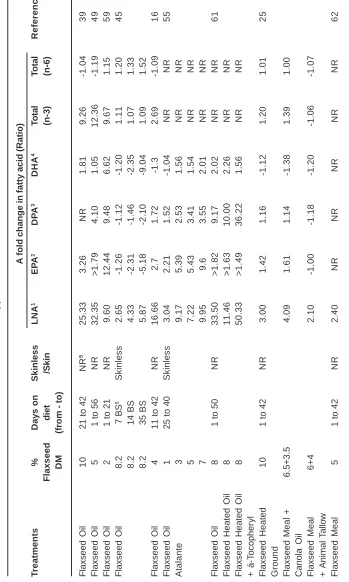
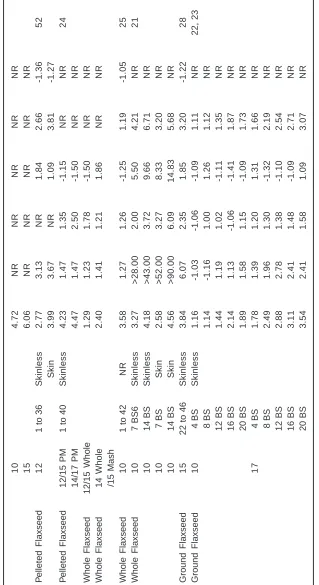
As illustrated in Table 2, fold change analysis identified three categories of desaturation response to feeding flaxseed: high, medium and low fold-changes. High fold-change of DHA with a value of 9.66 was determined when analyzing the
results of 21. In their study, broilers were fed 10%
whole flaxseed 14 days before slaughter. Medium
DHA ratio (6.62) resulted in the study of59, when
broilers were fed 2% flaxseed oil during 21 days; and low DHA ratio (<2.0) from all other studies reported in this review. Similarly, fold-change values for EPA were high (>28.0), medium (12.0) and low (>1.0). Even though, there is no evident linear relationship between the DHA concentration in the
diet and the corresponding DHA content of tissue54.
T
a
ble 1.
Fold c
hang
e in abdominal br
oiler fat of mean pol
yunsaturated fatty acid composition
between flaxseed supplemented diets and control diets
A fold change in fatty acid (Ratio)
T
reatments
%
Flaxseed
Days on diet
L
N
A
1
EP
A
2
DP
A
3
DHA
4
T
otal
T
otal
Reference
D
M
(from - to)
(n-3)
(n-6)
Flaxseed
Oil
1
0
21 to 42
27.17
0.00
N
R
5
0.00
27.17
1.45
3
9
Flaxseed
Oil
5
1
to 56
24.51
0.04
0.02
N
D
6
24.57
1.12
4
9
Flaxseed
Oil
5
1
to 49
7.96
2.08
N
R
N
R
5.21
-1.22
1
5
Flaxseed
Oil
4
11 to 42
13.53
0.00
0.00
0.00
13.53
-1.11
1
6
Ground
Flaxseed
1
5
22 to 46
14.35
N
R
N
R
N
R
14.35
N
R
2
8
1LNA –
α
-Linolenic Acid
2EP
A – Eicosapentaenoic Acid
3DP
A – Docosapentaenoic Acid,
4DHA – Docosahe
xaenoic Acid
5NR – Not
Reported
T
a
ble 2:
Fold c
hang
e in breast m
usc
le of mean pol
yunsaturated fatty acid composition
between flaxseed supplemented diets and control diets
A fold change in fatty acid (Ratio)
T reatments % Days on Skinless L N A 1 EP A 2 DP A 3 DHA 4 T otal T otal Reference Flaxseed diet /Skin (n-3) (n-6) D M
(from - to)
Flaxseed
Oil
1
0
21 to 42
N R 5 25.33 3.26 N R 1.81 9.26 -1.04 3 9 Flaxseed Oil 5 1 to 56 N R 32.35 >1.79 4.10 1.05 12.36 -1.19 4 9 Flaxseed Oil 2 1 to 21 N R 9.60 12.44 9.48 6.62 9.67 1.15 5 9 Flaxseed Oil 8 .2 7 BS 6 Skinless 2.65 -1.26 -1.12 -1.20 1.11 1.20 4 5 8.2 1 4 B S 4.33 -2.31 -1.46 -2.35 1.07 1.33 8.2 3 5 B S 5.87 -5.18 -2.10 -9.04 1.09 1.52 Flaxseed Oil 4
11 to 42
N R 16.66 2 .7 1.72 -1.3 2.69 -1.09 1 6 Flaxseed Oil 1
25 to 40
Skinless 3.04 2.21 1.52 -1.04 N R N R 5 5 Atalante 3 9.17 5.39 2.53 1.56 N R N R 5 7.22 5.43 3.41 1.54 N R N R 7 9.95 9 .6 3.55 2.01 N R N R Flaxseed Oil 8 1 to 50 N R 33.50 >1.82 9.17 2.02 N R N R 6 1
Flaxseed Heated Oil
8 11.46 >1.63 10.00 2.26 N R N R
Flaxseed Heated Oil
8 50.33 >1.49 36.22 1.56 N R N R + á-T ocopher yl Flaxseed Heated 1 0
1 to 42
N R 3.00 1.42 1.16 -1.12 1.20 1.01 2 5
Ground Flaxseed Meal +
6.5+3.5 4.09 1.61 1.14 -1.38 1.39 1.00
Canola Oil Flaxseed Meal
T
a
ble 2 Contin
u e 1 0 4.72 N R N R N R N R N R 1 5 6.06 N R N R N R N R N R P elleted Flaxseed 1 2
1 to 36
Skinless 2.77 3.13 N R 1.84 2.66 -1.36 5 2 Skin 3.99 3.67 N R 1.09 3.81 -1.27 P elleted Flaxseed 12/15 PM
1 to 40
Skinless 4.23 1.47 1.35 -1.15 N R N R 2 4 14/17 PM 4.47 1.47 2.50 -1.50 N R N R Whole Flaxseed 12/15 Whole 1.29 1.23 1.78 -1.50 N R N R Whole Flaxseed 14 Whole 2.40 1.41 1.21 1.86 N R N R /15 Mash Whole Flaxseed 1 0
1 to 42
N R 3.58 1.27 1.26 -1.25 1.19 -1.05 2 5 Whole Flaxseed 1 0 7 BS6 Skinless 3.27 >28.00 2.00 5.50 4.21 N R 2 1 1 0 1 4 B S Skinless 4.18 >43.00 3.72 9.66 6.71 N R 1 0 7 B S Skin 2.58 >52.00 3.27 8.33 3.20 N R 1 0 1 4 B S Skin 4.56 >90.00 6.09 14.83 5.68 N R Ground Flaxseed 1 5
22 to 46
Skinless 3.84 6.07 2.35 1.85 3.20 -1.22 2 8 Ground Flaxseed 1 0 4 BS Skinless 1.16 -1.03 -1.06 -1.09 1.11 N R 22, 23 8 B S 1.14 -1.16 1.00 1.26 1.12 N R 1 2 B S 1.44 1.19 1.02 -1.11 1.35 N R 1 6 B S 2.14 1.13 -1.06 -1.41 1.87 N R 2 0 B S 1.89 1.58 1.15 -1.09 1.73 N R 1 7 4 B S 1.78 1.39 1.20 1.31 1.66 N R 8 B S 2.49 1.96 1.30 -1.32 2.19 N R 1 2 B S 2.88 2.78 1.38 -1.10 2.54 N R 1 6 B S 3.11 2.41 1.48 -1.09 2.71 N R 2 0 B S 3.54 2.41 1.58 1.09 3.07 N R
1LNA –
α
-Linolenic Acid
2EP
A – Eicosapentaenoic Acid
3DP
A – Docosapentaenoic Acid
4DHA – Docosahe
xaenoic Acid
5NR – Not Repor
ted
T
a
ble 3:
Fold c
hang
e in thigh m
usc
le of mean pol
yunsaturated fatty acid composition
between flaxseed supplemented diets and control diets
A fold change in fatty acid (Ratio)
T reatments % Days Skinless L N A 1 EP A 2 DP A 3 DHA 4 T otal T otal Reference Flaxseed o n diet /Skin (n-3) (n-6) D M
(from - to)
Flaxseed
Oil
1
0
21 to 42
N R 5 29.72 2.97 N R 1.65 12.26 1.03 3 9 Flaxseed Oil 5 1 to 56 N R 29.50 >1.24 3.68 2.60 17.62 -1.13 4 9 Flaxseed Oil 2 1 to 21 N R 10.61 7.20 4.11 2.50 7.54 1.04 5 9 Flaxseed Oil 8 .2 7 BS 6 Skinless 4.42 -1.86 -1.86 -2.30 -1.12 1.10 4 5 8.2 1 4 B S 8.06 -4.76 -3.92 -6.65 -1.03 1.29 8 .2 3 5 B S 11.64 -15.17 -5.37 -18.97 1.21 1.49 Flaxseed Oil 1
25 to 40
Skinless 3.02 2.89 2.09 1.01 N R N R 5 5 Atalante 3 6.47 3.92 3.10 1.19 N R N R 5 7.66 6.85 3.12 1.11 N R N R 7 8.72 6.27 3.43 1.32 N R N R Flaxseed Oil 8 1 to 50 N R 42.05 >0.81 5.21 1.91 N R N R 6 1
Flaxseed Heated Oil
8 24.73 >0.99 23.50 2.97 N R N R
Flaxseed Heated Oil
8 34.41 >0.82 24.80 3.31 N R N R + α -T ocopher yl P elleted Flaxseed 12/15 PM
1 to 40
Skinless 4.61 >1.70 2.10 >0.20 N R N R 2 4 14/17 PM 5.02 >1.70 2.30 >0.30 N R N R P elleted Flaxseed 1 2
1 to 36
Skin 4.00 3.64 N R 1.48 3.82 -1.38 5 2 Flaxseed Heated 1 0 4.18 1.60 1.23 1.03 1.61 -1.02 2 5
Ground Flaxseed Meal + Oil
T
a
b
le 3 Contin
u e Flaxseed Meal 6 + 4 2.08 1.00 -1.10 -1.12 1.06 -1.09 + T allo w Whole Flaxseed 1 0
1 to 42
Skinless 4.56 1.43 1.39 -1.01 1.63 -1.01 Whole Flaxseed 12/15 Whole 1.59 >1.20 1.80 >0.30 N R N R 2 4 14 Whole/ 3.00 >1.50 2.10 >0.90 N R N R 15 Mash Whole Heated 5 1 to 42 N R -2.33 -5.00 1.25 -1.83 N R N R 3 4 Flaxseed 1 0 1.91 1.10 2.37 1.72 N R N R 1 5 2.83 2.60 3.25 3.09 N R N R Whole Flaxseed 5 -3.25 -2.00 -2.00 1.37 N R N R 1 0 -1.46 -1.25 -1.14 1.12 N R N R 1 5 -1.38 -1.25 -4.00 -1.33 N R N R Whole Flaxseed 1 0 7 BS Skinless 2.90 >13.00 >13.00 >12.00 3.79 N R 2 1 1 0 1 4 B S Skinless 5.05 >35.00 >26.00 >34.00 7.26 N R 1 0 7 B S Skin 2.61 >50.00 >33.00 >37.00 3.15 N R 1 0 1 4 B S Skin 4.71 >105.00 >65.00 >80.00 5.82 N R Whole Flaxseed 5 1.69 -1.28 2.00 2.00 1.56 1.08 5 7 7.5 2.00 -1.28 3.00 2.00 1.76 1.11 Ground Flaxseed 5 8 to 42 Skinless 4.94 -1.50 3.00 3.00 3.64 1.12 7.5 6.87 -1.50 5.00 3.00 4.96 1.21 Ground Flaxseed 1 5
22 to 46
Skinless 3.14 5.00 2.08 1.81 2.90 -1.26 2 8 Ground Flaxseed 1 0 4 BS N R 1.40 1.28 N R -1.76 1.31 -1.04 2 3 8 B S 2.15 1.71 N R -1.35 1.99 1.10 1 2 B S 2.23 2.02 N R -1.33 2.07 -1.00 1 6 B S 2.35 2.33 N R -1.64 2.19 -1.11 2 0 B S 2.78 2.27 N R -1.24 2.56 1.00
1LNA –
α
-Linolenic Acid
2EP
A – Eicosapentaenoic Acid
3DP
A – Docosapentaenoic Acid
4DHA – Docosahe
xaenoic Acid
5NR – Not Repor
ted
6BS –
These results reflect the effect of feeding strategies on the elongation and desaturation of LNA and are in agreement with previous works. On the other hand, it was reported that dietary modifications
could increase DHA deposition in broiler tissues60.
In general, fold change analysis was able to determine variations between treatments in different studies. For example, in a study with broilers fed heated flaxseed oil supplemented with
α-tocopheryl, the LNA fold-change was 50.33-fold
increase compared to the control; EPA, DPA and DHA also increased >1.49 (control diet was reported zero content), 36.22 and 1.56-fold,
respectively61. Negative ratio was found for DHA
when heated ground flaxseed was compared with
heated ground canola, rich in oleic acid60.
LNA fold-changes varied from 2.40 to 6.06 in the studies that used flaxseed meal for broilers, showing that increased dietary flaxseed
levels resulted in LNA increases62.Similarly,
inclusion of flaxseed in the diet of broilers as pelleted or pelleted-then mashed caused broilers to produce breast muscle with increased LNA fatty
acid24, and EPA at the expense of decreased
concentrations of total (n-6) fatty acids52.
Feeding whole flaxseed during the life cycle of broilers, at 7 and 14 days before slaughter resulted in LNA fold changes that varied from 1.29 to 5.80. EPA values were higher when the control diet was zero, and high fold-change values were obtained for DHA. The DHA values varied from -1.25 to 14.83, indicating high values for DHA deposition in those studies. Even though, when samples were analyzed without skin, the values were lower.
The fold change analysis of the experiments carried out on the effect of feeding ground flaxseed to broilers resulted in values that varied from 1.07 to 7.25. Once consumed, the body converted LNA to EPA, DPA and DHA, albeit at low efficiency. DHA fold-change values varied from 1.0 to -1.41.
Thigh Muscle Fatty Acid Profile
It was reported in rats a higher concentration of n-6 and n-3 PUFA in type I and
type IIa fibers than type IIb fibers63. Nonetheless,
the results from the fold change analysis showed that in breast of broilers the total n-3 fatty acids varied from 1 to 12.36, and from 1 to 17.62 in thigh, but the total n-6 fatty acids was not much altered in those tissues, and the fold change was not higher than 1.52. These observations are consistent and
explain why a reduction in total n-6 was observed64.
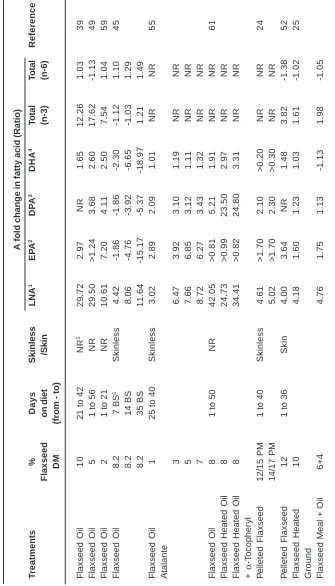
Several studies have been conducted, to evaluate the fatty acid composition of thigh muscle after feeding flaxseed oil (Table 3). The fold change analysis showed that the LNA ratio was between 3.02 and 29.71, EPA from 1.10 to 31, DPA from 1.42 to 15 and DHA from 1.01 to 3.25, demonstrating that elongation and desaturation is feasible in this tissue. Again, LNA fold changes varied by time of feeding with increased deposition occurring over
time45, and also by increasing the dosage of
treatment55.
Results (Table 3) showed that DHA deposition in thigh muscle followed the same trend found in breast tissue. The fold change analysis identified three categories of desaturation response to feeding flaxseed to broilers: high, medium and low fold changes. High fold change of DHA with a
value of >12.0 was found in the study of21, medium
DHA ratio (>2.0) in the work of59, and low DHA ratio
(<2.0) in all other studies analyzed here. On the other hand, the fold-change determined for EPA was high (>13), medium (7.20) and low (>1.0). One important aspect in this study is the discover of the three categories of fold-changes in EPA and DHA in breast and thigh muscles, which represent a step forward in the possibilities of EPA and DHA enrichment. In this context, the US DHA offered the most protection against Alzheimer Disease in
humans65. Also, LNA, EPA and DHA block the action
of some compounds that cause inflammation and help the body’s cells to work properly and be elastic
(Caughey et al., 199666).
The response of feeding whole and/or heated whole flaxseed resulted in fold changes in between 1.27 to 8.58 for LNA. The higher value
was found throughout the work of60. On the other
hand, the fold change analysis resulted in high
values for DHA (>80) in the research of21; in both
explains the obtained values. Similarly, the fold change analysis in diets using ground flaxseed varied from 1.40 to 6.87 for LNA, 1.28 to 5.0 for EPA, -1.25 to 3.0 for DHA, and the response observed in those studies varied by time of feeding and by increasing the dosage of treatment. In this tissue, flaxseed triggered increases in LC-n3.
Overall, this review, from animal performance to fatty acid deposition using fold change, may represent a very important step in the knowledge of poultry production providing new insights about feeding strategies using flaxseed, enabling n-3 enrichment without compromising animal performance.
CONCLUSION
Wide promotion of n-3 fatty acids spanned a research campaign on the use of flaxseed in animal production, while emphasizing the need to increase intake of n-3 PUFA. The knowledge achieved so far on enriching poultry meat with n-3 PUFA has made possible the availability of enriched poultry meat. As illustrated in this review, fold change analysis was a good method to interpret and determine the variation of results within experiments that do not report data in similar units of measure. The fold change analysis identified
three categories of desaturation response to feeding flaxseed to broilers, resulting in different values for EPA and DHA in both breast and thigh tissues: high, medium and low fold-changes. Flaxseed contains some anti-nutritional factors that can be avoided by the use of some feeding strategies to enrich chicken meat without compromising live performance. Increasing the concentration of n-3 PUFA in poultry diets results in an increase in the n-3 PUFA content of poultry meat, and the use of skin or skinless samples in the analysis of fatty acid composition had an effect on the FA deposited. Nutritionally meaningful amounts of LNA and LCn-3 have been achieved in breast and thigh muscles by manipulating feeding time, flaxseed concentration in the diets, and using a proper processing method. Three feeding strategies and processing alternatives of flaxseed were identified to optimize enrichment: The use of flaxseed oil, whole or ground flaxseed 14 to 21 days before slaughter can be recommended to producers. Excellent results in DHA deposition could be accomplished feeding whole flaxseed.
ACKNOWLEDGEMENTS
The author thanks Dr. Doug Kor ver (University of Alberta) for his suggestions, Caroline Parke and Isabel Allen for their input to this article.
1. Simopoulos A. P.,J. Am. Coll.
Nutr.,21:495-505 (2002).
2. Simopoulos A. P.,World Rev. Nutr.
Diet.,92:1-22 (2003).
3. Renaud S and Lanzmann-Petithor y
D.,Current Atherosclerosis Repor ts, 4(6):419-424 (2002).
4. Vos E.and Cunnane S.C.,America Journal
of Clinical Nutrition,77 (2):521-522 (2003).
5. Nash D. M., Hamilton R. M. G, and Hulan H.
W., Can. J. Anim. Sci.,75:247-253 (1995).
6. Salem N. J., Litman B., Kim H.Y., and
Gawrisch K., Lipids, 36:945-959 (2001).
7. Burdge G. C, and Wootton S. A., British
Journal of Nutrition, 88(4):411-420 (2002).
8. Gebauer S. K., Psota T. L., Harris W. S., et al.
American Journal of Clinical Nutrition,
REFERENCES
83(6)S: 1526S-1535S (2006).
9. Bhatty R. S., Nutritional composition of whole
flaxseed and flaxseed meal. In: Flaxseed in Human Nutrition, pp. 22-45 (ED. S. C. Cunnane and L. H. Thompson). AOCS Press, Champaign, IL. (1995).
10. Grossu D., Iliescu M., and Moisa. A., Biol.
Landwirtsch Nutztiere, 11:34-35 (1998).
11. Panford J. A.,and deMan J. M., JAOCS,
67(8):473-482 (1990).
12. DeClerq D. R. 2006. Quality of western
Canadian flaxseed. Canadian Grain Commission. www.grainscanada.gc.ca. access on 16 December 2007).
13. Conn E. E., Journal of Agricultural and Food
Chemistry. 17(3):519 (1969).
L.,Biochemistry,6(1):170-177 (1967).
15. Balevi, T.and Coskun B., Revue Méd.
Vét,151(10):937-944 (2000).
16. Manilla H. A., Husvéth F., and Németh K.,
Acta Agraria Kaposváriensis, 3(3):47-57(1999).
17. An B. K., Banno C, Xia Z. S., Tanaka K., and
Ohtani S.,Comp. Biochem. Physiol, 116B(1):119-125, (1997).
18. Zollitsch W.., Knaus W., Aichinger, and
Lettner F, 1997. Anim. Feed Sci. Technol., 66:63-73 (1997).
19. Crespo N, and Esteve-Garcia E., Poult. Sci.,
81:1555-1562 (2002).
20. Crespo N, and Esteve-Garcia E., Poult.
Sci.,81:512-518 (2002).
21. Gonzalez-Esquerra R, and Leeson S., British
Poult. Sci.,41:481-488 (2000).
22. Betti M, Perez T. I., Zuidhof M. J., and Renema
R. A., Poult. Sci., 88:1740-1754 (2009).
23. Zuidhof M. J., Betti M, Kor ver D. R.,
Hernandez F. I. L, et al., Poult. Sci.,88:1108-1120 (2009).
24. Shen Y., Feng D., Fan M. Z.,and Chavez E.
R., J. Sci. Food. Agric.,85:2005-2014 (2005).
25. Ajuyah AO, Lee K. H, Hardin R. T, and Sim J.
S, Poult. Sci., 70:2304-2314 (1991).
26. Treviño J, Rodriguez M. L, Ortiz L. T, Rebolé
A, and Alzueta C., Animal Feed Science and Technology, 84:155-166. (2000).
27. Shen Y, and Chavez E. R.,J. Sci. Food Agric.,
83:960-965 (2003).
28. Azcona J. O., Schang M. J., Garcia P.T.,
Gallinger C., Ayerza Jr.R., and Coates W.,Can. J. Anim. Sci.,88:257-269 (2008).
29. Rodriguez M. L, Alzueta C., Rebole A., Ortiz
L. R. T., Centeno C., and Treviño. J., Br. Poult. Sci., 42:368-375 (2001).
30. Feng D, Shen Y, and Chavez E. R., J. Sci.
Food Agric.,83:836-841 (2003).
31. Bond J. M, Julian R. J, and Squires E. J.,
Can. J. Anim. Sci.,77:279-286 (1997).
32. Calet C., World Poultry Sci., 21(1):23-52
(1965).
33. Jia W, Rogiewicz A, Br uce H. L, and
Slominski B. A., Can. J. Anim. Sci., 90:203-206 (2010).
34. Najib H, and Al-Yousef Y. M., Annual Review
&Research in Biology, 1(2):22-31 (2011).
35. Madhusudhan K. T, Ramesh H.P, Ogawa T,
Sasaoka K, and Singh N., Poult. Sci., 65:164-171 (1986).
36. Lee K. H., Olomu J. M., and Sim J. S., Can. J.
Anim. Sci., 71:897-903 (1991).
37. Murakami K. T. T., Pinto M. K., Ponsano E. H.
G., and Neto M. G., Pesq. Agropec. Bras., 45(4):401-407 (2010).
38. Crespo N. and Esteve-Garcia E., Poult.
Sci.,81:1533-1542 (2002).
39. Crespo N, and Esteve-Garcia E., Poult. Sci.,
81:1555-1562 (2001).
40. Sanz M., Lopez-Bote C. J, Menoyo D., and
Bautista J. M.,J. Nutr., 130:3034-3037 (2000).
41. Fu Z, and Sinclair A. J.,Lipids, 35:395-400
(2000).
42. Madsen L, Rustan A. C., Vaagenes H, Berge
K., Dyroy E. and Berge R. K., Lipids,34:951-963 (1999).
43. Gaíva M. H, Pithon T. C, and Olle, C. M., J. Vit.
Nutr. Res., 66:258-262 (1996).
44. Saadoun A, and Leclercq B., J. Nutr.,
117:428-435 (1987).
45. López-Ferrer S., Baucells M. D., Barroeta A.
C., and Grashorn M. A., Poult. Sci., 78:356-365 (1999)
46. Witten D. M., and Tibshirani, R., Nature
Reviews Genetics, 7(1):55-65 (2007).
47. Dalman M. R., Deeter, A., Nimishakavi G. et
al., BMC Bioinformatics, 13(2):S11 (2012).
48. Scheideler S. E., Use of flaxseed in animal
diets to create consumer products with modified fatty acid profiles. In A. D. Muir and N. D. Westcott (Eds.), Flax: the genus linum. Boca Ranton: CRC Press (2003)
49. Phetteplace H. W, and Watkins B. A., Journal
of Food Composition and Analysis, 2:104-117 (1989).
50. Whitehead C. C., Essential fatty acids in
poultry nutrition. Pages 153-166 in: Fats in Animal Nutrition. J. Wiseman , ed. Butterworths, London, UK. (1984).
51. Enser, M., The chemistry, biochemistry and
nutritional importance of animal fats. Pages 23-51 in: Fats in Animal Nutrition. J. Wiseman , ed. Butterworths, London, UK. (1984).
52. Jia W., Rogiewicz A., Br uce HL, and
Slominski B. A., Can. J. Anim. Sci.,90:203-206 (2010).
Sci. J., 53:155-183 (1997).
54. Rymer C, and Givens D., Lipids,
40(2):121-130 (2005).
55. Zelenka J., Schneiderova D., Mrkvicova E.,
and Dolezal P., Veter inar ni Medicina., 53(2):77-85 (2008).
56. Brenner R. R.,Factors influencing fatty acid
elongation and desaturation. The Role of
Fats in Human Nutrition 2nd edition. Ed:
Vergroesen, A. J. and M. Crawford. Academic Press: London, England, UK; Sand Diego, California, USA. ILLUS Pages: 45-80 (1989).
57. Roth-Maier, DA, Eder K, and Kirchgessne
M., J. Anim. Physiol. A. Anim. Nutr., 79:260-268. (1998).
58. Chanmugan P, Boudreau M, Boutte T, Park
RS, Hebert J, et al., Poult. Sci., 71:516-521 (1992).
59. Shin D., Kakani G., Karimi A., Cho Y. M., Kim
S. W, Ko Y. G., et al., Asian-Aust. J. Anim. Sci. 24(9):1249-1255 (2011).
60. Ajuyah A. O, Lee K. H, Hardin R. T, and Sim J.
S., Can. J. Anim. Sci. 71:1011-1019 (1991).
61. Sheehy P. J. A., Morrissey P. A., and Flynn A.,
British Poult. Sci. 34:367-381 (1993).
62. Mridula, D., Kaur D., Nagra S. S., Barnwal P.,
Gurumayum S., and Singh K. K., J. Anim. Sci. 4(12):1729-1735 (2011).
63. Kriketos A. D, Pan D. A. Sutton J. R, Baur J.
F.Y, Cooney L.A,et al., 1995.. Am. J. Physiol. 269:1154-1162 (1995).
64. Komprda T., Zelenka J., Fajmonova E.,
Fialova M., and Kladroba D., J. Agric. Food. Chem. 53:6804-6812 (2005).
65. Morris M. C., Evans D. A, Bienias J. L, et