The Effects of One Course of Perseverant Exercise on
Functional and Structural Indices of the Heart in Pediatrics
Introduction
Based on the World Health Organization (WHO), cardio-vascular diseases are the leading cause of death around the world. Most of those who die annually, suffer from these diseases than any other reason. In 2008, 17.5 million people died of this disease in the world (about 30% of all deaths). Interventional studies suggest that lack of physi-cal activities were related strongly to these diseases (1,2). Regular physical activities are very important in decreas-ing the incidence of the morbidity and mortality of the cardiovascular diseases (3). Long-term exercises lead to a better physiologic status of the cardiovascular system (4). Prolonged high intensity perseverant exercises are associ-ated with cardiac anatomical changes. Using new methods of technology such as echocardiography and some other imaging modalities, the changes can be documented (5). The body responds physiologically in a different manner to perseverant (aerobic) and strength (anaerobic), exercis-es (6-9).
All of the body including cardiovascular, respiratory, en-docrine, nervous, motor and thermoregulation systems get adaptation in prolonged and severe static exercises
(10, 11). These adaptations let the basic metabolic rate in-crease 20 times the rest value. Under such circumstances, cardiac output (CO) may increase about 6 times (8). The amount of the adaptation depends on age, gender, body size, fitness and the kind of exercises. Such cardiovascu-lar adaptations after prolonged and severe exercises, have been reported in lots of studies, in adults (12-14). These adaptations consist of structural and functional changes. Severe exercises lead to lower heart rate, left ventricular (LV) hypertrophy, higher blood pressure, increased stroke volume (SV), CO and maximal O2 consumption (15,16). A few short and long term studies have proved the car-diorespiratory adaptations following aerobic exercises and before puberty. Review articles and meta-analysis can prove better these findings (15,16).
The aim of this study is to evaluate the effect of a course of 12-week perseverant exercises with a maximal heart rate of 55%-70%, on the structural (Left ventricle end-diastol-ic diameter [LVEDd], left ventrend-diastol-icular posterior wall end diastole [LVPWd], left ventricular end-diastolic volume [LVEDV], left ventricular mass [LV mass]) and functional (left ventricular ejection fraction [LVEF], left ventricular Abstract
Objective:Endurance training exercises improve function state of cardiac in long-term. The aim of this study was evaluation of cardiac indices include stroke volume (SV), cardiac output (CO), left ventricular ejection fraction (LVEF) in strength exercise.
Materials and Methods: Twenty boys with fourth and fifth grader after the manager’s allowance and parent’s consent was selected (10 patients as the case and 10 as the control groups), with average age, height and weight of 10.8 ± 6 years, 149 cm and 36 ± 8 kg, respectively. Perseverant exercises, structural (Left ventricle end-diastolic diameter [LVEDd], left ventricular posterior wall end diastole [LVPWd], left ventricular end-diastolic volume [LVEDV], left ventricular mass [LV mass]) and functional include LVEF, left ventricular cardiac output (LVCO), left ventricular stroke volume (LVSV) parameters. Height, weight, age, exercise intensity, healthy status, history of sports and body composition were recorded.
Results: Results indicated there was no significant difference between the case and control groups who had increased their SV index by 5.3% and 1.37%, respectively. The CO index was increase by 7.29 in case and a decrease by 6.9 in the control groups (P > 0.05). LVEF has no significant difference between groups. LVPWd showed an increase by 2.14 and 2.17 in the case and control groups, respectively (P > 0.05). Neither LVEDd nor LV mass did not show any significant difference in the control group, with a decrease by 2.26 and 0.31, respectively. Meanwhile the case group demonstrated a significant difference in the latter indices, with an increase by 6.78 (P < 0.023) and 12.64 (P < 0.003), respectively.
Conclusion: A course of perseverant exercises in children can effect on LVEDV, LV mass and LVEDd, but no change on LVEDV.
Keywords: Pediatric, Aerobic exercises, Heart function
Ahmad Jameii Khosroshahi1, Bager Javadpoor1, Mahmood Samadi1*, Shahriar Anvari1
Open Access Original Article
Crescent Journal of Medical and Biological Sciences
Received 23 January 2016, Accepted 18 August 2016, Available online 29 August 2016
eISSN 2148-9696
cardiac output (LVCO), left ventricular stroke volume (LVSV)) parameters, in 10-12 years old children.
Materials and Methods
The study was done on 20 fourth and fifth grader boys (10 patients as the case and 10 ones as the control groups), having the average age, height and weight of 10.8 ± 6 years, 149 cm and 36 ± 8 kg, respectively. It was done af-ter the manager’s allowance and parent’s consent. In this study, perseverant exercises, structural (LVEDd, LVPWd, LVEDV, LV mass) and functional include LVEF, LVCO, LVSV parameters, were considered as independent and dependent criteria, respectively. In addition, criteria such as height, weight, age, exercise intensity, healthy status, history of sports and body composition were taken into consideration as background ones. Criteria including age, gender, history of sports, any disease contraction, time-ta-ble and period of exercises, life-style, primary fitness of the participants and daily activities were under-control and those like anthropometric and genetic differences, cli-mate, psychologic status, sport capabilities and initiatives were out of control.
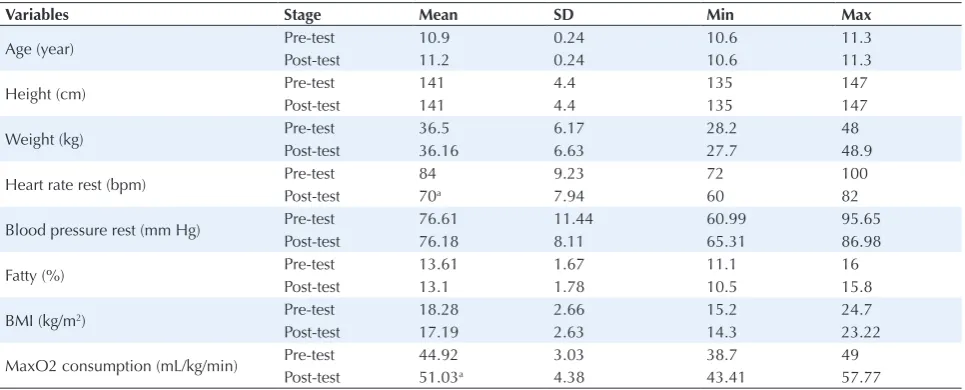
Topographic and physiologic characters of the children of the case and control groups at different stages of investiga-tion have been demonstrated in Tables 1 and 2.
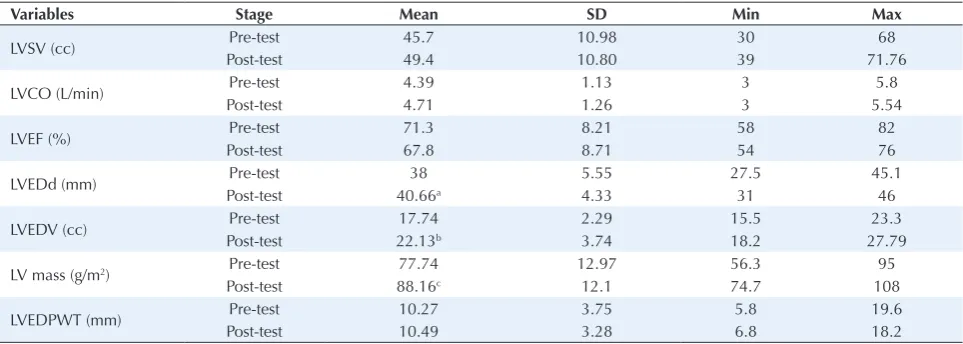
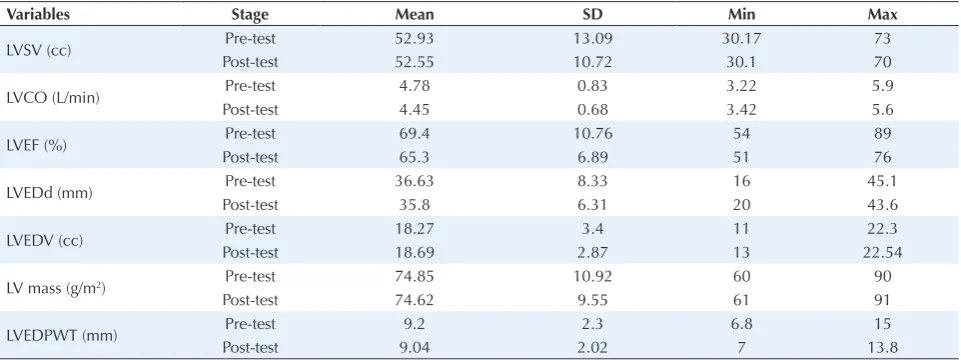
The case group had a course of perseverant running for 12 weeks (three times a week with a 50%-70% maximal heart rate). The cardiac functional and structural parameters were evaluated using “My Lab 60“ echocardiography, in the both groups. The results of the case and control groups (pre- and post-tests), at different stages, are shown in Ta-bles 3 and 4, respectively.
In order to define the criteria, descriptive statistics was used (mean and standard deviation for quantitative data). Independent t test was utilized to demonstrate the randomized selection and normal distribution of the case group. Paired sample t test used to compare the
in-tra-group average of criteria before and after the interven-tions. All the exams were done by SPSS 19, with a P value <0.05 (alpha 5%).
Results
The study showed no significant difference between the case and control groups who had increased their SV index by 5.3% and 1.37%, respectively. The CO index with an in-crease by 7.29 and a dein-crease by 6.9 in the case and control groups, respectively, without significant difference. LVEF displayed no significant difference in none of the groups with (the case) and without (the control) perseverant ex-ercises. LVEDd, with an increase by 6.78 after perseverant exercises, had a significant difference (P < 0.023), in the case group but with a decrease by 2.26, without the ex-ercises, in the control group no significant difference was detected. LV mass with an increase by 12.64 after perse-verant exercises, had a significant difference (P < 0.003 ), in the case group but with a decrease by 0.31, without the exercises, in the control group no significant difference was detected. LVPWd showed an increase by 2.14 and 2.17 in the case and control groups, respectively, which indicated no significant difference. LVEDV showed a sig-nificant difference with an increase by 24.7 (P < 0.002), in the case (after 12 weeks of perseverant exercises) and no significant difference with an increase by 2.29 in the con-trol groups, respectively.
Discussion
More information on the effect of exercise on the heart is in adult and research about effect of strength exercise on pediatric and adolescents has increased in last years (3,5,6). The safety and effectiveness of perseverant exer-cise are now well documented (17-22). Cardiovascular ad-aptations to sports training documented in adult athletes, in whom two morphological alterations are seen: eccen-tric and conceneccen-tric LV hypertrophy (3). Training for most
Table 1. Topographic and Physiologic Characters of the Children of the Case Group
Variables Stage Mean SD Min Max
Age (year) Pre-test 10.9 0.24 10.6 11.3
Post-test 11.2 0.24 10.6 11.3
Height (cm) Pre-test 141 4.4 135 147
Post-test 141 4.4 135 147
Weight (kg) Pre-test 36.5 6.17 28.2 48
Post-test 36.16 6.63 27.7 48.9
Heart rate rest (bpm) Pre-test 84 9.23 72 100
Post-test 70a 7.94 60 82
Blood pressure rest (mm Hg) Pre-test 76.61 11.44 60.99 95.65
Post-test 76.18 8.11 65.31 86.98
Fatty (%) Pre-test 13.61 1.67 11.1 16
Post-test 13.1 1.78 10.5 15.8
BMI (kg/m2) Pre-test 18.28 2.66 15.2 24.7
Post-test 17.19 2.63 14.3 23.22
MaxO2 consumption (mL/kg/min) Pre-test 44.92 3.03 38.7 49
Post-test 51.03a 4.38 43.41 57.77
sports involves a combination of aerobic endurance and strength training, and so most athletes have increased LV diameter and wall thickness (5), although to varying de-grees. LV mass is determined by various stimulus arising from the mechanical loads on the heart (17). Adaptations to LV structure and function appear to be dependent on the type, intensity and duration of exercise training in-creased venous return causes cell stretching, particularly in the endocardium. Increased after load (systolic arterial pressure) makes the myocardium work harder, and the effect is strengthened by higher heart rate. These hemo-dynamic stimuli trigger membrane receptors whose re-sponses include signal transduction, leading to the release of growth factors, overexpression of inducible genes and activation of dormant genes (19).
The significant structural alterations in the ventricle,
aris-ing from the mechanisms that control ventricular remod-eling, could be explained as a physiological response that results from balanced and proportional growth of myo-cytes and myocardial interstices; the functional changes are a consequence of the structural alterations. These, al-though more noticeable during exercise, are also detect-able at rest (18). Most cardiovascular adaptations to sports training appear during adulthood (6). Studying such ad-aptations in children and adolescents is more complicat-ed, as it is difficult to separate the effects of training from those of growth. Most studies have focused on selecting or identifying talent (16,20,21), largely ignoring dose-re-sponse relationships and the long-term significance of such changes. At the same time, the relatively light train-ing loads encountered in these age-groups may in part explain the lack of clinical evidence of morphological Table 2. Topographic and Physiologic Characters of the Children of the Control Group
Variables Stage Mean SD Min Max
Age (year) Pre-test 10.8 0.38 10.3 11.30
Post-test 11.1 0.38 10.3 11.30
Height (cm) Pre-test 143 5.15 136 152
Post-test 143 5.15 136 152
Weight (kg) Pre-test 37.31 7.04 29 48.5
Post-test 37.59 6.46 30 47.4
Heart rate rest (bpm) Pre-test 83 6.19 76 92
Post-test 78a 6.32 68 90
Blood pressure rest (mm Hg) Pre-test 83.88 12.16 59.32 101.31
Post-test 80.11 12.11 65.98 98.98
Fatty (%) Pre-test 13.84 2.39 10 17
Post-test 13.83 2.35 10.1 17
BMI (kg/m2) Pre-test 18.06 2.60 14.6 22.7
Post-test 17.92 2.63 14.7 22
MaxO2 consumption (mL/kg/min) Pre-test 46.28 3.27 41.76 52.26
Post-test 46.01 2.94 42.64 52.61
Abbreviation: BMI, body mass index. a Significantly different compared to pre-test.
Table 3. Structural and Functional Cardiac Parameters in the Case Group Stages of the Study (Pre-test and Post-test)
Variables Stage Mean SD Min Max
LVSV (cc) Pre-test 45.7 10.98 30 68
Post-test 49.4 10.80 39 71.76
LVCO (L/min) Pre-test 4.39 1.13 3 5.8
Post-test 4.71 1.26 3 5.54
LVEF (%) Pre-test 71.3 8.21 58 82
Post-test 67.8 8.71 54 76
LVEDd (mm) Pre-test 38 5.55 27.5 45.1
Post-test 40.66a 4.33 31 46
LVEDV (cc) Pre-test 17.74 2.29 15.5 23.3
Post-test 22.13b 3.74 18.2 27.79
LV mass (g/m2) Pre-test 77.74 12.97 56.3 95
Post-test 88.16c 12.1 74.7 108
LVEDPWT (mm) Pre-test 10.27 3.75 5.8 19.6
Post-test 10.49 3.28 6.8 18.2
Abbreviations: LVSV, left ventricular ejection fraction; LVCO, left ventricular cardiac output; LVEF, left ventricle ejection fraction; LVEDd: left ventricle end diastolic diameter; LVEDV: left ventricle end diastolic volume; LV mass: left ventricle mass; LVEDPWT: left ventricle end diastolic posterior wall tissue.
changes (20).
The characteristics of the young athletes themselves, in whom the process of biological maturation is not complete and thus autosomal regulation and catecholaminergic re-sponses are weaker and the influence of growth factors and sex hormones are stronger, may also mean that the changes in the young are less marked than in adults (19). The main objective of the present study was to evaluate the effect of aerobic training on LV morphology and func-tion in Endurance-trained children and to demonstrate specific LV morphological adaptations compared with trained adults.
Absolute values of LV end-diastolic and end-systolic di-ameters, LV wall thicknesses, LV mass, SV, and CO were higher in adult men than in children. When those vari-ables were scaled to body surface area (BSA), differenc-es between trained boys and men were observed on LV wall thickness, LV mass, and SV as indicated, significant health benefits can be obtained by engaging in moderate amounts of physical activity on most, and preferably all, days of the week.
This study shows perseverant exercise in 12 years old chil-dren has full effect on LVEDV, LV mass and LVEDd, but no changes on LVPWd, LVEF, LVSV and LVCO. The lack of the changes in the latter group might be due to the pe-riod intensity, style deficiencies of the exercises and genet-ic factors. As a result, we can conclude that perseverant exercise can changes structural and function indices of the heart in children. Our finding of increased LVEDV, LV mass and LVEDd agrees with previous studies in adult (1-3). It was demonstrated that the endurance exercise in university students for 90 days, could increase LVEDV, LV mass and LVEDd significantly (23) and in addition it was indicated that after endurance exercise the heart rate and diastolic blood pressure was reduced significantly. Our results also demonstrated blood pressure and heart rate significantly decrease after perseverant exercise.
Previous-ly, it was shown endurance training led to LV hypertrophy along with its dilation and finally improvement systolic function (23). Researchers indicated there is no significant difference between trained athletes and sedentary con-trols in case of LVEF (24), our results in agreement with them and there was no significant changes on LV ejection fraction. Investigation of elite distance runners shown reduced LVEF, which it seems because of LV dilation in them (25). Endurance training improve diastolic function an d led to LVEDV increase and could increase LV preload and impress LV systolic function (23).
All in all, these results mainly support that, during resting conditions, the enhanced cardiac performance in endur-ance-trained children as well as adult men was mainly due to their higher LV filling.
Our results in agreement with the findings of Obert et al, and it was shown that the endurance training led to de-velop different left ventricular shape and left ventricular relaxation (3,5,6).
Conclusion
Therefore we suggest that similar studies be done, using “strength or combined” exercises at the same age range and in girls or at higher ages.
Ethical Issues
This study was performed after approving by the ethics committee of Tabriz University of Medical Sciences based on Declaration of Helsinki. Also, written informed con-sent was obtained from the patients.
Conflict of Interests
The authors declare that there is no potential conflicting interest for this study.
Financial Support
There was no financial support. Table 4. Structural and Functional Cardiac Parameters in the Control Group Stages of the Study (Pre-test and Post-test)
Variables Stage Mean SD Min Max
LVSV (cc) Pre-test 52.93 13.09 30.17 73
Post-test 52.55 10.72 30.1 70
LVCO (L/min) Pre-test 4.78 0.83 3.22 5.9
Post-test 4.45 0.68 3.42 5.6
LVEF (%) Pre-test 69.4 10.76 54 89
Post-test 65.3 6.89 51 76
LVEDd (mm) Pre-test 36.63 8.33 16 45.1
Post-test 35.8 6.31 20 43.6
LVEDV (cc) Pre-test 18.27 3.4 11 22.3
Post-test 18.69 2.87 13 22.54
LV mass (g/m2) Pre-test 74.85 10.92 60 90
Post-test 74.62 9.55 61 91
LVEDPWT (mm) Pre-test 9.2 2.3 6.8 15
Post-test 9.04 2.02 7 13.8
Acknowledgments
The authors would like to thank all of the participants and all colleagues and dormitories’ managers and patients.
References
1. MacFarlane N, Northridge DB, Wright AR, Grant S, Dargie HJ. A comparative study of left ventricular structure and function in elite athletes. Br J Sports Med. 1991;25:45-8. 2. Manolas V. Echocardiographic changes in the development
of the athletic heart in 9-to-18 year-old female and male subjects and allometric modeling to body size. Budapest: Semmelweis University; 2002.
3. Obert P, Mandigout S, Vinet A, N’Guyen LD, Stecken F, Courteix D. Effect of aerobic training and detraining on left ventricular dimensions and diastolic function in prepubertal boys and girls. Int J Sports Med. 2001;22:90-6. doi: 10.1055/s-2001-11343.
4. Scharhag J, Schneider G, Kürschner R, Urhausen A, Mayer F, Kindermann W. Right and left ventricular mass and function in strength athletes determined by MRI:1044:May 29 4:00 PM-4:15 PM. Med Sci Sports Exerc. 2009;41:158-9. 5. Nottin S, Nguyen LD, Terbah M, Obert P. Left ventricular function in endurance-trained children by tissue Doppler imaging. Med Sci Sports Exerc. 2004;36:1507-13.
6. Obert P, Stecken F, Courteix D, Lecoq AM, Guenon P. Effect of long-term intensive endurance training on left ventricular structure and diastolic function in prepubertal children. Int J Sports Med. 1998;19:149-54. doi: 10.1055/s-2007-971897
7. ÖZER S, Çil E, Baltaci G, Ergun N, Özme S. Left ventricular structure and function by echocardiography in childhood swimmers. Jpn Heart J. 1994;35:295-300.
8. Obert P, Nottin S, Baquet G, Thevenet D, Gamelin F, Berthoin S. Two months of endurance training does not alter diastolic function evaluated by TDI in 9–11-year-old boys and girls. Br J Sports Med. 2009;43:132-5.
9. Paffenbarger RS Jr, Kampert JB, Lee IM. Physical activity and health of college men:longitudinal observations. Int J Sports Med. 1997;18(Suppl 3):S200-3. doi: 10.1055/s-2007-972715.
10. Vaccaro P, Clarke DH. Cardiorespiratory alterations in 9 to 11 years old children following a season of competitive swimming. Med Sci Sports. 1977;10:204-7.
11. Magel JK, Andersen KL. Pulmonary diffusing capacity and cardiac output in young trained Norwegian swimmers and untrained subjects. Med Sci Sports Exerc. 1969;1:131-9. 12. Dabiran S, Tootoonchi P, Tootoonchi AS, Khosravi G,
Mohebi A, Goodarzynejad H. An echocardiographic study of heart in a group of male adult elite athletes. The Journal of Tehran University Heart Center. 2008;3:107-12. 13. Ricci G, Lajoie D, Petitclerc R, et al. Left ventricular size
following endurance, sprint, and strength training. Med Sci Sports Exerc. 1981;14:344-7.
14. Vinet A, Mandigout S, Nottin S, et al. Influence of body composition, hemoglobin concentration, and cardiac size and function of gender differences in maximal oxygen uptake in prepubertal children. Chest. 2003;124:1494-9. 15. Chirico D, O’Leary D, Cairney J, et al. Left ventricular
structure and function in children with and without developmental coordination disorder. Res Dev Disabil. 2011;32:115-23. doi: 10.1016/j.ridd.2011.09.021
16. Spirito P, Pelliccia A, Proschan MA, et al. Morphology of the “athlete’s heart” assessed by echocardiography in 947 elite athletes representing 27 sports. Am J Cardiol. 1994;74:802-6.
17. Falk B, Tenenbaum G. The effectiveness of resistance training in children. A meta-analysis. Sports Med. 1996;22:176-86.
18. Levy WC, Cerqueira MD, Abrass IB, Schwartz RS, Stratton JR. Endurance exercise training augments diastolic filling at rest and during exercise in healthy young and older men. Circulation. 1993;88:116-26. doi: 10.1161/01.CIR.88.1.116 19. Ghorayeb N, Batlouni M, Pinto IM, Dioguardi GS.
Hipertrofia ventricular esquerda do atleta. Arq Bras Cardiol. 2005;85:191-7. doi: 10.1590/S0066-782X2005001600008 20. Rowland T, Goff D, Popowski B, DeLuca P, Ferrone L.
Cardiac responses to exercise in child distance runners. Int J Sports Med. 1998;19:385-90. doi: 10.1055/s-2007-971934 21. Sharma S, Maron BJ, Whyte G, Firoozi S, Elliott PM,
McKenna WJ. Physiologic limits of left ventricular hypertrophy in elite junior athletes: relevance to differential diagnosis of athlete’s heart and hypertrophic cardiomyopathy. J Am Coll Cardiol. 2002;40:1431-6. doi: 10.1016/S0735-1097(02)02270-2
22. Faigenbaum AD. Strength training for children and adolescents. Clin Sports Med. 2000;19:593-619.
23. Baggish AL, Yared K, Wang F, et al. The impact of endurance exercise training on left ventricular systolic mechanics. Am J Physiol Heart Circ Physiol. 2008;295:H1109-H16. doi: 10.1152/ajpheart.00395.2008.
24. Pluim BM, Zwinderman AH, van der Laarse A, van der Wall EE. The athlete’s heart a meta-analysis of cardiac structure and function. Circulation. 2000;101:336-44. 25. Arrese AL, Ostáriz ES, Carretero MG, Blasco IL.
Echocardiography to measure fitness of elite runners. J Am Soc Echocardiogr. 2005;18:419-26.
Copyright © 2017 The Author(s); This is an open-access article distributed under the terms of the Creative Commons Attribution