Available online on 15.09.2018 at http://jddtonline.info
Journal of Drug Delivery and Therapeutics
Open Access to Pharmaceutical and Medical Research© 2011-18, publisher and licensee JDDT, This is an Open Access article which permits unrestricted non-commercial use, provided the original work is properly cited
Open
Access
Research Article
Formulation and evaluation of
in situ
herbal gel containing aqueous
and methanolic extract of fruits of
Quercus infectoria
Oliv. for vaginal
application
Sarika Sharma Tiwari
1*, Shailesh K. Gupta
2, Sumeet Dwivedi
3and Raghvendra Dubey
1 1College of Pharmacy, Dr. A.P.J. Abdul Kalam University, Indore, (M.P.) - India 2
Department of Pharmaceutics, SRK University, Bhopal, (M.P.) - India
3 Department of Pharmacognosy, Swami Vivekanand College of Pharmacy, Indore, (M.P.) India
ABSTRACT
Conventional vaginal dosage forms frequently produce leakages and drip. There is a need for the development of innovative vaginal formulation technology that fulfills certain criteria such as desirable product dispersion throughout the vagina, retention for intended intervals, and adequate release of drug. These features can be achieved by the use of bioadhesive based novel delivery systems. In-situ gelation is a process of gel formation at the site of application after the composition or formulation has been applied the site. Formulation and evaluation of one such bioadhesive based novel drug delivery system for an effective and patient friendly use of an antifungal drug to formulated In-situ gel. Quercus infectoria is medicinally important plant grown wildly in India and is useful in the treatment of fungal and microbial infection by tribal’s of India. The plant is used by tribal women to treat vaginal infection as mentioned in folk-lore. Therefore, the present plant as selected to formulate in-situ herbal gel using Quercus infectoria as active ingredients for the treatment of vaginal infection.
Keywords: Herbal Gels, Quercus infectoria, bioadhesive, vaginal drug delivery
Article Info:Received 15 July, 2018; Review Completed 11 Sep 2018; Accepted 11 Sep 2018; Available online 15 Sep 2018
Cite this article as:
Tiwari SS, Gupta SK, Dwivedi S, Dubey R, Formulation and evaluation of in situ herbal gel containing aqueous and methanolic extract of fruits of Quercus infectoria Oliv. for vaginal application, Journal of Drug Delivery and Therapeutics. 2018; 8(5):495-503 DOI: http://dx.doi.org/10.22270/jddt.v8i5.1913
*Address for Correspondence:
Sarika Sharma Tiwari, College of Pharmacy, Dr. A.P.J. Abdul Kalam University, Indore, (M.P.) - India
INTRODUCTION
The conventional dosage forms such as preformed gel and solutions have limitations that they do not remain for long time at the site of application and needs frequent dosing. Direct application of gels onto the infected sites of the vagina might be difficult, inconvenient as well as have frequent dosing because the conventional gels do not remain for long time at the site of application. A new and recent approach is to try to combine advantages of both gels and solution so that an accurate dose can be administered with ease of administration. These formulations remain to a solution state before administration but transforms to gel after
administration in to vaginal cavity.1-2 In situ gel has
broad drug absorption peak and a longer drug residence
time as compared to conventional dosage form. For a better therapeutic efficacy and patient compliance, mucoadhesive, thermosensitive and prolonged release vaginal gel was formulated for the treatment of vaginitis.
Nowadays, in situ-gelling liquids have also proved as
more convenient dosage forms for local applications because they are easy to administer into desired body cavities. To achieve desirable therapeutic effect, vaginal delivery systems need to reside at the sites of infection for a prolonged period. The conventional formulations such as solutions, suspensions, ointments, etc., shows some constraints such as increased elimination, high
variability in efficiency which reduces their
liquid upon instillation and undergo phase transition in the vagina to form a viscoelastic gel in response to environmental changes such as change in temperature
and pH.3-4 Hence, it offers higher efficacy and
bioavailability as compare to other conventional dosage form.
Plant Profile
Botanical name: Quercus infectoria Oliv.
Synonyms: Quercus carpinea Kotschy ex A.DC.,
Quercus grosseserrata Kotschy ex Wenz., Quercus puberula O.Schwarz, Quercus thirkeana K.Koch
Local name: Oak, Majuphal
Family: Fagaceae
Description5-7
Quercus infectoria or locally known as Manjakani in Malaysia is a small tree native of Greece and Asia Minor, with four to six feet in height. The stems are crooked, shrubby looking with smooth and bright-green leaves borne on short petioles of 1 to 1.5 inches long. The leaves are bluntly mucronate, rounded, smooth, unequal at the base and shiny on the upper side. Meanwhile, Quercus infectoria galls are corrugated and can be used as a thickener in stews or mixed with cereals for making bread.
Chemical constituents8-9
The galls from Quercus infectoria contain the highest
naturally occurring level of tannin, approx. 50–70%, syringic acid, β-sitosterol, amentoflavone, hexamethyl ether, isocryptomerin, methyl betulate, methyl oleanate and hexagalloyl glucose. They also contain 2-4% each of gallic and ellagic acid that are polymerized to make tannins. Tannins have been used for hundreds of years for medical purposes and are currently indispensable in dermatology and have been used for tanning of leather.
Tannins comprise a large group of natural products widely distributed in the plant kingdom. They have a great structural diversity, but are usually divided into two basic groups: the hydrolyzable type and the condensed type. Hydrolyzable tannins include the commonly occurring gallic and ellagic acid contained in the nutgalls.
Hydrolyzable tannins are present in many different plant species but are found in particularly high concentrations in nutgalls growing on Rhus semialata (Chinese and Korean gallotannins) and Quercus infectoria (Turkish and Chinese gallotannins), the seedpods of Caesalpinia spinosa (Tara tannins), and the fruits of Terminalia chebula. The gallic and ellagic acid hydrolyzable tannins react with proteins to produce typical tanning effects; medicinally, this is important to treat inflamed or ulcerated tissues. They also contribute to most of the astringent property of manjakani and are therefore great for vaginal tightening.
Although both types of tannin have been used to treat diseases in traditional medicine, the hydrolyzable tannins have long been considered official medicinal agents in Europe and North America. They have been
included in many pharmacopoeias, in the older editions in particular, and are specifically referred to as tannic acid. These were recommended for treatment of
inflammation and ulceration, including topical
application for skin diseases and internal use for intestinal ulceration and diarrhea. Now, the condensed tannins also have important medicinal roles, such as stable and potent antioxidants. In China, tannin-containing substances, such as galls, pomegranate rinds, and terminalia fruits, are used in several medicinal preparations.
Pharmacology10-14
The galls of Quercus infectoria have also been
pharmacologically documented to possess astringent, antidiabetic, antitremorine, local anaesthetic, antiviral,
antibacterial, antifungal, larvicidal and
anti-inflammatory activities. The main constituents found in the galls of Quercus infectoria are tannin (50-70%) and small amount of free gallic acid and ellagic acid.
The wide range of pharmacological activities of this plant might support the efficacy of extract preparation of Quercus infectoria that are widely used in Malaysia for treating many kinds of health problems since many decades ago. The nutgalls have been pharmacologically
documented on their antiamoebic, anticariogenic and
anti-inflammatory activities, to treat skin infections and gastrointestinal disorders.
Traditional Uses15
It has been used as dental powder and in the
treatment of toothache and gingivitis.
Traditionally dried fruit powder used in the
treatment of women disorders
Whole plant is useful in the treatment of microbial
infection
Figure 1: Quercus infectoria Oliv. Fresh Fruits
MATERIAL AND METHODS
Selection, Collection and authentication of Plant material
Quercus infectoria Oliv. commonly known as Majuphal (H) and Nutgalls (E) is medicinal herb having a pivotal importance in traditional system of medicine. The plant has been reported to be used in fungal infection. Keeping this view the present plant was selected to formulate effective herbal preparation.
The dried fruits of Quercus infectoria Oliv. was
purchased from local market of Indore district of Madhya Pradesh and was authenticated by Dr. Neeta Singh, Professor & Head, Botany Department, Govt. College, Bhopal, (M.P.), A voucher specimen No. QF/F/189 was coded for further reference.
Extraction of Plant material
The methanolic extract was prepared by immersing 100
g of the Quercus infectoria Oliv. fruit powder in 500 ml
of absolute methanol (Merck) for 72 h in 50°C water bath. The mixture was then filtered using Whatman filter paper No 1. The filtrates were concentrated under reduced pressure using a rotary evaporator at temperature of 55°C. The resulting pellet was finally pounded to dryness at 50°C for 48 h to produce a powdered and brown crude extract. The aqueous extract
was prepared by immersing 100 g of Quercus infectoria
Oliv. fruit powder in 500 ml of sterile distilled water for
72 h in 50°C water bath. The mixture was then pre-filtered using a coffee filter and then pre-filtered using Whatmann filter paper No 1. The filtrates were concentrated under reduced pressure using a rotary evaporator at a temperature of 80°C. The resulting pellet was freeze-dried at −50°C under vacuum until the pellet produce a fine crystal-like crude extract. The crude
extracts were stored in airtight jars at 4°C.16
Formulation of In situ Herbal gel
Poloxamer (PLX) 407 & 188 was dissolved slowly with stirring in 60 mL of demineralized water for 1 h to avoid
agglomeration Then disodium edetate and
triethanolamine were dissolved in 10 mL of demineralized water separately and stirred for 10 min. Mixed HPMC K 100M in 12 mL of demineralized water with stirring for 10 min. Disodium edetate and triethanolamine solution were added to PLX solution and the pH was then adjusted to 7.4 by stirring the solution for 10 min. Then HPMC K 100 M solutions were added with stirring for 10 min until a clear consistent gel base was obtained. At last weighed quantity of extract was added with continuous stirring
and volume was adjusted with DM water. Twelve in situ
herbal gel formulations was prepared using AEQIF
(aqueous fruit extract of Quercus infectoria Oliv.) and
MEQIF (methanol fruit extract of Quercus infectoria
Oliv.) as per drug formulation manual17 as mentioned in
Table 1.
Table 1: Formulation of in-situ herbal gel
Formulation Code
AEQIF (g)
MEQIF (g)
PLX 407
(g)
PLX 188
(g)
Triethanol amine
(g)
Disodium EDTA
(g)
HPMC K100M
(g)
D.M. water (100
g)
ISG-1 0.5 - 5 30 1.5 0.005 0.25 100
ISG-2 1.0 - 10 25 1.5 0.005 0.25 100
ISG-3 1.5 - 15 20 1.5 0.005 0.50 100
ISG-4 2.0 - 20 5 1.5 0.005 0.50 100
ISG-5 2.5 - 25 10 1.5 0.005 0.75 100
ISG-6 3.0 - 30 5 1.5 0.005 0.75 100
ISG-7 - 0.5 30 5 1.5 0.005 0.25 100
ISG-8 - 1.0 25 10 1.5 0.005 0.25 100
ISG-9 - 1.5 20 15 1.5 0.005 0.50 100
ISG-10 - 2.0 5 20 1.5 0.005 0.50 100
ISG-11 - 2.5 10 25 1.5 0.005 0.75 100
ISG-12 - 3.0 5 30 1.5 0.005 0.75 100
Abbr.: AEQIF: Aqueous extract Quercus infectoria Oliv. fruit; MEQIF: Methanolic extract of Quercus infectoria Oliv. fruit: Poloxamer (PLX); HPMC: Hydoxyl prpyl methyl cellulose; DM: De-mineralized water
Evaluation of In situ Herbal gel17-19
Physical evaluation
The appearance of the formulation was observed which included clarity and transparency was determined visually.
Determination of pH
The pH of the gel was determined using a calibrated pH meter at 4 °C. The readings were taken for an average of 3 samples.
Gelling capacity
The gelling capacity was measured by visual method. 100μl sample was placed in a vial containing 2 ml of artificial tear fluid freshly prepared and equilibrated at
350C and then visually assessing the gel formation and
noting the time taken for gel formation.
Gelation temperature
The gelation temperature was determined using the
test-tube-inverting method. A volume of 2 ml of the in-situ
in a water bath at 15 °C. The temperature of the water bath was then gradually increased, samples were examined every 2 minutes, and the gelation temperature was recorded when the gel stops fowing upon test tube inversion at 90°. The readings were taken for an average of 3 samples
Viscosity
Viscosity of sols was measured using Brookfield viscometer (model DVII, Engineering Laboratories, Middleboro, MA) spindle no 01 at 20 r.p.m. at temperature 4 °C and 37 °C. The experiment was carried out in triplicate.
Syringeability study
The ability of the prepared formulations to fow easily through a syringe of 21 gauge needle was assessed using the method employed by Maheshwari. One ml of the cold gel was filled in 21 gauge needle syringe and the ability of the gel to flow under normal handling pressure was assessed.
Extrudability
A closed collapsible tube containing about 20 g of gel was pressed firmly at the crimped end and a clamp was applied to prevent any roll back. The cap was removed and the gel was extruded. The amount of the extruded gel was collected and weighed. The percentage of the extruded gel was calculated.
Spreadability
Two sets of glass slides of standard dimensions were taken. The herbal gel formulation was placed over one of the slides. The other slide was placed on the top of the gel, such that the gel was sandwiched between the two slides in an area occupied by a distance of 7.5 cm along the slides. Hundred g weight of gel was placed on the upper slides so that the gel was between the two slides was pressed uniformly to form a thin layer. The weight was removed and the excess of gel adhering to the slides was scrapped off. The two slides in position were fixed to a stand without slightest disturbance and in such a way that only upper slides to slip off freely by the force of weight tied on it. A 20 g weight was tied to the upper slide carefully. The time taken for the upper slide to travel the distance of 7.5 cm and separated away from the lower slide under the influence of the weight was noted. The experiment was repeated for three times and the mean time was taken for calculation.
Spreadability was calculated by using the following formula:
S= m × l/t
where, S= spreadability, m-weight tied to upper slides (20 g), l- length of the glass slide (7.5 cm), t- time taken in sec.
Drug content
Each formulation (1 g) was taken in a 50 mL volumetric flask and made up to volume with methanol and shaken well to dissolve the active constituents in methanol. The solution was filtered through Whatman filter paper and 0.1 mL of the filtrate was pipetted out and diluted to 10
mL with methanol. The content of active constituents was estimated spectro photometrically by using standard curve plotted at 280 nm.
In-Vitro release studies
A sample of 1 ml of gel was placed into a dialysis membrane 7 cm long. Bags were then suspended in 50 ml of (ethanol: water 1:1) preheated at 37± 0.5 °C in shaking water bath at 37 °C and 25 strokes per min. At predetermined time intervals, one milliliter sample was withdrawn and replaced with an equal volume of fresh medium. The whole release media were changed and replaced with fresh media every day (24 h) during the release studies duration (up to one week). Samples were diluted and analyzed using an UV spectrophotometer for
tannins concentration at λ 280 nm. The cumulative
amount of drug released was calculated based on a calibration curve. All experiments were done in triplicate.
Stability testing of In situ Herbal gel20
The main objective of the stability testing is to provide evidence on how the quality of the drug product varies with time under the influence of temperature and humidity. The stability study for the insitu herbal gel formulation was done as per ICH guidelines in a stability chamber for a period of 6 months. The selected
in-situ herbal gel formulation of extract was loaded in a humidity chamber at 25°C ± 2°C/60% RH ± 5% RH, 32°C ± 2°C/60% RH ± 5% RH and 40°C ± 2°C/75% RH ± 5% RH.
Antifungal activity (Anti-Candida activity)21
Fungal strain
Culture Collection (ATCC) strains of Candida albicans
was used in this study.
Screening by disc-diffusion method
The standardized test inoculum was spread in three directions onto the surface of the Mueller Hinton agar using a sterile cotton swab. The optimized herbal formulation ISG-3 & ISG-9 discs were placed on the inoculated agar surface along with negative and positive control within 15 min of inoculation. Disc impregnated with sterile distilled water was used as negative control, while amphotericin B disc (10 μg) was used as positive control. The test was done in triplicate. All plates were
incubated at 35°C for 24 h. The anti-Candida activity
was observed from the size of the inhibition zone diameter surrounding the disc measured in millimeters (mm).
Statistical analysis
All the values were statistically analyzed by one-way analysis of variance (ANOVA) followed by student t- test. Comparison between positive control (standard) and treated were considered to be significant (*P<0.001). All values are expressed as mean ± SEM.
RESULTS AND DISCUSSION
The fruits of plant were collected; dried and powdered
plant material was extracted with methanol and water.
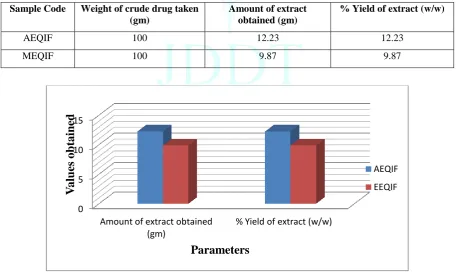
be 12.23 % w/w is more than the methanolic extract 9.87% w/w. Twelve different batches of formulation were prepared using aqueous and methanolic extract of
Quercus infectoria fruit.
ISG-1 to ISG-6 was formulated using different concentration (0.5, 1.0, 1.5, 2.0, 2.5 & 3.0) of aqueous
extract of Quercus infectoria Oliv, while 7 to
ISG-12 was formulated using different concentration (0.5, 1.0, 1.5, 2.0, 2.5 & 3.0) of methanolic extract of
Quercus infectoria Oliv. In above mentioned both the extract different proportion (5 to 30 g) of PLX 407 & 188 was added along with three different concentrations (0.25, 0.50 & 0.75) of HPMC K 100 M.
Various evaluation parameters such as physical appearance, pH, gelling capacity, gelation temperature,
viscosity, Syringeability study, Extrudability,
Spreadability and drug content were performed to
evaluate the formulated in-situ herbal gel.
From the results observed it was concluded that all the prepared herbal gel has good clarity and transparency. The pH so obtained was within the limit as for most of the preparation indented to be used for mucosal vaginal membrane. The pH values of all the formulations were in the close range of neutral pH (7.42-7.88) and hence it caused no skin irritation.
The gelling capacity and gelation temperature were found within the limit. Polymers were included in the designed topical formulations in order to provide a prompt release of drug and to achieve as well as to
maintain the drug concentration within the
therapeutically effective range. As the concentration of the polymer was 0.25, 0.50 & 0.75 in all gel formulations no major variation in viscosity was observed. Further the value between 0.38 and 0.39 poise
was reported to be an ideal viscosity value for topical
in-situ gel formulation developed using HPMC polymers. Values of the spreadability indicated that the gel formulations are easily spreadable. Among the gel formulations ISG-1 to ISG-12, more than 90% of the contents were extrudable indicating they have excellent extrudability (>90% extrudability: excellent, >80% extrudability: good, >70% extrudability: fair).
The drug content was found to be maximum of 99.87
(ISG-3) followed by 99.78 (ISG-5), 99.43(ISG-11) &
99.27 (ISG-9). From the data obtained it was concluded that the insitu herbal gel formulated using aqueous
extract of Quercus infectoria Oliv. fruit was found to
be more potent and efficacious than methanolic extract
of Quercus infectoria Oliv. fruit.
Further the same conclusion has been confirmed by the
results of in-vitro drug release studies. All the four
formulation i.e., ISG-3, ISG-5, ISG-9 & ISG-11 was further tested for stability testing for a period of one month at 25°C ± 2°C/60% RH ± 5% RH, 32°C ± 2°C/60% RH ± 5% & 40°C ± 2°C/75% RH ± 5% RH. From the results it was concluded that the formulation code ISG-3 (1.5% AEQIF) is best formulation and shows optimum efficacy at 25°C ± 2°C/60% RH ± 5% RH.
Table 2: Percentage yield of Extract
Sample Code Weight of crude drug taken (gm)
Amount of extract obtained (gm)
% Yield of extract (w/w)
AEQIF 100 12.23 12.23
MEQIF 100 9.87 9.87
Graph 1: Percentage yield of Extract
0 5 10 15
Amount of extract obtained (gm)
% Yield of extract (w/w)
V
alu
es
ob
tained
Parameters
AEQIF
Table 3: Evaluation parameters of in-situ herbal gel containing aqueous extract of Quercus infectoria Oliv.
Evaluation Parameters Formulation Code
ISG-1 ISG-2 ISG-3 ISG-4 ISG-5 ISG-6
Clarity C C C C C C
Transparency T T T T T T
pH 7.68 7.52 7.23 7.44 7.28 7.50
Gelling capacity - + ++++ +++ ++++ +
Gelation temperature 25.2 28.9 30.1 38.1 32.8 42.4 Viscosity (Poise) 0.3812 0.3882 0.3921 0.3810 0.3914 0.3841
Syringeability study E E E E E E
Extrudability (%) 94.28 97.46 99.88 97.58 99.15 95.42 Spreadability (gcm/sec) 59.13 67.28 74.39 68.49 72.43 60.37 Drug content (%) 97.49 97.48 99.87 98.47 99.78 98.68
Abbr: - : No gelation, + : Gel forms after some time, ++ : Gel forms immediately, +++: Immediate gelation remains for 8 hrs, ++++ : Immediate gelation remains for more than 10hrs. T : Translucent, C: Clear, E: Easily easily syringeable through 21-gauge needle at
cold temperature.
Table 4: Evaluation parameters of in-situ herbal gel containing methanolic extract of Quercus infectoria Oliv.
Evaluation Parameters Formulation Code
ISG-7 ISG-8 ISG-9 ISG-10 ISG-11 ISG-12
Clarity C C C C C C
Transparency T T T T T T
pH 7.61 7.48 7.22 7.51 7.18 7.52
Gelling capacity - + ++++ +++ ++++ +
Gelation temperature 24.8 29.2 32.7 40.5 35.4 40.8 Viscosity (Poise) 0.3842 0.3871 0.3979 0.3715 0.3998 0.3748
Syringeability study E E E E E E
Extrudability (%) 93.22 97.45 99.65 97.02 99.42 94.28 Spreadability (gcm/sec) 60.21 66.25 75.28 69.18 70.43 59.81 Drug content (%) 95.45 96.28 99.27 97.25 99.43 97.42
Abbr: - : No gelation, + : Gel forms after some time, ++ : Gel forms immediately, +++: Immediate gelation remains for 8 hrs, ++++ : Immediate gelation remains for more than 10hrs. T : Translucent, C: Clear, E: Easily easily syringeable through 21-gauge needle at
cold temperature.
Table 5: In-vitro drug release of in-situ herbal gel containing aqueous extract of Quercus infectoria Oliv.
Time (hrs)
Formulation Code
ISG-1 ISG-2 ISG-3 ISG-4 ISG-5 ISG-6
0 0 0 0 0 0 0
2 23.49 25.46 32.18 27.34 30.27 24.14
4 47.28 51.27 58.29 55.19 56.19 46.09
6 79.82 81.90 88.49 84.94 86.27 77.46
8 88.38 90.16 98.11 94.15 97.43 89.10
Table 6: In-vitro drug release of in-situ herbal gel containing methanolic extract of Quercus infectoria Oliv.
Time (hrs)
Formulation Code
ISG-7 ISG-8 ISG-9 ISG-10 ISG-11 ISG-12
0 0 0 0 0 0 0
2 20.62 24.78 30.64 25.81 28.99 22.82
4 45.94 49.53 56.44 54.80 54.29 45.16
6 68.26 78.97 85.03 83.18 84.11 75.20
Graph 2: Drug content of in-situ herbal gel containing aqueous & methanolic extract of Quercus infectoria Oliv.
Graph 3: Extrudability and spreadbility of in-situ herbal gel containing aqueous & methanolic extract of
Quercus infectoria Oliv.
Graph 4: In-vitro drug release of in-situ herbal gel containing aqueous extract of Quercus infectoria
Oliv. (ISG-1, ISG-2 & ISG-3)
Graph 5: In-vitro drug release of in-situ herbal gel containing aqueous extract of Quercus infectoria
Oliv. (ISG-4, ISG-5 & ISG-6)
Graph 6: In-vitro drug release of in-situ herbal gel containing methanolic extract of Quercus infectoria
Oliv. (ISG-1, ISG-2 & ISG-3)
Graph 7: In-vitro drug release of in-situ herbal gel containing methanolic extract of Quercus infectoria
Oliv. (ISG-4, ISG-5 & ISG-6)
93 94 95 96 97 98 99 100
ISG-1 ISG-2 ISG-3 ISG-4 ISG-5 ISG-6 ISG-7 ISG-8 ISG-9 ISG-10 ISG-11 ISG-12
Drug content (%)
Drug content (%)
0 20 40 60 80 100
ISG-1 ISG-2 ISG-3 ISG-4 ISG-5 ISG-6 ISG-7 ISG-8 ISG-9 ISG-10 ISG-11 ISG-12
Extrudability (%) Spreadability (gcm/sec)
0 20 40 60 80 100 120
1 2 3 4 5
ISG-1 ISG-2 ISG-3
0 20 40 60 80 100 120
1 2 3 4 5
ISG-4 ISG-5 ISG-6
0 20 40 60 80 100 120
1 2 3 4 5
ISG-7 ISG-8 ISG-9
0 20 40 60 80 100 120
1 2 3 4 5
Table 7: Stability testing of in-situ herbal gel containing aqueous & methanolic extract of Quercus infectoria
Oliv. at 25°C ± 2°C/60% RH ± 5% RH
Evaluation Parameters
Formulation Code
ISG-3 ISG-5 ISG-9 ISG-11
Initial Final Initial Final Initial Final Initial Final
Clarity C C C C C C C C
Transparency T T T T T T T T
pH 7.23 7.23 7.28 7.26 7.22 7.20 7.18 7.13
Gelling capacity ++++ ++++ ++++ ++++ ++++ ++++ ++++ ++++ Gelation
temperature
30.1 30.0 32.8 31.9 32.7 32.5 35.4 35.1
Viscosity (Poise) 0.3921 0.3920 0.3914 0.3911 0.3979 0.3978 0.3998 0.3996 Syringeability
study
E E E E E E E E
Extrudability (%) 99.88 99.87 99.15 99.11 99.65 99.63 99.42 99.40 Spreadability
(gcm/sec)
74.39 74.36 72.43 72.41 75.28 75.61 70.43 70.42
Drug content (%) 99.87 99.13 99.78 99.03 99.27 99.00 99.43 98.98
Table 8: Stability testing of in-situ herbal gel containing aqueous & methanolic extract of Quercus infectoria
Oliv. at 32°C ± 2°C/60% RH ± 5%
Evaluation Parameters
Formulation Code
ISG-3 ISG-5 ISG-9 ISG-11
Initial Final Initial Final Initial Final Initial Final
Clarity C C C C C C C C
Transparency T T T T T T T T
pH 7.23 7.21 7.28 7.24 7.22 7.21 7.18 7.15
Gelling capacity ++++ ++++ ++++ ++++ ++++ ++++ ++++ ++++ Gelation
temperature
30.1 30.0 32.8 31.4 32.7 32.1 35.4 35.0
Viscosity (Poise) 0.3921 0.3918 0.3914 0.3889 0.3979 0.3974 0.3998 0.3990 Syringeability
study
E E E E E E E E
Extrudability (%) 99.88 99.85 99.15 98.79 99.65 98.61 99.42 98.14 Spreadability
(gcm/sec)
74.39 74.30 72.43 72.33 75.28 74.58 70.43 69.10
Drug content (%) 99.87 99.10 99.78 98.10 99.27 98.12 99.43 97.82
Table 9: Stability testing of in-situ herbal gel containing aqueous & methanolic extract of Quercus infectoria
Oliv. 40°C ± 2°C/75% RH ± 5% RH.
Evaluation Parameters
Formulation Code
ISG-3 ISG-5 ISG-9 ISG-11
Initial Final Initial Final Initial Final Initial Final
Clarity C C C C C C C C
Transparency T T T T T T T T
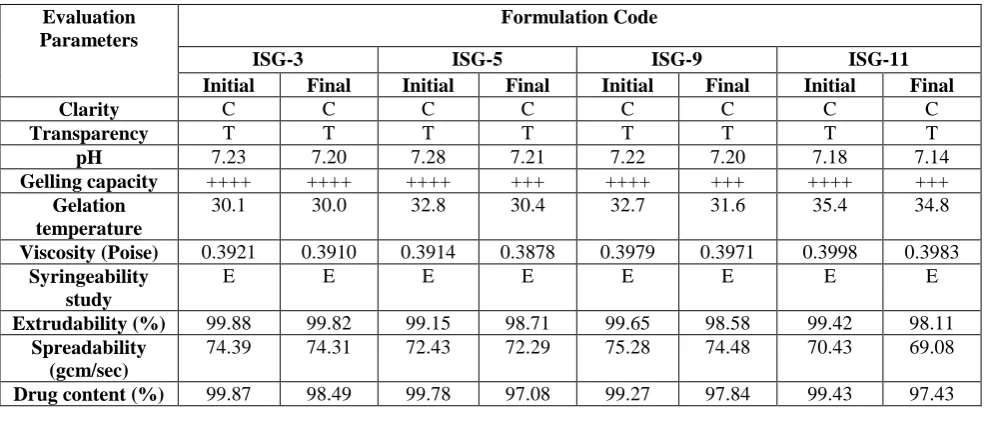
pH 7.23 7.20 7.28 7.21 7.22 7.20 7.18 7.14
Gelling capacity ++++ ++++ ++++ +++ ++++ +++ ++++ +++ Gelation
temperature
30.1 30.0 32.8 30.4 32.7 31.6 35.4 34.8
Viscosity (Poise) 0.3921 0.3910 0.3914 0.3878 0.3979 0.3971 0.3998 0.3983 Syringeability
study
E E E E E E E E
Extrudability (%) 99.88 99.82 99.15 98.71 99.65 98.58 99.42 98.11 Spreadability
(gcm/sec)
74.39 74.31 72.43 72.29 75.28 74.48 70.43 69.08
Table 10: Anti-Candida activity of herbal gel conating aqueous and methanolic extract of fruit of Quercus
infectoria Oliv.
Formulation Code Zone of Inhibition (mm; Mean±SEM) Positive control
(10 µg/disc)
20.37±0.51
ISG-3 (5 mg/disc)
17.24±0.35*
ISG-9 (5 mg/disc)
15.28±0.28*
Abbr.: All values are mean±SEM (n=3). The values are statistically significant (student t-test) when compared from standard (Positive control) p<0.001
Graph 8: Anti-Candida activity of herbal gel containing aqueous and methanolic extract of fruit of
Quercus infectoria Oliv.
CONCLUSION
From the results of stability testing it was found that the formulation code ISG-3 and ISG-9 was found to have satisfactory results, therefore further these two
formulations was screened for anti-Candida activity.
The results indicate that herbal gel formulation ISG-3 i.e., AEQIF is more potent when compared with ISG-9 i.e., MEQIF.
Hence, it was concluded from the present investigation that ISG-3 i.e., AEQIF is beneficial in the treatment of vaginal infection in the form of herbal gel. Moreover, further detail clinical trial may be carried in respect of its safety and efficacy profile.
REFERENCES
1. Patel P.V., and Vachanni M.V. Biodegradable polymers-excipients for injectable drugs. Invent Rapid Nov Excip. 2013; 4:1–4.
2. Jain S.K., Jain N.K., Gupta Y., Jain A., Jain D. and Chaurasia M. Mucoadhesive chitosan microspheres for non-invasive and improved nasal delivery of insulin. International Journal of Pharmaceutics. 2007; 64:498–504.
3. William R. Vaginal Microbicide Formulation Workshop. Virginia: Contraceptive Research and Development Program Arlington. 1998.
4. Merabet J., Thompson D., Saul Levinson R.. Advancing vaginal drug delivery. Expert Opin Drug Deliv. 2005; 2:769– 77.
5. Kottakkal AVS. Indian Medicinal Plants. 4. Orient Longman Ltd. 1995.
6. Bhattacharjee SK. Handbook of Medicinal Plants. India: Pointer Publishers. 2001.
7. Evans WC Pharmacopoeial and related drugs of biological origin. London: WB Saunders Co. Ltd. 1996.
8. Wiart C. and Kumar A. Practical Handbook of Pharmacognosy. Malaysia: Pearson Education Malaysia Sdn Bhd. 2001.
9. Ikram M. and Nowshad F. Constituents of Quercus infectoria. Planta Med 1977; 31:286–287.
10. Hwang J.K., Kong T.W., Baek, N.I. and Pyun Y.R. alpha-Glycosidase inhibitory activity of hexagalloylglucose from the galls of Quercus infectoria. Planta Med 2000; 66:273–274. 11. Kaur G., Hamid H., Ali A., Alam M.S. and Athar M.
Antiinflammatory evaluation of alcoholic extract of galls of Quercus infectoria. J Ethnopharmacol 2004; 90:285–292. 12. Kaur G., Athar M. and Alam M.S. Quercus infectoria galls
possess antioxidant activity and abrogates oxidative stress-induced functional alterations in murine macrophages. Chem Biol Interact 2008; 171:272–282.
13. Sawangjaroen N., Sawangjaroen K. and Poonpanang P. Effects of Piper longum fruit, Piper sarmentosum root and Quercus infectoria nut gall on caecal amoebiasis in mice. J Ethnopharmacol 2004; 91:357–360.
14. Chusri S. and Voravuthikunchai S.P. Quercus infectoria: a candidate for control of methicillin-resistant Staphylococcus aureus infections. Phytother Res 2008; 22, doi: 10:1002 ⁄ ptr.2377..
15. Dwivedi S. Status survey of medicinal plants wealth of Malwa region of Madhya Pradesh with special reference to conservation of vulnerable and endangered species, J. Econ. Taxon. Bot., 2009; 33(2):443-452.
16. Saeida N, Hasmah A, Amilah WN. Potential use of Quercus infectoria galls extracts against urinary tract pathogenic bacteria. Int J. of Res. In Pharmacology & Pharmacotherapeutics, 2014; 3(3):184-191.
17. Patel P. and Papel P. Formulation and evaluation of clindamycin HCL in situ gel for vaginal application. Int J Pharm Investig.; 2015; 5(1):50–56.
18. Masoudi M, Miraj S, Rafieian-Kopaei M. Comparison of the Effects of Myrtus Communis L, Berberis Vulgaris and Metronidazole Vaginal Gel alone for the Treatment of Bacterial Vaginosis. J Clin Diagn Res. 2016; 10(3):QC04-7. 19. Rençber S, Karavana SY, Şenyiğit ZA, Eraç B, Limoncu MH
and Baloğlu E. Mucoadhesive in situ gel formulation for vaginal delivery of clotrimazole: formulation, preparation, and in vitro/in vivo evaluation. Pharm Dev Technol., 2017; 22(4):551-561
20. Bhinge SD, Bhutkar MA, Randive DS, Wadkar GH, Todkar SS, Kakade PM and Kadam PM Formulation development and evaluation of antimicrobial polyherbal gel. Ann Pharm Fr. 2017; 75(5):349-358.
21. Khanbabaee K, van Ree T. Tannins: Classification and definition. Nat Prod Rep. 2001; 18:641–9.
0 5 10 15 20 25
Positive control
ISG-3 ISG-9
ZO
I (m
m
)