World
abstract
Over the last decade, health care has experienced continuous,
ca-pricious, and ever-accelerating change. In response, the American
Academy of Pediatrics convened the Vision of Pediatrics (VOP) 2020
Task Force in 2008. This task force was charged with identifying
forces that affect child and adolescent health and the implications
for the field of pediatrics. It determined that shifts in
demograph-ics, socioeconomdemograph-ics, health status, health care delivery, and
scien-tific advances mandate creative responses to these current trends.
Eight megatrends were identified as foci for the profession to
ad-dress over the coming decade. Given the unpredictable speed and
direction of change, the VOP 2020 Task Force concluded that our
profession needs to adopt an ongoing process to prepare for and
lead change. The task force proposed that pediatric clinicians,
practices, organizations, and interest groups embark on a
contin-ual process of preparing, envisioning, engaging, and reshaping
(PEER) change. This PEER cycle involves (1) preparing our capacity
to actively participate in change efforts, (2) envisioning possible
futures and potential strategies through ongoing conversations,
(3) engaging change strategies to lead any prioritized changes, and
(4) reshaping our futures on the basis of results of any change
strategies and novel trends in the field. By illustrating this process
as a cycle of inquiry and action, we deliberately capture the
contin-uous aspects of successful change processes that attempt to peer
into a multiplicity of futures to anticipate and lead change.
Pediatrics
2010;126:982–988
In January 2008, the American Academy of Pediatrics launched the
Vision of Pediatrics (VOP) 2020 project. At the heart of this project was
the explicit acknowledgment of the inevitability of change in a world of
increasing complexity, unpredictability, and interconnectedness.
The VOP 2020 focus on change and its impact on child and
adoles-cent (hereafter, “child”) health and the practice of pediatric health
care was built on previous efforts. Shifts in US population
demo-graphics, family structure, income, educational levels, and cultural
norms
1–3continue to directly affect the health and well-being of
chil-dren, adolescents, and young adults (hereafter, “children”) as
por-trayed in the Future of Pediatric Education reports in 1978 and 2000.
4Modifying pediatric educational programs to adapt to change was the
focus of the recent Residency Review and Redesign Project.
5Medical
journals and the media flood practitioners and families with scientific
advances, and health organizations, professional societies, federal
agencies, health plans, and accrediting bodies have implemented tools
AUTHORS:Laurel K. Leslie, MD, MPH, FAAP,aKenneth M.
Slaw, PhD,bAnne Edwards, MD, FAAP,cAmy J. Starmer,
MD, MPH, FAAP,dJohn C. Duby, MD, FAAP,eand Members
of the Vision of Pediatrics 2020 Task Force
aPediatrics and Medicine, Tufts Medical Center/Floating Hospital for Children, Boston, Massachusetts;bDepartment of
Membership and Strategic Planning, American Academy of Pediatrics, Elk Grove Village, Illinois;cPediatrics, Park Nicollet Health Services, Minneapolis, Minnesota;dGeneral Pediatrics, Children’s Hospital Boston, Boston, Massachusetts; andeDivision of Developmental and Behavioral Pediatrics, Akron Children’s Hospital, Akron, Ohio
KEY WORDS
pediatrics, future, leadership, innovation, change management
ABBREVIATIONS
VOP—Vision of Pediatrics
PEER—preparing, envisioning, engaging, reshaping IT—information technology
The opinions expressed in this article are those of the authors and do not necessarily represent American Academy of Pediatrics policy.
www.pediatrics.org/cgi/doi/10.1542/peds.2010-1890 doi:10.1542/peds.2010-1890
Accepted for publication Aug 16, 2010
Address correspondence to Laurel K. Leslie, MD, MPH, FAAP, Tufts Medical Center/Floating Hospital for Children, 800 Washington St, No. 345, Boston, MA 02111. E-mail: lleslie@ tuftsmedicalcenter.org
PEDIATRICS (ISSN Numbers: Print, 0031-4005; Online, 1098-4275). Copyright © 2010 by the American Academy of Pediatrics
to disseminate and translate new
knowledge into pediatric practice.
However, the process of anticipating
and leading change has not been a
ma-jor focus for pediatrics. Koeck noted in
a 1998 article in the
British Medical
Journal
that a “student of
manage-ment and organizational theory could
only be stunned by how little the
ef-forts to improve quality [in health]
have learnt from the current thinking
in management and from the
experi-ence of other industries.”
6The VOP
2020 Task Force deliberately sought to
anticipate upcoming changes that may
affect child health care and pediatric
practice through a scenario process
commonly used by businesses, the
mil-itary, and policy makers.
7–9The task
force brainstormed a range of
possi-ble future scenarios and identified 8
“megatrends” to address in preparing
for plausible futures (see Table 1 and
the accompanying article in this issue
of
Pediatrics
10).
Despite its focus on scenario planning,
the VOP 2020 Task Force also
acknowl-edged that the timing and scope of
change are not predictable. In addition
to the 8 megatrends, several
“wild-card” trends were identified as
possi-ble, but less probapossi-ble, futures (see
Ta-ble 2). Before we had finished the
project, events relating to both the
megatrends and the wild cards
oc-curred on a national and international
scale. The passage of health care
re-form in the United States in Spring
2010 has already affected pediatric
health
coverage.
The
unexpected
emergence of the H1N1 influenza virus
and its propensity to affect children
surprised a public health community
focused on the risks of avian flu and
reminded us of our vulnerabilities to
emerging diseases. Environmental
di-sasters (eg, the Icelandic volcano
eruption and the Gulf of Mexico oil
spill) have had societal as well as
health implications. The cataclysmic
effects of the economic recession are
still affecting families and the public
and private systems that care for
them. These recent events heightened
the task force’s awareness of the
un-predictability of change.
In response, we modified our goals as a
task force. Although a major focus was
identifying next steps with respect to the
8 megatrends, we also prioritized
pro-moting an ongoing process of reshaping
a multiplicity of possible futures and
choosing how we, as a field, want to lead
those futures. Drawing on the business,
sociology, psychology, organizational,
and quality-improvement literature, we
sought to delineate a relatively simple
framework to visually represent this
type of process.
THE PEER CYCLE AND
IMPLICATIONS FOR PEDIATRICS
Our framework (see Fig 1), the PEER
(preparing, envisioning, engaging, and
reshaping) cycle, parallels the
plan-do-study-act (PDSA) cycle used in
quality-improvement initiatives to implement
changes in health settings.
11The
top-most position in the cycle is preparing
by building our capacity to actively
par-ticipate in change efforts.
Simulta-neously, we move clockwise to
envi-sioning possible futures and potential
strategies for leading change. Next is
engaging in strategies to initiate,
im-plement, and catalyze change. We then
enter into a period of reshaping our
vision and strategies on the basis of
feedback from previous implemented
changes, ongoing monitoring of trends
in the field, and the creation of new
scenarios that incorporate these data.
Preparing by Building Our Capacity
to Lead Change
In the business world, the
develop-ment and dissemination of innovations
are critical for success. Yet, experts
have estimated that, despite novel
ideas and ample resources, there is a
70% to 75% failure rate for enacting
effective change.
12–14Successful
orga-TABLE 2 Wild-Card Trends Identified From the Scenario Process of the VOP Project
Domain Example
Societal changes Large pandemic or major disease World famine or drought
A disaster necessitating resettlement War on US soil
Health advances Gene therapy able to provide true and effective cures Change in birth rates
Universal health insurance Cure for autism
Economics US and global economies collapse Greater disparities between rich and poor
Decline or exponential increase in cost of higher education Work-life balance Access to high-quality child care with job security
Implementation of a 56-h week for residents Changes in family-planning policies
Preparing
Envisioning
Engaging Reshaping
FIGURE 1
The PEER cycle.
TABLE 1 Eight Megatrends Identified Through the Scenario Process of the VOP 2020
1. Changing demographic and clinical characteristics of children and families 2. Burgeoning health information technology 3. Ongoing medical advances
4. Alterations in health care–delivery system(s) 5. Growth of consumer-driven health care 6. Dynamics of pediatric workforce 7. Disasters (environmental, infectious,
man-made) 8. Globalism
in change. Components of
capacity-building described in the literature
in-clude (1) training leaders at all levels
of an organization, (2) promoting a
cul-ture that supports learning and
inno-vation, (3) emphasizing effective team
development, (4) using information
technology (IT), and (5) investing
ade-quate fiscal and time resources.
15,16In pediatrics, many of these
compo-nents deserve our attention. Although
a number of outstanding individuals
hold pediatric leadership roles,
lead-ership training and development have
only been marginally addressed. The
American Academy of Pediatrics
Pedi-atric Leadership Alliance
17and the
Ac-ademic Pediatric Association
leader-ship training series
1are examples of
programs that make the requisite
commitment of developing leaders.
Second, our medical culture is
primar-ily hierarchical and individualistic in
nature; in contrast, more integrated,
dynamic, and flexible environments
foster successful change across other
industries.
18–22Third, our training
con-tinues to be physician focused,
ap-prenticeship based, and top-down,
rather than modeling and explicitly
teaching effective team strategies and
“servant leadership” principles for
both providing care and implementing
change.
23,24Fourth, the use of IT also
mandates attention and, we hope, will
be catalyzed by the current federal
ad-ministration’s efforts to promote the
use of IT in health care.
25Envisioning Possible Futures and
Strategies for Leading Change
Many writers on change have
com-mented that the types of problems we
are facing as a society are increasingly
complex and should be considered
“wicked problems.”
26Wicked problems
are messy, multifaceted, and
multisys-tem; lack clear-cut solutions; and are
insoluble
by
conventional
means.
Hence, discussions about these types
of problems and possible solutions are
often
challenging,
convoluted,
and
conflict-ridden. Thus, thought leaders in
change theory promote the use of
ongo-ing, in-depth dialogues or “permanent
strategic conversations” that delve into
the murkiness of these wicked
prob-lems, confront status-quo assumptions,
acknowledge the inherent tensions of
addressing them, and specifically seek
to build off of these tensions to envision
creative solutions.
7,27–29Each of the megatrends and wild cards
presented in the accompanying
arti-cle
10represents wicked problems that
deserve this type of strategic
discus-sion. Although the content of these
conversations could and should evolve
over time, the VOP 2020 Task Force
pro-poses that we begin by discussing the
megatrends and/or wild cards
identi-fied through the VOP 2020, using the
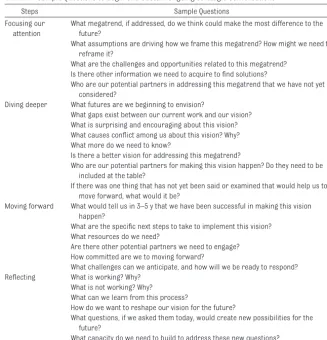
questions provided in Table 3 as a
starting point. These discussions will
need to build on systems perspectives
that draw attention to the
intercon-nectedness of systems in initially
cre-ating problems and in promoting
or hindering change.
13Discussions
should include members of a
particu-lar system (eg, practice setting, team
unit, health plan, subspecialty group)
but also stakeholder groups outside
the system that may overlap in
func-tion or interest area and have the
po-tential to facilitate change.
28,30Identify-ing stakeholders with political, social,
and monetary capital will also prove
es-sential for having sufficient resources to
implement change in pediatric health
care. Children’s needs have routinely
had limited political voice, and this is not
Focusing our attention
What megatrend, if addressed, do we think could make the most difference to the future?
What assumptions are driving how we frame this megatrend? How might we need to reframe it?
What are the challenges and opportunities related to this megatrend? Is there other information we need to acquire to find solutions?
Who are our potential partners in addressing this megatrend that we have not yet considered?
Diving deeper What futures are we beginning to envision?
What gaps exist between our current work and our vision? What is surprising and encouraging about this vision? What causes conflict among us about this vision? Why? What more do we need to know?
Is there a better vision for addressing this megatrend?
Who are our potential partners for making this vision happen? Do they need to be included at the table?
If there was one thing that has not yet been said or examined that would help us to move forward, what would it be?
Moving forward What would tell us in 3–5 y that we have been successful in making this vision happen?
What are the specific next steps to take to implement this vision? What resources do we need?
Are there other potential partners we need to engage? How committed are we to moving forward?
What challenges can we anticipate, and how will we be ready to respond? Reflecting What is working? Why?
What is not working? Why?
What can we learn from this process?
How do we want to reshape our vision for the future?
What questions, if we asked them today, would create new possibilities for the future?
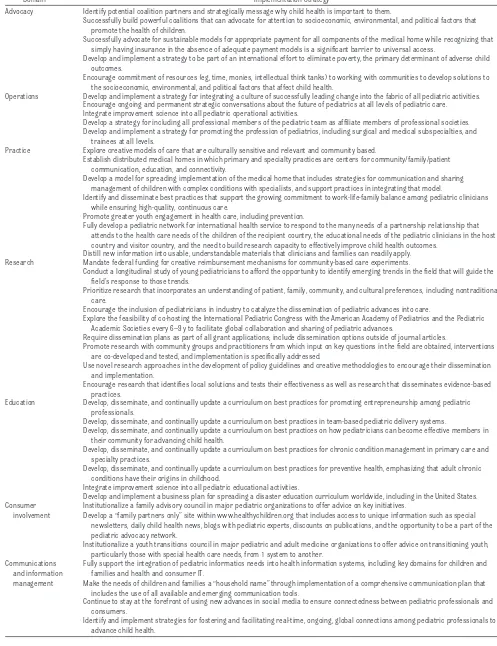
TABLE 4 Sample Implementation Strategies Identified by the VOP 2020 Task Force
Domain Implementation Strategy
Advocacy Identify potential coalition partners and strategically message why child health is important to them.
Successfully build powerful coalitions that can advocate for attention to socioeconomic, environmental, and political factors that promote the health of children.
Successfully advocate for sustainable models for appropriate payment for all components of the medical home while recognizing that simply having insurance in the absence of adequate payment models is a significant barrier to universal access.
Develop and implement a strategy to be part of an international effort to eliminate poverty, the primary determinant of adverse child outcomes.
Encourage commitment of resources (eg, time, monies, intellectual think tanks) to working with communities to develop solutions to the socioeconomic, environmental, and political factors that affect child health.
Operations Develop and implement a strategy for integrating a culture of successfully leading change into the fabric of all pediatric activities. Encourage ongoing and permanent strategic conversations about the future of pediatrics at all levels of pediatric care. Integrate improvement science into all pediatric operational activities.
Develop a strategy for including all professional members of the pediatric team as affiliate members of professional societies. Develop and implement a strategy for promoting the profession of pediatrics, including surgical and medical subspecialties, and
trainees at all levels.
Practice Explore creative models of care that are culturally sensitive and relevant and community based.
Establish distributed medical homes in which primary and specialty practices are centers for community/family/patient communication, education, and connectivity.
Develop a model for spreading implementation of the medical home that includes strategies for communication and sharing management of children with complex conditions with specialists, and support practices in integrating that model.
Identify and disseminate best practices that support the growing commitment to work-life-family balance among pediatric clinicians while ensuring high-quality, continuous care.
Promote greater youth engagement in health care, including prevention.
Fully develop a pediatric network for international health service to respond to the many needs of a partnership relationship that attends to the health care needs of the children of the recipient country, the educational needs of the pediatric clinicians in the host country and visitor country, and the need to build research capacity to effectively improve child health outcomes.
Distill new information into usable, understandable materials that clinicians and families can readily apply. Research Mandate federal funding for creative reimbursement mechanisms for community-based care experiments.
Conduct a longitudinal study of young pediatricians to afford the opportunity to identify emerging trends in the field that will guide the field’s response to those trends.
Prioritize research that incorporates an understanding of patient, family, community, and cultural preferences, including nontraditional care.
Encourage the inclusion of pediatricians in industry to catalyze the dissemination of pediatric advances into care.
Explore the feasibility of co-hosting the International Pediatric Congress with the American Academy of Pediatrics and the Pediatric Academic Societies every 6–9 y to facilitate global collaboration and sharing of pediatric advances.
Require dissemination plans as part of all grant applications; include dissemination options outside of journal articles.
Promote research with community groups and practitioners from which input on key questions in the field are obtained, interventions are co-developed and tested, and implementation is specifically addressed.
Use novel research approaches in the development of policy guidelines and creative methodologies to encourage their dissemination and implementation.
Encourage research that identifies local solutions and tests their effectiveness as well as research that disseminates evidence-based practices.
Education Develop, disseminate, and continually update a curriculum on best practices for promoting entrepreneurship among pediatric professionals.
Develop, disseminate, and continually update a curriculum on best practices in team-based pediatric delivery systems.
Develop, disseminate, and continually update a curriculum on best practices on how pediatricians can become effective members in their community for advancing child health.
Develop, disseminate, and continually update a curriculum on best practices for chronic condition management in primary care and specialty practices.
Develop, disseminate, and continually update a curriculum on best practices for preventive health, emphasizing that adult chronic conditions have their origins in childhood.
Integrate improvement science into all pediatric educational activities.
Develop and implement a business plan for spreading a disaster education curriculum worldwide, including in the United States. Consumer
involvement
Institutionalize a family advisory council in major pediatric organizations to offer advice on key initiatives.
Develop a “family partners only” site within www.healthychildren.org that includes access to unique information such as special newsletters, daily child health news, blogs with pediatric experts, discounts on publications, and the opportunity to be a part of the pediatric advocacy network.
Institutionalize a youth transitions council in major pediatric and adult medicine organizations to offer advice on transitioning youth, particularly those with special health care needs, from 1 system to another.
Communications and information management
Fully support the integration of pediatric informatics needs into health information systems, including key domains for children and families and health and consumer IT.
Make the needs of children and families a “household name” through implementation of a comprehensive communication plan that includes the use of all available and emerging communication tools.
Continue to stay at the forefront of using new advances in social media to ensure connectedness between pediatric professionals and consumers.
Identify and implement strategies for fostering and facilitating real-time, ongoing, global connections among pediatric professionals to advance child health.
anticipated to change with the aging of
the baby-boom population and the
in-creasing numbers of children who live in
poverty.
2,31Engaging in Strategies to Initiate
and Implement Change
The success of plan-do-study-act
cy-cles in quality-improvement work
par-tially reflects their commitment to
small, “safe-fail” experiments with
real-time data collected, analyzed, and
applied.
18Similarly, we in pediatrics
need to commit to experimentation
with new models of care. Our
protocol-based,
guideline-driven
profession
may, at times, naturally resist these
types of experiments. Comprehensive
multilevel approaches also are
in-creasingly lauded in business as more
effective than single interventions but
have been less likely to be adopted in
medicine, perhaps because of our
training in single-intervention
ran-domized clinical trials and the silo
na-ture of medical systems.
15Writers on change processes
acknowl-edge that change is difficult to initiate,
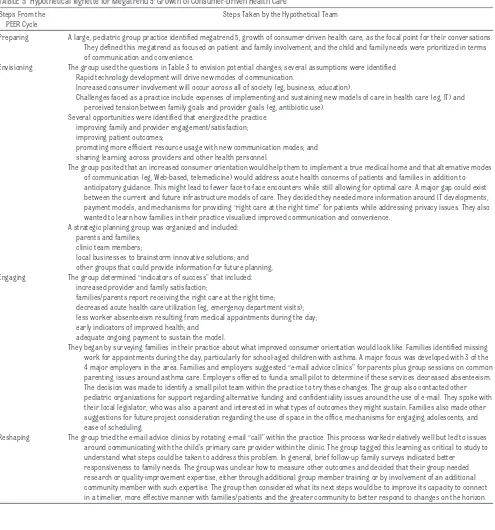
PEER Cycle
Preparing A large, pediatric group practice identified megatrend 5, growth of consumer-driven health care, as the focal point for their conversations. They defined this megatrend as focused on patient and family involvement, and the child and family needs were prioritized in terms of communication and convenience.
Envisioning The group used the questions in Table 3 to envision potential changes; several assumptions were identified: Rapid technology development will drive new modes of communication.
Increased consumer involvement will occur across all of society (eg, business, education).
Challenges faced as a practice include expenses of implementing and sustaining new models of care in health care (eg, IT) and perceived tension between family goals and provider goals (eg, antibiotic use).
Several opportunities were identified that energized the practice: improving family and provider engagement/satisfaction; improving patient outcomes;
promoting more efficient resource usage with new communication modes; and sharing learning across providers and other health personnel.
The group posited that an increased consumer orientation would help them to implement a true medical home and that alternative modes of communication (eg, Web-based, telemedicine) would address acute health concerns of patients and families in addition to anticipatory guidance. This might lead to fewer face-to-face encounters while still allowing for optimal care. A major gap could exist between the current and future infrastructure models of care. They decided they needed more information around IT developments, payment models, and mechanisms for providing “right care at the right time” for patients while addressing privacy issues. They also wanted to learn how families in their practice visualized improved communication and convenience.
A strategic planning group was organized and included: parents and families;
clinic team members;
local businesses to brainstorm innovative solutions; and other groups that could provide information for future planning. Engaging The group determined “indicators of success” that included:
increased provider and family satisfaction;
families/parents report receiving the right care at the right time; decreased acute health care utilization (eg, emergency department visits); less worker absenteeism resulting from medical appointments during the day; early indicators of improved health; and
adequate ongoing payment to sustain the model.
They began by surveying families in their practice about what improved consumer orientation would look like. Families identified missing work for appointments during the day, particularly for school-aged children with asthma. A major focus was developed with 3 of the 4 major employers in the area. Families and employers suggested “e-mail advice clinics” for parents plus group sessions on common parenting issues around asthma care. Employers offered to fund a small pilot to determine if these services decreased absenteeism. The decision was made to identify a small pilot team within the practice to try these changes. The group also contacted other pediatric organizations for support regarding alternative funding and confidentiality issues around the use of e-mail. They spoke with their local legislator, who was also a parent and interested in what types of outcomes they might sustain. Families also made other suggestions for future project consideration regarding the use of space in the office, mechanisms for engaging adolescents, and ease of scheduling.
implement, and sustain whether at the
individual, organizational, or systems
level.
12,13,18Pediatric leaders can help
by creating a sense of urgency that
combats people’s inherent resistance
to change; establishing a strong,
trust-worthy, guiding coalition; and clearly
stating and restating a vision for the
future, including its benefits and
po-tential challenges. Additional steps for
promoting change described in the
lit-erature include enabling others to act,
publicizing successful change efforts,
and
institutionalizing
change.
32,33Thought leaders in medicine also have
suggested several mechanisms for
promoting change, including providing
time and resources to innovators and
designating roles in an organization as
“improvement fellows.”
34Both the megatrends and the wild-card
trends demonstrate potential
opportu-nities for experimentation. For
exam-ple, the passage of health care reform
and the extension of health care
bene-fits into early adulthood could
stimu-late creative solutions regarding the
transition of youth with chronic
disor-ders into adult systems of care. These
experiments do not have to be large
but do need sufficient visibility and
support. Table 4 provides some
poten-tial innovation strategies that the VOP
2020 Task Force identified. We
ac-knowledge that our strategies may be
bounded by our own assumptions as a
task force; however, they may provide
a starting point for discussions.
Reshaping Change
This fourth step in the PEER cycle
moves beyond conventional evaluation
purposes and, instead, focuses on
lessons from previous actions, novel
trends, and implications for future
PEER cycles. Pediatrics can support
ef-forts to reshape change by embracing
the role of learning organizations,
health care breakthrough
collabora-tives, social networks, and innovation
networks in implementing and
assess-ing specific care processes.
34–37In
ad-dition, futurists and business leaders
alike have commented on the
impor-tance of monitoring trends for radical
innovations that may herald the
fu-ture.
38Monitoring in a spirit of creative
inquiry may provide opportunities for
pediatrics to lead change rather than
simply respond. For example,
consum-ers increasingly use “minute clinics”
39and on-line health information tools
such as Zipnosis,
40which assist in
identifying
disorders
and
medical
treatment.
These
trends
should
prompt conversations regarding why
consumers are seeking these types of
options and how pediatric care can
creatively address these unmet needs.
Ultimately, this fourth step in the PEER
cycle leads to identifying new areas of
capacity to develop, unanswered
ques-tions for dialogue, and novel
innova-tions to implement.
APPLYING THE PEER CYCLE
We live in an age in which the speed of
change, decision-making, and
opportu-nity are palpable. The lessons of the
last decade, coupled with significant
recent events, point to the need of
re-specting both the quickness and
un-predictability of change. Without
em-bracing possibilities, the potential to
become obsolete is high.
On an individual level, each of us can
choose to commit to self-development
as
leaders,
team
members,
and
change agents and examine our own
resistance to change, our particular
passions with respect to future trends,
any assumptions that we harbor about
the types of problems we face now and
potentially in the future, and possible
strategies we could use to create
inno-vative solutions. We also can identify
current successes on which we can
build to support future tasks within
our spheres of influence.
Service settings and systems (eg,
practices, public health agencies,
hos-pitals, plans, industries, professional
organizations, committees and/or task
forces within organizations, and
advo-cacy groups) can also embark on PEER
cycles by determining what capacity
needs to be built, identifying topics and
participants for strategic
conversa-tions, and recognizing future
innova-tions to implement. The American
Academy of Pediatrics has committed
to embarking on a PEER cycle across
the organization, and several chapters
already plan on hosting planning
meet-ings. We also hope to stimulate similar
types of activities across the field. An
example of the type of activities on
which a group practice might
em-bark for 1 of the megatrends is
pro-vided in Table 5. We invite you to peer
into the future and engage in a process
that will help create and reshape the
future of pediatrics and the future of
the children and families for whom we
care.
ACKNOWLEDGMENTS
Dr Leslie’s work on this article was
provided by the William T. Grant
Foun-dation (9443) and the Tufts Clinical and
Translational Science Institute (UL1
RR025752); funding for the VOP 2020
Task Force was provided by the
Amer-ican Academy of Pediatrics.
Members of the VOP 2020 Task Force
included John Duby, MD, FAAP (chair),
Jeff Kaczorowski, MD, FAAP
(vice-chair), Maria Britto, MD, FAAP,
Chris-toph Diasio, MD, FAAP, Anne Edwards,
MD, FAAP, Amy J. Starmer, MD, MPH,
FAAP, Renee Jenkins, MD, FAAP, Robert
Kliegman, MD, FAAP, Danielle Laraque,
MD, FAAP, Laurel K. Leslie MD, MPH,
FAAP, Martin Michaels, MD, FAAP, and
Marleta Reynolds, MD, FAAP. The task
force acknowledges the contributions
of task force consultants Thomas Boat,
MD, FAAP, David Bergman, MD, FAAP,
Edward Schor, MD, FAAP, Bonita
Stan-ton, MD, FAAP, Robert Walker, MD,
ing contributions to this work by AAP
staff. Kenneth M. Slaw, PhD, designed
and Susan Flinn, MA, provided superb
fa-cilitation and staff support. Last, we
Pediatrics 2020 project, please visit
www.aap.org/visionofpeds.
REFERENCES
1. Cheng T. The wisdom, the will, and the wallet: leadership on behalf of kids and families.Acad Pediatr. 2010;10(2):81– 86 2. Wise P. Children of the recession.Arch
Pe-diatr Adolesc Med. 2009;163(11):1063–1064 3. Palfrey JS, Sofis LA, Davidson EJ, Liu J, Free-man L, Ganz ML; Pediatric Alliance for Coor-dinated Care. The Pediatric Alliance for Co-ordinated Care: evaluation of a medical home model.Pediatrics. 2004;113(5 suppl): 1507–1516
4. Leslie L, Rappo P, Abelson H, et al. Final re-port of the FOPE II Pediatric Generalists of the Future Workgroup.Pediatrics. 2000; 106(5):1199 –1223
5. Jones MD Jr, McGuinness GA, Carraccio CL. The Residency Review and Redesign in Pedi-atrics (R3P) project: roots and branches.
Pediatrics. 2009;123(suppl 1):S8 –S11 6. Koeck C. Time for organisational
develop-ment in healthcare organisations: improv-ing quality for patients means changimprov-ing the organisationBMJ. 1998;317(7168): 1267–1268
7. Schwartz P. The Art of the Long View: Plan-ning for the Future in an Uncertain World. New York, NY: Currency Doubleday; 1996 8. Bentham J.Scenarios: An Explorer’s Guide.
Shell International; 2007
9. Scearce D, Fulton K. What if? The art of sce-nario thinking for nonprofits. Available at: www.gbn.com/articles/pdfs/GBN_What_If. pdf. Accessed September 8, 2010 10. Starmer AJ, Duby JC, Slaw KM, Edwards A,
Leslie LK; Members of the Vision of Pediat-rics 2020 Task Force. PediatPediat-rics in the year 2020 and beyond: preparing for plausible futures.Pediatrics. 2010;126(5):971–981 11. Speroff T, O’Connor G. Study designs for
PDSA quality improvement research.Qual Manag Health Care. 2004;13(1):17–32 12. Kotter J. Leading Change. Boston, MA:
Har-vard Business School Press; 1996 13. Senge P. The Dance of Change: The
Chal-lenges of Sustaining Momentum in Learning Organizations. Toronto, Ontario, Canada: Random House of Canada; 1999
14. Peters T, Waterman R. In Search of Excel-lence. New York, NY: HarperBusiness; 1982 15. Ferlie E, Shortell S. Improving the quality of
health care in the United Kingdom and the United States: a framework for change. Mil-bank Q. 2001;79(2):281–315
16. Solberg L. Improving medical practice: a conceptual framework.Ann Fam Med. 2007; 5(3):251–256
17. Leslie L, Miotto M, Liu G, et al. Training young pediatricians as leaders for the 21st cen-tury.Pediatrics. 2005;115(3):765–773 18. Scholtes P, Ackoff R. The Leader’s
Hand-book: Making Things Happen, Getting Things Done. New York, NY: McGraw-Hill; 1998 19. Senge P. The Fifth Discipline: The Art and
Practice of the Learning Organization. New York, NY: Doubleday; 1990
20. Kouzes J, Posner B. The student leadership challenge: five practices for exemplary leaders.J Coll Stud Dev. 2009;50(March/ April 2009):245–247
21. Clemmer T, Spuhler V, Berwick D, Nolan T. Cooperation: the foundation of improve-ment.Ann Intern Med. 1998;128(12 pt 1): 1004 –1009
22. Brown J. Change Favours the Prepared Mind. London, United Kingdom: Her Majes-ty’s Stationery Office; 1996
23. Greenleaf R, Spears L. Servant Leadership: A Journey Into the Nature of Legitimate Power and Greatness. New York, NY: Paulist Press; 2002
24. Greenleaf R. Servant Leadership. New York, NY: Paulist Press; 1977
25. State Health Information Exchange Cooper-ative Agreement Program. Health informa-tion technology. Available at: http://healthit. hhs.gov/portal/server.pt?open⫽512&objID⫽ 1488&parentname⫽CommunityPage& parentid⫽58&mode⫽2&in_hi_userid⫽ 11113&cached⫽true. Accessed September 14, 2010
26. Conklin J. Wicked problems and social com-plexity. In: Dialogue Mapping: Building Shared Understanding of Wicked Problems.
Chichester, United Kingdom: John Wiley & Sons; 2006: 3– 40
27. Kahane A. Solving Tough Problems: An Open Way of Talking, Listening, and Creating New Realities. San Francisco, CA: Berrett-Koehler Publishers; 2004
28. Westley F, Zimmerman B, Patton M. Getting to Maybe. Toronto, Ontario, Canada: Vintage Canada; 2007
29. Vogt E, Brown J, Isaacs D. The Art of Power-ful Questions: Catalyzing Insight, Innovation, and Action. Mill Valley, CA: Whole Systems Associates; 2003
30. Stelk W, Slaton E. The role of infrastructure in the transformation of child-adolescent mental health systems.Adm Policy Ment Health. 2010;37(1–2):100 –110
31. Pachter L. Child health care disparities: findings from the annual report on chil-dren’s health care. Acad Pediatr. 2003; 10(2):87– 88
32. Rogers E. Diffusion of Innovations. 4th ed. New York, NY: Free Press; 1995
33. Van de Ven A. Central problems in the man-agement of innovation.Manage Sci. 1986; 32(5):590 – 607
34. Berwick D. Disseminating innovations in health care.JAMA. 2003;289(15):1969 –1975 35. Noveck B. Wiki Government: How Technology Can Make Government Better, Democracy Stronger, and Citizens More Powerful. Washington, DC: Brookings Institution; 2009 36. Leviton LC, Orleans CT. Promoting the up-take of evidence in clinical practice: a pre-scription for action.Clin Perinatol. 2003; 30(2):403– 417
37. Margolis P, Halfon N. Innovation networks: a strategy to transform primary health care.
JAMA. 2009;302(13):1461–1462
38. Heijden K, Schlange L. Scenarios: The Art of Strategic Conversation. West Sussex, United Kingdom: John Wiley & Sons; 1997 39. MinuteClinic at CVS Pharmacy. About
Minute-Clinic. Available at: http://minuteclinic.com/en/ USA/About. Accessed June 9, 2010