APPLIED COMPUTING, MATHEMATICS
AND STATISTICS GROUP
Division of Applied Management and Computing
Development of a Prototype
Simulation Tool for an Aircraft
Materials Remanufacturing System
P. Johnson, D. Kulasiri and R. Sedcole
Research Report No: 99/10
July 1999
R
ESEARCH
E
R
PORT
L I N C O L N
U N I V E R S I T Y
T e W h a r e Wān a k a O A o r a k i
Applied Computing, Mathematics and Statistics
The Applied Computing, Mathematics and Statistics Group (ACMS) comprises staff of the Applied Management and Computing Division at Lincoln University whose research and teaching interests are in computing and quantitative disciplines. Previously this group was the academic section of the Centre for Computing and Biometrics at Lincoln University.
The group teaches subjects leading to a Bachelor of Applied Computing degree and a computing major in the Bachelor of Commerce and Management. In addition, it contributes computing, statistics and
mathematics subjects to a wide range of other Lincoln University degrees. In particular students can take a computing and mathematics major in the BSc.
The ACMS group is strongly involved in postgraduate teaching leading to honours, masters and PhD degrees. Research interests are in modelling and simulation, applied statistics, end user computing, computer assisted learning, aspects of computer networking, geometric modelling and visualisation.
Research Reports
Every paper appearing in this series has undergone editorial review within the ACMS group. The editorial panel is selected by an editor who is appointed by the Chair of the Applied Management and Computing Division Research Committee.
The views expressed in this paper are not necessarily the same as those held by members of the editorial panel. The accuracy of the information presented in this paper is the sole responsibility of the authors. This series is a continuation of the series "Centre for Computing and Biometrics Research Report" ISSN 1173-8405.
Copyright
Copyright remains with the authors. Unless otherwise stated permission to copy for research or teaching purposes is granted on the condition that the authors and the series are given due acknowledgement. Reproduction in any form for purposes other than research or teaching is forbidden unless prior written permission has been obtained from the authors.
Correspondence
This paper represents work to date and may not necessarily form the basis for the authors' final conclusions relating to this topic. It is likely, however, that the paper will appear in some form in a journal or in conference proceedings in the near future. The authors would be pleased to receive correspondence in connection with any of the issues raised in this paper. Please contact the authors either by email or by writing to the address below.
Any correspondence concerning the series should be sent to: The Editor
Applied Computing, Mathematics and Statistics Group Applied Management and Computing Division
PO Box 84
Lincoln University Canterbury
NEW ZEALAND
Development of a Prototype Simulation Tool for an
Aircraft Materials Remanufacturing System
Peter Johnson, Don Kulasiri, Richard Sedcole
Applied Management and Computing Division, Lincoln University, New Zealand peterj, kulasird, [email protected]
Abstract
Remanufacturing is a process involving the repair or refurbishment of worn parts. Systems involved .'ith remanufacturing differ from more traditional manufacturing operations in terms of material and work content characteristics. Parts are subject to variable recovery rates and lead times, while service requirements are unknown in advance and the processing times are variable. A data-driven prototype simulation model was developed for decision support in an Air New Zealand Engineering Service's aircraft materials remanufacturing system. The model,. named SIMMA T, consists of structured logic statements based on observations and information supplied by the system's staff. It processes information relating to staffmg levels and the work received over time. Processing times are represented using probability disUibutions. Outputs include numerical data and animated graphics. For evaluation purposes SIMMA T was set to simulate operations for a recent period of time. Simulated workloads were compared against the expectations of experienced staff. It was felt that the model gave a credible indication of how the actual system had performed. From this study, appropriately designed simulation models appear to have good potential to support scheduling and decision making in remanufacturing systems.
1. Introduction
Remanufacturing involves repair or refurbishment of worn parts or products to enable their reuse. Systems involved with remanufacturing differ considerably from more traditional manufacturing operations in terms of material and work content characteristics. Typical assemblies, for example aircraft engines, are disassembled and worn parts removed for repair or scrap. Parts are subject to variable recovery rates and lead times. Service requirements are unknown in advance and processing times stochastic. Remanufacturing often involves specialist operations, such as machining or surface treatment, carried out in finite capacity job shops.
With job shop environments Sellarurai et al. [1995] reports that parts for different low-volume orders frequently arrive at irregular intervals and follow different sequences through resource centres. These resource centres are grouped by function to accommodate the varying customer-specialised requirements, as well as variations in demand for products and service. Job shops as such are dynamic systems that are difficult to plan or schedule. When linked to remanufacturing the problems encountered can be acute given that work volumes and processing requirements are not known in advance.
Planning and control strategies for remanufacturing tend to be complicated. Inventory costs associated with remanufacturing are high with buffer stocks of serviceable parts required so that assemblies can be serviced and reassembled by a required date given the uncertainty. Perry [1991] estimated that remanufacturing operations with good scheduling and control systems could achieve inventory cost savings of over 40 per cent compared to less efficient competitors.
Remanufacturing systems would in general benefit from the availability of quantitative or logical representations of structure and operation to:
• Evaluate scenarios involving alternative strategies and practices; or
• Assess schedules and make forecasts about a system's future state.
2. The Aircraft Materials Remaunfacturing System
Air New Zealand Engineering Services operate a materials remanufacturing system on their base in Christchurch, New Zealand. This system, known as the Materials Repair Group, is part of the group responsible for aircraft engine servicing and overhaul, principally parts off Pratt and Whitney JT8D and Rolls Royce Dart engines. As well it conducts refurbishment, repair and custom manufacturing for other airline service groups and some external customers. The Repair Group is expected to process a large volume and ~ide variety of parts, cope with varying workloads, <lnd manage competing demands for resources. Varying engine conditions and customer requirements cause work levels to fluctuate considerably.
Schedules of assembly induction and ftnish dates are specified for each service group. These groups are continually inducting assemblies such as aircraft or engines. Once inducted, any disassembly is carried out and servicing requirements ascertained. There will be contracted dates for each assembly's release, with timeframes for the completion of processing developed as standardised appraisals or estimates specified through experience. These time frames are divided into interim periods that correspond to particular stages of processing eg, disassembly. After disassembly or analogous handling, jobs that require repair or refurbishment, together with requests for custom manufacturing, are forwarded to the Repair Group. These jobs might be single items, batch lots, or 'stands' of engine parts for cleaning or testing. They arrive in the repair system with documented details of the repairs to be made and services carried out. All received work is released immediately to the shop floor to follow specified routings for service. Target dates for the completion of processing within the Repair Group are specified as Pll:rt
0'£
each job's documentation.Routings are usually unique to a job although influenced by a part's nature and history. They can be quite simple or involve visits to a succession of sections with multiple operations carried out in each. A routing can also include visits to external service vendors or other groups on the base. The times for individual processing operations to be carried out are effectively stochastic with the nature of operations being so variable. Transit delays often occur when work moves between routing stages.
The Repair Group consists of several self-contained job shops partitioned into sections. Sections are organised so similar tasks are performed and related items of equipment grouped together. It operates on
a two-shift basis, ftve days per week, with overtime and additional shifts worked when required.
Five shops and two support groups constitute the Repair Group. One support group inputs processing details to a production database, as well as providing 'release to service' certification for serviced parts, and technical support when repairs are defective. A Process and Cleaning shop is responsible for painting, cleaning and chemical treatments, as well as compressive stress treatments. Magnetic particle and dye penetrant inspections are carried out in the Non-Destructive Testing Shop. The Machine Shop and Reconditioning Bay provides assembly, disassembly and fitting services, and also possesses varied machining, milling and grinding capabilities. Metallic plating and electro-plating surface treatment-processes are carried out in a Plating Shop to give protection against wear or corrosion, enable physical processing, and also to rebuild worn surfaces. Welding and heat treatment, together with plasma rebuilding of worn surfaces, is carried out in a Welding Shop. Some specialist processing, such as x-ray testing, is conducted by other service groups on the Christchurch Base. Processing can also be outsourced to external service vendors when operational or capacity constraints exist. A second support group exists to manage outsourcing.
A control and tracking production database system is used to track each job's position, prioritise work queueing for resources, and apportion overhead costs of maintenance. Estimates of the labour content of processing, man-hours, to be undertaken in each section are recorded into the tracking system. As processing staff complete each operation the actual processing man-hours are also recorded. Timeframes for the completion of processing in each routed section are partitioned into interim periods, with each stage demarcated by an interim target date. These are determined by partitioning the overall timeframe, with measures of shop or section workload at each stage used for weightings.
Critical-ratio rules are applied so waiting jobs receive increased priority the closer they are to their target date, taking into account the time estimated to remain for the completion of processing. The ratios are of the form
h r =-2..
h '
r
(1)
to the man-hours of work still to be processed. Ratios become negative if a target date has passed. However in spite of the implemented system delays still occur however when processing resources become bottlenecks or too much work is received at once. Target dates can be tightened where a job requires increased priority to be completed on time. Target dates can also be extended out where a target will not be met.
3. Model Development
3.1 Overview of Conceptual Model
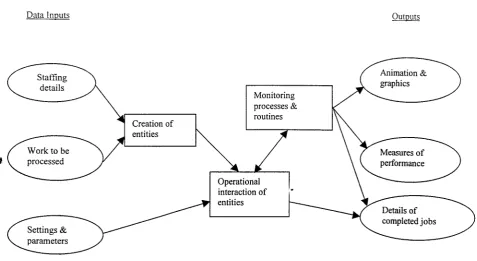
A prototype model for operational planning purposes was developed as a data-driven discrete event simulation. Its logical engine resembles the interacting factors that constitute the system with entities created and conditioned through exogenous data inputs. Over a simulated time frame it reads, on a daily basis, information regarding staffmg levels and the work to be received. Details such as probability distribution parameters or quantities that cannot otherwise be estimated are also specified externally. Figure 1 gives a conceptual overview. As a program the model is constructed from statements of structured logic to represent a non-networked system of equipment resources. There are entities that mimic staff and the jobs processed by these staff. Other structures coded into the model effect the shops and sections of the Material's Repair Group. It is set to run over a simulated period of time with information read from mes to trigger creation of:
• Staff entities that operate each day in a shop or section; and
• Job entities that follow specified service routings around the shops and sections.
The external determination of staff entities together with job- characteristics' and volumes has analogies to reality. It also allows complex and dynamic behaviours to be developed through the interactions of relatively simplistic entities.
Some delays, such as when jobs are outsourced or sent to other service groups cannot be represented using stochastic values. The length of such delays is as much a function of vendor or service group as a characteristic of the job or processing resources. Accordingly such delay durations are specified exogenously along with details such as each job's service routing.
Processing by specialist service groups that are not part of the Materials Repair Group is represented in a
more arbitrary manner. These groups' workloads include processing that does not originate from the Repair Group. Queueing mechanisms could not describe the delays involved given a lack of information on these groups overall workload compositions. So within the model such delays are represented using temporary interruptions to arrest a job's progress. These are generated using probability distribution appropriate to each specialist service group.
3.2 Estimation of Parameters
When the remanufacturing system was investigated the characteristics were determined of those processes and operations which defme it. However inspection of the production database revealed processing durations were only recorded at an aggregated level. This prevented the objective specification of distribution forms and parameters corresponding to actual processes or operations. Following recommendations given by Law and Kelton [1991] three bounded theoretical distribution types were assumed. By interviewing experienced staff and management, indications were obtained of the duration of operations as well as other forms of delay such as internal handling or data entry. Appropriate parameters were then specified heuristically of scaled uniform, triangular and beta distributions to reflect these operations and delays. 3.3 Implementation
This prototype model, named SIMMAT, takes input details for a particular situation, processes this information using logic and operations based on the actual system, and provides a depiction of how the system would likely react. It was coded using Simscript II.S® (Version 1.9, CACI Products Company Inc., La Jolla, Calif.) processes, routines and related data structures. SIMMA T consists of over 8000 lines of source code, with additional libraries of Simgraphics graphical objects and external files containing data and settings to drive the model.
Data Inputs
Staffing details
Work to be .. processed
parameters
Creation of entities
entities
Monitoring processes &
routines
Animation &
graphics
Details of completed jobs
Figure 1: Schematic diagram of conceptual model. Throughout execution the model's state records to file. Inputs and settings are supplied from computer files, while measures of delay and performance are both recorded to file and displayed using animated graphics.
processing requirments, shift durations, and staffing levels.
Details such as parameters for model probability distributions are also supplied from computer files. There is no hierarchy with central or local model components providing a control function. Constituent entities behave in accordance with standardised procedures and practices. Among the entities that constitute the model are:
• Leadhands accepting work into and signing
completed work out of a shop or section;
• Jobs that follow specified sequences of steps
around the resources in specified shops and sections;
• EqUipment resources for the processing of jobs; • Shop processes to control, on behalf of a job
entity, placement in queues for leadhands or processing resources;
• External and specialist operation processes that
represent outsourced processing or processing conducted by specialist service groups;
• Processing staff that monitor specified resource
queues in assigned shops and simulate the processing of work, which can be newly arrived,
queued, or in a state of interrupted processing. Simplified variants of these staff entities are used to effect processing in the support sections. Miscellaneous processes operate to monitor staff numbers, processing operation and delay durations, queue-lengths, and workloads, prioritise simulated work, as well as drive animated displays. Staff entity associations with equipment resources are referenced using pointer variables. Queue structures are incorporated with the resource routines to record waiting job entities.
3.4 Initialisation and Graphics
In addition to supplying SIMMA T with fonnatted files it is necessary to specify other settings at initialisation by way of user dialog box interaction. Among the details specified or options selected are a stream for random number generation, the possible use of antithetic variables for variance reduction, and choices regarding animated graphical displays. A wide range of outputs are produced to enable verification and validation of operations, evaluation of what-if scenarios, and the making of forecasts about the system's state on the basis of supplied schedules and .~dffmg level details. To this end measures are produced indicating the:
• Time each job instance took to pass through the system, both absolute and relative to the specified target date;
•
•
Time spent by each job instance, off a selected assembly, in each of the sections it was routed to; together with
Workload, delay and throughput for each section, as well as work volumes and the meeting of target dates for the system overall. With regard to this last point, the measures produced were those staff and management actually use or could otherwise relate to.
Animated displays of workload and state are produced as an aid to verification, and a means to visualise the model's essence and operation. The displays dynamically update as simulated time progresses with time indicated as a calendar date. Figure 2 is an example.
EiSIMMAT . System Operations ~~1E3
4. Evaluation
Following informal testing and review conducted during implementation, SIMMA T was subjected to further evaluation. The evaluation efforts took into account the model's stochastic basis and terminating nature, its reliance on dynamic inputs, and other concerns regarding discrete event simulations and correlated observations with non-stationary outputs. There was a lack of information to drive the model or evaluate it against. Further there was limited retention of performance data that model behaviours could be compared against. For these reasons, and in view of SIMMAT's prototype status, subjective evaluation was employed to justify the model. Approximate profiles were developed and executed of work received, staffIng h;vels, and other settings, for the period 1 June 1997 to 31 March 1998, based on available records [Johnson, 1999]. Overall staff found the prototype's behaviours, for the simulated situations, to be credible. The employed measures were commented as been meaningful. Performance measures were recognisable to staff in terms of magnitude for particular situations and also responsiveness to changes in situation.
5. Conclusions
The model, SIMMA T, consists of entities and structures that relate to those present in the actual system. It is data-driven allowing simulated staffing levels, work arrival characteristics, and also the processing requirements of individual jobs to be changed over time as would happen in reality. SuffIcient detail was built into SIMMA T for the system's main processing resources, particularly staff entities and major items of equipment, to be represented. The model was evaluated subjectively under conditions approximate to the actual system's state over a recent period of time. Expert staff who evaluated SIMMA T under the defmed scenarios found its performance credible.
With further development and testing the model could be utilised as a decision support tool. Ostensibly it should also be possible to develop useful simulation models for the management of other dynamic remanufacturing systems. Empirical testing and calibration would be a necessary aspect of any further development, and require accurate details to be available from production databases. Integration with a recently implemented enterprise resource planning system, capable of providing the model with detailed inputs for its execution, is a possibility.
6. Acknowledgements
Research described in this article was undertaken in conjunction with the Airmotive Group and the Materials Repair Group on Air New Zealand's Christchurch Base. The New Zealand Government, through its Graduate Research in Industry Fund, provided fmancial support. This scheme is administered by the Foundation for Research, Science and Technology.
7. References
Johnson, P.K, Development of a simulation model of an Air New Zealand aircraft materials remanufacturing system, thesis, M. Appl.
Sci., Lincoln University, 1999.
Law, A.M, and D.W. Kelton, Simulation modelling and analysis, McGraw-Hill, 1999.
Perry, lH., The impact of lot size and production scheduling on inventory investment in a remanufacturing environment, Production and Inventory Management Journal, (3),
41-45, 1991.
Selladurai, V., P. Aravindan, S.G. Ponnambalam, and A. Gunasekaran, Dynamic simulation of job shop scheduling for optimal performance,
International Journal of Operations and Production Management, 15(7), 106-120,