BANDWIDTH AND EFFICIENT
ENCODING SCHEME COMBINING
TCM-UGM TO STBC
MOHAMED BENAISSA Bechar University, BP 417,
Bechar, 08000, Algeria
ABDESSELAM BASSOU
Telecommunication and Digital signal Processing Laboratory, University of Djillali Liabes Sidi Bel Abbes, 22000, Algeria
MOHAMMED BELADGHAM Bechar University, BP 417,
Bechar, 08000, Algeria
ABDELMOUNAIM MOULAY LAKHDAR Bechar University, BP 417,
Bechar, 08000, Algeria
Abstract :
In this paper, a bandwidth efficient encoding scheme is proposed. It combines the modified version of trellis coded-modulation (called trellis coded-modulation with Ungerboeck-Gray mapping, TCM-UGM) to space-time block code (STBC). The performance of this encoding scheme is investigated over memoryless Rayleigh fading (MRF) channel for throughput 2 bits/s/Hz. The simulation result, using 2/3 rate 16-state TCM-UGM encoder, two transmit antennas and two receive antennas, shows clearly that the proposed scheme outperforms the performance of the association TCM/STBC by 0.67 dB at FER=10-2.
Keywords: Logarithm of maximum a posteriori; Space-time block code; coded modulation; Trellis-coded modulation with Ungerboeck-Gary mapping
.
1. Introduction
In future wireless communication systems, high data rates need to be reliably transmitted over time-varying band limited channels. The wireless channel mainly suffers from time-varying fading due to multipath propagation and destructive superposition of signal received over different paths. Fortunately, the effects of fading can be substantially mitigated by the use of diversity. As demonstrated by Foschini and Gans [Foschini and Gans (1998)], the theoretical capacity over multiple-input-multiple-output (MIMO) Rayleigh fading channels increases linearly with min (nT, nR) if the fading coefficients between any pair of nT transmit antennas
and nR receive antennas are statistically independent and known to the receiver. Many transmit diversity
schemes have been recently proposed, which can be classified into three major categories: layered space-time (LST) architecture [Foschini (1998)], space-time trellis coding [Tarokh, et al. (1998)][ Y. Gong (2000)], and
space-time block coding [Alamouti (1998)][Tarokh, et al. (1999)]. Throughout this paper, we only consider the
full-diversity order coding schemes, which is space-time block coding. In [Alamouti (1998)], Alamouti proposed a remarkable 2-transmit-antenna diversity scheme as a solution. This approach has a very simple decoding process while retaining the full diversity gain 2nR. It was later generalized to an arbitrary number of
transmit antennas as space-time block coding [Tarokh, et al. (1999)]. Space-time block codes operate on a block
coding gain, unless concatenated with an outer code. Trellis Coded Modulation (TCM) [Ungerboeck (1982)][Hanzo, et al. (2002)], was introduced by Ungerboeck in 1982 [Ungerboeck (1982)]. This coding
technique improves error performance of synchronous data links without sacrificing data rate or requiring more bandwidth. This is achieved by channel coding with expanded sets of multilevel/phase signals in a manner which increases free Euclidean distance (df). The TCM codes can be interpreted as binary convolutional codes
with a mapping of coded bits into channel signals using mapping by set partitioning. Using simple hand-designed trellis codes for 8 phase-shift keying (PSK) and 16 quadrature amplitude-shift keying (QASK) modulation, and soft maximum likelihood (ML) decoding using the Viterbi algorithm [Forney (1973)], the achieved coding gains are in the order of 3-4 dB. The TCM for a single-antenna channel, space-time trellis codes provide coding gain. Since they also provide full diversity gain, their key advantage over space-time block codes is the provision of coding gain.
In [Gong and Ben Letaief (2000)], Yi Gong and K. Ben Letaief proposed a system concatenating STBC with TCM over fading channels, when perfect interleavers are used. S. M. Alamouti and al. showed in [Alamouti, et al. (1998)] that optimal trellis codes designed for the additive white Gaussian noise (AWGN) are also the best
codes that have optimal error event probability for concatenation with STBCs over Rayleigh fading channels. In [Siwamogsathamand Fitz (2002)], Siwamogsatham proposed a robust space-time code for data transmission over correlated Rayleigh fading channel. It is a concatenation of trellis coded modulation (TCM) and STBC as its outer encoder. In the recently work the trellis-coded modulation combine with Ungerboeck-Gray mapping (TCM-UGM) was proposed [Bassou and Djebbari (2007)]. The simulation results showed that the TCM-UGM outperforms the original TCM scheme proposed by Ungerboeck by 2.59 dB over Rayleigh fading channel. The comparison is done at a Bit Error Rate (BER) of 10-5.
In this paper, a system concatenating STBC with TCM-UGM over fading channels is proposed and analyzed. In section 2, the principles of space-time block codes are introduced. In section 3, the trellis-coded modulation combined to Ungerboeck-Gray mapping (UGM) is described. In section 4 the TCM-UGM/STBC system is exposed. The simulation results are presented in section 5. Finally, the paper is concluded in section 6.
2. Space–time block codes
A Space Time Block Code describing the relationship between the original transmitted signal and the signal replicas artificially created at the transmitter for transmission over various diversity channels is defined by an nTxp dimensional transmission matrix. The entries of the matrix are constituted of linear combinations of the
k-airy input symbols x1, x2, …, xk and their conjugates. The k-airy input symbols xi i=1,…,k are used to represent
the information-bearing binary bits to be transmitted over the transmit diversity channels. In a signal constellation having 2m constellation points, a number m of binary bits are used to represent a symbol xi. Hence,
a block of k×m binary bits are entered into the STB encoder at a time and it is, therefore, referred to as a STB
code. The number of transmitter antennas is nT and p represents the number of time slots used to transmit k input
symbols. Hence, a general form of the transmission matrix of a STBC is written as
pn 2n 1n p2 22 12 p1 21 11 g g g g g g g g g . (1)
Where, the entries gij represent linear combinations of the symbols x1, x2,…, xk and their conjugates. More
specifically, the entries gij, where xi, i=1,…,nT are transmitted simultaneously from transmit antennas 1,…,nT in
each time slot j=1,…, p.
The transmission matrix in (1) (which defines the STBC) is based on a complex generalized orthogonal design, as defined in [Tarokh, et al. (1999)]. Since there are k symbols transmitted over p time slots, the code
rate of the STBC is given by
p
k
R
. (2)At the receiving end, one can have an arbitrary number of nR receivers. A simple transmit diversity scheme
for two transmit antennas was introduced by Alamouti in [Alamouti (1998)]. The transmission matrix is
1 2 2 1 2 x x x x
Combiner Channel
Estimation
ML Detecor
Tx2
h2
Tx1
h1
h1
h2
n1
n2
1 2 2 1 1
1 hx hx n
y y2h1x2h2x1n2
2 1 x x
1 2 x x
… unc xˆ2
It can be seen in the transmission matrix G2 that there are nT=2 (number of columns in the matrix G2)
transmitters, k=2 possible input symbols, namely, x1, x2 and the code spans over p=2 (number of rows in the
matrix G2) time slots. Since k=2 and p=2, the code rate is unity. The associated encoding and transmission
process is shown in Table 1. At any given time instant T, two signals are transmitted simultaneously from the
antennas Tx1 and Tx2. For example, in the first time slot T=1, signal x1 is transmitted from antenna Tx1 and signal x2 is transmitted simultaneously from antenna Tx2. In the next time slot T=2, signals
x
2 andx
1 (the conjugates of symbols x1and x2) are simultaneously transmitted from antennas Tx1 and Tx2, respectively.Table 1. Encoding and transmission process for the STBC.
Time slot, T Antenna Tx1 Tx2
1 x1 x2
2 x2 x1
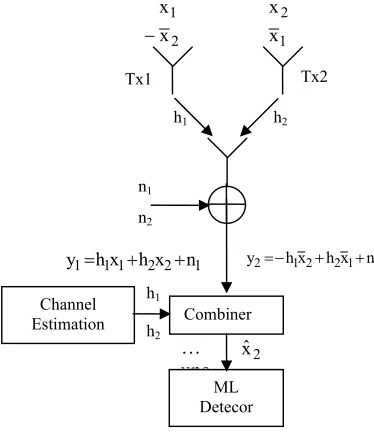
Fig.1. shows the baseband representation of a simple two-transmitter STBC, namely, that of the G2 code
seen in Eq. (3) using one receiver. We can see from the fig.1 that there are two transmitters, namely, Tx1 as well
as Tx2 and they transmit two signals simultaneously.
As it can be seen from the fig. 1, the transmitted symbol x1 and x2 propagates through two different fading
channels, namely, h1 and h2.As mentioned earlier, the complex fading envelope is assumed to be constant across
the corresponding two consecutive time slots.
1
1
2
11
h
T
h
T
h
. (4)
1
2
2
22
h
T
h
T
h
. (5)At the receiver, independent noise samples, n1 and n2 are added in each time slot; hence the signals received
over non dispersive or narrow-band channels can be expressed with the aid of Eq. (3) as
1 2 2 1 1
1
h
x
h
x
n
y
. (6)2 1 2 2 1
1
h
x
h
x
n
y
. (7)where y1 is the first received signal and y2 is the second. Note that the received signal y1 consists of the
transmitted signals x1 and x2, while y2 consists of their conjugates. In order to determine the transmitted symbols,
we have to extract the signals x1 and x2 from the received signals y1 and y2. Therefore, both signals y1 and y2 are
perfect estimation of the diversity channels in this example-simple signal processing is performed in order to separate the signals x1 and x2. Specifically, in order to extract the signal x1, the received signals y1 and y2 are
combined according to
2 2 1 2 1 2 1 2 1 1 2 2 1 1 1 1 2 2 1 1 1
ˆ
n
h
x
h
h
x
h
h
n
h
x
h
h
x
h
h
y
h
y
h
x
1 1 1 2 2 22 2
1
h
x
h
n
h
n
h
. (8)
Similarly, for signal x2, one generates
2 1 1 2 1 2 1 1 1 2 2 2 2 1 1 2 2 1 1 2 2
ˆ
n
h
x
h
h
x
h
h
n
h
x
h
h
x
h
h
y
h
y
h
x
2 2 1 1 22 2 2
1
h
x
h
n
h
n
h
. (9)
Clearly, from Eq. (8) and Eq. (9), we can see that we have separated the signals
x
1andx
2 by simple multiplications and additions. Due to the orthogonality of the STBC G2 in Eq. (3) [Tarokh, et al. (1999)], theunwanted signal x2 is canceled out in Eq. (8) and vice versa, signal x1 is removed from Eq. (9). Both signals
1
x
andx
2 are then passed to the maximum likelihood detector of Fig.1, based on the Euclidean distances between the combined signal x and all possible transmitted symbols. The simplified decision rule is based onchoosing xi if and only if
x
x
dist
x
x
i
j
dist
ˆ
,
i
ˆ
,
j
. (10)where dist(A,B) is the Euclidean distance between signals A and B and the index j spans all possible transmitted
signals. From Eq. (10), we can see that maximum likelihood transmitted symbol is the one having the minimum Euclidean distance from the combined signalxˆ.
3. Trellis coded modulation with Unger-boeck-Gray Mapping
The TCM scheme, proposed by Ungerboeck, was designed for throughput of m bits/sec/Hz, where m bits are
input to the encoder (among input bits
m
~
0
are uncoded) and m+1 bits are output and mapped with 2m+1-arymodulation using set partitioning yielding a coding rate
1
m
m
R
. (11)In this case the mapping by set partitioning (called also Ungerboeck mapping) is applied. The Unger-boeck TCM encoder was chosen by maximizing df. In [Ungerboeck (1992)], df is compute by an algorithm that
replaces the search in TCM trellis for the path that maximizes df.
In [Bassou and Djebbari (2007)], the TCM-UGM scheme considered, for a throughput of m bits/sec/Hz, that
the mapper is a 2m+1-airy that uses a mapping technique combining Ungerboeck mapping and Gray code
mapping. In this case,
m
m
~
bits are input to the encoder, and systematically output and mapped using Unger-boeck mapping. The Gray mapping is applied on the remainingm
~
m
~
1
uncoded bits and the generated parity bit. When no uncoded bits are considered (m
~
0
), this scheme is equivalent to Ungerboeck TCM scheme withm
~
0
.In [Bassou and Djebbari (2007)], the optimal encoder code-generator is obtained by searching in the trellis, of two different paths (with a minimum Euclidean distance) that begin at state zero and finish to the same state. The optimal code-generator is obtained by maximizing df. In this work, the TCM-UGM encoder, illustrated in
combiner combiner combiner
T T
T …
T
…
MSB
…
… … …
combiner …
LSB
4. Proposal system
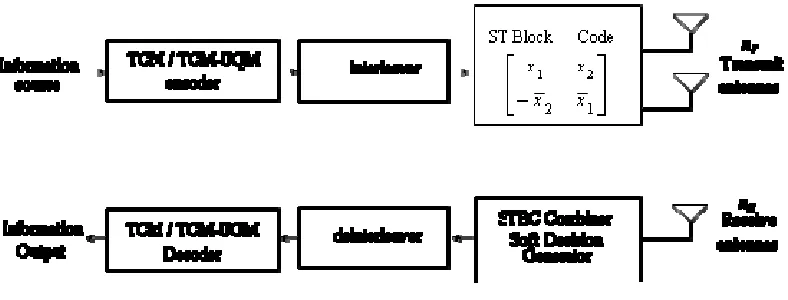
In this paper, a serial concatenation of space-time bloc code (with nT transmit and nR receive antennas) and TCM
or TCM-UGM is proposed. The transmission chain is presented in fig. 3. The information data is first encoded by the TCM or TCM-UGM encoder exposed in section 2. The complex constellation symbols, generated by mapper, are interleaved and fed into the space-time block encoder described in section 1. At each time slot T,
the output symbols xi are modulated and transmitted simultaneously each from a different transmit antenna. At the receiver end, the received noisy symbol is decoded using space-time block decoder and deinterleaved giving a soft-decision exploited by TCM or TCM-UGM decoder.
4.1.TCM-UGM decoder
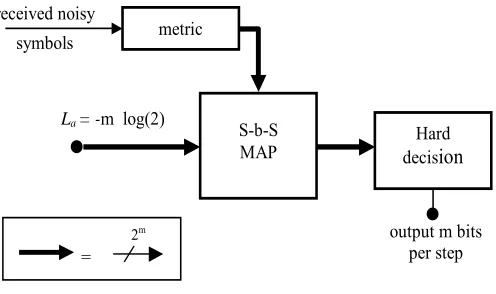
The decoder for TCM/TCM-UGM is illustrated in Fig. 4. Based on symbol by symbol MAP decoding algorithm developed in [Robertson and Woerz (1998)], the decoder has as inputs
The a priori information represented by La in fig. 4. This information is set to
mk k
a
d
i
d
i
L
log
Pr
log
1
2
(12) The branch transition probability of the encoder trellis. This probability, that represents the output of the bloc ‘metric’, is given by
.
,
'
.
'
,
,
,'
,
1 1
M
S
M
S
i
d
q
M
S
M
S
i
d
y
p
M
M
y
k k
k
k k
k k k
i
S
k
M
S
k1
M
Pr
.
(13)Fig. 2. TCM-UGM encoder for throughput 2 bits/s/Hz
metric
S-b-S
MAP decisHard ion
output m bits per step received noisy
symbols
= 2m
La = -m log(2)
where, dk is a group of m information bits at step k,
L
Ly
,
,
y
y
y
1
1
is the total received sequence of length L, and
0,1, ,2υ1
k
S is the state, at step k, of the encoder trellis with memory order of
. All thinsignals paths, in Fig. 4, are channel outputs, and thick paths represent a group of values of 2m logarithms of
probabilities.
5. Simulation results
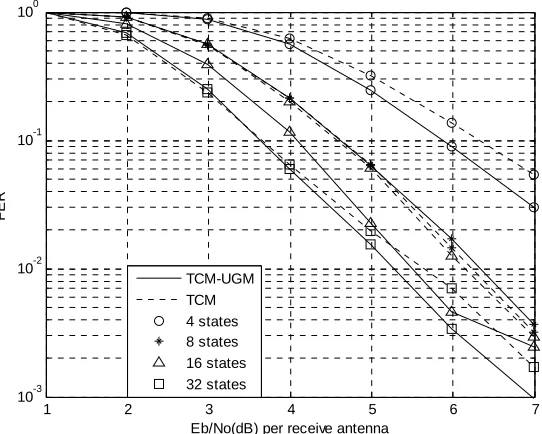
The performance simulation of the associations TCM/STBC and TCM-UGM/STBC using 8PSK Ungerboeck mapper (for TCM) and Ungerboeck-Gray mapper (for TCM-UGM) are investigated for throughput 2 bit/s/Hz. Rate 2/3 4, 8, 16 and 32-state TCM or the TCM-UGM encoders are considered. Transmissions over MRF channel, using one or two receiver antennas, are simulated employing STBC with G2 as orthogonal code.
The optimal encoders’ code-generator (in sense of df) for the used TCM and TCM-UGM encoders, are
illustrated in Table 2 (the average power per dimension in the constellation is normalized to 1/2).
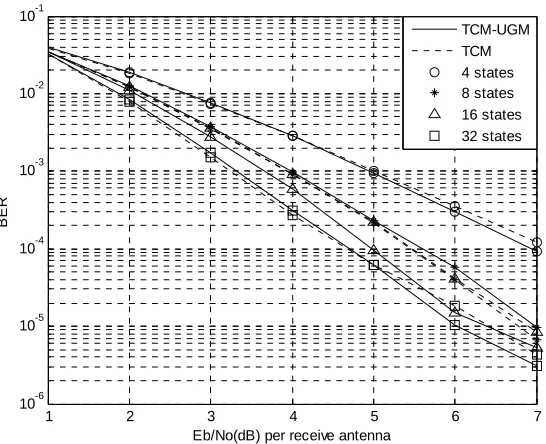
Fig. 5 to Fig. 8 illustrate the performance in sense of bit error rate (BER) and frame error rate (FER) of TCM/STBC and TCM-UGM/STBC considering one or two receiver antennas. The FER computation considers a frame length of 1024.
For 4 and 8-state codes, it can be observed that, whatever the number of receiver antennas, the TCM-UGM/STBC and TCM/STBC present approximately the same performance in sense of BER (see fig. 5 and fig. 6), and a little advantage for TCM-UGM in sense of FER (see fig. 7 and fig. 8). For 16 and 32-state codes, it can be observed that TCM-UGM/STBC presents better performance in sense of BER and FER. The most remarkable result is realized using 16-state TCM-UGM encoder, where its performance outperforms that of 32-state TCM; e.g., in fig. 7, a gain of 0.5 dB can be obtained at FER of 2.10-3.
Table 2. Best TCM and TCM-UGM encoders’ code-generator for throughput bits/s/Hz STBC.
df² Memory
order Code-generator
h0 h1 h2
TCM
4.000 2 58 68 2
4.586 3 11 10 04
5.172 4 31 14 30
5.758 5 51 70 34
TCM-UGM
4.000 2 58 68 58
4.586 3 15 04 11
5.172 4 23 34 15
5.758 5 51 34 05
6. Conclusion
In this work, the performance comparison of the serial concatenations TCM/STBC and TCM-UGM/STBC was presented for throughput of 2 bits/s/Hz. The obtained results for two transmit antennas and, one or two receive antennas, have shown that TCM-UGM present better performance for 16 and 32-state codes in sense of BER and FER. The most remarkable result is realized using 16-state TCM-UGM encoder, where its performance outperforms that of 32-state TCM.
5 6 7 8 9 10 11 12
10-6 10-5 10-4 10-3 10-2 10-1
Eb/No(dB) per receive antenna
BER
TCM-UGM TCM 4 states 8 states 16 states 32 states
Fig. 5. BER Performance of TCM/STBC and TCM-UGM/STBC schemes over MRF channel (nR=1)
1 2 3 4 5 6 7
10-6 10-5 10-4 10-3 10-2 10-1
Eb/No(dB) per receive antenna
BER
TCM-UGM
TCM 4 states 8 states 16 states 32 states
References
[1] Alamouti, S. M. (1998a): A simple transmit diversity technique for wireless communications, IEEE J. Select. Areas Commun., vol. 16, pp.1451–1458,.
[2] Alamouti, S. M.; Tarokh, V. and Poon P. (1998b): Trellis coded modulation and transmit diversity: Design criteria and performance evaluation, in Proc. IEEE ICUPC’98, pp. 703–707.
[3] Bassou , A. and Djebbari A. (2007): Performance Evaluation of a New Trellis-Coded Modulation Scheme, 4rth International Conference: Sciences of Electronic, Technologies of Information and Telecommunications.
[4] Foschini, G. J. and Gans, M. J. (1998): On limits of wireless communications in a fading environment when using multiple antennas, Wireless Personal Commun., vol. 6, pp. 311–335.
5 6 7 8 9 10 11 12
10-3 10-2 10-1 100
Eb/No(dB) per receive antenna
FE
R
TCM-UGM TCM 4 states 8 states 16 states 32 states
Fig. 7. FER Performance of TCM/STBC and TCM-UGM/STBC schemes over MRF channel (nR=1)
1 2 3 4 5 6 7
10-3 10-2 10-1 100
Eb/No(dB) per receive antenna
FE
R
TCM-UGM TCM 4 states 8 states 16 states 32 states
[5] Foschini, G. J. (1996): Layered space-time architecture for wireless communication in a fading environment when using multi-element antennas, Bell Labs Tech. J., pp. 41–59.
[6] Forney, G. D. (1973): The Viterbi Algorithm, Proc. IEEE, vol. 61, pp. 268-278.
[7] Gong, Y. and Letaief, K. B. (2000): Performance evaluation and analysis of space-time coding in unequalized multipath fading links, IEEE Trans. Commun., vol. 48, pp. 1778–1782.
[8] Hanzo, L. T.; Liew H. and Yeap, B. L. (2002): Turbo Coding, Turbo Equalisation and Space Time Coding for Transmission over Wireless channels. New York, USA: John Willy IEEE Press.
[9] Robertson P. and Woerz, T. (1998): Bandwidth-Efficient Turbo Trellis-Coded Modulation Using Punctured Component Codes, IEEE J. Select. Areas Commun., vol. 16, pp. 206-218.
[10] Siwamogsatham S. and Fitz, M. P. (2002): Robust space-time codes for correlated Rayleigh fading channels, IEEE Trans. Signal Process., vol. 50, pp. 2408-2416.
[11] Tarokh, V.; Jafarkhani, H. and Calderbank, A. R. (1999): Space-time block codes from orthogonal designs, IEEE Trans. Inform. Theory, vol. 45, pp. 1456–1467.
[12] Tarokh, V.; Seshadri, N and Calderbank, A. R. (1998): Space-time codes for high data rate wireless communications: Performance criteria and code construction, IEEE Trans. Inform. Theory, vol. 44, pp. 744–765.