Research Article
Automatic Eye Winks Interpretation System for
Human-Machine Interface
Che Wei-Gang,1Chung-Lin Huang,1, 2and Wen-Liang Hwang3
1Department of Electrical Engineering , National Tsing-Hua University, Hsin-Chu, Taiwan 2Department of Informatics, Fo-Guang University, I-Lan, Taiwan
3Institute of Information Science, Academic Sinica, Taipei, Taiwan
Received 2 January 2007; Revised 30 April 2007; Accepted 21 August 2007
Recommended by Alice Caplier
This paper proposes an automatic eye-wink interpretation system for human-machine interface to benefit the severely handi-capped people. Our system consists of (1) applying the support vector machine (SVM) to detect the eyes, (2) using the template matching algorithm to track the eyes, (3) using SVM classifier to verify the open or closed eyes and convert the eye winks into a sequence of codes (0 or 1), and (4) applying the dynamic programming to translate the code sequence to a certain valid command. Different from the previous eye-gaze tracking methods, our system identifies the open or closed eye, and then interprets the eye winking as certain commands for human-machine interface. In the experiments, our system demonstrates better performance as well as higher accuracy.
Copyright © 2007 Che Wei-Gang et al. This is an open access article distributed under the Creative Commons Attribution License, which permits unrestricted use, distribution, and reproduction in any medium, provided the original work is properly cited.
1. INTRODUCTION
Recently, there has been an emerging community of ma-chine perception scientists focusing on automatic eye detec-tion and tracking research. It can be applied for vision-based human-machine interface (HMI) applications such as moni-toring human vigilance [1–6] and assisting the disable [7,8]. The eye detection and tracking approaches can be classified into two categories: CCD camera-based approaches [1–11] and active IR-based approaches [12–15].
An eye-wink control interface [7] is proposed to provide the severely disabled with increased flexibility and comfort. The eye tracker [2] makes use of a binary classifier with a dy-namic training strategy and an unsupervised clustering stage to efficiently track the pupil (eyeball) in real time. Based on optical flow and color predicates, the eye tracking [4] can ro-bustly track a person’s head and facial features. It classifies the rotation of all viewing directions, detects eye blinking, and recovers the 3D gaze of the eyes. In [5], the eye detec-tion operates on the entire image, looking for regions that have the edges with a geometrical configuration similar to the expected one of the iris. It uses the mean absolute error measurement for eye tracking and a neural network for eyes validation.
The eye movement collection data can be analyzed to de-termine the pattern and duration of eye fixations and the
se-quence of scan path as a user visually moves his eyes. The eye tracking researches, such as the eye-gaze estimation [2,9] and eye blink rate analysis [3–5], can be applied to analyze the fatigue and deceit of human being [6]. Another applica-tion such as head-mounted goggle type eye detecapplica-tion device [10] with a liquid crystal display is developed for investiga-tion of eye movements of neurological disease patients. In [11], they formulate a probabilistic image model and derive optimal inference algorithms for finding objects. It requires the likelihood-ratio models for object versus background, which can be applied to find faces and eyes on arbitrary im-ages.
Locating face in the next frame
No
Yes
No
Yes
No
Yes Face found
Eye detection using SVM
Eye found Update eye template
Identify open or closed eye
Command interpreter using dynamic programming Tracking eye using template
matching
Eye matched
Figure1: Flowchart of the eye-winks interpretation system.
However, the active methods [12–15] require additional resources in the form of infrared sources and infrared sen-sors. Here, we propose a vision-based eye-wink control inter-face for helping the severely handicapped people to manip-ulate the household devices. Recently, many researchers have shown great interests in the research topics of HMI. In this paper, we propose an eye-wink control HMI system which allows the severely handicapped people to control the appli-ances by using their eye winks. We assume that the possi-ble head poses of the handicapped people are very limited. Under the front-pose assumption, we may easily locate the eyes, track the eyes, and then identify the open or closed eye.
Before eye tracking, we use the skin color information to find the possible face region which is a convex region larger than a certain size. Once the face region is found, we define the possible eye region in which we may apply SVM to lo-calize the eyes precisely and create the eye template obtained from the identified eye image. In the next frame, we apply the template matching to track the eyes based on the eye template extracted in the previous frame. The eye template is updated every time the eye is successfully tracked. After eye tracking, we apply SVM to verify whether the tracked block is an eye or a noneye region. If it is an eye region, then we use SVM again to identify whether it is an open eye or a closed eye, and then convert the eye winks to a sequence of 1 or 0 codes. Finally, we apply the dynamic programming to validate the code sequence and convert the code sequence into a certain command. The flow chart of the proposed system is illus-trated inFigure 1.
2. EYE DETECTION AND TRACKING
Our eye detection and tracking method consists of three stages: (1) face region detection, (2) eye localization, and (3)
eye tracking. The three steps are illustrated in the following sections.
2.1. Face region detection
To reduce the eye search region, we need to locate the pos-sible face region. In the captured human face images, we as-sume that the color distribution of the human face is some-how different from that of the image background. Pixels be-longing to face region exhibit similar chrominance values within and across people of different ethnic groups [16]. However, the color of face region may be affected by different illuminations in the indoor environment. For skin color de-tection, we analyze the color of the pixels in HSI color space to decrease the effect of illumination changes, and then clas-sify the pixels into face color or nonface color based on their hue component only.
Similar to [17], we analyze the statistics of skin color and nonskin color distributions from a set of training data to obtain the conditional probability density functions of skin color, and nonskin color. From 100 training close-up face im-ages, we have the probability density function of hue value
els into face color regions. A merging stage is then itera-tively performed on the set of homogeneous face color pix-els to provide a contiguous region as the candidate face area. Constraints of shape and size of face region are applied on each candidate face area for potential face region detection. Figure 2(a)is the original face image, andFigure 2(b) illus-trates the corresponding hue distribution in a 3D coordinate. The face color is distributed in a specified range (in blue), and the z-axis shows the normalized hue value (between 0 and 1). To determine the face region, we perform the verti-cal and horizontal projections on the classified face pixels and find the right and left region boundaries where the projecting value exceeds a certain threshold. The extracted face region is shown inFigure 2(c). We use 100 images of different subjects, background complexities, and lighting conditions to test our face detection algorithm. The correct face detection rate is 88%. The system does not know whether the identified face region is accurate or not, however, if the following eye de-tection can not locate an eye region, then the detected face region is not a false alarm.
After the face region detection, there may be more than one face-like region in the block image. We select the maxi-mum region as the face region. We assume that eyes should be located in the upper half face area. Once the face region is found, we may assume that the possible eye region is the upper portion of the face region (i.e., the yellow rectangle as shown inFigure 2(d)). These eyes are searched within the yellow rectangle area only.
2.2. Eye localization using SVM
The support vector machine (SVM) [18] is a general clas-sification scheme that has been successfully applied to find a separating hyperplane by maximizing the margin between two classes, where the margin is defined as the distance of the closest point in each class to the separating hyperplane. Given a data set{xi}Ni=1of examples with labelsyi ∈ {−1, +1}, we
find the optimal hyperplane by solving a constrained opti-mization problem using quadratic programming, where the optimization criterion is the width of the margin between the classes. The separating hyperplane can be represented as a linear combination of the training examples and classifying a new test patternxby using the following expression:
f(x)= N
i=1
αiyik(x,xi) +b, (1)
wherek(x,xi) is a kernel function and the sign of f(x) deter-mines the class membership ofx. Constructing the optimal hyperplane is equivalent to finding the nonzeroαi. Any data pointxicorresponding to nonzeroαiis termed “support vec-tor.” Support vectors are the training patterns closest to the separating hyperplane. A training process is developed to de-termine the optimal hyperplane of the SVM.
The efficiency of SVM classification is based on the se-lected features. Here, we convert the eye edge image block as the feature vector. An eye edge image is represented by a feature vector consisting of the edged pixel values. We
man-(noneye). The eye images are processed by using histogram equalization and their image sizes are normalized to 20×10. Figure 3shows the training samples consisting of open eye images, closed eye images, and noneye images.
Supervise learning algorithms (such as SVM) require as many training samples as possible to reach higher accuracy rate. Since we do not have so many training samples, the al-ternative way is to retrain the classifier by reusing the miss-classified testing samples as the training samples. Here, we have tested at least one thousand unlabeled samples, and then we select the misslabeled data for retraining the classi-fier. After applying this retraining process, based on the miss-labeled data, several times, we can boost the accuracy of the SVM machine.
The eye detection algorithm will search every candidate image block inside the possible eye region to locate the eyes. Each image block is processed by Sobel edge detector and converted to a feature vector consisting of edge pixels, which is more insensitive to the intensity change. With the feature vector (with dimension 200), the image block will be classi-fied by the SVM as an eye block or a noneye block.
2.3. 3 Eye tracking
Eye tracking is applied to find the eye in each frame by using template matching. Given the detected eyes in the previous frame, the eyes in subsequent frames can be tracked frame by frame. Once the eye is correctly localized, we update the eye templates (gray level image) for eye tracking in the next frame. The search region in the next frame is defined by ex-tending 50% length in four directions of the previously lo-cated eye bounding box. We individually normalize an eye template as a 20×10 block so that we may track different size eye images which are normalized for template matching. We consider an eye templatet(x,y) located at (a,b) of the image frame f(x,y). To compute the similarity between the candi-date image blocks and the eye template, we have the following equation as
M(p,q)=min
w
x=0
h
y=0
|fn(x+p,y+q)−tn(x,y)|
, (2)
where (1)wandhare the width and height of the eye tem-platetn(x,y) and (2) pandq are offsets of thex-axis and
y-axis, that is,a−0.5∗w < p < a+ 0.5∗wandb−0.5∗h <
q < b+ 0.5∗h. IfM(p,q) is the minimum value within the search area, the point (p,q) is defined as the best matched position of the eye, and (a,b) is updated by the new position (p,q) as (a,b)=(p,q). The new eye template is applied for the eye tracking in the next frame.
(a)
0.5
0
0
20
40
60
80
100
120
150 100
50 0
(b)
(c) (d)
Figure2: Results of face detection. (a) The original image. (b) Hue distribution of the original image. (c) Skin color projection. (d) Possible eye region.
centroid of iris and pupil is the centroid of the eye region which is located at the center of bounding box. However, in the closed eye image, the centroid is located at the center of eyelashes instead of the center of bounding box. Based on the centroids of the binarized images, the eye tracking will be faster and more accurate. Once the eye region is tracked, we apply the SVM again to classify the tracked region as an open eye, a closed eye, or a noneye region. If the tracked im-age is a non-eye region, the system will restart the face and eye localization procedures.
3. THE COMMAND INTERPRETER USING DYNAMIC PROGRAMMING
After eye tracking, we continue using SVM to distinguish be-tween the open eye and the closed eye. If the eye opens and exceeds a fixed duration, then it represents a digit “1”.
Sim-ilarly, the closed eye represents a digit “0”. So we can con-vert the sequence of eye winks to a sequence of 0 and 1. The command interpreter validates the sequence of codes, and is-sues the corresponding output command. Each command is represented by the corresponding sequence of codes. Start-ing from the base state, the user issues a command by a se-quence of eye winks. The base state is defined as an open eye for a long time without intentionally closing the eye. The in-put sequence of codes is then matched with the predefined sequence of codes by the command interpreter.
(a)
(b)
(c)
Figure3: (a) The open eye images. (b) The closed eye images. (c) The noneye images.
(a) (b) (c) (d)
Figure4: . (a) The original open eye. (b) The binarized open eye. (c) The original closed eye. (d) The binarized closed eye.
continuously open or closed eye is longer thanθth, then we may consider it as code 00 or 11. The thresholdθtl is user-dependent, user may select the best suitable threshold for his specific eye blinking condition.
Here, we may predefine some valid code sequences, and each one corresponds to a specific command. Once the code sequence has been issued, we need to validate the code se-quence. To find a valid code sequence, we need to calcu-late the similarity (or alignment) score between the issued
code sequence and the predefined code sequences. Because the code lengths are different, we need to align the two code sequences to maximize the similarity by using the dy-namic programming [19]. We assume the predefined codes as shown inTable 1.
Table1: Code sequences.
Code length 1 3 4 5
— 0 010 0010 00100
— — — 0100 00110
— — — 0110 01010
— — — — 01100
(4) a trace back of the matrix to recover the structure of the optimal solution that generates the optimal score. These four steps are explained as follows.
3.1. Recursive definition of the optimal alignment score
There are only three conditions that the alignment can possi-bly be: (i) residuesxMandyNare aligned with each other; (ii) residuexMis aligned to a gap character andyNappears some-where earlier in the alignment; or (iii) residueyNis aligned to a gap character andxMappears earlier in the alignment. The optimal alignment will be the most preferred of these three cases. The optimal alignment score of the prefix of sequence {xl,. . .,xM}to the prefix of sequence{yl,. . .,yN}is defined as
S(i,j)=max
⎧ ⎪ ⎪ ⎨ ⎪ ⎪ ⎩
S(i−1,j−1) +σ(xi,yj),
S(i−1,j) +γ,
S(i,j−1) +γ,
(3)
wherei ≤Mand j ≤NCase (i) is the scoreσ(xM,yN) for aligningxMtoyNplus the scoreS(M−1,N−1) for an optimal alignment of everything else up to this point. Case (ii) is the gap penaltyγplus the scoreS(M−1,N). Case (iii) is the gap penaltyγplus the scoreS(M,N−1). The divide-and-conquer approach breaks the problem into independently optimized pieces, as the scoring system is strictly local to one aligned column at a time. For instance, the optimal alignment of {x1,. . .,xM−1}to{y1,. . .,yN−1}is unaffected by adding the
aligned residue pairxM andyN. The initial scoreS(0, 0) for aligning nothing to nothing is zero.
3.2. The dynamic programming matrix
For the pairwise sequence alignment algorithm, the optimal scoresS(i,j) are tabulated in a two-dimensional matrix, with
i = 0. . . M and j = 0. . . N, as shown in Figure 5. As we calculate the solutions to subproblemsS(i,j), their optimal alignment scores are stored in the appropriate (i,j) cell of the matrix.
3.3. A bottom-up calculation to get the optimal score
the dynamic programming matrixS(i,j) is laid out, it is easy to fill it in a bottom-up way, from the smallest problems to progressively bigger problems. We know the boundary con-ditions in the leftmost column and the topmost row (i.e.,
S(0, 0) =0;S(i, 0)= γ∗i; andS(0,j)= γ∗j). For example, the optimum alignment of the firstiresidues of sequencexto
Sequencey j i Seq u en ce x
0 1 0 1 0
0
0
1
0
0 −2 −4 −6 −8 −10
−2 1 −1 −3 −5 −7
−4 −1 0 0 −2 −4
−6 −3 0 −1 1 −1
−8 −5 −2 1 −2 2
Optimum alignment score 2:
0 1 0 1 0
0 − 0 1 0
+1 −2 +1 +1 +1
Figure5: An example of the dynamic programming matrix.
Table2: Result of eye tracking.
Video 1 Video 2 Video 3 Video 4
Total frame # 1763 1544 583 1241
Tracking failure frame # 17 19 6 15
Correct rate 99 % 98.7 % 98.9 % 98.7 %
Average correct rate 98.8 %
nothing in sequenceyhas only one possible solution which is to align to the gap characters and payigap penalties. Once we have initialized the top row and left column, we can fill in the rest of the matrix by using the recursive definition of
S(i,j). So we may calculate any cell based on the three adjoin-ing cells to the upper left (i−l,j−l), above (i−l,j), and to the left (i,j−l) which are already known. We may iterate two nested loops,i=l . . . Mand j=l . . . N, to fill in the matrix left to right and top to bottom.
3.4. A trace back to get the optimal alignment
Once we have finished filling the matrix, the score of the op-timal alignment of the complete sequences is the last score, that is,S(M,N). We still do not know the optimal alignment; however, we recover this by a recursive trace back of the ma-trix. Starting from cell (M,N), we determine which of the three cases (i.e., (3)) can be applied to record that choice as part of the alignment, and then follow the appropriate path for that case back into the previous cell on the optimum path. We keep doing that, one cell in the optimal path at a time, until we reach cell (0, 0), at which point, the optimal align-ment is fully reconstructed. Figure 5shows an example of the dynamic programming matrix for two code sequences,
(a)
(b)
Figure6: (a) Open eyes, and (b) closed eyes detected correctly.
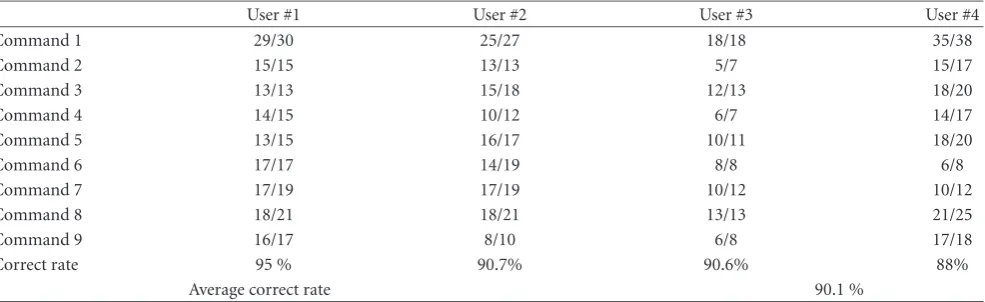
Table3: Results of eye signal detection.
User #1 User #2 User #3 User #4
Command 1 29/30 25/27 18/18 35/38
Command 2 15/15 13/13 5/7 15/17
Command 3 13/13 15/18 12/13 18/20
Command 4 14/15 10/12 6/7 14/17
Command 5 13/15 16/17 10/11 18/20
Command 6 17/17 14/19 8/8 6/8
Command 7 17/19 17/19 10/12 10/12
Command 8 18/21 18/21 13/13 21/25
Command 9 16/17 8/10 6/8 17/18
Correct rate 95 % 90.7% 90.6% 88%
Average correct rate 90.1 %
4. EXPERIMENT RESULTS
We use a Logitech QuickCam Pro3000 camera to capture the video sequence of the disable, and the image resolution is 320×240. The system is implemented on a PC with Athlon 3.0 GHz CPU with Microsoft Windows XP. The eye-wink control system can achieve the speed of 13 frames per sec-ond. We have tested 5131 frames of the videos of four people under normal indoor lighting conditions. Based on the SVM for eye detection, the accuracy of the eye detection inside the correctly detected face region is above 90%. The correct clas-sification rate of the open and closed eye is also higher than 92%.Figure 6shows that the SVM-based eye classifier can correctly identify the open and closed eyes. The SVM classi-fier works fine under different illumination conditions due to the intensity normalization of the training images via his-togram equalization. The face region is separated into the two parts for the detection of the individual left eye and the right eye.
Table 2lists the results of eye tracking applied on four dif-ferent test videos. “Total frames #” indicates the total num-ber of frames in each video. “Tracking failure frame #” is the number of frames in which the eye tracking fails. The eye tracking fails when the system can not locate the eye
accu-rately, and then it may missidentify the open eye as a closed eye or vice versa. The correct rate of eye tracking is defined as
correct rate = Total frame #−Tracking failure frame
Total frame # (4)
Table 2shows that the proposed system achieves 98% correct eye identification.
Table 3shows the results of eye-winks interpretation sys-tem operating on the test video sequences of four different users. Our system can interpret nine different commands. Each command is composed of a sequence of eye winks. For each command, the correct interpretation rate for a different user is described in terms ofr1/r2, wherer2is the total test
video sequences for the specific command issued by the des-ignated user, andr1 indicates the correctly identified video
sequences.
(a)
(b)
Figure7: Program interface. (a) Layer 1 commands. (b) Layer 2 commands for audio.
a lamp, and a telephone. There are two layers in the com-mand mode, so we can create at most 9∗9(81) commands. Here, we only use 8∗8 + 1(65) commands because in each layer, we have a “Return” command. InFigure 7, we illustrate layer 1 commands and layer 2 commands.
5. CONCLUSION AND FUTURE WORK
We propose an effective algorithm for eye-wink interpreta-tion for human-machine interface. By integrating SVM and dynamic programming, the eye-wink control interpretation system will enable the severely handicapped people to ma-nipulate the household appliances by using a sequence of eye winks. Experimental results have illustrated the encouraging performance of the current methods in both accuracy and speed.
REFERENCES
[1] P. W. Hallinan, “Recognizing human eyes,” inGeometric Meth-ods in Computer Vision, vol. 1570 ofProceedings of SPIE, pp. 214–226, San Diego, Calif, USA, July 1991.
[2] S. Amarnag, R. S. Kumaran, and J. N. Gowdy, “Real time eye tracking for human computer interfaces,” inProceedings of the International Conference on Multimedia and Expo (ICME ’03), vol. 3, pp. 557–560, Baltimore, Md, USA, July 2003.
[3] Q. Ji and X. Yang, “Real-time eye, gaze, and face pose track-ing for monitortrack-ing driver vigilance,”Real-Time Imaging, vol. 8, no. 5, pp. 357–377, 2002.
[4] P. Smith, M. Shah, and N. da Vitoria Lobo, “Monitoring head/eye motion for driver alertness with one camera,” in
Proceedings of the 15th International Conference on Pattern Recognition (ICPR ’00), vol. 4, pp. 636–642, Barcelona, Spain, September 2000.
[5] T. D’Orazio, M. Leo, P. Spagnolo, and C. Guaragnella, “A neu-ral system for eye detection in a driver vigilance application,” inProceedings of the 7th International IEEE Conference on In-telligent Transportation Systems (ITS ’04), pp. 320–325, Wash-ington, DC, USA, October 2004.
[6] K. F. Van Orden, T.-P. Jung, and S. Makeig, “Combined eye activity measures accurately estimate changes in sustained vi-sual task performance,”Biological Psychology, vol. 52, no. 3, pp. 221–240, 2000.
[7] R. Shaw, E. Crisman, A. Loomis, and Z. Laszewski, “The eye wink control interface: using the computer to provide the severely disabled with increased flexibility and comfort,” in
Proceedings of the 3rd Annual IEEE Symposium on Computer-Based Medical Systems (CBMS ’90), pp. 105–111, Chapel Hill, NC, USA, June 1990.
[8] L. Gan, B. Cui, and W. Wang, “Driver fatigue detection based on eye tracking,” inProceedings of the 6th World Congress on Intelligent Control and Automation (WCICA ’06), vol. 2, pp. 5341–5344, Dalian, China, June 2006.
[9] A. Haro, M. Flickner, and I. Essa, “Detecting and tracking eyes by using their physiological properties, dynamics, and appear-ance,” inProceedings of the IEEE Conference on Computer Vi-sion and Pattern Recognition (CVPR ’00), vol. 1, pp. 163–168, Hilton Head Island, SC, USA, June 2000.
[10] A. Iijima, M. Haida, N. Ishikawa, H. Minamitani, and Y. Shi-nohara, “Head mounted goggle system with liquid crystal dis-play for evaluation of eye tracking functions on neurological disease patients,” inProceedings of the 25th Annual Interna-tional Conference of the IEEE Engineering in Medicine and Biol-ogy Society (EMBS ’03), vol. 4, pp. 3225–3228, Cancun, Mex-ico, September 2003.
[11] I. Fasel, B. Fortenberry, and J. Movellan, “A generative frame-work for real time object detection and classification,” Com-puter Vision and Image Understanding, vol. 98, no. 1, pp. 182– 210, 2005.
[12] Z. Zhu and Q. Ji, “Robust real-time eye detection and track-ing under variable lighttrack-ing conditions and various face orien-tations,”Computer Vision and Image Understanding, vol. 98, no. 1, pp. 124–154, 2005.
[13] C. H. Morimoto and M. Flickner, “Real-time multiple face detection using active illumination,” inProceedings of the 4th IEEE International Conference on Automatic Face and Gesture Recognition (FG ’00), pp. 8–13, Grenoble, France, March 2000. [14] X. Liu, F. Xu, and K. Fujimura, “Real-time eye detection and tracking for driver observation under various light condi-tions,” inProceedings of the IEEE Intelligent Vehicle Symposium (IV ’02), vol. 2, pp. 344–351, Versailles, France, June 2002. [15] D. W. Hansen and A. E. C. Pece, “Eye tracking in the wild,”
Computer Vision and Image Understanding, vol. 98, no. 1, pp. 155–181, 2005.
[16] D. Chai and K. N. Ngan, “Face segmentation using skin-color map in videophone applications,”IEEE Transactions on Cir-cuits and Systems for Video Technology, vol. 9, no. 4, pp. 551– 564, 1999.
Springer, New York, NY, USA, 1995.