
R E S E A R C H
Open Access
Modeling of SSIM-based end-to-end distortion for
error-resilient video coding
Qiang Peng
1, Lei Zhang
1,2*, Xiao Wu
1and Qionghua Wang
3Abstract
Conventional end-to-end distortion models for videos measure the overall distortion based on independent estimations of the source distortion and the channel distortion. However, they are not correlating well with the perceptual characteristics where there is a strong inter-relationship among the source distortion, the channel distortion, and the video content. As most compressed videos are represented to human users, perception-based end-to-end distortion model should be developed for error-resilient video coding. In this paper, we propose a structural similarity (SSIM)-based end-to-end distortion model to optimally estimate the content-dependent perceptual distortion due to quantization, error concealment, and error propagation. Experiments show that the proposed model brings a better visual quality for H.264/AVC video coding over packet-switched networks.
Keywords:End-to-end distortion model; Structural similarity; Error resilience
1 Introduction
Most video coding standards achieve high compression using transform coding and motion-compensated predic-tion, which creates a strong spatial-temporal dependency in compressed videos. Thus, transmitting highly com-pressed video streams over packet-switched networks may suffer from spatial-temporal error propagation and may lead to severe quality degradation at the decoder side [1]. To protect compressed videos from packet loss, error-resilient video coding becomes a crucial require-ment. Given transmission conditions, such as bit rate and packet loss ratio, the target of error resilient video coding is to minimize the distortion at the receiver [2]:
minf gD s:t: R ≤ RT and ρ ð1Þ
where D and R denote the distortion at the receiver
and the bit rate, respectively.RTis the target bit rate andρ is the packet loss ratio. Note that we assume the transmis-sion conditions are available at the encoder throughout this paper. This can be either specified as part of the initial negotiations or adaptively calculated from information provided by the transmission protocol [3].
Assume packet containing video data is lost in the channel and the decoder performs error concealment. Clearly, the resulting reconstruction at the decoder is different from the reconstruction at the encoder and the difference will propagate to the following frames due to the prediction chain. Therefore, the key challenge of the error-resilient video coding is to estimate at the encoder the reconstruction error and error propagation of the decoder, which is useful to optimize the coding options to solve the above minimization problem.
A number of end-to-end distortion models (also known as joint source-channel distortion models) for video transmission over lossy channels have been proposed in the literature. In [4,5], several low-complexity estima-tion models were presented for low error rate applicaestima-tions. For a more accurate distortion estimation model, the work in [2] developed a frame-level recursion distortion model, which relates to the channel-induced distortion due to bit errors. Another efficient approach is the well-known recursive optimal pixel estimation (ROPE) model [3] and its extensions [6-10], which estimate the overall distortion due to quantization, error concealment, and error propagation. Recently, several novel source-channel distortion models were developed for distributed video coding [11], generic multi-view video transmission [12], and error-resilient schemes based on forward error cor-rection [13].
* Correspondence:[email protected]
1School of Information Science and Technology, Southwest Jiaotong
University, Chengdu, China
2Institution of Academia Sinica, Jiuzhou Electric Group, Sichuan, China
Full list of author information is available at the end of the article
However, these models are derived in terms of mean squared error (MSE), which has been criticized for weak correlation with perceptual characteristics. As most com-pressed videos are presented to humans, it is meaningful to incorporate visual features into the error-resilient video coding to protect important visual information of compressed videos from packet loss. Thus, several region-of-interest (ROI)-based approaches were pre-sented to better evaluate the visual quality [14,15]. How-ever, ROI-based approaches do not provide accurate distortion estimation, and ROI determination may be diffi-cult for most videos, especially for videos with natural scenes. Therefore, it is expected that a perception-based end-to-end distortion model could provide a more general and accurate perceptual distortion estimation.
In [16], the structural similarity (SSIM)-based end-to-end distortion was predicted by several factors extracted from the encoder. Although the variation trend is very similar at the block level, the estimated SSIM cannot reach the peak points of the actual SSIM. In [17], a para-metric model was proposed to accurately estimate the degradation of SSIM over error-prone networks, in which the content, encoding, and network parameters are con-sidered. However, the encoding parameters only included the number of slices per frame and the GOP length. The proposed model cannot estimate the relative quality of a block given different coding modes. In our earlier work [18], we introduced a block-level SSIM-based distortion model into the error-resilient video coding to minimize the perceptual distortion. In [19], improved SSIM-based distortion model and Lagrange multiplier decision method are proposed for better coding performance. In [18] and [19], the expected SSIM scores were estimated by the expected decoded frames. Due to the nonlinear variation of SSIM, the estimated SSIM scores may be less accurate, especially at high bit rate.
In this paper, we develop an SSIM-based end-to-end distortion model to estimate the overall perceptual dis-tortion for H.264/AVC coded video transmission over packet-switched networks. Unlike the traditional end-to-end distortion model, the perceptual quantization distortion and the perceptual error propagation distor-tion are dependent on the video content, which makes the end-to-end distortion become complex or difficult to estimate at the encoder. Therefore, this paper provides two major contributions: 1) a SSIM-based reconstruction quality model; 2) a SSIM-based error propagation model. Both models are useful to estimate the content-dependent perceptual distortion at the encoder. Our extensive experi-mental results demonstrate that the proposed end-to-end distortion model can bring visual quality improvement for H.264/AVC video coding over packet-switched networks. We would like to mention that the scheme presented in this paper is an enhanced approach based on our
preliminary work in [20]. Different settings are con-sidered in this paper, including additional descriptions of related works, technical and implementation details, and comparison experiment results to better evaluate the efficiency of the proposed scheme.
The rest of the paper is organized as follows. Section 2 states the problem and motivation. Section 3 describes the proposed SSIM-based end-to-end distortion model. Section 4 introduces the distortion model into the error-resilient video coding. Section 5 provides the simulation results and Section 6 concludes the paper.
2 Problem and motivation
For H.264/AVC coded video transmission over packet-switched networks, the general formulation of the widely used MSE-based end-to-end distortion can be defined as
D¼ð1−ρÞ⋅DQþρ⋅DCþð1−ρÞ⋅DP f þρ⋅DP c ð2Þ
where ρ is the packet loss ratio. D is the estimated overall distortion.DQdenotes the source distortion due to the quantization.Dc,DP_f, andDP_crepresent the channel distortion due to the error concealment, error propagation from the reference frames, and error propagation from the concealment frames, respectively.
With such a model in Equation 2, the end-to-end dis-tortion can be individually and independently estimated by the quantization distortion, error concealment dis-tortion, and error propagation distortion. This model is appealing because it is easy to calculate and has clear physical meanings. However, since the perceptual distor-tion is dependent on the video content, the individual and independent objective distortion estimation does not correspond well with human perceptual characteris-tics. For instance, as shown in Figure 1, since ten com-pressed or lossy transmitted videos (Live video quality database [21,22]) have different perceptual characteristics, a similar objective distortion may result in different levels of perceptual quantization distortion or transmission dis-tortion. Therefore, we aim to propose a perception-based end-to-end distortion model for more accurate estima-tion of the overall perceptual distorestima-tion in the following section.
3 SSIM-based end-to-end distortion model
SSIMðx;yÞ ¼l xð ;yÞ⋅c xð ;yÞ⋅s xð ;yÞ
¼ 2μxμyþc1
μ2
xþμ2yþc1 ⋅
2σxyþc2 σ2
xþσ2yþc2
ð3Þ
wherel(x,y),c(x,y), ands(x,y) represent the luminance, contrast and structure perceptual components, respect-ively. μ, σ2, and σxy are the mean, variance, and cross covariance, respectively. c1and c2are used to avoid the
instability when means or variances are close to zero. Based on the perceptual distortion metric, we develop a novel end-to-end distortion model as follows. In Figure 2,
b denotes the original block and ~b is the corresponding reconstruction block at the decoder.^r and~r represent the prediction block of b at the encoder and at the decoder, respectively. e denotes the prediction residual and its reconstruction value is^e. If the block is received correctly, ~
b¼~rþ^e. When the block is lost, an error concealment technique is used to estimate the missing content. Let ^c and~crepresent the concealment block ofbat the encoder
and at the decoder, respectively. In this case,~b¼~c. For a given packet loss ratioρ, the general SSIM-based end-to-end distortion can be expressed as
DSSIM b;~b
¼ð1−ρÞ⋅Ef1−SSIMðb;r~þ^eÞg
þρ⋅Ef1−SSIMðb;~cÞg
ð4Þ
with
Ef1−SSIMðb;~rþ^eÞg ¼1−EfSSIMðb;~rþ^eÞg
¼ 1−Φr⋅E bð ;r^þ^eÞ ð5Þ Ef1−SSIMðb;~cÞg ¼1−EfSSIMðb;~cÞg
¼1−Φc⋅SSIMðb;^cÞ ð6Þ
where E{ } is the expectation operator. Φ is the error propagation factor. It indicates how the transmission errors from prediction block or concealment block in-fluence the quality of current block. SSIMðb;~rþ^eÞand SSIMðb;~cÞdenote the quality of prediction coding and error concealment at the decoder, respectively. SSIM Figure 1Quality comparison. (a)PSNR results for compressed videos;(b)DMOS results for compressed videos;(c)PSNR results for lossy transmitted videos;(d)DMOS results for lossy transmitted videos.
b;~rþ^e
ð Þ and SSIMðb;^cÞ are the quality of prediction coding and error concealment at the encoder, respectively. With this formula, the reconstruction quality SSIM
b;^rþ^e
ð Þ and error propagation factor Φ are the key
terms of the SSIM-based end-to-end distortion model. In the following section, we will make a development of the two terms based on content dependency.
3.1 Development of reconstruction quality model
In this section, we aim to estimate the content-dependent reconstruction quality SSIMðb;^rþ^eÞ at the block level (the 4 × 4 transform and quantization unit is used throughout this paper). Since the accurate reconstruc-tion quality can only be obtained after de-quantizareconstruc-tion, the proposed quality estimation reduces the computational complexity of de-quantization process for each candidate modes.
According to the SSIM index, the reconstruction quality is derived as
SSIMðb;^rþ^eÞ ¼l bð ;^rþ^eÞ⋅c bð ;r^þ^eÞ⋅s bð ;^rþ^eÞ ð7Þ with
l bð ;^rþ^eÞ ¼ 2μbμ^rþ2μbμ^eþc1 μ2
bþμ^r2þμ^e2þ2μ^rμ^eþc1
ð8Þ
c bð ;^rþ^eÞ⋅s bð ;^rþe^Þ ¼ 2σb^rþ2σb^eþc2 σ2
bþσ^r 2
þσ^e2
þ2σ^r^eþc2
ð9Þ
From Equations 8 and 9, we can see that the estimation of content-dependent reconstruction quality is converted to the estimation problem of three content-independent parameters: 1) the variance of reconstructed prediction re-sidual; 2) the cross-covariance between the reconstructed prediction residual and current block; 3) the cross-covariance between the reconstructed prediction residual and prediction block.
It is reported that the DCT coefficients of prediction residual closely follows a zero-mean Laplacian distribution [25]. Based on this phenomenon, the work in [26] proved that the reconstruction distortion from the prediction re-sidual can be estimated by the Laplacian parameter and the quantization step. Extending the derivation in [26] into pixel-domain, we establish the following two estimation models for above parameters:
σe^2 ¼Mvarðα;QPÞ⋅σ2e; α¼ ffiffiffiffiffiffiffiffiffiffi 2=σ2 e
q
ð10Þ
σb^e ¼Mcovðβ;QPÞ⋅σbe; β¼
ffiffiffiffiffiffiffiffiffiffiffi 2=σbe
p
ð11Þ
whereαandβdenote the Laplacian parameters.QPis the quantization parameter in H.264/AVC.MvarandMcov
indicate the scaling maps, which vary from 0 to 1.
The scaling maps Mvar and Mcov are modeled based
on four video sequences [27]: ‘Crow_run’, ‘In_to_tree’, ‘Ducks_take_off’, and ‘Old_town_cross’, which have abundant and various structural information. Each se-quence is coded as intra-frame (I frame) and inter-frame (P frame), respectively. To cover various reconstruction variances, 11 different QP values are tested, ranging from 15 to 45 uniformly with the step size of 3.
Firstly, we calculate the variance of initial and recon-structed prediction residual with different QP values. Secondly, we obtain the scaling curve by doing statistics analysis for each test QP. Finally, we interpolate the eleven scaling curves to establish the scaling map. Based on the simulations, the fitted scaling map Mvar and Mcov are
shown in Figure 3, which can be constructed as look-up tables.
To demonstrate the accuracy of the proposed recon-struction quality models, 250 frames of each sequence are coded with constant quantization parameters: 20, 25, 30, and 35, respectively. Table 1 shows the average mean absolute deviation (MAD) between the actual and esti-mated variance, cross covariance, and reconstruction quality. The first two terms denote the accuracy of the fitted models (10) and (11), respectively. The following three terms show the accuracy of the final estimated SSIM scores. It can be seen that the proposed models are valid to predict the reconstruction quality.
3.2 Development of error propagation model
The error propagation is the key component of the end-to-end distortion model. Different from the inde-pendent estimation in conventional MSE-based end-to-end distortion model, the perceptual error propagation depends on the source distortion or the concealment dis-tortion. In this section, our primary goal is to develop the error propagation models to estimate the overall percep-tual quality for given transmission errors of prediction block or concealment block.
The error propagation models are motivated by three observations. The first observation is related to the impact of error propagation on the three components of SSIM. LetQattdenote the quality attenuation of a given blockb
due to the error propagation.
Qattð Þ ¼b SSIM b;~b
=SSIM b;b^
ð12Þ
To illustrate the fact,Qattis measured by three different
changes with SSIM. On the other hand, the impact of error propagation on the luminance component is limited. The second observation is made on the relationshipfp
between the quality attenuation of block b and the
quality attenuation of its compensation block p. p
indi-cates the compensation block of b, which may contain
the transmission errors. Thus, p can be used to repre-sent the prediction blockror concealment blockcofb.
fp¼Qatt bp =Qattð Þ ¼p SSIM b;˜p
ð Þ
SSIMb;^p=
SSIMðp;˜pÞ
SSIMp;p^ ð13Þ
Usually, the quality attenuation of blockb correlates with the quality attenuation of its compensation block
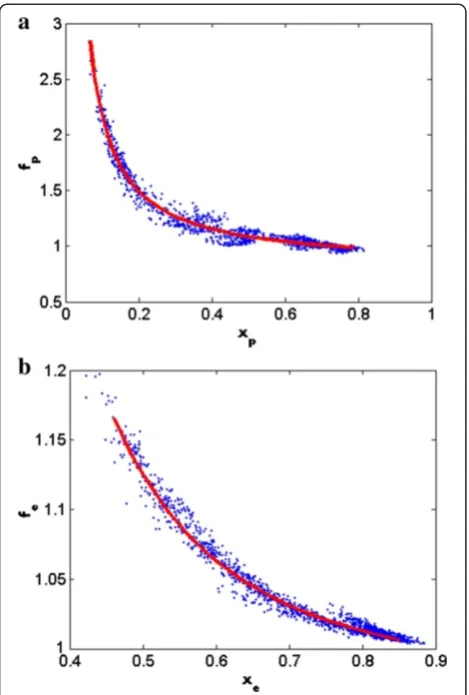
p. In addition, the structural similarity between current block and its compensation block may be another factor in estimation of fp. xp is defined as follows to explore the effect of quality attenuation and structural similarity onfp.
xp¼Qattð Þp ⋅SSIMðb;^pÞ ð14Þ
The simulation results are carried out on the same four sequences as Section 3.1. Each sequence is coded with
four different QPs: 15, 25, 35, and 45. One I frame followed by all inter frames (IPPP). To cover various error propagation, each block is tested with random transmission errors propagated from prediction block and concealment block, respectively. Note that the prediction residuals of blockb are not included in this observation.
Figure 5a displays the simulation results. The mean of each test frame is recorded as one blue sample, and the fitted curve of fp(xp) is shown as the red line. It shows
that the quality attenuation of block, in terms of SSIM, is Figure 3The scaling maps. (a)For residual variance by intra-coding;(b)for residual variance by inter-coding;(c)for residual cross covariance by intra-coding;(d)for residual cross covariance by inter-coding.
Table 1 MAD between actual and estimated scores
Test terms σ^e2 σbe^ l c⋅s DSSIM
MAD (Intra-coding) 5.8118 3.4852 0.0001 0.0067 0.0067
related with the quality attenuation of its compensation block and the structural similarity. Moreover, it demon-strates that less quality attenuation of compensation block or less structural similarity between current block and compensation block leads to less quality attenuation.
The third observation is related to the impact of pre-diction residual on the decoded quality. LetQenhdenote
the quality enhancement of a given block b due to its
prediction residuals e. fe represents the relationship
between the quality attenuation of block b with and
without the prediction residual.
Qenh bp;e
¼SSIMðb;pþeÞ=SSIMðb;pÞ ð15Þ
fe¼Qatt bp;e
=Qatt bp att ¼
SSIMb;˜pþ^e SSIMb;^pþ^e=
SSIMðb;˜pÞ SSIMb;^p
ð16Þ
In this observation, the quality attenuation of block b may link with the quality attenuation of its compensation block p and the quality enhancement of its prediction
residualse. xeis defined as follows to explore the effect of
quality attenuation and quality enhancement onfp:
xe¼Qatt bp =Qenh bp^;^e
ð17Þ
The simulation set-up is the same as that in the second observation. In this observation, each block including the prediction residuals is tested with random transmission errors propagated from its prediction blocks. Figure 5b shows the simulation results. The mean of each test frame is recorded as one blue sample, and the fitted curve of
fe(xe) is shown as the red line. The results show that a
larger prediction residual leads to a better decoded quality of current block, and the influence of error propagation from prediction blocks will be smaller.
According to Equations 13 and 16, the effective ap-proximation of SSIMðb;~rþ^eÞand SSIMðb;~cÞcan be de-veloped as
SSIMðb;~rþ^eÞ≈feð Þxe⋅SSIMðb;^rþ^eÞ⋅SSIMðb;~rÞ SSIMðb;^rÞ
≈feð Þxe⋅SSIMðb;^rþ^eÞ⋅fpð Þxr ⋅
SSIMðr;~rÞ SSIMðr;^rÞ ≈Qattð Þr ⋅feð Þxe ⋅fpð Þxr⋅SSIMðb;^rþ^eÞ
ð18Þ
SSIMðb;~cÞ≈fpð Þxc ⋅SSIMðb;^cÞ⋅SSIMðc;~cÞ SSIMðc;^cÞ ≈Qattð Þc ⋅fpð Þxc ⋅SSIMðb;^cÞ
ð19Þ
Where SSIMðr;~rÞand SSIMðc;~cÞrepresent the end-to-end distortion of prediction block and concealment block, respectively. The approximations used in the equations represent the estimation offpandfe.
Based on Equations 18 and 19, the error propagation factors in Equations 5 and 6 can be obtained by
Φr¼Qattð Þr ⋅fpð Þxr ⋅feð Þxe ð20Þ
Φc¼Qattð Þc ⋅fpð Þxc ð21Þ
To better demonstrate the accuracy of the proposed error propagation models, Table 2 shows the average MAD between the actual and estimated SSIM of the four test sequences. It indicates that video quality at the Figure 5Quality attenuation due to error propagation. (a)The
relationship betweenfpandxp;(b)the relationship betweenfe andxe.
Table 2 MAD between actual and estimated SSIM
Test sequences Error propagation from concealment block
Error propagation from prediction block
Crow_run 0.0213 0.0238
In_to_tree 0.0112 0.0137
Ducks_take_off 0.0126 0.0140
Old_town_cross 0.0153 0.0173
decoder, in terms of SSIM, can be approximately calcu-lated by the fitted models (20) and (21) at the encoder.
4 Error-resilient video coding
It is widely recognized that intra-update is an effective approach for error-resilient video coding because decoding of an intra-coding block does not require information from its previous frames. To better evaluate the performance of our proposed model, we incorporate the proposed
SSIM-based end-to-end distortion model into the mode selection to improve the RD performance over packet-switched networks. Thus, the optimization problem in Equation 1 can be converted to the problem of mode selection between intra-coding and inter-coding as follows:
minfJðmodeÞg ¼ minfDSSIMðmodejρ;QPÞ
þλSSIM⋅Rðmode QPj Þg
ð22Þ
where DSSIM and R denote the end-to-end distortion
and bit-rate of current coding block.ρis the packet loss ratio. mode denotes the coding mode. QP is the quantization parameter, which is determined by the tar-get bit rate. According to [8,28,29], the Lagrange multi-plierλSSIMis determined as follows:
λSSIM¼ð1−ρÞ⋅D―SSIM⋅f RTð Þ ð23Þ
whereD―SSIMdenotes the average distortion of previous coding units. f(RT) is an look-up experimental function
[20], which is inversely proportional to the target bit rate
RT.
5 Experimental results
5.1 Evaluation of end-to-end distortion model
To validate the effectiveness of our proposed models, the end-to-end distortion models proposed in [16] and [19] are used as comparison. In [17], the SSIM-based
Table 3 MAD between actual and estimated end-to-end distortion
Test sequences [16] [19] Proposed
Park_joy 0.15784 0.01182 0.00880
Blue sky 0.09282 0.00779 0.00780
Mobile calendar 0.12679 0.01444 0.01209
Pedestrian area 0.24684 0.02055 0.01561
Park run 0.19973 0.02865 0.04162
River bed 0.09601 0.00797 0.00560
Rush hour 0.14633 0.01719 0.00762
Sunflower 0.17936 0.01888 0.01078
Shields 0.10850 0.01320 0.00790
Station 0.18221 0.02256 0.01231
Average 0.153643 0.016305 0.013013
Table 4 Detail information of the test sequences
Test sequences Resolution Frame rate (fps) Target bit rates (Kbps)
Flower 352 × 288 30 2,000 1,300 700 400
Football 352 × 288 30 1,400 840 500 300
Mobile 352 × 288 30 2,800 1,600 800 380
Stefan 352 × 288 30 1,700 1,000 500 270
Bus 352 × 288 30 1,700 1,000 560 310
Crow_run 640 × 360 25 7,500 4,500 2,500 1,500
Park_joy 640 × 360 25 8,000 5,000 2,600 1,500
Ducks_take_off 640 × 360 25 7,000 4,500 2,400 1,200
In_to_tree 640 × 360 25 1,000 480 220 120
Old_town_cross 640 × 360 25 1,400 620 270 140
Blue sky 768 × 432 25 2,800 1,400 630 320
Mobile calendar 768 × 432 50 7,400 3,400 1,300 560
Pedestrian area 768 × 432 25 1,800 1,100 600 400
Park run 768 × 432 50 15,200 8,800 4,600 2,400
River bed 768 × 432 25 8,700 5,500 3,200 1,800
Rush hour 768 × 432 25 1,500 850 470 280
Sunflower 768 × 432 25 1,200 650 380 220
Shields 768 × 432 50 5,000 2,400 1,100 560
Station 768 × 432 25 850 440 250 160
estimation model is not suitable for a block given different coding modes. Thus, we did not compare the performance with the proposed model in [17].
We performed the simulation with ten LIVE sequences [21,22]. First 100 frames of each sequence are encoded by
four different QPs: 24, 28, 32, and 36, respectively. Random packet losses (10% and 20%) are used. Each experiment is repeated 200 times and the results are averaged. Table 3 shows the average MAD between the actual and estimated end-to-end distortion, in terms of Figure 6Comparison of Rate-SSIM performance. (a)‘Ducks_take_off’by with 5% packet loss.(b)‘Football’by with 10% packet loss.(c)‘Park run’by with 10% packet loss.(d)‘Shields’by with 20% packet loss.
Table 5 Simulation results of SSIM again with different packet loss ratios and bit rates
Test sequences Packet loss ratio: 20% Packet loss ratio: 10% Packet loss ratio: 5%
[19] Proposed [19] Proposed [19] Proposed
Flower 0.0234 0.0255 0.0143 0.0182 0.0054 0.0154
Football 0.0093 0.0171 0.0132 0.0167 0.0173 0.0174
Mobile 0.0185 0.0210 0.0128 0.0279 0.0112 0.0198
Stefan 0.0192 0.0294 0.0233 0.0334 0.0220 0.0299
Bus 0.0312 0.0319 0.0387 0.0428 0.0384 0.0447
Crow_run 0.0134 0.0174 0.0109 0.0168 0.0091 0.0141
Park_joy 0.0229 0.0241 0.0212 0.0240 0.0148 0.0213
Ducks_take_off 0.0056 0.0042 0.0001 0.0039 −0.0038 0.0026
In_to_tree 0.0200 0.0280 0.0163 0.0266 0.0129 0.0248
Old_town_cross 0.0072 0.0170 0.0038 0.0142 0.0026 0.0120
Blue sky 0.0131 0.0309 0.0197 0.0366 0.0121 0.0311
Mobile calendar 0.0272 0.0239 0.0222 0.0138 0.0231 0.0125
Pedestrian area 0.0040 −0.0029 0.0055 −0.0025 0.0060 0.0013
Park run 0.0318 0.0375 0.0242 0.0332 0.0129 0.0213
River bed 0.0069 0.0062 0.0058 0.0065 0.0049 0.0061
Rush hour 0.0083 0.0043 0.0062 0.0046 0.0050 0.0045
Sunflower 0.0363 0.0554 0.0258 0.0560 0.0292 0.0566
Shields 0.0262 0.0589 0.0295 0.0512 0.0278 0.0313
Station 0.0039 0.0097 −0.0004 0.0076 0.0007 0.0198
Tractor 0.0147 0.0179 0.0088 0.0166 0.0037 0.0157
SSIM. It is obvious that our proposed model achieves better performance for most sequences.
5.2 Evaluation of RD performance
To validate the RD performance of error-resilient video coding, the MSE-based error resilient video
coding scheme (MSE-ER) and the SSIM-based error-resilient video coding scheme (SSIM-ER) in [19] are used as the comparison schemes. For MSE-ER, the end-to-end distortion is estimated by the ROPE model [3], which is well studied and regarded as an
advanced MSE-based distortion model, and the
Figure 7Subjective quality comparison of one CIF sequence. (a)Original frame of‘Stefan’;(b)‘Stefan’by‘MSE-ER’(SSIM 0.913);(c)‘Stefan’by SSIM-ER [19] (SSIM 0.917);(d)‘Stefan’by our proposed (SSIM 0.929).
Figure 8Subjective quality comparison of one 640 × 360 sequence. (a)Original frame of‘In_to_tree’;(b)‘In_to_tree’by MSE-ER (SSIM 0.833);
Lagrange multiplier is calculated by the model pre-sented in [8].
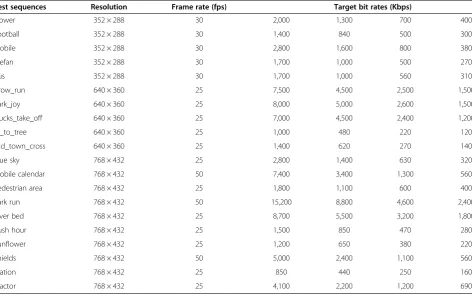
We evaluate the performance on the platform of JM 15.1 [30], in which the SSIM index is adopted as an opti-mal quality metric. Five CIF sequences [27], five 640 × 360 sequences [27] and ten LIVE sequences [21,22] are tested in the experiments. The first frame is coded as I frame and the rest are coded as P frames. The rate control is turned on. Table 4 shows the detail information of target bit rates for test sequences. Corresponding to four differ-ent target bit rates, the initial QP is equal to 24, 28, 32, and 36 for the first I frame and P frame. Frames are parti-tioned into one or more slices (each slice contains no more than 1,200 bytes), and the slices are organized in packets for transmission where each slice is packed into one packet. The test sequences are encoded with 5%, 10%, and 20% random packet loss ratio, respectively. For each packet loss ratio, four different target bit rates are tested in the experiments. Each experiment is repeated by 200
times, and the results are averaged, which are used as the final result.
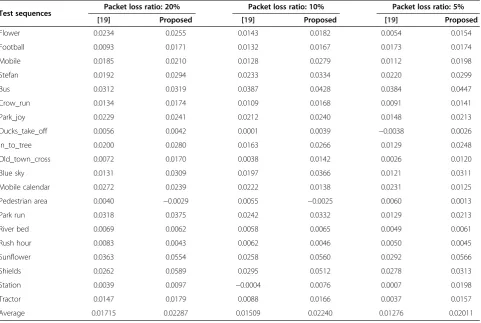
Figure 6 illustrates the results of Rate-SSIM perform-ance comparison for four test sequences. Moreover, we choose the MSE-ER scheme as the baseline and calculate all the simulation results of average SSIM gain with dif-ferent bit rates and packet loss ratios, which are tabu-lated in Table 5.
It can be seen that the proposed model yields con-sistent gains over the MSE-ER for all sequences except
‘Pedestrian area’. Our proposed scheme achieves an
average SSIM gain of 0.0218 or equivalently a bit rate saving of 15.7%. Comparing to the SSIM-ER [19], our proposed scheme has better performance of most se-quences and obtains an average gain of 0.0068. For some sequences, such as‘Mobile calendar’and‘Pedestrian
area’, although our proposed scheme cannot achieve
the best performance, the quality of the two SSIM-ER schemes is similar.
Figure 9Subjective quality comparison of one LIVE sequence. (a)Original frame of‘Station’;(b)‘Station’by MSE-ER (SSIM 0.826);(c)‘Station’ by SSIM-ER [19] (SSIM 0.851);(d)‘Station’by our proposed (SSIM 0.869).
Table 6 Average encoding time ratio of SSIM-ER [19] and proposed scheme to MSE-ER, respectively
Test sequences [19] Proposed Test sequences [19] Proposed
Flower 2.77% 4.63% Blue sky 4.09% 6.97%
Football 3.70% 4.99% Mobile calendar 6.23% 9.77%
Mobile 4.37% 6.95% Pedestrian area 3.89% 3.66%
Stefan 3.60% 4.78% Park run 2.72% 4.85%
Bus 5.33% 7.13% River bed 2.64% 2.21%
Crow_run 1.39% 3.98% Rush hour 3.99% 4.46%
Park_joy 2.24% 3.22% Sunflower 6.33% 7.54%
Ducks_take_off 2.40% 2.76% Shields 5.19% 7.43%
In_to_tree 1.91% 6.57% Station 3.70% 7.70%
Old_town_cross 3.45% 6.90% Tractor 2.98% 5.23%
5.3 Evaluation of subjective quality
Finally, we show the visual quality comparison of recon-structed images by different error-resilient video coding schemes. Figure 7 compares the subjective quality of the
25th frame of ‘Stefan’ encoded at 1.7 Mbps with 10%
packet loss. Figure 8 shows the comparison on visual qual-ity of the 38th frame of ‘In_to_tree’ encoded at 1 Mbps with 20% packet loss. Figure 9 represents the visual quality of the 29th frame of ‘Station’encoded at 0.85 Mbps with 5% packet loss.
For the similar bit rate, the reconstructed images based on the SSIM-based error-resilient video coding can provide a better visual quality due to more image details being protected from transmission errors. On the other side, the reconstructed images based on the conventional MSE-based error-resilient video coding suffer from larger perceptual distortion. Compared to SSIM-ER [19], our proposed scheme obtains similar or better visual quality.
5.4 Evaluation of coding complexity
Our proposed SSIM-based error resilient video coding scheme improves the RD performance for lossy transmis-sion over packet-switched network. However, the computa-tional complexity of codec is increased due to SSIM-based distortion calculation and mode selection.
We compare the coding efficiency with different bit rates and packet loss ratios. Table 6 shows the average encoding time ratio of SSIM-ER [19] and proposed scheme to MSE-ER, respectively. The experiments are performed on a laptop with 3.4 GHz Intel Core i7-3770 CPU and 4G memory running on Microsoft Windows 7 professional platform. Each experiment is repeated 100 times and the results are averaged.
Comparing to MSE-ER, the average computation of SSIM-ER [19] and proposed scheme increase by 3.65% and 5.58%, respectively. In addition, different sequences have inconsistent degree of encoding time, as can be seen in Table 6. That is because the computation complexity is also affected by the characteristics of video content and the results of mode selection. The SSIM-based schemes may take more time to code the image details, such as ‘Sunflower’and‘Mobile’.
6 Conclusions
In this paper, we propose an SSIM-based end-to-end distortion model for H.264/AVC video coding over packet-switched networks. This model is useful to esti-mate the content-dependent perceptual distortion of quantization, error concealment, and error propagation. We integrate the proposed end-to-end distortion model into the error-resilient video coding framework to opti-mally select the coding mode. Simulation results show that the proposed scheme outperforms the state-of-the-art schemes in terms of SSIM.
Competing interests
The authors declare that they have no competing interests.
Acknowledgements
The work described in this paper was supported by the National Natural Science Foundation of China (No. 60972111, 61036008, 61071184, 61373121), Research Funds for the Doctoral Program of Higher Education of China (No. 20100184120009, 20120184110001), Program for Sichuan Provincial Science Fund for Distinguished Young Scholars (No. 2012JQ0029, 13QNJJ0149), the Fundamental Research Funds for the Central Universities (Project no. SWJTU09CX032, SWJTU10CX08, SWJTU11ZT08), and Open Project Program of the National Laboratory of Pattern Recognition (NLPR).
Author details
1
School of Information Science and Technology, Southwest Jiaotong University, Chengdu, China.2Institution of Academia Sinica, Jiuzhou Electric
Group, Sichuan, China.3School of Electronics and Information Engineering, Sichuan University, Chengdu, China.
Received: 11 December 2013 Accepted: 25 August 2014 Published: 13 September 2014
References
1. S Wenger, H.264/AVC over IP. IEEE Transact Circ Syst Video Technol 13, 645–656 (2003)
2. ZH He, JF Cai, CW Chen, Joint source channel rate-distortion analysis for adaptive mode selection and rate control in wireless video coding. IEEE Transact Circ Syst Video Technol12, 511–523 (2002)
3. R Zhang, SL Regunathan, K Rose, Video coding with optimal inter/intra-mode switching for packet loss resilience. IEEE J Selected Areas Commun 18, 966–976 (2000)
4. XK Yang, C Zhu, ZG Li, X Lin, GN Feng, S Wu, N Ling, Unequal loss protection for robust transmission of motion compensated video over the Internet. Signal Process. Image Commun.18, 157–167 (2003)
5. CY Zhang, H Yang, SY Yu, XK Yang, GOP-level transmission distortion modeling for mobile streaming video. Signal Process. Image Commun. 23, 116–126 (2008)
6. Y Wang, ZY Wu, JM Boyce, Modeling of transmission-loss-induced distortion in decoded video. IEEE Transact Circ Syst Video Technol16, 716–732 (2006) 7. H Yang, K Rose, Advances in recursive per-pixel end-to-end distortion
estimation for robust video coding in H.264/AVC. IEEE Transact Circ Syst Video Technol17, 845–856 (2007)
8. Y Zhang, W Gao, Y Lu, Q Huang, D Zhao, Joint source-channel rate-distortion optimization for H.264 video coding over error-prone networks. IEEE Transact Multimed9, 445–454 (2007)
9. H Yang, K Rose, Optimizing motion compensated prediction for error resilient video coding. EURASIP J Image Video Process19, 108–118 (2010) 10. JM Xiao, T Tillo, CY Lin, Y Zhao, Joint redundant motion vector and intra
macroblock refreshment for video transmission. EURASIP J Image Video Process12, (2011). doi: 10.1186/1687-5281-2011-12
11. YX Zhang, C Zhu, KH Yap, A joint source-channel video coding scheme based on distributed source coding. IEEE Transact Multimed10, 1648–1656 (2008)
12. Y Zhou, CP Hou, W Xiang, F Wu, Channel distortion modeling for multi-view video transmission over packet-switched networks. IEEE Transact Circ Syst Video Technol21, 1679–1692 (2011)
13. JM Xiao, T Tillo, CY Lin, Y Zhao, Dynamic sub-GOP forward error correction code for real-time video applications. IEEE Transact Multimed
14, 1298–1308 (2012)
14. Z Xue, KK Loo, J Cosmas, M Tun, PY Yip, Error-resilient scheme for wavelet video coding using automatic ROI detection and Wyner-Ziv coding over packet erasure channel. IEEE Transact Broadcast56, 481–493 (2010) 15. MB Dissanayake, S Worrall, WAC Fernando, Error resilience for multi-view
video using redundant macroblock coding, inProceedings of the IEEE International Conference on Industrial Information Systems (ICIIS)(University of Peradeniya, Kandy, 2011), pp. 472–476
17. YJ Kwon, J-S Lee, Parametric estimation of structural similarity degradation for video transmission over error-prone networks. Electron. Lett. 49, 1147–1148 (2013)
18. L Zhang, Q Peng, X Wu, SSIM-based Error-resilient video coding over packet-switched, inProceedings of the Pacific-Rim Conference on Multimedia (PCM)(Singapore, 2012), pp. 263–272
19. PH Zhao, YW Liu, JX Liu, S Li, RX Yao, SSIM-based error-resilient rate-distortion optimization of H.264/AVC video coding for wireless streaming. Signal Process. Image Commun.29, 303–315 (2014)
20. L Zhang, Q Peng, X Wu, SSIM-based end-to-end distortion model for error resilient video coding over packet-switched networks, inProceedings of the International Conference on Multimedia Modeling (MMM)(Huangshan, 2013), pp. 307–317
21. K Seshadrinathan, R Soundararajan, AC Bovik, LK Cormack, Study of subjective and objective quality assessment of video. IEEE Transact Image Process19, 1427–1441 (2010)
22. Live Video Quality Database, 2012. http://www.utexas.edu/ece/research/live/ vqdatabase/
23. Z Wang, AC Bovik, HR Sheikh, EP Simoncelli, Image quality assessment: from error visibility to structural similarity. IEEE Transact Image Process 13, 600–612 (2004)
24. WS Lin, CCJ Kuo, Perceptual visual quality metrics: a survey. J Visual Commun Image Represent22, 297–312 (2011)
25. E Lam, J Goodman, A mathematic analysis of the DCT coefficient distribution for images. IEEE Transact Image Process9, 1661–1666 (2000) 26. TW Yang, C Zhu, XJ Fan, Q Peng, Source distortion temporal propagation
model for motion compensated video coding optimization, inProceedings of the IEEE International Conference on Multimedia and Expo (ICME)
(Melbourne, 2012), pp. 85–90
27. Xiph.org Video Test Media, 2010. http://media.xiph.org/video/derf/ 28. TS Ou, YH Huang, HH Chen, SSIM-based perceptual rate control for video
coding. IEEE Transact Circ Syst Video Technol21, 682–691 (2011) 29. T Wiegand, B Girod, Lagrange multiplier selection in hybrid video coder
control, inProceedings of the IEEE International Conference on Image Processing (ICIP)(Thessaloniki, Thessaloniki, 2001), pp. 542–545 30. JVT Reference Software, 2011. http://iphome.hhi.de/suehring/tml/
doi:10.1186/1687-5281-2014-45
Cite this article as:Penget al.:Modeling of SSIM-based end-to-end distortion for error-resilient video coding.EURASIP Journal on Image and Video Processing20142014:45.
Submit your manuscript to a
journal and benefi t from:
7Convenient online submission 7Rigorous peer review
7Immediate publication on acceptance 7Open access: articles freely available online 7High visibility within the fi eld
7Retaining the copyright to your article


![Figure 7 Subjective quality comparison of one CIF sequence. (a)SSIM-ER [19] (SSIM 0.917); Original frame of ‘Stefan’; (b) ‘Stefan’ by ‘MSE-ER’ (SSIM 0.913); (c) ‘Stefan’ by (d) ‘Stefan’ by our proposed (SSIM 0.929).](https://thumb-us.123doks.com/thumbv2/123dok_us/912163.1589019/9.595.58.539.504.704/subjective-comparison-sequence-original-stefan-stefan-stefan-proposed.webp)
![Table 6 Average encoding time ratio of SSIM-ER [19] and proposed scheme to MSE-ER, respectively](https://thumb-us.123doks.com/thumbv2/123dok_us/912163.1589019/10.595.57.540.565.733/table-average-encoding-ratio-ssim-proposed-scheme-respectively.webp)
