LIS qualifications in an African context: considerations
from a South African study
I
Jaya
Raju
2Library and Information Studies Programme, Durban University of Technology, M.L. Sultan Campus, P.O. Box 1334, Durban, 4000, Republic of South Africa
[email protected]
Received: IstOctober 2007 Accepted:21stSeptember2008
It is important for countries in Africa toblaze their own unique paths in terms ofadopting LIS qualification models that would be realistic and relevant to the local African context and, importantly, add value to their library and information services which have acrucial role toplay in growth and development. As a contribution tothis end. a
research project is currently being undertaken in South Africa where. aspart ofthe project. work environments in other disciplines such asjournalism. health care and engineering are being empirically investigated and compared with LIS services in terms ofjob functions and higher education qualification types required to fulfill these job functions. The intention is to see if perhaps there are any innovations, lessons or best practices that the LIS profession can draw from these disciplines in terms ofstaff structures in LIS services. job functions ofincumbents. and qualification requirements defining these structures and functions. The purpose ofthis paper is toreport on some
of
the preliminary findings in an initial and novel comparison involving public. academic and special libraries. and engineering firms. newspaper houses and health care services in an African city. The findings. in the main. reveal that other disciplines seem toembrace vocational institutions. such asuniversities oftechnology. in the work place much more than the LIS work environment. The paper concludes that while there are significant aspectsof
western developed qualification models that continue tobe useful in developing contexts. LIS qualification models in these contexts do not necessarily have to travel the same route as done in the West. The development ofsuch qualification models should be guided by African realities. The paper recommends the need todraw lessons from work place practices in other disciplines and from innovative work place behavior within the LIS discipline evident in the preliminary findings presented in this paper, and more fully utilize qualification products from non traditional university institutions which often are the only tertiary level institutions many African school leavers are able to access. At the same time qualification models should afford articulation means that provide opportunities for further education and developmentof
these individuals.Keywords: LIS education-Africa; LIS education-South Africa; LIS services-Africa; LIS services-South Africa
Introduction
Establishing library and information science (LIS) as a graduate profession as currently happens in first world contexts such as the United States of America and Canada, indeed does propel the status of the profession in society and, significantly, guarantees general (liberal arts) education which universally is argued to be crucial in the preparation of the LIS professional (Shera 1972; Wilson and Hermanson 1998; IFLA2000; Kagan2002; Raju2006). Kagan(2002: 13)argues that "this wider perspective [that comes with engaging general education/liberal arts subjects as well as various discipline based subjects as part of a university bachelor's degree] is a prerequisite for enhanced professional status". This scenario is perhaps also affordable in a first world context where, following the post-graduate route, it can take up to five/six years
to become an LIS professional. Can the developing African context afford this? Perhaps not, particularly in a context of scarce resources, pressing national development priorities and, very importantly, educational difficulties associated with a school-leaving population, the majority of which come from severely disadvantaged (educationally and economically) backgrounds. It therefore becomes important for countries in Africa to blaze their own unique paths in terms of adopting LIS qualification models that would be realistic and relevant to the local African context and, importantly, add value to their library and information services which have a crucial role to play in growth and development.
• As a contribution to this end, a research project is currently being undertaken in South Africa where, as part of the project, work environments in other disciplines are being empirically investigated and compared with library and
information services (LIS) in terms of job functions and higher education qualification types required to fulfill these job functions. Langley, Gray and Vaughn (2003: 1-2) suggest that in order to instigate change in an atmosphere (libraries)
I. This paper is a revised version of a paper originally presented at the World Library and Information Congress (73rd IFLA General Conference &Council), Africa Section held in Durban, South Africa on 19-23 August 2007.
traditionally associated with a sluggishnessto change, "we need to look outside the profession to other models of work
behavior to see how we can do it better". In line with this innovative thinking this project has begun with journalism,
health care and engineering important disciplines also contributing to growth and development in the African context -to see if perhaps there are any innovations, lessons or best practices that the LIS profession can draw from these
disciplines in terms of staff structures in LISservices, job functions of incumbents, and qualification requirements defining
these structures and functions. The purpose of this paper is to report on some of the preliminary findings in an initial and novel comparison involving public, academic and special libraries, and engineering firms, newspaper houses and health
care services. To contextualize this, the paper will first briefly elucidate on the idea of seeking LIS qualification models suited to an African context; then take a cursory look at development in an African context and the role of LIS services in
this development. Further, in the process of reporting on the above initial findings, the paper will discuss issuessuch as vocational higher education institutions like the emerging universities of technology in South Africa and the value and role
of their LISqualificationsvis6visthose of the traditional universities, the role and contribution of the LIS paraprofessional to LISservices in a developing context, and the issue of articulation between higher education qualification types and the
relevance of this for LIS education in a developing context. Teasing out such issues is important in the search for qualification models that are relevant to information and libraries in an African context and to growth and development in general.
2 Exploratory study
This paper reports on work in progress. The word 'model' is used in this paper not in the sense of having arrived at
something definitive and complete. Rather it is used as a means of exploring LIS qualification scenarios for an African context. Broadbent (1988: 92-93) claims that one of the medium by which a model may be represented is the "verbal" or "narrative" medium, as is being used in this paper. Broadbent (1988: 91) also points out that one of the functions of
models may be "exploratory", which the author believes is the purpose for which it is being used here. One also needs to be mindful that "no model can ever be complete ... " (Broadbent 1988: 88). In seeking other scenarios or models, "certain properties of the object" are "singled out, represented in their pure, simplified form and then studied in the absence of
the actual object" (Bless and Higson-Smith 2000: 10). Kebede (2002: 71) usefully points out that the strength of the model concept is its ability to capture and communicate essential aspects in order to generate a better understanding of
the reality under study. It is in this exploratory context that this paper discussesqualification models or scenarios that are relevant to information and libraries in a developing context in Africa.
3 Development
in Africa and the role of LIS services
African populations (including large sections of the South African population) generally suffer from a "lack of requisite high
level and varied types of needed literacy skills" (Raseroka2005: 4) necessaryfor accessto required information, especially electronic access to information which has become the dominant mode of access in our current knowledge society. Furthermore, electronic access to information is dependent on complex information and communication technology
(ICT) infrastructure which, according to Raseroka (2005: 4) is "poorly distributed to the majority of African populations or is unaffordable". The latter is largely the result of economic constraints facing most African countries. These factors collectively contribute to the information access divide that precludes Africa's meaningful participation in a true
knowledge society where there is equitable accessto information by all communities and which is required for African
development in the various sectors. While South Africa in these instances might be somewhat better off than most other African countries, there are still significant sections of its population that suffer similar disadvantages. Library and information services have a significant role to play in helping to bridge this divide, for example, by making creative efforts
towards literacy development of African populations, by using innovative methods to make information needed for everyday survival available to local African communities or by providing accessto research outputs published abroad to scholars based in Africa and who are working on African research problems. This calls for LIS education that is cognizant of African needs and African development priorities.
African (including South African) LIS education and training, historically, has been influenced by British and American trends. In the pre-independence era many African librarians trained abroad or engaged in distance education with
•
came from the West in the setting up of the first library schools in African countries. The curriculum content too tended to be based on what was taught in the United States of America and in the United Kingdom. According to Rosenberg
(1999: 16-19) the necessity to indigenize curricula and make them relevant to local African needs was recognized as far back as 1962 but this has been difficult to achieve. Understandably, African library schools, in their aspirations to maintain
international standards in professional LIS education and also as a result of the general lack of teaching and learning materials relevant to library and information work in Africa, have largely maintained the curriculum content from the west. However, in more recent years there have been efforts in African scholarship generally to de-emphasize
hegemonic Euro-American values and for higher education and research to reflect the lived experiences of the vast majority of Africans. Okolie (2003: 235) in his call for knowledge production in higher education for sustainableAfrican development, appeals for African-centered higher education where African ideas, knowledges and ways of knowing are
affirmed and promoted. Raseroka (2005: 4) too, in her call to help bridge Africa's knowledge divide, appeals to African scholars and librarians to "stimulate knowledge creation and its analysisby local researchers and communities [and] thus
stimulate rigour in the critical analysisof local research issues". Okolie (2003: 247) laments that African researchers and academics are dependent on western sources for research funds, equipment and publishing outlets; they "crave for recognition by their western counterparts, and for institutional affiliation with western universities or research institutes".
Hence programmes in university and college faculties become organized along lines similar to programmes in Europe and America - as noted above in the case of LIS education in African countries. Okolie (2003: 248) argues rather for critical
pedagogues in higher education that create room for interrogation of and research in areas that address African needs and priorities. It is in this critical context that this paper attempts to explore qualification scenarios that are relevant to the library and information environment in a developing African context.
4 Empirical work
As a preliminary phase in a wider project area led by the author, three limited studies (Dlabantu 2006; Ngubane 2006;
Rajagopaul 2006) were conducted in 2006 in the busy port city of Durban, KwaZulu-Natal, South Africa under the auspices of the Library and Information Studies Programme of the Durban University of Technology. The collective objective of the studies was to investigate job functions of traditional university and university of technology (Uo T)
graduates in special, public and academic library environments on the one hand and in engineering, journalism and health care environments on the other. The intention was to draw on possible trends and best practices from the latter for the former. Like LIS, engineering, journalism and health care disciplines draw their personnel from both traditional
universities and UoTs.The research questions that were used to guide the studies in meeting this objective were: • What are the job functions of university and university of technology graduates in the staff structures of selected
special, public and academic libraries in the Durban area?
• What are the job functions of university and university of technology graduates in the staff structures of selected engineering firms, newspaper housesand health care services in the Durban area?
• Are there any trends and best practices in staff structures in the engineering, journalism and health care work environments that can be adopted/adapted for the LISwork place?
After reviewing literature related to the individual areas of investigation to become acquainted with current issuesin the areas of research and also to integrate the studies into the wider body of knowledge that is relevant to the research problem being investigated, these studies used mainly self-administered questionnaires and structured interviews as data collection instruments. The questionnaire was used to collect data from selected samples (using appropriate sampling techniques) of traditional university and university of technology LIS, engineering and journalism graduates from purposively selected special, public and academic libraries, and engineering firms and newspaper houses in the Durban
area. In order to increase the validity of data collected structured interviews were employed to gather data from purposively selected samples of managers from special library environments, public libraries and academic libraries, and from newspaper houses and heath care services. In the case of engineering firms the self-administered questionnaire was also used to collect data from managersas this was found to be a more workable option in this particular environment.
With the health care services the graduates themselves were not engagedbecausethe intention was to source data from the managers as it was found that this would be the best route to follow when dealing with a terrain that is large, unfamiliar and hasa great variety of health care practitioners. This proved to be a difficult sector to accessand evidence of this is that eventually only one health care service, but a very big and significant one, out of the three approached afforded an interview, albeit an in-depth and very useful interview. Due to reasons of space further details regarding the methodology and other aspects of these individual preliminary studies, including difficulties associated with data
5 Preliminary findings
Table I Institutions surveyed
Special library services
I . Engenoil Library 2. Oceanographic research Institute Library
3. Shepstone & Wiley Law Library
Engineering firms
I. Amalgamated Beverage Industries LTD.
2. Ethekwini Water & Sanitation. 3. Conlog: Prepayment Metering Systems.
LIS Services
Public library services
10 branches of the Ethekwini Municipal Library Service:
I. Beach 2. Central Lending 3. Durban North 4. Glenashley S. Glenwood 6. Grosvenor 7. Montlands 8. Prince Edward 9. Umbilo 10. Windermere
Institutions from other disciplines
Newspaper house
Independent Newspapers - the only major newspaper house in Durban which publishes many of South Africa's daily and weekly newspapers.
Academic library services
I. B.M. Patel Library (Durban University of Technology)
2. E.G. Malherbe Library (University of KwaZulu-Natal)
3. McO'Dowd Resource Center (Mangosuthu Technikon)
Health care service
Addington Hospital - one of the largest public health care services in the province of KwaZulu-Natal.
Table 2 Research question I:
What are the job functions of university and university of technology graduates in the staff structures of
selected special, public and academic libraries in the Durban area?
Special libraries
I. Both university and UoT graduates (degree and diploma UoT graduates) stand the same chance of securing positions, both professional and support positions.
2. Special libraries do not seem to correlate job titles/functions and type of higher education institution the LIS graduate comes from.
3. Thin line separating the job functions of Librarian and Library Assistant, often with an over-lap in functions. In instances where just one person is employed (common in special libraries) the individual assumes both professional and assisting functions.
Public libraries
I . University LIS graduates are generally employed in professional positions (e.g. Librarian) while UoT graduates are employed in support positions (e.g. Library Assistant).
2. Emerging trend of B.Tech LIS graduates from the Uo Ts being considered for professional positions. 3. Professional functions of Librarians are clearly defined to include staff
supervision, decision making, collection development, administrative/
management functions, etc.
4. Support functions of Assistants are also clearly defined to include clerical tasks, circulation duties, shelving, cash routines, etc.
Academic libraries
I . In the academic library located in the traditional university, LIS graduates from universities occupy professional positions (e.g. Subject Librarian) and those from UoTs, including those with a B.Tech. degree, occupy support or paraprofessional positions.
2. In the academic libraries located in the universities of technology, LIS graduates from both the traditional university and the Uo T qualify for professional positions (involving general librarianship functions, subject librarian functions, administrative/ management functions, etc.) while holders of the National Diploma in LIS from the UoTs qualify for
paraprofessional/support positions involving routine tasks.
Table 3Researchquestion 2:
Health care services
I. Positions such as those of Medical Doctors, Nurses, Pharmacists, Dieticians, Speech Therapists, Radiographers, etc. are recognized as professional positions and required qualifications for these positions may be from universities or UoTs.
2. Positions and job functions that categorize as paraprofessional are those of clerical personnel.
3. Incumbents are not employed in terms of the type of higher education institution they come from but rather the
requirements of the available position are the focus.
What are the job functions of university and university of technology graduates in the staff structures of selected engineering firms, newspaper houses and health care services in the Durban area?
Engineering firms Newspaper houses
I. Engineering graduates from the UoTs I. Most of the journalism graduates holding the B.Tech.(Engineering) degree surveyed were UoT graduates. and those from the traditional university 2. All graduates have the same job holding the B.Sc. (Engineering) degree designations and job functions (e.g. are assigned professional job functions Reporter) whether they carry a UoT such as those of Engineering Managers. Diploma or B.Tech. in journalism or a 2. Holders of the National Diploma in university journalism qualification. Engineering from the UoTs qualify for 3. All graduates and diplomates start at support positions and functions as in that the bottom as Reporters and work their of a Technician. way up the career ladder through hard
work and dedication to the profession. 3. A journalism qualification may be an advantage but it is hard work that counts.
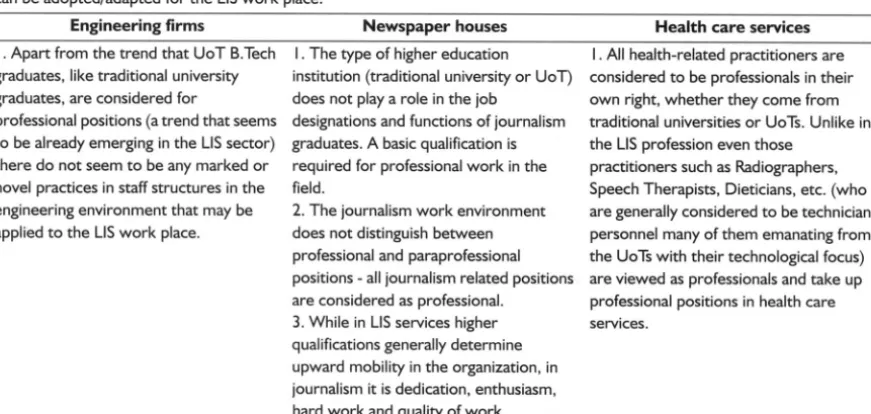
Table 4 Researchquestion 3:
Health care services
I. All health-related practitioners are considered to be professionals in their own right, whether they come from traditional universities or UoTs. Unlike in the LISprofession even those
practitioners such as Radiographers, Speech Therapists, Dieticians, etc. (who are generally considered to be technician personnel many of them emanating from the UoTs with their technological focus) are viewed as professionals and take up professional positions in health care services.
Newspaper houses
I. The type of higher education institution (traditional university or UoT) does not playa role in the job
designations and functions of journalism graduates. A basic qualification is required for professional work in the field.
2. The journalism work environment does not distinguish between professional and paraprofessional positions - all journalism related positions are considered as professional.
3. While in LISservices higher qualifications generally determine upward mobility in the organization, in journalism it is dedication, enthusiasm, hard work and quality of work.
Are there any trends and best practices in staff structures in the engineering, journalism and health care work environments that can be adopted/adapted for the LISwork place?
Engineering firms
I. Apart from the trend that UoT B.Tech graduates, like traditional university graduates, are considered for
professional positions (a trend that seems to be already emerging in the LISsector) there do not seem to be any marked or novel practices in staff structures in the engineering environment that may be applied to the LISwork place.
•
6 Discussion
While the above preliminary investigations are based on limited samples, they do nonetheless reveal some interesting findings in a novel comparison from which one can draw on to explore qualification models or scenarios that allow for maximum use of LIS-trained human resources in an African LISwork place with its particular needs and priorities. These limited studies are currently being expanded on with more scientifically extracted samples from a wider geographic area to see if the trends revealed by the above preliminary investigations are indeed applicable more widely.
In the meantime, what are some of the "work behavior" from "outside the profession" (Langley, Gray and Vaughn
2003: 2) revealed by these initial findings that we in the LIS discipline can draw on to more efficiently, in an African context, utilise our qualification products?
Ocholla and Bothma (2006), who have reflected on LISeducation and training in Eastern and Southern Africa, point to two dominant qualification models predominant in South Africa and likely to be applicable in other parts of Africa with some variation: the undergraduate model (three/four years of undergraduate study, followed by postgraduate studies if
desired) and the postgraduate model (any general degree plus a postgraduate diploma in LIS, followed by further post-graduate studies, if desired). Literature on LIS education and training in Africa generally tends to make only cursory
reference to university of technology (UoT), polytechnic or equivalent LIS programmes. UoTs (previously technikons in
South Africa), polytechnics, etc. have traditionally not been regarded in society as being as elite as the traditional
universities among higher education institutions. Vocational institutions, such as universities of technology, have an applied and solutions-driven approach to education (Du Pre
2007: 2)
as opposed to the more academic and theoretical approach of traditional universities. Thus, such higher education vocational institutions havevery functional roles to play particularly in growth and development in an African context with its particular needs and priorities. In fact the South African HigherEducation Qualifications Framework (HEQF) consciously promotes such diversity and differentiation in the higher education system for the purpose of meeting "the varying needs of ... clients and communities ... " (Department of Education (South Africa)
2007: 5-6).
Testimony to the value of ,,:ocationally-oriented higher education lies both in the above preliminary findings aswell as in the literature (as discussedbelow).According to the above findings, other disciplines seem to be embracing the emerging UoTs in the work place much
more than the LIS work environment. For example, Bachelor of Technology (B.Tech.) graduates from the UoTs, like traditional university engineering graduates, are considered in the Engineeringwork place for professional positions such as that of Engineering Manager.This is a trend that, after many years of resistance, is only just beginning to surface in the
public library work environment in South Africa. Academic libraries based in traditional universities seem to still vehemently resist this. In an age of advanced technologies which are redefining traditional library roles (Neal
2006:
para I) university academic libraries, argues Ngubane(2006: 49-50),
need to re-visit their traditional view and "embrace new role functions that the new university of technology graduate, particularly at the B.Tech. level, can contribute in a technologically advancing academic library environment", especially in technology-oriented positions. Academic libraries of the UoTs, probably more appreciative of the value of vocational education, tend to display a more progressive demeanor towards the B.Tech. LIS qualification and embrace these together with the university LIS qualifications asprofessional qualifications. Speciallibraries, generally located in the corporate world and perhaps influenced by the rigour of corporate culture have no fetishes about qualification types and even those with the National Diploma in LIS, and not just degree holders, could be appointed in professional posts.
Dlabantu
(2006: 46)
observes that the LIS work environment can learn from journalism. She purports that while qualifications are important perhaps LIS services have "become overly preoccupied with them to the detriment of good service, which often is the outcome of hard work, enthusiasm and dedication to the profession" - a culture that the journalism work environment seems to promote and in the process generate much productivity and creativity. The LISwork environment can learn from health care services too where all health-related practitioners, whether they come from traditional universities or from the UoTs,are considered to be professionals in their own right and take up positions in the work place accordingly. Some of the rigidity in the LIS work environment regarding job titles/functions and qualification types evidenced in the above findings is perhaps an indication of us, in Africa, still engaging in old practices
imported into our work environments at another time in a different age. Some LISservices, albeit a few, have been brave enough to break away from the dominant work place models. For example, in the UoT academic library cited in the above findings, the Management has bravely made the National Diploma in LIS from the UoT a requirement for entry level professional positions (e.g. Assistant Librarian) with routine clerical duties being allocated to incumbents who are
not LISgraduates and diplomates - a position similar to that in the health care service cited earlier. The Director of this particular academic library goes further to claim that she in fact discouragesthe use of the word 'paraprofessional' as she believes that it does not allow for progression in the work place. It is such 'out of the box' thinking and employment practices that are needed for us to break with old models both in the work place and in the learning environment to meet African needs in an African context.
Thapisa
(1999: 99),
writing in the African context, calls for LIS education and training that is "more market driven, vocational in approach and competence based" and that provides students with skills and competencies that enable them"to tackle real job or employment-related issues and problems". However, Thapisa claims, at the same time this education should be broad-based enough so as not to be concerned only with the technical understanding of jobs but also with "the attitudes, competencies and skills that make up a whole and complete worker". An African LIS work environment, then, has place for the products of traditional universities, where general education and subject expertise (the liberal arts) has always been a focus, as well as products of vocational institutions such as UoTs, polytechnics and others which despite their traditional focus on work place competencies also emphasize life long learning skills as, for example, required of all higher education qualifications in South Africa (Department of Education (South Africa)
2007: 6).
The knowledge economy, influenced largely by rapidly advancing leTs, "has brought about a whole range of opportunities and excitement and the changing roles of information professionals has been a result of these inevitable forces" (Tin and AI-Hawamdeh
2002:
331). For example, as people's information needs and demands rise in this knowledge context a trend has evolved, globally, for paraprofessionals, generally the products of LIS education at•
•
•
•
vocational institutions, to take over the role of professionals "in providing basic reference service, thereby releasing the
professionals to provide other value-added services to users" (Tin and AI-Hawamdeh 2002: 333). Similarly, in many areas
of information work particularly where there has been the automation of functions, paraprofessionals are being assigned tasks that were previously solely the domain of professionals (Neal 2006: para. 14). Significantly, this downward shift in
the work hierarchy has resulted in much task overlap and blurring of lines between responsibilities of products of
traditional universities and those of the universities of technology, polytechnics and other vocational institutions. Is it
perhaps not time then for us, especially in Africa, in the context of basic information required for everyday survival in
many communities, to more fully utilize the skills and knowledge of the latter. This is also relevant in the context of many
school leavers in African countries coming from severely disadvantaged educational and economic backgrounds and thus
in many instances not being able to access the more elite traditional universities but are in many cases able to access
vocational institutions (a case in point in South Africa), and thus emerge as paraprofessional LIS products after three years
or so of study. Such available skills and knowledge should be harnessed not only for the provision of efficient LIS services
which have a role to play in the betterment of African societies, but also for the educational development of these
individuals themselves so that they too may grow and develop and in turn impact on the growth and development of their communities. Why do we have to, both in the work place and in terms of learning models adhere to demarcations and
boundaries developed in another context to meet needs that are largely different from that of our context.
Research sojourns by the author to countries like Canada and Australia and interactions with LIS academics, LIS
services managers and general staff in these contexts revealed first hand that they can afford to continue with the
traditional and dominant qualification models as they do not have the same development challenges that African countries
have. Visits over the past year by the author, as part of a wider study being undertaken, to a variety of public, special and academic libraries in KwaZulu-Natal (one of the economically embattled provinces in South Africa) to observe and
enquire about staff numbers, qualification levels and job functions revealed that in many instances, particularly in community public libraries, the skills and knowledge of LIS products from vocational institutions such as the Uo Tare
being successfully utilized to run these services. The Congress on Professional Education (COPE) (2003: para. 3) usefully
points out that information technology has changed the nature of work and this calls for the contents of many jobs to be
evaluated and re-defined. This presents the ideal opportunity for us to re-visit traditional boundaries in the LIS work place
and traditional qualification requirements. It is an opportunity to maximize the use of the skills and knowledge of products of vocational institutions, such as Uo Ts which have a technology and problem solving focus.
This also presents an opportunity to build into our higher education systems real mechanisms that facilitate articulation between vocational qualifications and those of the traditional universities so as to allow individuals who were
not initially able to access the latter the opportunity to experience more theoretical or academic LIS education, if they
wish. This could be for their own personal growth and development as individuals as well as to contribute to LIS services
and to development generally, rather than remaining locked in a particular qualification stream with limited opportunities for vertical and horizontal mobility in the LIS work place. While the HEQF in South Africa does attempt to "facilitate
qualification articulation across the higher education system" by providing general guidelines for such articulation, "possession of a qualification does not guarantee a student's progression and admission to a programme of study ... the
decision to admit a student to higher education study is the right and responsibility of the higher education institution
concerned" (Department of Education (South Africa) 2007: 10, 14). Ultimately, then, allowing for such desired articulation rests with individual institutions with some being more amenable to this than others. This situation is
compounded by the fact that the HEQF makes very clear that the "positioning of two or more qualifications [for example, the four-year Uo T LIS qualification and the four-year university LIS qualification] on the same NQF level. .. does
not indicate that they have the same purpose, content or outcomes ... nor does it necessarily demonstrate equivalence of qualifications" (Department of Education (South Africa) 2007: I I). Again, this leaves weighty responsibility on employers
this time to apply their minds cogently and make maximum use of the diversity of LIS qualification products that the higher education system allows for, when seeking personnel for positions requiring certain competencies - and not to
simply go by traditional qualification requirements. These issues also explain the diversity in reactions among employers evident in the above preliminary findings.
7 Conclusion and recommendations
LIS qualification models in developing contexts do not necessarily have to travel the same route as done in the West. It must be acknowledged that there are significant aspects of western developed qualification models that continue to be
development of our qualification models be guided by African realities. Drawing from preceding discussions such realities include:
• the African context and its development challenges;
• the relevance of vocational higher education institutions to development in an African context, particularly with their technology driven and applied nature;
• the value and use of LIS 'paraprofessionals' in information and knowledge services, here again, their work place application skills and technology focus being strengths for LIS services in a developing context; and,
• the need for articulation possibilities between LISvocational education and traditional university education for further education and development of personnel.
While the preliminary studies reported in this paper are part of ongoing research, their findings do point to the need to be creative and innovative and to draw lessons, where possible, from work place practices in other disciplines also
contributing to growth and development in an African context, as well as from innovative work place behavior from
within our own discipline as evident in the reported findings. LIS products from both traditional universities and vocational institutions have a place in an African LIS work environment, such as in South Africa, and the exemplars emanating from these preliminary studies point to the need to more fully utilize qualification products from non
traditional university institutions which often are the only tertiary level institutions that many school leavers in African countries are able to access. At the same time qualification models should provide adequate articulation means that
provide opportunities for further educational development of these individuals.
Acknowledgement
The author wishes to acknowledge the National Research Foundation of South Africa (NRF) which provided funding for
the research reported in this paper.
References
Bless,C. and Higson-Smith, C. 2000.Fundamentals
of
social research methods: an African perspective. 3rd ed. Cape Town: Juta Broadbent, G. 1988.Design in architecture: architecture and the human sciences. London: David FultonCongress on Professional Education(COPE). 2003. Delegates define sustainable solutions for support staff issues. Visited on 04/05/ 06at:http://www.IFLA.org.
Department of Education (South Africa). 2007. The Higher Education Qualifications Framework. Visited on 30/07/2008 at:
http://www.che.ac.za/documents
Dlabantu, E. 2006. A comparative study of the job functions of university and university of technology graduates in the staff structures of selected public library services and newspaper houses in the Durban area. B.Tech. research project. Durban: University of Technology
Du Pre, R. 2007. The conceptualization of research at a university of technology,Research at Durban University
of
Technology5(3): 1-2
International Federation of Library Associations and Institutions [IFLA]. 2000. Guidelines for professional library/information educational programs - 2000. Visited on 23/02/200 I at:http://www.ifla.org/VlI/s23/bulletin/guidelines.htm.
Kagan,A 2002. The transformation of South African Iibrarianship: survey results and analysisof current opinions, Innovation
(25): 1-19
Kebede, G. 2002. Modelling the information needs of users in an electronic information environment. PhD thesis. Pietermaritzburg: University of Natal
Langley,A, Gray, ED. and Vaughn, K.T.L. 2003.The role
of
the academic librarian. London: Chandos Neal, N.G. 2006. Raisedby wolves. Visited on 04/05/06 at:http://www.libraryjournal.com.Ngubane, S. 2006. A comparative study of the job functions of university and university of technology graduates in the staff structures of selected academic library services and health care services in the Durban area. B.Tech. research project. Durban: Durban University of Technology
Ocholla, D.N. and Bothma, T. 2006. Trends, challengesand opportunities of LISeducation and training in Eastern and Southern Africa. Visited on 04/04/07 at:http://mg.csufresno.edu/papers/forumj/ocholla_bothma.pd
f
Okolie, AC. 2003. Producing knowledge for sustainable development in Africa: implications for higher education, Higher education 46: 235-260
Rajagopaul,A 2006. A comparative study of the job functions of university and university of technology graduates in the staff structures of selected special library services and engineering firms in the Durban area. B.Tech. research project. Durban: Durban University of Technology
Raju,J. 2006. A careful blend of general and vocational education: is this still necessary in the education and training of the modern LIS professional?Proceedings
of
the Australian Library and Information Association 2006 Biennial Conference, Perth Convention Exhibition Centre, Perth, Western Australia, 19-22 September 2006Raseroka,K. 2005. Africa to Africa: building its knowledge community,African research &documentation 99: 3-1 I
Rosenberg, D. 1999.An overview of education for librarianship in Anglophone Sub-SaharanAfrica. In Wise, M. ed.Education for librarianship and information science in Africa. pp.II-33. Stockholm, Sweden: Uppsala University Library.
Shera,J.H. 1972.The foundations
of
education for librarianship. New York: Becker and Hayes.Thapisa, A 1999. Developing lasting competencies for a twenty-first century information economy in Africa, Library management 20(2): 90-99
•
Tin, K.L. and AI-Hawamdeh, S. 2002. The changing role of paraprofessionals in the knowledge economy,
Journal
of
information
science,
28(4): 331-343.Wilson, A.M. and Hermanson, R. 1998. Educating and training library practitioners: a comparative history with trends and recommendations.