www.astrophys-space-sci-trans.net/4/13/2008/ © Author(s) 2008. This work is licensed
under a Creative Commons License. Astrophysics and Space Sciences
Transactions
Helioseismology
M. P. Di Mauro
INAF-Istituto di Astrofisica Spaziale e Fisica Cosmica-Roma, Italy
Received: 14 November 2007 – Revised: 18 January 2008 – Accepted: 21 January 2008 – Published: 10 April 2008
Abstract. Helioseismology, the study of solar oscillations, has proved to be an extremely powerful tool for the inves-tigation of the internal structure and dynamics of the Sun. Here I will review the present status of helioseismic studies and comment on recent results and on prospects for future investigations to solve the most discussed open questions as-sociated with solar structure modelling.
1 Introduction
The story began in the early 60’s when Doppler velocity ob-servations of the solar disk made by Leighton et al. (1962) showed clear evidence of the presence of solar surface’s os-cillations with periods of about 5 min. These osos-cillations were theoretically explained by Ulrich (1970), and indepen-dently by Leibacher and Stein (1971), as due to standing acoustic waves (i.e. p modes) – generated for some not well known reason in the convection zone and maintained by pres-sure forces – trapped in the solar interior. Few years later, more accurate observations carried out by Deubner (1975) were able to confirm the theoretical hypothesis about the global character and the modal nature of the solar oscilla-tions. This unprecedented discovery opened, for the first time, human eyes to the knowledge of the solar interior and formed the basis for the development of helioseismology. Like the geoseismology, which studies the Earth’s interior through the waves produced during the earthquakes, helio-seismology studies the interior of the Sun through the small quakes detected at the photosphere.
Since the first observations, several thousands of modes of oscillation have been identified with great accuracy from a number of experiments, including the MDI (Scherrer et al., 1995) and GOLF (Gabriel et al., 1995) instruments on
Correspondence to: M. P. Di Mauro
the SOHO spacecraft and the groud-based BISON (Chaplin et al., 1996), GONG (Harvey et al., 1996) and IRIS (Fos-sat, 1991) networks. The incredible amount of information collected over the past two decades contributed to reach a deep knowledge of the internal structure of the Sun, not imaginable forty years ago. The present paper provides a general overview of the main achievements in helioseismol-ogy. Further details can be found in the reviews written by, e.g. Christensen-Dalsgaard (2002), Kosovichev (2003) and Di Mauro (2003).
2 Helioseismic investigations
The observed solar oscillations correspond to standing acoustic waves maintained by pressure forces, which form the class of the p modes, and to standing surface gravity waves, maintained by gravity, known as f modes. In addition, we should mention the probable, although quite discussed, existence of the internal gravity waves, g modes, which are sensitive to the structure and rotation of the deeper interior of the Sun (Garc´ıa et al., 2007).
Oscillations have several advantages over all the other ob-servables: frequencies of oscillations can be measured with high accuracy and depend in quite simple way on the equi-librium structure of the Sun. In addition, each mode, charac-terized by a specific frequency and wave number, propagates through a confined region of the Sun, probing the physical properties of the crossed medium, like temperature and com-position. Thus, it is possible to deduce the internal stratifica-tion and dynamics of the Sun from a sufficiently rich spec-trum of observed resonant modes.
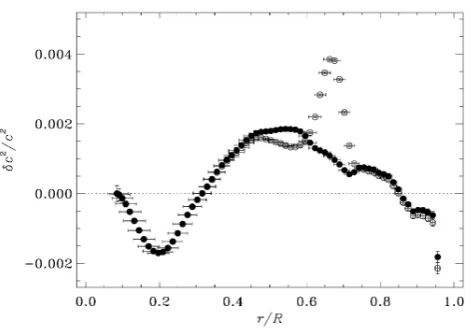
re-Fig. 1. The relative squared sound-speed difference between the Sun and two standard solar models (from Christensen-Dalsgaard and Di Mauro, 2007). The open symbols are obtained for Model S of Christensen-Dalsgaard (1996) while the filled symbols are for a model differing only in the inclusion of turbulent diffusion beneath the convection zone. The vertical error bars correspond to the stan-dard deviations based on the errors in the mode sets, whereas the horizontal bars give a measure of the localization of the solution.
veals large-scale properties of the solar structure and dynam-ics of the Sun; ii)“local” helioseismology, based on the use of the travel times of the acoustic waves through the interior between different points on the solar surface, which provides three-dimensional maps of the sound speed and of the flows in the upper convection zone, to probe local inhomogeneities in the sub-surface and surface layers. Here I will concen-trate on the results obtained by applying techniques of global helioseismology. Global helioseismology is based on the ap-plication of two different but complementary strategies. The first is the forward approach which consists in comparing the observed data with the theoretical frequencies computed for a stellar model. The second is based on the use of the ob-served data to deduce the internal structure and rotation of the Sun by means of data inversion.
3 The internal structure of the Sun
During the last decade, several efforts have been made in or-der to test the correctness of the standard models in view of the improvements accomplished in the description of the rel-evant physics.
The first significant result concerning the application of helioseismic analysis was obtained by Christensen-Dalsgaard et al. (1985), who reproduced the sound speed pro-file in the interior of the Sun. The results, so far, have shown that the solar structure is remarkably close to the predictions of the standard solar model and that the near-surface region can be probed with sufficiently high spatial resolution to
al-l &al-lt;
curate frequencies of low harmonic degree, which allow to resolve the solar core. The inversion results for Model S of Christensen-Dalsgaard et al. (1996), shown by empty sym-bols in Fig. 1, indicate that the differences between the Sun and the model’s prediction are extremely small, except below the base of the convection zone (0.71R), where the
gradi-ent of the hydrogen abundance changes abruptly as conse-quence of the helium settling. A significant progress can be achieved, as shown by filled symbols in Fig. 1, with the inclu-sion in the models of turbulent diffuinclu-sion of helium and heavy elements at the base of the convective zone in order to smooth the step gradient of the hydrogen abundance (Christensen-Dalsgaard and Di Mauro, 2007).
3.1 New solar abundances
Fig. 2. The relative squared sound-speed difference between the Sun and two standard solar models (from Montalb´an et al., 2004) differing in using the new solar surface abundances by Asplund (2005) and the old solar surface abundances by Grevesse and Noels (1993).
3.2 The equation of state and helium abundance
The solar plasma is almost an ideal gas, and the first adia-batic exponent01, the partial logarithmic derivative of pres-sure with respect to density at constant specific entropy, is therefore close to 5/3 in most of the interior.
Helioseismic data have been used to derive the differences between the equation of state of the Sun and that of the model and to probe the helium abundance in the solar envelope. The results showed that01 deviates from 5/3 in the zones of hydrogen and helium ionization below the surface (e.g. Di Mauro et al., 2002), and at very high temperatures as in the centre due to relativistic effects (Elliott and Kosovichev, 1998).
4 The solar dynamics
The inversion results about the internal angular velocity of the Sun are summarized in Fig. 3, which shows a cut of the interior of the Sun, where the contours and colour scale indi-cate the isorotation surfaces (Di Mauro et al., 1998) as deter-mined by inversion of data set obtained by SOI-MDI in 1996 (Schou et al., 1998).
The results show that the latitudinal differential rotation observed at the surface persists throughout the convection zone, while the radiative interior rotates almost rigidly at a rate of about 430 nHz. Through the largest part of the con-vection zone, the angular velocity at low latitude decreases with the radius, while at high latitudes increases inwards. The near-surface behaviour is consistent with the observed surface rotation rate. The properties of the tachocline, the transition layer from latitude-dependent rotation to nearly in-dependent rotation (e.g. Spiegel and Zahn, 1992), have been
Fig. 3. Rotation rate in the Sun obtained by inversion of SOI-MDI data (Schou et al. 1998). Colours and contours indicate the isorotation surfaces. The white area indicates the region in the Sun where the data have no reliable determinations (from Di Mauro et al., 1998)
also studied. It is in fact commonly accepted that the global dynamo action, responsible for the generation of the solar 22 yr magnetic cycle, is induced by the strong toroidal mag-netic fields generated by rotation shear in this thin region. 4.1 Temporal variation and the solar cycle
The rotation rate inferred by inversion of helioseismic data shows a complex variation with time, only partly correlated with the solar cycle. Regions of slightly faster and slower surface rotation, known as torsional oscillations, moving to-wards the equator have been studied extensively (e.g. Basu and Antia, 2003; Vorontsov et al., 2002; Howe et al., 2000a, 2005). This pattern characterized by flows which are few me-ters per second slower or faster than the mean solar rotation at a given latitude, extends from the surface to at least 0.92R
and appears closely linked to the 11-years sunspot cycle. The origin of these zonal flows is not definitely established.
Another temporal variation of the rotation rate, without a clear link to the solar cycle, was found by Howe et al. (2000b) near the base of the convective envelope. This variation with a period of the order of 1.3 yr occurs above and belove the tachocline and appears more pronounced near the equator. However, the oscillation seems to have stopped after 2001 (Howe et al., 2007). The possible physical cause of such a variation is unknown, although it could have a magnetic origin.
4.2 The rotation of the core
Despite such overall success, helioseismology has not yet ex-hausted its resources, since helioseismic results clearly sug-gest further refinements of the solar models. To reach the required sensitivity and frequency resolution, several helio-seismology experiments have been already planned to op-erate on-board of satellites and will soon be devoted to the measurements from space: SDO, Solar Dynamics Observa-tory (http://sdo.gsfc.nasa.gov/), a NASA mission to under-stand the variation of the solar magnetic field, the dynamical processes and their impact on Earth (launch 2008); PICARD (Thuillier et al., 2003), a CNES mission to study the Earth climate and Sun variability relationship (launch 2009); SO, Solar Orbiter (Marsden and Fleck, 2007), an ESA satellite to study the polar regions and the side of the Sun not visi-ble from Earth (launch 2013); DinaMICS (Garc´ıa and Turck-Chi`eze, 2006), to study Dynamics and Magnetism from the Internal core to the Chromosphere of the Sun, a French project not yet planned for launch.
Finally, it is important to mention the existence of a new European initiative, the European Helio- and Asteroseismol-ogy Network HELAS, funded as a Coordination Action by the European Commission under the Sixth Framework Pro-gramme for 2006-2010. HELAS, which is led by ten ma-jor research groups from nine European countries, offers the unique opportunity to facilitate the exchange of knowledge and the coordination of research in helio- and asteroseis-mology through international conferences, smaller meetings, staff exchange and a strong plan for the dissemination of the latest results in the fields of helio- and asteroseismology. Fur-ther information can be obtained through the HELAS website http://www.helas-eu.org.
Acknowledgements. The author is grateful to the organizers for
the kind invitation and the financial support which allowed her to participate to the IHY conference with the present contribution, and to the anonymous referees for the comments and suggestions which led to the improvement of the present paper.
Edited by: H. Fichtner
Reviewed by: two anonymous referees
Basu, S., Christensen-Dalsgaard, J., Chaplin, W. J., Elsworth, Y., Isaak, G. R., New, R., Schou, J., Thompson, M. J., and Tomczyk, S.: Solar internal sound speed as inferred from combined BiSON and LOWL oscillation frequencies, Mon. Not. Roy. Astron. Soc., 292, 243–251, 1997.
Chaplin, W. J., Elsworth, Y., Howe, R., Isaak, G. R., mcLeod, C. P., Miller, B. A., van der Raay, H. B., Wheeler, S. J., and New, R.: BiSON Performance, Solar Phys., 168, 1–18, 1996.
Christensen-Dalsgaard, J.: Helioseismology, Rev. Mod. Phys., 74, 1073–1129, 2002.
Christensen-Dalsgaard, J. and Di Mauro, M. P.: Diffusion and Helioseismology, in: Stellar Evolution and Seismic Tools for Asteroseismology - Diffusive Processes in Stars and Seismic Analysis, edited by Straka, C. W., Lebreton, Y., and Mon-teiro, M. J. P. F. G., EAS Publications Series, 26, 3–16, 2007. Christensen-Dalsgaard, J., Duvall, T. L. Jr., Gough, D. O.,
Har-vey, J. W., and Rhodes, E. J. Jr. : Speed of sound in the solar interior, Nature, 315, 378–382, 1985.
Christensen-Dalsgaard, J., D¨appen, W., Ajukov, S. V., Ander-son, E. R., Antia, H. M., Basu, S., Baturin, V. A., Berthomieu, G., Chaboyer, B., Chitre, S. M., Cox, A. N., Demarque, P., Donatow-icz, J., Dziembowski, W.‘A., Gabriel, M., Gough, D. O., Guen-ther, D. B., Guzik, J. A., Harvey, J. W., Hill, F., Houdek, G., Iglesias, C. A., Kosovichev, A. G., Leibacher, J. W., Morel, O., Proffitt, C. R., Provost, J., Reiter, J., Rhodes, E. J., Rogers, F. J., Roxburgh, I. W., Thompson, M. J., and Ulrich, R. K.: The current state of solar modeling, Science, 272, 1286–1292, 1996. Deubner, F. L.: Observations of low wavenumber nonradial
eigen-modes of the Sun, Astron. Astrophys., 44, 371–375, 1975. Di Mauro, M. P.: Helioseismology: a fantastic tool to probe the
interior of the Sun, in: The Sun’s surface and subsurface. Inves-tigating shape and irradiance, LNP 599, edited by Rozelot, J. P., Springer, Berlin-Heidelberg, 31–67, 2003.
Di Mauro, M. P., Dziembowski, W. A., and Patern`o, L.: Rotation of the solar interior: New results by helioseismic data inver-sion, in: Structure and Dynamics of the Interior of the Sun and Sun-like Stars SOHO6/GONG98 Workshop, Boston, USA, May 1998, ESA SP-418, 759–762, 1998.
Di Mauro, M. P., Christensen-Dalsgaard, J., Rabello-Soares, M. C., and Basu, S.: Inferences on the solar envelope with high degree modes, Astron. Astrophys., 384, 666–677, 2002.
Elliott, J. R. and Kosovichev, A. G.: The Adiabatic Exponent in the Solar Core, Astrophys. J., 500, L199–L202, 1998.
Fossat, E.: The IRIS network for full disk helioseismology: Present status of the programme, Sol. Phys., 133, 1–12, 1991.
Gabriel, A. H., Grec, G., Charra, J., Robillot, J.-M., Roca Cort´es, T., Turck-Chi`eze, S., Bocchia, R., Boumier, P., Cantin, M., Cesp´edes, E., Cougrand, B., Cr´etolle, J.; Dam´e, L., De-caudin, M., Delache, P., Denis, N., Duc, R., Dzitko, H., Fos-sat, E., Fourmond, J.-J., Garc´ıa, R. A., Gough, D., Grivel, C., Herreros, J. M., Lagard`ere, H., Moalic, J.-P., Pall´e, P. L., P´etrou, N., Sanchez, M., Ulrich, R., and van der Raay, H. B.: Global oscillations at low frequency from the SOHO mission (GOLF), Sol. Phys., 162, 61–99, 1995.
Garc´ıa, R. and Turck-Chi`eze, S.: The DynaMICS project, in: High-lights of Recent Progress in the Seismology of the Sun and Sun-Like Stars, 26th meeting of the IAU, Joint Discussion 17, Prague, Czech Republic, 23 August 2006, 2006.
Garc´ıa, R. A., Turck-Chi`eze, S., Jim´enez-reyes, S. J., Ballot, J., Pall´e, P., Eff-Darwich, A., Mathur, S., and Provost, J.: Tracking Solar Gravity Modes: The Dynamics of the Solar Core, Science, 316, 1591–1593, 2007.
Grevesse, N. and Noels, A.: La composition chimique du Soleil, in: La formation des ´el´ements chimiques, edited by Hauck, B., Pal-tani, S., Raboud, D., Cours de perfectionnement de l’Association Vaudoise des Chercheurs en Physique, 205–257, 1993.
Guzik, J. A.: Reconciling the revised solar abundances with helio-seismic constraints, in: SOHO 18/GONG 2006/HELAS I, Be-yond the spherical Sun, Sheffield, UK 7-11 August 2006, ESA SP-624, 17.1–17.11, 2006.
Harvey, J. W., Hill, F., Hubbard, R. P., Kennedy, J. R., Leibacher, J. W., Pintar, J. A., Gilman, P. A., Noyes, R. W., Title, A. M., Toomre, J., Ulrich, R. K., Bhatnagar, A., Ken-newell, J. A., Marquette, W., Patr´on, J., Sa´a, O., and Ya-sukawa, E.: The Global Oscillation Network Group (GONG) project, Science, 272, 1284–1286, 1996.
Howe, R., Christensen-Dalsgaard, J., Hill, F., Komm, R. W., Larsen, R. M., Schou, J., Thompson, M. J., and Toomre, J.: Deeply penetrating banded zonal flows in the solar convection zone, Astrophys. J., 533, L163–L166, 2000a.
Howe, R., Christensen-Dalsgaard, J., Hill, F., Komm, R. W., Larsen, R. M., Schou, J., Thompson, M. J., and Toomre, J.: Dy-namic variations at the base of the solar convection zone, Sci-ence, 287, 2456–2460, 2000b.
Howe, R., Christensen-Dalsgaard, J., Hill, F., Komm, R. W., Schou, J., Thompson, M. J., and Toomre, J.: Solar Convection-Zone Dynamics, 1995-2004, Astrophys. J., 634, 1405–1415, 2005.
Howe, R., Christensen-Dalsgaard, J., Hill, F., Komm, R. W., Schou, J., Thompson, M. J., and Toomre, J.: Temporal varia-tions in solar rotation at the bottom of the convection zone: The current status, Adv. in Space Res., 40, 915–918, 2007.
Kosovichev, A. G.: What helioseismology teaches us about the Sun, in: Solar variability as an input to the Earth’s environment, Inter-national Solar Cycle Studies (ISCS) Symposium, Tatransk Lom-nica, Slovak Republic, 23- 28 June 2003, ESA SP-535, 795–806, 2003.
Kosovichev, A. G., Christensen-Dalsgaard, J., D¨appen, W., Dziem-bowski, W. A., Gough, D. O., and Thompson, M. J.: Sources of uncertainty in direct seismological measurements of the solar helium abundance, Mon. Not. Roy. Astron. Soc., 259, 536–558, 1992.
Leibacher, J. W. and Stein, R. F.: A new description of the solar five-minute oscillation, Astophys. L., 7, 191–192, 1971. Leighton, R. B., Noyes, R. W., and Simon, G. W.: Velocity fields
in the solar atmosphere I. Preliminary report, Astrophys. J., 135, 474–499, 1962.
Marsden, R. G. and Fleck, B.: Solar Orbiter: A Mission Update, in: The Physics of Chromospheric Plasmas, Coimbra, Portugal, 9–13 October, 2006, ASP Conference Series, 368, 645, 2007. Montalb´an, J., Miglio, A., Noels, A., Grevesse, N., and
Di Mauro, M. P.: Solar Model with CNO Revised Abundances, in: Helio- and Asteroseismology: Towards a Golden Future, SOHO 14/GONG 2004 Workshop, New Haven, Connecticut, USA, 12–16 July, 2004, ESA SP-559, 574–576, 2004.
Scherrer, P. H., Bogart, R. S., Bush, R. I., Hoeksema, J. T., Koso-vichev, A. G., Schou, J., Rosenberg, W., Springer, L., Tar-bell, T. D., Title, A., Wolfson, C. J., Zayer, I., and the MDI en-gineering team: The solar oscillations investigations-Michelson Doppler Imager, Solar. Phys., 162, 129–188, 1995.
Schou, J., Antia, H. M., Basu, S., Bogart, R. S., Bush, R. I., Chitre, S. M., Christensen-Dalsgaard, J., Di Mauro, M. P., Dziembowski, W. A., Eff-Darwich, A., Gough, D. O., Haber, D. A., Hoeksema, J. T., Howe, R., Korzennik, S. G., Kosovichev, A. G., Larsen, R. M., Pijpers, F. P., Scherrer, P. H., Sekii, T., Tarbell, T. D., Title, A. M., Thompson, M. J., and Toomre, J.: Helioseismic Studies of Differential Rotation in the Solar Envelope by the Solar Oscillations Investigation Using the Michelson Doppler Imager, Astrophys. J., 505, 390–417, 1998. Spiegel, E. A. and Zahn, J. P.: The solar tachocline, Astron.
Astro-phys., 265, 106–114, 1992.
Thuillier, G., Joukoff, A., and Schmutz, W.: The PICARD mission, in: Solar variability as an input to the Earth’s environment, Inter-national Solar Cycle Studies (ISCS) Symposium, Tatransk Lom-nica, Slovak Republic, 23-28 June 2003, ESA SP-535, 251–257, 2003.
Vorontsov, S. V., Christensen-Dalsgaard, J., Schou, J., Strakhov, V. N., and Thompson, M. J.: Helioseismic mea-surements of solar torsional oscillations, Science, 296, 101–103, 2002.