ISSN: 2231-5381
http://www.ijettjournal.org
Page 609Comparative Study of Data Transmission
Techniques of Different Block Codes over
AWGN Channel using Simulink
Jagpreet Singh#1 , Dr. Shalini Bahel *2
#1
Assistant Professor, Electronics Department B.C.E.T,Gurdaspur, Punjab,India
*2
Assistant Professor, Electronics Department
Guru Nanak Dev University Amritsar, Punjab,India
Abstract-Channel Coding is the process of adding redundant data bits to a digital data stream which facilitates in reduction in the BER caused by noise in the transmission channel. This paper presents a study of various block code namely Hamming code, Bose-Chaudhuri-Hocquenghem (BCH) and Low density Parity Check code (LDPC). In order to analyse a communication link with AWGN Channel, and different modulations, Matlab is used for simulation. The simulation helps in better estimating the performance of such system because they are very easy to implement as compared to analytical methods which prove to be too complicated. LDPC have gained popularity in recent year and moreover it claims the performance near Shannon limit. In this paper LDPC performs better as compared to other block codes..Moreover BCH is having better performance in comparison to Hamming code because it is an extension of hamming code and having better result with small value of Eb/No whereas Hamming code is having better performance with large value of Eb/No whereas Without coding is having the worst performance in comparison to all the method. These results are plotted using BERTOOL in communication system tool. The comparison is based on the results to understand better performance of these codes.
Keywords-Channel Coding,Hamming Codes,Simulink. BCH, LDPC.
I. INTRODUCTION TO CODING THEORY
Coding theory originated with the advent of computers. Early computers were huge mechanical monsters whose reliability was low as compared to the computers of today. As they were based on banks of mechanical relays, if a single relay failed to close the entire calculation was in error. The engineers of the day devised ways to detect faulty relays so that they could be replaced. Setting to work on this problem Hamming devised a way of encoding information so that if an error was detected it could also be corrected. Based in part on this work, Claude Shannon developed the
theoretical framework for the science of coding theory [1].
The following figure provides a rough idea of general information about transmission process of a message.
Fig1:Example of how a data move from source to receiver
The output of an information source is a continuous sequence of binary symbols over Generator function called an information sequence. The binary symbols in an information sequence are commonly called information bits, where a bit stands for a binary digit. In block coding, an information sequence is segmented into message blocks of fixed length; each message block consists of k information bits.[8] There are 2k distinct messages. At the channel encoder, each input message u = ( uo,u1,…..uk-1) of k information bits is
encoded into longer binary sequence v = (v0,v1,……,vn-1) of n binary digits with n > k ,
ISSN: 2231-5381
http://www.ijettjournal.org
Page 610 interpreted as the average number of informationbits carried by each code bit.
Fig2:Structure of Block Code
For a block code of length n with 2k codewords,unless it has certain special structural properties,the encoding and decoding apparatus would be prohibitevely complex for large k since the encoder has to store 2k codewords of length n in a dictionary and the decoder has to perform a table(with 2k enteries)lookup to determine that transmitted codeword.The desirable structure for a block code is linearity as shown in figure 2.A binary block code of length n with2k codewords is called an (n,k) linear block code if and only if its 2k codewords form a k-dimensional subspace of the vector space V of all the n-tuples over Generator Function[11].
II. DIFFERENT BLOCK CODING MODELS
There are two structurally different types of codes, block and convolution codes both types of codes have been widely used for error control in communication and storage systems. Block codes can be divided into two categories linear and nonlinear block codes. Nonlinear block codes are never used in practical applications and not much investigated.In block coding, an information sequence is segmented into message blocks of fixed length; each message block consists of k information bits. There are 2k distinct messages.[3]
A. Without Code Model:
In without coding model basically no coding has been used. It is a simple model containing different modulations and demodulations like BPSK, QPSK, 8PSK and 16PSK and AWGN channel model as shown in figure3.
Fig 3: Without Code Model
B. Hamming Code:
In the late 1940's Claude Shannon was developing information theory and coding as a mathematical model for communication. At the same time, Richard Hamming, a colleague of Shannon's at Bell Laboratories, found a need for error correction in his work on computers. Parity checking was already being used to detect errors in the calculations of the relay-based computers of the day, and Hamming realized that a more sophisticated pattern of parity checking allowed the correction of single errors along with the detection of double errors. The codes that Hamming devised, the single-error-correcting binary Hamming codes and their single-error-correcting,
double-error-detecting extended versions marked the beginning of coding theory. These codes and their variations have been widely used for error control in digital
communication and data storage
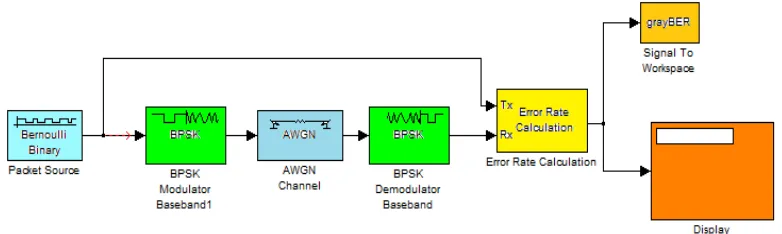
systems[7].Hamming Code model is shown in figure 4.
For any positive integer m ≥ 3, there exists a
Hamming code with the following parameters: [4]
Code length: n = 2m – 1
ISSN: 2231-5381
http://www.ijettjournal.org
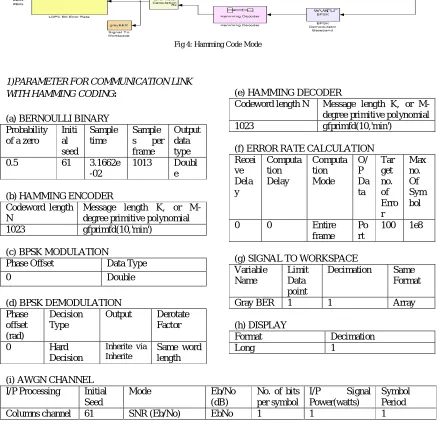
Page 611 Fig 4: Hamming Code Mode1)PARAMETER FOR COMMUNICATION LINK WITH HAMMING CODING:
(a) BERNOULLI BINARY Probability
of a zero
Initi al seed
Sample time
Sample
s per frame
Output data type
0.5 61 3.1662e
-02
1013 Doubl
e
(b) HAMMING ENCODER Codeword length
N
Message length K, or M-degree primitive polynomial
1023 gfprimfd(10,'min')
(c) BPSK MODULATION
Phase Offset Data Type
0 Double
(d) BPSK DEMODULATION Phase
offset (rad)
Decision Type
Output Derotate Factor
0 Hard
Decision
Inherite via Inherite
Same word length
(e) HAMMING DECODER
Codeword length N Message length K, or M-degree primitive polynomial
1023 gfprimfd(10,'min')
(f) ERROR RATE CALCULATION Recei
ve Dela y
Computa tion Delay
Computa tion Mode
O/ P Da ta
Tar get no. of Erro r
Max no. Of Sym bol
0 0 Entire
frame Po rt
100 1e8
(g) SIGNAL TO WORKSPACE Variable
Name
Limit Data point
Decimation Same Format
Gray BER 1 1 Array
(h) DISPLAY
Format Decimation
Long 1
(i) AWGN CHANNEL I/P Processing Initial
Seed
Mode Eb/No
(dB)
No. of bits per symbol
I/P Signal Power(watts)
Symbol Period
Columns channel 61 SNR (Eb/No) EbNo 1 1 1
C. BCH Code:
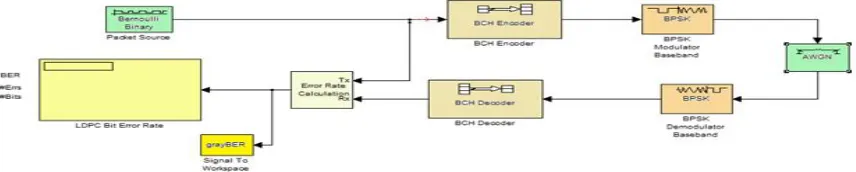
BCH codes are a generalization of Hamming codes, and they can be designed to correct any error pattern of size t or less [1, 2, 4]. In this sense the generalization of the Hamming codes extends the design of codes for t = 1 (Hamming codes) to codes for any desired higher value of t (BCH codes).The model is shown in figure5. The design method is based on taking an LCM of appropriate minimal polynomials, as described in the previous section
for a particular example. For any positive integer m
≥ 3 and t < 2m−1, there exists a binary BCH code CBCH (n, k) with the following properties:[5]
Code length n = 2m− 1
Number of parity bits n −k ≤ mt
Minimum Hamming distance dmin ≥ 2t + 1 Error-correction capability t errors in a code vector. These codes are able to correct any error pattern of size t or less, in a code vector of length n,
ISSN: 2231-5381
http://www.ijettjournal.org
Page 612 Fig 5: BCH Code Model1) PARAMETER FOR COMMUNICATION LINK WITH BCH CODING:
(a) BERNOULLI BINARY Probabili
ty of a zero
Initial seed
Sample time
Sampl es per frame
Output data type 0.5 435345 6.2500e
-005
16 Double
(b) BCH ENCODER
Codeword length N Message length K
31 16
(c) BPSK MODULATION
Phase Offset Data Type
0 Double
(d) BPSK DEMODULATION Phase
offset (rad)
Decision Type
Output Derotate Factor
0 Hard
Decision
Inherite via Inherite
Same word length
(e) BCH DECODER
Codeword length N Message length Kdegree
31 16
(f) ERROR RATE CALCULATION Recei
ve Dela
y
Computa tion Delay
Computa tion Mode
O/ P Da ta
Tar get no. of Erro
r
Max no. Of Sym
bol
0 0 Entire
frame Po
rt
100 1e8
(g) SIGNAL TO WORKSPACE Variable
Name
Limit Data point
Decimation Same Format
Gray BER 1 1 Array
(h) DISPLAY
Format Decimation
Long 1
(i) AWGN CHANNEL I/P Processing Initial
Seed
Mode Eb/No
(dB)
No. of bits per symbol
I/P Signal Power(watts)
Symbol Period
Columns channel 123456 SNR (Eb/No) 7 1 1 6.2500e-05
D. LDPC:
Low-density parity-check codes are a class of linear block codes which provide near capacity performance on a large collection of data transmission and storage channels while simultaneously admitting implementable decoder. It is forward error-correction codes, first proposed in the 1962 PhD thesis of Gallager at MIT. At the time, their incredible potential remained
ISSN: 2231-5381
http://www.ijettjournal.org
Page 613 amount of 0’s. It’s also a bit different from generalparity check matrix[14]. The order of matrix in
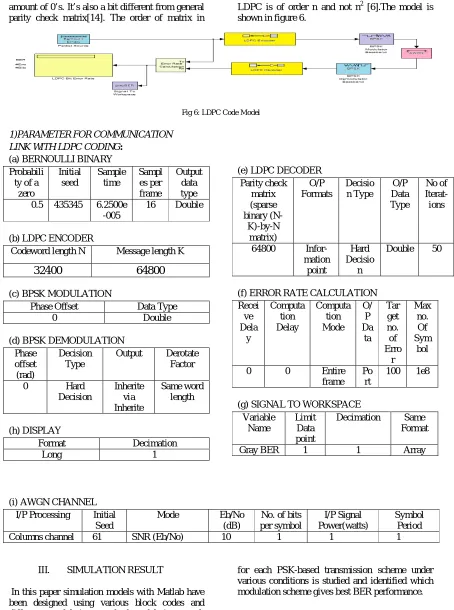
LDPC is of order n and not n2 [6].The model is shown in figure 6.
Fig 6: LDPC Code Model
1)PARAMETER FOR COMMUNICATION LINK WITH LDPC CODING:
(a) BERNOULLI BINARY Probabili
ty of a zero
Initial seed
Sample time
Sampl es per frame
Output data type 0.5 435345 6.2500e
-005
16 Double
(b) LDPC ENCODER
Codeword length N Message length K
32400
64800
(c) BPSK MODULATION
Phase Offset Data Type
0 Double
(d) BPSK DEMODULATION Phase
offset (rad)
Decision Type
Output Derotate Factor
0 Hard
Decision
Inherite via Inherite
Same word length
(h) DISPLAY
Format Decimation
Long 1
(e) LDPC DECODER Parity check
matrix (sparse binary
(N-K)-by-N matrix)
O/P Formats
Decisio n Type
O/P Data Type
No of Iterat-ions
64800
Infor-mation point
Hard Decisio
n
Double 50
(f) ERROR RATE CALCULATION Recei
ve Dela
y
Computa tion Delay
Computa tion Mode
O/ P Da ta
Tar get no. of Erro
r
Max no. Of Sym
bol
0 0 Entire
frame Po
rt
100 1e8
(g) SIGNAL TO WORKSPACE Variable
Name
Limit Data point
Decimation Same Format
Gray BER 1 1 Array
(i) AWGN CHANNEL I/P Processing Initial
Seed
Mode Eb/No
(dB)
No. of bits per symbol
I/P Signal Power(watts)
Symbol Period
Columns channel 61 SNR (Eb/No) 10 1 1 1
III. SIMULATION RESULT
In this paper simulation models with Matlab have been designed using various block codes and different modulations and demodulations such bpsk, qpsk, 8psk and 16psk. The BER performance
ISSN: 2231-5381
http://www.ijettjournal.org
Page 614A. WITHOUT CODE:
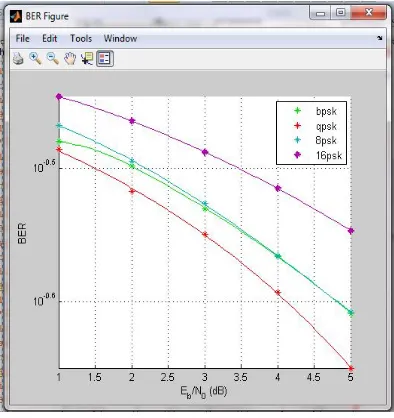
The performance analysis of communication link in various modulation techniques but in without channel coding. It has been observed that at Eb/No = 4db , as shown in figure7, the BPSK modulation signal has 0.4168 BER, QPSK modulation has 0.4178 BER, 8-PSK modulation signal has 0.4266 BER and 16-PSK modulation signal has 0.4325 BER. So it can be concluded that performance of BPSK is best
Fig 7:BER for Without-Coding Model
B. HAMMING CODE:
The performance analysis of (1023,10) Hamming code for various modulation technique are shown in figure 8. The BER values for Eb/No = 4db are 0.3388 BER, 0.3589 BER, 0.3802 BER and 0.4169 BER for BPSK, QPSK, 8-PSK and 16-PSK.
Fig 8:BER for Hamming Code
C. BCH CODE:
BCH codes constitute a powerful class of codes that provides a large selection of block length , code rate and error-correction capability. BCH code used for simulation has ( n,k ) = (31,16) with code rate is .51. Performance analysis of BCH codes with binaray phase shift keying modulation and using a AWGN channel .The result is 0.3090 BER.
Fig 9:BER for BCH coding Model
D. LDPC CODING:
In case of low Density Parity Check code the code rate used is ½ and the message length and code length used is 32400 and 64800 respectively. The BER values for Eb/No = 4db are 0.2559 BER, 0.2818 BER, 0.2818 BER and 0.3062 BER for BPSK, QPSK, 8-PSK and 16-PSK.
ISSN: 2231-5381
http://www.ijettjournal.org
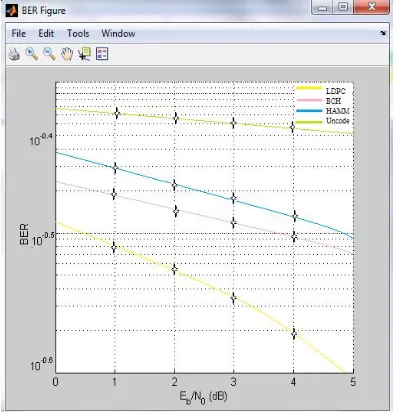
Page 615 E.COMPARISON OF VARIOUS CODESThe comparison of various codes is as shown in figure
Fig 6:Comparison of various codes
IV. CONCLUSION
In this paper a computer simulation using Matlab has been created by making model which allows the simultaneous analysis of various block code schemes namely, LDPC, Hamming and BCH Codes. The different models were run for 100 frames. Model was designed for better performance and accuracy. The results carry out a comparison of error rate performance of the coding schemes. The various computer based simulation model have been created and their results have been plotted on the graphs of BER vs Eb/No . These result shows that LDPC seem to have better performance then all other block codes. BCH is the extention to the HAMMING code so the performance of BCH is better then HAMMING . It is seen that for smaller value of Eb/No the BCH is having better results and HAMMING give better results for higher value. In some cases the results of HAMMING and BCH overlaps or appear to be closer to each other. On the basis of the results obtained in the present simulation based study, it can be concluded that the LDPC coding scheme is very much effective for retrieval of transmitted data in noisy transmitting medium compared to BCH Hamming and without coding scheme. Though the BCH and Hammming coding scheme provides a definite error correcting capability, the complexity of this code increases as the code length is increased. Further, for a very large code length BCH coding scheme becomes
impractical. LDPC codes provides the best decoding performance.
FUTURE WORK
Some suggestion for future work are as follows: I. In LDPC code use different decoding techniques and alyzing their error correction capabilites.
II. With LDPC , modifying the interleaver and analyzing the performance of the codes with different code rates.
III. Modifying the frame size to analyze the effect of frame size on block codes. IV. Modifying the channel type from AWGN
Channel to Rayleigh channel and analyzing the error performance of the Channel coding schemes.
Additionally other coding schemes can also be compared using this simulation setup. On a more complex level multiple coding schemes can be used to determine better error correction capabilities codes.
REFERENCES
[1] Roth .R M.Introduction to Coding Theory, Cambridge University Press (2006).
[2] PROKIS.J, SALEHI, Fundamental of Communication Systems, International Edition ,(2004)..
[3] RYAN. W & LIN. S, Channel Code Modern Classic ,Cambridge University press (2002)
[4] TANENBAUM , A. S Computer Networks. Pearson Education, Inc., Prentice Hall, 4. edition 2
[5] BCH Codes Yunghsiang S. Han Graduate Institute of Communication Engineering, National Taipei University Taiwan
[6] C. Jones, A. Matache, T.Tian, J. Villasenor, and R. Wesel, “The universality of LDPC codes on wireless channels, “to appear, proc 2003 IEEE Milcom conf. , Oct. 2003
[7] http: // www.ieee.org/about/awards/sums/hamming.htm. [8] Introduction to Error-Correcting Codes, British Library
Cataloguing in Publication Data, Purser, Michael, I.Title 621-790
[9] Fundamental of Error-Correcting Codes, W. Cary Huffman and Vera Pless Cambridge University Press 2003.
[10] PPT on Linear Block Codes about Advantage and disadvantage. Slide 10-11.
[11] MIT DRAFT LECTURE NOTES Last update: FEB 28,(2012) Chapter 6 LBC Encoding and Syndrome Decoding.
[12] C. Jones, A. Matache, T.Tian, J. Villasenor, and R. Wesel, “The universality of LDPC codes on wireless channels, “to appear, proc 2003 IEEE Milcom conf. , Oct. 2003
[13] Video lecture from IIT Banglore under NPTEL program by Dr. P. Vijay Kumar on Error correction codes. ( YouTube)