For the Benefit of All?
Developing a Critical Perspective in Mega-event Leverage
Vassilios Ziakas
Published in: Leisure Studies
Abstract
The purpose of this article is to bring to light the need for developing a critical leveraging perspective on mega-events and propose a research agenda that extends the focus of the leverage concept towards this direction. Current research on leverage focuses on the attainment and magnification of mega-event outcomes. A critical lens of inquiry however is needed to move forward and take into account the influence of power structures and social ordering processes on developing and implementing strategic leveraging programmes. Such a perspective can help examine if and how the benefits of mega-events are fairly delivered to host communities, equally distributed among stakeholders and then sustained, while negative impacts are minimised. Ten research themes are brought forward to help build a robust ground for a critical mega-event leveraging perspective.
Introduction
The concept of event leverage entails an analytic focus on crafting strategies and tactics around an event pursuant to the attainment and magnification of specific ends (Chalip, 2004). From this perspective, events are not viewed as interventions per se but instead as resources providing a set of opportunities that can be leveraged to optimise intended benefits. While this new perspective marked a shift from merely evaluating the impacts of events (ex post) to understanding how host communities can strategically create positive outcomes and legacies from events (ex ante), a critical issue remains rather overlooked within the emerging event leverage literature: Do any stakeholders receive most of the magnified benefits obtained from leverage at the expense of others? In other words, the current literature has spelled out leveraging strategies dictating how event benefits will be optimised but there is limited engagement with how benefits will be equally distributed among stakeholders and sustained in the long-term.
which are embedded within social structures. This clearly requires a critical lens bringing to the fore issues of power, inequality and resistance especially within the context of mega-events where the magnitude and scale of interests create conditions for antagonism as powerful stakeholders curtail to control the event and its benefits or elites exploit it to maintain their hegemonic status (Burbank, Andranovich, Heying, 2001; Hiller, 2000; Rojek, 2013; Sack & Johnson, 1996; Whitson & Macintosh, 1996).
In fact, critical concerns have already been expressed. Smith (2014) has identified the danger that leverage initiatives may be adopted and publicised merely for public relations reasons to fend off criticism against event projects and thereby justify public spending. Minnaert (2012) showed that the Olympic Games generally bring few benefits for socially excluded groups, although these benefits are often important legitimations in the bidding stage. More broadly, in his critique of global event management, Rojek (2014) argued that the professional and academic discourse on event management is uncritical and based in principles of neo-liberalism and communitarianism with the result of overlooking the relationship between events, manipulation, corruption and social control. In response, the underlying purpose of this article is to highlight the need for developing a critical leveraging perspective on mega-events and suggest a research agenda that extends the focus of the leverage concept towards this direction.
Delivering Benefits to Stakeholders and Host Communities: Moving towards Equity and Sustainability?
abstract moralism, needs to be conceptually demarcated. According to economic theory, equity in event leverage can be understood and portrayed as one of Pareto optimality (Cirillo, 1979): Are some stakeholders made better off while none is worse off? It can certainly be suggested that mega-events are fundamentally income transfers from some of the population to others, especially from working classes to economic elites (Mules, 1998; Putsis, 1998). That is not Pareto optimal. But this does not mean that some sectors or stakeholders cannot benefit more than others if none is worse off. In other words, a pragmatic approach to equity means that some groups of stakeholders do not benefit at the expense of others and receive the benefits that match their level of involvement and input.
In terms of sustainability, the perspective of event leverage has recognised the interdependent and mutually reinforcing pillars of economic development, social development, and environmental protection, widely known as the triple bottom line. O’Brien and Chalip (2008) pushed towards the triple bottom line by highlighting the common ground and strategies between the economic and social leveraging of sport events. This suggests the potential to develop a joint strategic framework for leveraging multiple economic, social or environmental benefits, thereby enabling the sustainability of events in terms of the longevity of their outcomes and scope while encompassing the pillars of social equity, economic efficiency and environmental integrity.
massive investment in a one-off event and opportunity cost be compensated for by the temporally-limited outcomes and consequently ephemeral benefits obtained? Indeed, one of the major challenges to sustainability (and positive versus negative) effects of mega-events is that they often stimulate development investments that then compress a decade or more of planning and development into a few years. This causes a boom and bust cycle in some industries, especially construction, which can have very negative effects. This was clearly the case for the Atlanta or Athens Olympics, and arguably the case elsewhere.
In addressing this problem, the discourse has moved towards creating event outcomes and leveraging positive legacies (Preuss, 2007) in pursuit of sustainability (Gibson et al. 2014; Girginov & Hills, 2008; Grix, 2014; VanWynsberghe, Derom, & Maurer, 2012). Moreover, the argument that small-scale events comply with sustainability because they operate in existing infrastructures by capitalising on local capacities and serving their needs is increasingly gaining acceptance (Gibson, Kaplanidou, & Kang, 2012; Higham, 1999; Taks, 2013). Consequently, Getz (2009) argued that a paradigm shift is needed towards institutionalising sustainability in event policy. In response, Dredge and Whitford (2010) suggested the need for a more nuanced understanding of the complex processes and interdependencies involved in order to account for, and accommodate, the intricacies of events and resultant event policy.
stakeholders and thereby satisfy the different pillars of sustainability. In other words, the matter for leverage is not only to optimise event outcomes but also to impartially deliver sustainable benefits to stakeholders and the host community. However, operationally this brings forward the issues of how to prioritise goals, allocate resources, distribute benefits equally, and coordinate the implementation of strategies and tactics among a large number of stakeholders.
Of course, the application of leverage is not a simple endeavour and avowedly presents significant challenges that constrain its effectiveness. The range of main challenges includes the lack of skills, resources and strategic management/marketing capabilities, the limited involvement of non-event entities, the monitoring of outcomes and evaluation, and the inducement of collaboration in leverage initiatives (Taks, Misener, Chalip, & Green, 2013). For example, it has been shown that small business managers often lack the inclination, the information, or the skills to engage in event leveraging (Chalip & Leyns, 2002). In addition, willingness of local stakeholders to participate in leverage may fade depending on perceptions of aversion effects or limited identification of leveraging opportunities. The handling of these challenges requires a process-oriented approach to leverage that aims to increase awareness, engage the local community, build its capacity for implementing effectively event leverage and balance the planning of leveraging initiatives around their social-cultural, economic, and environmental dimensions and outcomes. To this end, a balancing mechanism among the different dimensions is necessary to be established within the core of leveraging programmes and initiatives.
capacity-building process of social learning and negotiation towards achieving a set of defined goals that serve the needs of the host community. Therefore, the leverage of mega-events needs to be situated in, and fed by, locally meaningful contexts and power structures that frame the social order seeking to balance antithetical values and interests by encompassing a set of processes that reflect collective and contested goals. Within this context, the leveraging of mega-events entails the efficient exploitation of their interrelationships and interdependencies with the product mix and overall assets of the host community. A bottom-up planning process can integrate the divergent forces for change and thus deliver sustainable benefits to the host community contesting inherent or emergent inequalities.
From Contested Legacies to Sustainable Benefits
The lack of leverage in mega-events can partly explain the failure of such events to deliver benefits that outweigh their cost and prevent or mitigate their negative impacts (Ritchie, 1999; Weed, 2008; Ziakas, 2013). Of course, presumably leveraging should improve the benefit-to-cost ratio from events, but that is undemonstrated, as leveraging is not likely to be cost-free. Furthermore, standard input-output models of economic impact are formulated in ways that make positive results more likely than if more rigorous analyses are performed. This is amply demonstrated by Taks et al. (2011), who found that positive input-output impacts became negative when cost-benefit analysis was undertaken.
2012), which eventually contribute to the reinforcement of existing inequalities in the cities that stage them (Horne & Manzenreiter, 2006; Roche, 2000; Rojek, 2013).
Nevertheless, there is a knowledge gap how the application of leverage to mega-events can systematically redress the above problems through the formulation and implementation of strategies that have at their core the principles of equity and sustainability. In fact, the ongoing critique of sustainability poses the question whether a convergence of sustainable mega-events leveraging is realistic (Hall, 2012). From a tourism development standpoint, Sharpley (2009) proposed a more pragmatic approach to sustainability, which provides a framework for optimising benefits within locally determined environmental parameters. According to this approach, the productive assets of any destination are based on their capitals: socio-cultural, human, environmental, financial, political, and technological. The most important task for a destination is not to consider each capital in-depth, but to identify their nature and inter-connectedness as a basis for appreciating the potential to generate a flow of benefits to both tourists and tourism producers.
magnifying, and sustaining their outcomes. In this context, leveraging initiatives can be implemented to create and harness sustainable mega-event legacies.
It seems therefore that the most effective way of leveraging mega-events and contributing to the sustainability of the host city is by linking all the event stakeholders with the pertinent actors related to economic, social, and environmental development, based on the carrying capacity and efficient deployment of local resources. In doing so, mega-event leveraging strategies should be inclusive. They must ensure the active and equal participation of all stakeholders and facilitate their reaching a consensus through negotiating trade-offs for the efficient distribution of event benefits that will satisfy environmental, social, and economic concerns (Ziakas & Boukas, 2012). There are still problems with the ties of social networks being fostered through and within a mega-event and the resulting social capital development (Ziakas, In Press). Little is known how to foster ‘bridging’ diversity in network development, how to transfer social capital to civic settings, and how to mitigate the negative effects of social capital.
developmental model to developing countries, as it happens with the expansion of mega-events in emerging markets such as Brazil or South Africa and thus control their growth.For example, the case of Brazil exposed the ways that economic elites have used the World-Cup and the Olympics in Rio to enable significant capital gains on insider property investments at the expense of the working and under classes through imposing a neo-liberal ‘shock doctrine’ that installed temporary regimes of governance aimed to enforce socio-spatial discipline (Gaffney, 2010; Freeman, 2012). Undoubtedly, there are no simple solutions to the above problems since these are rooted on macro processes of social ordering and diachronic power arrangements that find expression through ideological vehicles. Leveraging as a micro process is shaped by wider environmental conditions and forces, which can be beneficent or corrupt. It should be emphasised that fundamentally, leverage is a particular application of strategy to the use of events in the host destination’s overall product and service mix. Since nearly all the work on leverage has taken place in liberal democracies, there is an overly positive tone to the work, which needs to be more critically addressed. What is overlooked within the emerging event leverage literature is the fact that strategy is double-edged. It can be used for both positive and negative purposes. Consequently, strategic leveraging of mega-events can be aligned with beneficial, benign, or downright unscrupulous purposes.
given context. The effective transfer of knowledge can build local community capacity in event management and leveraging based on the host community’s needs and keep thus control of its growth. In doing so, localised leveraging can lead to the generation of new knowledge that will perhaps enable developing nations to exploit mega-events and not be instead exploited by those corporate networks of developed countries that control them.
their socio-cultural transformation by interpreting how they perceive themselves fitting into it.
Arguably, mega-event leveraging should be applied in innovative ways as it is understood by local people in their own terms. This means that strategies should empower and enable locals to interpret, contest, and express the conditions and influences that make their lives. From this standpoint, the range of leveraging programmes and activities built around a mega-event should aim to express different viewpoints that altogether synthesise a dynamic cosmology. In this light, mega-event leveraging can facilitate a polytopia of perspectives to emerge, find dialectical expression in the public discourse and build alternative social constructions that integrate different or even antithetical perspectives. Polytopia has been conceptualised as the emergent synergy of ideas, thoughts, dreams, sensations, ambitions, views, interests and agendas, evolving and synthesised within an inclusive events network as a result of stakeholders’ cooperative interactions and exchanges (Ziakas, In Press). Within a polytopian context, sustainability is both a state of mindset and an elusive ideal towards which the primary task is the building of a host community’s capacity to develop its own approach and design pertinent strategies to leverage its own events (Ziakas, 2013), thereby delivering sustainable benefits to event stakeholders and host communities.
The Imperative for Cross-leverage
event leverage entails a focus on relationships (among different events or between event managers and community planners) and bringing together different event stakeholders. The purpose is to cross-leverage events with one another in the host community’s portfolio as well as with its overall product mix in order to attain multiple ends and maximise their overall outcomes (Ziakas, 2013). To do so, it is essential to know how events complement each other and, in turn, how they can be complemented by the attractions, amenities, products, and services of a host community. In other words, cross-leverage is about understanding interrelationships, fostering synergies, and enhancing complementarities (Ziakas, 2010). This constitutes an integrated mindset for formulating and implementing strategies that ultimately can help build community capacity to leverage mega-events.
The development of a broader leveraging framework for mega-events can guide the formulation and implementation of cross-leveraging strategies to attain and magnify event outcomes. To do so, it is imperative to find the means for cross-leveraging mega-events with periodic small-scale events. This entails the identification of joint strategies and tactics that enhance synergies among different events in order to serve multiple purposes and generate intended outcomes. Cross-leveraging can take place within the context of an event portfolio (Chalip, 2004; Ziakas, 2013; Ziakas & Costa, 2011) wherein the roles of events can be viewed in concert as tools contributing to sustainable development.
goal of all types of cross-leveraging is to enable the development of synergistic means to attain, magnify and sustain the benefits and planned legacies of events. Cross-leverage can also be applied by cross-leveraging the portfolio with the legacy of mega-events and with the overall product mix of a host community. However, little is known about how to cross-leverage mega-events with an event portfolio.
Such an interdisciplinary approach may facilitate the development of a range of cross-leveraging initiatives that were not previously seen or did not receive sufficient support to be implemented. In this context, the array of a portfolio’s events needs to be cross-leveraged with a mega-event’s legacy, engendering a range of sustainable economic and social outcomes in the post-event period (Ziakas, 2014). Overall, the relationship between mega-events and event portfolios can be mutually beneficial providing that synergies are established to cross-leverage a mega-event with the host community’s portfolio (Ziakas, 2013). To do so, it is imperative to find the means for cross-leveraging in the pre-, during- and post-event periods. In the context of the Olympic Games, their legacy can be built on the host city’s event portfolio assets and resources. In turn, the investment in Olympic projects and infrastructure can substantially enhance the host city’s event portfolio. For example, the legacy of the Olympics can be associated with, and transferred to, the host city’s portfolio, thus fostering post-Games tourism (Boukas et al., 2013). This brings forth the need to extend our focus on post-Games leveraging of the Olympics, and in general, on post-event leverage, in order to enhance and sustain the legacies of mega-events.
Final Thoughts and Critical Research Directions
upon an approach that addresses the instrumental rationality of leveraging, the contextual dynamics that influence the formulation and implementation of strategies and tactics as well as the possibilities for creating outcomes that contribute to the sustainable development of host communities.
The underpinnings of a critical leveraging perspective can be profitably informed by Foucault’s (1977) thesis that multiple forms and techniques of governance operate simultaneously to preserve power structures by creating discursive regimes that discipline social relations and reproduce inequalities (Foley, 1990). Arguably, mega-events constitute governable spaces wherein a constellation of different interests, exigencies of capital and power arrangements takes place. Following Roche (2000), if mega-events are understood as social spatio-temporal hubs that channel, mix, and re-route global flows imposing socio-spatial structures, then it is revealed that they discursively produce, promote and establish social control techniques of governance, which have enduring effects on the (re)shaping of social order and contestation of power. From this standpoint, leveraging needs to be viewed and applied essentially as a means to enable positive social change, rectify power imbalances and decrease inequalities.
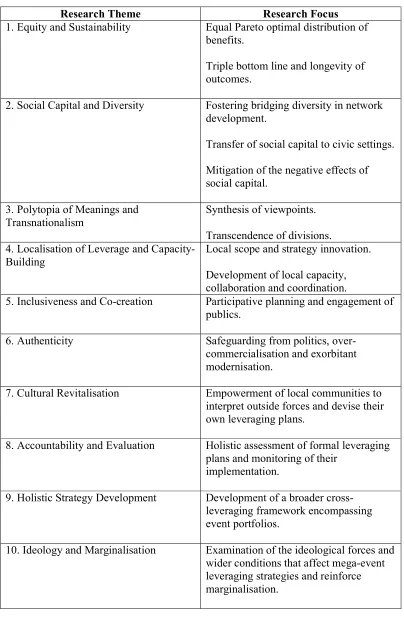
research to social network analysis, quantitative and mixed methods in order for developing critical insight into the ways in which leveraging is conceived, initiated and implemented within different locales. Specifically, it is important to examine if (and which) social groups benefit more or at the expense of others, if (and which) stakeholder groups are excluded, and what potential exists for enabling social change. Therefore, similar to Silk’s (2011) call for a sociological analysis of the mega-event spectacle, a critical mega-event leveraging perspective can allow scholars to investigate how strategies are being (re)shaped and challenged by the socio-spatial practices of various stakeholder groups and individuals. Overall, Table 1 pinpoints ten research themes to help build a robust ground for this perspective.
[Insert Table 1]
socio-economic and/or political divisions through leveraging the interpretive function of mega-events for understanding the conditions that make up the world order and the public sphere. Little is known on how these ambitious possibilities can be achieved.
References
Beesley, L.G., & Chalip, L. (2011). Seeking (and not seeking) to leverage mega-sport events in non-host destinations: The case of Shanghai and the Beijing Olympics. Journal of Sport & Tourism, 16(4), 323-344.
Boorstin, D. (1961). The image: A guide to pseudo-events in America. New York: Harper & Row.
Boukas, N., Ziakas, V., & Boustras, G. (2013). Olympic legacy and cultural tourism: Exploring the facets of Athens’ Olympic heritage. International Journal of Heritage Studies, 19(2), 203-228.
Burbank, M.J., Andranovich, G., & Heying, C.H. (2001). Olympic dreams: The impact of mega-events on local politics. Boulder, CO: Lynne Rienner.
Chalip, L. (2004). Beyond impact: A general model for sport event leverage. In B.W. Ritchie & D. Adair (Eds.), Sport tourism: Interrelationships, impacts and issues (pp. 226-252). Clevedon, UK: Channel View.
Chalip, L. (2006). Towards social leverage of sport events. Journal of Sport & Tourism, 11(2), 109-127.
Chalip, L. (2014). From legacy to leverage. In J. Grix (Ed.) Leveraging legacies from sports mega-events: Concepts and Cases (pp. 2-12). London: Palgrave.
Chalip, L., & Costa, C.A. (2005). Sport event tourism and the destination brand: Towards a general theory. Sport in Society, 8(2), 218-237.
Chalip, L., & Leyns, A. (2002). Local business leveraging of a sport event: Managing an event for economic benefit. Journal of Sport Management, 16(2), 132-158. Chalip, L., & McGuirty, J. (2004). Bundling sport events with the host destination.
Journal of Sport & Tourism, 9(3), 267-282.
Cirillo, R. (1979). The economics of Vilfredo Pareto. London: Frank Cass.
Di Giovine, M.A. (2009). Revitalization and counter-revitalization: Tourism, heritage, and the Lantern Festival as catalysts for regeneration in Hội An, Việt Nam. Journal of Policy Research in Tourism, Leisure & Events, 1(3), 208-230. Debord, G. (1967). The society of the spectacle. New York: Zone Books.
Dredge, D., & Whitford, M. (2010). Policy for sustainable and responsible festivals and events: Institutionalization of a new paradigm – a response. Journal of Policy Research in Tourism, Leisure & Events, 2(1), 1-13.
Foucault, M. (1977). Discipline and punish: The birth of the prison. London: Allen Lane.
Freeman, J. (2012). Neoliberal accumulation strategies and the visible hand of police pacification in Rio de Janeiro. Revista de Estudos Universitários, 38(1), 95-126.
Gaffney, C. (2010). Mega-events and socio-spatial dynamics in Rio de Janeiro, 1919-2016. Journal of Latin American Geography, 9(1), 7-29.
Gibson, H.J., Kaplanidou, K., & Kang, S.J. (2012). Small-scale event sport tourism: A case study in sustainable tourism. Sport Management Review, 15(2), 160-170. Gibson, H.J., Walker, M., Thapa, B., Kaplanidou, K., Geldenhuys, S., & Coetzee, W.
(2014). Psychic income and social capital among host nation residents: A pre-post analysis of the 2010 FIFA World Cup in South Africa. Tourism Management, 44, 113-122.
Girginov, V., & Hills, L. (2008). A sustainable sports legacy: Creating a link between the London Olympics and sports participation. International Journal of the History of Sport, 25(14), 2091-2116.
Getz, D. (2009). Policy for sustainable and responsible festivals and events: Institutionalization of a new paradigm. Journal of Policy Research in Tourism, Leisure & Events, 1(1), 61-78.
Gold, J.R., & Gold, M.M. (Eds.) (2011). Olympic cities: City agendas, planning, and
the world’s Games, 1896-2016 (2nd edition). London: Routledge.
Grix, J. (2013). Sport politics and the Olympics. Political Studies Review, 11(1), 15- 25.
Grix, J. (Ed.) (2014). Leveraging legacies from sports mega-events: Concepts and cases. London: Palgrave.
Hall, C.M. (2012). Sustainable mega-events: Beyond the myth of balanced approaches to mega-event sustainability. Event Management, 16(2), 119-131. Hall, C.M., & Hodges, J. (1996). The party’s great but what about the hangover? The
housing and social impacts of mega-events with special reference to the 2000 Sydney Olympics. Festival Management & Event Tourism, 4(1/2), 13-20. Higham, J. (1999). Commentary—Sport as an avenue of tourism development: An
analysis of the positive and negative impacts of sport tourism. Current Issues in Tourism, 2(1), 82-90.
Hiller, H.H. (2000). Mega-events, urban boosterism and growth strategies: An analysis of the objectives and legitimizations of the Cape Town 2004 Olympic Bid. International Journal of Urban & Regional Research, 24(2), 439-458. Horne, J. (2007). The four ‘knowns’ of sports mega-events. Leisure Studies, 26(1),
81-96.
Horne, J., & Manzenreiter, W. (Eds.) (2006). Sports mega-events: Social scientific analyses of a global phenomenon. Oxford: Wiley-Blackwell.
Horne, J., & Whannel, G. (2012). Understanding the Olympics. London: Routledge. Minnaert, L. (2012). An Olympic legacy for all? The non-infrastructural outcomes of
the Olympic Games for socially excluded groups (Atlanta 1996–Beijing 2008). Tourism Management, 33(2), 361-370.
Mog, J. (2004). Struggling with sustainability: A comparative framework for evaluating sustainable development programs. World Development, 32(12), 2139-2160.
Mules, T. (1998). Taxpayer subsidies for major sporting events. Sport Management Review, 1, 25-43.
O’Brien, D. (2006). Event business leveraging: The Sydney 2000 Olympic Games. Annals of Tourism Research, 33(1), 240-261.
O’Brien, D., & Chalip, L. (2008). Sport events and strategic leveraging: Pushing towards the triple bottom line. In A. Woodside & D. Martin (Eds.), Tourism management: Analysis, behaviour and strategy (pp. 318-338). Wallingford, UK: CABI.
Olds, K. (1998). Urban mega-events, evictions and housing rights: The Canadian case. Current Issues in Tourism, 1(1), 2-46.
Prasad, D. (1999). Environment. In R. Cashman & A. Hughes (Eds.), Staging the Olympics: The event and its impact (pp. 83-92). Sydney: University of New South Wales Press.
Preuss, H. (2004). The economics of staging the Olympics: A comparison of the Games 1972-2000. Cheltenham, UK: Edward Elgar.
Preuss, H. (2007). The conceptualisation and measurement of mega sport event legacies. Journal of Sport and Tourism, 12(3/4), 207-228.
Putsis, W.P. (1998). Winners and losers: Redistribution and the use of economic impact analysis in marketing. Journal of Macromarketing, 18(1), 24-33. Ritchie, J.R.B. (1999). Lessons learned, lessons learning: Insights from the Calgary
Roche, M. (2000). Mega-events and modernity: Olympics, expos and the growth of global culture. London: Routledge.
Rojek , C. (2013). Event power: How global events manage and manipulate. London: Sage.
Rojek, C. (2014). Global event management: A critique. Leisure Studies, 33(1), 32- 47.
Sack, A.L., & Johnson, A.T. (1996). Politics, economic development, and the Volvo International Tennis Tournament. Journal of Sport Management, 10(1), 1-14. Searle, G. (2002). Uncertain legacy: Sydney’s Olympic stadiums. European Planning
Studies, 10(7), 845-860.
Sharpley, R. (2009). Tourism development and the environment: Beyond sustainability? London: Earthscan.
Silk, M. (2011). Towards a sociological analysis of London 2012. Sociology, 45(5), 733-748.
Smith, A. (2014). Leveraging sport mega-events: New model or convenient justification? Journal of Policy Research in Tourism, Leisure & Events, 6(1), 15-30.
Spilling, O.R. (1996). The entrepreneurial system: On entrepreneurship in the context of a mega-event. Journal of Business Research, 36(1), 91-103.
Sugden, J., & Tomlinson, A. (Eds.) (2012). Watching the Olympics: Politics, power and representation. London: Routledge.
Taks, M. (2013). Social sustainability of non-mega sport events in a global world.
European Journal for Sport and Society, 10(2),121-141.
Taks, M., Kesenne, S., Chalip, L., Green, B.C., & Martyn, S. (2011). Economic impact analysis versus cost benefit analysis: The case of a medium-sized sport event. International Journal of Sport Finance, 6(3), 187-203.
Taks, M., Misener, L., Chalip, L., & Green, B.C. (2013). Leveraging sport events for participation. Canadian Journal for Social Research, 3(1), 12-23.
VanWynsberghe, R., Derom, I., & Maurer, E. (2012). Social leveraging of the 2010 Olympic Games: ‘Sustainability’ in a City of Vancouver initiative. Journal of Policy Research in Tourism, Leisure & Events, 4(2), 185-205.
Whitson, D., & Horne, J. (2006). The glocal politics of sports mega-events: Underestimated costs and overestimated benefits? Comparing the outcomes of sports mega-events in Canada and Japan. The Sociological Review, 54(s2), 71-89.
Whitson, D., & Macintosh, D. (1996). The global circus: International sport, tourism, and the marketing of cities. Journal of Sport & Social Issues, 20(3), 278-295. Ziakas, V. (2010). Understanding an event portfolio: The uncovering of
interrelationships, synergies, and leveraging opportunities. Journal of Policy Research in Tourism, Leisure & Events, 2(2), 144-164.
Ziakas, V. (2013). Event portfolio planning and management: A holistic approach. London: Routledge.
Ziakas, V. (2014). Planning and leveraging event portfolios: Towards a holistic theory. Journal of Hospitality Marketing & Management, 23(3), 327-356. Ziakas, V. (In Press). Fostering the social utility of events: An integrative framework
for the strategic use of events in community development. Current Issues in Tourism, doi: 10.1080/13683500.2013.849664.
Ziakas, V., & Boukas, N. (2012). A neglected legacy: Examining the challenges and potential for sport tourism development in post-Olympic Athens. International Journal of Event & Festival Management, 3(3), 292-316.
Table 1. Ten Critical Research Themes in Mega-Event Leveraging.
Research Theme Research Focus
1. Equity and Sustainability Equal Pareto optimal distribution of benefits.
Triple bottom line and longevity of outcomes.
2. Social Capital and Diversity Fostering bridging diversity in network development.
Transfer of social capital to civic settings. Mitigation of the negative effects of social capital.
3. Polytopia of Meanings and
Transnationalism Synthesis of viewpoints.
Transcendence of divisions. 4. Localisation of Leverage and
Capacity-Building Local scope and strategy innovation.
Development of local capacity, collaboration and coordination.
5. Inclusiveness and Co-creation Participative planning and engagement of publics.
6. Authenticity Safeguarding from politics,
over-commercialisation and exorbitant modernisation.
7. Cultural Revitalisation Empowerment of local communities to interpret outside forces and devise their own leveraging plans.
8. Accountability and Evaluation Holistic assessment of formal leveraging plans and monitoring of their
implementation.
9. Holistic Strategy Development Development of a broader cross-leveraging framework encompassing event portfolios.