Neuropsychiatric Disease and Treatment 2018:14 2485–2496
Neuropsychiatric Disease and Treatment
Dovepress
submit your manuscript | www.dovepress.com 2485
O r i g i N a l r e s e a r c h
open access to scientific and medical research
Open access Full Text article
The role of
COMT
gene Val108/158Met
polymorphism in suicidal behavior: systematic
review and updated meta-analysis
Thelma Beatriz
gonzález-castro,1 Yazmín
hernández-Díaz,1 isela esther
Juárez-rojop,2 María lilia
lópez-Narváez,3 carlos
alfonso Tovilla-Zárate,4 Julian
ramírez-Bello,5 Nonanzit
Pérez-hernández,6 alma Delia
genis-Mendoza,7 ana Fresan,8
crystell guadalupe
guzmán-Priego2
1Multidisciplinary academic Division of Jalpa de Méndez, Juarez autonomous University of Tabasco, Jalpa de Méndez, Tabasco, Mexico; 2Multidisciplinary academic Division of health sciences, Juarez autonomous University of Tabasco, Villahermosa, Tabasco, Mexico; 3general hospital of Yajalon, Ministry of health, Yajalon, chiapas, Mexico; 4Multidisciplinary academic Division of comalcalco, Juarez autonomous University of Tabasco, comalcalco, Tabasco, Mexico; 5research Unit, Juárez hospital of Mexico, Ministry of health, Mexico city, Mexico; 6Department of Molecular Biology, National institute of cardiology, Mexico city, Mexico; 7Psychiatric care services, National institute of genomic Medicine (iNMegeN), health secretary, Ministry of health, Mexico city, Mexico; 8sub-direction of clinical research, children’s Psychiatric hospital “Dr. Juan N. Navarro”, Mexico city, Mexico
Background: It is accepted that there is a genetic factor that influences the risk of suicidal behavior. The catechol-O-methyltransferase (COMT) gene, especially the Val108/158Met polymorphism, has been associated with suicide; however, no conclusive outcome has been attained. Therefore, the aim of the present study was to assess the role of COMT Val108/158Met in suicidal behavior throughout an updated meta-analysis.
Methods: We performed an online search using PubMed and Web of Science (up to March 2017). Our systematic review included case-control studies of individuals who attempted suicide and completed suicide. We tested allelic, homozygous, heterozygous, dominant, and recessive inheritance models. The meta-analysis was performed in accordance with the state-ment of Preferred Reporting Items for Systematic Reviews and Meta-Analyses.
Results: The meta-analysis comprised 17 studies, which included 3,282 cases and 3,774 controls, and showed that when evaluating the overall population, the Val108/158Met polymorphism of
COMT was not associated with suicidal behavior in any of the inheritance models; however,
the subanalyses showed that this polymorphism exhibits a risk factor in males and a protective effect in females. Additionally, it conveyed a risk factor in Asian populations when using the allelic (OR 1.25; CI: 1.04–1.51) and recessive models (OR 1.32; CI: 1.03–1.68).
Conclusion: Our updated meta-analysis suggests a possible association between COMT Val108/158Met and suicidal behavior in Asian populations. However, in view of the small number of studies, these results should be considered exploratory. We recommend that more studies be performed with larger samples.
Keywords: suicide, epidemiology, mental health, risk factors
Introduction
Suicidal behavior (SB) is a complex phenotype with biological, genetic, and
environ-mental risk factors involved.1,2 Several arguments show that psychiatric disturbances
are major contributing factors in SB; however, genetic predisposition has been strongly
considered to be a contributory factor in SB,3,4 and evidence indicates that SB is
modu-lated by a number of gene variants.2,4 The majority of investigations have focused on
genes that codify proteins of different neurotransmitter systems, such as dopamine transporter, serotonin transporter, the two isoforms of tryptophan hydroxylase, the
serotonin receptors family, and catechol-O-methyltransferase (COMT).2,5,6
The COMT gene has been repeatedly explored in SB. COMT is one of the major enzymes involved in catecholamine degradation. Its gene is located on chromosome
22q11.1-11.2, and more than 4,000 polymorphisms have been identified (https://www.
genecards.org/).7–12 Human COMT contains a common functional polymorphism,
correspondence: carlos alfonso Tovilla-Zárate División académica Multidisciplinaria de comalcalco, Universidad Juárez autónoma de Tabasco, ranchería sur, cuarta sección, c.P. 86650, comalcalco, Tabasco, Mexico Tel +52 993 358 1500 ext 6900 Fax +52 993 358 1500
email [email protected]
Journal name: Neuropsychiatric Disease and Treatment Article Designation: Original Research
Year: 2018 Volume: 14
Running head verso: González-Castro et al Running head recto: COMT and suicide DOI: 172243
Neuropsychiatric Disease and Treatment downloaded from https://www.dovepress.com/ by 118.70.13.36 on 25-Aug-2020
For personal use only.
Dovepress gonzález-castro et al
G.A substitution in exon 4, which changes the amino acid
at codon 108 (Val108Met) in soluble COMT or position 158
(Val158Met) in the membrane-bound COMT protein.13–16
It has been observed that the COMT enzyme that contains valine has a relatively higher activity than the COMT enzyme
that contains methionine.17–21 This allele seems to be
codomi-nant with heterozygote enzyme activity following midway
between the homozygous alleles.13–16
During the last few decades, many studies have analyzed the role of COMT and SB, with contradictory results. For
instance, Ohara et al22 reported, in 1996, that there was no
association between COMT and suicide, while the group
of Pivac et al23 reported, in 2011, an association between
COMT Val/Val genotype and suicide in nonalcoholic suicide completers. In addition, other studies have shown that the genotype that encodes the more active COMT enzyme (Val/Val) is more frequent in suicide attempters than in
healthy subjects used as controls.24 However, other reports
have found no overall difference in allele/genotype frequency distribution between cases and controls but have found that the Met allele was more frequent among violent suicide
attempters.25 Several studies suggest that the Val108/158Met
polymorphism of the COMT gene plays a role in numerous
psychiatric disorders26–32 but have not obtained conclusive
results about a relationship between SB and the COMT gene. Therefore, meta-analytic techniques that summarize all data available and assess sample size effects as well as publication
bias can provide results with a major statistical power.7,14,33–36
Up to 2011, three meta-analyses had evaluated the association
between the COMT gene and suicide;7,33,37 however, five more
recently published studies have contributed more information to understand the complexity of the genetic background of SB. Given the importance of the COMT gene in SB, we per-formed an updated meta-analysis and systematic review to further explore the hypothesis of the genetic predisposition of the Val108/158Met COMT polymorphism in SB.
Materials and methods
The systematic review and meta-analysis were conducted in light of the statement of Preferred Reporting Items for Systematic Reviews and Meta-Analyses. This study had been previously registered in PROSPERO (PROSPERO 2017 CRD42017070229). As no human participants or animals had been recruited, ethical approval was not required.
literature search strategy
To identify relevant articles, we performed an online search through PubMed and Web of Science, up to March 2017,
using as keywords “COMT gene AND suicide,” “rs4680 AND suicide,” and “Val108/158Met AND suicide.”
inclusion/exclusion criteria
Relevant studies had to fulfill the following criteria: 1) studies with a case-control or cohort design; 2) studies evaluating the association between rs4680 COMT variant and suicide; 3) studies published in English and in peer-re-viewed journals; 4) the genotype frequency distribution had to be cited or could be calculated; and 5) studies containing sufficient information to calculate ORs. The articles were excluded when 1) they were found to contain overlapping data, 2) the number of null and wild genotypes could not be ascertained, and 3) family members had been included in the case group because their analyses were based on linkage consideration.
Data extraction
The general information extracted from the articles included the following: first author, year of publication, country (area) of origin, study design, source of control groups (case-control studies), sample size, genotyping methods, diagnostics, methods used for the diagnostics matching variables, genotype and allele frequency distributions, and outcome findings. This key information was extracted in consensus by Hernández-Díaz and González-Castro.
statistical analysis
The meta-analysis was carried out with the use of the Com-prehensive Meta-Analysis Version 2.0 software (Biostat Inc., Englewood, NJ, USA). The analysis was performed using five genetic models (allele, dominant, recessive, homozygous, and heterozygous). For each model, the OR and 95% CI were calculated, and the results are presented as the random effects model of meta-analysis. The presence of heterogeneity was
indicated when the P-value of the Q test ,0.1 or I2.50%.
The OR estimates for each study were used to analyze the fixed effects model (the Mantel–Haenszel method) when there was no evidence of statistical heterogeneity. Other-wise, the random effects model (the DerSimonian and Laird method) was considered. The Galbraith plot and sensitivity analysis were used to search for published studies with heterogeneity, and the meta-analysis was performed again
after these published studies were excluded. The χ2 test was
used to define whether the gene frequency distribution was in Hardy Weinberg Equilibrium (HWE); the studies with
a P,0.5 were considered out of the HWE; therefore, they
were excluded from the meta-analysis. Subgroup analyses
Neuropsychiatric Disease and Treatment downloaded from https://www.dovepress.com/ by 118.70.13.36 on 25-Aug-2020
Dovepress cOMT and suicide
based on location and ethnicity (Asian and European), gender (males and females), and individuals with suicide attempt (SA) were also completed. Finally, a meta-regression based on age was performed.
The power of the study was calculated as previously
reported elsewhere.38 Using an effect size d=0.20 and
14 studies with 140 patients per group, we obtained a power of 0.99.
Quality assessment
The quality assessment of each study was performed using the Newcastle–Ottawa Quality Assessment Scale (NOS).
A NOS .6 was considered a high-quality study. Any
dis-parity about the NOS scores was resolved in consultation with a third reviewer.
Publication bias and sensitivity analyses
In addition, sensitivity and publication bias of the studies were evaluated. The sensitivity analysis was done by elimi-nating one study at a time. Begg’s test and Egger’s test were used to evaluate publication bias of the included studies;P,0.5 was considered statistically significant.
Results
studies included
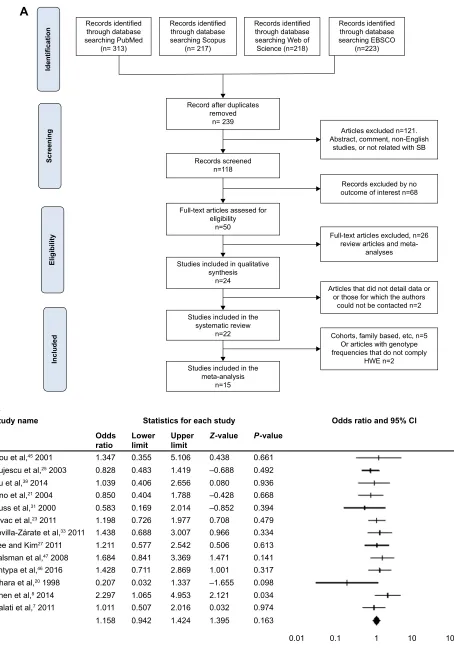
Ninety-three studies were first identified; after reviewing titles, abstracts, and compliance with the inclusion criteria, 17 studies were enrolled in this meta-analysis. A flowchart describing the inclusion/exclusion of the individual studies is displayed as Figure 1. The included studies were published between 1998 and 2016. Of these 17 studies, six evaluated European populations, six evaluated Asian descendants, three used a mixed population, and two evaluated American individuals. The genotype and frequency distributions
are presented in Table 1. The studies of Schosser et al,32
Baud et al,24 and Sun et al,36 were excluded from all the
analyses because their control groups presented a HWE P-value ,0.05.
Overall findings
In the overall population, after discarding the studies of
Nedic et al,11 and Ono et al,21 (because the sensitivity and
heterogeneity analyses indicated that they favored the pres-ence of heterogeneity between studies), the association between the Val108/158Met COMT polymorphism and susceptibility to suicide was evaluated in 3,282 cases and 3,774 controls. No significant association was observed
in any of the comparisons: allele model (OR =1.05;
95% CI =0.95–1.18; Z P-value =0.29), homozygous
(OR =1.15, 95% CI =0.94–1.42, Z P-value =0.16),
heterozy-gous (OR =1.06, 95% CI =0.91–1.24, Z P-value =0.43),
dominant (OR =1.15, 95% CI =0.97–1.37, Z P-value =0.10),
and recessive model (OR =1.10, 95% CI =0.95–1.28,
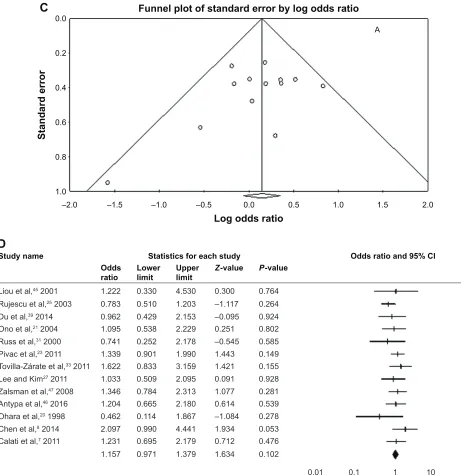
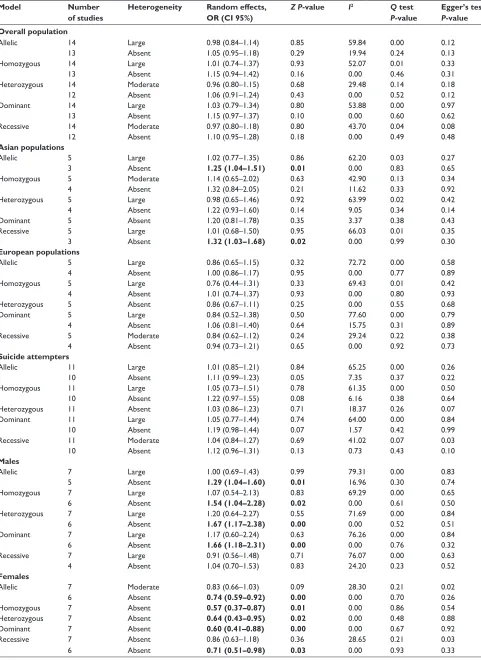
Z P-value =0.18). The Egger’s test and Begg’s funnel did not evidence publication bias; Figure 1. Our results are presented in Table 2.
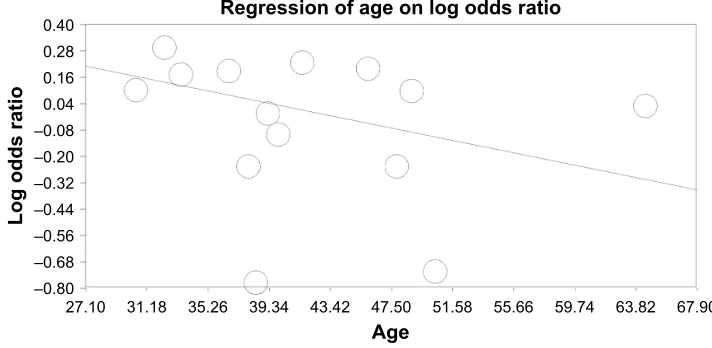
Regarding the meta-regression based on age, the over-all population analysis revealed a point estimate slope of 0.0183 and a P-value of 0.222 (Figure 2).
subgroup analysis
asian populations
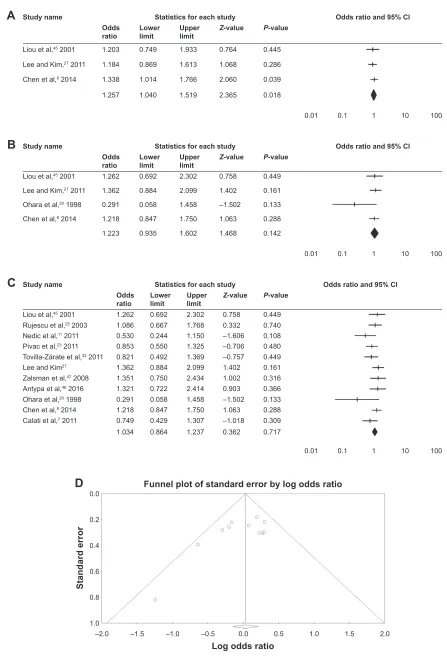
Five studies were included to investigate the association between the Val108/158Met COMT polymorphism and SB in Asian populations. We used allelic, homozygous, heterozy-gous, dominant, and recessive models and did not find any association; however, when we discarded the studies that favored heterogeneity, we found a slight association in the
allelic (OR =1.25, 95% CI =1.04–1.51, Z P-value =0.01) and
recessive (OR =1.32, 95% CI =1.03–1.68, Z P-value =0.02)
models; Figure 3 and Table 2.
european populations
Subsequently, using five articles, we performed an analysis of European populations. In the absence of heterogene-ity, no statistical association was observed in any of the
models used: allele (OR =1.00; 95% CI =0.86–1.17;
Z P-value =0.95), homozygous (OR =1.01, 95% CI =0.74–1.37, Z P-value =0.93), heterozygous (OR =0.86, 95%
CI =0.67–1.11, Z P-value =0.25), dominant (OR =1.06, 95%
CI =0.81–1.40, Z P-value =0.64), and recessive (OR =0.94,
95% CI =0.73–1.21, Z P-value =0.65) models; Figure 1 and
Table 2.
suicide attempters
Finally, to better comprehend the role of the COMT108/158 polymorphism, we performed a subgroup analysis using 11 studies that had evaluated suicide attempters. We still found the same negative results, even when we excluded
one study that supported heterogeneity: allelic (OR =1.11;
95% CI =0.99–1.23; Z P-value =0.05), homozygous
(OR =1.22; 95% CI =0.97–1.55; Z P-value =0.08),
heterozy-gous (OR =1.03; 95% CI =0.86–1.23; Z P-value =0.71),
dom-inant (OR =1.19; 95% CI =0.98–1.44; Z P-value =0.07), and
Neuropsychiatric Disease and Treatment downloaded from https://www.dovepress.com/ by 118.70.13.36 on 25-Aug-2020
Dovepress gonzález-castro et al
$
6WDWLVWLFVIRUHDFKVWXG\
/LRXHWDO
5XMHVFXHWDO 6WXG\QDPH
'XHWDO
2QRHWDO
5XVVHWDO
3LYDFHWDO
7RYLOOD=iUDWHHWDO
/HHDQG.LP
=DOVPDQHWDO
$QW\SDHWDO
2KDUDHWDO
&KHQHWDO
&DODWLHWDO
2GGV UDWLR
/RZHU OLPLW
8SSHU OLPLW
±
=YDOXH
± ± ±
3YDOXH
2GGVUDWLRDQG&O
%
5HFRUGDIWHUGXSOLFDWHV UHPRYHG
Q
5HFRUGVVFUHHQHG Q
6WXGLHVLQFOXGHGLQTXDOLWDWLYH V\QWKHVLV
Q
5HFRUGVH[FOXGHGE\QR RXWFRPHRILQWHUHVWQ
)XOOWH[WDUWLFOHVDVVHVHGIRU HOLJLELOLW\
Q
)XOOWH[WDUWLFOHVH[FOXGHGQ UHYLHZDUWLFOHVDQGPHWD
DQDO\VHV
6WXGLHVLQFOXGHGLQWKH V\VWHPDWLFUHYLHZ
Q
,GHQWLILFDWLRQ
6FUHHQLQJ
(OLJLELOLW\
,QFOXGHG
$UWLFOHVWKDWGLGQRWGHWDLOGDWDRU RUWKRVHIRUZKLFKWKHDXWKRUV
FRXOGQRWEHFRQWDFWHGQ $UWLFOHVH[FOXGHGQ $EVWUDFWFRPPHQWQRQ(QJOLVK
VWXGLHVRUQRWUHODWHGZLWK6% 5HFRUGVLGHQWLILHG
WKURXJKGDWDEDVH VHDUFKLQJ:HERI 6FLHQFHQ 5HFRUGVLGHQWLILHG
WKURXJKGDWDEDVH VHDUFKLQJ3XE0HG
Q
6WXGLHVLQFOXGHGLQWKH PHWDDQDO\VLV
Q
&RKRUWVIDPLO\EDVHGHWFQ 2UDUWLFOHVZLWKJHQRW\SH IUHTXHQFLHVWKDWGRQRWFRPSO\
+:(Q 5HFRUGVLGHQWLILHG
WKURXJKGDWDEDVH VHDUFKLQJ6FRSXV
Q
5HFRUGVLGHQWLILHG WKURXJKGDWDEDVH VHDUFKLQJ(%6&2
Q
Figure 1 (Continued)
Neuropsychiatric Disease and Treatment downloaded from https://www.dovepress.com/ by 118.70.13.36 on 25-Aug-2020
Dovepress cOMT and suicide
6WDWLVWLFVIRUHDFKVWXG\
5XMHVFXHWDO
6WXG\QDPH
/LRXHWDO
'XHWDO
2QRHWDO
5XVVHWDO
3LYDFHWDO
7RYLOOD=iUDWHHWDO
/HHDQG.LP
=DOVPDQHWDO
$QW\SDHWDO
2KDUDHWDO
&KHQHWDO
&DODWLHWDO
2GGV UDWLR
/RZHU OLPLW
8SSHU OLPLW
±
=YDOXH
± ± ±
3YDOXH
2GGVUDWLRDQG&O
'
± ± ± ±
/RJRGGVUDWLR
6WDQGDUGHUURU
)XQQHOSORWRIVWDQGDUGHUURUE\ORJRGGVUDWLR
$
&
Figure 1 Procedures and data analysis.
Notes: (A) Flowchart showing study inclusion and exclusion details. (B) Forest plot of a homozygous model in the overall population. (C) Begg’s funnel plot analysis of
publication bias in homozygous models in the overall population. (D) Forest plot of a dominant model in european populations.
recessive (OR =1.12; 95% CI =0.96–1.31; Z P-value =0.13)
models; Figure 3 and Table 2.
Male group analysis
Because of the possible influence that gender could have over the psychopathology of suicide, we evaluated the role of the COMT polymorphism in males. The analysis revealed an association when heterogeneity was absent in the allelic
(OR =1.29; 95% CI =1.04–1.60; Z P-value =0.01), homozygous
(OR =1.54; 95% CI =1.04–2.28; Z P-value =0.02),
heterozy-gous (OR =1.67; 95% CI =1.17–2.38; Z P-value =0.001), and
dominant (OR =1.66; 95% CI =1.18–2.31; Z P-value =0.001)
models; Table 2 and Figure 4.
Female group analysis
Similarly, we explored the involvement of the COMT gene variants in suicide in females. Here too, we found an
associa-tion when heterogeneity was absent in the allelic (OR =0.74;
Neuropsychiatric Disease and Treatment downloaded from https://www.dovepress.com/ by 118.70.13.36 on 25-Aug-2020
Dovepress gonzález-castro et al
Table 1
s
ystematic review of the genetic association of Val66Met and
sB, characteristics of the studies included
First author
Location
Diagnosis instrument
SB cases
Number of Mean age Male/female Cases Controls HWE NOS Cases Control Cases Control Cases Control V-V V-M M-M V-V V-M M-M Cases Controls
Ohara et al,
20 1998
Japan D sM-iV sa 115 135 38.5 – 60/55 – 2 7 3 58 59 18 0.54 0.62 4
Nolan et al,
12 2000
U sa , Finland D sM-iV, D sM-iii -r sa 148 – 42.35 – 42.35 – 44 66 38 – – – – – 4 r
uss et al,
31 2000
U sa D sM-iV si 51 51 38 41 32/19 28/23 12 28 9 16 26 7 0.39 0.56 8
liou et al,
45 2001
Taiwan D sM-iV sa 62 188 36.7 38.6 26/36 97/91 36 23 3 98 79 11 0.77 0.45 5 r
ujescu et al,
25 2003
g ermany D sM-iV sa 149 328 40 46 53/96 149/179 35 69 45 78 167 83 0.41 0.82 8 de
luca et al,
26 2005
c anada sci D i sa 336 – 35.36 – 128/208 – – – – – – – – – 4
Ono et al,
21 2004
Japan sc 163 169 47.9 47.115 112/51 114/55 68 79 16 90 61 18 0.38 0.13 8 de
luca et al,
13 2006
c anada sci D i sa 92 178 42.6 40.6 68/24 129/49 – – – – – – – – 4
Baud et al,
24 2007
switzerland, France
sT a X i sa 427 185 38.7 46.08 125/302 130/55 124 218 85 34 107 44 0.55 0.03* 8
Zalsman et al,
47 2008
U sa D sM-iV axis-i and ii sa 486 119 41.6 41.2 209/277 78/41 27 67 25 34 114 53 0.20 0.05 5
Perroud et al,
29 2010
switzerland, France
D igs and M iN i sa 875 – – – 256/619 – 252 387 183 – – – – – 4
Nedic et al,
11 2011
c roatia D sM-iV – 82 311 50.465 50.74 59/23 253/58 9 38 35 76 170 65 0.78 0.09 7
Pivac et al,
23 2011
slovenia – sa 356 198 48.9 47.1 – – 78 197 81 45 97 56 0.05 0.88 7
Tovilla-Zárate et al,
33 2011
Mexico D sM-iV axis-i and ii sa 105 236 30.5 34.5 55/50 132/104 34 58 13 80 112 44 0.15 0.68 6 c
alati et al,
7 2011
g ermany sci D i and sci D ii sa 111 289 39.3 45.2 43/68 123/166 23 56 19 79 144 66 0.22 0.98 7 lee and h im,
27 2011
Korea D sM-iV sa 197 170 33.5 36.2 70/127 85/85 94 85 18 69 85 16 0.84 0.23 7
schosser et al,
32 2012 M iN i and ha M-D si /sa 68 150 50.75 – 68/182 – 20 33 15 29 93 29 0.81 0.005 7
Du et al,
39 2014
h ungary D sM-iV sc 49 72 64.5 48.915 35/14 46/26 16 19 14 22 30 20 0.15 0.16 8 c
hen et al,
8 2014
Taiwan D sM-iV sa 187 386 32.4 34.3 11/176 168/218 100 78 9 179 170 37 0.25 0.81 6
Pasi et al,
28 2015
india D sM-iV and c -ssrs sa 25 – – – 20:05 – 13 23 4 – – – – – 4
sun et al,
36 2016
People’s r epublic of c hina D sM-iV-T r axis-i sa 369 369 44.1 43.9 117/252 117/252 218 129 22 193 161 15 0.66 0.005 7 a
ntypa et al,
46 2016
Belgium D sM-iV sa 213 240 45.99 48.88 63/150 148/192 32 44 23 38 69 39 0.31 0.51 7 Notes:
Data not available is indicated with “–”. Statistical significance is indicated with “*”.
Abbreviations: s B, suicidal behavior; V-V, Val-Val; V-M, Val-Met; M-M, Met-Met; D sM, Diagnostic and statistical Manual of Mental Disorders; sci D, structured c linical interview for D sM-iV; sT a X i, state-Trait a nger expression inventory; D igs , Diagnostic interview for g enetic studies; ha M-D, h amilton Depression r ating scale; c -ssrs : c olumbia-suicide severity r ating scale.
Neuropsychiatric Disease and Treatment downloaded from https://www.dovepress.com/ by 118.70.13.36 on 25-Aug-2020
Dovepress cOMT and suicide
Table 2 Meta-analysis results comparing inherence models between cases and controls
Model Number
of studies
Heterogeneity Random effects,
OR (CI 95%)
Z P-value I2 Q test
P-value
Egger’s test P-value Overall population
allelic 14 large 0.98 (0.84–1.14) 0.85 59.84 0.00 0.12
13 absent 1.05 (0.95–1.18) 0.29 19.94 0.24 0.13
homozygous 14 large 1.01 (0.74–1.37) 0.93 52.07 0.01 0.33
13 absent 1.15 (0.94–1.42) 0.16 0.00 0.46 0.31
heterozygous 14 Moderate 0.96 (0.80–1.15) 0.68 29.48 0.14 0.18
12 absent 1.06 (0.91–1.24) 0.43 0.00 0.52 0.12
Dominant 14 large 1.03 (0.79–1.34) 0.80 53.88 0.00 0.97
13 absent 1.15 (0.97–1.37) 0.10 0.00 0.60 0.62
recessive 14 Moderate 0.97 (0.80–1.18) 0.80 43.70 0.04 0.08
12 absent 1.10 (0.95–1.28) 0.18 0.00 0.49 0.48
Asian populations
allelic 5 large 1.02 (0.77–1.35) 0.86 62.20 0.03 0.27
3 absent 1.25 (1.04–1.51) 0.01 0.00 0.83 0.65
homozygous 5 Moderate 1.14 (0.65–2.02) 0.63 42.90 0.13 0.34
4 absent 1.32 (0.84–2.05) 0.21 11.62 0.33 0.92
heterozygous 5 large 0.98 (0.65–1.46) 0.92 63.99 0.02 0.42
4 absent 1.22 (0.93–1.60) 0.14 9.05 0.34 0.14
Dominant 5 absent 1.20 (0.81–1.78) 0.35 3.37 0.38 0.43
recessive 5 large 1.01 (0.68–1.50) 0.95 66.03 0.01 0.35
3 absent 1.32 (1.03–1.68) 0.02 0.00 0.99 0.30
European populations
allelic 5 large 0.86 (0.65–1.15) 0.32 72.72 0.00 0.58
4 absent 1.00 (0.86–1.17) 0.95 0.00 0.77 0.89
homozygous 5 large 0.76 (0.44–1.31) 0.33 69.43 0.01 0.42
4 absent 1.01 (0.74–1.37) 0.93 0.00 0.80 0.93
heterozygous 5 absent 0.86 (0.67–1.11) 0.25 0.00 0.55 0.68
Dominant 5 large 0.84 (0.52–1.38) 0.50 77.60 0.00 0.79
4 absent 1.06 (0.81–1.40) 0.64 15.75 0.31 0.89
recessive 5 Moderate 0.84 (0.62–1.12) 0.24 29.24 0.22 0.38
4 absent 0.94 (0.73–1.21) 0.65 0.00 0.92 0.73
Suicide attempters
allelic 11 large 1.01 (0.85–1.21) 0.84 65.25 0.00 0.26
10 absent 1.11 (0.99–1.23) 0.05 7.35 0.37 0.22
homozygous 11 large 1.05 (0.73–1.51) 0.78 61.35 0.00 0.50
10 absent 1.22 (0.97–1.55) 0.08 6.16 0.38 0.64
heterozygous 11 absent 1.03 (0.86–1.23) 0.71 18.37 0.26 0.07
Dominant 11 large 1.05 (0.77–1.44) 0.74 64.00 0.00 0.84
10 absent 1.19 (0.98–1.44) 0.07 1.57 0.42 0.99
recessive 11 Moderate 1.04 (0.84–1.27) 0.69 41.02 0.07 0.03
10 absent 1.12 (0.96–1.31) 0.13 0.73 0.43 0.10
Males
allelic 7 large 1.00 (0.69–1.43) 0.99 79.31 0.00 0.83
5 absent 1.29 (1.04–1.60) 0.01 16.96 0.30 0.74
homozygous 7 large 1.07 (0.54–2.13) 0.83 69.29 0.00 0.65
6 absent 1.54 (1.04–2.28) 0.02 0.00 0.61 0.50
heterozygous 7 large 1.20 (0.64–2.27) 0.55 71.69 0.00 0.84
6 absent 1.67 (1.17–2.38) 0.00 0.00 0.52 0.51
Dominant 7 large 1.17 (0.60–2.24) 0.63 76.26 0.00 0.84
6 absent 1.66 (1.18–2.31) 0.00 0.00 0.76 0.32
recessive 7 large 0.91 (0.56–1.48) 0.71 76.07 0.00 0.63
4 absent 1.04 (0.70–1.53) 0.83 24.20 0.23 0.52
Females
allelic 7 Moderate 0.83 (0.66–1.03) 0.09 28.30 0.21 0.02
6 absent 0.74 (0.59–0.92) 0.00 0.00 0.70 0.26
homozygous 7 absent 0.57 (0.37–0.87) 0.01 0.00 0.86 0.54
heterozygous 7 absent 0.64 (0.43–0.95) 0.02 0.00 0.48 0.88
Dominant 7 absent 0.60 (0.41–0.88) 0.00 0.00 0.67 0.92
recessive 7 absent 0.86 (0.63–1.18) 0.36 28.65 0.21 0.03
6 absent 0.71 (0.51–0.98) 0.03 0.00 0.93 0.33
Note: The data in bold means association.
Neuropsychiatric Disease and Treatment downloaded from https://www.dovepress.com/ by 118.70.13.36 on 25-Aug-2020
Dovepress gonzález-castro et al
$JH
/RJRGGVUDWLR
± ± ± ± ± ± ±
5HJUHVVLRQRIDJHRQORJRGGVUDWLR
Figure 2 Meta-regression analysis based on mean age.
95% CI =0.59–0.92; Z P-value =0.001), homozygous
(OR =0.57; 95% CI =0.37–0.87; Z P-value =0.01),
heterozy-gous (OR =0.64; 95% CI =0.43–0.95; Z P-value =0.02),
dom-inant (OR =0.60; 95% CI =0.41–0.88; Z P-value =0.001), and
recessive (OR =0.71; 95% CI =0.51–0.98; Z P-value =0.03)
models; Table 2 and Figure 4.
sensitivity analysis
We conducted a sensitivity analysis to evaluate the stability of our results by removing each study at a time. However, no obvious changes were observed, and this confirmed that our results were stable under the five genetic models for the COMT Val108/158Met polymorphism.
Discussion
Some studies support the idea that there are neurobiological and genetic risks to developing SB, but the results have been inconsistent. The inconclusive results might be due to the use
of small samples and differences in ethnicity.13,39 Therefore,
our aim was to further understand the effect of the COMT polymorphism in healthy individuals and suicide attempters by undertaking a systematic review and an updated meta-analysis. The current meta-analysis investigated the effect of the COMT Val108/158Met polymorphism in SB in global and subgroup analyses divided into ethnicities (Asians and Europeans), suicide attempters, and gender.
The global analysis showed no effect of the COMT polymorphism and SB in the overall population (using 14 high-quality studies); even though we used five different models, we did not observe any statistical association. On the contrary, in 2007, a meta-analysis that evaluated six studies showed a significant association between the COMT Val108/158Met polymorphism and SB; however,
when one study at a time was removed from the analysis, the relationship between COMT and SB was no longer
significant.14
Furthermore, when we divided the populations by loca-tion and ethnicity (Asians and Europeans), we observed an association between the Val108/158 polymorphism and SB in Asian individuals, but not in Europeans; however, it is noteworthy that statistical significance was seen only after we excluded heterogeneity and only after three studies remained; therefore, this sample size was too small to give conclusive results. We therefore recommend that more studies be undertaken in order to reach a conclusion about this relationship. The discrepancy observed among the outcomes can be explained as follows: the frequency dis-tribution of the Val and Met alleles might be dependent on ethnicity, genetic architecture, as well as the combination of behavioral and environmental risk factors, assignment of a higher or lower risk of developing SB to a particular
location or sample.17,25
Furthermore, we performed, with the five models previ-ously indicated, another subanalysis using researches that studied only suicide attempters and observed no association. However, it has been seen that the etiology of SB is multi-factorial, including biological and genetic factors that differ in each particular SB (risk of suicide, suicide ideation, SA, or completed suicide); therefore, to reach definitive conclu-sions, it is necessary to take this multifactorial characteristic
into consideration.14,40
The negative association we observed in the global analysis agrees with the meta-analyses by Tovilla-Zárate
et al33 and Calati et al,7 who also obtained negative results
in the pooled ORs in the overall populations. On the other
hand, the study of Sadeghiyeh et al,41 published in 2017,
Neuropsychiatric Disease and Treatment downloaded from https://www.dovepress.com/ by 118.70.13.36 on 25-Aug-2020
Dovepress cOMT and suicide
6WDWLVWLFVIRUHDFKVWXG\ 2GGVUDWLRDQG&O
6WXG\QDPH
/LRXHWDO
/HHDQG.LP
&KHQHWDO
2GGV UDWLR
/RZHU OLPLW
=YDOXH
8SSHU OLPLW
3YDOXH
6WDWLVWLFVIRUHDFKVWXG\ 2GGVUDWLRDQG&O
6WXG\QDPH
/LRXHWDO
/HHDQG.LP
2KDUDHWDO
&KHQHWDO
±
2GGV
UDWLR /RZHUOLPLW 8SSHUOLPLW =YDOXH 3YDOXH
6WDWLVWLFVIRUHDFKVWXG\ 2GGVUDWLRDQG&O
6WXG\QDPH
/LRXHWDO
5XMHVFXHWDO
1HGLFHWDO
3LYDFHWDO
7RYLOOD=iUDWHHWDO
/HHDQG.LP
=DOVPDQHWDO
$QW\SDHWDO
2KDUDHWDO
&KHQHWDO
&DODWLHWDO
± ± ± ± ±
2GGV
UDWLR /RZHUOLPLW 8SSHUOLPLW =YDOXH 3YDOXH
'
±
± ± ±
)XQQHOSORWRIVWDQGDUGHUURUE\ORJRGGVUDWLR
6WDQGDUGHUUR
U
/RJRGGVUDWLR
&
%
$
Figure 3 Data analysis.
Notes: (A) Forest plot of allelic model in asian populations. (B) Forest plot of the recessive model in asian populations. (C) Forest plot of the heterozygous model in suicide
attempters. (D) Begg’s funnel plot analysis of publication bias in the heterozygous model in suicide attempters.
Neuropsychiatric Disease and Treatment downloaded from https://www.dovepress.com/ by 118.70.13.36 on 25-Aug-2020
Dovepress gonzález-castro et al
Figure 4 Forest plot in the (A) male group in the allelic model, (B) male group in the homozygous model, (C) female group in the dominant model, (D) female group in
the recessive model.
6WDWLVWLFVIRUHDFKVWXG\ 2GGVUDWLRDQG&,
$
6WXG\QDPH2KDUDHWDO
/HHDQG.LP
3LYDFHWDO
'XHWDO
6XQHWDO
3YDOXH
8SSHU OLPLW
±
=YDOXH
/RZHU OLPLW 2GGV
UDWLR
6WDWLVWLFVIRUHDFKVWXG\ 2GGVUDWLRDQG&,
%
6WXG\QDPH2KDUDHWDO
/HHDQG.LP
2QRHWDO
3LYDFHWDO
'XHWDO
6XQHWDO
3YDOXH
8SSHU OLPLW
=YDOXH
±
/RZHU OLPLW
2GGV UDWLR
6WDWLVWLFVIRUHDFKVWXG\ 2GGVUDWLRDQG&,
&
2KDUDHWDO
2QRHWDO
/HHDQG.LP
3LYDFHWDO
1HGLFHWDO
'XHWDO
6XQHWDO
6WXG\QDPH
3YDOXH
8SSHU OLPLW
±
±
±
±
±
±
=YDOXH
/RZHU OLPLW
2GGV UDWLR
'
6WDWLVWLFVIRUHDFKVWXG\ 2GGVUDWLRDQG&,
6WXG\QDPH
'XHWDO
2QRHWDO
3LYDFHWDO
/HHDQG.LP
2KDUDHWDO
1HGLFHWDO
3YDOXH
8SSHU
OLPLW
=YDOXH
± ± ±
± ± ± ± /RZHU
OLPLW
2GGV UDWLR
Neuropsychiatric Disease and Treatment downloaded from https://www.dovepress.com/ by 118.70.13.36 on 25-Aug-2020
Dovepress cOMT and suicide
showed that the COMT 158G/A (COMT Val158Met) poly-morphism was associated with suicide susceptibility only in
females.7,14,33 Following this sense, we performed an analysis
by gender; the evaluation of males using the five genetic models proposed previously revealed that Val could be a risk factor for suicide in males. Regarding the group of females, we observed a protective effect of the Val allele of COMT polymorphism, which is similar to the findings observed by
Sadeghiyeh et al,41 namely, a risk effect of the Met allele in
homozygous and recessive models in the female group. How-ever, we recommend increasing the sample size in features studies in order to increase the power to detect small effects of the polymorphism.
We emphasize that the main strength of our study in comparison with previous meta-analyses published is the
number of cases and controls included. Kia-Keting et al14
used 519 cases and 933 controls, Calati et al,7 1,324 cases
and 1,415 controls, and Tovilla-Zárate et al,33 2,723 cases and
1,886 controls. An additional meta-analysis by Sadeghiyeh
et al41 involved 2,353 suicide attempters and 2,593 controls.
Meanwhile, we compared 3,282 cases and 3,774 controls. Therefore, our study has more power to detect the small effects of the polymorphism.
Our study has some limitations. First, despite the sample size we used (a large number of cases and controls), our sample is not as large as the ones evaluated in other reports that have studied psychiatric disorders such as schizophrenia or bipolar
disorder.42–44 Second, we did not analyze the endophenotypes
of SB. Hence, because of the available data, we could evaluate only SA, apart from SB. This is an important limitation because it has been reported that SA, suicide ideation, and death by suicide could have differences in the etiology. Third, we did not analyze environmental or biological factors that influence SB,
although analyses of all variants should be performed.21,45
Conclusion
To sum up, our outcomes revealed a possible association of the COMT Val108/158 polymorphism with SB. In males, COMT Val108/158 increased the risk of SB, whereas in females, COMT Val108/158 exhibited a protective factor against SB. Also, COMT Val108/158 could be a risk factor in Asian indi-viduals. Because of the limitation of the study, we recommend that more studies be undertaken using larger samples.
Acknowledgments
We would like to thank the authors who provided additional information on their studies. This research received no
specific grant from any funding agency and commercial or not-for-profit sectors.
Disclosure
The authors report no conflicts of interest in this work.
References
1. Baldessarini RJ, Hennen J. Genetics of suicide: an overview. Harv Rev
Psychiatry. 2004;12(1):1–13.
2. Mcguffin P, Perroud N, Uher R, et al. The genetics of affective disorder and suicide. Eur Psychiatry. 2010;25(5):275–277.
3. Voracek M, Loibl LM. Genetics of suicide: a systematic review of twin studies. Wien Klin Wochenschr. 2007;119(15–16):463–475.
4. Bondy B, Buettner A, Zill P. Genetics of suicide. Mol Psychiatry. 2006;11(4):336–351.
5. Brezo J, Klempan T, Turecki G. The genetics of suicide: a critical review of molecular studies. Psychiatr Clin North Am. 2008;31(2):179–203. 6. Souery D, Oswald P, Linkowski P, Mendlewicz J. Molecular genetics
in the analysis of suicide. Ann Med. 2003;35(3):191–196.
7. Calati R, Porcelli S, Giegling I, et al. Catechol-o-methyltransferase gene modulation on suicidal behavior and personality traits: review, meta-analysis and association study. J Psychiatr Res. 2011;45(3): 309–321.
8. Chen CK, Lin SK, Chiang SC, Su LW, Wang LJ. Polymorphisms of COMT Val158Met and DAT1 3′-UTR VNTR in illicit drug use and drug-related psychiatric disorders. Subst Use Misuse. 2014;49(11): 1385–1391.
9. Ikeda M, Kitajima T, Iwata N, Ozaki N. [Molecular genetics of mood disorders]. Nihon Shinkei Seishin Yakurigaku Zasshi. 2002;22(5): 137–143. Japanese.
10. Nedic Erjavec G, Nenadic Sviglin K, Nikolac Perkovic M, Muck-Seler D, Jovanovic T, Pivac N. Association of gene polymorphisms encoding dopaminergic system components and platelet MAO-B activity with alcohol dependence and alcohol dependence-related phenotypes.
Prog Neuropsychopharmacol Biol Psychiatry. 2014;54:321–327.
11. Nedic G, Nikolac M, Sviglin KN, Muck-Seler D, Borovecki F, Pivac N. Association study of a functional catechol-O-methyltransferase (COMT) Val108/158Met polymorphism and suicide attempts in patients with alcohol dependence. Int J Neuropsychopharmacol. 2011;14(3): 377–388.
12. Nolan KA, Volavka J, Czobor P, et al. Suicidal behavior in patients with schizophrenia is related to COMT polymorphism. Psychiatr
Genet. 2000;10(3):117–124.
13. De Luca V, Tharmalingam S, Müller DJ, Wong G, de Bartolomeis A, Kennedy JL. Gene-gene interaction between MAOA and COMT in suicidal behavior: analysis in schizophrenia. Brain Res. 2006;30(1): 26–30.
14. Kia-Keating BM, Glatt SJ, Tsuang MT. Meta-analyses suggest association between COMT, but not HTR1B, alleles, and suicidal behavior. Am J
Med Genet B Neuropsychiatr Genet. 2007;144B(8):1048–1053.
15. Opmeer EM, Kortekaas R, Aleman A. Depression and the role of genes involved in dopamine metabolism and signalling. Prog Neurobiol. 2010;92(2):112–133.
16. Ozalp E. [The genetics of suicidal behavior]. Turk Psikiyatri Derg. 2009;20(1):85–93. Turkish.
17. Cheng WW, Jia CX, Pan YF, Zhao SY, Jia GY, Hu MH, Mh H. [The rela-tionship between gene polymorphism of catechol-O-methyltransferase and survival of oral pesticides suicide attempters]. Zhonghua Nei Ke
Za Zhi. 2006;45(5):403–405. Chinese.
18. De Luca V, Strauss J, Kennedy JL. Power based association analysis (PBAT) of serotonergic and noradrenergic polymorphisms in bipolar patients with suicidal behaviour. Prog Neuropsychopharmacol Biol
Psychiatry. 2008;32(1):197–203.
Neuropsychiatric Disease and Treatment downloaded from https://www.dovepress.com/ by 118.70.13.36 on 25-Aug-2020
Neuropsychiatric Disease and Treatment
Publish your work in this journal
Submit your manuscript here: http://www.dovepress.com/neuropsychiatric-disease-and-treatment-journal
Neuropsychiatric Disease and Treatment is an international, peer-reviewed journal of clinical therapeutics and pharmacology focusing on concise rapid reporting of clinical or pre-clinical studies on a range of neuropsychiatric and neurological disorders. This journal is indexed on PubMed Central, the ‘PsycINFO’ database and CAS,
and is the official journal of The International Neuropsychiatric Association (INA). The manuscript management system is completely online and includes a very quick and fair peer-review system, which is all easy to use. Visit http://www.dovepress.com/testimonials.php to read real quotes from published authors.
Dovepress
Dovepress
gonzález-castro et al19. Jia CX, Zhao ZT, Hu MH, Gao LJ, Wang XT. [A paired case-control study on related factors to attempted suicide]. Zhonghua Liu Xing
Bing Xue Za Zhi. 2005;26(5):339–343.
20. Ohara K, Nagai M, Suzuki Y, Ohara K. Low activity allele of catechol-o-methyltransferase gene and Japanese unipolar depression. Neuroreport. 1998;9(7):1305–1308.
21. Ono H, Shirakawa O, Nushida H, Ueno Y, Maeda K. Association between catechol-O-methyltransferase functional polymorphism and male suicide completers. Neuropsychopharmacology. 2004;29(7): 1374–1377.
22. Ohara K, Nakamura Y, Xie DW, et al. Polymorphisms of dopamine D2-like (D2, D3, and D4) receptors in schizophrenia. Biol Psychiatry. 1996;40(12):1209–1217.
23. Pivac N, Pregelj P, Nikolac M, et al. The association between catechol-O-methyl-transferase Val108/158Met polymorphism and suicide.
Genes Brain Behav. 2011;10(5):565–569.
24. Baud P, Courtet P, Perroud N, Jollant F, Buresi C, Malafosse A. Catechol-O-methyltransferase polymorphism (COMT) in suicide attempters: a possible gender effect on anger traits. Am J Med Genet B
Neuropsychiatr Genet. 2007;144B(8):1042–1047.
25. Rujescu D, Giegling I, Gietl A, Hartmann AM, Möller HJ. A functional single nucleotide polymorphism (V158M) in the COMT gene is asso-ciated with aggressive personality traits. Biol Psychiatry. 2003;54(1): 34–39.
26. De Luca V, Tharmalingam S, Sicard T, Kennedy JL. Gene-gene interac-tion between MAOA and COMT in suicidal behavior. Neurosci Lett. 2005;383(1–2):151–154.
27. Lee HY, Kim YK. Gender effect of catechol-O-methyltransferase Val158Met polymorphism on suicidal behavior. Neuropsychobiology. 2011;63(3):177–182.
28. Pasi S, Singh PK, Pandey RK, Dikshit PC, Jiloha RC, Rao VR. Evalu-ation of psychiatric and genetic risk factors among primary relatives of suicide completers in Delhi NCR region, India. Psychiatry Res. 2015;229(3):933–939.
29. Perroud N, Jaussent I, Guillaume S, et al. COMT but not serotonin-related genes modulates the influence of childhood abuse on anger traits. Genes Brain Behav. 2010;9(2):193–202.
30. Pinna M, Manchia M, Oppo R, et al. Clinical and biological predictors of response to electroconvulsive therapy (ECT): a review. Neurosci
Lett. 2018;669:32–42.
31. Russ MJ, Lachman HM, Kashdan T, Saito T, Bajmakovic-Kacila S. Analysis of catechol-O-methyltransferase and 5-hydroxytryptamine transporter polymorphisms in patients at risk for suicide. Psychiatry
Res. 2000;93(1):73–78.
32. Schosser A, Calati R, Serretti A, et al. The impact of COMT gene polymorphisms on suicidality in treatment resistant major depressive disorder – a European multicenter study. Eur Neuropsychopharmacol. 2012;22(4):259–266.
33. Tovilla-Zárate C, Juárez-Rojop I, Ramón-Frias T, et al. No associa-tion between COMT val158met polymorphism and suicidal behavior: meta-analysis and new data. BMC Psychiatry. 2011;11(1):11–151.
34. Schosser A, Serretti A, Souery D, et al. European Group for the Study of Resistant Depression (GSRD) – where have we gone so far: review of clinical and genetic findings. Eur Neuropsychopharmacol. 2012;22(7):453–468.
35. Soyka M, Zill P, Koller G, Samochowiec A, Grzywacz A, Preuss UW. Val158Met COMT polymorphism and risk of aggression in alcohol dependence. Addict Biol. 2015;20(1):197–204.
36. Sun SH, Hu X, Zhang JY, Qiu HM, Liu X, Jia CX. The COMT rs4680 polymorphism and suicide attempt in rural Shandong, China.
Psychiatr Genet. 2016;26(4):166–171.
37. Kia-Keating BM, Glatt SJ, Tsuang MT. Meta-analyses suggest associa-tion between COMT, but not HTR1B, alleles, and suicidal behavior.
Am J Med Genet B Neuropsychiatr Genet. 2007;144B(8):1048–1053.
38. Borenstein M, Hedges LV, Higgins JP, Rothstein HR. Introduction to
Meta-Analysis. Chichester, UK: John Wiley & Sons; 2011.
39. Du L, Merali Z, Poulter MO, Palkovits M, Faludi G, Anisman H. Catechol-O-methyltransferase Val158Met polymorphism and altered COMT gene expression in the prefrontal cortex of suicide brains. Prog
Neuropsychopharmacol Biol Psychiatry. 2014;50:178–183.
40. Blum K, Chen A, Chen TJ, et al. Activation instead of blocking mesolimbic dopaminergic reward circuitry is a preferred modality in the long term treatment of reward deficiency syndrome (RDS): a com-mentary. Theor Biol Med Model. 2008;5:24.
41. Sadeghiyeh T, Hosseini Biouki F, Mazaheri M, Zare-Shehneh M, Neamatzadeh H, Poursharif Z. Association between Catechol-O-Methyltransferase Val158Met (158G/A) Polymorphism and Sui-cide Susceptibility: A Meta-analysis. J Res Health Sci. 2017;17(2): e00383.
42. González-Castro TB, Tovilla-Zárate CA. Meta-analysis: a tool for clinical and experimental research in psychiatry. Nord J Psychiatry. 2014;68(4):243–250.
43. Ou J, Li M, Xiao X. The schizophrenia susceptibility gene ZNF804A confers risk of major mood disorders. World J Biol Psychiatry. 2017; 18(7):557–562.
44. Rao S, Yao Y, Ryan J, et al. Genetic association of rs1344706 in ZNF804A with bipolar disorder and schizophrenia susceptibility in Chinese populations. Sci Rep. 2017;7:41140.
45. Liou YJ, Tsai SJ, Hong CJ, Wang YC, Lai IC. Association analysis of a functional catechol-o-methyltransferase gene polymorphism in schizo-phrenic patients in Taiwan. Neuropsychobiology. 2001;43(1):11–14. 46. Antypa N, Souery D, Tomasini M, et al. Clinical and genetic factors
associated with suicide in mood disorder patients. Eur Arch Psychiatry
Clin Neurosci. 2016;266(2):181–193.
47. Zalsman G, Huang YY, Oquendo MA, et al. No association of COMT Val158Met polymorphism with suicidal behavior or CSF monoam-ine metabolites in mood disorders. Arch Suicide Res. 2008;12(4): 327–335.
Neuropsychiatric Disease and Treatment downloaded from https://www.dovepress.com/ by 118.70.13.36 on 25-Aug-2020