S O F T W A R E
Open Access
PIBAS FedSPARQL: a web-based platform
for integration and exploration of
bioinformatics datasets
Marija Djokic-Petrovic
1,2*, Vladimir Cvjetkovic
2, Jeremy Yang
3,4, Marko Zivanovic
5and David J. Wild
3Abstract
Background:There are a huge variety of data sources relevant to chemical, biological and pharmacological research, but these data sources are highly siloed and cannot be queried together in a straightforward way. Semantic technologies offer the ability to create links and mappings across datasets and manage them as a single, linked network so that searching can be carried out across datasets, independently of the source. We have developed an application called PIBAS FedSPARQL that uses semantic technologies to allow researchers to carry out such searching across a vast array of data sources.
Results:PIBAS FedSPARQL is a web-based query builder and result set visualizer of bioinformatics data. As an advanced feature, our system can detect similar data items identified by different Uniform Resource Identifiers (URIs), using a text-mining algorithm based on the processing of named entities to be used in Vector Space Model and Cosine Similarity Measures. According to our knowledge, PIBAS FedSPARQL was unique among the systems that we found in that it allows detecting of similar data items. As a query builder, our system allows researchers to intuitively construct and run Federated SPARQL queries across multiple data sources, including global initiatives, such as Bio2RDF, Chem2Bio2RDF, EMBL-EBI, and one local initiative called CPCTAS, as well as additional user-specified data source. From the input topic, subtopic, template and keyword, a corresponding initial Federated SPARQL query is created and executed. Based on the data obtained, end users have the ability to choose the most appropriate data sources in their area of interest and exploit their Resource Description Framework (RDF) structure, which allows users to select certain properties of data to enhance query results.
Conclusions:The developed system is flexible and allows intuitive creation and execution of queries for an extensive range of bioinformatics topics. Also, the novel“similar data items detection”algorithm can be particularly useful for suggesting new data sources and cost optimization for new experiments. PIBAS FedSPARQL can be expanded with new topics, subtopics and templates on demand, rendering information retrieval more robust.
Keywords:Federated SPARQL query, Bioinformatics, Data integration, Ontologies, Data mining and information retrieval
Background
Motivation
Nowadays, large amounts of bioinformatics data are pub-licly available to researchers of the life science community. These data and associated annotations are accessible through heterogeneous databases hosted as part of many
independent and highly specialized resources and repre-sented in different formats, conventions, vocabularies and ontologies. Still, modern research in bioinformatics greatly depends on the availability and efficient use of these data. Scientific research often requires access to various data points across scattered and highly distributed sources. This makes finding relevant data for scientific research projects a difficult and laborious task. With the rapid accumulation of bioinformatics data, this issue has only become more important and challenging.
* Correspondence:[email protected]
1Virtual World Services GmbH, Asperner Heldenplatz 6, 1220 Wien, Austria 2Department of Mathematics and Informatics, Faculty of Science, University
of Kragujevac, Radoja Domanovica 12, Kragujevac 34000, Serbia Full list of author information is available at the end of the article
The lack of integrated solutions that would contrib-ute to better results and discovering of new knowledge is a primary issue in the bioinformatics community [1]. Hence, the bioinformatics community has increasingly taken to employing Semantic Web technologies for better and easier data integration. The benefits of this approach include aggregation of heterogeneous data using explicit semantics, and simplified annotation and expression of rich and well-defined models for data aggregation and searching [2]. Therefore, the grand vision and practical technologies of the Semantic Web offer a possibility of solving longstanding problems of data integration in bioinformatics [3].
Motivated and influenced by the ongoing needs of supporting the research activities of the PIBAS (CPCTAS-LCMB) Research Center (RC) [4], the authors have suc-cessfully employed Semantic Web technologies, enabling integration of external and internal bioinformatics data-sets. RC is a laboratory for testing bioactive substances which are candidates for use in pharmaceutical therapeu-tics. Work at RC includes monitoring of in vitro effects of active substances in cell lines of different origin (primarily cancer cell lines) and primary cells isolated from other types of tissue. Experiments carried out in RC include measuring the effectiveness of a substance in inhibiting a specific biological function (IC50) in human cancer cell
lines and quantifying the mechanisms of apoptosis, migra-tion and angiogenesis. The experimental data obtained at RC are varied and complex and represent intertwined re-lationships among various terms and concepts used at RC. This complex data structure is represented as an ontology [5]. The ontology simplifies the search for experimental data and comprises a formal, rigorous representation of the conceptual model of the domain.
The main subjects that RC staff are interested in are information about targets, bioassays and cell lines used in earlier experiments. In addition to the PIBAS ontol-ogy [5], which provides internal support to RC staff, supplementary information can be extracted from glo-bal initiatives such as Bio2RDF [6], Chem2Bio2RDF [7] and the EMBL-EBI platform [8]. For example, information about targets can be found in ChEMBL [9], BindingDB [10] and Drugbank [11] datasets, form the EMBL-EBI, Chem2Bio2RDF and Bio2RDF initiatives, respectively. The necessary information for bioassays can be found in ChEMBL and Pubchem [12] datasets form the EMBL-EBI and Chem2Bio2RDF initiatives, respectively. Information about cell lines can be found in ChEMBL and ChemBank [13] datasets from the EMBL-EBI and Chem2Bio2RDF initiatives, respectively. Another search requirement is in-vestigation of actual research results in publications. For example, information about publications can be found via PubMed [14], from the Bio2RDF initiative, as well as in the local Reference ontology [15] developed for internal
use at RC. In previous work [16], the authors focused on integration of these initiatives. Based on manually entered data, such as InChi, InChiKey, SMILES or molecular for-mula, the system offers templates and generates static Federated SPARQL queries [17] for retrieval of relevant information. This system has been very helpful in discov-ering new knowledge, but in the light of ever-increasing volume of experimental data, the needs of RC mandated the development of a new system. One of the main re-quirements in this regard was the inclusion of relevant and new datasets in predefined queries to make it possible to find complementary information about data items (tar-gets, bioassays and cell lines). An additional requirement was the capability to detect similar data items to increase the performance of experiments and lower processing costs. This is one of the major challenges in the bioinfor-matics community, as the data items are represented by distinct URIs at different endpoints [18], which necessi-tated a serious effort to discover and compare their com-mon properties.
In order to meet the above-mentioned requirements of
RC, the authors developed PIBAS FedSPARQL,1 a
plat-form based on Semantic Web technologies that allows end users to easily provide input data and run predefined Federated SPARQL queries across multiple data sources and detect similar data items, among data obtained from a query. For the process of detecting similar data items, the authors developed a text-mining algorithm based on the processing of object values (strings) of the named entities to be used in Vector Space Model (VSM) [19] and Cosine Similarity Measures (CSM) [20]. Also, one of the features of PIBAS FedSPARQL is the capability of filtering results obtained by a query. Filtering is based on a projection of RDF data sources included in the query. Searching and sorting of results is also offered. Users can add additional data source if they are interested in querying endpoint that is not contained in the predefined query. The system can also be extended with new topics, subtopics and tem-plates on demand.
Features
Adhering to the philosophy of Arsic et al. [16], the au-thors implemented the following SPARQL features:
Federation: Federated SPARQL queries over remote endpoints, gather novel and complementary data about targets, bioassays and cell lines in real time. This eliminates constant update monitoring. Scalability: Data integration with user-specified data
Advancement: Detecting similar data items using a method based on text-mining. This feature is helpful for optimizing the costs of new experiments. Availability: Locally used RC data are now public
and available to the entire bioinformatics community.
The rest of the paper is organized as follows: The next subsection represents a survey on related works. In the Implementation section, we present the architecture of PIBAS FedSPARQL. In the Methods section, we describe all features of PIBAS FedSPARQL and highlight our al-gorithm for similar data items detection, explaining it in detail and presenting a use case. In the Results section we present the results obtained through an evaluation. In the Conclusions and future work section, apart from presenting the final remarks, we also outline a possible approach for future work. The section Appendices con-tains various definitions used in our study.
Related work
In modern biology and chemistry, exploiting the diverse kinds of available data about a topic of interest is challen-ging, as data are spread over many sources. Bioinformatics datasets are highly distributed and heterogeneous, and this heterogeneity exists at many levels including data formats, conventions and meaning. Due to these factors, trad-itional approaches for data searching often deliver un-satisfactory results. The need for an integrated solution has led many organizations to use the Semantic Web, because of its wide range of possibilities. The Semantic Web is recognized as a common framework that allows data to be used and shared across applications and database boundaries [21].
Initiatives such as Bio2RDF [6] and LODD [22] address the problem of connecting biological and drug data. Bio2RDF has transfigured and interrelated many biological databases, offering a platform for constructing queries across these data sources. The LODD initiative integrates various sources of drug data, motivated by domain-aware scientific questions. Chem2Bio2RDF [7] aggregates data from various data sources that are contained in Bio2RDF and LODD. It covers around 25 distinct datasets with con-nected compounds, drugs, pathways, side effects, genes, diseases and PubMed documents. Chem2Bio2RDF also includes a tool to facilitate queries and a set of compre-hensive functions to address specific research requests. EMBL-EBI [8] contains a wide range of freely accessible molecular data sources, such as UniProt [23], ChEMBL and Reactome [24]. Open PHACTS [25] is a unique initia-tive developed as a shared platform for integration and knowledge discovery. It constitutes an approach based on the Semantic Web to address bottlenecks in drug discov-ery. The project mainly focuses on distinct information
sources, lack of standards and information overcharge as major issues. Its goals are establishing open standards and creating infrastructure for research cooperation. Projects such as LinkHub [26], SWIT [27] and BioGateway [28] also offer their solutions for the integration of bioinfor-matics data.
All the solutions mentioned above have many datasets in common and together they combine vast amounts of bioinformatics data. Besides profound background know-ledge about the underlying data sources, users also need to have solid command of the SPARQL query language to successfully access the data. SPARQL is an RDF query lan-guage used to retrieve and control data stored in RDF graphs [29]. SPARQL also allows executing queries that are distributed over multiple endpoints, so-called Feder-ated SPARQL queries [30]. Generally, SPARQL has a complex syntax that is difficult to work with for inexperi-enced users and, consequently, querying data is a problem for many researchers. Therefore, a number of existing ap-plications strive to provide a user-friendly interface for browsing bioinformatics data or to allow users to perform Federated SPARQL queries. Several of these solutions are described below.
SPARQLGraph [31] is a web-based platform for the vis-ual creation and execution of biological SPARQL queries. The graphical query builder allows end users to create and share query graphs in a simple way. Several template quer-ies are provided, offering a great starting point for building new graphs and assisting researchers in finding answers to biological questions. In the SPARQLGraph the datasets are integrated in the interface internally and no other datasets are supported. In PIBAS FedSPARQL some data-sets are integrated and end users can also add an outside dataset if they want to query endpoints that are not in the list of integrated datasets. Both interfaces provide template queries in multiple datasets and enable end users to choose from these datasets to facilitate direct querying.
QueryMed [18] allows queries relevant to a wide range of biomedical topics. It runs federated queries across multiple SPARQL endpoints. QueryMed is designed to be accessible to users who are not familiar with the underlying ontologies or the SPARQL query language. The system allows users to select the data sources they wish to use. Users can also add additional data sources. After retrieval of the initial result set, query results can be filtered to improve their relevance. As an advanced search feature, the system also allows users to exploit the underlying structure of the RDF data to improve query results. This solution is the most similar to our approach, but the main difference lies in the fact that PIBAS FedSPARQL offers a feature for finding similar data items in the retrieved result set.
users are expected to know what is already available at the SPARQL endpoints and to write the queries that can be used to directly query remote SPARQL endpoints. This approach is the opposite of ours: initial PIBAS Fed-SPARQL queries are predefined, while conversance of SPARQL is necessary for adding new datasets. Although Twinkle was mostly designed as a general purpose system, it only supports a small number of specific SPARQL endpoints, while PIBAS FedSPARQL allows users to add any new SPARQL endpoint.
GoWeb [33] was created for answering queries on bio-medical data. It lets users run old-style keyword-based web searches with ontology search features. After a key-word search, documents can be filtered based on the biomedical annotations they contain. Nevertheless, in GoWeb the exact queried sources are not transparent and cannot be selected or customized by end users as in PIBAS FedSPARQL.
The SMART [34] query tool is a web-based application that allows biology researchers to run SPARQL queries over multiple data sources. Their queries are constructed using a description logic written in the Manchester OWL syntax [35]. In contrast, PIBAS FedSPARQL allows end users to intuitively run predefined queries by selecting topics, subtopics, templates and entering keywords with-out requiring background knowledge abwith-out the SPARQL syntax.
BioQueries [36] lets users to design and share SPARQL queries that can simplify and reduce many common and frequent bioinformatics data retrieval tasks. The BioQu-eries interface provides context-specific anchoring for queries via the use of placeholders. Queries are repre-sented as a sentence with one or more gaps where a user can enter context-specific information. In the PIBAS Fed-SPARQL system, Federated Fed-SPARQL queries are displayed as a corresponding virtual sentence based on the items se-lected and keyword entered.
FedX [37] runs queries over either Sesame
repositor-ies2 or SPARQL endpoints. During the initial phase, it
loads the list of data sources without its statistical information. The source selection is done by sending SPARQL ASK queries. The size of intermediate result is minimized by a rule-based join optimizer according to a cost estimation. By contrast, PIBAS FedSPARQL pre-serves intermediate results because it is very important for RC staff to gain all relevant data.
To overcome the problem of querying multiple data sources, which can vary in their RDF representations, pro-ficiency in SPARQL is essential, but usually not sufficient, for successful information retrieval from such data sources. Identifying relevant data sources and discovering their capabilities and the type of data they contain is a process known as source discovery [38] and a necessary pre-step for determining whether a particular data source
matches researchers’demands. There are often many
al-ternative ways of carrying out source discovery [38], all of varying efficiency, and SPARQL experts have to choose from these options. Our approach for solving these challenges is based on close co-operation with RC experts. In order to fulfill the requirements of RC, we carried out a source discovery process and arrived at Bio2RDF, Chem2-Bio2RDF and EMBL-EBI as viable data sources (initia-tives). Then, a series of small SPARQL queries were created from pattern queries that were partly handpicked from initiative examples and handcrafted. Furthermore, we interoperated between data sources, tracking and link-ing related instances, which we received as results from executing the series of the SPARQL queries. Assessing the results, we picked up suitable handcrafted pattern queries and created the final SPARQL queries for each require-ment. Thus, PIBAS FedSPARQL federates data by execut-ing already predefined Federated SPARQL queries and this is different from a federated query engine BioFed [39] that is able to federate more than 130 public SPARQL endpoints. In BioFed queries are built based on existing data and then distributed to the relevant endpoints through a source selection approach.
Although integrated approaches in the bioinformatics domain are available, there are still a number of challenges that must be addressed in order to make such resources accessible to researchers. Data warehousing within bio-informatics information infrastructures in order to enable semantic interoperability between its various stakeholders, is one of the main challenges [40]. A simple form of a data warehouse that is focused on a single subject is called a data mart [41]. Depending on the requirements and complexity of the system, there are several types of imple-mentation of data warehousing. For example, Open PHACTS [25] uses a bottom-up approach, where the data marts are created first and then combined into a single, all-encompassing data warehouse. Generally, in data management, semantic warehousing is a methodology of digitalizing text data using similar functions as data warehousing such as ETL (extract, transform, load) [40]. In PIBAS FedSPARQL authors do not use semantic warehousing, although the VSM approach employed can be seen as a data mart solution in the sense that extracted semantic information (text) is transformed and prepared for usage in CSM.
The study of semantic similarity between words has long been an integral part of information retrieval, natural language processing and the Semantic Web. Semantic similarity between entities changes over time and across domains. The rest of this paragraph outlines some traditional approaches to identifying semantic similarity. Given a taxonomy of concepts, a straightfor-ward method to calculate similarity between two words (concepts) is to find the length of the shortest path connecting the two words in the taxonomy [42]. If a word is polysemous, then multiple paths might exist between the two words. In such cases, only the shortest path between any two senses of the words is considered for calculating similarity. A problem that is frequently acknowledged in relation to this approach is that it re-lies on the notion that all links in the taxonomy repre-sent a uniform distance. Resnik [43] proposed a similarity measure using information content. This ap-proach defines the similarity between two concepts C1 and C2 in the taxonomy as the maximum of the infor-mation content of all concepts C that subsume both C1 and C2. The similarity between two words, then, is defined as the maximum of the similarity between any concepts that the words belong to. Resnik used Word-Net [44] as taxonomy and calculated information con-tent using the Brown corpus [45]. Matsuo et al. [46] used a similar approach to measure the similarity be-tween words and apply their method in a graph-based word-clustering algorithm.
Semantic similarity measures have been used in many Semantic Web applications. Ehrig et al. [47] describes a
framework that aims at comparing concepts across ontol-ogies, and not ontologies themselves. This is similar to our solution, where we only compare object values (concepts). David et al. [48] present a number of measures for ontology matching and state that simple measures like Cosine Similarity on a term-frequency vector give accur-ate results. This is also the measure method we use in our system.
In our previous work, we demonstrated the power of ontology-based information system [5]. A new ontology was developed for RC that contains encoded knowledge about local experimental structure and an ontological database was created that contains data from individual experiments. Additionally, to make it possible to find relevant information essential for the further perform-ance of local experiments, a local approach for running static Federated SPARQL queries over CPCTAS [5], Bio2RDF, Chem2Bio2RDF and EMBL-EBI was created [16]. Currently, RC wanted to expand the search and discover complementary data by adding new dataset and finding similar data items to potentially narrow down the choice of materials and methods for future experiments. In this paper, the PIBAS FedSPARQL sys-tem is described, which implements these ontological, database and strategic approaches.
Implementation
Architecture overview
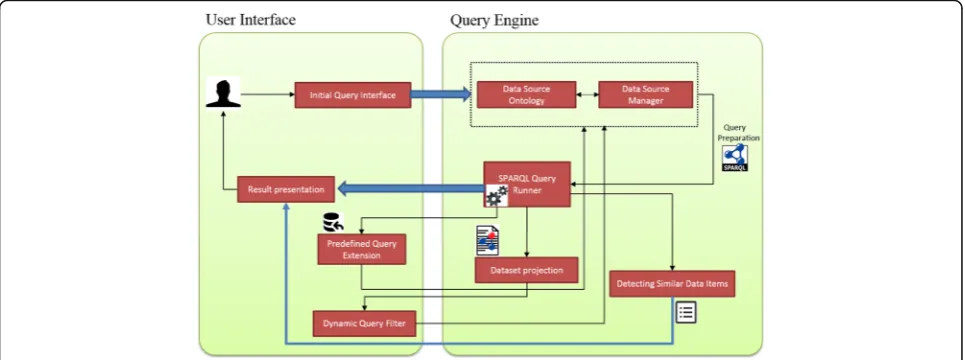
The PIBAS FedSPARQL architecture is shown in Fig. 1. The main components are user interface and query engine. The user interface enables users to construct simple and
advanced queries and view the results of their execu-tion, while the query engine executes queries across re-mote SPARQL endpoints. PIBAS FedSPARQL was
implemented in PHP and Python. The JQuery library3
was used to develop an interactive and user-friendly
interface, while sparqllib4 was used to run Federated
SPARQL queries. The list of available datasets used for creating predefined Federated SPARQL queries is
placed in the local DataSources ontology [49]
devel-oped using Protégé 4.0.2 [50].
User interface
The user query interface was implemented in HTML, JQuery and JavaScript. Its core components are:
Initial query interface Users can choose from prede-fined topics, subtopics and templates. The selection of subtopics is limited by of the topic selected. This also applies to the relation between topics and templates. All relations reflect the needs of the researchers at RC. Every
template is based on a form of an underlying predefined Federated SPARQL query.
Predefined query extension This component allows end users to add new datasets to the predefined Feder-ated SPARQL queries.
Dynamic query filter This component allows end users to select the desired datasets, load the properties avail-able for these datasets and dynamically expand Feder-ated SPARQL queries with selected properties.
Result presentation This component allows end users to view the results of predefined queries in table form.
One column shows retrieved results as URI or string, while another column displays data source and initiative name. End users can also apply a dynamic query filter to view the results organized by source. In both cases, the columns can be sorted and searched based on entered text.
Query engine
PIBAS FedSPARQL runs Federated SPARQL queries on
our local JOSEKI endpoint.5 Before the queries can be
executed, a series of demanding processes need to be performed. These tasks are carried out by the following components:
Data source ontology This component implies the
DataSourcesontology that contains the patterns of pre-defined queries for all templates as well as information about datasets that are initially included in queries.
Data source manager This component scans the data source ontology and uses the corresponding datasets in-formation to fulfill the user requirements. The data source manager also keeps track of predefined datasets and the datasets included in extended queries.
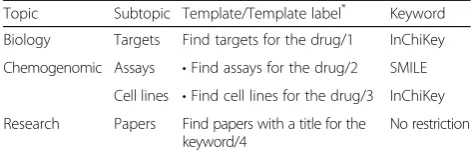
Table 1Representation of current (sub)topics and templates in theDataSourcesontology
Topic Subtopic Template/Template label* Keyword
Biology Targets Find targets for the drug/1 InChiKey
Chemogenomic Assays •Find assays for the drug/2 SMILE
Cell lines •Find cell lines for the drug/3 InChiKey
Research Papers Find papers with a title for the keyword/4
No restriction
a
Template labels are used in Table2and Table6
Dataset projection This component returns properties for every dataset included in Federated SPARQL queries. End users can choose from a number of properties based on their description.
Query preparation This component is in charge of translating and preparing the requirements of end users into valid Federated SPARQL queries. Requirements in-clude selecting options from the initial query interface, adding new endpoints to predefined queries and dynamic query filtering.
SPARQL query runner This component executes Fed-erated SPARQL queries.
Detecting similar data items This component detects similar data items (URIs) from results retrieved after running predefined queries or queries extended with new datasets. Similar data items are shown on a new web page.
Table 2List of RDF datasets integrated in PIBAS FedSPARQL
PIBAS FedSPARQL
Data source Triples Template label
Reference or dataset link
CPCTAS
PIBAS dataset 437 1; 2; 3 [5]
Reference dataset
42.089 4 [15]
EMBL-EBI
ChEMBL 425.304.329 1; 2; 3 https://www.ebi.ac.uk/chembl/
Chem2Bio2RDF
BindingDB 20.484 1 https://www.bindingdb.org/ bind/index.jsp
Pubchem 78.000.000 2 https://www.ncbi.nlm.nih.gov/ pcassay
Bio2RDF
Drugbank 3.672.531 1 http://www.drugbank.ca/
PubMed 5.005.343.905 4 http://www.ncbi.nlm.nih.gov/ pubmed/
Methods
Running of predefined queries
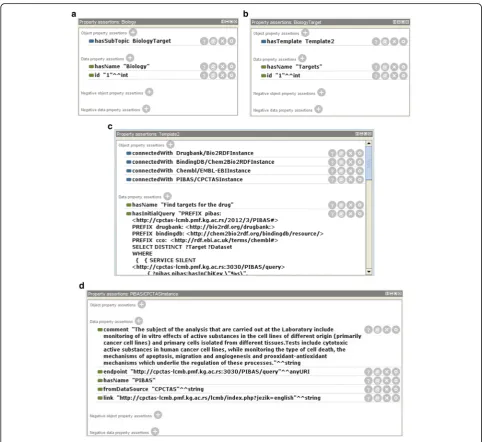
Information about initiatives and datasets included in predefined queries is placed in the local ontology Data-Sources. Each dataset is represented as an instance, while each template is connected to a dataset instance
using the object property connectedWith. With respect
to their purpose, the same dataset can be associated with a variety of templates. Every template belongs to a corresponding subtopic. Each subtopic has its own
topic. For example, the topic Biology has the subtopic
BiologyTarget while it is connected to Template2 (see
Fig. 2). Template2 is created based on the following
preselected datasets: PIBAS/CPCTAS, BindingDB/
Chem2Bio2RDF, Drugbank/Bio2RDF and ChEMBL/ EMBL-EBI.
Currently, the DataSources ontology contains topics
that are created in accordance with the requirements of RC experts. Topics are divided into three areas:
Biology, Chemogenomic and Research. All (sub)topics and templates are changeable and can easily be modi-fied or added to. Templates can be modimodi-fied in various
ways. For example, the template Find targets for the
drug, which requires the InChiKey value, can be
trans-formed into a template that requires another value, such as SMILES. This change necessitates a manual modification in the predefined query. Templates can be expanded with one or more new datasets. Similarly, datasets can also be excluded from templates. A repre-sentation of all topics and their relations in PIBAS FedSPARQL is shown in Table 1.
The property hasInitialQuery of each template
repre-sents a predefined Federated SPARQL query that runs across preselected datasets. Pattern queries for every dataset are collected from initiative examples and parts of them are handcrafted. Figure 3 shows the predefined query of Template2. All “%s” characters that represent objects in the predefined query will be replaced with the keyword entered by the end user, while the aftermost character is reserved for an additional dataset.
At the moment, PIBAS FedSPARQL uses datasets (Table 2) from the EMBL-EBI, Bio2RDF and Chem2-Bio2RDF platforms. These are, used to establish the predefined Federated SPARQL queries. CPCTAS, as union of the PIBAS and Reference dataset, covers all the men-tioned topics currently used for templates. Seeking to meet the needs of RC staff and highlight the importance of small laboratories, we have related the PIBAS dataset
with templates from the Biology and Chemogenomic
topics. The Reference dataset, as collection of ontologies, which describes references of scientific and research PMF6 staff, covers theResearchtopic.
To illustrate the remaining basic features of PIBAS FedSPARQL we will introduce the following use case: Researchers from a laboratory have just received a syn-thesized substance (a drug) and a list of its molecular information from chemists. The information they were provided with includes the molecular formula, molecu-lar weight, InChiKey and SMILES. Before the re-searchers can determine how they will proceed in their investigation, they are carrying out a pre-screening of the synthesized substance.
The main questions posed in this process are related to whether a substance has already been synthesized and used by other initiatives. Data collected in this way can be useful for further experiments. Suppose that re-searchers want to find targets for a particular drug that
has the following InChiKey:
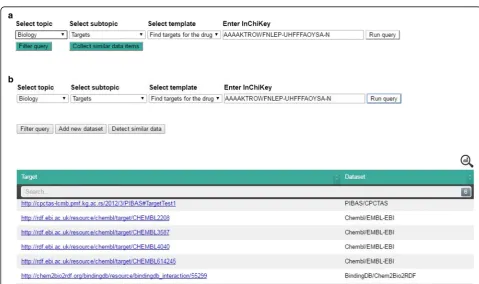
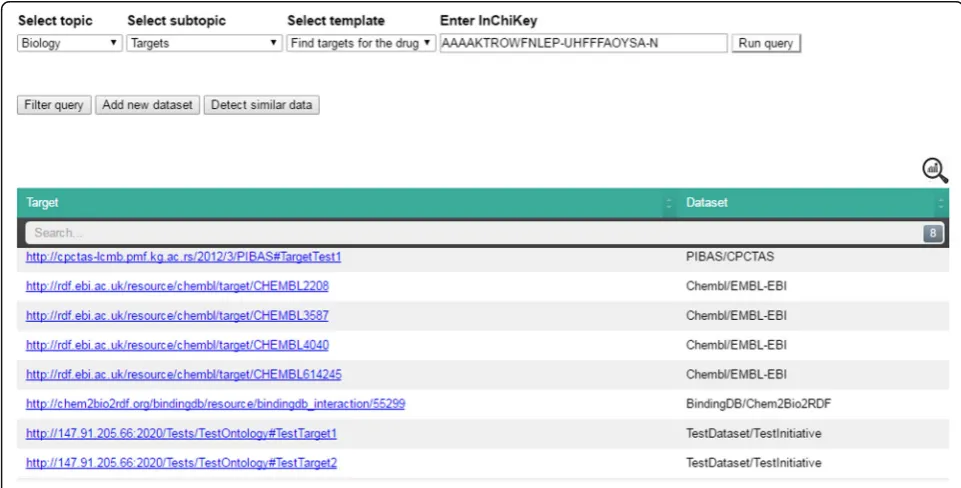
AAAAKTROWFNLEP-UHFFFAOYSA-N. After determining the selection cri-teria and running the query (Fig. 4a) researchers receive information that targets are found in the PIBAS, ChEMBL and BindingDB datasets (Fig. 4b). In this case, the Federated SPARQL query is predefined over four
pre-selected datasets, as it is specified in the
Data-Sources ontology (see Fig. 2), and it retrieves results from three of them. As in this case, it may happen that endpoints do not contain the requested data or that they are not reachable. Statistical information about the
retrieved data can be viewed by clicking the icon in
the top-right corner of the results table.
Adding new datasets
A major issue in bioinformatics research is the sheer volume of information that researchers are faced with. It is often a laborious task to find data relevant or vital to analyzing and interpreting experimental findings in a particular area of research. Data from high-profile pro-jects are usually easily found, but there are also many smaller laboratories. Their data are harder to obtain, but may be related to and complement the research interest at hand. It would therefore be highly beneficial if it were possible to easily explore the datasets of these laboratories. In PIBAS FedSPARQL, all semantically
represented data can be integrated and used for further exploring by way of the system’s feature for adding new dataset (Fig. 5).
This feature increases the flexibility of our system and opens the door to a better understanding of data, creating new opportunities for the researchers to per-form more productive experiments in the future. By
clicking the “Add” button, the researchers can add
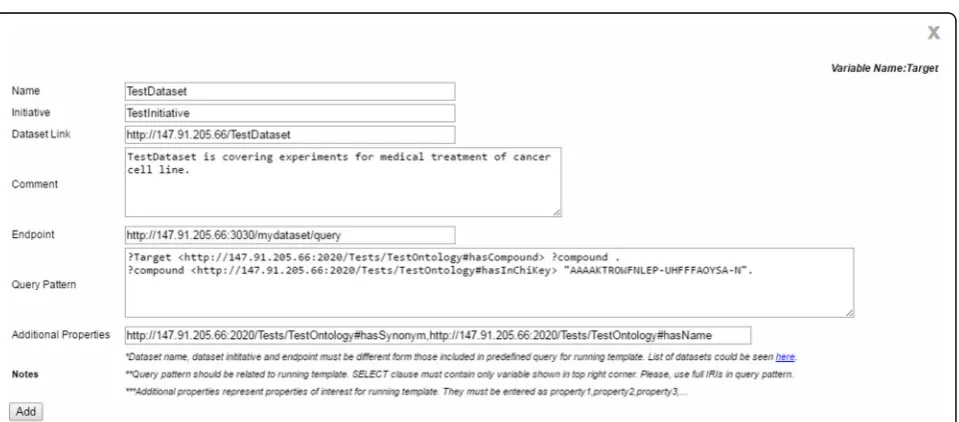
dataset that is not included in the predefined list of datasets for an existing template. In the pop-up win-dow that appears, the dataset name, initiative name, dataset link, a comment, the endpoint URL, pattern query and some dataset properties that are most im-portant for the selected template and topic have to be
entered. The additional properties are used for the
system’s feature for detecting similar data items. The
pattern query entered should match a selected topic and template. Following our use case, the pattern
query must contain the variable Target that matches
the name of the running template. The pattern query variable is visible in the top-right corner of the pop-up window for adding new dataset. For testing purposes, we are using a test dataset with a test ontology and a
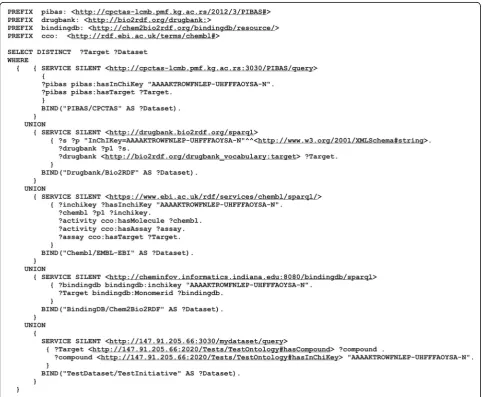
test endpoint.7 After entering the basic information,
the query preparation component rewrites the original query (Fig. 6) and the researchers can now run a new query. Following this, the rewritten query is evaluated and a more complete answer is returned to the end users (Fig. 7).
Dynamic query filter
The dynamic query filter can be used to obtain add-itional information. This feature can improve queries by using the underlying structure of datasets without prior knowledge of their structure. By clicking on the “Filter
query” button, dynamic accordion elements are created
(Fig. 8).
Each dataset used in the query is assigned to an accor-dion element. Accoraccor-dion elements are labeled with the dataset name and initiative name. The names are linked, so the end user can directly explore the respective dataset or initiative through their websites or public endpoints. By clicking on an accordion element, it is expanded and auto-matically populated with the list of properties according to the selected template and topic. This list is generated by running a dynamic SPARQL query in the background. Each property listed in an accordion element has a hyperlink to the web page with its description. This way, end users can analyze properties and determine which of them are relevant for obtaining additional information. Each property can be added to the query
by selecting it and the query button “Run query” then
changes to “Run new query”.
After the properties selection, a new star-shaped SPARQL query is generated for every dataset of inter-est. A star-shaped query has one variable as subject and k joins, i.e. (k + 1) triple patterns. Suppose that re-searchers want to get additional information from datasets used in a predefined query. The focus of their
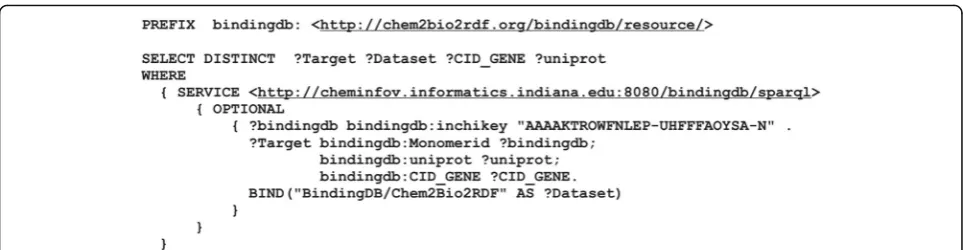
interests could be http://chem2bio2rdf.org/bindingdb/ resource/CID_GENE and http://chem2bio2rdf.org/bin dingdb/resource/uniprot properties from the Binding DB/Chem2Bio2RDF and the property http://cpctas-lcmb.pmf.kg.ac.rs/2012/3/PIBAS#hasTargetName from the PIBAS/CPCTAS dataset. Figure 9 shows an example
of a star-shaped query generated for this particular case.
New query results are organized by source and displayed in a paginated table (Fig. 10). Results can be further sorted and filtered in order to refine the query result and show only the most relevant information. This
option is particularly useful when dealing with a large number of results.
Similar data items detection
The development of efficient algorithms for detecting similar data items is an important goal in bioinformatics. The concept of similarity is typical for the study of macro-molecular structures, genomes, proteomes and metabolic pathways [51]. Together with the experience and expertise of RC staff, use of similar data items (targets and cell lines) resulted in a greater percentage of successful experiments compared to selecting data items based on intuition. This
accelerated the process of obtaining desired results and re-duced the cost of performing experiments. In PIBAS Fed-SPARQL, similar data items detection can be applied to the results of predefined queries as well as to the results retrieved after adding a new dataset. This feature can be
manually disabled for some templates in theDataSources
ontology. Based on the input of RC staff, this option is
more important for theBiologyandChemogenomictopics,
than for the Researchtopic for two main reasons. Firstly, finding similar items is more important for topics that will be used for performing further experiments. Secondly, ob-tained results come in the form of URIs (see Table 4), and
Fig. 9Generated star-shaped query for BindingDB/Chem2Bio2RDF dataset after dynamic query filtering. This figure shows the star-shaped SPARQL query created for the Binding/Chem2Bio2RDF dataset after adding the properties http://chem2bio2rdf.org/bindingdb/resource/CID_GENE and http://chem2bio2rdf.org/bindingdb/resource/uniprot to the query
our algorithm is applied to URIs, rather than strings. Fol-lowing the use case specified in this paper, the researchers can find the most similar targets by selecting“Detect simi-lar data items”after adding the test dataset. This is useful as the known targets can be used to make sense of new targets.
As an introduction to a detailed explanation of the algorithm, a brief overview follows: similar data items detection is based on presenting the object values (strings) in the form of a vector and determining the cosines of their mutual angles, which actually represent the degree of their semantic relatedness. The proposed algorithm for similar data items detection is imple-mented in Python and its pseudocode is presented in Listing 1.
For each data item (URI) in the result set, a SPARQL query that retrieves the entire collection of its predicates and objects is generated and executed (step 3 and 4). Next, based on the RC expert’s decision, the algorithm uses the predicates selected for every template (step 6). Our feature Dynamic query filter assisted RC experts in analyzing and selecting the predicates for every template, i.e. for ontology classes, likeTargets,Cell linesandAssay
contained in the predefined dataset. Also, when end users add a new dataset to a predefined query, they have to enter the selected predicates (see Fig. 5). Conversance with SPARQL and a profound understanding of the
underlying newly added dataset ontology are necessary for this step, because this dataset can be unfamiliar to the bioinformatics community. Generally, the selection of predicates should be performed according to two principles. First, predicates should coincide with the
re-searchers’ interest and the running template. Second,
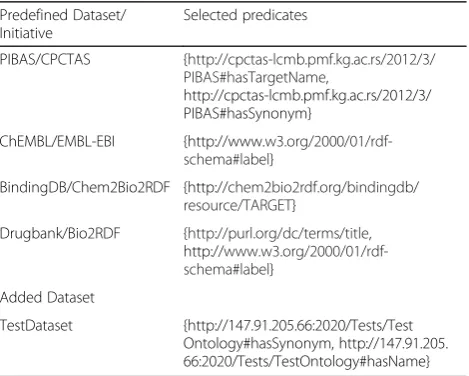
there should be a high occurrence of strings as object values in the RDF statement. For the running template, the selected predicates of the predefined and test dataset can be seen in Table 3. The object values after the selec-tion of predicates can be seen in Table 4.
Then, all object values are transformed and prepared to be used in VSM (step 10) to calculate their similarity, as follows: First, all strings are converted to lower case. Then strings are filtered using regular expression to ex-tract alphabetic and numeric characters [a-z, 0–9]. All words from strings are added to a dictionary that keeps track of the words and the number of their occurrences. Before adding a word to the dictionary, a list of stop words is checked that contains high-frequency words with relatively low information content, such as function words (e.g. of, the, and) and pronouns (e.g. them, who, that). For us, it was important to check the stop words before stemming the word, as strings appear to be more related than they really are. In our case, the stemming task (suffix removal) is performed by applying Porter‘s Stemming Algorithm [52]. Figure 11 shows the process of preparing strings to be used in VSM.
In order to achieve the best similarity value between appropriate pairs of vectors we use CSM. CSM achieved better results in comparison with two other
Words/n-grams measures, Jaccard Coefficient8 and Dice
Coeffi-cient,9 as shown in [53]. CSM is calculated using
for-mula (1) (step 13). The results from [53] influenced the selection of the threshold, so that pairs of vectors
Table 3Set of selected predicates for running template
Predefined Dataset/ Initiative
Selected predicates
PIBAS/CPCTAS {http://cpctas-lcmb.pmf.kg.ac.rs/2012/3/ PIBAS#hasTargetName,
http://cpctas-lcmb.pmf.kg.ac.rs/2012/3/ PIBAS#hasSynonym}
ChEMBL/EMBL-EBI {http://www. w3.org/2000/01/rdf-schema#label}
BindingDB/Chem2Bio2RDF {http://chem2bio2rdf.org/bindingdb/ resource/TARGET}
Drugbank/Bio2RDF {http://purl.org/dc/terms/title, http:// www.w3.org/2000/01/rdf-schema#label}
Added Dataset
with CSM values below 0.7 are not taken into account. Further, the algorithm sums up the CSM values between each URI pair (step 17). Based on the final sum, similar items for our use case (steps 19–21) are lined up, as repre-sented in Table 5. The final results are shown on a new web page, like in Fig. 12.
Results
Evaluation
One of the challenges in the bioinformatics is detection of similar data items across different datasets and initia-tives. PIBAS FedSPARQL offers a solution to this prob-lem. In our case, the combination of the VSM and the CSM have a promising role. Evaluation in this context basically means checking if data items are similar. The
evaluation task was carried out in cooperation with RC staff, two chemists and five biologists, who participated in the selection process of 29 drug samples. The test set is derived from the experiments at RC, where the cancer cell lines were treated with certain active sub-stances (drugs). Some drug samples are selected arbi-trarily. The same RC experts also participated in the selection of the predicates necessary for the evaluation process, during which our Dynamic query filter proved helpful.
The RC experts used drug samples to perform in total 50 queries (test cases): 25 samples on the tem-plate 1, 10 samples on the temtem-plate 2 and 15 samples on the template 3 (some of the samples are used on more than one template). Then, the main evaluation task was applied to the obtained data and the results were analyzed. The analysis process was done manu-ally by RC experts, where the resulting data (URIs) were accessed and compared with each other. The
relevant tests cases are presented in Table 6.10 Based
on human judgment, our algorithm gave accurate re-sults in 92% of test cases, so it can be concluded that our solution is promising for finding similar data items.
The data obtained from the evaluation process were the basis for further experiments carried out at RC. With the help of our algorithm, it became easier for staff to choose targets and cell lines. It turned out that more similar tar-gets and cell lines provide the same or better results for testing active substances on cancer cells than when they were selected based on intuition. The application of our algorithm has contributed to the publications of some novel results in the field of cancer research [54, 55].
Our evaluation also contains a comparison of two approaches for our algorithm:
Predicates selected: Using user-determined predicates.
Table 4Object values after the selection of predicates
Dataset item (URI) URI abbreviation Object values after the selection of predicates
http://cpctas-lcmb.pmf.kg.ac.rs/2012/3/PIBAS#TaregtTest1 URI1 •MAPKAP kinase 2
•MAPK-activated protein kinase 2 http://rdf.ebi.ac.uk/resource/ChEMBL/target/CHEMBL2208 URI2 MAP kinase-activated protein kinase 2
http://rdf.ebi.ac.uk/resource/ChEMBL/target/CHEMBL3587 URI3 Dual specificity mitogen-activated protein kinase kinase 1
http://rdf.ebi.ac.uk/resource/ChEMBL/target/CHEMBL4040 URI4 MAP kinase ERK2
http://rdf.ebi.ac.uk/resource/ChEMBL/target/CHEMBL614245 URI5 THP-1
http://chem2bio2rdf.org/bindingdb/resource/bindingdb_interaction/ 55299
URI6 MAPK-Activated Protein Kinase 2 (MK2)
http://147.91.205.66:2020/Tests/TestOntology#TestTarget1 URI7 •MAPKAPK-2
•MAPK-activated protein kinase 2 http://147.91.205.66:2020/Tests/TestOntology#TestTarget2 URI8 •Histidine-containing protein
•Phosphocarrier protein HPr
Predicates not selected: No restriction on predicates.
Figure 13 shows the number of retrieved data for every test case from Table 6, the number of similar items ob-tained using these two approaches and similarity matching based on human judgment (1 means that a matching exist, 0 means that no matching exist). The second ap-proach did not do well in practice. Its score of total matching is only 16.6%. This weaker judgment may be explained by the fact that the algorithm uses non-relevant predicates, which in turn may affect the final
results. For example, targets from the
ChEMBL/EBML-EBIdataset have the propertyhttp://rdf.ebi.ac.uk/terms/ chembl#organismName that represents the source or-ganism of a molecular target or tissue. Many targets could have the same value for this property, for
ex-ample Homo sapiens. Only this successful matching
could influence targets similarity, although they are dif-ferent. Therefore, it is necessary to select predicates. As a consequence, the first approach gives better results.
Usability and usefulness
Cooperating with RC staff during the evaluation process was of great importance because it enabled them to be-come more familiar with the system. After the evaluation task, through the usage of our system on performing experiments (which produced scientific results [54, 55]), the employees in RC have come to conclusions about the system. We conducted a survey to find out how we
could further improve the system according to user re-quirements. We based the content of the survey on our experience with a similar usability survey for the IMI Python system [56]. The authors used the six-item Likert scale-based System Usability (SUS) questionnaire. In order to numerically analyze the survey results, the Likert scale responses were translated to numbers using the follow-ing five point scale: 1 = strongly disagree; 2 = disagree, 3 = neutral; 4 = agree; 5 = strongly agree. The results of the survey are shown in Fig. 14.
The answers to question 1 (4.3 ± 0.73) suggest that our system was very well adopted by end users. The re-sponses to question 2 (4.1 ± 0.85) indicate that the dif-ferent features left a good impression with the end users. Highly rated question 3 (4.2 ± 0.83) assures us that the end users benefited from our algorithm. This addition-ally motivated us to continue improving our algorithm in the current direction. The responses to question 4 (4.4 ± 0.6) indicate that our system was helpful for searching for complementary data, that would be used for future experiments. The users positively rated ques-tion 5 (average score = 4.0 ± 0.86). This fact implies that our system is a great starting point for finding novel in-put data used for further experiments. The high rating of question 6 (4.3 ± 0.73) has a positive and encouraging effect on the authors. We will continue to listen to the demands of users and try to tailor the system to their needs. The overall impression of the survey is satisfying and we found the PIBAS FedSPARQL to be very benefi-cial and useful.
Table 5Some running steps in the algorithm for detecting similar data items*
Pair of URIs Pairs of strings/vectors CMS > 0.7
URI1: URI2 MAPK-activated protein kinase 2: MAP kinase-activated protein kinase 2 0.800000
URI1: URI6 MAPK-activated protein kinase 2: MAPK-Activated Protein Kinase 2 (MK2) 0.912871
URI1: URI7 MAPK-activated protein kinase 2: MAPK-activated protein kinase 2 1.000000
URI2:URI6 MAP kinase-activated protein kinase 2: Dual specificity mitogen-activated protein kinase kinase 1 0.730297
URI2:URI7 MAP kinase-activated protein kinase 2: MAPK-activated protein kinase 2 0.800000
URI6:URI7 MAPK-Activated Protein Kinase 2 (MK2): MAPK-activated protein kinase 2 0.912871
Line up result {URI1-URI7: 1.0, URI1-URI6:0,9, URI6-URI7:0.9, URI1- URI2:0.8, URI1-URI2:0.8}
Final result URI1, URI7, URI6,URI2
*
Based on Table3and Table4
Limitations
In this section, we outline the known limitations of the system.
Expert knowledge of SPARQL and RDF when adding a new dataset: Proficiency in SPARQL and a profound understanding of the underlying ontology are required
as the new dataset could be unknown to the bioinfor-matics community. In the future work, we may be able to reduce this limitation through integration of our local approach [57]. It would provide easier SPARQL queries management and automatic favorization of predicates.
Table 6Results obtained from detection of similar data items for different templates
Keyword Number of data after
running predefined query
Number of similar data
Human Judgment
Template label: 1
MJFJKKXQDNNUJF-UHFFFAOYSA-N 10 8 Yes
MSTNYGQPCMXVAQ-KIYNQFGBSA-N 30 12 Yes
PMATZTZNYRCHOR-IMVLJIQENA-N 5 3 Yes
GUGOEEXESWIERI-UHFFFAOYSA-N 347 99 No
SEKGMJVHSBBHRD-WZHZPDAFSA-M 6 2 Yes
HSMNQINEKMPTIC-UHFFFAOYSA-N 341 106 No
Template label: 2
C1 = CC(=CC(=C1)F)CSC2 = NC3 = C(N2)C = NC = C3 4 3 Yes
CCOC(=O)C1(CCN(C)CC1)c2ccccc2 104 65 No
C1CCC(CC1)N2C(=O)C3 = CC = CC = C3N = C2SCC#N 3 2 Yes
CC1CCCCC1NC(=S)NC2 = CC = C(C = C2)SC(F)F 2 0 Yes
CC1(CC1(Cl)Cl)C(=O)NNC(=O)C2CCCCC2 7 3 Yes
Nc1nc(O)c2NC(CNc3ccc(cc3)C(=O)N[C@@H](CCC(=O)O)C(=O)O)CNc2n1 23 18 Yes
Template label: 3
AAAAKTROWFNLEP-UHFFFAOYSA-N 2 0 Yes
MIQPIUSUKVNLNT-UHFFFAOYSA-N 107 41 No
STQGQHZAVUOBTE-VGBVRHCVSA-N 149 50 Yes
UWWDHYUMIORJTA-HSQYWUDLSA-N 2 0 Yes
XCGSFFUVFURLIX-VFGNJEKYSA-N 20 2 Yes
ZPEIMTDSQAKGNT-UHFFFAOYSA-N 117 44 Yes
Total matching: 92% (over all 50 test cases)
Endpoint is down: The PIBAS FedSPARQL search relies on the availability of the used remote SPARQL endpoints. Overcoming this limitation by using a local copy of the endpoints is not feasible due to the large size of the data sources measured in terabytes. As a precaution, our system makes use of the ability of Federated SPARQL queries to skip an endpoint which is down with the SILENT keyword.
Duration time of query execution: The initial run of query takes longer than the following iterations, probably due to browser caching. Query execution time may vary significantly according to computer network conditions.
Conclusion and future work
PIBAS FedSPARQL, is an open-source SPARQL query builder and result set visualizer for bioinformatics data which allows end users to easily construct and run Federated SPARQL queries across multiple datasets. PIBAS FedSPARQL allows users to create queries in a very simple way by selecting a (sub)topic, template and entering a keyword. Currently, (sub)topics and tem-plates are related to the most important requirements of RC staff. All templates provide a great starting point for researchers to find answers to bioinformatics ques-tions. Besides preselected datasets for predefined quer-ies, PIBAS FedSPARQL actively supports end users in adding new datasets for existing queries. After retrieval of the initial result set, query results can be filtered to improve their relevance. Based on projections of indi-vidual RDF data sources, queries can be filtered by selecting data which are in the end user’s focus. As an advanced feature, PIBAS FedSPARQL offers the possi-bility of detecting similar data items based on the given results. We showed that the combination of Vector Space Model and Cosine Similarity Measures offers promising results. Based on end user reviews, we dem-onstrated that our novel sentence alignment algorithm constitutes an improvement over this baseline. We
found that the success of our algorithm mostly depends on suitable predicate selection by experts. In the future, we will focus on automating the favorization of these predicates. We plan to use this strategy to further im-prove efficacy and usability of our system.
Availability and requirements
Project name:PIBAS FedSPARQL
Project home page: http://cpctas-lcmb.pmf.kg.ac.rs/fed/ and https://github.com/marijadjokic/PIBASFedSPARQL
Operating system(s):Platform independent
Programming language:PHP and Python
Other requirements: Modern Browser, i.e. current version of Firefox or Chrome
License:GNU GPL
Any restrictions to use by non-academics:none
Endnotes 1
http://cpctas-lcmb.pmf.kg.ac.rs/fed/index.html
2
https://bitbucket.org/openrdf/sesame
3
https://jqueryui.com/accordion/
4
http://graphite.ecs.soton.ac.uk/sparqllib/
5
http://cpctas-lcmb.pmf.kg.ac.rs:2020/
6
http://www.pmf.kg.ac.rs/
7
http://147.91.205.66:3030/
8
https://en.wikipedia.org/wiki/Jaccard_index
9
https://en.wikipedia.org/wiki/S%C3%B8rensen%E2% 80%93Dice_coefficient
10
Sometimes, the result of a real-time SPARQL query can contain a lot of data. The results of test cases pre-formed for this evaluation can be seen at http://cpctas-lcmb.pmf.kg.ac.rs/fed/evaluation/
Appendices
This section contains a short introduction to the basic concepts used in this study. In the following, we use the definitions from the RDF Recommendation [58] and Cosine Similarity for Vector Space Model [59].
Definition 1 (URI): A Uniform Resource Identifier (URI) is a unique name given to a resource to identify it over a network using specific protocols. URI provides a generic syntax and consists of a generic set of schemes such as URL (Uniform Resource Locator), URN (Uniform Resource Name), URC (Uniform Resource Characteristic), etc. for document (resource) identification.
Definition 2 (RDF statement): An RDF graphGis a finite set of RDF statements. For an RDF, the statement is
S= (s,p,o), where the element s is called subject, p is called predicate andois called object. A collection of RDF statements can be intuitively understood as a graph: re-sources, subjects and object are nodes and predicates are arcs connecting the nodes. The set of all values occurring in all triples ofG(set of URIs and literal values) provides the vocabulary for representing knowledge according to the guidelines for publishing Linked Open Data.
Definition 3 (Cosine Similarity): Cosine similarity is a non-Euclidean distance measure between two vectors. Given two feature vectors!ci and!cj the similarity score
between concepts i and j is represented using the dot
product:
Sim ið Þ ¼;j ci
!∙c
j
!
ci
! c
j
! ð1Þ
The resulting score is in the range of [0, 1] with 1 as the highest relatedness between conceptsiandj.
Abbreviations
CPCTAS-LCMB:Center for Preclinical Testing of Bioactive Substances -Laboratory for Cell and Molecular Biology; CSM: Cosine Similarity Measures; PIBAS: Preclinical Investigation of Bioactive Substances; RC: Research Center; RDF: Resource Description Framework; URI: Uniform Resource Identifier; VSM: Vector Space Model
Acknowledgements
The authors are grateful to the Ministry of Education, Science and Technological Development of the Republic of Serbia for financial support (Grant Nos. III41010).
Funding
Not applicable.
Availability of data and materials
The PIBAS FedSPARQL web application is available at http://cpctas-lcmb.pmf.kg.ac.rs/fed/. In order to support collaborations and the extension of the software we have submitted the code to a public repository on GitHub (https://github.com/marijadjokic/PIBASFedSPARQL). The data source ontology used in this study is available at http://cpctas-lcmb.pmf.kg.ac.rs/2012/3/PIBAS/datasources.owl. The CPCTAS datasets used in this study can be explored using the remote SPARQL endpoint at http://cpctas-lcmb.pmf.kg.ac.rs:3030/PIBAS/sparql. A video illustrating the sample use case of this study can be found at https://youtu.be/it32Vrs84GQ.
Authors’contributions
Designed and developed application: MDJP and VC. Created theDataSources ontology and implemented the algorithm for detection of similar data items: MDJP. Performed the evaluation: MZ. Analyzed the survey results: MDJP, VC and JY. Contributed to the writing of the manuscript: MDJP, VC, JY and DW. All the authors have approved the final manuscript.
Authors’information
MDJP is a Research Associate and PhD student of computer science at the Department of Mathematics and Informatics, Faculty of Science, University of Kragujevac, Serbia. She is currently employed as a software developer at an Austrian company that is supported by the Graz University of Technology. VC is an Assistant Professor at the Department of Mathematics and Informatics, Faculty of Science, University of Kragujevac, Serbia. JY is a research scientist at the School of Informatics and Computing, Indiana University and Translational Informatics Division, School of Medicine, University of New Mexico focused on bimolecular and biomedical data science. MZ is a Research Associate at the Department of Biology and Ecology, Faculty of Science, University of Kragujevac, Serbia. DW is an Associate Professor at Indiana University School of Informatics and Computing, and leads the Integrative Data Science Laboratory. This group created one of the original semantic data sources used in this work (Chem2Bio2RDF).
Ethics approval and consent to participate
Not applicable.
Consent for publication
Not applicable.
Competing interests
The authors declare that they have no competing interests.
Publisher’s Note
Springer Nature remains neutral with regard to jurisdictional claims in published maps and institutional affiliations.
Author details
1Virtual World Services GmbH, Asperner Heldenplatz 6, 1220 Wien, Austria. 2Department of Mathematics and Informatics, Faculty of Science, University
of Kragujevac, Radoja Domanovica 12, Kragujevac 34000, Serbia.3School of Informatics and Computing, Indiana University, 901 E 10th St, Bloomington, Indiana 47408, USA.4Translational Informatics Division, School of Medicine,
University of New Mexico, Albuquerque, NM 87131, USA.5Department of
Biology and Ecology, Faculty of Science, University of Kragujevac, Radoja Domanovica 12, Kragujevac 34 000, Serbia.
Received: 29 March 2017 Accepted: 12 September 2017
References
1. Masseroli M, Mons B, Bongcam-Rudloff E, Ceri S, Kel A, Rechenmann F, Lisacek F, Romano P. Integrated bio-search: challenges and trends for the integration, search and comprehensive processing of biological information. BMC Bioinformatics. 2014;15(Suppl 1):S2. doi:10.1186/1471-2105-15-S1-S2. 2. Stephens S, LaVigna D, DiLascio M, Luciano J. Aggregation of bioinformatics
data using Semantic Web technology. Web Semantics: Science, services and agents on the world wide web. 2006 Sep 30; 4(3):216–221.
3. Stevens R, Bodenreider O, Lussier YA. Semantic webs for life sciences. In: Pacific symposium on Biocomputing. Pacific symposium on Biocomputing 2006 (p. 112). NIH Public Access.
4. CPCTAS-LCMB, Faculty of Science, University of Kragujevac, Serbia, http:// cpctas-lcmb.pmf.kg.ac.rs/lcmb/
5. Cvjetkovic V, Djokic M, Arsic B, Curcic M. The ontology supported intelligent system for experiment search in the scientific research center. Kragujevac Journal of Science. 2014;36:95–110.
6. Belleau F, Nolin MA, Tourigny N, Rigault P, Morissette J. Bio2RDF: towards a mashup to build bioinformatics knowledge systems. J Biomed Inform. 2008; 41(5):706–16.
7. Chen B, Dong X, Jiao D, Wang H, Zhu Q, Ding Y, Wild DJ. Chem2Bio2RDF: a semantic framework for linking and data mining chemogenomic and systems chemical biology data. BMC Bioinformatics. 2010; 11(1):1. 8. Weizhong LI, et al. The EMBL-EBI bioinformatics web and programmatic
tools framework. Nucleic Acids Res. 2015;43(W1):W580–4.
9. Willighagen EL, Waagmeester A, Spjuth O, Ansell P, Williams AJ, Tkachenko V, Hastings J, Chen B, Wild DJ. The ChEMBL database as linked open data. J Cheminformatics. 2013;5(1):23.
11. Wishart DS, Knox C, Guo AC, Shrivastava S, Hassanali M, Stothard P, Chang Z, Woolsey J. DrugBank: a comprehensive resource for in silico drug discovery and exploration. Nucleic Acids Res. 2006;34(suppl_1):D668–72. 12. Wang Y, Xiao J, Suzek TO, Zhang J, Wang J, Bryant SH. PubChem: a public
information system for analyzing bioactivities of small molecules. Nucleic Acids Res. 2009;37(suppl_2):W623–33.
13. Seiler KP, George GA, Happ MP, Bodycombe NE, Carrinski HA, Norton S, Brudz S, Sullivan JP, Muhlich J, Serrano M, Ferraiolo P. ChemBank: a small-molecule screening and cheminformatics resource database. Nucleic Acids Res. 2007;36(suppl_1):D351–9.
14. Wheeler DL, Barrett T, Benson DA, Bryant SH, Canese K, Chetvernin V, Church DM, DiCuccio M, Edgar R, Federhen S, Feolo M. Database resources of the national center for biotechnology information. Nucleic Acids Res. 2007;36(suppl_1):D13–21.
15. Cvjetkovic V, Djokic M, Semantic web based organization of scientific bibliography references. Proceedings SCIECONF (ScieConf), ISBN: 978–80– 554-0891-0, ISSN: 1339–9071, 3(1); 2015. p. 230–235.
16. Arsic B, Djokic M, Cvjetkovic V, Spalevic P, Zivanovic M, Mladenovic M. Integration of bioactive substances data for preclinical testing with Cheminformatics and Bioinformatics resources. Proceedings of the 23nd International Electrotechnical and Computer Science Conference. ERK: Portorož, Slovenia; 2014. p. 146–149.
17. Rakhmawati NA, Umbrich J, Karnstedt M, Hasnain A, Hausenblas M. Querying over Federated SPARQL Endpoints—A State of the Art Survey. arXiv preprint arXiv:1306.1723. 2013 Jun 7.
18. Seneviratne O. Sealfon R. An Intuitive Federated SPARQL Query Builder for Biomedical RDF Data: QueryMed; 2010.
19. Salton G, Wong A, Yang CS. A vector space model for automatic indexing. Commun ACM. 1975;18(11):613–20.
20. Sidorov G, Gelbukh A, Gómez-Adorno H, Pinto D. Soft similarity and soft cosine measure: similarity of features in vector space model. Computación y Sistemas. 2014 Sep;18(3):491–504.
21. Koivunen MR, Miller E. W3c semantic web activity. Semantic Web Kick-Off in Finland. 2001 Nov;2:27–44.
22. Jentzsch A, Zhao J, Hassanzadeh O, Cheung KH, Samwald M, Andersson B. Linking Open Drug Data. In: I-SEMANTICS; 2009.
23. Bairoch A, Apweiler R, Wu CH, Barker WC, Boeckmann B, Ferro S, Gasteiger E, Huang H, Lopez R, Magrane M, Martin MJ. The universal protein resource (UniProt). Nucleic Acids Res. 2005;33(suppl_1):D154–9.
24. Matthews L, Gopinath G, Gillespie M, Caudy M, Croft D, de Bono B, Garapati P, Hemish J, Hermjakob H, Jassal B, Kanapin A. Reactome knowledgebase of human biological pathways and processes. Nucleic Acids Res. 2008; 37(suppl_1):D619–22.
25. Harland L. Open phacts: a semantic knowledge infrastructure for public and commercial drug discovery research. In International conference on knowledge engineering and knowledge management. Springer Berlin Heidelberg; 2012. pp. 1-7.
26. Smith AK, Cheung KH, Yip KY, Schultz M, Gerstein MB. LinkHub: a semantic web system that facilitates cross-database queries and information retrieval in proteomics. BMC Bioinformatics. 2007;8(Suppl 3):S5.
27. Carmen Legaz-García M, Miñarro-Giménez J, Menárguez-Tortosa M, Fernández-Breis J. Generation of open biomedical datasets through ontology-driven transformation and integration processes. Journal of Biomedical Semantics. 2016;7(1)
28. Antezana E, Blondé W, Egaña M, Rutherford A, Stevens R, De Baets B, Mironov V, Kuiper M. BioGateway: a semantic systems biology tool for the life sciences. BMC Bioinformatics. 2009;10(10):1.
29. Prud E, Seaborne A. Sparql query language for rdf. 2006. https://www.w3. org/TR/rdf-sparql-query.
30. Prud’hommeaux E, Buil-Aranda C. SPARQL 1.1 federated query. W3C Recommendation. 2013 Mar:21.
31. Schweiger D, Trajanoski Z, Pabinger S. SPARQLGraph: a web-based platform for graphically querying biological semantic web databases. BMC Bioinformatics. 2014;15(1):1.
32. Dodds L. Twinkle: a sparql query tool. 2007.
33. Dietze H, Schroeder M. GoWeb: a semantic search engine for the life science web. BMC Bioinformatics. 2009;10(10):1.
34. De Leon Battista A, Villanueva-Rosales N, Palenychka M, Dumontier M. Smart: a web-based, ontology-driven, semantic web query answering application. In Proceedings of the 2007 international conference on semantic web challenge-volume 295. CEUR-WS org; 2007. pp. 129-36.
35. Horridge M, Drummond N, Goodwin J, Rector AL, Stevens R, Wang H. The Manchester OWL syntax. In OWLed 2006 Nov 10 (Vol. 216).
36. García-Godoy MJ, Navas-Delgado I, Aldana-Montes J. Bioqueries: a social community sharing experiences while querying biological linked data. In Proceedings of the 4th international workshop on semantic web applications and tools for the life sciences 2011 Dec 7 (pp. 24-31). ACM. 37. Schwarte A, Haase P, Hose K, Schenkel R, Schmidt M. Fedx: optimization techniques for federated query processing on linked data. In International semantic web conference. Springer Berlin Heidelberg; 2011. pp. 601-16. 38. Buttler D, Coleman M, Critchlow T, Fileto R, Han W, Pu C, Rocco D, Xiong L.
Querying multiple bioinformatics information sources: can semantic web research help? ACM SIGMOD Record. 2002;31(4):59–64.
39. Hasnain A, Mehmood Q, e Zainab SS, Saleem M, Warren C, Zehra D, Decker S, Rebholz-Schuhmann D. BioFed: federated query processing over life sciences linked open data. J Biomed Semantics. 2017;8(1):13.
40. Bianchi S, Burla A, Conti C, Farkash A, Kent C, Maman Y, Shabo A. Semantic warehousing of diverse biomedical information. Next Generation Information Technologies and Systems. 2009:73–85.
41. Bonifati A, Cattaneo F, Ceri S, Fuggetta A, Paraboschi S. Designing data marts for data warehouses. ACM Trans Softw Eng Methodol. 2001;10(4):452– 83.
42. Rada R, Mili H, Bicknell E, Blettner M. Development and application of a metric on semantic nets. IEEE transactions on systems, man, and cybernetics. 1989 Jan;19(1):17–30.
43. Resnik P. Using information content to evaluate semantic similarity in a taxonomy. arXiv preprint cmp-lg/9511007. 1995 Nov 29.
44. Miller GA. WordNet: a lexical database for English. Commun ACM. 1995; 38(11):39–41.
45. Kjellmer G. A dictionary of English collocations: based on the Brown corpus. USA: Oxford University Press; 1994 Mar 3.
46. Matsuo Y, Sakaki T, Uchiyama K, Ishizuka M. Graph-based word clustering using a web search engine. In Proceedings of the 2006 conference on empirical methods in natural language processing. Association for Computational Linguistics; 2006. pp. 542-50
47. Ehrig M, Haase P, Hefke M, Stojanovic N. Similarity for ontologies-a comprehensive framework. ECIS 2005 Proceedings. 2005 Jan 1:127. 48. David J, Euzenat J. Comparison between ontology distances (preliminary
results). In international semantic web conference 2008 Oct 26 (pp. 245-260). Springer. Berlin Heidelberg.
49. Data Sources ontology: http://cpctas-lcmb.pmf.kg.ac.rs/2012/3/PIBAS/ DataSources.owl (2016), Accessed 15 Jan 2017.
50. Rubin DL, Noy NF, Musen MA. Protege: a tool for managing and using terminology in radiology applications. J Digital Imaging. 2007;20(1):34–46. 51. Ágoston V, Kaján L, Carugo O, Hegedus Z, Vlahovicek K, Pongor S. Concepts
of similarity in bioinformatics. NATO SCIENCE SERIES SUB SERIES I LIFE AND BEHAVIOURAL SCIENCES. 2005;368:11.
52. Porter MF. An algorithm for suffix stripping. Program. 1980 Mar 1;14(3):130–7. 53. Takale SA, Nandgaonkar SS. Measuring semantic similarity between words
using web documents. International Journal of Advanced Computer Science and Applications (IJACSA). Oct. 2010:1(4).
54. ŽivanovićMN, KošarićJV,Šmit B,ŠeklićDS, PavlovićRZ, MarkovićSD. Novel seleno-hydantoin palladium (II) complex–antimigratory, cytotoxic and prooxidative potential on human colon HCT-116 and breast MDA-MB-231 cancer cells. Gen Physiol Biophys. 2017;36:187–96.
55. Canovic P, Bogojeski J, Kosaric J, Markovic S, Zivanovic M. Pt (IV), Pd (II), Rh (III). Complexes induced oxidative stress and cytotoxicity in the HCT-116 colon cancer cell line. Turk J Biol. 2017;41(1):141–7.
56. Djokic-Petrovic M, Pritchard D, Ivanovic M, Cvjetkovic V. IMI python: upgraded CS circles web-based python course. Comput Appl Eng Educ. 2016;24(3):464–80.
57. CvjetkovićV, DjokićM, ArsićB. Wikipedia Browsing With DBpedia. In Proceedings in EIIC-The 2nd Electronic International Interdisciplinary Conference 2013 Sep (No. 1).
58. Prud’hommeaux E, Seaborne A. SPARQL query language for RDF (January 2008). URL http://www.w3.org/TR/rdf-sparql-query. 2013.