Anti-inflammatory and Analgesic Effects of
Pongamia glabra Leaf Gall Extract
Mani Ganesh*1, Mani Vasudevan1, Kaliappan Kamalakannan1, Arthanari Saravana Kumar1, Mari Vinoba2 , Swastika Ganguly3 ,Thangavelu Sivakumar1
1Natural Product Research Lab, Nandha College of Pharmacy, Koorapalayam Pirivu,
Erode (Tamil Nadu) -638 052, India
2Department of Chemical Engineering, Alagappa College of Technology, Anna
University, Guindy, Chennai-600 025, India.
3 Dept of Pharmaceutical Sciences, Birla Institute of Technology, Mesra, Ranchi,
Johrkhand, India
_________________________________________
Summary
The ethanol extract of Pongamia glabra Vent leaf gall (PG) was investigated for
anti-inflammatory and analgesic activity at the doses (p.o.) of 100, 200, and 400 mg/kg body weight. For evaluation of inflammation carrageenan-, histamine- and serotonin-induced paw edema served as acute models and cotton pellet–serotonin-induced granuloma served as a chronic model in rats. The acetic acid-induced writhing response and hot plate method using mice were used to assess analgesic activity. The higher doses of PG (200 and 400 mg/kg, p.o.) were inhibiting carrageenan, histamine and serotonin-induced paw edema as well as cotton pellet –induced granuloma successfully. In addition, PG (200 and 400 mg/kg, p.o.) significantly attenuated the writhing responses induced by an intraperitoneal injection of acetic acid. There were no significance changes in the reaction time by using hot plate method in mice. Furthermore, our phytochemical studies indicated that the ethanolic extract of leaf gall contains carbohydrates, protein, tannins, steroids, flavonoids, and mucilage. From acute oral toxicity studies (OECD-423 guidelines), no mortality was observed even at highest dose of PG (2000 mg/kg, p.o.).
Keywords: Pongamia glabra leaf gall, anti-inflammatory, analgesic, paw edema.
Introduction
Pongamia glabra. Linn. (Papilionaceae) Leaf gall (Synonym, Pongamia pinnata)
which may also be called as Galdupa indica, is a large tree found in tropical regions and
costal forests of India, North Australia, Southeast Asia and Malaysia (1,2). In the Ayurvedic literature of India, different parts of the plant have been recommended as a remedy for various ailments, and have been used in traditional medicine for bronchitis, whooping cough and rheumatic joints (3). Aqueous extracts of the leaf have significant anti-ulcer activity (4), dried flowers of the plant was shown potent anti-diabetic activity in normal and non-insulin dependent diabetes mellitus patients (5). The seed and seed oil have been used for treating various inflammatory and infectious diseases such as lecoderma, leprosy, lumbago, articular rheumatism, and muscular (6, 7). Extracts of roots, leaves and seeds of the Pongamia glabra have been reported to have
anti-inflammatory and antidiarrhoeal activities (8-12). The leaves are hot, digestive, laxative, anthelmintic and cure piles, wounds and other inflammations. A hot infusion of leaves is used as a medicated bath for relieving rheumatic pains and for cleaning ulcers in gonorrhea and scrofulous enlargement (2, 13). In addition, the phytochemical examinations of this plant have indicated the presence of furanoflaovones, furanoflavonols, chromenoflavones, flavones, furanodiketones and flavonoid glucosides (14-21). In the light of above, the present study investigated the potential of ethanolic extract of Pongamia glabra leaf gall on as an anti-inflammatory and analgesic in rodents.
Material and Methods Plant Material
The fresh Pongamia glabra leaf gall was collected during the month of June,
2004 from Erode situated in the state of Tamil Nadu (India). The plant material was taxonomically identified and authenticated by The Head, Department of Botany, Tamilnadu Agricultural University, Coimbatore. A voucher specimen (NCP/RHM/535/10) has been deposited at the herbarium of natural product research lab, Nandha College of Pharmacy, Tamilnadu, India for ready reference.
Preparation of the Extract
The freshly collected leaf galls were shade-dried, pulverized using a mechanical grinder and passed through 40 mach sieve. The powdered leaf galls (2.25 Kg) were extracted with 95% ethanol using a Soxhlet extractor, at room temperature. After exhaustive extraction, the ethanolic extract was filtered and concentrated by distillation process. A brownish-black colored residue was obtained (yield 17.8% w/w), which was kept in a desiccator. This ethanolic extract of Pongamia glabra leaf gall (PG) was used in
Animals
All the experiments were carried out using male, Swiss Albino mice (25-30 g) and Wistar rats (150-200 g) were obtained from animal house, IRT Perundurai medical college, Erode, India. On arrival the animals were placed at random and allocated to treatment groups in polypropylene cages with paddy husk as bedding. Animals were housed at a temperature of 24 ± 2oC and relative humidity of 30 – 70 %. A 12:12 light: day cycle was followed. All animals were allowed to free access to water and fed with standard commercial rat chaw pallets (M/s. Hindustan Lever Ltd, Mumbai). All the experimental procedures and protocols used in this study were reviewed by the Institutional Animal Ethics Committee (Register Number: 688/2/C-CPCSEA) and were in accordance with the guidelines of the CPCSEA, Ministry of Forests and Environment, Government of India.
Drugs and Chemicals
The drugs and fine chemicals were purchased from Sigma-Aldrich, USA. All other chemicals and solvents were obtained from local firms (India) and were of highest pure and analytical grade.
Vehicle
Plant extract (PG) and indomethacin were suspended in 0.5% w/v carboxymethylcellulose sodium (CMC) and administered orally to animals. Carrageenan, histamine, serotonin and acetic acid diluted separately in normal saline and injected.
Preliminary Chemical tests
The extract was subjected to preliminary screening, for various active phytochemical constituents such as alkaloids, carbohydrates, steroids, protein, tannins, phenols, flavonoids, gum and mucilage, glycosides, saponins and terpins.
Acute Oral Toxicity Studies
Acute Anti-inflammatory Studies
Carrageenan, histamine and serotonin induced paw oedema models were used for evaluating potential of PG on inflammation. For each model, rats were divided in to five groups (n = 6). PG (100, 200, and 400 mg/kg) and indomethacin (10 mg/kg) were administered orally one hour before the subplantar injection of edematogenic agent. The control groups of animals were received vehicle (1 ml/kg) orally. A digital vernier caliper (Model 2061, Mututoyo Digimatic Caliper, Japan) used for measuring paw thickness (mm) of rats (23,24). Edema (∆T) was calculated as follows:
∆T = Tt – T0
Where Tt is the right hind paw thickness (mm) at time‘t’, T0 is hind paw thickness
(mm) before subplantar injection.
Carrageenan Induced Edema in Rats
In this method, acute inflammation was produced by the subplantar administration of 0.1 ml of 1% w/v carrageenan in the right paw of the rat. The thickness (mm) of the paw was measured immediately and at 1, 2, 3, and 4 h intervals after the administration of the carrageenan (23-27).
Histamine and Serotonin Induced Edema in Rats
Edema in rats was induced by injecting 0.1 ml of 0.1% w/v histamine or 0.2% w/v serotonin in subplantar region of the right hind paw. The thickness (mm) of the paw was measured immediately and at 1, 2, 3, and 4 h intervals after the administration of the histamine or serotonin (28,29).
Cotton Pellet –induced Granuloma
Acetic acid-Induced Writhing Method
Analgesic activity was evaluated on the acetic acid-induced writhing according to
Koster et al. (31). Male Albino mice were divided in to five groups of six animals each. The animals were pretreated with PG (100, 200 and 400 mg/kg, p.o.) or aspirin (200 mg/kg, p.o.) used as a standard drug, one hour prior to intraperitoneal injection of 1% v/v acetic acid (0.1 ml/10g). Five minutes after the intraperitoneal injection of acetic acid, the number of writhing during the following 10 minutes was counted. Control mice received drugless (0.5% w/v CMC; 10 ml/kg) vehicle (27,32).
Hot Plate Method
Five groups of six mice each were selected for the present study. Group 1 served as control and received the vehicle. The PG extract at the concentration of 100, 250 and 500 mg/kg was administered orally to groups 2, 3 and 4, respectively and group 5 received the standard drug pentazocine (30 mg/kg, i.p.). The mice were placed on Eddy’s hot plate kept at a temperature of 55 ± 0.5oC for a maximum time of 15 sec (33). Reaction time was recorded when the animals licked their fore-and hind paws and jumped; at before 0 and 15, 30, 45, and 60 min after administration of test drugs.
Statistical Analysis
All the results were expressed as Mean ± Standard Error (SEM). Data was analyzed using one-way ANOVA followed by Dunnett’s t-test. P-values < 0.05 were
considered as statistically significant.
Results Preliminary Chemical Tests
Our phytochemical studies indicated that ethanolic extract of PG leaf gall contains carbohydrates, protein, tannins, sterols, flavonoids, and mucilage. Alkaloids, glycosides and proteins were showed negative.
Acute Oral Toxicity Test
Pongamia glabra leaf gall extract did not produce any mortality even at the
highest dose (2000 mg/kg, p.o.) employed. All the doses (5, 50, and 300 mg/kg, p.o.) of PG were thus found to be non-toxic. Three doses (100, 200, and 400 mg/kg, p.o.) of PG were selected for further pharmacological studies.
Carrageenan Induced Edema in Rats
However, carrageenan-induced inflammation was significantly (P < 0.001)
Histamine and Serotonin Induced Edema in Rats
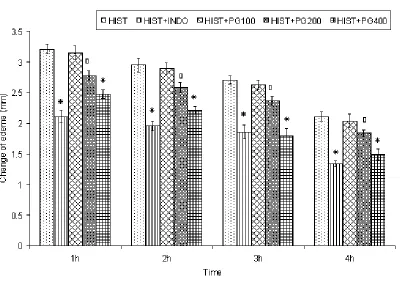
Fig. 2 and 3 show the effects of histamine and serotonin induced paw edema in rats. The maximal paw thickness was observed at 1h of after subplantar injection in vehicle treated groups of both the models. The animals treated with higher doses of PG (200 and 400 mg/kg, p.o.) as well as indomethacin (10 mg/kg, p.o.) produced statistically significant (P < 0.01) inhibition of the edema induced by histamine or serotonin in all the
Cotton pellet –Induced Granuloma
The anti-inflammatory effect of PG was calculated depending on the wet and dry weight of cotton pellets. The continuous oral treatment (7 days) with plant extract (200 and 400 mg/kg, p.o.) and indomethacin (10 mg/kg i.p.) remarkably reduced (P < 0.001)
Acetic acid-Induced Writhing Method
The ethanolic extract from leaf galls of Pongamia glabra strongly reduced the
abdominal constrictions induced by the intraperitoneal administration of acetic acid solution. The treatment of animal with PG (200 and 400 mg/kg, p.o.) produced a significant (P < 0.001) and dose depend inhibition in abdominal writhes produced by
Hot Plate Method
The extract at the all dose levels (100, 200 and 400 mg/kg, p.o.) did not show any significant changes in reaction time at through out the observation period as compared with control animals. The mice treated with standard drug pentazocine (30 mg/kg, i.p.) showed significant (P < 0.001) increase in reaction time at 30, 45, and 60 min as
Discussion
Among several traditional claims, the usefulness of Pongamia glabra leaf gall in
inflammation and pain has been emphasized more in literature. Hence, it was considered that investigations for these medicinal properties might give scientific authentication to the traditional claims. Moreover, this plant has not been subjected to the above mentioned systemic pharmacological screening so far. In the present study, the anti-inflammatory activities of the ethanolic extract of Pongamia glabra leafgall (PG) has been established
in both acute and chronic inflammation models, which were employed.
Carrageenan-induced rat paw edema is a suitable test for evaluating anti-inflammatory drugs which has frequently been used to assess the anti-edematous effect of natural products (35). Development of edema in the paw of the rat after injection of carrageenan is a biphasic event. The initial phase observed during the first hour is attributed to the release of histamine and serotonin. The second phase of edema is due to the release of prostaglandins, protease and lysosome (36, 37). Based on this, it could be argued that the suppression of the first phase may be due to inhibition of the release of early mediators, such as histamine and serotonin, and the action in the second phase may be explained by an inhibition of cyclo-oxygenase. The result of the present study indicates that PG (200 and 400 mg/kg, p.o.) and indomethacin play a crucial role as protective factors against the carrageenan-induced acute inflammation.
Histamine and serotonin are important inflammation mediators and they are potent vasodilator substances as well as increase the vascular permeability (38-40). In the present study, PG (200 and 400 mg/kg, p.o.) effectively suppressed the edema produced by the histamine and serotonin indicating that the extract exhibit its anti-inflammatory action by means of either inhibiting the synthesis, release or action of inflammatory mediators viz., histamine, serotonin and prostaglandin might be involved in inflammation.
Chronic inflammation is a reaction arising when the acute response is insufficient to eliminate proinflammatory agents. Chronic inflammation includes a proliferation of fibroblasts and the infiltration of neutrophils and exudation (41). Chronic inflammation occurs by means of the development of proliferative cells. These cells an either spread or granuloma form (42). Efficacy of anti-inflammatory agents in chronic inflammatory states is indicated by their ability to inhibit the increase in the number of fibroblasts and synthesis of cologne and mucopolysaccharides during granuloma tissue formation (43).The ethanolic extract of PG showed significant anti-inflammatory activity in cotton pellet induced granuloma and thus found to be effective in chronic inflammatory condition.
The hot plate method was originally described by Woolfe and Mac Donald (44). This test has been found to be suitable for the evaluation of centrally but not of peripherally acting analgesics. The validity of this test has been shown even in the presence of substantial impairment of motor performance (45). The present findings of the study indicate that the PG did not show any changes in analgesic activity by using hot plate method.
In conclusion, the data obtained in this study demonstrated that Pongamia glabra
extract might have analgesic and anti-inflammatory activities through peripherally.
Further studies are necessary to elucidate the mechanisms behind its traditional effects.
References
1. Krishnamurthy A. Wealth of India. Volume 8 Publication and Information Directorate,
New Delhi, India. p 206, 1969.
2. Satyavati GV, Gupta AK, Neeraj T. Medicinal Plants of India. ICMR, New Delhi,
Volume II, 490, 1987.
3. Kirtikar KR, Basu BD. Indian Medicinal Plants. International Book Distributors,
Dehradune, India, Volume 1,2nd ed, 1995.
4. Akhtar AH, Ahmad KD, Gilani SN, Nazir A. Antiulcer effects of aqueous extracts of
Nigella sativa and Pongamia pinnata in rats. Fitoterapia 1996; 67:195-9.
5. Akhtar MS. Hypoglycemic effect of dried (sukhchain) Pongamia pinnata flowers in
normal and non-insulin dependent diabetes mellitus patients. Hamdard Medicus
1999; 2: 33-6.
6. Nadkarni KM. Indian Materia Medica. Popular Book Depot, Bombay, India, Volume
I, 1001, 1954.
7. Chaurasia SC, Jain PC.Antibacterial activity of essential oils of four medicinal plants. Indian J Hosp Pharm 1978;5: 166-8.
8. Singh RK, Pandey BL. Anti-inflammatory activity of seeds extracts of Pongamia pinnata in rats. Indian J Physiol Pharmacol 1996; 40: 355-8.
9. Singh RK, Joshi VK, Goel RK. Pharmacological action of Pongamia pinnata seeds-a
preliminary report. Indian J Exp Biol 1996; 34:1204-7.
10.Srinivasan K, Muruganandan S, Lal J. Evaluation of anti-inflammatory activity of
11. Shoba GF, Thomos M, Ramakutty C. Study of antidiarrhoel activity of four medicinal plants in castor oil induced diarrhea. J Ethanopharmacol 2001; 73: 73-6.
12. Brijesh S, Daswani PG, Tetali P, Rojatkar SR, Anita NH, and Birdi TI. Studies on
Pongamia pinnata (L) Pierre Leaves: Understanding the mechanism(s) of action in
infectious diarrhea. J Zhejiang University Sci 2006; 7: 665-74.
13. Chopra RN. Indigenous Drugs of India. Academic Publishers, Calcutta.388. 1933
14. Talapatara SK, Malik AK, Talapatara B. Pongaglabol, a new hydroxy furanoflavone and aurantiamide acetate, a dipeptide from the flower of Pongamia glabra. Phytochemistry 1980; 19 :1199-202.
15. Tanaka T, Yuki K, Fuji Y, Mizuno M. Flavonoids in root bark of Pongamia pinnata. Phytochemistry 1992; 31: 993-8.
16. Murthy PBR, Seshadri TR. Chemical examination of the flowers of Pongamia glabra
and a note on the glycosidic components of Bueta frodosa flowers. Proc Indian Acad Sci 1944;20A: 279-91.
17.Yin H, Zhang S, Wua J, Nana H. Dihyderopyranoflavones from Pongamia pinnata. J Braz Chem Soc 2006;7: 1432-5.
18. Rangaswami S, Rao JV, Seshadri TR. Kanujin, a crystalline compound of the roots
Pongamia glabra. Proc Indian Acad Sci 1942; 16A: 319-22.
19. Sharma P, Seshadri TR, Mukherjee SK. Some synthetic and natural analogs of glabrachomene. Indian J Chem 1973; 1 : 985-6.
20. Pathak VP, Saini TR, Khanna RN. Glabrachalchine from Pongamia glabra seeds. Phytochemistry 1983; 22:1303-4.
21. Ahemed G, Yadav PP, Mary R. Furanoflavonoid glycosides from Pongamia pinnata
fruits. Phytochemistry 2004;65: 921-924.
22. Ecobichon DJ. The Basis of Toxicology Testing. CRC Press, New York. 43-86. 1997
23. Winter CA, Risley EA, Nuss GW. Carrageenan-induced edema in hind paws of the rat as an assay for anti-inflammatory drugs. Proc Soc Exp Bio Med.1962;111: 544-7.
24.Kweifio-Okai G. Anti-inflammatory activities of Ghanaian antiarthritic herbal preparation: I. J Ethnopharmacol . 1991;33: 263-7.
26. Nkeh, BC, Njamen D, Wandji J, Fomum ZT, Dongmo A, Nguelefack TB, et al., Anti- inflammatory and analgesic effects of drypemolundein A, a sesquiterpene lactone from Drypetes molunduana. Pharm Biol 2003; 41 : 26-30.
27.Young H, Luo Y, Cheng H, Hsieh W, Liao J, Peng W. Analgesic and anti- inflammatory activities of [6] - gingerol. J Ethnopharmacol 2005;96: 207-10.
28. Suleyman H, Demirezer LO, Kuruuzum A, Banoglu ZN, Gocer F, Ozbakir G, et al., Anti-inflammatory effect of the aqueous extract from Rumex patientia L. roots. J Ethnopharmacol 1999;65 : 141-8.
29. Gupta M, Mazumder UK, Kumar RS, Kumar TS. Studies on anti-inflammatory, analgesic and antipyretic properties of methanol extract of Caesalpinia bonducella
leaves in experimental animal models. Iranian J Pharmacol Ther 2003;2:30-4.
30. D’Arcy PF, Haward EM, Muggleton RW, Townsend SB. The anti-inflammatory action of griseofulvin in experimental animal. J Pharm Pharmacol 1960; 12:659-65.
31.Koster R, Anderson M, De-Beer EJ.Acetic acid analgesic screen. Federation Proc
1959;18 : 418-20.
32. Taber RI, Greenhouse, DD, Rendell JK, Irwin S. Agonist and antagonist interactions of opioids on acetic acid-induced abdominal stretching in mice. J Pharmacol Exp Ther 1969; 69: 29-37.
33.Medhi B, Khanikor, HN, Lohon LC, Mohan P, Barua. Analgesic, Anti-inflammatory and local anesthetic activity of Moronga pterygosperma in laboratory animals. Pharm Bio 2003; 41: 248-52.
34. Hollander C, Nystrom M, Janciauskiene S, Westin U. Human mast cell decrease SLPI
levels in type II like alveolar cell model in vitro. Can Cell Int 2003;3:14-22.
35.Panthong A, Kanjanapothi D, Taesotikul T, Wongcome T, Reutrakul V. Anti- inflammatory and antipyretic properties of Clerodendrum petasites S. Moore. J Ethnopharmacol 2003; 85:151-6.
36.Vinegar R, Schreiber W, Hugo R .Biphasic development of carrageenan edema in rats.
J Pharmacol Exp Ther 1969; 166: 96-103.
37. Crunkhon P, Meacock SER . Mediators of the inflammation induced in the rat paw by carrageenan. Brit J Pharmacol 1971. 42: 392-402.
39. Cuman RKN, Bersani-Amadio CA, Fortes ZB. Influence of type 2 diabetes on the
inflammatory response in rat. Inflamm Res 2001;50: 460-465.
40. Skidmore I, Whitehouse M. Biochemical properties of anti-inflammatory drugs X: The inhibition of serotonin formation in vitro and inhibition of the esterase activity of
α-Chymyotrysin. Biochem Pharmacol 1967;16 : 737-751.
41. Dunne MW. Pathophysiology: Concepts of Altered Health States with Contributors.
Lipinncott, Philadaphia.165-76, 1990.
42. Arrigoni-Martelli E Z. Inflammation and Anti-inflammatories. Spectrum Publication, New York.119-20,1990.
43. Recio MC, Giner RM, Menez S, Ros JL. Structural requirements for the anti-inflammatory activity of natural triterpenoids. Planta Med 1995; 6:182-5.
44. Woolfe G, Mc Donald ADZ. The evaluation of the analgesic action of pethidine hydrochloride. J Pharmacol Exp Ther 1995;80: 300.