An ERP study of low and high relevance semantic features
Giuseppe Sartori
a,∗, Francesca Mameli
a, David Polezzi
a, Luigi Lombardi
b aDepartment of General Psychology, University of Padua, Via Venezia, 8, 35100 Padova, ItalybDepartment of Cognitive Sciences and Education, University of Trento, Via Matteo del Ben, 5, 38068 Rovereto (TN), Italy Received 27 October 2005; received in revised form 30 November 2005; accepted 30 November 2005
Available online 20 December 2005
Abstract
It is believed that the N400 elicited by concepts belonging to living is larger than N400 to non-living. This is considered as evidence that concepts are organized, in the brain, on the basis of categories. We conducted a feature-verification experiment where living and non-living concepts were matched for relevance of semantic features. Relevance is a measure of the contribution of semantic features to the “core” meaning of a concept. We found that when relevance is low the N400 is large. In addition, we found that when the two categories of living and non-living are equated for relevance the seemingly category effect at behavioral and neural level disappeared. In sum, N400 is sensitive, rather than to categories, to semantic features, thus showing that previously reported effects of semantic categories may arise as a consequence of the differing relevance of concepts belonging to living and non-living categories.
© 2005 Elsevier Inc. All rights reserved.
Keywords: Semantic memory; Semantic relevance; N400
1. Introduction
How concepts are represented in the brain is a highly con-troversial issue[6]. High-level functional accounts of how the brain implements a conceptual system at least according to two different views.
According to one view concepts are organized in categories (such as living and non-living concepts) [2,8]. Clues to the neural substrates of concept come also from electrophysiolog-ical investigations that showed how the N4001 is different for stimuli belonging to different categories[9]. It is reported that [3,9,15,20]living concepts show a larger N400 with respect to non-living in a feature-verification task. The theoretical view that concepts are represented in the brain on the basis of their categories is seemingly confirmed also by those fMRI studies which show that differing brain activities are associated with differing categories (living and non-living)[1,7,9,13,20].
∗Corresponding author. Tel.: +39 0498276608; fax: +39 0498276600.
E-mail address:[email protected] (G. Sartori).
1 The N400, a negative deflection in the ERP peaking at about 400 ms after stimulus presentation[11], has been widely used as an electrophysiological correlate ofsemantic processing[10]and more precisely, it has been shown to be sensitive to semantic deviations[11].
Ad opponendum, a different view states that concepts are organized in the brain according to their constituent seman-tic features. Semanseman-tic features are attributes of the concept (e.g. “lives in Africa”). Although a concept may have uncount-able semantic features, those really useful in distinguishing the same concept from closely related ones may be not numerous. Recently it has been proposed a measure, semantic relevance, which indexes the level of contribution of a semantic feature to the core meaning of the concept[18](seeAppendix Afor details). High accuracy and fast responses depend on high rele-vance of semantic features. In contrast, when semantic relerele-vance is lower retrieval is inaccurate and slower. The following is a telling example: “has a trunk” is a semantic feature of high rel-evance for the conceptElephant, because most subjects use it to defineElephant, whereas very few use the same feature to define other concepts. Among all the semantic features of a con-cept those with high relevance, such as “has a trunk” are useful in distinguishing the target concept from closely related concepts. Instead “has four legs” is a semantic feature with lower rele-vance for the same concept, because few subjects use to define Elephantbut do use it to define many other concepts. An exam-ple of a concept with its major constituents semantic features listed ordered by relevance is reported inTable 1.
It has been shown that differing categories have different average semantic relevance[18]. Specifically, living items have
Table 1
Example of features listed by subjects in defining concept airplane Concept: airplane
Semantic feature (ordered by relevance) Relevance
Airport 2.16
Has wings 0.93
To travel 0.91
Has propeller 0.69
Is large 0.35
Data from[4]. Relevance values computed according to[18].
semantic features, which are, on the average, less relevant when compared to non-living items. As regards to category-specific knowledge impairments, it has also been shown that selective liv-ing impairment disappears when semantic relevance is equated across categories[19]. In addition, the original category-specific impairment (performance to living reduced to performance to non-living), may be reversed (into an impairment for non-living with respect to living) just by manipulating the level of semantic relevance[17].
Given what reported above, here we specifically wondered whether, in a N400 study, an eventual ERP difference between categories, might be the result of uncontrolled relevance of con-stituent semantic features[10,20]. More specifically, we expect that if low relevance of semantic features manifests itself in larger N400 then this could be the cause of the reported category differences in N400[9]. To anticipate our results, we will report the following empirical results consistent with our hypothesis: (i) low relevance descriptions have larger N400 with respect to high relevance descriptions; (ii) there are no differences in N400 to the differing categories of living and non-living. On these grounds we will conclude that previously reported category effects in N400 may therefore be side effects of uncontrolled semantic relevance.
2. Experiment
2.1. Materials and method
2.1.1. Subjects
Sixteen Italian undergraduate students (age range 19–29 years; mean = 22, S.D. = 3.06) participated in the experiment. Four were male and 12 female. Aver-age education was 15.4 years. All the subjects were healthy and had normal or corrected-to-normal vision. Subjects signed an informed consent form before the experiment was started. The study was approved by the Ethics Committee of the Department of General Psychology of the University of Padua.
2.1.2. Stimuli and task
Subjects were presented, on a computer screen, with three semantic features representing a concept. A total of 320 trials were presented to the participants. Every trial included the sequential presentation of a verbal description of three semantic features (e.g. “has two humps, used by the Magi, found in the desert”) followed by the presentation of a target word (e.g.Camel) after which a YES/NO response was required.2One hundred and sixty of the target words were living
items and 160 were non-living. The target word half of the times matched the
2 Semantic relevance of a description was calculated as the sum of relevance values of constituent semantic features using the database published in[18].
previously presented description. The task was to respond whether the three features were appropriated for the concept or not. Half of the subjects responded, for YES responses, with their right hand using the index finger and for NO responses the middle finger and the remaining half did the opposite. Target words were matched, across categories (living and non-living), for Age of Acquisition (p= 0.58), familiarity (p= 0.60), typicality (p= 0.90) and most importantly for relevance (p= 0.51). Relevance values of the three semantic features were taken from the norms reported in[18].
Instructions were presented to the subject on a computer screen. A trial was as follows. A blank screen was displayed for 1000 ms; next came the first word of the concept description. Every word of a trial was presented sequentially for 300 ms with 200 ms of separation between one word and the following one. The target word was displayed after a random interval ranging between 10 and 1000 ms after the final word of the description and stayed for a maximum of 2000 ms or until the subject responded. Subjects were required to answer as quickly and as accurately as possible whether the target word matched the pre-viously presented description. The total 320 trials were presented in a single session in two blocks, which lasted about 25 min. Every target word was pre-sented four times: two matched with a low relevance description and two with a high relevance description. Each subject was presented every condition in ran-domized order. Stimuli were presented in random order. At the end of the task, every subject was briefly informed about the goal of the experiment.
2.1.3. ERP recording
Scalp voltages were collected using a 64-channel Electrocap. The net sists of 64 sintered Ag/AgCl electrodes. A frontal electrode (AFZ) was con-nected to the ground, and the vertex electrode was used as reference. Electrode impedance has been kept under 10 kfor all recordings. Ocular movements have been monitored through four electrodes fixed close to the eyes: two for vertical movements and two for the horizontal movements. Scalp voltage were continuously recorded, digitised by a computer at a sampling rate of 1000 Hz, and stored on the hard disk for off-line analysis. Electrical signals were ampli-fied with Synamps amplifier (high pass = 0.10 Hz, 24-dB/octave attenuation; low pass = 1000 Hz, 24-dB/octave attenuation; 50 Hz notch filter). The signal has been recorded in all the scalp’s areas: frontal, temporal, parietal, and occipital. The signal has been filtered using alow pass filterfor 30 Hz, 24 dB/octave atten-uation. The continuous EEG was segmented inepochsstarting 100 ms before target onset and lasting until 1500 ms after its onset. The epochs were aligned to the 100 ms baseline before the onset of the target. EEG epochs were examined, and all trials contaminated with ocular or movements artefacts were discarded. Approximately 5% of the trials were excluded from the average because of ocular and movements artefacts. Consequently, reference channel has been replaced with average-reference. This procedure allows computing the mean signal recorded in all active channels and then using this mean signal as ref-erence. This step has been necessary because the N400 we were interested in has its maximum amplitude in the parietal areas[7], very close to the vertex. In accord with the literature[7], the time window was selected between 300 ms and at 500 ms after target onset.
3. Results
3.1. ERPs data
As a first step we compared the N400 in sites along the median line FPZ, FZ, FCZ, CZ, CPZ, PZ, POZ and OZ3where we observed a significant effect in the N400 amplitude (F(1, 7) = 7.85, p< 0.001). Moreover, in accordance with previous
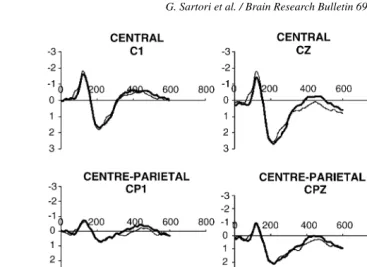
Fig. 1. ERPs for living (thick line) and non-living (thin line) items. In thex-axis time is represented (ms), in they-axis amplitude is represented (V). Half of the stimuli were living and half non-living. Living and non-living were matched for relevance and other psycholinguistic variables that are presumed to modulate performance and N400 voltage. ERPs did not differ between categories in any site.
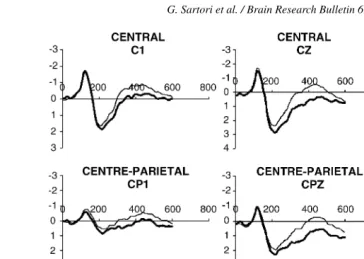
studies[9,10], the maximal N400 effect was detected in CZ, CPZ and PZ. Hereafter our analyses refer to the CPZ site. We performed an ANOVA on average voltage of the time window, with category (living versus non-living), relevance (high versus low) and congruency (yes versus no) as within subjects factors. The N400 did not differ between categories (F(1, 15) = 0.917, p= 0.353) and no other effect involving category was significant. More specifically, the interaction between category and congru-ency was not significant (F(1, 15) = 2.444,p= 0.139). The N400 to low relevance was larger than to high relevance semantic fea-tures (F(1, 15) = 20.465,p< 0.001). The significant interaction between relevance and congruency (F(1, 15) = 9.297,p< 0.01) indicates that the N400 is larger for congruent low relevance and incongruent both high and low relevance as compared to the con-gruent high relevance. Finally, the interaction between category and relevance was not significant (F(1, 15) = 0.031,p= 0.862) (Figs. 1 and 2).
A similar analysis conducted along the lateral line (CP3, CP1, CP2, CP4) confirmed the absence of any category effect (F(1, 15) = 1.613, p= 0.223), a strong relevance effect (F(1, 15) = 22.463, p< 0.001) and also a strong congruency effect (F(1, 15) = 14.446,p< 0.01). Furthermore, the significant inter-action congruency by laterality (F(4, 60) = 3.296, p< 0.05) indexes a larger N400 on the right hemisphere sites, a result that was previously reported many times[7].
3.2. Behavioural data
Two separate ANOVAs were conducted using as depen-dent variable both reaction times and accuracy. The within
subjects factors were category (living versus non-living), rel-evance (high versus low) and congruency (yes versus no). At behavioral level reaction times did not show any differ-ence between ‘yes’ [1045 ms] and ‘no’ responses [1002 ms] (F(1, 15) = 2.363, p= 0.145). Furthermore accuracy for ‘yes’ responses [88.5%] was not different from accuracy for ‘no’ responses [89%] (F(1, 15) = 0.116,p= 0.738). In RTs, category (living [1021 ms] versus non-living [1026 ms]) did not show any difference between living and non-living (F(1, 15) = 0.289, p= 0.599) and also the interaction category×congruency was not significant (F(1, 15) = 0.289,p= 0.599). As regards to accu-racy, it did not differ between living [87.5%] and non-living [89.5%] (F(1, 15) = 3.214,p= 0.093) and category did not inter-act with congruency (F(1, 15) = 0.031, p= 0.864). Reaction times to low relevance stimuli [1094 ms] were slower than those to high relevance stimuli [953 ms] (F(1, 15) = 130.469, p< 0.001), both for yes and no responses (F(1, 15) = 51.538, p< 0.001). In addition, average accuracy to low relevance stim-uli [84.5%] was lower than that to high relevance stimstim-uli [93%] (F(1, 15) = 42.126,p< 0.001). Similarly to ERPs also at behav-ioral level there was no interaction between category and rel-evance neither for RTs (F(1, 15) = 1.647, p= 0.219) nor for accuracy (F(1, 15) = 0.451,p= 0.512).
4. Discussion
Fig. 2. ERPs for high (thick line) and low (thin line) relevance items. In thex-axis time is represented (ms), in they-axis amplitude is represented (V). Half of the stimuli were living and half non-living. Low relevance items elicits larger N400 in comparison with high relevance items, mainly in centre-parietal regions.
using relevance, a parametric index that highly predicts concept retrieval accuracy (seeTable 1andAppendix Afor a more for-mal definition). The results of our experiment show that there are no category differences in brain processing, as indexed by the N400, when the presented semantic features of differing cate-gories have comparable probability in retrieving the concept (as measured by semantic relevance). Neither main effect nor inter-actions involving category were detected. In contrast, there are large differences in processing semantic features. Specifically, the N400 for low relevance semantic features was larger (e.g. “is large” – airplane) than for high relevance semantic features (e.g. “has wings” – airplane). In addition, at behavioral level, reaction times for high relevant semantic features were more rapid and accurate with respect to low relevance features. This latter result is predicted by the semantic relevance model[19]. In fact, when relevance is high, the target concept is retrieved faster and with higher accuracy because features address more efficiently the “core” meaning of the concept, presumably in an effortless automatic process. In contrast, when semantic rele-vance is low the concept is harder to retrieve and gives rise to longer reaction times and lower accuracy because feature are less diagnostic of the concept. This low diagnosticity requires, in the case of low relevance features, an attention-demanding effortful strategy that is detected by the N400.
A coherent picture appears here as regards to semantic fea-tures. The more the semantic feature is diagnostic of the concept (i.e. has high relevance), the more the concept is retrieved accu-rately and rapidly and the less the N400 is magnified. As regards to the N400, it is usually described as a neurophysiological cor-relate of semantic incongruency[7,11]and it is reported when predictability of meaning is reduced[10]. Here we show that the same N400 amplitude is reported to congruent stimuli of low
In sum, skeptic views on categorical organization of concepts at the neural level have recently gained currency as researchers are looking more closely at criteria used in defining the phe-nomenon. At behavioral level, credibility of semantic memory dissociations in brain damaged patients, is diminished by a number of methodological problems that concern the way disso-ciations are established. Several susceptibility factors have been shown to modulate semantic representations and these include distinctiveness, similarity, visual complexity, familiarity, corre-lated features, etc.[5]. Given that most investigations did not control for these susceptibility factors in selecting the stimuli for testing, it is not clear how many and which dissociations should survive after strict control of these factors[12].
Similar problems arise for investigations at neural level. Within the fMRI literature the original evidence for separate neu-ral systems for living and non-living categories has been ques-tioned[6,14]. As regards to ERP evidence, previously reported category effects could have arisen due to a lack of control of one or more of these susceptibility factors. We have shown that these effects could entirely be due to relevance of semantic features. We also showed that the only neural effects that survive strict control of susceptibility factors are those of semantic features, which is more likely to be what is encoded at neural level.
Appendix A
In our model, concepts are represented by a vector of seman-tic features and relevance is a measure of the contribution of semantic features to the “core” meaning of a concept. The “core” meaning of a concept is thought to include those semantic fea-tures that enable to identify the concept and to discriminate it from other similar concepts. We assume that subjects’ verbal descriptions, as collected in a feature-listing task, may be used to derive these important features.
The whole procedure may be split into four consecutive steps:
(i) Cued verbal descriptions of concepts are collected. (ii) Semantic features are identified from verbal descriptions
of subjects.
(iii) I (concepts)×J (semantic features) co-occurrence data matrixXis computed by setting entry xij of Xas equal
to the frequency of occurrence of feature jin concept i over all subjects’ descriptions (for details, see[16]). (iv) Under the FF×ICF (feature frequency×inverse concept
frequency) assumption semantic relevance valueskijmay
be computed fromXas follows:
kij=lij×gj=xij×log
I
Ij
(∀i=1, . . . , I,∀j=1, . . . , J) (1)
wherekijandIjdenote the relevance of featurejfor concept
Iand the number of concepts in which feature j occurs (that is Ij=|{i: xij> 0}|). Notice that lij=xij defines the
local component ofkij, whereasgj= log (I/Ij) indicates the
global component ofkij. In words,(1)states that a feature
which captures the core meaning of a concept will have both high local value and high global value and will be a feature which is frequently used in defining the target concept and rarely used in defining other concepts.
References
[1] S.F. Cappa, D. Perani, T. Schnur, M. Tettamanti, F. Fazio, The effects of semantic category and knowledge type on lexical-semantic access: a PET study, Neuroimage 8 (1998) 350–359.
[2] A. Caramazza, J.R. Shelton, Domain-specific knowledge systems in the brain, J. Cognit. Neurosci. 10 (1998) 1–34.
[3] M. Coltheart, L. Inglis, L. Cupples, P. Michie, A. Bates, B. Budd, A semantic subsystem of visual attributes, Neurocase 4 (1998) 353–370. [4] G.S. Cree, K. McRae, Analyzing the factors underlying the structure and
computation of the meaning of chipmunk, cherry, chisel, and cello (and many other such concrete nouns), J. Exp. Psychol.: Gen. 132 (2003) 163–201.
[5] R. Dell’Acqua, L. Lotto, R. Job, Naming time and standardized norms for the Italian PD/DPSS of 266 pictures: direct comparisons with Amer-ican, English, French, and Spanish published databases, Behav. Res. Meth. Instrum. Comput. 32 (2000) 588–612.
[6] J.T. Devlin, C.J. Moore, C.J. Mummery, M.L. Gorno-Tempini, J.A. Phillips, U. Noppeney, R.S.J. Frackowiak, K.J. Friston, C.J. Price, Anatomic constraints on cognitive theories of category specificity, Neu-roImage 15 (2002) 675–685.
[7] K.D. Federmeier, M. Kutas, A rose by any other name: long-term mem-ory structure and sentence processing, J. Memmem-ory Language 41 (1999) 469–495.
[8] G.W. Humphreys, M.J. Riddoch, On telling your fruit from your veg-etable: a consideration of category-specific deficits after brain damage, Trends Neurosci. 10 (1987) 145–148.
[9] M. Kiefer, Perceptual and semantic source of category-specific effects: event-related potentials during picture and word categorization, Memory Cognit. 29 (2001) 100–116.
[10] M. Kutas, K.D. Federmeier, Electrophysiology reveals semantic memory use in language comprehension, Trends Cognit. Sci. 4 (2000) 463–470. [11] M. Kutas, S.A. Hillyard, Reading senseless sentences: brain potentials
reflect semantic incongruity, Science 297 (1980) 203–205.
[12] K.R. Laws, Illusions of normality: a methodological critique of category-specific naming, Cortex 6 (2005) 842–851.
[13] A. Martin, L.L. Chao, Semantic memory and the brain: structure and processes, Curr. Opin. Neurobiol. 11 (2001) 194–201.
[14] A. Mechelli, G. Sartori, P. Orlandi, C. Price, Semantic Relevance explains category effects in medial fusiform gyri, Neuroimage, in press. [15] F. Ostrosky-Solis, M. Castaneda, M. Perez, G. Castello, M.A. Bobes, Cognitive brain activity in Alzheimer’s disease: electrophysiological response during picture semantic categorization, J. Int. Neuropsychol. Soc. 4 (1998) 415–425.
[16] R.T. Pivik, R.J. Broughton, R. Coppola, R.J. Davidson, N. Fox, M.R. Nuwer, Guidelines for recording and quantitative analysis of elec-troencephalographic activity in research contexts, Psychophysiology 30 (1993) 547–558.
[17] G. Sartori, F. Gnoato, I. Mariani, S. Prioni, L. Lombardi, Semantic relevance and the sensory/functional theory of category-specificity, sub-mitted for publication.
[18] G. Sartori, L. Lombardi, Semantic relevance and semantic disorders, J. Cognit. Neurosci. 16 (2004) 439–452.
[19] G. Sartori, L. Lombardi, L. Mattiuzzi, Semantic relevance best pre-dicts normal and abnormal name retrieval, Neuropsychologia 43 (2005) 754–770.