SOCIAL DEVELOPMENT WITH HUMAN RIGHTS
Dr. Sandeep Bansal
Associate Professor, I G N College, Ladwa, India.
ABSTRACT
Every individual has the human right to education. It is because only through education a society
can be developed in its proper direction. Women are considered as the integral part of society.
Hence, there cannot be an educated nation without educated women. The destiny of a nation is
moulded and fashioned through its education and in this; the education of women has a strategic
importance. But the general plight of women in the society is a saga of bias and disregard.
Traditionally women have been compelled to play the second fiddle in every sphere. Women
continue to face discrimination at all levels of education, a fact which poses tremendous
obstacles to the development of social environment.
However, now women are no less proficient than men in any field. They have ultimately
disregarded their homely image and are now making meaningful contribution to the progress of
the nation. But is the progress made by them an all-encompassing phenomenon, or is it confined
to some specific cases only? Have the all women of society been educated or empowered? It is
precisely these questions that this paper will attempt to throw some light upon.
Keywords: Women, human rights, education, social development.
Introduction:
Human Rights are inherent to all human being. These rights are necessary to ensure the dignity
of life of every individual irrespective of his race, religion, nationality, language, sex or any
other factor. By virtue of his birth he gets inalienable rights to live with dignity which must not
be intruded by others. The Universal Declaration of Human Rights (1948) recognized education
discrimination, has been reaffirmed in all major international human rights conventions. It is
because education is the only instrument that helps in socio-economic development of a nation.
Education ensures development in all spheres of a society. Women constitute the vulnerable
section of the society. They are considered as the integral part of a society. There cannot be an
educated nation without educated women. We cannot think of any development without
educating this almost half of the total population of the world. According to encyclopedia of
human rights and women‟s development “women make up almost 50% of the human resource of
every society”. They can be even greater instrument in the development of human resources than
men. Trained and educated women can be an asset in accelerating economic growth and in
ensuring social change in desired directions as education develops basic skills and abilities and
fosters a value system conducive to national development. Education unlocks women‟s potential
and is accompanied by improvement in their families, neighbours as well as society as a whole.
The present paper is an attempt to focus on the importance of women education in the
development of society and on the obstacles that are confronting the natural progress of the
same.
Educated women and society:
Education is generally understood as a variable upon which the entire contour of social progress
hinges. Education of women folk not only leads to economic empowerment but also results in
their political, psychological, cultural and emotional empowerment which makes them more
powerful and confident members of society.Poverty has been universally affirmed as the key
obstacle to the enjoyment of human rights, and it has a visible gender profile. The main reason
for this is the fact that poverty results from violations of human rights, including the right to
education, which disproportionately affect girls and women. Various grounds of discrimination
combine, trapping girls in a vicious downward circle of denied rights. Educated women can play
a pivotal role in eradicating poverty and accelerating development process. They can take active
part in all the spheres of life. Educated mother can take care of the education of their children.
The children in turn improve their capabilities and thereby enlarge their choices, enjoying long
and healthy life, educated environment having access to the resources because of their better
educational qualifications. Thus peace, prosperity and stability of a family depend on the females
environment. A literate and working woman can not only minimize the wasteful expenditure on
marriages, evil customs but can try to build a utopia on earth too. Educated women are likely to
have jobs, marry later and have small and healthy family. Education empowers women to make
decision about themselves, their families and their communities at large. Mother‟s education is
more influential as she is the primary source of influence on children during early years of
socialization. The role of women in our society is not insignificant. They have achieved
reputations as active politicians, efficient administrators and so on. Their contribution to
scientific research and armed forces is also note-worthy. Educated women have naturally the
upper hand in creative activities. Their contribution to the growth and development of literature
is unmistakable. Women can play a major role in the conservation and restoration of the
environment.
Basic education provides girls and women with an understanding of basic health, nutrition and
family planning, giving them choices and the power to decide over their own lives and bodies.
Women's education leads directly to better reproductive health, improved family health,
economic growth, for the family and for society, as well as lower rates of child mortality and
malnutrition. It is also a key to fight against the spread of HIV & AIDS.
But the general plight of women in the society is a saga of bias and disregard. Though they make
half of the world population, women have remained as an oppressed group from the beginning of
the history. Though some societies regard women as superior in the family and community, most
of societies of the world have been treating women as second class citizens. Because of religious
and cultural values and physical structure, women are forced to remain as dominated group
around the globe, especially in the least developed nations. Traditionally women have been
compelled to play the second fiddle in every sphere. Cultural and traditional values stand
between girls and their prospects for education. The achievement of girls‟ right to education can address some of societies‟ deeply rooted inequalities, which condemn millions of girls to a life
without quality education- and, therefore, also all too often to a life of missed opportunities.
Education is also seen in some societies as a fear of change and now with globalization. The fear
becomes even greater- fear to lose the cultural identity, fear of moving towards the unknown or
the unwanted, and fear of dissolving in the many others.Women continue to face discrimination
Despite widespread agreement that all people have the fundamental human right to education,
100 million children, at least 60% of them girls, do not have access to primary education. 960
million adults in the world are illiterate, and more than two-third of them are women. The 2011
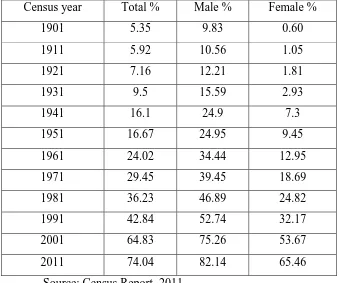
Census report of India indicates that literacy among women is only 65 percent. It is virtually
disheartening to observe that the literacy rate of women India is even much lower to national
average i.e. 74.04 .The growth of women‟s education in rural areas is very slow. This obviously
means that still large womenfolk of our country are illiterate, weak, backward and exploited.
Moreover education is also not available to all equally. Gender inequality is reinforced in
education which is proved by the fact that the literacy rate for the women is only 65% against
[image:4.612.137.476.316.599.2]82% of men as per 2011 Census.
Table 1: Census report of the year 2011
Census year Total % Male % Female %
1901 5.35 9.83 0.60
1911 5.92 10.56 1.05
1921 7.16 12.21 1.81
1931 9.5 15.59 2.93
1941 16.1 24.9 7.3
1951 16.67 24.95 9.45
1961 24.02 34.44 12.95
1971 29.45 39.45 18.69
1981 36.23 46.89 24.82
1991 42.84 52.74 32.17
2001 64.83 75.26 53.67
2011 74.04 82.14 65.46
Source: Census Report, 2011
In spite of the forceful intervention by a bastion of female privilege, feminist critics,
constitutional guarantees, protecting laws and sincere efforts by the state governments and
central government through various schemes and programmes over the last 65 years and above
terms of education is still in the state of an enigma in India for several reasons. According to the
Table-1 during the pre-Independence period literacy rate for women had a very poor spurt in
comparison to literacy rate of men. This is witnessed from the fact that literacy rate of women
has risen from 0.6 % to 7.3 % whereas the literacy rate of men has risen from 9.8 % to 24.9 %
during these four decades. During the post-independence period literacy rates have shown a
substantial increase in general. However the literacy rate of male has almost tripled over the
period e.g. 25% in 1951 and 82% in 2011.Surprisingly the female literacy rate has increased at a
faster pace than the male literacy during the decade 1981-2011. The growth is almost 7 times e.g.
9.45 % in 1951 and 65% in 2011. From this analysis one can infer that the female literacy rate is
lower than male literacy rate. The rate of school drop outs is also found to be comparatively
higher in case of women. This higher rate of illiteracy of women is undoubtedly attributing for
women dependence on men and to play a subordinate role. The lack of education is the root
cause for women‟s exploitation and negligence. Only literacy can help women to understand the Indian‟s constitutional and legislative provisions that are made to strengthen them. Thus
promoting education among women is of great important in empowering them to accomplish
their goals in different spheres of life.
Factors responsible for women’s illiteracy:
Women education is a multi-dimensional phenomenon. No single factor or cause can be held
responsible for very low literacy rate of women in India. Subsequently it is associated with
combination of many factors including social, cultural, economic, educational, demographic,
political and administrative and so on. The following are the some of the important factors which
could be attributed for the present poor state of affairs of womenfolk in education.
Low Enrolment:The lower enrolment of girls in schools is one of the foundational factors which
stand as stumbling block for women empowerment in India. Reliable sources indicate that more
than 50% of the Non-Starters (those who have never been to school) are girls. According to the
latest statistics, two out of every ten girls in the age group of 6-11 are still not enrolled in
schools.The incidence and prevalence of drop-outs among girls especially in rural, tribal and
slums areas seem to be quite high. According to available sources, occurrence of drop-out and
Negligence of girls’ education: In many families girl children play the role of second mother by
shouldering the responsibilities of household work such as looking after the sibling, fetching
water, collecting firewood, bringing fodder for cattle, cleaning, cooking and so on. In rural India
especially in poor families this traditional sex role makes girl child handicapped and conditioned
by the attitude of mother and the family and discourages girl child to go to school as it becomes
secondary. This social evil is a quite discouraging phenomenon which stands as barrier for girl‟s
education in rural areas for the underprivileged families of washer men and agricultural labour,
scheduled caste and scheduled tribes. Children belonging to low caste families are forced to learn
skills and work ways and not encouraged to go to school due to various factors in the sphere of
strict instruction /threat from high caste communities for their selfish motives of keeping them as
domestic servants and child labourers in the farms or factories.
Evil social practices:Dowry system and other social practices act as main causes of the neglect
of the girl child and discrimination against girl child including the deprivation of right of
education. In many families especially poor and down-trodden think that if their daughters are
educated more, they have to accumulate more assets and properties to provide as dowry in large
proportion at the time of marriage, so prefer rather to either stop their children with average
education and so on but never higher education. This prevails more in underprivileged families
and communities.
Child labour:A large segment of child population in India is engaged in child labour practices.
According to UN sources India is the most child labour populous nation in the globe with more
than 50 million child labourers indulged in carpet making, bricks, mining, quarrying, glass,
bangles, match and fireworks, gem polishing, handloom works, embroidery, coir industry,
domestic works, construction etc. In most of these industries girl children are preferred for high
productivity and low cost.
Defective school environment: In general the school environment for girls in India is not really
interesting and encouraging. The subjects taught in schools are also not related to the
environment of girl children. The methods of teaching are mostly outdated, rigid and
uninteresting. There are still hundreds of schools with poor basic amenities such as drinking
especially female teachers preferable for any parents for safety of their girl children from
different types of exploitation and abuse.
Early marriage:There is high association of female literacy with female age at marriage. By
and large the female age at marriage of 18 (recently 21 years) as prescribed by various
legislations not at all followed in India. It is very much ignored and neglected by the families of
parents with low literacy and illiteracy background. This obnoxious practice discourages female
children to continue their schooling and higher education as they enter into family life at the
early age which is not advisable from the physical and mental health point of view and also of
social development.The female child in Indian culture especially in rural, tribal and poor families
is expected to develop the qualities of inferiority; subservience and domesticity which place
sever limitations on her education and development.
Poverty:In many poverty stricken families, children especially girls are considered as
economic assets as they bring income for livelihood as well to save from economic crises due to
death or incapacity of parents. Indian constitution and various legislations pertaining to
education to children assure free and compulsory education to all children of this nation. But
unfortunately the enforcement machinery fails to discharge its duties and responsibilities to the
satisfaction of the public interest and welfare of women.
Miscellaneous: The high population growth rate, rapid urbanization, migration etc. also attribute
immensely for the poor literacy level of women and girls in India.
Strategies for ensuring girls’ education:
Since the prevailing situation of poor or less enrolment of girls in schools closes the doors for
development and prosperity of future generation of women, concerted efforts must be initiated
jointly by the government, parents and civil society to achieve universal enrolment for girls
without any compromise. The enrolment can be made even mandatory for every girl by the
government in the realm of compulsory education. . The Ministry of Education both at Centre
and State level should work out strategic steps to stop firmly the ongoing high drop-outs among
girls especially in rural, tribal and slums areas with the serious involvement of voluntary
organizations in every locality to realize zero drop-out among girls. The poverty stricken families
can be identified through proper research and necessary poverty alleviation services can be
and colleges without much financial difficulties. Child labour practices must be abolished with
strict administrative measures and the relieved children form bondage should be integrated into
schools with suitable defence social mechanism. Appropriate steps should be taken by the
educational authorities with the participation of communities in order to bring the girl children to
the main stream of education and development at every level including family and community.
The female child in every Indian family irrespective of socio-economic status should be moulded
to overcome the challenges of inferiority; subservience and domesticity which place sever
limitations on her education and development. Every family irrespective of its socio-cultural and
economic background can take it as a challenge to bring up their girl children as dignified human
being with empowerment in physical, mental, economic and social dimensions of life. The
Midday meal scheme and other educational supportive services like free text books, Note books,
Free uniforms, Free Bicycles, Free bus, scholarships and so on as done in the state of Tamil
Nadu can be provided in all states and union territories to lift up the literacy level among girls.
As social evils like dowry, child marriage, caste system and other practices deprive rights of
education for children belonging to poor and underprivileged families and communities, they
should be eliminated through well-designed packages of mass awareness programmes and social
welfare measures with full support of public, political parties, NGOs and government agencies.
The electronic and print media can play significant role in building a good and positive image
about girls and women in general in the society by giving no focus for such advertisements and
news fetching commercial gain at the cost of depicting women as an object. This would help in
changing the society‟s attitudes towards girls and their roles to treat every girl or woman as
human being with self-respect and dignity. Government, voluntary sector and philanthropic
organizations and individuals should come forward to provide free education for poor girls and
provide free hostel facilities for girls studying in schools and colleges in every state of India.
This will certainly encourage children of poor families to pursue good and higher education
without much impediments. The schools of social work, departments of women studies, Women
Universities and other educational institutions in hand with NGOs and social service
organizations such as Rotary Clubs, Lions Clubs, etc. can work together to improve the
educational status of the womenfolk in this country on mutual respect and understanding. The
proper social formula to help them to understand the significance of education for their girl
children as foundation for empowerment. Government, NGOs and public should work hand in
hand to implement the minimum age at marriage (21and above). The law enforcing machinery
should be made really effective with efficient monitoring vigilant system to implement the
constitutional and legislative provisions and administrative measures to assure free and
compulsory education for all children of this nation without any gender discrimination.
One of the recommendations of National Policy on Education (1986) by the Government of India
is to promote empowerment of women through the agency of education and it is considered to be
a land mark in the approach to women‟s education of illiterate. The National Literacy Mission is
another positive step towards eradication of illiteracy in the age group of 15-35 years. Women‟
education has assumed special significance in the context of India‟s planned development, as it is
incorporated in every Five-year plans as the major programme for the development of women.
Universalization of elementary education, enrolment and retention of girls in the schools,
promotion of balwadies and crutches, raising number of schools and colleges of arts , science,
and professional for girls, politechniques, girls hostels, multipurpose institutions and adult
education programmes are some of the steps being taken by both central and state governments
in India to boost-up women‟s education.
The Government of India had ushered in the new millennium by declaring the year 2001 as
„Women‟s Empowerment Year‟ to focus on a vision where women are equal partners like men. The most common explanation of women‟s empowerment is the ability to exercise full control
over one‟s actions. The last decades have witnessed some basic changes in the status and role of
women in our society. There has been shift in policy approaches from the concept of „welfare‟ in
the seventies to „development‟ in the eighties and now to „empowerment‟ in the nineties. This
process has been further accelerated with some sections of women becoming increasingly
self-conscious of their discrimination in several areas of family and public life. They are also in a
position to mobilize themselves on issues that can affect their overall position.
Conclusion:
Women play a very important role in every society. They are regarded as the mother of the race.
The women also have the right to live with dignity. It is inhumane to discriminate women in
society. Women are equally responsible for progress of any society. Thus women should be
empowered in all spheres of their life. Empowerment would become more relevant if women are
educated, better informed and can take rational decisions. It is also necessary to sensitize the
other sex towards women. It is important to usher in changes in societal attitudes and perceptions
with regard to the role of women in different spheres of life. A clear vision is needed to remove
the obstacles to the path of women‟s emancipation both from the government and women
themselves. Efforts should be directed towards all round development of each and every section
References:
1. Chaudhary J. A textbook of Human Rights. Wisdom Press - New Delhi (2011).
2. Deka B., Goswami M.& Ali L. Educational Essays on Higher Education. Ashok
Book Stall-Guwahati (2007).
3. Desai N.&KrishnarajM. Women and Society in India. Ajanta Publication (1987).
4. Government of India: Census of India2011, Government of Indi- New Delhi.
5. Hossain N.&, Naila K. (2004). Achieving Universal Primary Education and
Eliminating Gender Disparity.Economic and Political Weekly, September 4,
P.4093-4099.
6. Khanna S.D., Saxena V.K., Lamba T.P. & Murthy V. Current Problems of Indian
Education. Doaba House-New Delhi (1986).
7. Johri B.P. &Pathak P.D. Development of Educational System in India.Agrawal
Publication-Agra (2009).
8. Thakur J. S. Women and Development- the changing scenario. Mittal Publication