INTRODUCTION
Poly(amide-imide)s, PAIs, are a class of high-performance polymers, which show excellent mechanical and thermal properties and are also solvent resistant1-3. There are numerous applications for them, which include electronic wire enamel adhesives, injection-moulding and extrusion products and membranes4-7. They inherit desirable characteristics from both polyamide and polyimides and possess good thermal properties compared to polyamide, and better melt process-ability than polyimides. Many approaches have been investigated in attempting to improve the solubility of aromatic polyimides including the addition of pendant groups to polymeric
8-9 10-12
www.orientjchem.org
Est. 1984
An International Open Free Access, Peer Reviewed Research Journal CODEN: OJCHEG 2012, Vol. 28, No. (4): Pg. 1645-1650
Synthesis and Characterization of New
Copoly(amide-imide)s and Copoly amides with
Azo Groups in their Main Chains
SHAHAB ZOMORODBAKHSH*, HAYRON-NESA MOTEVASEL ,
EHSAN TAVAHODI, HOSSEIN ANARAKI - ARDAKANI and EBRAHIM BALALI
Department of Chemistry, Mahshahr Branch, Islamic Azad University, Mahshahr, Iran. *Corresponding author E-mail: [email protected]
(Received: September 29, 2012; Accepted: November 10, 2012) ABSTRACT
New aromatic copoly(amide-imide)s with high inherent viscosities were prepared by direct polycondensation reaction of diacides 2 or 5 and 4-nitro-1,2-phenylendiamine and three different derivatives of diacides 7 as a second diacides using triphenyl phosphite in N-methyl-2-pyrrolidone (NMP)/pyridine solution containing dissolved CaCl2. Their decomposition temperatures at 10% weight loss in nitrogen atmosphere were above 165 ºC and the anaerobic char yield at 600 ºC ranged from 46% to 74%. These polymers were readily soluble in various organic solvents and by their casting into transparent, tough and flexible films can be easily achieved.
Key words: Copoly(amide-imide)s (CPAIs), Polycondensation, Characterization, Thermostability.
flexible13-15 and heterocycles16-18 unit within the parent chain.
Azo-containing polymers are macromolecules with azo groups in the main chain or side chain. Polymers with azobenzene moiety have good stability and usually show high glass transition temperature (Tg). Introducing azobenzene linkages in the polymeric main chain can improve thermal stability and allow broad application as an engineering plastic18-20.
derivatives of diacides 7 as a second diacides by using N-methyl pyrrolidone ( NMP), triphenyl phosphite and pyridine as condensing agents.
Due to the presence of azo group and aromatic ring on the Copoly(amide-imide) backbone, they may have good thermal stability. The solubility, thermal properties and tensile properties of the PAIs are described herein.
EXPERIMENTAL Materials
All chemicals were purchased from Fluka Chemical Co. (Switzerland), Aldrich Chemical Co. (Milwaukee, WI, USA) and Merck Chemical Co. (Germany).
Techniques
Fourier transform infrared (FTIR) spectra were recorded on a Galaxy series FTIR 5000 spectrophotometer (England). Spectra of solids were obtained using KBr pellets. Vibrational transition frequencies were reported in wave number (cm-1). Band intensities were assigned as weak (w), medium (m), shoulder (sh), strong (s) and broad (br). Inherent viscosities were measured by a standard procedure using a Technicor Viscometer. Thermal gravimetric analysis (TGA and DTG) data for polymers were recorded on a Mettler TA4000 System under N2 atmosphere at a rate of 10 æ%C/ min. Elemental analyses were performed by the Arak Petrochemical Company, Arak, Iran.
Monomer synthesis
4,4iAzodibenzoic Acid [4,4í -Azodibenzenedicarboxylic Acid] 2
4-Nitrobenzoic acid 1 (13 g, 0.079 mol) was heated in sodium hydroxide solution (50 g in
250 mL) at 50°C. A solution of glucose (100 g in 150 mL of water) was added slowly at this temperature with occasional shaking. The reaction mixture was then cooled to ambient temperature and aerated for 8 h with vigorous stirring until orange crystals were formed. The mixture was acidified with dilute acetic acid. The liberated diacid was filtered, washed with water and dissolved in hot potassium carbonate solution to obtain orange coloured solution. This solution was concentrated to obtain orange crystals of potassium salt of diacid. On acidifying with dilute acetic acid, 18 gr (86 %) of rose coloured
4,4í-azodibenzoic acid 2 was obtained, mp > 400°C, 1579 (s), 1410 (s), 1300-1200 (s, br), 1100-1000 (s, br), 868 (s), 777 (s) cm-1. Analysis: Calculated for C14H10N2O4: C, 62.24; H, 3.70; N, 10.36; found: C, 62.4 ; H, 3.8 ; N, 10 .FTIR (KBr): 3600-2900 (m, br), 1669 (s, br), 1614 (s).
2-(4-carboxyphenyl)-1,3-dioxoisoindoline-5-carboxylic acid 5
Into a 250-mL, round-bottom flask, 0.5 g (2.5 mmol) of trimellitic anhydride (3), 0.34 g (2.5 mmol) of 4-aminobenzoic acid (4), 20 mL of acetic acid and a stirring bar were placed. The mixture was stirred at room temperature overnight and then was refluxed for 4 h. The solvent was removed under reduced pressure, and the residue was dissolved in 100 mL of cold water; then, 5 mL of concentrated HCl was added. The solution was stirred until a white precipitate was formed, and then the precipitate was filtered off and dried; this yielded 4.95 g (90.3%) of white crystals (3). mp: 373–374°C. FTIR (KBr): 3100– 2200 (m, br), 1770(sh), 1720 (s), 1710(m),1405(m),1400-1610(s), cm_1. Anal. Calcd for C16H9NO6 :C, 61.74; H, 2.91; N, 4.50%. Found: C, 61.8; H, 2.7; N, 4.6 %.
Polymer synthesis
Copoly(amide-imide)s 8a-c were synthesized by a typical procedure shown in Figure 2. A mixture of (1mmol) of diacid 2 and (1mmol) of 4-nitro-1,2-phenylendiamine 6, and (1mmol) diacides 7 as a second diacides , 0.6gr of calcium chloride, 5ml of N-methyl pyrrolidone ( NMP), 1ml of pyridine, and 1ml of triphenyl phosphite was heated with stirring at 140 oC for 4h. After cooling,
the resulting viscous reaction mixture was poured into rapidly stirred 200 ml methanol. The precipitated polymer was filtered, washed with methanol and hot water and dried under vacuum at 80°C for 12 h.
Furthermore, Copolyamide 9a-c was prepared by the above procedure.
NH2 N
H2
NO2
N H
NO2 N
H
O O
R O N
O
O O
O
O
H R
O
O
H H
(CH2)4 R =
O OH N
O
O HO2C
+ +
5 6 7
9
a b c
Fig. 2:
RESULTS AND DISCUSSION Polymer Synthesis
The CPAIs (8a–c) or (9a–c) and were synthesized by the direct solution polycondensation reactions of an equimolar diazo dicarboxylic acid
stringy precipitates formed when the viscous CPAIs solutions were trickled into stirred methanol. All the copolymers were obtained in quantitative
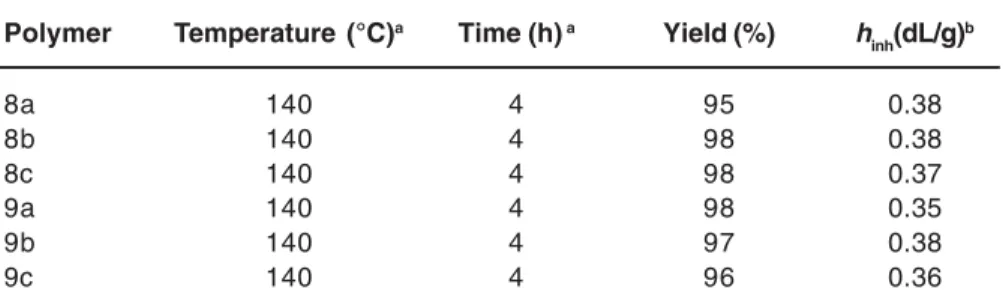
y i e l d s w i t h m o d e r a t e i n h e r e n t v i s c o s i t i e s between of 0.36-0.38 dL/g.
Table 1: Synthesis and some physical properties of CPAIs (8a-f) and (9a-f) Polymer Temperature (°C)a Time (h) a Yield (%) h
inh(dL/g) b
8a 140 4 95 0.38
8b 140 4 98 0.38
8c 140 4 98 0.37
9a 140 4 98 0.35
9b 140 4 97 0.38
9c 140 4 96 0.36
bMeasured at a concentration of 0.5 g/dL in DMF at 25°C
Polymer Characterization
The representative FT-IR spectrum of copoly(amide-imide)s 8a is shown in Figure 3. The copolymer shows absorption bands at 1726-1636 cm-1 due to imide, amide and ester carbonyl groups. Absorption bands around 1410-1341 and 730-710 cm-1 show the presence of imide heterocycle in this
polymer. Absorption bands around 1262-1000 cm-1 which correspond to C-O stretching frequencies of ester. The other spectra show a similar pattern (See Table 2. The elemental analysis values of the resulting copolymers were in good agreement with the calculated values for the proposed structures (Table 3).
Table 2: The FT-IR Spectra of Copoly(amide-imide)s 8a-c and 9a-c Copolymer FT-IR spectra (cm-1)
8a 3493, 3378, 1726, 1636, 1599, 1570, 1522, 1467, 1410, 1341, 1226 8b 3437, 3374, 1642, 1599, 1520, 1408, 1335, 1248
8c 3470, 3359, 1638, 1602, 1521, 1473, 1412, 1341, 1248 9a 3477, 3378, 1720, 1661, 1593, 1569, 1523, 1340, 1340, 1226 9b 3488, 3374, 1720, 1656, 1592, 1514, 1410, 1342, 1248 9c 3460, 3373, 1720, 1662, 1592, 1516, 1342, 1248
Table 3: Elemental Analysis of Copoly(amide-imide)s 8a-c and 9a-c
Copolymer Formula C% H% N%
8a C17H11N4O4 calc 60.89 3.28 16.71
(335)n found 59.17 3.05 14.36
8b C15H10N4O4 calc 59.06 3.22 18.06
(310)n found 56.45 2.73 16.53
8c C15H10N4O4 calc 58.06 3.22 18.06
(310)n found 57.56 2.54 16.58
9a C18H10.5N3.5O5 calc 60.75 2.95 13.78
(355)n found 57.59 2.73 11.48
9b C16H9.5N3.5O5 calc 58.09 2.87 14.82
(330.5)n found 54.77 2.69 12.48
9c C16H9.5N3.5O5 calc 58.09 2.87 14.82
Solubility
The solubility behaviors of copoly (amide-imide)s 8a-c and 9a-c were investigated as 0.01 g of polymeric sample in 2 mL of solvent. All of the polymers are soluble in organic solvents such as DMF, DMAc, DMSO, NMP and H2SO4 at room temperature, but insoluble in solvents such as THF, acetone, chloroform, methylene chloride, methanol, ethanol and water
Thermal Properties
The thermal properties of copolymers 8a-c and 9a-8a-c were investigated by means of
Fig. 3: FT-IR Spectrum of polymer 8a
thermogravimetric analysis (TGA) and derivative thermogravimetric (DTG) analysis in a nitrogen atmosphere at a heating rate of 10°C/min (Table 2). Initial decomposition temperature, 5% and 10% weight loss (T5, T10) and char yields at 600°C for these samples are summarized in Table 4.
Copolyamide 8a exhibited good resistance to thermal decomposition up to 180-185°C in nitrogen and began to decompose gradually above that temperature. The char yield for this polymer at 600°C was 59.96% in nitrogen (Figure 4).
Fig. 4: TGA & DTG of copolyamide 8a Table 4: Thermal behavior
of copolyamides 8a-c and 9a-c Polymer T5 (°C)a T
10 (°C)
b Chard Yieldc
8a 180-185 310-315 59.96
8b 160 220-225 56.47
8c 130-135 165-170 57.57
9a 149-145 215-220 74.35
9b 165-170 270-275 47.02
9c 160-165 220-225 46.15
a,b Temperature at which 5% or 10% weight loss respectively was recorded by TGA at a
heating rate of 10 °C/min in N 2
.
CONCLUSIONS
A new copolyamide (8), (9) containing azo group in the main chain was synthesized by polycondensation reaction of an equimolar mixture of diacides 2 or 5 and 4-nitro-1,2-phenylendiamine and three different derivatives of diacides 7 as a second diacides. This copolymer showed good solubility and thermal stability characterized by thermal gravimetric analysis (TGA and DTG).
REFRENCES
1. Cassidy P.E., Thermally Stable Polymers, Synthesis and Properties, Marcel & Dekker, New York (1980).
2. Critchly J.P., Knight G.J., and Wright W.W., Heat Resistant Polymers, Plenum, New York (1983).
3. Billerbeck C.J. and Henke S.J., Engineering Thermoplastics, Marcel & Dekker, New York (1985).
4. Rami Reddy A.V., Sreenivasulu Reddy P., and Anand P.S., Eur. Polym. J., 34: 1441-1445 (1998).
5. R. Indira, T. Tamizharuvi and V. Jaisankar, Orient J. Chem. 28(3): 1479-1487 (2012). 6. Fritsch D., Peinemann K.V., J. Membrane Sci.,
99: 29-38 (1995).
7. Simmons J.W. and Ekiner O.K., , US Patent 5: 232, 472 (1993).
8. Yang C.P. and Wei C.S., Polymer, 42: 1837-1848 (2001).
9. Zheng H.B., Qi Y, Wang Z.Y., and Jian X.G., , J. Polym. Sci. Part A, Polym, Chem., 37: 4541-4545 (1999).
10. Chern Y.T., Shiue H.C., and Kao S.C., , J. Polym. Sci. Part A, Polym, Chem., 36: 785-792 (1998).
11. Bender T.P. and Wang Z.Y., , J. Polym. Sci. Part A, Polym, Chem., 36: 1349-1353 (1998). 12. Yang C.P., Hsiao S.H., and Yang C.C., J. Polym. Sci. Part A, Polym, Chem., 36: 919-927 (1998).
13. Im J.K. and Jung J.C., Polymer, 41: 8709-8716 (2000).
14. Liaw D.J., Liaw B.Y., and Chen Y.S., , Polymer, 40, 4041-4047(1999).
15. Bennabi Lamia, Bebarbi Lahcen, Bousabem Smain and Abederrezak Mesbi, Orient J. Chem. 27(2): 537-543 (2011).
16. Mallakpour S.E., Hajipour A.R., Faghihi Kh., Foroughifar N., and Bagheri J., J. Appl. Polm. Sci., 80: 2416-2421 (2001).
17. Bruma M., Hamciuc E., Schulz B., Kopnick T., Stiller B., and Mercer F., Polymer, 40: 6865-6871 (1999).
18. Mikroyannidis J.A., , J. Polym. Sci. Part A, Polym. Chem., 35: 1535-1361 (1997). 19. Faghihi K., Fouroghifar N., Hajibeygi M. and
Mallakpour, Sh. Iranian Polym. J., 12, 339 (2003).
20. Faghihi K and Hajibeygi, M. Eurpean Polym. J. 39, 2307 (2003).
ACKNOWLEDGMENTS