Open Access Journal of Sports Medicine
Dove
press
O r i g i n A l r e S e A r c h
open access to scientific and medical research
Open Access Full Text Article
Do physiological measures predict selected
crossFit
®
benchmark performance?
Scotty J Butcher1,2
Tyler J neyedly3
Karla J horvey1
chad r Benko2,4 1Physical Therapy, University of Saskatchewan, 2BOSS Strength institute, 3Physiology, University of Saskatchewan, 4Synergy Strength and conditioning, Saskatoon, SK, canada
correspondence: Scotty J Butcher School of Physical Therapy, University of Saskatchewan, 1121 college Dr, Saskatoon, SK, S7n 0W3, canada Tel +1 306 966 1711
Fax +1 306 966 6575 email [email protected]
Purpose: CrossFit® is a new but extremely popular method of exercise training and competition
that involves constantly varied functional movements performed at high intensity. Despite the popularity of this training method, the physiological determinants of CrossFit performance have not yet been reported. The purpose of this study was to determine whether physiological and/ or muscle strength measures could predict performance on three common CrossFit “Workouts of the Day” (WODs).
Materials and methods: Fourteen CrossFit Open or Regional athletes completed, on separate days, the WODs “Grace” (30 clean and jerks for time), “Fran” (three rounds of thrusters and pull-ups for 21, 15, and nine repetitions), and “Cindy” (20 minutes of rounds of five pull-ups, ten push-ups, and 15 bodyweight squats), as well as the “CrossFit Total” (1 repetition max [1RM] back squat, overhead press, and deadlift), maximal oxygen consumption (VO2max), and Wingate anaerobic power/capacity testing.
Results: Performance of Grace and Fran was related to whole-body strength (CrossFit Total) (r=−0.88 and −0.65, respectively) and anaerobic threshold (r=−0.61 and −0.53, respectively); however, whole-body strength was the only variable to survive the prediction regression for both of these WODs (R2=0.77 and 0.42, respectively). There were no significant associations
or predictors for Cindy.
Conclusion: CrossFit benchmark WOD performance cannot be predicted by VO2max, Wing-ate power/capacity, or either respiratory compensation or anaerobic thresholds. Of the data measured, only whole-body strength can partially explain performance on Grace and Fran, although anaerobic threshold also exhibited association with performance. Along with their typical training, CrossFit athletes should likely ensure an adequate level of strength and aerobic endurance to optimize performance on at least some benchmark WODs.
Keywords: strength, aerobic, anaerobic, high-intensity, training, exercise, functional
Introduction
CrossFit® (CrossFit, Inc., Washington, DC, USA) is a relatively new but extremely
popular form of multimodal exercise training that encompasses many types of func-tional movement patterns within a single exercise session, conducted at high intensity.1
These types of exercises are incorporated group workout sessions called “Workouts of the Day”, or WODs, usually involving a combination of movements performed in a circuit format with little to no rest periods. Although the structure of each session will vary between affiliates, each session is typically 1 hour and comprises of a specific warm-up, strength and/or skill technique work, a programmed strength or conditioning workout for 10–30 minutes, and cool down and/or mobility work. Despite CrossFit, Inc. affiliating over 11,000 gyms, and the over 200,000 athletes participating in the 2014
Open Access Journal of Sports Medicine downloaded from https://www.dovepress.com/ by 118.70.13.36 on 26-Aug-2020
For personal use only.
Number of times this article has been viewed
This article was published in the following Dove Press journal: Open Access Journal of Sports Medicine
Dovepress
Butcher et al
CrossFit Open, there is very little reported in the literature regarding the physiological aspects of CrossFit training or performance.
Within the currently available literature, CrossFit training has been shown to elicit a high acute cardiovascular training response2 as well as large increases in aerobic and anaerobic
performance,3,4 while being time-efficient and enjoyable.5
Despite the emergence of these few studies, there remains a paucity of research examining the performance of CrossFit tests, or benchmarks, or of the physiological requirements of CrossFit sport competition. CrossFit benchmark WODs are designed to be reflective of multiple dimensions of physical fitness and are usually performed and repeated often within an athlete’s training cycle to monitor progress. In other sports, progress is often monitored by physiological and/or fitness tests, and their performance can be partially predicted by physiological and/or muscle performance data.6,7 Given that
CrossFit competition involves using many aspects of fitness in a sport environment, it is possible that performance can be at least partially explained by physiological measures, which would have implications for directing training pro-gram design.
The purpose of this study was to determine the physiolog-ical predictors of performance in three CrossFit benchmark workouts performed by competitive CrossFit athletes. We hypothesized that: 1) physiological performance measures of maximal oxygen consumption (VO2max), anaerobic threshold (AT), respiratory compensation threshold (RCT), anaerobic power and capacity, or 1 repetition max (1RM) back squat, press, and deadlift strength would be related to CrossFit benchmark workouts “Grace”, “Fran”, and “Cindy” and 2) physiological parameters could partially predict Cross-Fit benchmark workout performance.
Materials and methods
Participants
Fourteen participants were recruited from CrossFit affili-ates in the Canada West Region and had at least 1 year of CrossFit training experience. Participants competed in the 2014 CrossFit Open and/or Regional competitions and could perform the benchmark workouts with the pre-scribed loads. Nine participants completed the Open only, and five participants were also Regional competitors. All participants gave written consent for the study, which was approved by the University of Saskatchewan Biomedical Ethics Review Board in the spirit of the Declaration of Helsinki. Participants were excluded if they reported any cardiovascular, respiratory, or musculoskeletal concerns that
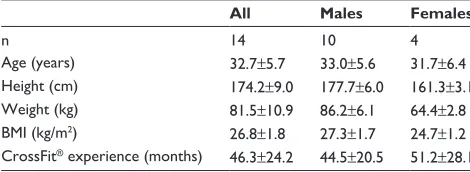
would limit their ability to perform high-intensity exercise. Participant characteristics are presented in Table 1.
Design
This study had a descriptive design, whereby participants completed three phases of data collection, including screen-ing, the completion of CrossFit benchmark workouts, and physiological testing. Phase 1 included screening of par-ticipants with the Physical Activity Readiness Questionnaire (PAR-Q)8 to determine the eligibility for the study, and
report-ing of their total number of months of dedicated CrossFit training experience, which was recorded for the analysis.
In phase 2, participants performed four CrossFit bench-mark workouts. The three common benchbench-marks used as dependent variable for the analysis of performance were the Fran, Cindy, and Grace workouts. In addition, partici-pants’ maximal strength was assessed using the benchmark “CrossFit Total”. Each of these workouts is described in more detail below.
Phase 3 of testing involved participants performing two physiological performance measurements – a VO2max test and the 30-second Wingate Anaerobic Test (WAnT) – as described below. VO2max testing was performed at the Inte-grative Clinical Exercise Physiology Lab at the University of Saskatchewan. The WAnT was performed at one of the CrossFit affiliates by research staff.
Methodology
Benchmark workouts
The CrossFit benchmark workouts were selected as common workouts in CrossFit that theoretically represent a range of aerobic, anaerobic, and muscle performance variables. While all benchmark workouts likely have components of each of the predominant energy systems and of muscle strength and/ or power, we can speculate that each benchmark would have greater elements of one or more components and that the use of different benchmarks may elicit different results. Fran is a fast WOD that likely has more anaerobic components, Grace
Table 1 Participant characteristics
All Males Females
n 14 10 4
Age (years) 32.7±5.7 33.0±5.6 31.7±6.4
height (cm) 174.2±9.0 177.7±6.0 161.3±3.1
Weight (kg) 81.5±10.9 86.2±6.1 64.4±2.8
BMi (kg/m2) 26.8±1.8 27.3±1.7 24.7±1.2
crossFit® experience (months) 46.3±24.2 44.5±20.5 51.2±28.1
Note: The values are expressed as mean ± SD.
Abbreviations: BMi, body mass index; SD, standard deviation.
Open Access Journal of Sports Medicine downloaded from https://www.dovepress.com/ by 118.70.13.36 on 26-Aug-2020
Dovepress crossFit physiology and performance
is a repeated power WOD that likely has aerobic, strength, technique, and anaerobic elements, and Cindy likely has aerobic and muscle endurance elements. Each workout was performed at the participant’s home affiliate under the supervision of, and scored by, a CrossFit Level 1 trainer and/or certified CrossFit coach, to ensure the movement and workout standards were met. All participants performed the prescribed exercises and workouts with no modifications or scaling. Participants were asked to complete these workouts on separate days following at least 48 hours of recovery from a previous workout.
“Fran”
This workout is a couplet of barbell thrusters (a front squat to push press) and pull-ups following a 21-15-9 repetition scheme, where 21 thrusters were completed, then 21 pull-ups completed, 15 thrusters and 15 pull-pull-ups, nine thrusters, and nine ups completed for time. Variations of pull-ups, including butterfly and kipping, were encouraged. Thrusters were performed with 43.2 kg for males and 29.5 kg for females. The time to complete all repetitions was recorded.9
“cindy”
A triplet of five repetitions of pull-ups, ten repetitions of push-ups, and 15 repetitions of bodyweight squats made up one round of Cindy. Participants had 20 minutes to complete as many rounds and repetitions as possible. Total rounds and repetitions were scored and converted to total number of repetitions in 20 minutes for the analysis.9
“grace”
In Grace, 30 clean and jerks are performed for time. Power cleans or full cleans and jerk, push jerk, and split jerk varia-tions were allowed. Male participants were required to use 61.4 kg and females to use 43.2 kg.10
“crossFit Total”
In the CrossFit Total, participants were given 90 minutes to find, under supervision, their 1RM for back squat, press, and deadlift. For each lift starting with the back squat, an indi-vidually progressed 10-minute warm-up for each lift began at approximately 50% of participants’ previously known or esti-mated 1RM. After the lift-specific warm-up, participants were allowed three attempts to reach a 1RM, with 3–5 minutes rest encouraged between attempts. This procedure was also used for the press and deadlift. The individual 1RM loads were summed to determine overall score.11
Physiological testing
Testing for aerobic and anaerobic performance was com-pleted at two separate sessions. Participants were asked to not train for at least 48 hours prior to each test session.
VO2max
An individualized test of VO2max, as a measure of aerobic power, was performed on a Trackmaster TMX 425C tread-mill (Trackmaster, Newton, KS, USA), using a TrueOne Metabolic Cart (ParvoMedics, Sandy, UT, USA) for the collection of respiratory gases, and a Polar heart rate (HR) monitor (Polar Electro Canada; Lachine, QC, Canada) for measuring HR. After a standardized warm-up of 3 minutes at 5.5 kph and 1.0% grade, the test began with a speed of 7.5 kph and 1.0% grade. The speed was increased by 1.0 kph until participants reached a self-determined fast but com-fortable running pace. Once the desired speed was selected, the grade was increased 1.5% every minute until volitional exhaustion. The participant was asked to rate their rate of perceived exertion (RPE) on a modified ten-point Borg Scale.12 Maximum HR, RPE, and respiratory exchange ratio
(RER) values were used to determine whether a maximal test had been completed. If any two out of the following three measures was attained, the test was deemed maximal: 1) over 90% of predicted maximal HR, calculated as
Maximum HR = 220 – participant’s age; (1)
2) RER over 1.1; and 3) RPE greater than 8/10. Respi-ratory data was used to calculate the VO2 at AT, at RCT, and at maximum.13 AT and RCT were used as measures of
aerobic capacity.
WAnT
The WAnT was performed per standardized procedures,14
using 10% of participants’ bodyweight for the brake weight applied to the flywheel. Participants completed a self-paced 5-minute warm-up on the cycle ergometer (Monark 894 E; Monark, Vansbro, Sweden). Continual standardized encour-agement was given to the participant throughout the test. The fixed 5-second average maximum (anaerobic power), minimum, and 30-second mean power outputs (anaerobic capacity), as well as the fatigue index, calculated as
Fatigue index maximum minimum
maximum 100
=( power− power)
power × ,,
(2)
were used in the analysis.
Open Access Journal of Sports Medicine downloaded from https://www.dovepress.com/ by 118.70.13.36 on 26-Aug-2020
Dovepress
Butcher et al
Statistical analysis
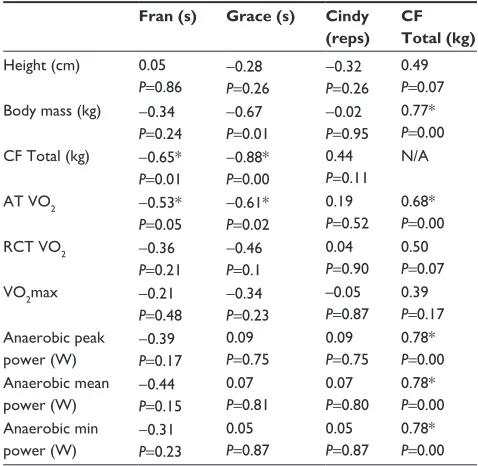
Data analysis was performed with Statistica 8.0 (StatSoft, Tulsa, OK, USA). Simple Pearson’s r correlations were used to determine the associations between benchmark perfor-mance data, and the physiological and strength measures. For each of the dependent benchmark variables, a forward stepwise linear regression model was created using the significant correlative data. The probability of F used for variables to enter the model was less than or equal to 0.05, and to remove variables was greater than or equal to 0.10. Multicollinearity was assessed by examining each signifi-cant variable in an independent regression model. Statistical significance was set a priori at an alpha of 0.05. The data is reported as mean and standard deviation, unless otherwise indicated.
Results
Performance data and correlations
The performance measurements are shown in Table 2, and the correlations between independent and dependent variables are shown in Table 3. The results demonstrate that the bench-marks Grace and Fran correlated strongly with the strength data (CrossFit Total) as well as with the oxygen consumption at AT but not the remaining physiological data. There were no significant associations for Cindy.
Performance regression
The results of the linear regression are presented in Table 4. For both Grace (Figure 1) and Fran (Figure 2), the only predictor of performance was the CrossFit Total. Laboratory physiological data had no further impact on either prediction.
For Cindy, there was no measured variable that survived the regression analysis.
Discussion
The overall purpose of this study was to determine the physiological predictors of performance across three CrossFit benchmark workouts. We hypothesized that physiological performance measures of aerobic, anaerobic, and strength performance would be related to benchmark workouts and that the physiological measurements would predict perfor-mance in benchmark workouts. Our data indicated partial, not full, support for our hypotheses. There were only small associations between some of the physiological data and benchmark performance (AT for Grace and Fran); however, this physiological data did not predict CrossFit benchmark
Table 2 Performance data
Mean SD Range
AT (ml/kg/min) 47.2 4.3 40.5–52.6
rcT (ml/kg/min) 51.2 4.9 44.0–58.4
VO2max (ml/kg/min) 54.7 5.6 46.3–64.7
Anaerobic peak power (W) 953 222 565–1,180
Anaerobic mean power (W) 710 161 435–903
Anaerobic min power (W) 460 85 305–620
Fatigue index (%) 50.6 6.5 38.0–58.0
crossFit® Total (kg) 401.5 83.1 240.9–548.6
Press (kg) 69.1 16.6 38.6–93.2
Squat (kg) 147.0 36.6 88.6–220.5
Deadlift (kg) 185.4 32.8 113.6–235.0
grace (seconds) 136 32 93–194
Fran (seconds) 203 48 130–289
cindy (repetitions) 698 113 489–1,010
Abbreviations: AT, VO2 at anaerobic threshold; rcT, VO2 at respiratory
compensation threshold; SD, standard deviation; VO2max, maximal oxygen consumption; min, minimum.
Table 3 correlations between crossFit® benchmark performance and physiological measures
Fran (s) Grace (s) Cindy
(reps) CF Total (kg)
height (cm) 0.05
P=0.86
−0.28
P=0.26
−0.32
P=0.26 0.49
P=0.07 Body mass (kg) −0.34
P=0.24
−0.67
P=0.01
−0.02
P=0.95
0.77*
P=0.00 cF Total (kg) −0.65*
P=0.01
−0.88*
P=0.00
0.44
P=0.11 n/A
AT VO2 −0.53*
P=0.05
−0.61*
P=0.02
0.19
P=0.52
0.68*
P=0.00
rcT VO2 −0.36
P=0.21
−0.46
P=0.1
0.04
P=0.90 0.50
P=0.07
VO2max −0.21
P=0.48
−0.34
P=0.23
–0.05
P=0.87 0.39
P=0.17 Anaerobic peak
power (W)
−0.39
P=0.17
0.09
P=0.75
0.09
P=0.75
0.78*
P=0.00 Anaerobic mean
power (W)
−0.44
P=0.15
0.07
P=0.81
0.07
P=0.80
0.78*
P=0.00 Anaerobic min
power (W)
−0.31
P=0.23
0.05
P=0.87
0.05
P=0.87
0.78*
P=0.00
Note: *significant correlation P,0.05.
Abbreviations: AT VO2, VO2 at anaerobic threshold; cF, crossFit®; min, minimum;
rcT VO2, VO2 at respiratory compensation threshold; VO2max, maximal oxygen consumption; reps, repetitions; s, seconds.
Table 4 regression analysis for crossFit® benchmark workouts Fran and grace
Fran Grace
R2 0.42 0.77
P 0.01 0.00
β −0.65 –0.88
Se of β 0.22 0.14
Partial eta2 0.42 0.77
Observed power 0.78 0.99
Note: There were no significant regression variables for the benchmark Cindy.
Abbreviation: Se, standard error of the mean.
Open Access Journal of Sports Medicine downloaded from https://www.dovepress.com/ by 118.70.13.36 on 26-Aug-2020
Dovepress crossFit physiology and performance
performance for any of the workouts utilized in this study. The stronger associations were between the composite total body strength score, as measured by the CrossFit Total, and benchmark performance, and the CrossFit Total was the only predictor of performance in the benchmark workouts Fran and Grace.
In our selected benchmark CrossFit workouts, whole-body strength played an important role in determining per-formance, more so than the physiological data. The measure of whole-body strength, the CrossFit Total, explained 77% and 42% of the variance in Grace and Fran, respectively,
although not in Cindy. Although the exercises themselves in both Grace and Fran are different from those in the Cross-Fit Total, all three workouts were barbell-based. The skill required to perform well on barbell exercises may partially explain the closer association among these three workouts than with the nonbarbell workout, Cindy. In addition, whole-body strength is very important for many sports15 and in
particular, when the intensity of the sport/activity is high6,16
compared with lower intensity, longer duration activity.7
When examining the role of strength in the sport of weight-lifting, performance of the clean and the snatch can be each
215
195
175
155
135
115
95
75
200 250 300
R=−0.88 P=0.00
350 400 450
CF Total (kg)
Grace (seconds)
500 550 600
Figure 1 Association between grace and crossFit® Total.
Abbreviation: cF, crossFit.
240 260 280 300
220
200
180
160
140
120
100
200 250 300
R=−0.65 P=0.01
350 400 450
CF Total (kg)
Fran (seconds)
500 550 600
Figure 2 Association between Fran and crossFit® Total.
Abbreviation: cF, crossFit.
Open Access Journal of Sports Medicine downloaded from https://www.dovepress.com/ by 118.70.13.36 on 26-Aug-2020
Dovepress
Butcher et al
highly explained by the athletes’ 1RM back squat strength.17
Stone et al17 found that back squat strength explained 87%
of the variance in the 1RM performance of the clean. This prediction is slightly higher than that obtained in the present study for the clean- and jerk-based Grace, which is likely explained by the fact that Grace is repeated for 30 repetitions and likely has an element of fatigue tolerance not captured purely by strength data or the physiological data collected for this study. Fatigue across multiple repetitions of strength exercises reduces the efficiency of biomechanical technique and may have an impact on lifting performance.18 In contrast,
whole-body strength did not play an important role in the performance of the bodyweight movement workout Cindy. It is possible that because performance of Cindy involves the difficult bodyweight movement pull-ups and push-ups, specific strength in these movements or other physiological measures may play more important roles than the movements tested in the CrossFit Total and the physiological measures used in this study. Further study is required to determine the validity of this proposition.
Given that the CrossFit is the self-proclaimed “Sport of Fitness”,1 the lack of association between the
physiologi-cal fitness data collected in this study and the benchmark workouts is somewhat surprising. However, CrossFit defines fitness as the development of increased work capacity across broad time and modal domains,1 rather than as single or a
combination of traditional fitness measures, such as VO2max or anaerobic capacity. Contrary to our hypotheses, our data support the assertion that these traditional measures cannot adequately predict performance for the benchmarks assessed. The only associations, albeit moderate ones, between Cross-Fit benchmark performance and our physiological data were with AT for Grace and Fran. These associations support pre-vious findings of a limited importance of the aerobic energy system in optimal performance of higher intensity, repeated anaerobic work.19–21 Because different CrossFit benchmark
WODs, as well as those programmed for CrossFit compe-titions, such as the CrossFit Games, likely have different physiological demands, the results of our study are not be applicable across all WODs. For example, WODs with a run-ning component, such as “Helen” (400 m run, 21 kettlebell swings, and 12 pull-ups, for three rounds) or “Nancy” (400 m run and 15 overhead squats, for five rounds) may be better reflected by physiological data collected during a running VO2max test.
The results of our study are limited to a small number of experienced CrossFit Open and Regional athletes and may therefore not apply to the more elite athletes (ie, CrossFit
Games participants) or to beginners. There are very little data available at present with which we can compare the results of our study; however, the physiological data on our participants were very similar to those obtained by Smith et al for the above-average athlete level of VO2max3 and those
of Outlaw et al for both VO2max and anaerobic power.4 It is
reasonable to assume that our data is likely representative of most experienced Open- and Regional-level competi-tors for the WODs assessed; however, future work should examine whether these relationships and predictors remain across all levels of athlete and for different WODs. In addi-tion, these data are limited to cross-sectional analysis, and the longitudinal outcomes of various methods of training should be examined.
Practical implications
The constantly varied nature of CrossFit training and benchmark performance likely necessitates a focus on multiple physiological adaptations; however, along with their training, CrossFit athletes should ensure an adequate amount of whole-body strength to optimize CrossFit benchmark performance, at least for the benchmarks Grace and Fran. In addition, because of the small associa-tion between Grace and Fran and AT, there is likely an impact of the development of an adequate aerobic base on the performance of these WODs, although this can likely be accomplished through regular CrossFit training with varied programming.3 Future research should address, in
more detail, the physiological adaptations that occur with CrossFit training and their relationship with benchmark WOD performance.
Conclusion
The performance of three common CrossFit Benchmark WODs (Grace, Cindy, and Fran) cannot be adequately predicted by traditional measures of aerobic and anaerobic power and capacity. Whole-body strength, as measured with the CrossFit Total, was a greater predictor of performance on select CrossFit benchmarks than were the treadmill VO2max and WAnT tests, in Open- and Regional-level CrossFit athletes, while AT had only a small association with Grace and Fran.
Acknowledgments
The authors would like to acknowledge the valued assistance of the athlete participants and coaches at CrossFit Brio, Synergy Strength and Conditioning (CrossFit Saskatoon), and Reebok CrossFit 306.
Open Access Journal of Sports Medicine downloaded from https://www.dovepress.com/ by 118.70.13.36 on 26-Aug-2020
Open Access Journal of Sports Medicine
Publish your work in this journal
Submit your manuscript here: http://www.dovepress.com/open-access-journal-of-sports-medicine-journal
Open Access Journal of Sports Medicine is an international, peer-reviewed, open access journal publishing original research, reports, reviews and commentaries on all areas of sports medicine. The manuscript management system is completely online and includes a very quick and fair peer-review system.
Visit http://www.dovepress.com/testimonials.php to read real quotes from published authors.
Dovepress
Dove
press
crossFit physiology and performance
Disclosure
SB is an unpaid consultant with Synergy Strength and Conditioning (CrossFit Saskatoon), which is a registered CrossFit affiliate. CB is co-owner of Synergy Strength and Conditioning (CrossFit Saskatoon), which is a registered CrossFit affiliate. The authors report no other conflicts of interest in this work.
References
1. Glassman G. Understanding CrossFit. CrossFit Journal. 2007;56:1–2. 2. Babiash PE. Determining The Energy Expenditure and Relative Intensity
of Two CrossFit Workouts [master’s thesis]. La Crosse: University of
Wisconsin – La Crosse; 2013.
3. Smith MM, Sommer AJ, Starkoff BE, Devor ST. Crossfit-based high-intensity power training improves maximal aerobic fitness and body composition. J Strength Cond Res. 2013;27(11):3159–3172.
4. Outlaw JJ, Wilborn CD, Smith-Ryan AE, et al. Effects of a pre-and post-workout protein-carbohydrate supplement in trained crossfit individuals.
Springerplus. 2014;3:369.
5. Heinrich KM, Patel PM, O’Neal JL, Heinrich BS. High-intensity com-pared to moderate-intensity training for exercise initiation, enjoyment, adherence, and intentions: an intervention study. BMC Public Health. 2014;14:789.
6. Akça F. Prediction of rowing ergometer performance from functional anaerobic power, strength and anthropometric components. J Hum Kinet. 2014;41:133–142.
7. Dellagrana RA, Guglielmo LG, Santos BV, Hernandez SG, da Silva SG, de Campos W. Physiological, anthopometric , strength, and muscle power characteristics correlates with running performance in young runners.
J Strength Cond Res. 2015;29(6):1584–1594.
8. Canadian Society for Exercise Physiology. PAR-Q and You. Ottawa, ON: Canadian Society for Exercise Physiology; 2002. Available from: http://www.csep.ca/cmfiles/publications/parq/par-q.pdf. Accessed July 6, 2015.
9. Glassman G. Benchmark workouts. CrossFit Journal. 2003;13:1–5. 10. Glassman G. The New Girls. CrossFit Journal. 2004;4:1–2. 11. Rippetoe M. The CrossFit Total. CrossFit Journal. 2006;52:1–4. 12. Borg GA. Psychophysical Bases of Perceived Exertion. Med Sci Sports
Exerc. 1982;14(5):377–381.
13. Simon J, Young JL, Gutin B, Blood DK, Case RB. Lactate accumula-tion relative to the anaerobic and respiratory compensaaccumula-tion thresholds.
J Appl Physiol Respir Environ Exerc Physiol. 1983;54(1):13–17.
14. Bar-Or O. The Wingate anaerobic test. An update on methodology, reliability and validity. Sports Med. 1987;4(6):381–394.
15. Stone MH, Moir G, Glaister M, Sanders R. How much strength is necessary? Phys Ther Sport. 2002;3(2):88–96.
16. Stone MH, Sands WA, Carlock J, et al. The importance of isometric maximum strength and peak rate-of-force development in sprint cycling.
J Strength Cond Res. 2004;18(4):878–884.
17. Stone MH, Sands WA, Pierce KC, Carlock J, Cardinale M, Newton RU. Relationship of maximum strength to weightlifting performance. Med
Sci Sports Exerc. 2005;37(6):1037–1043.
18. Hooper DR, Szivak TK, Distefano LJ, et al. Effects of resistance training fatigue on joint biomechanics. J Strength Cond Res. 2013; 27(1):146–153.
19. Bishop D, Edge J, Goodman C. Muscle buffer capacity and aerobic fitness are associated with repeated-sprint ability in women. Eur J Appl
Physiol. 2004;92(4–5):540–547.
20. Bogdanis GC, Nevill ME, Boobis LH, Lakomy HK. Contribution of phosphocreatine and aerobic metabolism to energy supply during repeated sprint exercise. J Appl Physiol (1985). 1996;80(3):876–884. 21. McGawley K, Bishop DJ. Oxygen uptake during repeated-sprint exercise.
J Sci Med Sport. 2015;18(2):214–218.
Open Access Journal of Sports Medicine downloaded from https://www.dovepress.com/ by 118.70.13.36 on 26-Aug-2020