650
Smart Architecture For Retailing System Using
Loe Technique Cloud Computing
C. Kaleeswari, Dr. K. Kuppusamy
Abstract: Internet of Things (IoT) is a recent technology, a vast range of smart applications are deployed in various platforms to utilize the quality of day – to – day life. Community based Smart Retail is one of the important IoT application. Cloud acts like a server in this research work that offers easy to access the data via the network connectivity with on – demand. In a recent era, to maintain the detailed list of goods in inventory management is so complicated. The stock owner and the clients can faced the problems of incrementing sales, cost reduction, goods details, offers, searching a product to spend a long time in a store. To solve these kinds of complexities, we propose a new scheme for Smart retailing System. Really, unification of Location of Everything Techniques and Cloud Computing can make a smart service application for IoT. With the help of this paper admin can easily maintain the inventory control and also clients can easily see the goods details like cost, offers, notification of the new product, location of the product, product availability, etc. To use the cloud storage, the users can access the data and store the data in a secure environment.
Keywords : Internet of Things, Cloud Computing, Smart retail, LoE (Location of Everything), K-means Clustering.
————————————————————
1. INTRODUCTION
Applications of IoT and Cloud are increasing up-to-date. IoT can reach the real-time application areas where the humans or others not able to reach, improves the need of sensors. Cloud is the most secure paradigm for storage. Some of the widely used IoT areas are Smart Community, Smart Transport, and Smart grid and so on [1]. IoT is a generic network that includes actuators, simulators, sensors, Smart devices and internet connectivity that are used to collect these things and maintain the data stored in the cloud for the security purpose [2]. The deployment of sensors is in any application area of IoT to acquire the data from the environment and forwards the collected information to the Cloud. Humans can use the collected data for further processes. In a recent era of Smart Community, Humans modern life and their associated services such as retailing is structured, unstructured and semi structured data strongly by usage of available resources from various sources [3]. Indeed, Location of Everything is the major particle in IoT service where the activity is used to find the location of any object in the Smart Retail. According to the statistical analysis of integration of Cloud and IoT connected devices suddenly increasing around the world. Along with the rapid development of these type of systems , Security-attacks will also increased and pretend a most serious security threats and privacy mining then even before [4]. Moreover, as the IoT has the wide range of usage in various real-time applications, intruders can endanger public and private security.
Cloud environment gives product developers to construct a
range of software’s from simple websites from complicated applications [5]. Its applications are fatly deployed in new business, reduce the risks in innovative business, Global scale and reach. In retails have some challenges like network extensibility, storage process of data, confidentiality, diversity, clients and employees attitude towards using almost using IoT technology. This paper proposes a new scheme for Smart Retail for the management of inventory control in Cloud assisted with IoT. One of the major risks is security in Cloud-linked IoT. Motivated by an incrimination of security threats, data loss, IoT manufactures errors, Cloud Service Providers (CSP) and researchers are spending more time with design secure systems and develop the recent technology applied in real-time applications like Smart Retailing.
RESEARCH CONTRIBUTION:
The main objective of this paper is to design a Location – Based real time Retailing System to give a capability of IoT based modern application service for clients and stock owners by using various components. This research work also includes a localization that is used to discover the current location of the product in a store. This paper organised as follows: Section II presents related work. The Location – Based Retailing System Architecture has been described in Section III. Proposed research work Experimental Evaluation and Comparative analysis discussed in Section IV. Finally, conclusion is presented in Section V.
2. RELATED
WORKS
Mohammad Wazid et al. [1] designed a new scheme for HIoTNs, called UAKMP (User Authenticated Key Management Protocol). Three type of authentication performed in this research work. They are: Smart Card, Password and Biometrics. The authors used the AVISPA tool to check the UAKMP is secure. A. Al-Fuqaha et al. [2] Presented a horizontal overview of relevant protocols are in IoT and also this paper provides the IoT challenges, emerging technologies like big data, cloud and fog computing. Javad Rezazadeh et al [3], developed a smart application for shopping system. In this system includes four components such as Data gathering component, data percolating component, data extraction component and LoE (Location of Everything) component. This research work provides the better results compared with other localization mechanisms. Wei Zhou et al [4], proposed the basic concept of IoT features and security and secrecy _________________________________
C.Kaleeswari is working as a project fellow in Department of Computational Logistics in Alagappa University, Karaikudi, India. E-mail: [email protected]
651 impacts of eight IoT new features. Dr. M. Sughasiny [5],
suggested a model cooperation key processing for providing data process and seclusion in in Cloud – linked IoT using Elliptical curve cryptography (ECC) and Hash Map. The author describes the services of security and privacy via the key – based encryption and decryption in real – time applications. Santhosh H.Kalange [7], offered a smart retailing based on IoT. The author using the RFID technology with arduino programming for the inventory management. One drawback of this research work is all user’s android phones are haven’t to read the capacity of RFID tags. B.G.J. Ten Bok [6], provides how IoT permits retailers to discover their applications in innovative ways by seeing at the key drivers of smart environment in the retail business. The experimental results given are in format of Micro – Segmentation. It offers the real – time analytics, scalability, privacy and safety. The experts group investigates this research work that plays a minor role only. Ming – Chang lee [8], introduced the PMA (Privacy Mining Approach) to extract the percolate from smart home applications by managing a sequence of subtractions and statistical analytics on sensor data collections produced by smart homes. Outcome of this research work is to decrease the global sensor topology for smart homes and provide the data privacy and secure mining. Majid Al – Ruithe [9], has presented the vast conversations of the recent events, roles, liabilities and services are the key supports of cloud assisted in the IoT. It also gives a generic architecture for data governance, secrecy and produces a way for future enhancement process. Dylan Hicks[10], implemented a practicable study that leverages the IoT technology to store products “smart”. An open – Source Android application is developed and used by the clients in this research work.
3. PROPOSED
SYSTEM
3.1 A SMART ARCHITECTURE FOR RETAIL SYSTEM
Smart Retailing applications and their quality are most important for both Stock owners and Clients. The proposed scheme is based on smart IoT devices such as Indoor Inductive Elevator Door sensor ST758 PIR Microwave Motion Sensor Switch Small Motion Sensor, Android phone with retail app and the cloud infrastructure. In this scheme, each client has their own profile that can easily maintain it with any time at anywhere. The system offers product details that are available at the stock. So, the customers can select their wanted list of items using their username and password to login for order the products. Smart Retail System (SRS) added one new feature of remarks section. If any complaints, suggestions used to upload in this page. It will be processed day-to-day by the admin section. The Client’s information’s, admin details, inventory management details are securely stored in the Cloud. The leading factors of the proposed system activity are Location- Based System, Data Privacy Component, IoT components that are presented in this research work.
Figure 1: System Architecture
LoE can show a leading aspect of Location – Based System in Iota services. This component gives product details in a store, location of goods, employees, clients and any physical objects that are stored in the cloud and the admin can track and the user can extract all products based on the LoE component. Cloud collects the user’s data as well as admin data. The client’s data (location of the product) is collected from their Android phone and sensors with IoT connected objects. Along with the admin retail based appropriate data like stock details, goods, offer notifications, remarks, etc.) Are stored in the cloud and reviewed by the admin system up-to-date. Wi-Fi is used for internet connectivity both the clients’ android phone and admin system. ST758 PIR Microwave Motion Sensor Switch is fixed all indoors in the retail store. This sensor is fit up into lights to sensing the location of the product. There are two things to find the locations of the goods such as LoE and the Sensor. These are all used for much better than retailing process.
Figure 2 : Block Diagram of SRS
3.2 HARDWARE REQUIREMENTS
3.2.1. PIR Sensor:
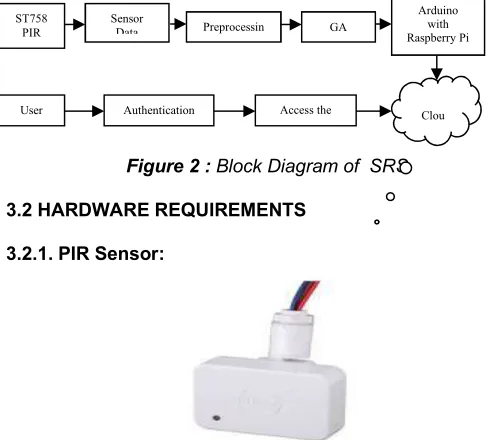
Figure 3 : Indoor Inductive Elevator Door sensors ST758 PIR This item is a new power saving switch. It associates microwave sensor cast with high – frequency electro – magnetic wave, IC (Integrated Chip). It involves in security, ease, self moving ability, power saving and real – time functions. The vast investigation field id composing of
User
Retail App
Authentication
Product Details
Offers
Admin Section
Cloud
Remarks
Arduino Raspberry pi
Gateway Wi-Fi with
PIR sensor
Day-to-Day Updating LoE
Sensor
Data Preprocessin GA
User Access the
data Authentication
ST758 PIR
Arduino with Raspberry Pi
Gateway
652 detectors. It works by accepting human needs a location of
something. It has an easy installation process. Detection is applied via the doors, panes of glass or thin walls and lights. Fetch the sensor with the lamp and energy source according to the wire – connection. Finally, on the power switch and check whether it is sensing or not.
3.2.2 Arduino:
Arduino is an easily available electronics product used with integration of hardware and software. This circuit board connected with some smart devices able to execute something innovative in online. It has ease of access handling by the user experience and also it has been applied in a lot of various projects and real – time application. It provides scalability for advanced users. It executes on MAC OS, windows and Linux. It offers some advantages: low – cost, low – power, wireless transformation, long battery life time capacity and efficiency. Sensors are used to gathers the data from the platform continuously shifted to another transformation.
Figure 4 : Arduino UNO Board
3.2.3Raspberry Pi Gateway:
Figure 5 : Industrial IoT Gateway
It controls the bidirectional data bus among various protocols and networks. Another program of gateway is to transmit variety of internet protocols and network. It connects the physical devices and sensors. It pre - processes the data collected from the sensors for the next transmission stage. It also gives level of security for network and transmitting data in the cloud environment.
3.3 COMPONENTS OF THE PROPOSED WORK
3.3.1 Data Mining Components:
Data mining could be a method utilized by firms to show information into helpful information. By mistreatment code to seem for patterns in giant batches of information, businesses will learn a lot of concerning their customers to develop simpler promoting methods, increase sales and reduce prices. Data processing depends on effective information assortment, storage, and laptop process. Extract the data from the sensors that are classified using the Naïve Bayes Classification Algorithm.
Preprocessing:
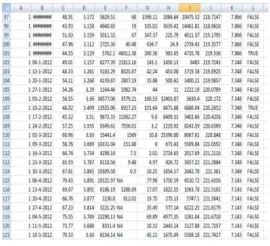
Preprocessing is one of the data extraction process that includes changing crude data into a justifiable organize. Real-world data is regularly inadequate, conflicting, and/or missing in certain behaviours or patterns, and is likely to contain numerous mistakes. Data pre-processing may be a demonstrated strategy of settling such issues.
Pre-processing Steps Step 1: Import the libraries Step 2: Import the data-set Step 3: explore the missing values Step 4: See the explicit Values
Step 5: Cacophonous the data-set into coaching and watch and show the dataset.
Step half dozen: Feature Scaling
Figure 5 : Pre-processed Dataset
4.
EXPERIMENTAL
EVALUATION
4.1 Genetic Algorithm (Evolutionary Approach):
The Evolutionary algorithm is an approach for clarifying both restricted and depraved optimization problems that is established on instinctive selection, the operation that rides organic evolution. This algorithm frequently revises a population of separate outcomes. At every step, it choose individuals at arbitrary from the recent population to be parents and utilize them to deliver the siblings for the later genesis. Over consecutive generations, the populace "derives" toward an excellent result. Apply this mechanism to clarify different types of optimization problems that are not applicable for standard optimization algorithms, inclusive problems in which the objective function is unstable, homogeneous, problematic, or hugely nonlinear.
The genetic algorithm uses three major categories of regulations at each and every step to build the later generation from the recent populace:
Selection constraints choose the separations, called Root, that devote to the populace at the later generation.
Crossover constraints associate two root nodes to develop leaf nodes for the later generation.
Mutation constraints apply frequent modifications to separate root nodes to develop child nodes.
In this Paper is to overcome the drawbacks of K – means Clustering for implementing some basic border restraints on the k values and the Genetic Algorithm is applied to diminish the cross-validation error. Genetic Algorithm is also used for filtering and processing the data.
653 Binary of 110111 is the genotype and 55 is the phenotype
depiction. After depiction every chromosome the authority path to distribute to search the space, later is to forecast the fitness value of each separation. Consider that the fitness function utilized in the example below:
f(x)=4x+4 Where x is the chromosome value
Then the value of the fitness in preceding chromosome is: f (55)=4(55)+4=229
The process of determining the value of the fitness is a chromosome is called fitness calculation.
GA is used in this research work for reduce the cross-validation error to get an optimal results in clustering.
5.
EXPERIMENTAL
RESULTS
In this section visualize the Fitness calculation using Genectic algorithm results representation of fitness evaluation using Python 3.7 for 32-bit OS.
Figure 6 : Python implementation for GA
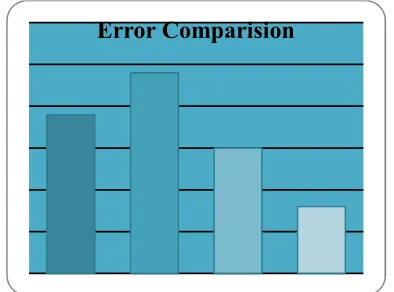
In this section also presents an average of localization error comparison of Existing methodologies with table representation. Sensor positioning in indoors and lights accuracy experiments are reported in this Diagram. Our proposed scheme could successfully extract the accuracy of user’s information, admin details and goods details in inventory management. The Fig. 5 shows the proposed system standard deviation of localization error compared with other mechanisms exists in the literature. This figure is plotted by using some statistical analysis of other existing localization techniques.
Figure 7 : Average Localization Error Comparisons
Table. 1 : displays the Error Comparison and Improvement
Evaluation in terms of various statistical measures of the proposed and existing system in the literature.
Error APT WCL Orbital SRS %Improvement
Average 1.88 2.18 1.42 0.91 38.7%
Variance 1.43 2.06 0.49 0.23 81.3%
Max 4.11 4.55 2.96 1.72 37.5%
Min 0.20 0.35 0.23 0.18 37.2%
6.
CONCLUSION
A Smart Retailing System is suggested in this paper. This scheme automatically controls the retail which is very capable to stockowner in industry statistical analysis of data representation. LoE is the most believable technique for developing IoT applications and services. Cloud is a storage platform for the collected data by sensor is so securely. SRS model estimates the location of the mobile objects. The experimental results have been examined and evaluate the performance of the SRS scheme. The designed scheme could achieve 38.7% higher precision than APT, WCL and Orbital methods.
ACKNOWLEDGEMENT
This research work has been written with the financial support of Rashtriya Uchchatar Shiksha Abhiyan (RUSA – Phase 2.0) grant sanctioned vide Letter No. F.24-51/2014-U, Policy (TNMulti-Gen), Dept. of Edn. Govt. of India, Dt. 09.10.2018.
REFERENCES
[1] Mohammed Wazid, Ashok kumar Das, Neeraj kumar, Mauro conti, MinhoJo.(2017). Design of Secure User Authenticated Key Management Protocol for Generic IoT Networks. IEEE Internet of Things Journal.
[2] A. Al-Fuqaha, M. Guizani, M. Mohammadi, M. Aledhari, and M. Ayyash. (2015). “Internet of Things: A survey on
enabling Technologies, protocols, and
applications.In IEEE communications surveys tutorials, Vol. 17, no. 4, pp. 2347-2376, Fourthquarter.
[3] Javad Rezazadeh, Kumbesan Sandrasegaran, Xiaoying kong,. A Location-Based Smart Shopping System with IoT Technology.
[4] Wei Zhou, Yuqing Zhang, and Peng Liu. (2018, January 31). The Effect of IoT New Features on
[5] Security and Privacy: New Threats, Existing solutions, and Challenges yet to be solved.
[6] Dr. M. Sughasiny. (2017, May). Enhanced Security Framework for Cloud-Linked IoT. International Journal of Advances in Scientific Research and Engineering. Vol. 03, Issue 4, ISSN: 2454-8006.
[7] B.G. J. ten Bok. Innovating the Retail Industry; an IoT approach . (2016, July). In 7th IBA Bachelor thesis Conference.
[8] Santosh H. Kalange, Dipti A. Kadam, Asmita B.Mokal, Avinash A. Patil. (2017, November). International Research Journal of Engineering and Technology. Volume: 04, Issue: 11, e-ISSN: 2395-0056, p-ISSN: 2395-0072.
654 [9] Ming-Chang Lee, Jia-Chun Lin, Olaf Owe. (2018,
September). Privacy Mining from IoT-based Smart Homes. 13th International Conference on Broad-Band Wireless Computing, Communication and Applications. [10] Majid Ai-Ruithe, Siyakha Mthunzi, Elhadj Benkhelifa.
(2016). Data Governance for Security in IoT & Cloud Converged Environments. In IEEE.
[11] Dylan Hicks, Kevin Mannix, Hannah M. Bowles, Byron J.