1729 IJSTR©2020
Human Tracking System In A Certain Area
Based On Iot Application
Daniel Patricko Hutabarat, Robby Saleh
Abstract— This research is a development of previous research that was successfully published in early 2017. The research was continued by
combining RFID, GPS, IP Camera and a smartpone android in order to build human tracking and monitoring system. All the item are connected to each other by Wi-Fi and will convey data to a station pc in the control room. Theme park as the location for deploying the system is the large area, consist of many indoors and outdoors playground and can be visited up to 4000 people/day. Human tracking and monitoring system is important for people who visit theme park, it help visitors to locate the position of their families, friends and relatives who are separated. The tracking system that is built using RFID and GPS works properly with 100% accuracy of indoor tracking and 3.27 meters erorrs for the outdoor tracking while the monitoring system that is built using IP camera and android smartphone also works properly with 100% accuracy in plotting the location of the object tracked to the map and 100% correctly choose active IP Cameras that is nearest to the object tracked. Thus this human tracking and monitoring system is suitable to track and monitor the human position for both indoor and outdoor especially in a theme park.
.
Index Terms— Android Smartphone; GPS; IP Camera; RFID; Human Tracking, Monitoring System, IoT Application —————————— ——————————
1
I
NTRODUCTIONInternet of Things (IoT) is a term that describes the interconnection of different daily life object through the internet without human to human interaction [1]. The IoT is evolving and growing day by day, around 5 billion objects have connected through the internet today and will increase to 50 billion objects in 2020 [2]. Now, many IoT applications used in different aspect of life such as environmental monitoring [3], smart agriculture [4], product supply chain management [5], and much more.
Ji-Chun Zhao et al. [6] studied the applications of IoT in monitoring system based on internet and wireless sensor networks. An information management system was designed to provide the data for research in agriculture. The authors developed software for monitoring of the fields like data acquisition about the fields, data processing models, and system configuration module. The developed application provides accurate control for the monitoring of the green house.
Nilesh Dhwale et al. [7] introduced GPS and GPRS in human tracking system. The target carries a registered-smartphone with GPS and uses GPRS to send the coordinate to the server. A mobile application was developed and installed in both user and target’s smartphones. The application is used for registration, tracking and monitoring. The Google map is used by the apllication to show the target. The system is developed for outdoor tracking and no camera is used in this system.
Toshinori et al. [8] and Daniel P.H. et al [9] introduced an indoor human position tracking technique using UHF-band RFID. In Toshinori’s research, the target carries the transmitter while the base stations which equips receivers capture the transmitter’s signal and pass the data to central processor that run the postioning algorithm. The algorithm calculate the position of the target and the application plot the position on a map of the place. The Application of IOT based system that is developed in this research consist of two systems, those are the tracking and the monitoring system. The tracking system
must be able to track and locate the object in outdoor and indoor area. In this tracking system, Global Positioning System (GPS) as one of the frequently used for the outdoor tracking [10], [11], [12], [13] is used for the outdoor tracking system while the RFID is used for the indoor tracking system. The monitoring system must be able to show the position of the object tracked through the map that is developed and installed in the smartphone and also through the video that is captured by the IP camera. This research took place at one of the theme park in jakarta. The size of the theme park is 9.5 hectares and consist of 31 rides spreading to 9 regions. This research was conducted in the largest region of the theme park consisting of 7 rides in indoor and outdoor area. In this research, 14 RFID readers were placed at the entrance and exit gate of the rides, 90 RFID wristbands were provided for use by the visitors to enter and exit the rides, 28 IP cameras were placed before and after the entry gate and inside of the rides to give visualization to the tracker of the object tracked that is located around particular ride and 90 smartphones were installed the developed application for tracking and monitoring objects.
In this research, visitors who want to utilize the human tracking and monitoring system should do the registration at the registration center. At the center, visitors will register all the smartphones that will be used in tracking and monitoring activity. After receiving all the smartphone numbers from the visitor, registration center will do the mapping of the smartphone number to the RFID wristband user identity (UID) and put it into the database. The registration center will give the RFID wristbands together with the mapping list to the visitors and asks the visitors to do the registration through smartphone by first install the human tracking and monitoring apllication into their smartphones. After finishing the installation and registration, the visitors are able to do tracking and monitoring.
2
R
ESEARCHM
ETHODSThe block diagram of the system developed is divided into 4 main parts; RFID readers/tag, IP camera, android smartphones, server and networks. It can be seen in Figure 1. RFID readers/tag is developed by using raspberry Pi, RFID 13.56 Mhz / NFC Module, ESP8266 and 13.56 MHz RFID / NFC wristband. RFID reader is used to read the UID of the wristband and to send the UID and the device number to the server wirelessly through ESP8266. The RFID reader is ————————————————
Daniel Patricko Hutabarat is currently a lecturer in Computer Engineering Study Program, Bina Nusantara University, Indonesia. E-mail: [email protected]
Robby Saleh is currently a lecturer in Computer Engineering Study Program, Bina Nusantara University, Indonesia. E-mail:
1730 placed at the entrance and exit gate while the wristband is
given to the object tracked. The object tracked must tap his/her wristband before entering and exit the room so that the system can locate and mapping the room that is entered by the object tracked. Tapping the wristband when enter and exit the ride is also a sign to the system to change the tacking mode from GPS to RFID and vice versa.
IP cameras are placed inside and outside the ride. There is one
camera was placed outside the ride near the entrance gate while 2 cameras were place inside the ride. The IP camera inside the ride will be enable or can be monitored by the tracker via smartphone when the object tracked has tapped his/her wristband to the RFID reader that is placed at the entry gate. The camera will be disable after the object tracked leave the ride by first tap his/her wristband to the RFID reader at the
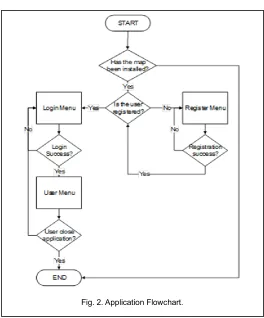
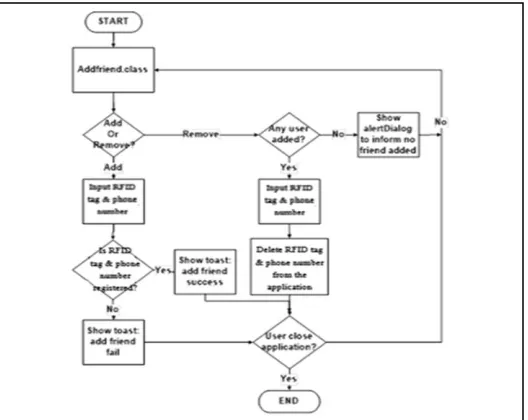
exit gate.The IP camera that was placed outside the ride will be enable or can be seen by the tracker from his/her smartphone when the object tracked is inside the coverage area of the camera. The outside camera will be enable when the position of the object tracked is in radius 30 meters in front of the outside camera. The system developed in this research can track and monitor up to five objects in a group. This system also allows everyone in the group track and monitor each other. To make this happen, besides registering their smart phone number at the registration center, every tracker must register all the smart phone number in his/her group that is going to be tracked into the application installed in his / her smart phone. The application in this research was developed using Android Studio 1.3.2 that can be directly compiled to the android device. The Flowchart of the application is shown in Figure 2 while Figure 3 shows the main menu of the application. The registration process should be done by user after application installation. In the registration process, user submit all the information that is required in Registration (Reg) Menu as seen in Figure 4. After the registration process is done, user must first login via Login Menu as seen in Figure 5. If the authentification process in Login Menu is succeed, user is able to access the User Menu. The User Menu is devided into two main menus and can be seen in Figure 6. The Add/Remove Friends Menu shown in Figure 7 is used to add / remove object that is being tracked. Track Position Menu is used to select the object to be monitored and to track the objects’s last location on the map. After clicking the Track Position Menu, user will be directed to Selection Menu. In this menu, the name list of the objects tracked is shown. To track an object, user must select the name from the list and afterward click the track button. Selection Menu can be seen in Figure 8. The flowchart of Add/Remove Friends Menu and Track Position Menu can be seen in Figure 9 and 10.
Fig 1. Block diagram system
Fig. 2. Application Flowchart.
Fig. 3. Main Menu. Fig. 4. Registration Fig. 5. Login
1731 IJSTR©2020
Fig. 10. Flowchart of ―Track Position‖.
3 Result and analysis
In this paper, experiments conducted aim to see whether the build system can work and perform its function properly or not. There are five experiments that have been done in this research. The first experiment was the registration of the users using smart phones, the second was the add friend process, the third was the trial of RFID tags reading, the fourth was the trial of mapping the object location to the map and the fifth was the trial of showing the visualization of IP Camera. In the first experiment, we asked two groups of five member to do the registration process at the registration center and after that we asked four member of each group to do the registration process through their smart phone. The result of the registration process at registration center can be seen in Tabel
1. It can be seen that all the members were successfully registered but all the status were still Not Active. In Tabel 2, we can see after the registration through smart phone the registration database was change where four members from each group was change the satus from Not Active to Active. The registration process of the group member through the smart phone can be seen in Figure 11(a) and 11(b). In the second experiment, we asked one person from each group to add four members through Add / Remove Friends Menu. The process of adding friends can be seen in figure 12(a) and 12(b) where Figure 13(a) and 13(b) show the name in the selection menu as the result of adding friends. In the third experiment, we asked two people to tap their wristband in different location. We asked each of them to tap their wristband 50 times to the RFID reader at entrance and exit gate. The result of the third experiments shown in Table 3. It seen that the result of the third experiment are successful.
Table 1
Registration database after registration at center
Group Phone Number Tag Number
Name Status
1 081284826996 2553445 Mesakh Not Active
1 0811185054 2553446 Kevin Not Active
1 081286004453 2553447 Andra Not Active
1 081807580588 2553448 Rico Not Active
1 081210003670 2553449 Johan Not Active
2 08176801888 2584192 Daniel Not Active
2 081385201946 2584193 Bethany Not Active
2 08118868685 2584194 Martha Not Active
2 0817726808 2584195 Andre Not Active
2 085222687799 2584196 John Not Active Table 2
Registration database after registration through smartphone
Group Phone Number Tag Number
Name Status
1 081284826996 2553445 Mesakh Active
1 0811185054 2553446 Kevin Active
1 081286004453 2553447 Andra Active
1 081807580588 2553448 Rico Active
1 081210003670 2553449 Johan Not Active
2 08176801888 2584192 Daniel Active
2 081385201946 2584193 Bethany Active
2 08118868685 2584194 Martha Active
2 0817726808 2584195 Andre Active
1732
Table 3 RFID Tags Reading
Trial Device RFID St Freq Succes s
Fail %
1 1 (SN:
2202192110061)
Ex 50 50 0 100
%
1 2 (SN:
2202192110062)
En 50 50 0 100
%
2 6 (SN:
2202192110063)
Ex 50 50 0 100
%
2 7 (SN:
2202192110064)
En 50 50 0 100
%
In the fourth and fifth experiments we asked a man to walk along the outdoor area and then entered two different rides. Figure 14(a) shows tracking result in outdoor area where the person’s movement is indicated by red circles. The application plots the first five coordinates to the map and then starts plotting from the beginning. The last plotting is the bigget circle. Figure 14(b) and 14(c) show the two rides entered by a person. The red shading indicates the rides entered by the person. Figure 15(a) and 15(b) show the results of camera monitoring when the person being tracked was within the camera range while the figure 15(c) shows the monitoring result when the person being tracked is not within the camera range.
(a) (b) Fig. 11. Registration Process (a) Before Submission, (b)
After Submission
(a) (b)
Fig. 13 Add Friend Process (a) Before Addition, (b) After Addition
(a (b) (c)
Fig. 14. (a) Tracking result in outdoor Area, (b) – (c) Tracking result in indoor area.
(a) (b) (c) Fig. 12 The result of camera monitoring (a) Inside the ride, (b)
1733 IJSTR©2020
3 C
ONCLUSSIONThe IOT based system and the application developed in this research can work properly in determining the location of the object both inside or outside area with 5 – 10 users involved in realtime sampling. This application also works properly for grouping the object being tracked and give visualization through the IP Camera. This research has successfully developed IOT based network that integrate RFID, GPS and IP camera together but don’t measure the quality, realibility and security of network itself in realtime condition with
larger samples . The next research will focus on the measurement of quality, realibility security of the network with 100 – 200 users in realtime condition.
A
CKNOWLEDGMENTThe authors wish to thank Bina Nusantara University. This work was supported by a grant from Bina Nusantara University
R
EFERENCES[1] Agrawal, Sarita, and Manik Lal Das. "Internet of Things— A paradigm shift of future Internet applications." In Engineering (NUiCONE), Nirma University International Conference, 2011. pp.1-7.
[2] Travis, J. W., E. Rajotte, R. Bankert, K. D. Hickey, L. A. Hull, V. Eby, P. H. Heinemann, R. Crassweller, and J. McClure. "Penn State apple orchard consultant: design and function of the pest management module." In III International Symposium on Computer Modelling in Fruit Research and Orchard Management 313, 1992. pp. 209-214.
[3] Morais, Raul, A. Valente, and C. Serôdio. "A wireless sensor network for smart irrigation and environmental monitoring: A position article." In 5th European federation for information technology in agriculture, food and environement and 3rd world congress on computers in agriculture and natural resources (EFITA/WCCA), 2005. pp.45-850.
[4] Raheela Shahzadi, Muhammad Tausif, Javed Ferzund, and Muhammad Asif Suryani, ―Internet of Things based Expert System for Smart Agriculture,‖ International Journal of Advanced Computer Science and Applications, 2016. vol. 7, no. 9, pp. 341-350.
[5] Hu, Xiangyu, and Songrong Qian, "IoT application system with crop growth models in facility agriculture," 6th International Conference on Computer Sciences and Convergence Information Technology (ICCIT). 2011. pp. 129-133.
[6] Zhao, Ji-chun, Jun-feng Zhang, Yu Feng, and Jian-xin Guo. "The study and application of the IOT technology in agriculture." In Computer Science and Information Technology ICCSIT, 3rd IEEE International Conference on, 2010. vol. 2, pp. 462-465.
[7] Nilesh Dawale, Mahesh Garad, Tushar Darwatkar, and Nilesh Shende, ―GPS and GPRS based Cost Effective Human Tracking System Using Mobile Phones,‖ International Journal of Innovations & Advancement in Computer Science (IJIACS), June 2014. Vol. 3, issue 4, pp. 5-10.
[8] Toshinori Tsuboi, Takehiro Shiraishi, Nobuyoshi Komuro, "Indoor Human Positioning Tracking Technique to Support High-Quality Life," International Joint Conference, Japan,
2009, pp. 5745-5749.
[9] Daniel P Hutabarat, Rudi Susanto, Achmad Fauzi, and Aldo J Wowor, ―Designing a Monitoring System to Locate a Child in a Certain Closed Area Using RFID Sensor and Android Smartphone,‖ Proceeding of the 5th International Conference on Communication and Broadband Networking, Bali, 2017. pp. 54 – 58.
[10] F. Miskelly, "Electronic Tracking of Patients with Dementia and Wandering Using Mobile Phone Technology," Age
and Ageing, 2005. vol. 34, no. 5, pp. 497-518.
[11] Daniel P Hutabarat, Darma Patria, Santoso Budijono, and Robby Saleh, ―Human Tracking Application in a Certain Closed Area Using RFID Sensors and IP Camera,‖ Proceeding of International Conference on Information Technology, Computer, and Electrical Engineering (ICITACEE), Semarang, 2016. pp 11-16.
[12] Yohanes Gerdisen, Vincent Solid, Osmond Wahyudi, Daniel P Hutabarat and Rinda Hedwig, ―Human Tracki ng in a Certain Closed Area based on Global Positioning System (GPS),‖ Internetworking Indonesia Journal, 2014. Vol. 6, no. 1 B, pp. 3-6.