3906
Design Of Interactive Learning Media Based On
Contextual Approach To Improve
Problem-Solving Ability In Fourth Grade Students
Fidi Andrianingrum, Suparman
Abstract: Problem-solving is one of the goals in mathematics learning. Learning media is one of the important components in achieving learning objectives. The purpose of this study is to design interactive learning media based on a contextual approach to improve problem-solving skills. This study uses the Research and Development (R & D) method with the ADDIE model. The procedure in the ADDIE model consists of five stages, namely Analysis, Design, Development, Implementation, and Evaluation. This research is limited to analysis and design only. The subjects in this study were class IV elementary school students at Glagah Public Elementary School, Yogyakarta, Indonesia. Data collection techniques are observation and interview. The instruments of data collection include observation guidelines and interview guidelines. Data were analyzed using the Miles and Huberman models. The results of this study indicate that the design of interactive learning media has been adapted to the characteristics of students and the 2013 curriculum. The design of interactive learning media based on contextual approach has the potential to improve problem-solving skills on the subject of the circumference and the area of a flat building. This research can be continued in the stages of development, implementation, and evaluation.
Index Terms: Contextual Approach, Interactive Learning Media, Problem-solving Ability.
—————————— ——————————
1 INTRODUCTION
Themain focus of mathematics learning is problem-solving [1]. The ability to solve mathematical problems is the goal to be achieved in mathematics learning [2][3]. NCTM (in [4]) states that the quality of mathematics learning in schools can be improved through problem-solving. Therefore, problem-solving becomes important in mathematics [5][6] and has been widely discussed by national, regional, and international bodies [3]. Some researchers have conducted research related to problem-solving abilities. The results of Kleden, Sugi, and Gerardus (2018) showed that the competency of students' problem-solving abilities increased through contextual learning [7]. A similar study was conducted by Khotimah (2016) [8] obtained results that students' problem-solving abilities improved and obtained the criteria of "very good" after applying contextual learning. Meanwhile, Surya (2017) [2] in his study concluded that students' mathematical problem-solving abilities improved using contextual learning models. Based on the results of previous studies, it is known that the role of context is something that needs to be considered in mathematics learning [9]. Contextual learning is one that pays attention to the role of context in learning. Contextual learning is a learning approach that uses everyday life problems as an object of student learning [8]. Contextual learning is done through learning activities that are associated with experience as part of life [1]. Therefore, contextual learning invites students to connect schoolwork to everyday life [10] so that they will find meaning from the learning material.]
The use of learning media is one of the determinants of success in mathematics learning [11]. This is in line with the Regulation of the Minister of Education and Culture of the Republic of Indonesia Number 65 of 2013 stated that one learning tool that needs to be used is learning media so that mathematics learning techniques can be more comfortable and more enjoyable [12]. The meaning that learning media become an integral part of learning planning that needs to be prepared. Based on this, the media of learning becomes an essential part of the learning process [13]. In the present era, the development of learning media is increasingly rapid [14]. Teachers are required to be able to make innovations and master varied learning media [15]. The function of media is to increase motivation and interest, help improve understanding, Macromedia Flash is software that is often used as an interactive learning media because of its ability to make exciting animations [19]. Penggunaan aplikasi flash dalam pembelajaran dapat menjadi solusi untuk mengoptimalkan proses belajar siswa [20]. Penelitian Utami (2019) menunjukkan bahwa penggunaan Macromedia Flash efektif membantu meningkat konsep pemahaman yang lebih baik [21]. Based on this, the researchers intend to make interactive learning media assisted by aplikasi flash yaituand simplify presenting data [14]. Computer-based learning media is the use of computers to help present material, present learning materials, and provide learning exercises [16]. One of the developments of computer-based learning media is interactive learning media. Interactive learning media is a learning media that presents text, images, application-assisted animations and is packaged in an interactive CD with computer-operated operations [17]. The use of interactive learning media makes learning active, interactive, and easy to understand so that it can increase students' interest in learning and motivation [18]. Based on this, it is known that the use of interactive learning media has a positive influence on the learning process.
2
METHOD
The design of this study uses the ADDIE model. The ADDIE model consists of five stages, namely, analysis, design, development, implementation, and evaluation [22]. The product of this study is the design of interactive learning media
________________________
• Fidi Andrianingrum is currently pursuing masters degree program in mathematics education in Ahmad Dahlan University, Indonesia, PH-085701286127. E-mail: [email protected]
to improve mathematical problem-solving skills. The analysis phase in this study consisted of performance analysis and needs analysis. Performance analysis is done through observation of the mathematics learning process and student learning outcomes, as well as interviews with mathematics teachers. The results of the performance analysis will be used to obtain a needs analysis. Needs analysis is done by determining the subject matter of mathematics that will be included in the learning media, determining KD (Basic Competence) and KD targets, and selecting software that will be used to create learning media. Furthermore, the design phase in this research was carried out through the framework preparation activities in the media and the design of learning media. Products in the form of learning media designs will be validated by experts. Design validation is done to find out the assessment and input from the expert as a revision material so that the design of the development of learning media has good quality.The subjects in this study were grade IV students of SD Negeri Glagah in the academic year 2018/2019. The instruments of data collection include observation guidelines and interview guidelines. Data were analyzed using the Miles and Huberman models whose stages included: data reduction, data display, and conclusion drawing/verification [23].
3 RESULT
AND
DICUSSION
3.1 Analysis Stage
Performance analysis that includes observations on the mathematics learning process and student learning outcomes obtain some information. First, the teacher has carried out the learning process according to the stages of the teaching and learning process, which includes: introduction, apperception, material delivery, evaluation, and closing. Second, the distribution of subject matter still uses the conventional method; namely, the teacher presents the material by continuing the provision of practice questions. Third, students are observed often asking the teacher to repeat the material presented. Fourth, students were seen to have difficulties in solving mathematical problems related to circumference and the area of a flat building. Fifth, student learning outcomes in the surrounding material and flat building area are still below the KKM (Minimum Completion Category) value that has been set at 75. Analysis of student learning outcomes data is shown in Table 1.
TABLE 1.
ANALYSIS OF STUDENT LEARNING DATA
No. Description of Statistics Quantitative Value
1. The number of students 25
2. Highest score 95
3. Lowest score 25
4. Average 69.5
Seen in Table 1, the average learning outcome of a total of 25 students is 69.5. The existence of this, it is known that students' problem-solving skills still need to be improved. Furthermore, the results of the observations were strengthened through interviews with teachers. Teacher interviews are conducted by interview guidelines. The grid of interview guidelines can be seen in Table 2.
TABLE 2.
GRID OF INTERVIEW GUIDELINES
No. Indicator
1. Mathematical learning in class 2. Use of mathematics learning media 3. Availability of interactive learning media
The results of the interviews with the teacher obtained some information. First, teachers rarely hold group discussions in mathematics learning. Secondly, the mathematics learning media that has been used is only in the form of teaching aids and measuring aids such as threads and rulers. Third, interactive learning media for mathematics learning is not yet available. Based on performance analysis, researchers concluded that students and teachers need interactive learning media that can help students improve their mathematical problem-solving skills and can support the teaching and learning process more effectively and efficiently. Needs analysis is obtained based on the results of performance analysis, namely that teachers and students need interactive learning media on flat planner material. Basic competency in flat-build equipment has been contained in Minister of Education and Culture Regulation Number 37 of 2018 consisting of essential competencies in knowledge and necessary skills competencies. Based on these basic competencies, target basic competencies can be determined. Description of basic competencies and basic target competencies can be seen in Table 3.
TABLE 3.
BASIC COMPETENCE AND TARGET BASIC COMPETENCIES
Basic Knowledge Competency
Target Basic Competencies
3.9 Explain and determine the circumference and area of a square, a rectangle, and a triangle and a power of two with a square root.
3.9.1 Explain and determine the circumference and area of a square. 3.9.2 Explain and determine
the perimeter and area of a rectangle.
3.9.3 Explain and determine the circumference and area of a triangle. 3.9.4 Explain and determine
the relationship of cube with cube roots. Basic Skills Competency Target Basic Competencies 4.9 Resolving a problem is
related to the circumference and area of a square, rectangle, and triangle including involving the power of two with a square root.
4.9.1 Solve problems related to the perimeter of a square, rectangle, and triangle.
4.9.2 Resolving problems related to the area of a square, rectangle, and triangle including involving cube with cube roots.
4.9.3 Resolving problems related to the circumference and area of squares, rectangles, and triangles including involving cube with cube roots.
3908
material content on interactive learning media. This is done so that interactive learning media can suit the specified learning goals.
3.2 Design Stage
The software used to create interactive learning media is Macromedia Flash Professional 8. The learning media framework in this study is a flowchart. Flowchart functions to find out the logic flow of presenting learning media scenes. The learning media flowchart in this study is divided into three parts, namely: the first part, the first core part, the second core part, and the final part. The flow of the presentation of the scene at the beginning of the learning media is shown in Figure 1.
Fig 1. Flowchart of the Early Section of Learning Media
It can be seen in Figure 1, that the flow or sequence of scenes in the first display of interactive learning media are: 1) start scene; 2) scene profile; and 3) instructions scenes. The design view of the start scene, scene profile, and scene instructions are shown in Figure 2.
Fig 2. Scene Start Design, Scene Profile, and Scene
Instructions
The start scene contains information related to the identity of learning media products, which include agency logos and texts that read "Mathematics Learning Media." The information is
displayed in the form of rolling text animations. Scene start is connected to the scene profile. The scene profile contains information related to the biodata of the makers of learning media products. Biodata information displayed is: 1) full name; 2) place and date of birth; 3) parent number; 4) agency name; e) email; and f) social media. The scene profile is connected to the instructions scene. Scene instructions will display information related to instructions in the form of functions from the navigation buttons in the learning media. The appearance of this scene is composed of text "Hint" at the top and continues with the icons of the navigation button arranged vertically. The function of each navigation button will appear automatically at the bottom of the navigation button icon. These scene instructions will be connected to the main course scene at the first core part of the learning media. The flow or sequence of scenes from the core part of the learning media is shown in Figure 3.
Fig 3. Flowchart Core of Learning Media
In figure 3, it is known that the main course scene becomes the parent of all scenes in the core part of the learning media. Scene main course is connected with material scenes, exercise scenes, scene quizzes, and video scenes. The appearance of the main course and scene material scene design is shown in Figure 4.
Fig 4. Design of the Main Course Scene and Material Scene
learning material is divided into two sub-material namely circumference and breadth. In each sub-material presents presentations related to facts, concepts, principles, procedures, and examples. To improve mathematical problem-solving skills, interactive learning media contains the exercise scene. The appearance of the scene exercise design is shown in Figure 5.
Fig 5. Design of Scene Exercise
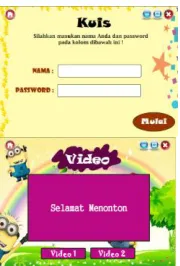
The exercise scene contains practice questions related to the learning material. Practice questions consist of six questions that will be presented in sequence. Each issue will be associated with the context of the environment in which students are located and other subject matter in an integrated manner. The appearance of the scene exercises is divided into two parts, namely the first part contains the description of the problem, and the second part contains related problem-solving. The completion section presents steps for solving problems that are integrated with the stages of problem-solving, according to Polya. The completion steps are explained by combining the stages in problem-solving according to Polya, namely: a) understanding the problem; b) plan problem solving; c) implement problem-solving strategies, and d) verify [24]. Integration is carried out through several activities, namely in the form of recording information related to what is known, what is asked, determining the right formula according to the report known, and applying formulas to solve existing problems. Meanwhile, at the core part of the interactive learning media is also equipped with quizzes and videos. The design of the scene quiz and video scene can be seen in Figure 6.
Fig 6. Design of Scene Quiz and Video Scene
Scene quiz is used as a means of reflection or evaluation for students as users of learning media. Quiz questions in this scene will amount to 10 items. The appearance of the scene quiz is divided into three parts, namely the beginning, the middle, and the end. The primary role will display the data
filling form, which includes "Name" and "Password." The middle section will show quiz questions accompanied by the answer option. Furthermore, at the end of the section, the results of the quiz will be displayed in the form of scores obtained. Meanwhile, the video scene contains several two videos related to student motivation in learning. Each video presented will contain messages such as moral, social, and religious. Next, the final part of the interactive learning media is shown by the flowchart in Figure 7.
Fig 7. Flowchart of the Final Section of Learning Media
Scene end is the closing scene of interactive learning media. This scene end will be displayed when the user clicks the close navigation button. The appearance of the end scene design can be seen in Figure 8.
Fig. 8: Design of Scene End
In the end, scene displays text information in the form of a question for the user (user), namely "Are you sure you want to exit?" Accompanied by the "Yes" and "No" button. If the user (user) selects the "Yes" button, the interactive learning media will close automatically. Meanwhile, if the user (user) selects the "No" button, then the display will return to the main course scene. This media design has been assessed for its feasibility by a lecturer and a mathematics teacher. Assessment is done by filling out the design validation sheet that was made by the researcher. The instrument grid of the design validation sheet can be seen in Table 6.
TABLE 6.
GRID OF LEARNING MEDIA DESIGN INSTRUMENTS
No. Indikator
1. Learning Media Content 2. Contextual Learning Steps 3. Stages of Problem Solving
3910 TABEL 5.
DESIGN EVALUATION RESULT
No. Validator Score Category
1. Syariful Fahmi, M.Pd. 42 Good 2. Dina Meika Putri, S.Pd. 39 Good
Total Score 81 - Average Score 40,50 Good
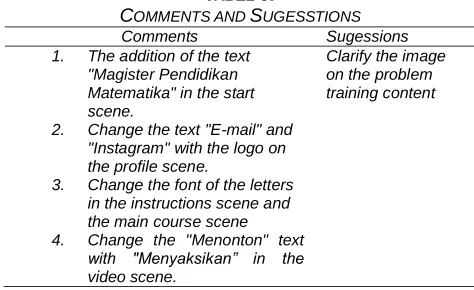
In Table 5., it can be seen that the feasibility of the design of learning media gets a good category. The learning media design was concluded to be feasible with revisions according to the comments and suggestions were given by the validator. Comments and suggestions from the validator can be seen in Table 6.
TABEL 6.
COMMENTS AND SUGESSTIONS
Comments Sugessions
1. The addition of the text "Magister Pendidikan Matematika" in the start scene.
Clarify the image on the problem training content
2. Change the text "E-mail" and "Instagram" with the logo on the profile scene.
3. Change the font of the letters in the instructions scene and the main course scene 4. Change the "Menonton" text
with "Menyaksikan” in the video scene.
4
C
ONCLUSIONThis study resulted in the design of interactive learning media based on a contextual approach. The interactive learning media design consists of nine components, namely: a) start scene; b) scene profile; c) scene instructions; d) main course scene; e) material scene; f) exercise scene; g) scene quiz; h) video scene, and i) scene end. The design of interactive learning media is following the characteristics of students and the 2013 curriculum. The design of the results of this study also has the potential to improve the fraction skills of elementary school students in grade IV on the subject of the circumference and the area of the flat building. This research can be further developed in the stages of development, implementation, and evaluation to become a quality interactive learning media.
A
CKNOWLEDGMENTThe author would like to thank SD Negeri Glagah for giving permission and helping to implement this research.
R
EFERENCES[1] Samo, D. D. (2018). Culture-Based Contextual Learning to Increase Problem-Solving Ability of First Year University Student. Journal on Mathematics Education, 9(1), 81-94. [2] Surya, E., & Putri, F. A. (2017). Improving Mathematical
Problem-Solving Ability and Self-Confidence of High School Students through Contextual Learning Model. Journal on Mathematics Education, 8(1), 85-94.
[3] Al-Khateeb, M. A. (2018). The Effect of Teaching Mathematical Problems Solving Through Using Mobile Learning on the Seventh Grade Students' Ability to Solve them in Jordan. International Journal of Interactive Mobile Technologies (iJIM), 12(3), 178-191.
[4] Pehkonen, E., Näveri, L., & Laine, A. (2013). On teaching problem solving in school mathematics. Center for Educational Policy Studies Journal, 3(4), 9-23.
[5] Zaman, A., Farooq, R.A., Ghaffar, A., Ali, R., & Naz, A. (2014). Problem Solving Performance in Mathematics: A Survey of Secondary School's Students in Pakistan. Research Journal of Recent Science, 3(6), 1-5.
[6] Özreçberoğlu, N., & Çağanağa, Ç. K. (2018). Making It Count: Strategies for Improving Problem-Solving Skills in Mathematics for Students and Teachers’ Classroom Management. Eurasia Journal of Mathematics, Science and Technology Education, 14(4), 1253-1261.
[7] Kleden, M. A., Sugi, Y., & Gerardus, U. (2018). Contextual Learning On The Basis of Coastal Culture to Enhance Students’ Competency in Mathematical Problems Solving. Journal of Physics: Conference Series, 1108(1), 012013. [8] Khotimah, R. P., Masduki. (2016). Improving Teaching
Quality and Problem Solving Ability Through Contextual Teaching and Learning in Differential Equations: A Lesson Study Approach. Journal of Research and Advances in Mathematics Education, 1(1), 1-13.
[9] Widjaja, W. (2013). The Use of Contextual Problem to Support Mathematical Learning. Journal on Mathematics Education, 4(2), 151-159.
[10]Johson, Elaine B. (2002). Conexstual Teaching and Learning: what it is and why it’s here to stay. California: Corwin Press, Inc.
[11]Widodo, S. A. (2018). Selection of Learning Media Mathematics for Junior School Students. Turkish Online Journal of Educational Technology-TOJET, 17(1), 154-160.
[12]Isdiarti, Fatim. (2018). Design Development Learning Media Based PMRI Oriented Capabilities Study Creative Students Grade VII of Junior Hight School in Indonesia. International Jurnal of Engineering & Technology, 7 (4.30), 50-52.
[13]Damarwan, E. S., & Khairudin, M. (2017). Development of an Interactive Learning Media to Improve Competencies. Proceedings of the International Conference on Technology and Vocational Teachers (ICTVT 2017). [14]Raras, G. M. A. (2018). Interactive learning media based
on flash for basic electronic engineering development for SMK Negeri 1 Driyorejo-Gresik. IOP Conference Series: Materials Science and Engineering, 336(1), 012034. [15]Akbarini, N. R., Murtini, W., & Rahmanto, A. N. (2018).
Design of Interactive Learning Multimedia Development in General Administration Subject. International Journal of Multicultural and Multireligious Understanding, 5(4), 138-148.
[16]Rachmadtullah, R., Ms, Z., & Sumantri, M. S. (2018). Development of computer-based interactive multimedia: study on learning in elementary education. Int. J. Eng. Technol, 7(4), 2035-2038.
[17]Nan, S. (2018). Multimedia Image Technology and Computer Aided Manufacturing Engineering Analysis. IOP Conference Series: Materials Science and Engineering, 317(1), 012046.
[19]Faruk, A. (2014). Development of Interactive Learning Media Based Lectore Inspire in Discrete Method Course. Proceeding of International Conference on Research, Implementation and Education of Mathematics and Sciences. UNY, 18-20, 2014. ME 69-77.
[20]Mustafidah, H., & Imani, M. G. A. (2018). Development of Natural Science Learning Media in Primary School Using Flash Applications to Increase Student’s Achievement. MATEC Web of Conferences, 205(3), 1-8.
[21]Utami, R. P., Rohaeti, E., & Si, M. (2019). Students’concept Understanding In Chemistry Learning Using Macromedia Flash Based Inquiry Learning. International Journal on New Trends in Education & their Implications (IJONTE), 10(3), 1-12. [22]Budoya, C. M., Kissaka, M. M., & Mtebe, J. S. (2019).
Instructional Design Enabled Agile Method Using ADDIE Model and Feature Driven Development Process. International Journal of Education and Development using Information and Communication Technology, 15(1).
[23]Akma, Tio. (2018). The Design of Student Worksheet Problem based Learning to Improve Problem-solving Ability of the Eight-Grade Students Junior Higt School in Indondesia. International Journal of Engineering and Technology, 7(4.30), 11-15.